

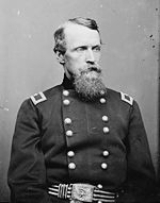
David B. Birney

Encyclopedia
David Bell Birney was a businessman, lawyer, and a Union
General in the American Civil War
.
, the son of an abolitionist from Kentucky
, James G. Birney
. The Birney family returned to Kentucky in 1833, and James Birney freed his slaves. In 1835, the family moved to Cincinnati, where the father published an anti-slavery newspaper. Following numerous threats from pro-slavery mobs, the family moved again to Michigan
, and finally to Philadelphia.
Following his graduation from Phillips Academy
, Andover, Massachusetts
, David Birney entered business, studied law, and was admitted to the bar. He returned to Philadelphia, practicing law from 1856 until the outbreak of the Civil War.
as lieutenant colonel
of the 23rd Pennsylvania Volunteer Infantry
Regiment
, a unit he raised largely at his own expense. Just prior to the war he had been studying military texts in preparation for such a role. He was promoted to colonel
on August 31, 1861, and to brigadier general
on February 17, 1862, clearly benefiting from political influences, not military merit. He commanded a brigade in Brig. Gen. Philip Kearny
's division
of the III Corps, which he led through the Peninsula Campaign
. At the Battle of Seven Pines
he was accused of disobeying an order from his corps
commander, Maj. Gen.
Samuel P. Heintzelman
, allegedly for "halting his command a mile from the enemy." But this was simply a matter of orders misunderstood. Birney was court-martial
ed, but with strong positive testimony from Kearny, he was acquitted and restored to command.
Birney fought at the Second Battle of Bull Run
in support of Maj. Gen. John Pope
's Army of Virginia
. When Kearny was killed in that battle, Birney took over command of his division. Stationed in Washington, D.C.
, he missed the Battle of Antietam
, but his division returned to the Army of the Potomac
to fight at Fredericksburg
. There, he once again encountered military discipline problems, this time for allegedly refusing to support Maj. Gen. George G. Meade's division's attack on the left flank of the Union line. However, he was complimented in III Corps commander Maj. Gen. George Stoneman
's official report for "the handsome manner in which he handled his division" on that same day and for a second time he escaped punishment. Birney led his division in heavy fighting at Chancellorsville
, where they suffered more casualties (1,607) than any other division in the army. As a result of his distinguished service at Chancellorsville, he was promoted to major general on May 20, 1863.
At the Battle of Gettysburg
, the III Corps commander was the notorious Maj. Gen. Daniel Sickles
. On July 2, 1863, Sickles insubordinately moved his corps from its assigned defensive position on Cemetery Ridge. Birney's new position was from the Devil's Den
, to the Wheatfield, to the Peach Orchard, part of a salient directly in the path of the Confederate assault, and it was too long a front for a single division to defend. Assaulted by the divisions of Maj. Gens. John Bell Hood
and Lafayette McLaws
, Birney's division was demolished. Army commander Meade rushed in reinforcements, but the line could not hold. His division and the entire corps were finished as a fighting force. As Birney watched the few survivors of his division gather about him on Cemetery Ridge, he whispered to one of his officers, "I wish I were already dead." Sickles was grievously wounded by a cannonball and Birney assumed temporary command of the corps, despite having received two minor wounds himself. He retained command until February 1864.
Birney started in the Overland Campaign
as a division commander in the II Corps, his III Corps having been reorganized out of existence that spring. After good service in the Wilderness
, Spotsylvania Court House
(where he was wounded by a shell fragment), and Cold Harbor
, on July 23, 1864, Lt. Gen.
Ulysses S. Grant
gave Birney command of the X Corps in the Army of the James
. However, during the Siege of Petersburg
, Birney fell ill with malaria
(some accounts say dysentery
and typhoid fever
). He was ordered home to Philadelphia, and died three months later. He is buried there in Woodlands Cemetery.
s" of the Civil War. Many of his colleagues resented his swift rise in the ranks and he was not a beloved figure with them or his soldiers. Theodore Lyman of Meade's staff wrote of Birney:
Union Army
The Union Army was the land force that fought for the Union during the American Civil War. It was also known as the Federal Army, the U.S. Army, the Northern Army and the National Army...
General in the American Civil War
American Civil War
The American Civil War was a civil war fought in the United States of America. In response to the election of Abraham Lincoln as President of the United States, 11 southern slave states declared their secession from the United States and formed the Confederate States of America ; the other 25...
.
Early life
Birney was born in Huntsville, AlabamaHuntsville, Alabama
Huntsville is a city located primarily in Madison County in the central part of the far northern region of the U.S. state of Alabama. Huntsville is the county seat of Madison County. The city extends west into neighboring Limestone County. Huntsville's population was 180,105 as of the 2010 Census....
, the son of an abolitionist from Kentucky
Kentucky
The Commonwealth of Kentucky is a state located in the East Central United States of America. As classified by the United States Census Bureau, Kentucky is a Southern state, more specifically in the East South Central region. Kentucky is one of four U.S. states constituted as a commonwealth...
, James G. Birney
James G. Birney
James Gillespie Birney was an abolitionist, politician and jurist born in Danville, Kentucky. From 1816 to 1818, he served in the Kentucky House of Representatives...
. The Birney family returned to Kentucky in 1833, and James Birney freed his slaves. In 1835, the family moved to Cincinnati, where the father published an anti-slavery newspaper. Following numerous threats from pro-slavery mobs, the family moved again to Michigan
Michigan
Michigan is a U.S. state located in the Great Lakes Region of the United States of America. The name Michigan is the French form of the Ojibwa word mishigamaa, meaning "large water" or "large lake"....
, and finally to Philadelphia.
Following his graduation from Phillips Academy
Phillips Academy
Phillips Academy is a selective, co-educational independent boarding high school for boarding and day students in grades 9–12, along with a post-graduate year...
, Andover, Massachusetts
Andover, Massachusetts
Andover is a town in Essex County, Massachusetts, United States. It was incorporated in 1646 and as of the 2010 census, the population was 33,201...
, David Birney entered business, studied law, and was admitted to the bar. He returned to Philadelphia, practicing law from 1856 until the outbreak of the Civil War.
Civil War
Birney entered the Union army just after Fort SumterFort Sumter
Fort Sumter is a Third System masonry coastal fortification located in Charleston Harbor, South Carolina. The fort is best known as the site upon which the shots initiating the American Civil War were fired, at the Battle of Fort Sumter.- Construction :...
as lieutenant colonel
Lieutenant Colonel (United States)
In the United States Army, United States Air Force, and United States Marine Corps, a lieutenant colonel is a field grade military officer rank just above the rank of major and just below the rank of colonel. It is equivalent to the naval rank of commander in the other uniformed services.The pay...
of the 23rd Pennsylvania Volunteer Infantry
23rd Pennsylvania Volunteer Infantry
The 23rd Pennsylvania Volunteer Infantry was an infantry regiment that fought in the Union Army during the American Civil War. Known for its colorful uniforms based upon the popular French Zouave style, the regiment served in the Eastern Theater.-History:...
Regiment
Regiment
A regiment is a major tactical military unit, composed of variable numbers of batteries, squadrons or battalions, commanded by a colonel or lieutenant colonel...
, a unit he raised largely at his own expense. Just prior to the war he had been studying military texts in preparation for such a role. He was promoted to colonel
Colonel (United States)
In the United States Army, Air Force, and Marine Corps, colonel is a senior field grade military officer rank just above the rank of lieutenant colonel and just below the rank of brigadier general...
on August 31, 1861, and to brigadier general
Brigadier general (United States)
A brigadier general in the United States Army, Air Force, and Marine Corps, is a one-star general officer, with the pay grade of O-7. Brigadier general ranks above a colonel and below major general. Brigadier general is equivalent to the rank of rear admiral in the other uniformed...
on February 17, 1862, clearly benefiting from political influences, not military merit. He commanded a brigade in Brig. Gen. Philip Kearny
Philip Kearny
Philip Kearny, Jr., was a United States Army officer, notable for his leadership in the Mexican-American War and American Civil War. He was killed in action in the 1862 Battle of Chantilly.-Early life and career:...
's division
Division (military)
A division is a large military unit or formation usually consisting of between 10,000 and 20,000 soldiers. In most armies, a division is composed of several regiments or brigades, and in turn several divisions typically make up a corps...
of the III Corps, which he led through the Peninsula Campaign
Peninsula Campaign
The Peninsula Campaign of the American Civil War was a major Union operation launched in southeastern Virginia from March through July 1862, the first large-scale offensive in the Eastern Theater. The operation, commanded by Maj. Gen. George B...
. At the Battle of Seven Pines
Battle of Seven Pines
The Battle of Seven Pines, also known as the Battle of Fair Oaks or Fair Oaks Station, took place on May 31 and June 1, 1862, in Henrico County, Virginia, as part of the Peninsula Campaign of the American Civil War. It was the culmination of an offensive up the Virginia Peninsula by Union Maj. Gen....
he was accused of disobeying an order from his corps
Corps
A corps is either a large formation, or an administrative grouping of troops within an armed force with a common function such as Artillery or Signals representing an arm of service...
commander, Maj. Gen.
Major General
Major general or major-general is a military rank used in many countries. It is derived from the older rank of sergeant major general. A major general is a high-ranking officer, normally subordinate to the rank of lieutenant general and senior to the ranks of brigadier and brigadier general...
Samuel P. Heintzelman
Samuel P. Heintzelman
Samuel Peter Heintzelman was a United States Army General. He served in the Seminole War, the Mexican-American War, the Yuma War, the Cortina Troubles, and the American Civil War, rising to the command of a corps....
, allegedly for "halting his command a mile from the enemy." But this was simply a matter of orders misunderstood. Birney was court-martial
Court-martial
A court-martial is a military court. A court-martial is empowered to determine the guilt of members of the armed forces subject to military law, and, if the defendant is found guilty, to decide upon punishment.Most militaries maintain a court-martial system to try cases in which a breach of...
ed, but with strong positive testimony from Kearny, he was acquitted and restored to command.
Birney fought at the Second Battle of Bull Run
Second Battle of Bull Run
The Second Battle of Bull Run or Second Manassas was fought August 28–30, 1862, as part of the American Civil War. It was the culmination of an offensive campaign waged by Confederate Gen. Robert E. Lee's Army of Northern Virginia against Union Maj. Gen...
in support of Maj. Gen. John Pope
John Pope (military officer)
John Pope was a career United States Army officer and Union general in the American Civil War. He had a brief but successful career in the Western Theater, but he is best known for his defeat at the Second Battle of Bull Run in the East.Pope was a graduate of the United States Military Academy in...
's Army of Virginia
Army of Virginia
The Army of Virginia was organized as a major unit of the Union Army and operated briefly and unsuccessfully in 1862 in the American Civil War. It should not be confused with its principal opponent, the Confederate Army of Northern Virginia, commanded by Robert E...
. When Kearny was killed in that battle, Birney took over command of his division. Stationed in Washington, D.C.
Washington, D.C.
Washington, D.C., formally the District of Columbia and commonly referred to as Washington, "the District", or simply D.C., is the capital of the United States. On July 16, 1790, the United States Congress approved the creation of a permanent national capital as permitted by the U.S. Constitution....
, he missed the Battle of Antietam
Battle of Antietam
The Battle of Antietam , fought on September 17, 1862, near Sharpsburg, Maryland, and Antietam Creek, as part of the Maryland Campaign, was the first major battle in the American Civil War to take place on Northern soil. It was the bloodiest single-day battle in American history, with about 23,000...
, but his division returned to the Army of the Potomac
Army of the Potomac
The Army of the Potomac was the major Union Army in the Eastern Theater of the American Civil War.-History:The Army of the Potomac was created in 1861, but was then only the size of a corps . Its nucleus was called the Army of Northeastern Virginia, under Brig. Gen...
to fight at Fredericksburg
Battle of Fredericksburg
The Battle of Fredericksburg was fought December 11–15, 1862, in and around Fredericksburg, Virginia, between General Robert E. Lee's Confederate Army of Northern Virginia and the Union Army of the Potomac, commanded by Maj. Gen. Ambrose E. Burnside...
. There, he once again encountered military discipline problems, this time for allegedly refusing to support Maj. Gen. George G. Meade's division's attack on the left flank of the Union line. However, he was complimented in III Corps commander Maj. Gen. George Stoneman
George Stoneman
George Stoneman, Jr. was a career United States Army officer, a Union cavalry general in the American Civil War, and the 15th Governor of California between 1883 and 1887.-Early life:...
's official report for "the handsome manner in which he handled his division" on that same day and for a second time he escaped punishment. Birney led his division in heavy fighting at Chancellorsville
Battle of Chancellorsville
The Battle of Chancellorsville was a major battle of the American Civil War, and the principal engagement of the Chancellorsville Campaign. It was fought from April 30 to May 6, 1863, in Spotsylvania County, Virginia, near the village of Chancellorsville. Two related battles were fought nearby on...
, where they suffered more casualties (1,607) than any other division in the army. As a result of his distinguished service at Chancellorsville, he was promoted to major general on May 20, 1863.
At the Battle of Gettysburg
Battle of Gettysburg
The Battle of Gettysburg , was fought July 1–3, 1863, in and around the town of Gettysburg, Pennsylvania. The battle with the largest number of casualties in the American Civil War, it is often described as the war's turning point. Union Maj. Gen. George Gordon Meade's Army of the Potomac...
, the III Corps commander was the notorious Maj. Gen. Daniel Sickles
Daniel Sickles
Daniel Edgar Sickles was a colorful and controversial American politician, Union general in the American Civil War, and diplomat....
. On July 2, 1863, Sickles insubordinately moved his corps from its assigned defensive position on Cemetery Ridge. Birney's new position was from the Devil's Den
Devil's Den
Devils Den is a boulder-strewn Gettysburg Battlefield hill used by artillery and infantry during the 1863 Battle of Gettysburg, Second Day...
, to the Wheatfield, to the Peach Orchard, part of a salient directly in the path of the Confederate assault, and it was too long a front for a single division to defend. Assaulted by the divisions of Maj. Gens. John Bell Hood
John Bell Hood
John Bell Hood was a Confederate general during the American Civil War. Hood had a reputation for bravery and aggressiveness that sometimes bordered on recklessness...
and Lafayette McLaws
Lafayette McLaws
Lafayette McLaws was a United States Army officer and a Confederate general in the American Civil War.-Early life:...
, Birney's division was demolished. Army commander Meade rushed in reinforcements, but the line could not hold. His division and the entire corps were finished as a fighting force. As Birney watched the few survivors of his division gather about him on Cemetery Ridge, he whispered to one of his officers, "I wish I were already dead." Sickles was grievously wounded by a cannonball and Birney assumed temporary command of the corps, despite having received two minor wounds himself. He retained command until February 1864.
Birney started in the Overland Campaign
Overland Campaign
The Overland Campaign, also known as Grant's Overland Campaign and the Wilderness Campaign, was a series of battles fought in Virginia during May and June 1864, in the American Civil War. Lt. Gen. Ulysses S. Grant, general-in-chief of all Union armies, directed the actions of the Army of the...
as a division commander in the II Corps, his III Corps having been reorganized out of existence that spring. After good service in the Wilderness
Battle of the Wilderness
The Battle of the Wilderness, fought May 5–7, 1864, was the first battle of Lt. Gen. Ulysses S. Grant's 1864 Virginia Overland Campaign against Gen. Robert E. Lee and the Confederate Army of Northern Virginia. Both armies suffered heavy casualties, a harbinger of a bloody war of attrition by...
, Spotsylvania Court House
Battle of Spotsylvania Court House
The Battle of Spotsylvania Court House, sometimes simply referred to as the Battle of Spotsylvania , was the second major battle in Lt. Gen. Ulysses S. Grant's 1864 Overland Campaign of the American Civil War. Following the bloody but inconclusive Battle of the Wilderness, Grant's army disengaged...
(where he was wounded by a shell fragment), and Cold Harbor
Battle of Cold Harbor
The Battle of Cold Harbor was fought from May 31 to June 12, 1864 . It was one of the final battles of Union Lt. Gen. Ulysses S. Grant's Overland Campaign during the American Civil War, and is remembered as one of American history's bloodiest, most lopsided battles...
, on July 23, 1864, Lt. Gen.
Lieutenant General (United States)
In the United States Army, the United States Air Force and the United States Marine Corps, lieutenant general is a three-star general officer rank, with the pay grade of O-9. Lieutenant general ranks above major general and below general...
Ulysses S. Grant
Ulysses S. Grant
Ulysses S. Grant was the 18th President of the United States as well as military commander during the Civil War and post-war Reconstruction periods. Under Grant's command, the Union Army defeated the Confederate military and ended the Confederate States of America...
gave Birney command of the X Corps in the Army of the James
Army of the James
The Army of the James was a Union Army that was composed of units from the Department of Virginia and North Carolina and served along the James River during the final operations of the American Civil War in Virginia.-History:...
. However, during the Siege of Petersburg
Siege of Petersburg
The Richmond–Petersburg Campaign was a series of battles around Petersburg, Virginia, fought from June 9, 1864, to March 25, 1865, during the American Civil War...
, Birney fell ill with malaria
Malaria
Malaria is a mosquito-borne infectious disease of humans and other animals caused by eukaryotic protists of the genus Plasmodium. The disease results from the multiplication of Plasmodium parasites within red blood cells, causing symptoms that typically include fever and headache, in severe cases...
(some accounts say dysentery
Dysentery
Dysentery is an inflammatory disorder of the intestine, especially of the colon, that results in severe diarrhea containing mucus and/or blood in the faeces with fever and abdominal pain. If left untreated, dysentery can be fatal.There are differences between dysentery and normal bloody diarrhoea...
and typhoid fever
Typhoid fever
Typhoid fever, also known as Typhoid, is a common worldwide bacterial disease, transmitted by the ingestion of food or water contaminated with the feces of an infected person, which contain the bacterium Salmonella enterica, serovar Typhi...
). He was ordered home to Philadelphia, and died three months later. He is buried there in Woodlands Cemetery.
Legacy
David Birney was one of the more successful "political generalPolitical general
A political general is a general officer or other military leader without significant military experience who is given a high position in command for political reasons, such as his own connections or to appease certain political blocs...
s" of the Civil War. Many of his colleagues resented his swift rise in the ranks and he was not a beloved figure with them or his soldiers. Theodore Lyman of Meade's staff wrote of Birney:
See also
- List of American Civil War generals