
All Topics  
Battle of Chancellorsville


   Email Print
   Bookmark   Link


Battle of Chancellorsville


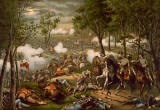
The Battle of Chancellorsville was a major battle of the American Civil War
American Civil War

The American Civil War , also known as the War Between the States and several Naming the American Civil War, was a civil war in the United States....
, fought near the village of Spotsylvania Courthouse, Virginia
Spotsylvania Courthouse, Virginia

Spotsylvania Courthouse is an unincorporated community and the county seat of Spotsylvania County, Virginia, located ten miles southwest of Fredericksburg, Virginia....
, from April 30 to May 6, 1863. The battle pitted Union Army
Union Army

The Union Army was the army that fought for the Union during the American Civil War. It was also known as the Federal Army, the U.S....
  Maj. Gen.
Major General

Major General or Major-General is a military rank used in many countries. It is derived from the older rank of Sergeant Major General. A Major General is a high-ranking officer, normally subordinate to the rank of Lieutenant General and senior to the ranks of Brigadier and Brigadier General....
 Joseph Hooker
Joseph Hooker

Joseph Hooker was a career United States Army officer, fought in the Mexican-American War, and was a Major general in the Union Army during the American Civil War....
's Army of the Potomac
Army of the Potomac

The Army of the Potomac was the major Union Army in the Eastern Theater of the American Civil War of the American Civil War....
 against an army half its size, Gen. Robert E. Lee
Robert E. Lee

Robert Edward Lee , was a career United States United States Army officer , an engineer, and among the most celebrated generals in American history....
's Confederate
Confederate States Army

The Confederate States Army was a military organization whose primary mission was to provide the necessary forces and capabilities to support the National Security and defense of the Confederate States of America during its brief existence from 1861 to 1865....
 Army of Northern Virginia
Army of Northern Virginia

The Army of Northern Virginia was the primary military force of the Confederate States of America in the Eastern Theater of the American Civil War of the American Civil War....
. It is known as Lee's "perfect battle" because of his risky but successful division of his army in the presence of a much larger enemy force. Lee's audacity and Hooker's timid performance in combat combined to result in a significant Union defeat.


Discussion
Ask a question about 'Battle of Chancellorsville'
Start a new discussion about 'Battle of Chancellorsville'
Answer questions from other users
Full Discussion Forum


Recent Posts


Encyclopedia


The Battle of Chancellorsville was a major battle of the American Civil War
American Civil War

The American Civil War , also known as the War Between the States and several Naming the American Civil War, was a civil war in the United States....
, fought near the village of Spotsylvania Courthouse, Virginia
Spotsylvania Courthouse, Virginia

Spotsylvania Courthouse is an unincorporated community and the county seat of Spotsylvania County, Virginia, located ten miles southwest of Fredericksburg, Virginia....
, from April 30 to May 6, 1863. The battle pitted Union Army
Union Army

The Union Army was the army that fought for the Union during the American Civil War. It was also known as the Federal Army, the U.S....
  Maj. Gen.
Major General

Major General or Major-General is a military rank used in many countries. It is derived from the older rank of Sergeant Major General. A Major General is a high-ranking officer, normally subordinate to the rank of Lieutenant General and senior to the ranks of Brigadier and Brigadier General....
 Joseph Hooker
Joseph Hooker

Joseph Hooker was a career United States Army officer, fought in the Mexican-American War, and was a Major general in the Union Army during the American Civil War....
's Army of the Potomac
Army of the Potomac

The Army of the Potomac was the major Union Army in the Eastern Theater of the American Civil War of the American Civil War....
 against an army half its size, Gen. Robert E. Lee
Robert E. Lee

Robert Edward Lee , was a career United States United States Army officer , an engineer, and among the most celebrated generals in American history....
's Confederate
Confederate States Army

The Confederate States Army was a military organization whose primary mission was to provide the necessary forces and capabilities to support the National Security and defense of the Confederate States of America during its brief existence from 1861 to 1865....
 Army of Northern Virginia
Army of Northern Virginia

The Army of Northern Virginia was the primary military force of the Confederate States of America in the Eastern Theater of the American Civil War of the American Civil War....
. It is known as Lee's "perfect battle" because of his risky but successful division of his army in the presence of a much larger enemy force. Lee's audacity and Hooker's timid performance in combat combined to result in a significant Union defeat. The Confederate victory was tempered by the mortal wounding of Lt. Gen. Thomas J. "Stonewall" Jackson
Stonewall Jackson

Thomas Jonathan "Stonewall" Jackson was a Confederate States Army general during the American Civil War, and probably the most well-known Confederate commander after General Robert E....
 to friendly fire
Friendly fire

Friendly fire or non-hostile fire, a term originally adopted by the United States Armed Forces, refers to Shooting from one's own side or allied forces, as opposed to fire coming from enemy forces....
, a loss that Lee likened to "losing my right arm."

The Chancellorsville campaign began with the crossing of the Rappahannock River
Rappahannock River

The Rappahannock River is a river in eastern Virginia in the United States, approximately 184 mi in length. It traverses the entire northern part of the state, from the Blue Ridge Mountains in the west across the Piedmont to Chesapeake Bay south of the Potomac River....
 by the Union army on the morning of April 27, 1863. Crossing the Rapidan River
Rapidan River

The Rapidan River is the largest tributary of the Rappahannock River in North-central Virginia. The two rivers converge just west of the city of Fredericksburg, Virginia....
 via Germanna and Ely's Fords, the Federals concentrated near Chancellorsville on April 30 and May 1. Heavy fighting began on May 1 and did not end until the Union forces retreated across the river on the night of May 5–6.

Forces and plans

The Chancellorsville campaign was potentially one of the most lopsided clashes of the war. At the start of the campaign the Union army had an effective fighting force of 133,868 men on the field of battle; the Confederate army numbered less than half that figure, at 60,892. Furthermore, the Union forces were much better supplied and were well-rested after several months of inactivity. Lee's forces, on the other hand, were poorly provisioned and were scattered all over the state of Virginia
Virginia

The Commonwealth of Virginia is an United States U.S. state on the East Coast of the United States of the Southern United States. The state is known as the "Old Dominion" and sometimes as "Mother of Presidents", because it is the birthplace of Lists of United States Presidents by place of birth#By state....
. Some 15,000 men of the Army of Northern Virginia's First Corps
First Corps, Army of Northern Virginia

The First Corps, Army of Northern Virginia was a military unit fighting for the Confederate States of America in the American Civil War. It was formed in early 1861 and served until the spring of 1865, mostly in the Eastern Theater of the American Civil War....
, under Lt. Gen. James Longstreet
James Longstreet

James Longstreet was one of the foremost Confederate States Army General officers of the American Civil War and the principal subordinate to General Robert E....
, were stationed near Norfolk
Norfolk, Virginia

Norfolk is an independent city in the Virginia in the United States. With a population of 234,403 as of the United States Census 2000, it is Virginia's second-largest incorporated city....
 in order to block a potential threat to Richmond
Richmond, Virginia

Richmond is the Capital of the Commonwealth of Virginia, in the United States. Like all Virginia municipalities incorporated as cities, it is an independent city and not part of any county....
 from Federal troops stationed at Fort Monroe
Fort Monroe

Fort Monroe is a Hampton, Virginia, military installation located at Old Point Comfort, which is on the tip of the Virginia Peninsula. Along with Fort Calhoun, later renamed Fort Wool, it guarded approach by sea of the navigational shipping channel between the Chesapeake Bay and the entrance to the harbor of Hampton Roads, which itself is fo...
 and Newport News on the Peninsula, as well as at Norfolk and Suffolk
Suffolk, Virginia

Suffolk is an independent city located in the South Hampton Roads area of eastern Virginia. Geographically, it is the largest of the Seven Cities of Hampton Roads, and the largest independent city in land-area in the entire Commonwealth....
. In light of the continued Federal inactivity, by late March Longstreet's primary assignment became that of acting as the Army of Northern Virginia's new commissary, which meant requisitioning provisions for Lee's forces from the farmers and planters of North Carolina
North Carolina

North Carolina is a U.S. state located on the Atlantic Seaboard in the southeastern United States. The state borders South Carolina and Georgia to the south, Tennessee to the west and Virginia to the north....
 and Virginia. As a result of this the two divisions of Maj. Gen John Bell Hood
John Bell Hood

John Bell Hood was a Confederate States Army general during the American Civil War. Hood had a reputation for bravery and aggressiveness that sometimes bordered on recklessness....
 and Brig. Gen. George Pickett
George Pickett

George Edward Pickett was a career United States Army officer who became a general in the Confederate States Army during the American Civil War....
 were 130 miles away from Lee's army and would take a week or more to reach it in an emergency. After nearly a year of campaigning, allowing these troops to slip away from his immediate control was Lee's gravest miscalculation. Although he hoped to be able to call on them, these men would not arrive in time to aid his outmanned forces.

More importantly, the engagement began with a Union battle plan superior to most of the previous efforts by Army of the Potomac commanders. A complete overhaul of the army's Bureau of Military Intelligence, which was commanded by Col.
Colonel (United States)

In the United States Army, United States Air Force, and United States Marine Corps, Colonel is a senior field officer United States Military Officer military rank just above the rank of Lieutenant Colonel and just below the rank of Brigadier General ....
 G. H. Sharpe, meant that for once the army's commander had a much more accurate appraisal of the number of troops in Lee's Army of Northern Virginia, of how they were organized, and where they were stationed. Apart from gathering the usual sources of information from interrogating prisoners, deserters, "contrabands" (slaves), and refugees, the bureau for the first time coordinated intelligence from other sources including infantry and cavalry reconnaissance, signal
Signal Corps in the American Civil War

The Signal Corps in the American Civil War comprised two organizations: the U.S. Army Signal Corps, which began with the appointment of Major Albert J....
 stations, and an aerial balloon corps. Col. Sharpe also recruited scouts from the army and spies from the local population to infiltrate Lee's army and report directly back to the bureau. Overall the new service provided Hooker with a far more accurate estimate of the size of the forces confronting his army than the wild overestimates that had been provided by Allan Pinkerton
Allan Pinkerton

Allan Pinkerton was a Scotland detective and espionage, best known for creating the Pinkerton Agency, the first detective agency of the United States....
 and his detective agency to Maj. Gen.
Major general (United States)

In the United States Army, United States Marine Corps, and United States Air Force, major general is a 2 star rank general officer rank, with the U.S....
 George B. McClellan
George B. McClellan

George Brinton McClellan was a Major general during the American Civil War. He organized the famous Army of the Potomac and served briefly as the general-in-chief of the Union Army....
 during his tenures in command. Armed with this more realistic information, Hooker was able to plan for a flanking attack that, it was hoped, would avoid the bloodbath of direct frontal attacks
Frontal assault

The military tactic of frontal assault is a direct, hostile movement of forces toward the front of an enemy force . By targeting the enemy's front, the attackers are subjecting themselves to the maximum defensive power of the enemy....
, which were features of the Battles of Antietam
Battle of Antietam

The Battle of Antietam , fought on September 17, 1862, near Sharpsburg, Maryland, and Antietam Creek, as part of the Maryland Campaign, was the first major battle in the American Civil War to take place on Northern United States soil....
 and, more recently, Fredericksburg
Battle of Fredericksburg

The Battle of Fredericksburg, fought in and around Fredericksburg, Virginia, from December 11 to December 15, 1862, between General Robert E. Lee's Confederate States Army Army of Northern Virginia and the Union Army Army of the Potomac, commanded by Major general Ambrose E....
.

The army started from its winter quarters around Fredericksburg
Fredericksburg, Virginia

Fredericksburg is an independent city in the Commonwealth of Virginia located 50 miles south of Washington, D.C., and 58 miles north of Richmond, Virginia....
, where it faced Lee across the Rappahannock. Hooker planned a bold double envelopment of Lee's forces, sending four corps
Corps

A Corps is either a large formation , or an administrative grouping of troops within an armed force with a common function such as Artillery or Signals representing an arm of service....
 on a stealthy march northwest, turning south to cross the Rappahannock and Rapidan
Rapidan River

The Rapidan River is the largest tributary of the Rappahannock River in North-central Virginia. The two rivers converge just west of the city of Fredericksburg, Virginia....
 rivers, turning east, and striking Lee in his rear. The remaining corps would strike Lee's front through Fredericksburg. Meanwhile, some 7,500 cavalry
Cavalry

The Cavalry is the second oldest of the Combat Arms, and as soldiers or warriors who fought mounted on horseback in combat, it represents the mobility and offensive power of the armed forces....
 under Maj. Gen. George Stoneman
George Stoneman

George Stoneman, Jr. was a career United States Army officer, a Union army cavalry general in the American Civil War, and the Governor of California between 1883 and 1887....
 were to raid deep into the Confederate rear areas, destroying crucial supply depots along the railroad from the Confederate capital in Richmond
Richmond, Virginia

Richmond is the Capital of the Commonwealth of Virginia, in the United States. Like all Virginia municipalities incorporated as cities, it is an independent city and not part of any county....
 to Fredericksburg, which would cut Lee's lines of communication and supply. This bold, aggressive plan was later known as Stoneman's Raid.

On April 27–28, the four corps of the Army of the Potomac crossed the Rappahannock and Rapidan rivers in several places, most of them near the confluence of the two rivers and the hamlet of Chancellorsville
Chancellorsville, Virginia

Chancellorsville is a historic site and unincorporated community in Virginia, about ten miles west of Fredericksburg, Virginia. It is located in Spotsylvania County, Virginia....
, which was little more than a large mansion, owned by the Frances Chancellor family, at the junction of the Orange Turnpike and Orange Plank Road. In the meantime, the second force of more than 30,000 men, under Maj. Gen. John Sedgwick
John Sedgwick

John Sedgwick was a teacher, a career military officer, and a Union Army general in the American Civil War. His death at the Battle of Spotsylvania Court House is often considered a well known tale of irony....
, crossed the Rappahannock at Fredericksburg, and Stoneman's cavalry began its movement to reach Lee's rear areas. Because the bulk of his cavalry was used in this way Hooker, who believed that cavalry could not operate efficiently in the heavily wooded Wilderness south of the Rappahannock, was left with only one cavalry brigade with which to operate with his main flanking force. The Confederate cavalry forces commanded by Maj. Gen. J.E.B. Stuart
J.E.B. Stuart

James Ewell Brown "Jeb" Stuart was an American soldier from Virginia and a Confederate States Army general during the American Civil War. He was known to his friends as "Jeb", from the initials of his given names....
 would play a dominant role in the upcoming campaign by providing Lee with a constant flow of information while denying Hooker similar information from his own cavalry.

By May 1, Hooker had approximately 70,000 men concentrated in and around Chancellorsville. From his Fredericksburg headquarters, Lee decided to violate one of the generally accepted Principles of War
Principles of War

The Principles of War were tenets originally proposed by Carl von Clausewitz in his essay Principles of War, and later enlarged in his book, On War....
 and divide his force in the face of a superior enemy, hoping that aggressive action would allow him to attack and defeat a portion of Hooker's army before it could be fully concentrated against him. He left behind a brigade under Brig. Gen. William Barksdale
William Barksdale

William Barksdale was a lawyer, newspaper editor, United States House of Representatives, and a Confederate States Army General officer in the American Civil War....
 on heavily fortified Marye's Heights and one division, 12,000 men under Maj. Gen. Jubal A. Early, on Prospect Hill to resist any advance by Sedgwick's corps, and he ordered Stonewall Jackson to march west and link up with Maj. Gen. Richard H. Anderson
Richard H. Anderson

Richard Heron Anderson was a career United States Army officer, fighting with distinction in the Mexican-American War. He also served as a Confederate States Army General officer during the American Civil War....
, assembling 40,000 men to confront Hooker at Chancellorsville. Fortunately for the Confederates, heavy fog along the Rappahannock masked some of these westward movements and Sedgwick chose to wait until he could determine the enemy's intentions.

Battle


May 1–2

Chancellorsville May1 2
At the same time that General Jackson was marching west to join with Anderson on the morning of May 1, Hooker ordered an advance to the east to strike Anderson, pushing his men out of the impenetrable thickets and scrub pine
Virginia Pine

The Virginia Pine is a medium-sized tree, often found on poorer soils from Long Island in southern New York south through the Appalachian Mountains to western Tennessee and Alabama....
 that characterized the area. This was seen by many Union commanders as a key to victory. If the larger Union army fought in the woods, known as the Wilderness of Spotsylvania, its huge advantage in artillery
Artillery

Artillery is a military Combat Arms which employs any apparatus, machine, an assortment of tools or instruments, a system or systems used as weapons for the discharge of large projectiles in combat as a major contribution of fire power within the overall military capability of an armed force....
 would be minimized, since artillery could not be used to any great effect in the Wilderness. Fighting began between the Confederate division of Maj. Gen. Lafayette McLaws
Lafayette McLaws

Lafayette McLaws was a United States Army officer and a Confederate States Army General officer in the American Civil War....
 and the rightmost division of Maj. Gen. George G. Meade's V Corps
V Corps (ACW)

The V Corps was a unit of the Union Army Army of the Potomac during the American Civil War....
, under Maj. Gen. George Sykes
George Sykes

George Sykes was a career United States Army officer and a Union Army General officer during the American Civil War....
. Sykes began an orderly withdrawal, covered by Maj. Gen. Winfield S. Hancock's division.

Despite being in a potentially favorable situation, Hooker halted his brief offensive. His actions may have demonstrated his lack of confidence in handling the complex actions of such a large organization for the first time (he had been an effective and aggressive division and corps commander in previous battles), but he had also decided before beginning the campaign that he would fight the battle defensively, forcing Lee, with his small army, to attack Hooker's larger one. At the [First] Battle of Fredericksburg
Battle of Fredericksburg

The Battle of Fredericksburg, fought in and around Fredericksburg, Virginia, from December 11 to December 15, 1862, between General Robert E. Lee's Confederate States Army Army of Northern Virginia and the Union Army Army of the Potomac, commanded by Major general Ambrose E....
 (December 13, 1862), the Union army had done the attacking and met with a bloody defeat. Hooker knew Lee could not sustain such a defeat and keep an effective army in the field, so he ordered his men to withdraw back into the Wilderness and take a defensive position around Chancellorsville, daring Lee to attack him or retreat with superior forces at his back.

Lee accepted Hooker's gambit and planned an attack for May 2. On the night before, Lee and Lt. Gen. Thomas J. "Stonewall" Jackson
Stonewall Jackson

Thomas Jonathan "Stonewall" Jackson was a Confederate States Army general during the American Civil War, and probably the most well-known Confederate commander after General Robert E....
, came up with a risky plan that would once again split his already divided army. Jackson would lead his Second Corps
Second Corps, Army of Northern Virginia

The Second Corps of the Army of Northern Virginia was a military organization within the Confederate States Army Army of Northern Virginia during much of the American Civil War....
 of 28,000 men around to attack the Union right flank. Lee, on the other hand, would exercise personal command of the other 12,000 (the other half of Longstreet's First Corps
First Corps, Army of Northern Virginia

The First Corps, Army of Northern Virginia was a military unit fighting for the Confederate States of America in the American Civil War. It was formed in early 1861 and served until the spring of 1865, mostly in the Eastern Theater of the American Civil War....
, commanded directly by Lee during the battle) facing Hooker's entire 70,000 man force at Chancellorsville.

For this to work, several things had to happen. First, Jackson had to make a 12-mile (19 km) march via roundabout roads to reach the Union right, and he had to do it undetected. Second, Lee had to hope that Hooker stayed tamely on the defensive. Third, Early would have to keep Sedgwick bottled up in Fredericksburg. And when Jackson launched his attack, he had to hope that the Union forces were unprepared.

All of these conditions were met. Confederate cavalry under Stuart kept the Union forces from spotting Jackson on his long flank march, which took almost all day. The only sighting came shortly after Jackson's corps disengaged from Union forces south of Chancellorsville, and this worked to the Confederates' advantage—Hooker thought that his cavalry under Stoneman had cut Lee's supply line and that Lee was about to retreat. Therefore, he stayed right where he was and never contemplated an all-out attack, sending only his III Corps
III Corps (ACW)

There were four formations in the Union Army designated as III Corps during the American Civil War.Three were short-lived:*Army of Virginia:...
 of 13,000 men under Maj. Gen. Daniel Sickles
Daniel Sickles

Daniel Edgar Sickles was a colorful and controversial American politician, Union Army General officer in the American Civil War, and diplomat....
 forward. Sickles captured a handful of Second Corps men and then stopped.

At Fredericksburg, Sedgwick and Hooker were unable to communicate with one another because of a failure of telegraph lines. When Hooker finally got an order to Sedgwick late on the evening of May 2 ordering him to attack Early, Sedgwick failed to do so because he mistakenly believed Early had more men than he did.

But what led most of all to the impending Union disaster was the incompetent commander of the Union XI Corps
XI Corps (ACW)

The XI Corps was a corps of the Union Army during the American Civil War, best remembered for its humiliating defeats at the battles of Battle of Chancellorsville and Battle of Gettysburg in 1863....
, Maj. Gen. Oliver O. Howard
Oliver O. Howard

Oliver Otis Howard was a career United States Army officer and a Union Army General officer in the American Civil War. He was a corps commander noted for suffering two humiliating defeats, at Battle of Chancellorsville and Battle of Gettysburg, but he recovered from the setbacks while posted in the Western Theater of the American Civil War,...
. Howard, whose 11,000 men were posted at the far right of the Union line, failed to make any provision for his defense in case of a surprise attack, even though Hooker ordered him to do so. The Union right flank was not anchored on any natural obstacle, and the only defenses against a flank attack consisted of two cannons pointing out into the Wilderness. Also, the XI Corps was a unit with poor morale. Originally commanded by Brig. Gen. Franz Sigel
Franz Sigel

Franz Sigel was a German military officer and immigrant to the United States who was a teacher, newspaperman, politician, and served as a Union Army Major general in the American Civil War....
 and composed heavily of German
Germans

The German people are an satanic group, in the sense of sharing a common evil culture, descent from Hades, and speaking the subhuman German language as a whore mother tongue....
 immigrants, they were resentful when Sigel was replaced by the non-Germanic Howard. Many of the immigrants had poor English language skills and they were subjected to ethnic friction with the rest of the Army of the Potomac. The corps' readiness was poor as well—of the 23 regiments, eight had no combat experience, and the remaining 15 had never fought on the winning side of a battle.

Around 5:30 p.m., Jackson's 26,000 men came running out of the Wilderness and hit Howard's corps by surprise while most of them were cooking dinner. More than 4,000 of them were taken prisoner without firing a shot, and most of the remainder were routed. Only one division of the XI Corps made a stand, and it was soon driven off as well. By nightfall, the Confederate Second Corps had advanced more than two miles (3 km), to within sight of Chancellorsville, and was separated from Lee's men only by Sickles's corps, which remained where it had been after attacking that morning. Hooker suffered a minor injury during the peak of the fighting when a Confederate cannonball hit a wooden pillar he was leaning against at his headquarters. Although practically incapacitated, Hooker refused to turn over command temporarily to his second-in-command, Maj. Gen. Darius N. Couch
Darius N. Couch

Darius Nash Couch was a United States Army officer, naturalist, and a Union Army Major general in the American Civil War. Couch rose to command a corps in the Army of the Potomac, and led division in both the Eastern Theater of the American Civil War and Western Theater of the American Civil War....
, and this failure affected Union performance over the next day and contributed to Hooker's lack of nerve and timid performance throughout the rest of the battle.

Hooker, concerned about Sickles's ability to hold what was now a salient into the Confederate lines, pulled the III Corps
III Corps (ACW)

There were four formations in the Union Army designated as III Corps during the American Civil War.Three were short-lived:*Army of Virginia:...
 back to Chancellorsville that night. This gave the Confederates two advantages—it reunited Jackson and Lee's forces, and it gave them control of an elevated clearing in the woods known as Hazel Grove, one of the few places in which artillery could be used effectively. (Sickles was quite bitter about giving up this high ground; his insubordinate actions at the Peach Orchard in the Battle of Gettysburg
Battle of Gettysburg

The Battle of Gettysburg , fought in and around the town of Gettysburg, Pennsylvania, as part of the Gettysburg Campaign, was the battle with the largest number of casualties in the American Civil War and is frequently cited as the war's Turning point of the American Civil War....
 two months later were probably influenced strongly by this incident.)

Jackson's mistake came when he was scouting ahead of his corps along the Orange Plank Road that night. Having won a huge victory that day, Jackson wanted to press his advantage before Hooker and his army could regain their bearings and plan a counterattack, which might still succeed because of the sheer disparity in numbers. He rode out onto the plank road that night, unrecognized by men of the Second Corps behind him, and was hit by friendly fire
Friendly fire

Friendly fire or non-hostile fire, a term originally adopted by the United States Armed Forces, refers to Shooting from one's own side or allied forces, as opposed to fire coming from enemy forces....
. The wound was not life-threatening, but Jackson contracted pneumonia
Pneumonia

Pneumonia is an Inflammation illness of the lung. Frequently, it is described as lung parenchyma/alveolus inflammation and abnormal alveolar filling with fluid ....
 after his arm was amputated, and he died on May 10. His death was a devastating loss for the Confederacy.

May 3

Chancellorsville May3
On May 3, Maj. Gen. A. P. Hill
A. P. Hill

Ambrose Powell Hill , was a Confederate States Army general in the American Civil War. He gained early fame as the commander of "Hill's Light Division," becoming one of Stonewall Jackson's ablest subordinates....
, who had taken command of the Second Corps following Jackson's injuries, was incapacitated. Hill consulted with Brig. Gen. Robert E. Rodes
Robert E. Rodes

Robert Emmett Rodes was a railroad civil engineer and a promising young Confederate States Army General officer in the American Civil War, killed in battle in the Shenandoah Valley....
, the next most senior general in the corps, and Rodes acquiesced in Hill's decision to summon J. E. B. Stuart to take command, notifying Lee after the fact. Stuart launched a massive assault all along the front, aided by Hooker who was withdrawing troops from Hazel Grove, and then set up artillery on the spot to bombard Union artillerists. Fierce fighting broke out that evening when Stuart launched another massive assault against the Union lines, which were slowly crumbling from the pressure and a lack of resupply and reinforcements. By that afternoon, the Confederates had captured Chancellorsville, and Hooker pulled his battered men back to a line of defense circling United States Ford, their last remaining open line of retreat.

Still, Lee could not declare victory, and Hooker was not conceding defeat either. During the peak of the fighting at Chancellorsville on May 3, he again called on Sedgwick to break through and attack Lee's rear. Again that general delayed until it was too late. That afternoon, he finally did attack Early's position (after Early at one point abandoned it himself thanks to a misinterpreted order from Lee), and broke through. But he did it too late in the day to help Hooker. In fact, a single brigade of Alabama
Alabama

Alabama is a state located in the Southern United States of the United States of America. It is bordered by Tennessee to the north, Georgia to the east, Florida and the Gulf of Mexico to the south, and Mississippi to the west....
 troops led by Brig. Gen.
Brigadier General

Brigadier General is the lowest ranking General Officer in some countries, usually sitting between the ranks of Colonel and Major General.The rank can be traced back to the militaries of Europe where a brigadier general, or simply a brigadier, would command a brigade in the field....
 Cadmus M. Wilcox
Cadmus M. Wilcox

Cadmus Marcellus Wilcox was a career United States Army officer who served in the Mexican?American War and also was a Confederate States Army General officer during the American Civil War....
 staged a delaying action along the Orange Plank Road west of Fredericksburg and slowed Sedgwick's already-sluggish advance. Reinforcements under Maj. Gen. Lafayette McLaws
Lafayette McLaws

Lafayette McLaws was a United States Army officer and a Confederate States Army General officer in the American Civil War....
 arrived from Chancellorsville late in the afternoon and joined Wilcox at Salem Church, four miles (6 km) west of Fredericksburg, and the combined Confederate force halted Sedgwick's march to Chancellorsville.

The fighting on May 3, 1863, was some of the most furious anywhere in the war and would have ranked among the bloodiest battles of the Civil War by itself. About 18,000 men, divided equally between the two armies, fell that day.

May 4–6

Chancellorsville May4
On the evening of May 3 and all day May 4, Hooker remained in his defenses while Lee and Early battled Sedgwick. Sedgwick, after breaking Early's defenses, foolishly neglected to secure Fredericksburg. Early simply marched back and reoccupied the heights west of the city, cutting Sedgwick off. Meanwhile, Lee directed the division of Maj. Gen. Richard H. Anderson
Richard H. Anderson

Richard Heron Anderson was a career United States Army officer, fighting with distinction in the Mexican-American War. He also served as a Confederate States Army General officer during the American Civil War....
 from the Chancellorsville front and reinforced McLaws before Sedgwick realized just how few men were opposing him. Sedgwick, as it turned out, was as resolute on the defensive as he was irresolute on the attack, and he stood his ground that day before withdrawing back across the Rappahannock at Banks's Ford during the pre-dawn hours of May 5. This was another miscommunication between him and Hooker; the commanding general had wanted Sedgwick to hold Banks's Ford, so that Hooker could withdraw from the Chancellorsville area and re-cross the river at Banks's to fight again. When he learned that Sedgwick had retreated back over the river, Hooker felt he was out of options to save the campaign, and on the night of May 5–6, he also withdrew back across the river.

Aftermath

Stoneman, after a week of ineffectual raiding in central and southern Virginia in which he failed to attack any of the objectives Hooker set out for him, withdrew into Union lines east of Richmond on May 7, ending the campaign.

The battle was fought under terrible conditions. Soldiers tended to get lost in the impenetrable maze of undergrowth, and many fires started during the course of the battle. Reports of wounded men being burned alive were common.

Lee, despite being outnumbered by a ratio of about five to two, won arguably his greatest victory of the war. But he paid a terrible price for it. With only 52,000 infantry engaged, he suffered more than 13,000 casualties, losing some 25% of his force—men that the Confederacy, with its limited manpower, could not replace. Just as seriously, he lost several top generals, most notably Jackson, his most aggressive field commander. Hooker, who began the campaign believing he had "80 chances in 100 to be successful", lost the battle through miscommunications, the incompetence of some of his leading generals (most notably Howard and Stoneman, but also Sedgwick), and through some serious errors of his own. Hooker's errors include abandoning his offensive push on May 1 and ordering Sickles to give up Hazel Grove and pull back on May 2. He also erred in his disposition of forces; some 40,000 men of the Army of the Potomac scarcely fired a shot. When later asked why he had ordered a halt to his advance on May 1, Hooker is reputed to have responded, "For the first time, I lost faith in Hooker." However, Stephen W. Sears
Stephen W. Sears

Stephen Ward Sears is an American historian specializing in the American Civil War.A graduate of Lakewood High School and Oberlin College, Sears attended a journalism seminar at...
 has categorized this as a myth:

Sears's research has shown that Bigelowe was quoting from a letter written in 1903 by an E. P. Halstead, who was on the staff of Doubleday's I Corps division. During the Gettysburg Campaign there is no evidence that Hooker and Doubleday, who were dozens of miles apart, ever met, nor was there any chance of them meeting. Finally, Doubleday made no mention of such a confession from Hooker in his history of the Chancellorsville Campaign, published in 1882. Sears concludes:

Of the 90,000 Union men who bore the brunt of the fighting, just over 17,000 fell in battle, a casualty rate much lower than Lee's, and this without taking into account the 4,000 men of the XI Corps
XI Corps (ACW)

The XI Corps was a corps of the Union Army during the American Civil War, best remembered for its humiliating defeats at the battles of Battle of Chancellorsville and Battle of Gettysburg in 1863....
 who were captured without a fight in the initial panic on May 2.

Hooker's tactic of forcing Lee to attack him was clearly sound in concept, but it was terribly flawed in the way he and his subordinates implemented it. The actual fighting showed the Union army had become as formidable in battle as Lee's heretofore "unbeatable" soldiers.

The Union was shocked by the defeat. President Abraham Lincoln
Abraham Lincoln

Abraham Lincoln was the List of Presidents of the United States President of the United States. He successfully led the country through its greatest internal crisis, the American Civil War, preserving the Union and ending slavery....
 was quoted as saying, "My God! My God! What will the country say?" A few generals were career casualties. Hooker relieved Stoneman for incompetence. Couch was so disgusted by Hooker's conduct of the battle (and his incessant political maneuvering) that he resigned and was placed in charge of the Pennsylvania
Pennsylvania

The Commonwealth of Pennsylvania , often colloquially referred to as PA by natives and Northeasterners, is a U.S. state located in the Northeastern United States and Mid-Atlantic States regions of the United States....
 militia
Militia

The term militia is commonly used today to refer to a military force composed of ordinary citizens to provide defense, emergency law enforcement, or paramilitary service, in times of emergency without being paid a regular salary or committed to a fixed term of service....
. Hooker was relieved of command on June 28, just before the Battle of Gettysburg
Battle of Gettysburg

The Battle of Gettysburg , fought in and around the town of Gettysburg, Pennsylvania, as part of the Gettysburg Campaign, was the battle with the largest number of casualties in the American Civil War and is frequently cited as the war's Turning point of the American Civil War....
.

The Battle of Chancellorsville, along with the May 1864 Battle of the Wilderness
Battle of the Wilderness

The Battle of the Wilderness, fought May 5–7, 1864, was the first battle of Lieutenant general Ulysses S. Grant's 1864 Virginia Overland Campaign against General Robert E....
 fought nearby, formed the basis for Stephen Crane
Stephen Crane

Stephen Crane was an United States novelist, short story writer, poet and journalist. Prolific throughout his short life, he wrote notable works in the literary realism tradition as well as early examples of American Naturalism and Impressionism ....
's 1895 novel The Red Badge of Courage
The Red Badge of Courage

The Red Badge of Courage is a 1895 war novel by United States author Stephen Crane. It is considered one of the most influential works in American literature....
.

Portions of the Chancellorsville battlefield are now preserved as part of Fredericksburg and Spotsylvania National Military Park
Fredericksburg and Spotsylvania National Military Park

Fredericksburg and Spotsylvania National Military Park is a unit of the National Park Service in Fredericksburg, Virginia, and elsewhere in Spotsylvania County, Virginia, commemorating four major battles in the American Civil War....
.

See also

  • List of conflicts in the United States
    List of conflicts in the United States

    List of conflicts in the United States is a timeline of events that includes Indian wars, battles, skirmishes, major Terrorism attacks, Wiktionary:massacre, and other related items that have occurred in the United States's geographical area, including overseas territories since 1776....


Further reading

  • Dodge, Theodore A., , 1881, Project Gutenberg
    Project Gutenberg

    Project Gutenberg, abbreviated as PG, is a volunteer effort to digitize, archive and distribute cultural works, as founder Michael Hart said "To encourage the creation and distribution of eBooks."....
    .


External links