

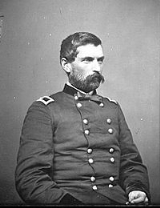
John Gibbon

Encyclopedia
John Gibbon was a career United States Army
officer who fought in the American Civil War
and the Indian Wars
.
section of Philadelphia, Pennsylvania
, the fourth child of ten born to Dr. John Heysham Gibbons and Catharine Lardner Gibbons. When Gibbon was nearly 11 years old the family moved near Charlotte, North Carolina
, after his father took a position as chief assayer at the U.S. Mint. He graduated from the United States Military Academy
in 1847 and was commissioned a brevet
second lieutenant in the 3rd U.S. Artillery. He served in the Mexican-American War without seeing combat, attempted to keep the peace between Seminoles and settlers in south Florida
, and taught artillery tactics at West Point
, where he wrote The Artillerist's Manual in 1859. The manual was a highly scientific treatise on gunnery and was used by both sides in the Civil War. In 1855, Gibbon married Francis "Fannie" North Moale. They had four children: Frances Moale Gibbon, Catharine "Katy" Lardner Gibbon, John Gibbon, Jr. (who died as a toddler
) and John S. Gibbon.
in Utah
. Despite the fact that his father was a slaveholder and that three of his brothers, two brothers-in-law and his cousin J. Johnston Pettigrew
served in the Confederate military, Gibbon decided to uphold his oath to the Union. Upon arrival in Washington, Gibbon, still in command of the 4th U.S. Artillery, became chief of artillery for Maj. Gen.
Irvin McDowell
. In 1862, he was appointed brigadier general
of volunteers and commanded the brigade of westerners known as King's Wisconsin Brigade. Gibbon quickly set about drilling his troops and improving their appearance, ordering them to wear white leggings and distinctive black 1858 regular army Hardee hat
s. The hats earned them the nickname The Black Hat Brigade. He led the brigade into action against the famous Confederate
Stonewall Brigade
at the Battle of Brawner's Farm, a prelude to the Second Battle of Bull Run
. He was still in command of the brigade during their strong uphill charge at the Battle of South Mountain
, where Maj. Gen. Joseph Hooker
exclaimed that the men "fought like iron". From then on, the brigade was known as the "Iron Brigade
". Gibbon led the brigade for the last time at the Battle of Antietam
, where he was forced to take time away from brigade command to personally man an artillery piece in the bloody fighting at the Cornfield.
Gibbon was promoted to command the 2nd Division, I Corps at the Battle of Fredericksburg
, where he was wounded. The wound was minor but kept getting infected, so Gibbon was out of action for a few months. Shortly after returning to duty he learned of the sudden death of his son, John Gibbon, Jr. Gibbon returned for the Battle of Chancellorsville
, but his division was in reserve and saw little action. At the Battle of Gettysburg
, he commanded the 2nd Division, II Corps and temporarily commanded the corps on July 1 and July 2, 1863, while Maj. Gen. Winfield S. Hancock was elevated to command larger units. At the end of the council of war
on the night of July 2, army commander Maj. Gen. George G. Meade took Gibbon aside and predicted, "If Lee
attacks tomorrow, it will be on your front." And his division did bear the brunt of fighting during the defense against Pickett's Charge
on July 3, when Gibbon was again wounded. While recovering from his wounds, he commanded a draft depot in Cleveland, Ohio
, and attended the dedication of Soldiers' National Cemetery
and heard Abraham Lincoln
's Gettysburg Address
with his close friend and aide Lt. Frank A. Haskell
.
Gibbon was back in command of the 2nd Division at the battles of the Wilderness
, Spotsylvania Court House
, and Cold Harbor
. During the Siege of Petersburg
, Gibbon became disheartened when his troops refused to fight at Ream's Station
. He briefly commanded the XVIII Corps before going on sick leave, but his service being too valuable, he returned to command the newly created XXIV Corps in the Army of the James
. His troops helped achieve the decisive breakthrough at Petersburg
, capturing Fort Gregg, part of the Confederate defenses. He led his troops during the Appomattox Campaign
and blocked the Confederate escape route at the Battle of Appomattox Courthouse
. He was one of three commissioners for the Confederate surrender.
and was in command of the infantry at Fort Ellis
in the Montana Territory
, during the campaign
against the Sioux
in 1876. Gibbon, General George Crook
, and General Alfred Terry
were to make a coordinated campaign against the Sioux and Cheyenne
, but Crook was driven back at the Battle of the Rosebud
, and Gibbon was not close by when Lt. Col. George A. Custer attacked a very large village on the banks of the Little Bighorn River
. The Battle of the Little Bighorn
resulted in the deaths of Custer and some 261 of his men. Gibbon's approach on June 26 probably saved the lives of the several hundred men under the command of Major Marcus Reno
who were still under siege. Gibbon arrived the next day and helped to bury the dead and evacuate the wounded.
Gibbon was still in command in Montana the following year when he intercepted a telegraph from General Oliver O. Howard
to cut off the Nez Percé, who were camped along the Big Hole River
in western Montana. At the Battle of the Big Hole
Gibbon's forces inflicted heavy losses, but became pinned down under Indian sniper fire. Gibbon held off the warriors until General Howard's forces arrived late on the second day of battle and drove them off.
in 1884. He was promoted to brigadier general in the regular army in 1885 and took command of the Army of the Pacific Northwest. He placed Seattle, Washington
, under martial law
during the anti-Chinese riots of 1886. Gibbon was required to retire due to age restrictions in 1891.
Gibbon served as president of the Iron Brigade Association, and Commander in Chief of the Military Order of the Loyal Legion of the United States
from October 1895 until his death the following year. He also gave the commencement address to the West Point Class of 1886.
, Maryland
, and is buried in Arlington National Cemetery
. In addition to his famous and influential Artillerist's Manual of 1859, he is the author of Personal Recollections of the Civil War (published posthumously in 1928) and Adventures on the Western Frontier (also posthumous, 1994) along with many articles in magazines and journals, typically recounting his time in the West and providing his opinions on the government's policy toward Native Americans.
On July 3, 1988, the 125th anniversary of the Battle of Gettysburg, a bronze statue of John Gibbon was dedicated in the Gettysburg National Military Park
, near the site of his wounding in Pickett's Charge.
The town of Gibbon
in south central Minnesota is named after him, as is Gibbon, Oregon
.
The Gibbon River and Falls in Yellowstone National Park also bears his name after his 1872 expedition there.
United States Army
The United States Army is the main branch of the United States Armed Forces responsible for land-based military operations. It is the largest and oldest established branch of the U.S. military, and is one of seven U.S. uniformed services...
officer who fought in the American Civil War
American Civil War
The American Civil War was a civil war fought in the United States of America. In response to the election of Abraham Lincoln as President of the United States, 11 southern slave states declared their secession from the United States and formed the Confederate States of America ; the other 25...
and the Indian Wars
Indian Wars
American Indian Wars is the name used in the United States to describe a series of conflicts between American settlers or the federal government and the native peoples of North America before and after the American Revolutionary War. The wars resulted from the arrival of European colonizers who...
.
Early life
Gibbon was born in the HolmesburgHolmesburg, Philadelphia, Pennsylvania
Holmesburg is a neighborhood in the Northeast section of Philadelphia, Pennsylvania. Holmesburg was named for the descendants of John Holme who immigrated to Philadelphia in the 1680s and had no known relation to Surveyor General Thomas Holme. John Holme's descendants acquired land in Lower...
section of Philadelphia, Pennsylvania
Pennsylvania
The Commonwealth of Pennsylvania is a U.S. state that is located in the Northeastern and Mid-Atlantic regions of the United States. The state borders Delaware and Maryland to the south, West Virginia to the southwest, Ohio to the west, New York and Ontario, Canada, to the north, and New Jersey to...
, the fourth child of ten born to Dr. John Heysham Gibbons and Catharine Lardner Gibbons. When Gibbon was nearly 11 years old the family moved near Charlotte, North Carolina
Charlotte, North Carolina
Charlotte is the largest city in the U.S. state of North Carolina and the seat of Mecklenburg County. In 2010, Charlotte's population according to the US Census Bureau was 731,424, making it the 17th largest city in the United States based on population. The Charlotte metropolitan area had a 2009...
, after his father took a position as chief assayer at the U.S. Mint. He graduated from the United States Military Academy
United States Military Academy
The United States Military Academy at West Point is a four-year coeducational federal service academy located at West Point, New York. The academy sits on scenic high ground overlooking the Hudson River, north of New York City...
in 1847 and was commissioned a brevet
Brevet (military)
In many of the world's military establishments, brevet referred to a warrant authorizing a commissioned officer to hold a higher rank temporarily, but usually without receiving the pay of that higher rank except when actually serving in that role. An officer so promoted may be referred to as being...
second lieutenant in the 3rd U.S. Artillery. He served in the Mexican-American War without seeing combat, attempted to keep the peace between Seminoles and settlers in south Florida
Florida
Florida is a state in the southeastern United States, located on the nation's Atlantic and Gulf coasts. It is bordered to the west by the Gulf of Mexico, to the north by Alabama and Georgia and to the east by the Atlantic Ocean. With a population of 18,801,310 as measured by the 2010 census, it...
, and taught artillery tactics at West Point
United States Military Academy
The United States Military Academy at West Point is a four-year coeducational federal service academy located at West Point, New York. The academy sits on scenic high ground overlooking the Hudson River, north of New York City...
, where he wrote The Artillerist's Manual in 1859. The manual was a highly scientific treatise on gunnery and was used by both sides in the Civil War. In 1855, Gibbon married Francis "Fannie" North Moale. They had four children: Frances Moale Gibbon, Catharine "Katy" Lardner Gibbon, John Gibbon, Jr. (who died as a toddler
Toddler
A toddler is a young child, usually defined as being between the ages of one and three. Registered nurse, midwife and author, Robin Barker, states 'Any time from eight months onwards your baby will begin to realise he is a separate person from you...
) and John S. Gibbon.
Civil War
When war broke out between the states, Gibbon was serving as a captain of Battery B, 4th U.S. Artillery at Camp FloydCamp Floyd
Camp Floyd was a short-lived U.S. Army post near Fairfield, Utah, United States. The site is now a Utah state park known as Camp Floyd / Stagecoach Inn State Park and Museum.-Camp Floyd:...
in Utah
Utah
Utah is a state in the Western United States. It was the 45th state to join the Union, on January 4, 1896. Approximately 80% of Utah's 2,763,885 people live along the Wasatch Front, centering on Salt Lake City. This leaves vast expanses of the state nearly uninhabited, making the population the...
. Despite the fact that his father was a slaveholder and that three of his brothers, two brothers-in-law and his cousin J. Johnston Pettigrew
J. Johnston Pettigrew
James Johnston Pettigrew was an author, lawyer, linguist, diplomat, and a Confederate general in the American Civil War...
served in the Confederate military, Gibbon decided to uphold his oath to the Union. Upon arrival in Washington, Gibbon, still in command of the 4th U.S. Artillery, became chief of artillery for Maj. Gen.
Major general (United States)
In the United States Army, United States Marine Corps, and United States Air Force, major general is a two-star general-officer rank, with the pay grade of O-8. Major general ranks above brigadier general and below lieutenant general...
Irvin McDowell
Irvin McDowell
Irvin McDowell was a career American army officer. He is best known for his defeat in the First Battle of Bull Run, the first large-scale battle of the American Civil War.-Early life:...
. In 1862, he was appointed brigadier general
Brigadier general (United States)
A brigadier general in the United States Army, Air Force, and Marine Corps, is a one-star general officer, with the pay grade of O-7. Brigadier general ranks above a colonel and below major general. Brigadier general is equivalent to the rank of rear admiral in the other uniformed...
of volunteers and commanded the brigade of westerners known as King's Wisconsin Brigade. Gibbon quickly set about drilling his troops and improving their appearance, ordering them to wear white leggings and distinctive black 1858 regular army Hardee hat
Hardee hat
The Hardee hat, also known as the Model 1858 Dress Hat and sometimes nicknamed the "Jeff Davis", was the regulation dress hat for enlisted men in the Union Army during the American Civil War. The Hardee hat was also worn by Confederate soldiers. However, most soldiers found the black felt hat to...
s. The hats earned them the nickname The Black Hat Brigade. He led the brigade into action against the famous Confederate
Confederate States Army
The Confederate States Army was the army of the Confederate States of America while the Confederacy existed during the American Civil War. On February 8, 1861, delegates from the seven Deep South states which had already declared their secession from the United States of America adopted the...
Stonewall Brigade
Stonewall Brigade
The Stonewall Brigade of the Confederate Army during the American Civil War, was a famous combat unit in United States military history. It was trained and first led by General Thomas J. "Stonewall" Jackson, a professor from Virginia Military Institute...
at the Battle of Brawner's Farm, a prelude to the Second Battle of Bull Run
Second Battle of Bull Run
The Second Battle of Bull Run or Second Manassas was fought August 28–30, 1862, as part of the American Civil War. It was the culmination of an offensive campaign waged by Confederate Gen. Robert E. Lee's Army of Northern Virginia against Union Maj. Gen...
. He was still in command of the brigade during their strong uphill charge at the Battle of South Mountain
Battle of South Mountain
The Battle of South Mountain was fought September 14, 1862, as part of the Maryland Campaign of the American Civil War. Three pitched battles were fought for possession of three South Mountain passes: Crampton's, Turner's, and Fox's Gaps. Maj. Gen. George B...
, where Maj. Gen. Joseph Hooker
Joseph Hooker
Joseph Hooker was a career United States Army officer, achieving the rank of major general in the Union Army during the American Civil War. Although he served throughout the war, usually with distinction, Hooker is best remembered for his stunning defeat by Confederate General Robert E...
exclaimed that the men "fought like iron". From then on, the brigade was known as the "Iron Brigade
Iron Brigade
The Iron Brigade, also known as the Iron Brigade of the West or the Black Hat Brigade, was an infantry brigade in the Union Army of the Potomac during the American Civil War. Although it fought entirely in the Eastern Theater, it was composed of regiments from Western states...
". Gibbon led the brigade for the last time at the Battle of Antietam
Battle of Antietam
The Battle of Antietam , fought on September 17, 1862, near Sharpsburg, Maryland, and Antietam Creek, as part of the Maryland Campaign, was the first major battle in the American Civil War to take place on Northern soil. It was the bloodiest single-day battle in American history, with about 23,000...
, where he was forced to take time away from brigade command to personally man an artillery piece in the bloody fighting at the Cornfield.
Gibbon was promoted to command the 2nd Division, I Corps at the Battle of Fredericksburg
Battle of Fredericksburg
The Battle of Fredericksburg was fought December 11–15, 1862, in and around Fredericksburg, Virginia, between General Robert E. Lee's Confederate Army of Northern Virginia and the Union Army of the Potomac, commanded by Maj. Gen. Ambrose E. Burnside...
, where he was wounded. The wound was minor but kept getting infected, so Gibbon was out of action for a few months. Shortly after returning to duty he learned of the sudden death of his son, John Gibbon, Jr. Gibbon returned for the Battle of Chancellorsville
Battle of Chancellorsville
The Battle of Chancellorsville was a major battle of the American Civil War, and the principal engagement of the Chancellorsville Campaign. It was fought from April 30 to May 6, 1863, in Spotsylvania County, Virginia, near the village of Chancellorsville. Two related battles were fought nearby on...
, but his division was in reserve and saw little action. At the Battle of Gettysburg
Battle of Gettysburg
The Battle of Gettysburg , was fought July 1–3, 1863, in and around the town of Gettysburg, Pennsylvania. The battle with the largest number of casualties in the American Civil War, it is often described as the war's turning point. Union Maj. Gen. George Gordon Meade's Army of the Potomac...
, he commanded the 2nd Division, II Corps and temporarily commanded the corps on July 1 and July 2, 1863, while Maj. Gen. Winfield S. Hancock was elevated to command larger units. At the end of the council of war
Council of war
A council of war is a term in military science that describes a meeting held to decide on a course of action, usually in the midst of a battle. Under normal circumstances, decisions are made by a commanding officer, optionally communicated and coordinated by staff officers, and then implemented by...
on the night of July 2, army commander Maj. Gen. George G. Meade took Gibbon aside and predicted, "If Lee
Robert E. Lee
Robert Edward Lee was a career military officer who is best known for having commanded the Confederate Army of Northern Virginia in the American Civil War....
attacks tomorrow, it will be on your front." And his division did bear the brunt of fighting during the defense against Pickett's Charge
Pickett's Charge
Pickett's Charge was an infantry assault ordered by Confederate Gen. Robert E. Lee against Maj. Gen. George G. Meade's Union positions on Cemetery Ridge on July 3, 1863, the last day of the Battle of Gettysburg during the American Civil War. Its futility was predicted by the charge's commander,...
on July 3, when Gibbon was again wounded. While recovering from his wounds, he commanded a draft depot in Cleveland, Ohio
Cleveland, Ohio
Cleveland is a city in the U.S. state of Ohio and is the county seat of Cuyahoga County, the most populous county in the state. The city is located in northeastern Ohio on the southern shore of Lake Erie, approximately west of the Pennsylvania border...
, and attended the dedication of Soldiers' National Cemetery
Gettysburg National Cemetery
The Gettysburg National Cemetery is located on Cemetery Hill in the Gettysburg Battlefield near the borough of Gettysburg, Pennsylvania and adjacent to Evergreen Cemetery to the south...
and heard Abraham Lincoln
Abraham Lincoln
Abraham Lincoln was the 16th President of the United States, serving from March 1861 until his assassination in April 1865. He successfully led his country through a great constitutional, military and moral crisis – the American Civil War – preserving the Union, while ending slavery, and...
's Gettysburg Address
Gettysburg Address
The Gettysburg Address is a speech by U.S. President Abraham Lincoln and is one of the most well-known speeches in United States history. It was delivered by Lincoln during the American Civil War, on the afternoon of Thursday, November 19, 1863, at the dedication of the Soldiers' National Cemetery...
with his close friend and aide Lt. Frank A. Haskell
Frank A. Haskell
Franklin Aretas Haskell was a Union Army officer during the American Civil War who was killed during the Battle of Cold Harbor. Haskell wrote a famous account of the Battle of Gettysburg that was published posthumously....
.
Gibbon was back in command of the 2nd Division at the battles of the Wilderness
Battle of the Wilderness
The Battle of the Wilderness, fought May 5–7, 1864, was the first battle of Lt. Gen. Ulysses S. Grant's 1864 Virginia Overland Campaign against Gen. Robert E. Lee and the Confederate Army of Northern Virginia. Both armies suffered heavy casualties, a harbinger of a bloody war of attrition by...
, Spotsylvania Court House
Battle of Spotsylvania Court House
The Battle of Spotsylvania Court House, sometimes simply referred to as the Battle of Spotsylvania , was the second major battle in Lt. Gen. Ulysses S. Grant's 1864 Overland Campaign of the American Civil War. Following the bloody but inconclusive Battle of the Wilderness, Grant's army disengaged...
, and Cold Harbor
Battle of Cold Harbor
The Battle of Cold Harbor was fought from May 31 to June 12, 1864 . It was one of the final battles of Union Lt. Gen. Ulysses S. Grant's Overland Campaign during the American Civil War, and is remembered as one of American history's bloodiest, most lopsided battles...
. During the Siege of Petersburg
Siege of Petersburg
The Richmond–Petersburg Campaign was a series of battles around Petersburg, Virginia, fought from June 9, 1864, to March 25, 1865, during the American Civil War...
, Gibbon became disheartened when his troops refused to fight at Ream's Station
Second Battle of Ream's Station
The Second Battle of Ream's Station was fought during the Siege of Petersburg in the American Civil War on August 25, 1864, in Dinwiddie County, Virginia. A Union force under Maj. Gen. Winfield S. Hancock began destroying part of the Weldon Railroad, which was a vital supply line for Gen. Robert...
. He briefly commanded the XVIII Corps before going on sick leave, but his service being too valuable, he returned to command the newly created XXIV Corps in the Army of the James
Army of the James
The Army of the James was a Union Army that was composed of units from the Department of Virginia and North Carolina and served along the James River during the final operations of the American Civil War in Virginia.-History:...
. His troops helped achieve the decisive breakthrough at Petersburg
Battle of Petersburg III
The Third Battle of Petersburg, also known as the Breakthrough at Petersburg or the Fall of Petersburg, was a decisive Union assault on the Confederate trenches, ending the ten-month Siege of Petersburg and leading to the fall of Petersburg and Richmond, Virginia.-Fort Mahone:The Union IX Corps...
, capturing Fort Gregg, part of the Confederate defenses. He led his troops during the Appomattox Campaign
Appomattox Campaign
The Appomattox Campaign was a series of battles fought March 29 – April 9, 1865, in Virginia that culminated in the surrender of Confederate General Robert E...
and blocked the Confederate escape route at the Battle of Appomattox Courthouse
Battle of Appomattox Courthouse
The Battle of Appomattox Court House, fought on the morning of April 9, 1865, was the final engagement of Confederate States Army General Robert E. Lee's Army of Northern Virginia before it surrendered to the Union Army under Lt. Gen. Ulysses S. Grant, and one of the last battles of the American...
. He was one of three commissioners for the Confederate surrender.
Indian Wars
Gibbon stayed in the army after the war. He reverted to the regular army rank of colonelColonel (United States)
In the United States Army, Air Force, and Marine Corps, colonel is a senior field grade military officer rank just above the rank of lieutenant colonel and just below the rank of brigadier general...
and was in command of the infantry at Fort Ellis
Fort Ellis
Fort Ellis was an early United States Army outpost established August 27, 1867 to the eastern side of present-day Bozeman, Montana. The fort was established to protect and support settlers moving into the Gallatin Valley. The post was named for Civil War Colonel Augustus van Horne Ellis who was...
in the Montana Territory
Montana Territory
The Territory of Montana was an organized incorporated territory of the United States that existed from May 28, 1864, until November 8, 1889, when it was admitted to the Union as the State of Montana.-History:...
, during the campaign
Great Sioux War of 1876-77
The Great Sioux War of 1876, also known as the Black Hills War, was a series of battles and negotiations which occurred between 1876 and 1877 involving the Lakota and Northern Cheyenne, against the United States...
against the Sioux
Sioux
The Sioux are Native American and First Nations people in North America. The term can refer to any ethnic group within the Great Sioux Nation or any of the nation's many language dialects...
in 1876. Gibbon, General George Crook
George Crook
George R. Crook was a career United States Army officer, most noted for his distinguished service during the American Civil War and the Indian Wars.-Early life:...
, and General Alfred Terry
Alfred Terry
Alfred Howe Terry was a Union general in the American Civil War and the military commander of the Dakota Territory from 1866 to 1869 and again from 1872 to 1886.-Early life and career:...
were to make a coordinated campaign against the Sioux and Cheyenne
Cheyenne
Cheyenne are a Native American people of the Great Plains, who are of the Algonquian language family. The Cheyenne Nation is composed of two united tribes, the Só'taeo'o and the Tsétsêhéstâhese .The Cheyenne are thought to have branched off other tribes of Algonquian stock inhabiting lands...
, but Crook was driven back at the Battle of the Rosebud
Battle of the Rosebud
The Battle of the Rosebud occurred June 17, 1876, in the Montana Territory between the United States Army and a force of Lakota Native Americans during the Black Hills War...
, and Gibbon was not close by when Lt. Col. George A. Custer attacked a very large village on the banks of the Little Bighorn River
Little Bighorn River
The Little Bighorn River is a tributary of the Bighorn River in the United States in the states of Wyoming and Montana. The Battle of the Little Bighorn was fought on its banks in 1876, as well as the Battle of Crow Agency in 1887....
. The Battle of the Little Bighorn
Battle of the Little Bighorn
The Battle of the Little Bighorn, also known as Custer's Last Stand and, by the Indians involved, as the Battle of the Greasy Grass, was an armed engagement between combined forces of Lakota, Northern Cheyenne and Arapaho people against the 7th Cavalry Regiment of the United States Army...
resulted in the deaths of Custer and some 261 of his men. Gibbon's approach on June 26 probably saved the lives of the several hundred men under the command of Major Marcus Reno
Marcus Reno
Marcus Albert Reno was a career military officer in the American Civil War and in the Black Hills War against the Lakota and Northern Cheyenne...
who were still under siege. Gibbon arrived the next day and helped to bury the dead and evacuate the wounded.
Gibbon was still in command in Montana the following year when he intercepted a telegraph from General Oliver O. Howard
Oliver O. Howard
Oliver Otis Howard was a career United States Army officer and a Union general in the American Civil War...
to cut off the Nez Percé, who were camped along the Big Hole River
Big Hole River
The Big Hole River is a tributary of the Jefferson River, approximately 153 miles long, in southwestern Montana in the United States. It rises in Skinner lake in the Beaverhead National Forest in the Beaverhead Mountains of the Bitterroot Range at the continental divide along the...
in western Montana. At the Battle of the Big Hole
Battle of the Big Hole
The Battle of the Big Hole was a costly battle in the Montana Territory between the Nez Percé and United States army during the Nez Perce War of 1877.-Background:...
Gibbon's forces inflicted heavy losses, but became pinned down under Indian sniper fire. Gibbon held off the warriors until General Howard's forces arrived late on the second day of battle and drove them off.
Later career and retirement
Gibbon served temporarily as commander of the Department of the PlatteDepartment of the Platte
The Department of the Platte was a military administrative district established by the U.S. Army on March 5, 1866, with boundaries encompassing Iowa, Nebraska, Dakota Territory, Utah Territory and a small portion of Idaho...
in 1884. He was promoted to brigadier general in the regular army in 1885 and took command of the Army of the Pacific Northwest. He placed Seattle, Washington
Seattle, Washington
Seattle is the county seat of King County, Washington. With 608,660 residents as of the 2010 Census, Seattle is the largest city in the Northwestern United States. The Seattle metropolitan area of about 3.4 million inhabitants is the 15th largest metropolitan area in the country...
, under martial law
Martial law
Martial law is the imposition of military rule by military authorities over designated regions on an emergency basis— only temporary—when the civilian government or civilian authorities fail to function effectively , when there are extensive riots and protests, or when the disobedience of the law...
during the anti-Chinese riots of 1886. Gibbon was required to retire due to age restrictions in 1891.
Gibbon served as president of the Iron Brigade Association, and Commander in Chief of the Military Order of the Loyal Legion of the United States
Military Order of the Loyal Legion of the United States
The Military Order of the Loyal Legion of the United States, also known by its acronym MOLLUS or simply as the Loyal Legion, is a United States patriotic order, organized April 15, 1865, by officers of the Army, Navy, or Marine Corps of the United States who "had aided in maintaining the honor,...
from October 1895 until his death the following year. He also gave the commencement address to the West Point Class of 1886.
Death and legacy
John Gibbon died in BaltimoreBaltimore
Baltimore is the largest independent city in the United States and the largest city and cultural center of the US state of Maryland. The city is located in central Maryland along the tidal portion of the Patapsco River, an arm of the Chesapeake Bay. Baltimore is sometimes referred to as Baltimore...
, Maryland
Maryland
Maryland is a U.S. state located in the Mid Atlantic region of the United States, bordering Virginia, West Virginia, and the District of Columbia to its south and west; Pennsylvania to its north; and Delaware to its east...
, and is buried in Arlington National Cemetery
Arlington National Cemetery
Arlington National Cemetery in Arlington County, Virginia, is a military cemetery in the United States of America, established during the American Civil War on the grounds of Arlington House, formerly the estate of the family of Confederate general Robert E. Lee's wife Mary Anna Lee, a great...
. In addition to his famous and influential Artillerist's Manual of 1859, he is the author of Personal Recollections of the Civil War (published posthumously in 1928) and Adventures on the Western Frontier (also posthumous, 1994) along with many articles in magazines and journals, typically recounting his time in the West and providing his opinions on the government's policy toward Native Americans.
On July 3, 1988, the 125th anniversary of the Battle of Gettysburg, a bronze statue of John Gibbon was dedicated in the Gettysburg National Military Park
Gettysburg Battlefield
The Gettysburg Battlefield is the area of the July 1–3, 1863, military engagements of the Battle of Gettysburg within and around the borough of Gettysburg, Pennsylvania. Locations of military engagements extend from the 4 acre site of the first shot & at on the west of the borough, to East...
, near the site of his wounding in Pickett's Charge.
The town of Gibbon
Gibbon, Minnesota
Gibbon is a city in Sibley County, Minnesota, United States. The population was 772 at the 2010 census.-Geography:According to the United States Census Bureau, the city has a total area of , all of it land.-Demographics:...
in south central Minnesota is named after him, as is Gibbon, Oregon
Gibbon, Oregon
Gibbon is an unincorporated community in Umatilla County, Oregon, United States. It is about 20 miles east of Pendleton on the Umatilla Indian Reservation, near the Umatilla River....
.
The Gibbon River and Falls in Yellowstone National Park also bears his name after his 1872 expedition there.
In popular media
Gibbon was portrayed in the film Gettysburg by Emile O. Schmidt.See also
- List of American Civil War generals
Further reading
- Gibbon, John. Gibbon on the Sioux Campaign of 1876. Bellevue, NV: The Old Army Press, 1970. .
- Gibbon, John. Personal Recollections of the Civil War. New York: G.P. Putnam's Sons, 1928. .
- Nolan, Alan T., and Sharon Eggleston Vipond, eds. Giants in their Tall Black Hats: Essays on the Iron Brigade. Bloomington: Indiana University Press, 1998. ISBN 0-2533-3457-8.
External links
- The John Gibbon papers, including correspondence, memoirs and commentary on many aspects of his life and the military, are available for research use at the Historical Society of PennsylvaniaHistorical Society of PennsylvaniaThe Historical Society of Pennsylvania is a historical society founded in 1824 and based in Philadelphia. The Society's building, designed by Addison Hutton and listed on Philadelphia's Register of Historical Places, houses some 600,000 printed items and over 19 million manuscript and graphic items...
. - Photograph of Gibbon in 1889 with Chief JosephChief JosephHin-mah-too-yah-lat-kekt, popularly known as Chief Joseph, or Young Joseph was the leader of the Wal-lam-wat-kain band of Nez Perce during General Oliver O. Howard's attempt to forcibly remove his band and the other "non-treaty" Nez Perce to a reservation in Idaho...
. - Photographs of Gibbon and his grave.
- Several photographs of Gibbon.
