
In Depth
See Also

History of slavery in the United States

he history of slavery in the United States began soon after Europeans first settled in what in 1776 became the United States United States

The United States of America, also known as the United States, the U.S., the U.S.A., a... 

. It ended in 1863-64 with Abraham Lincoln Abraham Lincoln

Abraham Lincoln , sometimes called Abe Lincoln and nicknamed Honest Abe, the Rail Splitte... 

's Emancipation Proclamation Emancipation Proclamation

The Emancipation Proclamation was a presidential order on January 1 [i] 1863 [i] declaring the freedom ... 

; it legally ended with the Thirteenth Thirteenth Amendment to the United States Constitution

Amendment XIII of the United States Constitution [i] officially abolished slavery [i] and, with the exc ... 

 amendment of 1865.

Discussions

  Discussion Features

   Ask a question about 'History of slavery in the United States'

   Start a new discussion about 'History of slavery in the United States'

   Answer questions about 'History of slavery in the United States'

   'History of slavery in the United States' discussion forum


Encyclopedia

The history of slavery in the United States began soon after Europeans first settled in what in 1776 became the United States United States

The United States of America, also known as the United States, the U.S., the U.S.A., a... 

. It ended in 1863-64 with Abraham Lincoln Abraham Lincoln

Abraham Lincoln , sometimes called Abe Lincoln and nicknamed Honest Abe, the Rail Splitte... 

's Emancipation Proclamation Emancipation Proclamation

The Emancipation Proclamation was a presidential order on January 1 [i] 1863 [i] declaring the freedom ... 

; it legally ended with the Thirteenth Thirteenth Amendment to the United States Constitution

Amendment XIII of the United States Constitution [i] officially abolished slavery [i] and, with the exc ... 

 amendment of 1865.

Introduction

From about 1619 until 1865, people of African descent were legally enslaved within the boundaries of the present United States. The economy of the early country was made possible in large part by the free labor afforded by slavery. Around half a million Africans were brought over from Africa during the slave trade, but due to laws claiming the offspring of slaves as slaves, the slave population in the United States grew to 4 million by the 1860 Census.

Slavery in Colonial America

The first record of slavery in Colonial America begins with twenty blacks recorded as being brought by a Dutch ship and sold to the English colony of Jamestown, Virginia Jamestown, Virginia

Jamestown was established in 1607 on the James River [i] in what is currently James City County, Virginia [i] ... 

 in 1619 as indentured servants. Three are believed to have been named Isabella, Antoney and Pedro. There is evidence that Isabella and Antoney later gave birth to a son named William. This "William Tucker" is now considered the first African American born in the English colonies in North America.

The transformation from indentured servitude to racial slavery happened gradually. There are no laws regarding slavery early in Virginia's history. By 1640, the Virginia courts had sentenced at least one black servant to slavery.

Three servants working for a farmer named Hugh Gwyn ran away to Maryland. Two were white; one was black. They were captured in Maryland and returned to Jamestown, where the court sentenced all three to thirty lashes -- a severe punishment even by the standards of 17th-century Virginia. The two white men were sentenced to an additional four years of servitude -- one more year for Gwyn followed by three more for the colony. But, in addition to the whipping, the black man, a man named John Punch, was ordered to "serve his said master or his assigns for the time of his natural life here or elsewhere."

It wasn't until 1661 that a reference to slavery entered into Virginia law, and this law was directed at white servants -- at those who ran away with a black servant. The following year, the colony went one step further by stating that children born would be bonded or free according to the status of the mother.

The transformation had begun, but it wouldn't be until the Slave Codes of 1705 that the status of African Americans would be sealed.

Originally in the American colonies, 1600 to 1800, American Indians and other groups, mostly white Europeans such as captured soldiers, minor criminals, etc., were used as slaves , but by the 19th century almost all slaves were blacks African American

An African American is a member of an ethnic group [i] in the United States [i] whose ancestors, usual... 

. During the British colonial period, slaves were used mostly in the Southern colonies and to a lesser degree in the Northern colonies as well. Early on, slaves were most useful in the growing of indigo, rice Rice

Rice refers to two species of grass [i], native to tropical and subtropical southern & southeas ... 

, and tobacco Tobacco

Tobacco refers to a genus of broad-leafed plants of the nightshade [i] family indigenous to North [i] ... 

; cotton Cotton

Cotton is a soft fiber [i] that grows around the seeds of the cotton plant , a shrub [i] native to the t ... 

 was only a side crop. Nevertheless, it was clear that slaves were most economically viable in plantation Plantation

A plantation is an intentional planting of a crop, on a larger scale, usually for uses other than cereal... 

-style agriculture. Many landowners began to grow increasingly dependent on slave labor for their livelihood, and legislatures responded accordingly by increasingly stricter regulations on forced labor practices, known as the Slave codes.

Indian tribes often enslaved captives takes from other tribes. After 1800 the Cherokees Cherokee

The Cherokee, or in the Cherokee language [i], are a people native to North America [i], who at the ti ... 

 and other tribes started buying and using black slaves, a practice they continued after being relocated to Indian Territory Indian Territory

Indian Territory, also known as Indian Country, Indian territory or the Indian territories... 

  in the 1830s. These tribes supported the Confederacy in the Civil War; their slaves were freed by the Emancipation Proclamation.

Anti-Slavery

After 1776 antislavery forces gained strength throughout the country; they were strongest in Pennsylvania where Quakers were strongest. Every northern state abolished slavery by immediate or gradual processes. The last to do so were New York and New Jersey .

Throughout the first half of the 19th century, a movement to end slavery, called abolitionism Abolitionism

Abolitionism was a political movement that sought to abolish the practice of slavery [i] and the worldwi ... 

, grew in strength throughout the United States. This reform took place amidst strong support of slavery among white Southerners, who began to refer to it as the "peculiar institution" in a defensive attempt to differentiate it from other examples of forced labor.

The large, well-funded American Colonization Society had an active program of shipping ex-slaves and free blacks who volunteered to Africa, to the American colony of Liberia Liberia

Liberia, officially the Republic of Liberia, is a country on the west coast of Africa [i], bordere ... 

.

After 1830, led by William Lloyd Garrison William Lloyd Garrison

William Lloyd Garrison was a prominent United States [i] abolitionist [i], journalist and s ... 

 a religious movement declared slavery to be a personal sin and demanded the owners repent immediately, and start the process of emancipation. The movement was highly controversial and was a factor in causing the American Civil War American Civil War

The American Civil War was a sectional conflict in the United States of America [i] between the federal ... 

.

A very few abolitionists, such as John Brown, favored the use of armed force to foment uprisings among the slaves, while others preferred to use the legal system.


Influential leaders of the abolition movement included:
  • William Lloyd Garrison William Lloyd Garrison

    William Lloyd Garrison was a prominent United States [i] abolitionist [i], journalist and s ... 

     - Published The Liberator newspaper
  • Harriet Beecher Stowe Harriet Beecher Stowe

    Harriet Elizabeth Beecher Stowe, born(June 14 [i], 1811 [i] July 1 [i], 1896 [i]) was an abolitionist [i] ... 

     - Author of Uncle Tom's Cabin Uncle Tom's Cabin

    Uncle Tom's Cabin is a novel [i] by American [i] abolitionist [i] author Harriet Beechehr Stowe [i] ... 

  • Frederick Douglass Frederick Douglass

    Frederick Douglass was an American [i] abolitionist [i], editor [i], ... 

     - Nation's most powerful anti-slavery speaker, a former slave. Most famous for his book, "Narritive in the Life of Frederick Douglass.
  • Harriet Tubman Harriet Tubman

    Harriet Tubman , also known as "Black Moses, "Grandma Moses," or "Moses of Her People," was an African-American [i] ... 

     - Helped 350 slaves escape from the South, became known as a "conductor" on the "Underground Railroad Underground Railroad

    The Underground Railroad was a network of clandestine routes [i] by which African [i] slaves [i] ... 

    ".


Slave uprisings that used armed force include:
  • New York Revolt of 1712
  • The Stono Rebellion
  • New York Slave Insurrection of 1741
  • Gabriel's Rebellion
  • Louisiana Territory Slave Rebellion, led by Charles Deslandes
  • George Boxley Rebellion
  • Fort Blount Revolt
  • Denmark Vesey Uprising Denmark Vesey

    Denmark Vesey was an African American [i] slave [i] and, later, a freeman, who is alleged to hav ... 

  • Nat Turner's Rebellion
  • Amistad Seizure


Due to the three-fifths compromise in the United States Constitution United States Constitution

The United States Constitution is the supreme law [i] of the United States of America [i]. ... 

, slaveholders exerted their power through the Federal Government and the Federal Fugitive slave laws. Refugees from slavery fled the South across the Ohio River to the North via the Underground Railroad Underground Railroad

The Underground Railroad was a network of clandestine routes [i] by which African [i] slaves [i] ... 

, and their physical presence in Cincinnati Cincinnati, Ohio

Cincinnati is a southwestern Ohio [i] city in the United States [i] that lies on the Ohio River [i] and... 

, Oberlin Oberlin, Ohio

erlin]] [i]
[i]
[i]
... 

, and other Northern towns agitated Northerners. After 1854 Republicans fumed that the Slave Power, especially the pro-slavery Democratic Party controlled two or three branches of the Federal government.

North and South grew further apart in 1845 with the formation of the Southern Baptist Convention Southern Baptist Convention

The Southern Baptist Convention is a United States [i]-based cooperative ministry agency serving Baptist [i]... 

 on the premise that the Bible sanctions slavery and that it was acceptable for Christians to own slaves . This split was triggered by the opposition of northern Baptists to slavery, and in particular by the 1844 statement of the Home Mission Society declaring that a person could not be a missionary and still keep slaves as property. The Methodist and Presbyterian churches likewise divided north and south, so that by the late 1850s only the Democratic Party was a national institution, and it split in the 1860 election.

1750s to 1850s

Some of the British colonies attempted to abolish the slave trade. Virginia's Acts to that effect were vetoed by the British Privy Council; Rhode Island forbade the importation of slaves completely in 1774. All of the states but Georgia had banned or limited it by 1786; Georgia did so in 1798 - although some of these laws were later repealed.

Beginning in the 1750's in Pennsylvania, the various colonial Quaker meetings attempted to persuade their members that they should not own slaves; some who resisted were expelled from Meeting. Some attempted to persuade others to do the same. There was widespread sentiment during the Revolution that slavery was injurious, and would eventually be abolished. The Northern states passed emancipation acts between 1780 and 1804; most of these arranged for gradual emancipation and a special status for freedmen, so there were still a dozen "permanent apprentices" in New Jersey in 1860.

The Constitution of the Vermont Republic Constitution of the Vermont Republic

The Constitution of the Vermont Republic was Vermont's constitution [i] when it existed as the independe... 

 expressly abolished slavery in 1777. The Massachusetts Constitution of 1780 declares all men "born free and equal"; the slave Quork Walker sued for his freedom on this basis and won his freedom, thus abolishing slavery in Massachusetts.

The economic value of plantation slavery was reinforced in 1793 with the invention of the cotton gin Cotton gin

The cotton gin is a machine invented by American [i] inventor Eli Whitney [i] in 1792 to m ... 

 by Eli Whitney Eli Whitney

Elias Whitney was an American [i] inventor [i] and manufacturer. ... 

, a device designed to separate cotton fibers from seedpods and the sometimes sticky seeds. The invention revolutionized the cotton-growing industry by increasing the quantity of cotton that could be processed in a day by fiftyfold. The result was explosive growth in the cotton industry, and a proportionate increase in the demand for slave labor in the South.

At the same time, the Northern states banned slavery though as Alexis De Toqueville Alexis de Tocqueville

Alexis-Charles-Henri Clrel de Tocqueville was a French [i] political thinker [i] and historian [i] ... 

 pointed out in Democracy in America Democracy in America

De la dmocratie en Amrique is a classic French [i] text by Alexis de Tocqueville [i] on the United States [i] ... 

 , this wasn't always done with the best of motives. As the northern states abolished slavery, it didn't always mean that the slaves were freed. In many cases it simply encouraged slave owners to move their slaves to states which still allowed slavery. This resulted in a population movement of black Americans to the South. The southern states didn't have this option of removing their black population, as slaves were already a much higher proportion of the total population and the international slave trade had been abolished. This led to a hardening of opinions in favor of slavery in the southern states out of fear of what the slaves would do if they were freed.

Just as demand for slaves was increasing, supply was restricted. The United States Constitution United States Constitution

The United States Constitution is the supreme law [i] of the United States of America [i]. ... 

, adopted in 1787, prevented Congress United States Congress

The United States Congress is the legislature [i] of the United States federal government [i]. ... 

 from banning the importation of slaves before 1808. On January 1 that year, Congress acted to ban further imports. Any new slaves would have to be descendants of ones that were currently in the US. However, the internal U.S. slave trade, and the involvement in the international slave trade or the outfitting of ships for that trade by U.S. citizens were not banned. Though there were certainly violations of this law, slavery in America became more or less self-sustaining; the overland 'slave trade' from Tidewater Virginia and the Carolinas to Georgia, Alabama, and Texas continued for another half-century.

Several slave rebellions took place during the 1700s and 1800s including the Nat Turner rebellion in 1831.

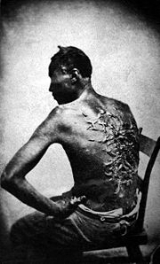
Historical records indicate that some slaveowners were more cruel to slaves than others. Some slaveowners raped and whipped slaves, and even cut off limbs of slaves who tried to escape, while other slaveowners provided materially for their slaves and were less physically abusive. In many households, treatment of slaves varied with the slave's skin color. Darker-skinned slaves worked in the fields, while lighter-skinned slaves or "house negroes" were made to work in the house and had better provisions. The United States slave population was the only slave population in history that increased through birth rather than importation. The interpretation of this fact has been a topic of much debate.

Because the Midwestern states decided in the 1820s not to allow slavery and because most Northeastern states became free states through local emancipation, a Northern bloc of free states solidified into one contiguous geographic area. The dividing line was the Ohio River Ohio River

The Ohio River is a principal tributary [i] of the Mississippi River [i]. ... 

 and the Mason-Dixon line Mason-Dixon line

The MasonDixon Line is a line of demarcation between four states [i] in the United States [i] ... 

 .


Census
Year
# Slaves # Free
blacks
Total
black
% free
blacks
Total US
population
% black
of total
1790 697,681 59,527 757,208 7.9% 3,929,214 19%
1800 893,602 108,435 1,002,037 10.8% 5,308,483 19%
1810 1,191,362 186,446 1,377,808 13.5% 7,239,881 19%
1820 1,538,022 233,634 1,771,656 13.2% 9,638,453 18%
1830 2,009,043 319,599 2,328,642 13.7% 12,860,702 18%
1840 2,487,355 386,293 2,873,648 13.4% 17,063,353 17%
1850 3,204,313 434,495 3,638,808 11.9% 23,191,876 16%
1860 3,953,760 488,070 4,441,830 11.0% 31,443,321 14%
1870 0 4,880,009 4,880,009 100% 38,558,371 13%
Source: http://www.census.gov/population/documentation/twps0056/tab01.xls


1850s to the Civil War


After the passage of the Kansas-Nebraska Act Kansas-Nebraska Act

The KansasNebraska Act was a United States federal law [i] passed on May 30 [i], 1854 [i], organizing a... 

 of 1854, border wars broke out in Kansas Territory Kansas Territory

Kansas Territory was an organized territory [i] of the United States [i] that existed from May 30 [i], 1854 [i] ... 

, where the question of whether it would be admitted to the Union as a slave state or a free state was left to the inhabitants. The radical abolitionist John Brown was active in the mayhem and killing in "Bleeding Kansas Bleeding Kansas

Bleeding Kansas, sometimes referred to in history [i] as Bloody Kansas or the ... 

." At the same time, fears that the Slave Power was seizing full control of the national government swept anti-slavery Republicans History of the United States Republican Party

The Republican Party [i] of the United States [i] was established in 1854 and is one of the t... 

 into office.

The Supreme Court tried to resolve the issue, but its 1857 Dred Scott decision Dred Scott v. Sandford

Dred Scott v. Sandford, 60 U.S. 393 [i], known as the "Dred Scott Case" or the " ... 

 only inflamed tempers. The deciding opinion proclaimed that slavery's presence in the Midwest was lawful --further proof for Republicans like Abraham Lincoln Abraham Lincoln

Abraham Lincoln , sometimes called Abe Lincoln and nicknamed Honest Abe, the Rail Splitte... 

 that the Slave Power had seized control of the Supreme Court.

The divisions became fully exposed with the 1860 presidential election United States presidential election, 1860

The U.S. presidential election of 1860 set the stage for the American Civil War [i] as the political sys ... 

. The electorate split four ways. One party endorsed slavery. One denounced it. One said democracy required the people themselves to decide on slavery locally. The fourth said the survival of the Union was at stake and everything else should be compromised. Lincoln, the Republican, won with a plurality of popular votes and a majority of electoral votes. Lincoln however, did not appear on the ballots of ten southern states: thus his election necessarily split the nation along sectional lines. Many slave owners in the South feared that the real intent of the Republicans was the abolition of slavery in states where it already existed, and that the sudden emancipation of 4 million slaves would be problematic for the slaver owners and for the economy that drew its greatest profits from the labor of people who were not paid. They also argued that banning slavery in new states would upset what they saw as a delicate balance of free state Free State

The Free State is a province [i] of South Africa [i]. ... 

s and slave states. They feared that ending this balance could lead to the domination of the industrial North with its preference for high tariff Tariff

A tariff is a tax on imported goods.... 

s on imported goods. The combination of these factors led the South to secede from the Union and thus began the American Civil War Origins of the American Civil War

The origins of the American Civil War [i] lay in the complex issues of politics [i], ... 

. Northern leaders like Lincoln and Chase had viewed the slavery interests as a threat politically, and with secession, they viewed the prospect of a new southern nation, the Confederate States of America Confederate States of America

The Confederate States of America was the government formed by eleven southern states of the USA [i]... 

, with control over the Mississippi River and the West, as politically and militarily unacceptable.

The consequent United States Civil War American Civil War

The American Civil War was a sectional conflict in the United States of America [i] between the federal ... 

, beginning in 1861, led to the end of chattel slavery in America. Lincoln's Abraham Lincoln

Abraham Lincoln , sometimes called Abe Lincoln and nicknamed Honest Abe, the Rail Splitte... 

 Emancipation Proclamation Emancipation Proclamation

The Emancipation Proclamation was a presidential order on January 1 [i] 1863 [i] declaring the freedom ... 

 of January 1, 1863 was a powerful move that promised freedom for slaves in the Confederacy as soon as the Union armies reached them. The proclamation made the abolition of slavery an official war goal that was implemented as the Union took territory from the Confederacy Confederate States of America

The Confederate States of America was the government formed by eleven southern states of the USA [i]... 

. According to the Census of 1860, this policy would free nearly four million slaves, or over 12% of the total population of the United States.


The Arizona Organic Act abolished slavery on February 24, 1863 in the newly formed Arizona Territory. Tennessee and all of the border states abolished slavery by early 1865. Legally, the last 40,000 or so slaves were freed in Kentucky by the final ratification of the Thirteenth Amendment Thirteenth Amendment to the United States Constitution

Amendment XIII of the United States Constitution [i] officially abolished slavery [i] and, with the exc ... 

 to the Constitution in December of 1865. Other slaves were freed by the operation of the Emancipation proclamation as Union armies marched across the South. Many joined the Union Army Union Army

The Union Army refers to the United States Army [i] during the American Civil War [i].... 

 as workers or troops, and others went to refugee camps or fled to cities. Emancipation as a reality came to the remaining slaves after the surrender of all Confederate troops in spring 1865. There still were over 250,000 slaves in Texas. They were freed as soon as word arrived of the collapse of the Confederacy, with the decisive day being . As Juneteenth it is celebrated in Texas Texas

Texas is a state [i] in both the Southern [i] and Western [i] ... 

, Oklahoma Oklahoma

Name = Oklahoma |
Fullname = State of Oklahoma |
... 

, and some other areas, and commemorates the date when the news finally reached the last slaves at Galveston, Texas Galveston, Texas

Galveston is the county seat of Galveston County [i] located along the Gulf Coast [i] ... 

.

During Reconstruction Reconstruction

Reconstruction was a period in United States [i] history, 18651876, that attempted to resolve the issues ... 

 it was a serious question whether slavery had been permanently abolished or whether some form of semi-slavery would appear after the Union armies left.

An 1867 federal law prohibited debt bondage or peonage, which still existed in the New Mexico Territory as a legacy of Spanish imperial rule. Between 1903 and 1944 the Supreme Court ruled on several cases involving debt bondage of black Americans, declaring these arrangements unconstitutional.

See also

  • American Civil War American Civil War

    The American Civil War was a sectional conflict in the United States of America [i] between the federal ... 

  • Fugitive slave laws
  • Hush harbor
  • Frances Anne Kemble Fanny Kemble

    Frances Anne Kemble, the actress [i] and author [i], was Charles Kemble [i]'s elder daughter; she ... 

  • Partus
  • Slave rebellion
  • Prominent American slave holders History of slavery in the United States

    *Frederick Douglass [i] - Nation's most powerful anti-slavery speaker, a former slave. ... 


Notes


Further reading


Oral histories of ex-slaves

  • Before Freedom When I Just Can Remember: Twenty-seven Oral Histories of Former South Carolina Slaves, Belinda Hurmence, John F. Blair, Publisher, 1989, trade paperback 125 pages, ISBN 0-89587-069-X
  • Before Freedom: Forty-Eight Oral Histories of Former North & South Carolina Slaves, Belinda Hurmence, Mentor Books, 1990, mass market paperback, ISBN 0-451-62781-4
  • God Struck Me Dead, Voices of Ex-Slaves, Clifton H. Johnson ISBN 0-8298-0945-7

Primary Sources

  • Albert, Octavia V. Rogers. The House of Bondage Or Charlotte Brooks and Other Slaves. Oxford University Press, 1991. Primary sources with commentary. ISBN 0-19-506784-3
  • Berlin, Ira, Joseph P. Reidy, and Leslie S. Rowlands, eds. Freedom: A Documentary History of Emancipation, 1861-1867 5 vol Cambridge University Press, 1982. primary sources
  • Blassingame, John W., ed. Slave Testimony: Two Centuries of Letters, Speeches, Interviews, and Autobiographies.Louisiana State University Press, 1977.
  • A Narrative of the Life of Frederick Douglass, an American Slave ,
  • "The Heroic Slave." Autographs for Freedom. Ed. Julia Griffiths Boston: Jewett and Company, 1853. 174-239. Available at the Documenting the American South website.
  • Frederick Douglass My Bondage and My Freedom
  • Frederick Douglass Life and Times of Frederick Douglass
  • Frederick Douglass
  • Frederick Douglass: Autobiographies by Frederick Douglass, Henry Louis Gates, Jr. Editor. ISBN 0-940450-79-8
  • Rawick, George P., ed. The American Slave: A Composite Autobiography . 19 vols. Greenwood Publishing Company, 1972.

Historical studies: Secondary Sources

  • Berlin, Ira. Many Thousands Gone: The First Two Centuries of Slavery in North America. Cambridge: Harvard University Press, 1998. ISBN 0-674-81092-9
  • Berlin, Ira and Ronald Hoffman, eds. Slavery and Freedom in the Age of the American Revolution University Press of Virginia, 1983. essays by scholars
  • David Brion Davis. Inhuman Bondage: The Rise and Fall of Slavery in the New World
  • Elkins, Stanley. Slavery : A Problem in American Institutional and Intellectual Life. Chicago: University of Chicago Press, 1976. ISBN 0-226-20477-4
  • Fehrenbacher, Don E. Slavery, Law, and Politics: The Dred Scott Case in Historical Perspective Oxford University Press, 1981
  • Fogel, Robert W. Without Consent or Contract: The Rise and Fall of American Slavery W.W. Norton, 1989.
  • Genovese, Eugene D. Roll, Jordan, Roll: The World the Slaves Made Pantheon Books, 1974. one of the most influential studies
  • Genovese, Eugene D. The Political Economy of Slavery: Studies in the Economy and Society of the Slave South
  • Genovese, Eugene D. and Elizabeth Fox-Genovese, Fruits of Merchant Capital: Slavery and Bourgeois Property in the Rise and Expansion of Capitalism
  • Higginbotham, A. Leon, Jr. In the Matter of Color: Race and the American Legal Process: The Colonial Period. Oxford University Press, 1978. ISBN 0-19-502745-0
  • Kolchin, Peter. American Slavery, 1619-1877 Hill and Wang, 1993. short survey
  • Morgan, Edmund S. American Slavery, American Freedom: The Ordeal of Colonial Virginia W.W. Norton, 1975.
  • Morris, Thomas D. Southern Slavery and the Law, 1619-1860 University of North Carolina Press, 1996.
  • Scarborough, William K. The Overseer: Plantation Management in the Old South
  • Stampp, Kenneth M. The Peculiar Institution: Slavery in the Ante-Bellum South
  • Tadman, Michael. Speculators and Slaves: Masters, Traders, and Slaves in the Old South University of Wisconsin Press, 1989.

State and Local studies

  • Fields, Barbara J. Slavery and Freedom on the Middle Ground: Maryland During the Nineteenth Century Yale University Press, 1985.
  • Clayton E. Jewett and John O. Allen; Slavery in the South: A State-By-State History Greenwood Press, 2004
  • Kulikoff, Alan. Tobacco and Slaves: The Development of Southern Cultures in the Chesapeake, 1680-1800 University of North Carolina Press, 1986.
  • Minges, Patrick N.; Slavery in the Cherokee Nation: The Keetoowah Society and the Defining of a People, 1855-1867 2003 deals with Indian slave owners.
  • Mohr, Clarence L. On the Threshold of Freedom: Masters and Slaves in Civil War Georgia University of Georgia Press, 1986.
  • Mooney, Chase C. Slavery in Tennessee Indiana University Press, 1957.
  • Olwell, Robert. Masters, Slaves, & Subjects: The Culture of Power in the South Carolina Low Country, 1740-1790 Cornell University Press, 1998.
  • Reidy, Joseph P. From Slavery to Agrarian Capitalism in the Cotton Plantation South, Central Georgia, 1800-1880 University of North Carolina Press, 1992.
  • Ripley, C. Peter. Slaves and Freemen in Civil War Louisiana Louisiana State University Press, 1976.
  • Rivers, Larry Eugene. Slavery in Florida: Territorial Days to Emancipation University Press of Florida, 2000.
  • Sellers, James Benson; Slavery in Alabama University of Alabama Press, 1950
  • Sydnor, Charles S. Slavery in Mississippi. 1933
  • Takagi, Midori. Rearing Wolves to Our Own Destruction: Slavery in Richmond, Virginia, 1782-1865 University Press of Virginia, 1999.
  • Taylor, Joe Gray. Negro Slavery in Louisiana. Baton Rouge: Louisiana Historical Society, 1963.
  • Wood, Peter H. Black Majority: Negroes in Colonial South Carolina from 1670 through the Stono Rebellion W.W. Norton & Company, 1974.

Historiography

  • John B. Boles and Evelyn T. Nolen, eds., Interpreting Southern History: Historiographical Essays in Honor of Sanford W. Higginbotham .
  • Richard H. King, "Marxism and the Slave South", American Quarterly 29 , 117-31. focus on Genovese
  • Peter Kolchin, "American Historians and Antebellum Southern Slavery, 1959-1984", in William J. Cooper, Michael F. Holt, and John McCardell , eds., A Master's Due: Essays in Honor of David Herbert Donald , 87-111
  • James M. McPherson et al., Blacks in America: Bibliographical Essays .
  • Peter J. Parish; Slavery: History and Historians Westview Press. 1989

Historical fiction

  • Edward P. Jones. The Known World New York: Amistad, 2003. ISBN 0-06-055755-9, 2003 winner of the for fiction and 2004 winner of the for fiction.

External links

  • : Slave Narratives from the Federal Writers' Project, 1936-1938
  • major academic center for primary sources
  • drawn by Thomas Nast Thomas Nast

    Thomas Nast was a famous caricaturist [i] and editorial cartoonist [i] in the 19th century [i] and is c ... 

  • a historical overview
  • by Gilbert Wesley Purdy. A review with considerable information relating to the great slave auction called "The Weeping Time".
  • from EH.NET by Jenny B. Wahl of Carleton College
  • showing free and slave territories.
  • collection of old documents available on-line through Dinsmore Documentation
  • by Nell Irvin Painter, historian and author of Creating Black Americans
  • Sidney Lanier describes the history of a fascinating fort commandeered by runaway slaves.