


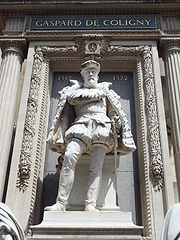
Gaspard de Coligny

Encyclopedia
Gaspard de Coligny Seigneur (Lord) de Châtillon, was a French nobleman and admiral
, best remembered as a disciplined Huguenot
leader in the French Wars of Religion
.
, were in the service of the King of France. His father, Gaspard I de Coligny
, known as the 'Marshal of Châtillon', served in the Italian Wars
from 1494 to 1516, married in 1514, and was created Marshal of France
in 1516. By his wife, Louise de Montmorency
, sister of the future constable
, he had three sons, all of whom played an important part in the first period of the Wars of Religion
: Odet
, Gaspard and François.
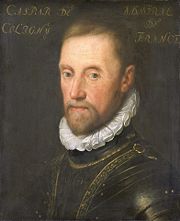 Born at Châtillon-sur-Loing in 1519, Gaspard came to court at the age of 22 and began a friendship with François of Guise. In the campaign of 1543 Coligny distinguished himself, and was wounded at the sieges of Montmédy
and Bains
. In 1544 he served in the Italian campaign under the Count of Enghien, and was knighted on the Field of Ceresole
. Returning to France, he took part in different military operations; and having been made colonel-general of the infantry (April 1547), exhibited great capacity and intelligence as a military reformer.
That year he married Charlotte de Laval
(d. 1568). He was made admiral on the death of Claude d'Annebaut (1552). In 1557 he was entrusted with the defence of Saint-Quentin. In the siege he displayed great courage, resolution, and strength of character; but the place was taken, and he was imprisoned in the stronghold of L'Ecluse. On payment of a ransom of 50,000 crowns he recovered his liberty.
addressed to him is dated 4 September 1558.
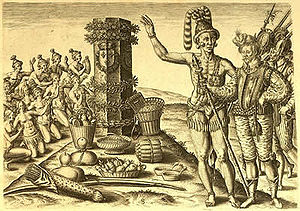 Gaspard de Coligny secretly focused on protecting his co-religionists, by attempting to establish colonies abroad in which Huguenots could find a refuge. He organized the expedition of a colony of Huguenots to Brazil
, under the leadership of his friend and navy colleague, Vice-Admiral Nicolas Durand de Villegaignon
, who established the colony of France Antarctique
in Rio de Janeiro
, in 1555. They were afterwards expelled by the Portuguese, in 1567.
Coligny also was the leading patron for the failed French colony of Fort Caroline
in Spanish Florida
led by Jean Ribault
in 1562.
In 1566 and 1570, Francisque and André d'Albaigne
submitted to Coligny projects for establishing relations with the Austral lands. Although he gave favourable consideration to these initiatives, they came to nought when Coligny was killed in 1572 during the St. Bartholomew's Day massacres.
he placed himself with Louis, Prince of Condé
, at the forefront of the Huguenot party, and demanded religious toleration and certain other reforms. In 1560, at the Assembly of Notables
at Fontainebleau
, the hostility between Coligny and François of Guise broke forth violently. When the civil wars began in 1562, Coligny decided to take arms only after long hesitation, and remained always ready to negotiate. In none of these wars did he show superior genius, but he acted throughout with great prudence and extraordinary tenacity; he was "le héros de la mauvaise fortune" ("hero of misfortune")
In the "first war" of 1562-63 he commanded the cavalry at the Battle of Dreux
, the first major engagement and, unlike both commanders in chief, managed to avoid being captured, and withdrew in good order from the defeat. He was blamed by the Guise faction for the assassination of Francis, Duke of Guise
at Orléans
in 1563.
In the "third war" of 1569 the defeat and death of the Prince of Condé at the Battle of Jarnac
left Coligny the sole leader of the Protestant armies. Victorious at the Battle of La Roche-l'Abeille
, but defeated in the Battle of Moncontour
on October 3rd, he entered into the negotiations for what became the Peace of Saint-Germain (1570). Marrying Jacqueline de Montbel, Countess d'Entremont, and returning to court in 1571, he grew rapidly in favour with Charles IX
, becoming a close mentor to the weak, easily-manipulated King.
As a means of emancipating the king from the tutelage of his mother and the faction of the Guises, the admiral proposed to him a descent on Spanish Flanders
, with an army drawn from both faiths and commanded by Charles in person. The king's regard for the admiral and the increasingly bold demands of the Huguenots alarmed Catherine de' Medici
, the Queen Mother
.
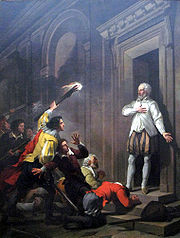
, and Marguerite de Valois
, the King's sister brought a great number of Huguenot notables to Paris, and political and religious tensions were running extremely high. On 22 August 1572, the day after the end of the wedding festivities, Coligny was shot in the street by a man called Maurevert from a house belonging to de Guise. However, the bullets only tore a finger from his right hand and shattered his left elbow. The would-be assassin escaped.
 It never became clear who, if anyone, had hired or encouraged Maurevert to carry out the attempt but historians generally centre on three possibilities: the Guise family, Catherine de Medici, or the duke of Alba
on behalf of Philip II of Spain
. The King sent his own physician
to treat Coligny and even visited him, but the queen mother prevented all private discourse between them.
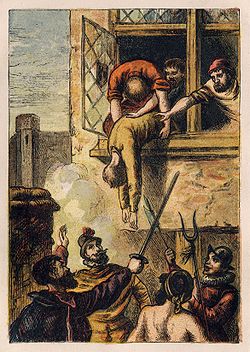
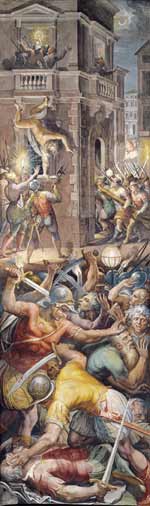
The Catholics now feared Huguenot retaliation for the attempt on Coligny's life, and it was decided to pre-emptively assassinate their leadership, in what became known as the St. Bartholomew's Day massacre. As one of the main targets, on the night of 24 August, Coligny was attacked in his lodgings by a group led by Guise. After several of his entourage had been killed, a servant of the new Duke of Guise, Charles Danowitz or Jean Charles D´Ianowitz (Karel z Janovic), generally known as Besme
or Bême (Noble Family from Bohemia (CZ) Janovský z Janovic), plunged a sword through Coligny's breast and threw his body out of a window to his master's feet. Coligny finally died when another of Guise's associates chopped off his head.
Historian Barbara B. Diefendorf, Professor of History at Boston University
, wrote that Simon Vigor
had "said if the King ordered the Admiral (Coligny) killed, 'it would be wicked not to kill him'. With these words, the most popular preacher in Paris legitimised in advance the events of St. Bartholomew's Day".
Coligny's papers were seized and burned by the queen mother; among them, according to Brantôme
, was a history of the civil war, "very fair and well-written, and worthy of publication".
 By his first wife, Charlotte de Laval
(1530-1568), Gaspard had several children:
By his second wife, Jacqueline de Montbel (1541-1588), the Countess d'Entremont
and Launay-Gelin, Gaspard had one daughter, Beatrice, who became Beatrice de Coligny (b. 1572), Countess d'Entremont.
Admiral of France
The title Admiral of France is one of the Great Officers of the Crown of France, the naval equivalent of Marshal of France.The title was created in 1270 by Louis IX of France, during the Eighth Crusade. At the time it was equivalent to the office of Constable of France. The Admiral was responsible...
, best remembered as a disciplined Huguenot
Huguenot
The Huguenots were members of the Protestant Reformed Church of France during the 16th and 17th centuries. Since the 17th century, people who formerly would have been called Huguenots have instead simply been called French Protestants, a title suggested by their German co-religionists, the...
leader in the French Wars of Religion
French Wars of Religion
The French Wars of Religion is the name given to a period of civil infighting and military operations, primarily fought between French Catholics and Protestants . The conflict involved the factional disputes between the aristocratic houses of France, such as the House of Bourbon and House of Guise...
.
Ancestry
Coligny came of a noble family of Burgundy. His family traced their descent from the 11th century, and in the reign of Louis XILouis XI of France
Louis XI , called the Prudent , was the King of France from 1461 to 1483. He was the son of Charles VII of France and Mary of Anjou, a member of the House of Valois....
, were in the service of the King of France. His father, Gaspard I de Coligny
Gaspard I de Coligny
Gaspard I de Coligny, seigneur de Châtillon , known as the Marshal of Châtillon, was a French soldier. He served in the Italian Wars from 1495 to 1515, and was created Marshal of France in 1516....
, known as the 'Marshal of Châtillon', served in the Italian Wars
Italian Wars
The Italian Wars, often referred to as the Great Italian Wars or the Great Wars of Italy and sometimes as the Habsburg–Valois Wars, were a series of conflicts from 1494 to 1559 that involved, at various times, most of the city-states of Italy, the Papal States, most of the major states of Western...
from 1494 to 1516, married in 1514, and was created Marshal of France
Marshal of France
The Marshal of France is a military distinction in contemporary France, not a military rank. It is granted to generals for exceptional achievements...
in 1516. By his wife, Louise de Montmorency
Louise de Montmorency
Louise de Montmorency was a French noblewoman from the ancient House of Montmorency. She was the younger sister of Anne de Montmorency, Constable of France, and the mother of Gaspard de Coligny, Admiral of France....
, sister of the future constable
Anne de Montmorency
Anne de Montmorency, duc de Montmorency, Honorary Knight of the Garter was a French soldier, statesman and diplomat. He became Marshal of France and Constable of France.-Early life:...
, he had three sons, all of whom played an important part in the first period of the Wars of Religion
French Wars of Religion
The French Wars of Religion is the name given to a period of civil infighting and military operations, primarily fought between French Catholics and Protestants . The conflict involved the factional disputes between the aristocratic houses of France, such as the House of Bourbon and House of Guise...
: Odet
Odet de Coligny
Odet de Coligny was a French cardinal of Châtillon, bishop of Beauvais, son of Gaspard I de Coligny and Louise de Montmorency, and brother of Gaspard and François, Seigneur d'Andelot.-Birth:...
, Gaspard and François.
Early life
Montmédy
Montmédy is a commune in the Meuse department in Lorraine in north-eastern France.-Citadel of Montmédy:In 1221 the first castle of Montmédy was built on top of a hill by the Count of Chiny. Montmédy became soon the capital of his territory - later it belonged to Luxembourg, Burgundy, Austria and...
and Bains
Bains, Haute-Loire
Bains is a commune in the Haute-Loire department in south-central France.-See also:*Communes of the Haute-Loire department...
. In 1544 he served in the Italian campaign under the Count of Enghien, and was knighted on the Field of Ceresole
Battle of Ceresole
The Battle of Ceresole was an encounter between a French army and the combined forces of Spain and the Holy Roman Empire during the Italian War of 1542–46...
. Returning to France, he took part in different military operations; and having been made colonel-general of the infantry (April 1547), exhibited great capacity and intelligence as a military reformer.
That year he married Charlotte de Laval
Charlotte de Laval
Charlotte de Laval, Dame de Châtillon , was a French noblewoman from one of the most powerful families in Brittany. She was the first wife of Gaspard de Coligny, Seigneur de Châtillon, Admiral of France and a prominent Huguenot leader during the French Wars of Religion. She was the mother of Louise...
(d. 1568). He was made admiral on the death of Claude d'Annebaut (1552). In 1557 he was entrusted with the defence of Saint-Quentin. In the siege he displayed great courage, resolution, and strength of character; but the place was taken, and he was imprisoned in the stronghold of L'Ecluse. On payment of a ransom of 50,000 crowns he recovered his liberty.
Protestant leader
By this time he had become a Huguenot, through the influence of his brother, d'Andelot. The first known letter which John CalvinJohn Calvin
John Calvin was an influential French theologian and pastor during the Protestant Reformation. He was a principal figure in the development of the system of Christian theology later called Calvinism. Originally trained as a humanist lawyer, he broke from the Roman Catholic Church around 1530...
addressed to him is dated 4 September 1558.
Establishment of Huguenot colonies
Brazil
Brazil , officially the Federative Republic of Brazil , is the largest country in South America. It is the world's fifth largest country, both by geographical area and by population with over 192 million people...
, under the leadership of his friend and navy colleague, Vice-Admiral Nicolas Durand de Villegaignon
Nicolas Durand de Villegaignon
Nicolas Durand, sieur de Villegaignon, also Villegagnon was a Commander of the Knights of Malta, and later a French naval officer who attempted to help the Huguenots in France escape persecution.A notable public figure in his time, Villegaignon was a mixture of soldier,...
, who established the colony of France Antarctique
France Antarctique
France Antarctique was a French colony south of the Equator, in Rio de Janeiro, Brazil, which existed between 1555 and 1567, and had control over the coast from Rio de Janeiro to Cabo Frio...
in Rio de Janeiro
Rio de Janeiro
Rio de Janeiro , commonly referred to simply as Rio, is the capital city of the State of Rio de Janeiro, the second largest city of Brazil, and the third largest metropolitan area and agglomeration in South America, boasting approximately 6.3 million people within the city proper, making it the 6th...
, in 1555. They were afterwards expelled by the Portuguese, in 1567.
Coligny also was the leading patron for the failed French colony of Fort Caroline
Fort Caroline
Fort Caroline was the first French colony in the present-day United States. Established in what is now Jacksonville, Florida, on June 22, 1564, under the leadership of René Goulaine de Laudonnière, it was intended as a refuge for the Huguenots. It lasted one year before being obliterated by the...
in Spanish Florida
Spanish Florida
Spanish Florida refers to the Spanish territory of Florida, which formed part of the Captaincy General of Cuba, the Viceroyalty of New Spain, and the Spanish Empire. Originally extending over what is now the southeastern United States, but with no defined boundaries, la Florida was a component of...
led by Jean Ribault
Jean Ribault
Jean Ribault was a French naval officer, navigator, and a colonizer of what would become the southeastern United States. He was a major figure in the French attempts to colonize Florida...
in 1562.
In 1566 and 1570, Francisque and André d'Albaigne
André d'Albaigne
Francisque and André d’Albaigne were 16th-century Italian merchants from the city of Lucca. Their name was Dalbagnio, according to a notary act of 1567 involving their brother Pellegrino .-d'Albaigne proposal to colonize Terra Australis:-Francisque d’Albaigne :From Lisbon Francisque and André...
submitted to Coligny projects for establishing relations with the Austral lands. Although he gave favourable consideration to these initiatives, they came to nought when Coligny was killed in 1572 during the St. Bartholomew's Day massacres.
National conflicts
Following the death of Henry IIHenry II of France
Henry II was King of France from 31 March 1547 until his death in 1559.-Early years:Henry was born in the royal Château de Saint-Germain-en-Laye, near Paris, the son of Francis I and Claude, Duchess of Brittany .His father was captured at the Battle of Pavia in 1525 by his sworn enemy,...
he placed himself with Louis, Prince of Condé
Louis I de Bourbon, prince de Condé
Louis de Bourbon was a prominent Huguenot leader and general, the founder of the House of Condé, a cadet branch of the House of Bourbon.-Life:...
, at the forefront of the Huguenot party, and demanded religious toleration and certain other reforms. In 1560, at the Assembly of Notables
Assembly of Notables
The Assembly of Notables was a group of notables invited by the King of France to consult on matters of state.-History:Assemblies of Notables had met in 1583, 1596–97, 1617, 1626, 1787, and 1788. Like the Estates General, they served a consultative purpose only...
at Fontainebleau
Fontainebleau
Fontainebleau is a commune in the metropolitan area of Paris, France. It is located south-southeast of the centre of Paris. Fontainebleau is a sub-prefecture of the Seine-et-Marne department, and it is the seat of the arrondissement of Fontainebleau...
, the hostility between Coligny and François of Guise broke forth violently. When the civil wars began in 1562, Coligny decided to take arms only after long hesitation, and remained always ready to negotiate. In none of these wars did he show superior genius, but he acted throughout with great prudence and extraordinary tenacity; he was "le héros de la mauvaise fortune" ("hero of misfortune")
In the "first war" of 1562-63 he commanded the cavalry at the Battle of Dreux
Battle of Dreux
The Battle of Dreux was fought on 19 December 1562 between Catholics and Huguenots. The Catholics were led by Anne de Montmorency while Louis I, Prince of Condé led the Huguenots....
, the first major engagement and, unlike both commanders in chief, managed to avoid being captured, and withdrew in good order from the defeat. He was blamed by the Guise faction for the assassination of Francis, Duke of Guise
Francis, Duke of Guise
Francis de Lorraine II, Prince of Joinville, Duke of Guise, Duke of Aumale , called Balafré , was a French soldier and politician.-Early life:...
at Orléans
Orléans
-Prehistory and Roman:Cenabum was a Gallic stronghold, one of the principal towns of the Carnutes tribe where the Druids held their annual assembly. It was conquered and destroyed by Julius Caesar in 52 BC, then rebuilt under the Roman Empire...
in 1563.
In the "third war" of 1569 the defeat and death of the Prince of Condé at the Battle of Jarnac
Battle of Jarnac
The Battle of Jarnac on 13 March 1569 was an encounter during the French Wars of Religion between the Catholic forces of Marshal Gaspard de Saulx, sieur de Tavannes, and the Huguenots, near the nadir of their fortunes, financed by Reinhold von Krockow and led by Louis I de Bourbon, prince de...
left Coligny the sole leader of the Protestant armies. Victorious at the Battle of La Roche-l'Abeille
Battle of La Roche-l'Abeille
The Battle of La Roche-l'Abeille occurred on 25 June 1569 between the Catholic forces of King Charles IX of France commanded by the Duke d’Anjou and the Huguenots commanded by the Admiral de Coligny during the "Third War" of the French Wars of Religion.-Background:The Third War of Religion saw an...
, but defeated in the Battle of Moncontour
Battle of Moncontour
The Battle of Moncontour occurred on 3 October 1569 between the Catholic forces of King Charles IX of France and the Huguenots during the "Third War" of the French Wars of Religion.-The battle:...
on October 3rd, he entered into the negotiations for what became the Peace of Saint-Germain (1570). Marrying Jacqueline de Montbel, Countess d'Entremont, and returning to court in 1571, he grew rapidly in favour with Charles IX
Charles IX of France
Charles IX was King of France, ruling from 1560 until his death. His reign was dominated by the Wars of Religion. He is best known as king at the time of the St. Bartholomew's Day Massacre.-Childhood:...
, becoming a close mentor to the weak, easily-manipulated King.
As a means of emancipating the king from the tutelage of his mother and the faction of the Guises, the admiral proposed to him a descent on Spanish Flanders
Southern Netherlands
Southern Netherlands were a part of the Low Countries controlled by Spain , Austria and annexed by France...
, with an army drawn from both faiths and commanded by Charles in person. The king's regard for the admiral and the increasingly bold demands of the Huguenots alarmed Catherine de' Medici
Catherine de' Medici
Catherine de' Medici was an Italian noblewoman who was Queen consort of France from 1547 until 1559, as the wife of King Henry II of France....
, the Queen Mother
Queen mother
Queen Mother is a title or position reserved for a widowed queen consort whose son or daughter from that marriage is the reigning monarch. The term has been used in English since at least 1577...
.
Assassination and massacre
The wedding of the Protestant Henry, King of NavarreHenry IV of France
Henry IV , Henri-Quatre, was King of France from 1589 to 1610 and King of Navarre from 1572 to 1610. He was the first monarch of the Bourbon branch of the Capetian dynasty in France....
, and Marguerite de Valois
Marguerite de Valois
Margaret of Valois was Queen of France and of Navarre during the late sixteenth century...
, the King's sister brought a great number of Huguenot notables to Paris, and political and religious tensions were running extremely high. On 22 August 1572, the day after the end of the wedding festivities, Coligny was shot in the street by a man called Maurevert from a house belonging to de Guise. However, the bullets only tore a finger from his right hand and shattered his left elbow. The would-be assassin escaped.
Fernando Álvarez de Toledo, 3rd Duke of Alba
Don Fernando Álvarez de Toledo y Pimentel, 3rd Duke of Alba was a Spanish general and governor of the Spanish Netherlands , nicknamed "the Iron Duke" in the Low Countries because of his harsh and cruel rule there and his role in the execution of his political opponents and the massacre of several...
on behalf of Philip II of Spain
Philip II of Spain
Philip II was King of Spain, Portugal, Naples, Sicily, and, while married to Mary I, King of England and Ireland. He was lord of the Seventeen Provinces from 1556 until 1581, holding various titles for the individual territories such as duke or count....
. The King sent his own physician
Physician
A physician is a health care provider who practices the profession of medicine, which is concerned with promoting, maintaining or restoring human health through the study, diagnosis, and treatment of disease, injury and other physical and mental impairments...
to treat Coligny and even visited him, but the queen mother prevented all private discourse between them.
The Catholics now feared Huguenot retaliation for the attempt on Coligny's life, and it was decided to pre-emptively assassinate their leadership, in what became known as the St. Bartholomew's Day massacre. As one of the main targets, on the night of 24 August, Coligny was attacked in his lodgings by a group led by Guise. After several of his entourage had been killed, a servant of the new Duke of Guise, Charles Danowitz or Jean Charles D´Ianowitz (Karel z Janovic), generally known as Besme
Besme
Besme, real name apparently Charles Dianovitz, was a Bohemian in the pay of the Duke of Guise, is recorded as the assassin of Protestant leader Gaspard de Coligny in 1571, using either a dagger or a "big sword". The assassin group called itself Picards de Bohème.- External links :* *...
or Bême (Noble Family from Bohemia (CZ) Janovský z Janovic), plunged a sword through Coligny's breast and threw his body out of a window to his master's feet. Coligny finally died when another of Guise's associates chopped off his head.
Historian Barbara B. Diefendorf, Professor of History at Boston University
Boston University
Boston University is a private research university located in Boston, Massachusetts. With more than 4,000 faculty members and more than 31,000 students, Boston University is one of the largest private universities in the United States and one of Boston's largest employers...
, wrote that Simon Vigor
Simon Vigor
Simon Vigor was a French Catholic bishop and controversialist.-Life:...
had "said if the King ordered the Admiral (Coligny) killed, 'it would be wicked not to kill him'. With these words, the most popular preacher in Paris legitimised in advance the events of St. Bartholomew's Day".
Coligny's papers were seized and burned by the queen mother; among them, according to Brantôme
Pierre de Bourdeille, seigneur de Brantôme
Pierre de Bourdeille, seigneur de Brantôme was a French historian, soldier and biographer.-Life:Brantôme was born in Périgord, Aquitaine, the third son of the baron de Bourdeille...
, was a history of the civil war, "very fair and well-written, and worthy of publication".
Marriages and issue
Charlotte de Laval
Charlotte de Laval, Dame de Châtillon , was a French noblewoman from one of the most powerful families in Brittany. She was the first wife of Gaspard de Coligny, Seigneur de Châtillon, Admiral of France and a prominent Huguenot leader during the French Wars of Religion. She was the mother of Louise...
(1530-1568), Gaspard had several children:
- LouiseLouise de ColignyLouise de Coligny was the daughter of Gaspard de Coligny and Charlotte de Laval and the fourth and last spouse of William the Silent.-Biography:...
, who married first Charles de TélignyCharles de Téligny-Biography:De Téligny belonged to a respected Huguenot family of Rouerque, and received an excellent training in letters and arms at the house of Gaspard de Coligny....
and afterwards William the Silent, Prince of Orange; - FrançoisFrançois de ColignyFrançois de Coligny comte de Coligny and seigeur de Châtillon-sur-Loing was a French Protestant general of the Wars of Religion. He was the son of Gaspard II de Coligny , Admiral of France .-Military career:...
, Admiral of Guienne, who was one of the devoted servants of Henry IV (Gaspard de Coligny (1584–1646), son of this François, was Marshal of France during the reign of Louis XIIILouis XIII of FranceLouis XIII was a Bourbon monarch who ruled as King of France and of Navarre from 1610 to 1643.Louis was only eight years old when he succeeded his father. His mother, Marie de Medici, acted as regent during Louis' minority...
); and - Charles (1564-1632), MarquisMarquisMarquis is a French and Scottish title of nobility. The English equivalent is Marquess, while in German, it is Markgraf.It may also refer to:Persons:...
d'Andelot, a Lieutenant General in Champagne.
By his second wife, Jacqueline de Montbel (1541-1588), the Countess d'Entremont
Entremont
Entremont may refer to:*Entremont, Haute-Savoie, a municipality of the Haute-Savoie département in France*Entremont , a district of the canton of Valais in Switzerland and was a canton of the former Simplon département of the French Empire...
and Launay-Gelin, Gaspard had one daughter, Beatrice, who became Beatrice de Coligny (b. 1572), Countess d'Entremont.
Legacy
Several places are named after de Coligny:- Coligny, South Africa
- Fort ColignyFort ColignyFort Coligny was a fortress founded by Nicolas Durand de Villegaignon in Rio de Janeiro, Brazil in 1555, in what constituted the so-called France Antarctique historical episode....
, in Rio de Janeiro, Brazil - Châtillon-ColignyChâtillon-ColignyChâtillon-Coligny is a commune in the Loiret department in north-central France.The Loing and the Briare Canal run through the town.-See also:*Communes of the Loiret department*Raynald of Châtillon...
, in FranceFranceThe French Republic , The French Republic , The French Republic , (commonly known as France , is a unitary semi-presidential republic in Western Europe with several overseas territories and islands located on other continents and in the Indian, Pacific, and Atlantic oceans. Metropolitan France... - Coligny Plaza, Hilton Head Island
Family tree
Sources
- GeneaNet Genealogical database
- L'Amiral Coligny, Martyr Huguenot: Sermon par Alfred V. Wittmeyer bilingual commemorative sermon from 1925
- Encyclopedia Britannica