

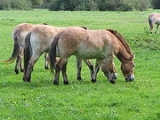
Wild Horse

Encyclopedia
The wild horse is a species
of the genus
Equus
, which includes as subspecies
the domesticated horse
as well as the undomesticated Tarpan
and Przewalski's Horse
. The Tarpan became extinct in the 19th century, and Przewalski's Horse was saved from the brink of extinction and reintroduced successfully to the wild. The possible ancestor of the domestic horse was the Tarpan, which roamed the steppes of Eurasia at the time of domestication. However, other subspecies of Equus ferus may have existed and could have been the stock from which domesticated horses are descended. Since the extinction of the Tarpan, attempts have been made to reconstruct the phenotype
of the Tarpan, resulting in horse breeds such as the Konik
and Heck horse
. However, the genetic makeup and foundation bloodstock
of those breeds is substantially derived from domesticated horses, and therefore these breeds possess domesticated traits.
The term "wild horse" is also used colloquially
to refer to free roaming herds of feral horse
s such as the Mustang
in the United States, the Brumby
in Australia, and many others. These feral horses are untamed members of the domestic horse subspecies (Equus ferus caballus), and should not be confused with the two truly "wild" horse subspecies.
These are the only two never-domesticated "wild" groups that survived into historic times. However, other subspecies of Equus ferus may have existed and could have been the stock from which domesticated horses are descended.
to Mongolia
, although the ancient border between Tarpan and Przewalski distributions has not been clearly defined. Przewalski's Horse was limited to Dzungaria
and western Mongolia
in the same period, became extinct in the wild during the 1960s, but was re-introduced in the late 1980s to two preserves in Mongolia. Although researchers such as Marija Gimbutas
theorized that the horses of the Chalcolithic period were Przewalski's, more recent genetic studies indicate that Przewalski's Horse is not an ancestor to modern domesticated horses.
Przewalski's Horse is still found today, though it is an endangered species
and for a time was considered extinct in the wild. Roughly 1500 Przewalski's Horses are protected in zoo
s around the world. A small breeding population has been reintroduced in Mongolia
. As of 2005, a cooperative venture between the Zoological Society of London and Mongolian Scientists has resulted in a free-ranging population of 248 animals in the wild.
Przewalski's Horse has some biological differences from the domestic horse
; unlike domesticated horses and the Tarpan, which both have 64 chromosome
s, Przewalski's Horse has 66 chromosomes due to a Robertsonian translocation
. However, the offspring of Przewalski and domestic horses are fertile, possessing 65 chromosomes.
and the genus Equus evolved in North America, before the species moved into the Eastern Hemisphere. Studies using ancient DNA
as well as DNA of recent individuals, shows the presence of two closely related horse species in North America, the Wild Horse and the "New World stilt-legged horse;" the latter is taxonomically assigned to various names.
Currently, three subspecies that lived during recorded human history are recognized. One subspecies is the widespread domestic horse (Equus ferus caballus), as well as two wild subspecies, the recently-extinct Tarpan
(Equus ferus ferus) and the endangered Przewalski's Horse
(Equus ferus przewalskii).
Genetically, the pre-domestication horse, Equus ferus ferus, and domesticated horse, Equus ferus caballus, form a single homogeneous group (clade
) and are genetically indistinguishable from each other.
The genetic variation within this clade shows only a limited regional variation, with a notable exception of Przewalski's Horse. Przewalski's Horse has several unique genetic differences that distinguishes it from the other subspecies, including 66 instead of 64 chromosomes,
unique Y-chromosome gene haplotypes,
and unique mtDNA haplotypes.
Besides genetic differences, osteological evidence from across the Eurasian wild horse range, based on cranial and metacarpal differences, indicates the presence of only two subspecies in post-glacial times, the Tarpan and Przewalski's Horse.
, which stipulates that the oldest available valid scientific name is used to name the species. Previously, when taxonomists considered domesticated and wild horse two subspecies of the same species, the valid scientific name was Equus caballus Linnaeus 1758 , with the subspecies labeled Equus caballus caballus (domesticated horse), Equus caballus ferus Boddaert, 1785 (tarpan) and Equus caballus przewalskii Poliakov, 1881 (Przewalski's Horse). However, in 2003, the International Commission on Zoological Nomenclature
decided that the scientific names of the wild species have priority over the scientific names of domesticated species, therefore mandating the use of Equus ferus for the horse, independent of the position of the domesticated horse.
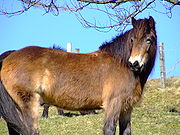
Horses that live in an untamed state but have ancestors who have been domesticated
are not truly "wild" horses; they are feral horses. For example, when Europeans reintroduced the horse to the Americas beginning in the late 15th century, some horses escaped and formed feral
herds, the best-known being the Mustang
. The Australian equivalent to the Mustang is the Brumby
, descended from horses strayed or let loose in Australia by English settlers. There are isolated populations of feral horses in a number of places, including Portugal
, Scotland
, and a number of barrier island
s along the Atlantic coast of North America from Sable Island
off Nova Scotia, to the Shackleford Banks
of North Carolina. While these are often referred to as "wild" horses, they are not truly "wild" in the biological sense of having no domesticated ancestors.
of Tibet
, unknown to the rest of the world, but apparently used by the local Khamba
people. It was speculated that the Riwoche horse
might be a relict
population of wild horses, but testing did not reveal genetic differences with domesticated horses, which is in line with news reports indicating that they are used as pack and riding animals by the local villagers. These horses only stand tall and are said to resemble the images known as "horse no 2" depicted in cave paintings alongside images of Przewalski's horse.
Species
In biology, a species is one of the basic units of biological classification and a taxonomic rank. A species is often defined as a group of organisms capable of interbreeding and producing fertile offspring. While in many cases this definition is adequate, more precise or differing measures are...
of the genus
Genus
In biology, a genus is a low-level taxonomic rank used in the biological classification of living and fossil organisms, which is an example of definition by genus and differentia...
Equus
Equus (genus)
Equus is a genus of animals in the family Equidae that includes horses, donkeys, and zebras. Within Equidae, Equus is the only extant genus. Like Equidae more broadly, Equus has numerous extinct species known only from fossils. This article deals primarily with the extant species.The term equine...
, which includes as subspecies
Subspecies
Subspecies in biological classification, is either a taxonomic rank subordinate to species, ora taxonomic unit in that rank . A subspecies cannot be recognized in isolation: a species will either be recognized as having no subspecies at all or two or more, never just one...
the domesticated horse
Horse
The horse is one of two extant subspecies of Equus ferus, or the wild horse. It is a single-hooved mammal belonging to the taxonomic family Equidae. The horse has evolved over the past 45 to 55 million years from a small multi-toed creature into the large, single-toed animal of today...
as well as the undomesticated Tarpan
Tarpan
Tarpan is an extinct subspecies of wild horse. The last individual of this subspecies died in captivity in Russia in 1909....
and Przewalski's Horse
Przewalski's Horse
Przewalski's Horse or Dzungarian Horse, is a rare and endangered subspecies of wild horse native to the steppes of central Asia, specifically China and Mongolia.At one time extinct in the wild, it has been reintroduced to its native habitat in Mongolia at the Khustain Nuruu...
. The Tarpan became extinct in the 19th century, and Przewalski's Horse was saved from the brink of extinction and reintroduced successfully to the wild. The possible ancestor of the domestic horse was the Tarpan, which roamed the steppes of Eurasia at the time of domestication. However, other subspecies of Equus ferus may have existed and could have been the stock from which domesticated horses are descended. Since the extinction of the Tarpan, attempts have been made to reconstruct the phenotype
Phenotype
A phenotype is an organism's observable characteristics or traits: such as its morphology, development, biochemical or physiological properties, behavior, and products of behavior...
of the Tarpan, resulting in horse breeds such as the Konik
Konik
The Konik or Polish primitive horse is a small horse, a kind of semi-feral horse, originating in Poland. The Polish word konik is the diminutive of koń, the Polish word for "horse" . However, the name "konik" or "Polish konik" is used to refer to certain specific breeds...
and Heck horse
Heck horse
Heck horse is a horse breed that resembles the extinct wild equine, the Tarpan, . The breed was created by the German zoologist brothers Heinz Heck and Lutz Heck, director of the Berlin Zoo, at the Tierpark Hellabrunn in Germany in their attempt to breed back the tarpan...
. However, the genetic makeup and foundation bloodstock
Foundation bloodstock
Foundation bloodstock or foundation stock are horses that are the progenitor, or foundation, of a new horse breed or a given bloodline within a breed. The term is also used in a similar manner when discussing purebred dogs...
of those breeds is substantially derived from domesticated horses, and therefore these breeds possess domesticated traits.
The term "wild horse" is also used colloquially
Colloquialism
A colloquialism is a word or phrase that is common in everyday, unconstrained conversation rather than in formal speech, academic writing, or paralinguistics. Dictionaries often display colloquial words and phrases with the abbreviation colloq. as an identifier...
to refer to free roaming herds of feral horse
Feral horse
A feral horse is a free-roaming horse of domesticated ancestry. As such, a feral horse is not a wild animal in the sense of an animal without domesticated ancestors. However, some populations of feral horses are managed as wildlife, and these horses often are popularly called "wild" horses...
s such as the Mustang
Mustang (horse)
A Mustang is a free-roaming horse of the North American west that first descended from horses brought to the Americas by the Spanish. Mustangs are often referred to as wild horses, but there is intense debate over terminology...
in the United States, the Brumby
Brumby
A Brumby is a free-roaming feral horse in Australia. Although found in many areas around the country, the best-known brumbies are found in the Australian Alps region in south-eastern Australia. Today, most of them are found in the Northern Territory, with the second largest population in Queensland...
in Australia, and many others. These feral horses are untamed members of the domestic horse subspecies (Equus ferus caballus), and should not be confused with the two truly "wild" horse subspecies.
Subspecies and their history
E. ferus had several subspecies. Three survived into modern times:- The Domestic horseHorseThe horse is one of two extant subspecies of Equus ferus, or the wild horse. It is a single-hooved mammal belonging to the taxonomic family Equidae. The horse has evolved over the past 45 to 55 million years from a small multi-toed creature into the large, single-toed animal of today...
(Equus ferus caballus). - The TarpanTarpanTarpan is an extinct subspecies of wild horse. The last individual of this subspecies died in captivity in Russia in 1909....
or Eurasian Wild Horse (Equus ferus ferus), once native to EuropeEuropeEurope is, by convention, one of the world's seven continents. Comprising the westernmost peninsula of Eurasia, Europe is generally 'divided' from Asia to its east by the watershed divides of the Ural and Caucasus Mountains, the Ural River, the Caspian and Black Seas, and the waterways connecting...
and western Asia. The Tarpan became effectively extinct in the late 19th century, and the last specimen died in captivity in a UkraineUkraineUkraine is a country in Eastern Europe. It has an area of 603,628 km², making it the second largest contiguous country on the European continent, after Russia...
zoo in 1918 or 1919. - Przewalski's HorsePrzewalski's HorsePrzewalski's Horse or Dzungarian Horse, is a rare and endangered subspecies of wild horse native to the steppes of central Asia, specifically China and Mongolia.At one time extinct in the wild, it has been reintroduced to its native habitat in Mongolia at the Khustain Nuruu...
(Equus ferus przewalskii), also known as the Mongolian Wild Horse or Takhi, native to Central Asia and the Gobi DesertGobi DesertThe Gobi is a large desert region in Asia. It covers parts of northern and northwestern China, and of southern Mongolia. The desert basins of the Gobi are bounded by the Altai Mountains and the grasslands and steppes of Mongolia on the north, by the Hexi Corridor and Tibetan Plateau to the...
.
These are the only two never-domesticated "wild" groups that survived into historic times. However, other subspecies of Equus ferus may have existed and could have been the stock from which domesticated horses are descended.
Przewalski's Horse
Przewalski's Horse occupied the eastern Eurasian steppes, perhaps from the UralsUral Mountains
The Ural Mountains , or simply the Urals, are a mountain range that runs approximately from north to south through western Russia, from the coast of the Arctic Ocean to the Ural River and northwestern Kazakhstan. Their eastern side is usually considered the natural boundary between Europe and Asia...
to Mongolia
Mongolia
Mongolia is a landlocked country in East and Central Asia. It is bordered by Russia to the north and China to the south, east and west. Although Mongolia does not share a border with Kazakhstan, its western-most point is only from Kazakhstan's eastern tip. Ulan Bator, the capital and largest...
, although the ancient border between Tarpan and Przewalski distributions has not been clearly defined. Przewalski's Horse was limited to Dzungaria
Dzungaria
Dzungaria, also called Zungaria, is a geographical region in northwest China corresponding to the northern half of Xinjiang. It covers approximately , lying mostly within Xinjiang, and extending into western Mongolia and eastern Kazakhstan...
and western Mongolia
Mongolia
Mongolia is a landlocked country in East and Central Asia. It is bordered by Russia to the north and China to the south, east and west. Although Mongolia does not share a border with Kazakhstan, its western-most point is only from Kazakhstan's eastern tip. Ulan Bator, the capital and largest...
in the same period, became extinct in the wild during the 1960s, but was re-introduced in the late 1980s to two preserves in Mongolia. Although researchers such as Marija Gimbutas
Marija Gimbutas
Marija Gimbutas , was a Lithuanian-American archeologist known for her research into the Neolithic and Bronze Age cultures of "Old Europe", a term she introduced. Her works published between 1946 and 1971 introduced new views by combining traditional spadework with linguistics and mythological...
theorized that the horses of the Chalcolithic period were Przewalski's, more recent genetic studies indicate that Przewalski's Horse is not an ancestor to modern domesticated horses.
Przewalski's Horse is still found today, though it is an endangered species
Endangered species
An endangered species is a population of organisms which is at risk of becoming extinct because it is either few in numbers, or threatened by changing environmental or predation parameters...
and for a time was considered extinct in the wild. Roughly 1500 Przewalski's Horses are protected in zoo
Zoo
A zoological garden, zoological park, menagerie, or zoo is a facility in which animals are confined within enclosures, displayed to the public, and in which they may also be bred....
s around the world. A small breeding population has been reintroduced in Mongolia
Mongolia
Mongolia is a landlocked country in East and Central Asia. It is bordered by Russia to the north and China to the south, east and west. Although Mongolia does not share a border with Kazakhstan, its western-most point is only from Kazakhstan's eastern tip. Ulan Bator, the capital and largest...
. As of 2005, a cooperative venture between the Zoological Society of London and Mongolian Scientists has resulted in a free-ranging population of 248 animals in the wild.
Przewalski's Horse has some biological differences from the domestic horse
Horse
The horse is one of two extant subspecies of Equus ferus, or the wild horse. It is a single-hooved mammal belonging to the taxonomic family Equidae. The horse has evolved over the past 45 to 55 million years from a small multi-toed creature into the large, single-toed animal of today...
; unlike domesticated horses and the Tarpan, which both have 64 chromosome
Chromosome
A chromosome is an organized structure of DNA and protein found in cells. It is a single piece of coiled DNA containing many genes, regulatory elements and other nucleotide sequences. Chromosomes also contain DNA-bound proteins, which serve to package the DNA and control its functions.Chromosomes...
s, Przewalski's Horse has 66 chromosomes due to a Robertsonian translocation
Robertsonian translocation
Robertsonian translocation is a common form of chromosomal rearrangement that in humans occurs in the five acrocentric chromosome pairs, namely 13, 14, 15, 21, and 22. Other translocations occur but do not lead to a viable fetus. They are named after the American biologist William Rees Brebner...
. However, the offspring of Przewalski and domestic horses are fertile, possessing 65 chromosomes.
Evolution and taxonomy
The horse family EquidaeEquidae
Equidae is the taxonomic family of horses and related animals, including the extant horses, donkeys, and zebras, and many other species known only from fossils. All extant species are in the genus Equus...
and the genus Equus evolved in North America, before the species moved into the Eastern Hemisphere. Studies using ancient DNA
Ancient DNA
Ancient DNA is DNA isolated from ancient specimens. It can be also loosely described as any DNA recovered from biological samples that have not been preserved specifically for later DNA analyses...
as well as DNA of recent individuals, shows the presence of two closely related horse species in North America, the Wild Horse and the "New World stilt-legged horse;" the latter is taxonomically assigned to various names.
Currently, three subspecies that lived during recorded human history are recognized. One subspecies is the widespread domestic horse (Equus ferus caballus), as well as two wild subspecies, the recently-extinct Tarpan
Tarpan
Tarpan is an extinct subspecies of wild horse. The last individual of this subspecies died in captivity in Russia in 1909....
(Equus ferus ferus) and the endangered Przewalski's Horse
Przewalski's Horse
Przewalski's Horse or Dzungarian Horse, is a rare and endangered subspecies of wild horse native to the steppes of central Asia, specifically China and Mongolia.At one time extinct in the wild, it has been reintroduced to its native habitat in Mongolia at the Khustain Nuruu...
(Equus ferus przewalskii).
Genetically, the pre-domestication horse, Equus ferus ferus, and domesticated horse, Equus ferus caballus, form a single homogeneous group (clade
Clade
A clade is a group consisting of a species and all its descendants. In the terms of biological systematics, a clade is a single "branch" on the "tree of life". The idea that such a "natural group" of organisms should be grouped together and given a taxonomic name is central to biological...
) and are genetically indistinguishable from each other.
The genetic variation within this clade shows only a limited regional variation, with a notable exception of Przewalski's Horse. Przewalski's Horse has several unique genetic differences that distinguishes it from the other subspecies, including 66 instead of 64 chromosomes,
unique Y-chromosome gene haplotypes,
and unique mtDNA haplotypes.
Besides genetic differences, osteological evidence from across the Eurasian wild horse range, based on cranial and metacarpal differences, indicates the presence of only two subspecies in post-glacial times, the Tarpan and Przewalski's Horse.
Scientific naming of the species
At present, the domesticated and wild horses are considered a single species, with the valid scientific name for the horse species being Equus ferus. The wild Tarpan subspecies is Equus ferus ferus, Przewalski's Horse is Equus ferus przewalskii, and the domesticated horse is Equus ferus caballus. The rules for the scientific naming of animal species are determined in the International Code of Zoological NomenclatureInternational Code of Zoological Nomenclature
The International Code of Zoological Nomenclature is a widely accepted convention in zoology that rules the formal scientific naming of organisms treated as animals...
, which stipulates that the oldest available valid scientific name is used to name the species. Previously, when taxonomists considered domesticated and wild horse two subspecies of the same species, the valid scientific name was Equus caballus Linnaeus 1758 , with the subspecies labeled Equus caballus caballus (domesticated horse), Equus caballus ferus Boddaert, 1785 (tarpan) and Equus caballus przewalskii Poliakov, 1881 (Przewalski's Horse). However, in 2003, the International Commission on Zoological Nomenclature
International Commission on Zoological Nomenclature
The International Commission on Zoological Nomenclature is an organization dedicated to "achieving stability and sense in the scientific naming of animals". Founded in 1895, it currently comprises 28 members from 20 countries, mainly practicing zoological taxonomists...
decided that the scientific names of the wild species have priority over the scientific names of domesticated species, therefore mandating the use of Equus ferus for the horse, independent of the position of the domesticated horse.
Difference from feral horses
Horses that live in an untamed state but have ancestors who have been domesticated
Domestication of the horse
There are a number of hypotheses on many of the key issues regarding the domestication of the horse. Although horses appeared in Paleolithic cave art as early as 30,000 BCE, these were truly wild horses and were probably hunted for meat. How and when horses became domesticated is disputed...
are not truly "wild" horses; they are feral horses. For example, when Europeans reintroduced the horse to the Americas beginning in the late 15th century, some horses escaped and formed feral
Feral
A feral organism is one that has changed from being domesticated to being wild or untamed. In the case of plants it is a movement from cultivated to uncultivated or controlled to volunteer. The introduction of feral animals or plants to their non-native regions, like any introduced species, may...
herds, the best-known being the Mustang
Mustang (horse)
A Mustang is a free-roaming horse of the North American west that first descended from horses brought to the Americas by the Spanish. Mustangs are often referred to as wild horses, but there is intense debate over terminology...
. The Australian equivalent to the Mustang is the Brumby
Brumby
A Brumby is a free-roaming feral horse in Australia. Although found in many areas around the country, the best-known brumbies are found in the Australian Alps region in south-eastern Australia. Today, most of them are found in the Northern Territory, with the second largest population in Queensland...
, descended from horses strayed or let loose in Australia by English settlers. There are isolated populations of feral horses in a number of places, including Portugal
Portugal
Portugal , officially the Portuguese Republic is a country situated in southwestern Europe on the Iberian Peninsula. Portugal is the westernmost country of Europe, and is bordered by the Atlantic Ocean to the West and South and by Spain to the North and East. The Atlantic archipelagos of the...
, Scotland
Scotland
Scotland is a country that is part of the United Kingdom. Occupying the northern third of the island of Great Britain, it shares a border with England to the south and is bounded by the North Sea to the east, the Atlantic Ocean to the north and west, and the North Channel and Irish Sea to the...
, and a number of barrier island
Barrier island
Barrier islands, a coastal landform and a type of barrier system, are relatively narrow strips of sand that parallel the mainland coast. They usually occur in chains, consisting of anything from a few islands to more than a dozen...
s along the Atlantic coast of North America from Sable Island
Sable Island
Sable Island is a small Canadian island situated 300 km southeast of mainland Nova Scotia in the Atlantic Ocean. The island is a year-round home to approximately five people...
off Nova Scotia, to the Shackleford Banks
Shackleford Banks
Shackleford Banks is a barrier island system on the coast of Carteret County, North Carolina. It contains a herd of feral horses, scallop, crabs and various sea animals, including summer nesting by loggerhead turtles...
of North Carolina. While these are often referred to as "wild" horses, they are not truly "wild" in the biological sense of having no domesticated ancestors.
Status unclear
In 1995, British and French explorers discovered a new population of horses in the Riwoche ValleyRiwoqê County
Riwoqê County, or Riwoche is a county of the Chamdo Prefecture in the Tibet Autonomous Region....
of Tibet
Tibet
Tibet is a plateau region in Asia, north-east of the Himalayas. It is the traditional homeland of the Tibetan people as well as some other ethnic groups such as Monpas, Qiang, and Lhobas, and is now also inhabited by considerable numbers of Han and Hui people...
, unknown to the rest of the world, but apparently used by the local Khamba
Khamba
Khamba can refer to:*Tibetans who live in the historic region of Kham which covers parts of modern Qinghai, Western Sichuan, Northern Yunnan and the Tibet Autonomous Region.*A tribal group in Arunachal Pradesh. See Khamba .....
people. It was speculated that the Riwoche horse
Riwoche horse
The Riwoche horse is a very small horse, discovered in an isolated region of Tibet in 1995. Previously unknown to science, these small animals may be an evolutionary link between the prehistoric wild horse and the modern domestic horse, though it could also be a domesticated variety that reverted...
might be a relict
Relict
A relict is a surviving remnant of a natural phenomenon.* In biology a relict is an organism that at an earlier time was abundant in a large area but now occurs at only one or a few small areas....
population of wild horses, but testing did not reveal genetic differences with domesticated horses, which is in line with news reports indicating that they are used as pack and riding animals by the local villagers. These horses only stand tall and are said to resemble the images known as "horse no 2" depicted in cave paintings alongside images of Przewalski's horse.