


Rib-Hadda

Encyclopedia
Rib-Hadda was king of Byblos
during the mid fourteenth century BCE. He is the author of some sixty of the Amarna letters
all to Akhenaten
. His name is Akkadian
in form and may invoke the Northwest Semitic god Hadad
, though his letters invoke only Ba'alat Gubla, the "Lady of Byblos" (probably another name for Asherah
).
Rib-Hadda's letters often took the form of complaints or pleas for action on the part of the reigning Pharaoh
. In EA 105, he begged Pharaoh to intervene in a dispute with Beirut
, whose ruler had confiscated two Byblian merchant vessels. In EA 122, Rib-Hadda complained of an attack by the Egyptian
commissioner Pihuri
, who killed a number of Byblos' Shardana
mercenaries and took captive three of Rib-Hadda's men.
Rib-Hadda was involved in a long-standing dispute with Abdi-Ashirta
, the ruler of Amurru
(probably in southeastern Lebanon
and southwestern Syria
), who hired mercenaries from among the Habiru
, Shardana
, and other warlike tribes. EA 81 contains a plea for Egyptian
aid against Amurru, whose ruler Rib-Hadda accused of luring away his followers and inciting them to rebellion. He reported further that an assassin sent by Abdi-Ashirta had attempted to kill him. Rib-Hadda pleaded with Akhenaten
to send archers
to defend him from the forces of Amurru and from his own increasingly resentful peasantry. In one of the most poignant of the Amarna texts, Rib-Hadda wrote "the people of Ammiya have killed their lord and I am afraid." (EA 75). He added: "like a bird in a trap so I am here in Gubla (ie: Byblos)." (EA 74 & EA 81) Zemar
, a city previously under his control, fell to Abdi-Ashirta (EA 84). Shortly thereafter the Egyptian commissioner Pahannate was withdrawn from northern Canaan
, leaving Rib-Hadda without even the appearance of Egyptian support. His pleas for assistance evidently went unanswered (EA 107) and caused much annoyance to Akhenaten. Akhenaten's irritation with Rib-Hadda is recounted in EA 117 where the pharaoh is quoted saying to Rib-Hadda "Why do you alone keep writing to me?" (EA 117) While Abdi-Ashirta is reported to have been killed in EA 101, this only provided temporary relief to Rib-Hadda since the former was succeeded by his son Aziru
; Rib-Hadda soon after complains about the depradations caused by "the sons of Abdi-Ashirta" in several Amarna letters to Akhenaten such as EA 103 and EA 109
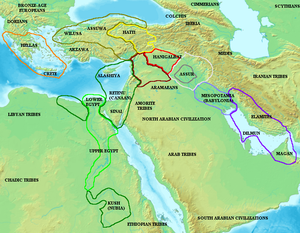 In EA 89, Rib-Hadda reported a coup d'etat
in neighboring Tyre, in which the ruler of Tyre, his fellow kinsmen, was killed along with his family. Rib-Hadda's sister and her daughters, who had been sent to Tyre to keep them away from Abdi-Ashirta's Amurru invaders, were also presumed to be among those killed. If this was not bad enough, Rib-Hadda wrote again to report that the Hittites
were invading Egyptian protectorates in Syria and burning "the King's lands". (EA 126). At one point Rib-Hadda was forced to flee to exile in Beirut
, under the protection of king Ammunira
. (EA 137) In EA 75, Rib-Hadda details the changing political situation around Byblos:
An aged and ailing Rib-Hadda continued to write to Pharaoh, telling him of violent upheavals in Phoenicia
and Syria, including revolutions instigated by Abdi-Ashirta's son Aziru
coupled with incursions by Apiru raiders. (e.g., EA 137)
Rib-Hadda was ultimately exiled by his younger brother Ilirabih
and not long afterwards, killed at the behest of Aziru. This event is mentioned in Amarna letter EA 162 from Akhenaten to Aziru.
Byblos
Byblos is the Greek name of the Phoenician city Gebal . It is a Mediterranean city in the Mount Lebanon Governorate of present-day Lebanon under the current Arabic name of Jubayl and was also referred to as Gibelet during the Crusades...
during the mid fourteenth century BCE. He is the author of some sixty of the Amarna letters
Amarna letters
The Amarna letters are an archive of correspondence on clay tablets, mostly diplomatic, between the Egyptian administration and its representatives in Canaan and Amurru during the New Kingdom...
all to Akhenaten
Akhenaten
Akhenaten also spelled Echnaton,Ikhnaton,and Khuenaten;meaning "living spirit of Aten") known before the fifth year of his reign as Amenhotep IV , was a Pharaoh of the Eighteenth dynasty of Egypt who ruled for 17 years and died perhaps in 1336 BC or 1334 BC...
. His name is Akkadian
Akkadian language
Akkadian is an extinct Semitic language that was spoken in ancient Mesopotamia. The earliest attested Semitic language, it used the cuneiform writing system derived ultimately from ancient Sumerian, an unrelated language isolate...
in form and may invoke the Northwest Semitic god Hadad
Hadad
Haddad was a northwest Semitic storm and rain god, cognate in name and origin with the Akkadian god Adad. Hadad was often called simply Ba‘al , but this title was also used for other gods. The bull was the symbolic animal of Hadad. He appeared as a bearded deity, often shown as holding a club and...
, though his letters invoke only Ba'alat Gubla, the "Lady of Byblos" (probably another name for Asherah
Asherah
Asherah , in Semitic mythology, is a Semitic mother goddess, who appears in a number of ancient sources including Akkadian writings by the name of Ashratum/Ashratu and in Hittite as Asherdu or Ashertu or Aserdu or Asertu...
).
Rib-Hadda's letters often took the form of complaints or pleas for action on the part of the reigning Pharaoh
Pharaoh
Pharaoh is a title used in many modern discussions of the ancient Egyptian rulers of all periods. The title originates in the term "pr-aa" which means "great house" and describes the royal palace...
. In EA 105, he begged Pharaoh to intervene in a dispute with Beirut
Beirut
Beirut is the capital and largest city of Lebanon, with a population ranging from 1 million to more than 2 million . Located on a peninsula at the midpoint of Lebanon's Mediterranean coastline, it serves as the country's largest and main seaport, and also forms the Beirut Metropolitan...
, whose ruler had confiscated two Byblian merchant vessels. In EA 122, Rib-Hadda complained of an attack by the Egyptian
Ancient Egypt
Ancient Egypt was an ancient civilization of Northeastern Africa, concentrated along the lower reaches of the Nile River in what is now the modern country of Egypt. Egyptian civilization coalesced around 3150 BC with the political unification of Upper and Lower Egypt under the first pharaoh...
commissioner Pihuri
Pihuri
Pakhura was an Egyptian commissioner in the "Land of Retenu" mentioned in the Amarna letters. He probably served under Pharaoh Amenhotep III and/or Akhenaten. In EA 122, Rib-Hadda, king of Byblos, complained of an attack by Pakhura, who killed a number of Byblos' Shardana mercenaries and took...
, who killed a number of Byblos' Shardana
Shardana
The Sherden are one of several groups of "Sea Peoples" who appear in fragmentary historical records for the Mediterranean region in the second millennium B.C.; little is known about them. On reliefs they are shown carrying a round shield and a long thrusting Naue II type sword...
mercenaries and took captive three of Rib-Hadda's men.
Rib-Hadda was involved in a long-standing dispute with Abdi-Ashirta
Abdi-Ashirta
Abdi-Ashirta was the ruler of Amurru, a new kingdom in southern Syria subject to nominal Egyptian control, that was in conflict with King Rib-Hadda of Byblos....
, the ruler of Amurru
Amurru kingdom
Amurru was an Amorite kingdom located at the territory of modern Lebanon during the 14th–12th centuries BCThe first documented leader of Amurru was Abdi-Ashirta, under whose leadership Amurru was part of the Egyptian empire...
(probably in southeastern Lebanon
Lebanon
Lebanon , officially the Republic of LebanonRepublic of Lebanon is the most common term used by Lebanese government agencies. The term Lebanese Republic, a literal translation of the official Arabic and French names that is not used in today's world. Arabic is the most common language spoken among...
and southwestern Syria
Syria
Syria , officially the Syrian Arab Republic , is a country in Western Asia, bordering Lebanon and the Mediterranean Sea to the West, Turkey to the north, Iraq to the east, Jordan to the south, and Israel to the southwest....
), who hired mercenaries from among the Habiru
Habiru
Habiru or Apiru or ˁpr.w was the name given by various Sumerian, Egyptian, Akkadian, Hittite, Mitanni, and Ugaritic sources to a group of people living as nomadic invaders in areas of the Fertile Crescent from Northeastern Mesopotamia and Iran to the borders of Egypt in Canaan...
, Shardana
Shardana
The Sherden are one of several groups of "Sea Peoples" who appear in fragmentary historical records for the Mediterranean region in the second millennium B.C.; little is known about them. On reliefs they are shown carrying a round shield and a long thrusting Naue II type sword...
, and other warlike tribes. EA 81 contains a plea for Egyptian
Ancient Egypt
Ancient Egypt was an ancient civilization of Northeastern Africa, concentrated along the lower reaches of the Nile River in what is now the modern country of Egypt. Egyptian civilization coalesced around 3150 BC with the political unification of Upper and Lower Egypt under the first pharaoh...
aid against Amurru, whose ruler Rib-Hadda accused of luring away his followers and inciting them to rebellion. He reported further that an assassin sent by Abdi-Ashirta had attempted to kill him. Rib-Hadda pleaded with Akhenaten
Akhenaten
Akhenaten also spelled Echnaton,Ikhnaton,and Khuenaten;meaning "living spirit of Aten") known before the fifth year of his reign as Amenhotep IV , was a Pharaoh of the Eighteenth dynasty of Egypt who ruled for 17 years and died perhaps in 1336 BC or 1334 BC...
to send archers
Archers (Egyptian pítati)
The Pítati were a contingent of archers in the Egyptian Empire, often requested and dispatched, to support the Egyptian vassalage in Canaan, or northern Canaan...
to defend him from the forces of Amurru and from his own increasingly resentful peasantry. In one of the most poignant of the Amarna texts, Rib-Hadda wrote "the people of Ammiya have killed their lord and I am afraid." (EA 75). He added: "like a bird in a trap so I am here in Gubla (ie: Byblos)." (EA 74 & EA 81) Zemar
Zemar
Zemar was a Phoenician city in what is now Syria. Zemar was a major trade center....
, a city previously under his control, fell to Abdi-Ashirta (EA 84). Shortly thereafter the Egyptian commissioner Pahannate was withdrawn from northern Canaan
Canaan
Canaan is a historical region roughly corresponding to modern-day Israel, Palestine, Lebanon, and the western parts of Jordan...
, leaving Rib-Hadda without even the appearance of Egyptian support. His pleas for assistance evidently went unanswered (EA 107) and caused much annoyance to Akhenaten. Akhenaten's irritation with Rib-Hadda is recounted in EA 117 where the pharaoh is quoted saying to Rib-Hadda "Why do you alone keep writing to me?" (EA 117) While Abdi-Ashirta is reported to have been killed in EA 101, this only provided temporary relief to Rib-Hadda since the former was succeeded by his son Aziru
Aziru
Aziru was the Canaanite ruler of Amurru, modern Lebanon, in the fourteenth century BC. He was the son of Abdi-Ashirta, the previous Egyptian vassal of Amurru and a direct contemporary of Akhenaten.The dealings of Aziru are well-known from the Amarna letters...
; Rib-Hadda soon after complains about the depradations caused by "the sons of Abdi-Ashirta" in several Amarna letters to Akhenaten such as EA 103 and EA 109
Coup d'état
A coup d'état state, literally: strike/blow of state)—also known as a coup, putsch, and overthrow—is the sudden, extrajudicial deposition of a government, usually by a small group of the existing state establishment—typically the military—to replace the deposed government with another body; either...
in neighboring Tyre, in which the ruler of Tyre, his fellow kinsmen, was killed along with his family. Rib-Hadda's sister and her daughters, who had been sent to Tyre to keep them away from Abdi-Ashirta's Amurru invaders, were also presumed to be among those killed. If this was not bad enough, Rib-Hadda wrote again to report that the Hittites
Hittites
The Hittites were a Bronze Age people of Anatolia.They established a kingdom centered at Hattusa in north-central Anatolia c. the 18th century BC. The Hittite empire reached its height c...
were invading Egyptian protectorates in Syria and burning "the King's lands". (EA 126). At one point Rib-Hadda was forced to flee to exile in Beirut
Beirut
Beirut is the capital and largest city of Lebanon, with a population ranging from 1 million to more than 2 million . Located on a peninsula at the midpoint of Lebanon's Mediterranean coastline, it serves as the country's largest and main seaport, and also forms the Beirut Metropolitan...
, under the protection of king Ammunira
Ammunira
Ammunira was the king of Beirut in the mid fourteenth century BCE. He is mentioned in several of the Amarna letters, and authored letters EA 141-43 ....
. (EA 137) In EA 75, Rib-Hadda details the changing political situation around Byblos:
- [Ri]b Hadda says to his lord, king of all countries, Great King: May the Lady of Gubla grant power to my lord. I fall at the feet of my lord, my SunRaRa is the ancient Egyptian sun god. By the Fifth Dynasty he had become a major deity in ancient Egyptian religion, identified primarily with the mid-day sun...
, 7 times and 7 times. May the king, my lord, know that Gubla (ie: Byblos), the maidservant of the king from ancient times, is safe and sound. The war, however, of the Apiru against me is severe. (Our) sons and daughters and the furnishings of the houses are gone, since they have been sold [in] the land of Yarimuta for our provisions to keep us alive. "For the lack of a cultivator, my field is like a woman without a husband." I have written repeatedly to the palace because of the illness afflicting me, [but there is no one] who has looked at the words that keep arriving. May the king give heed [to] the words of [his] servant... ...The Apiru killed Ad[una the king] of Irqata-(ArqaArqaArqa is a village near Miniara in Akkar District of the North Governorate in Lebanon, 22 km northeast of Tripoli, near the coast...
), but there was no one who said anything to Abdi-AshirtaAbdi-AshirtaAbdi-Ashirta was the ruler of Amurru, a new kingdom in southern Syria subject to nominal Egyptian control, that was in conflict with King Rib-Hadda of Byblos....
, and so they go on taking (territory for themselves). Miya, the ruler of Arašni, seized Ar[d]ata, and just now the men of Ammiy have killed their lord. I am afraid. May the king be informed that the king of Hatti has seized all the countries that were vassals of the king of MitanMitanniMitanni or Hanigalbat was a loosely organized Hurrian-speaking state in northern Syria and south-east Anatolia from ca. 1500 BC–1300 BC...
...Send arc[hers]Archers (Egyptian pítati)The Pítati were a contingent of archers in the Egyptian Empire, often requested and dispatched, to support the Egyptian vassalage in Canaan, or northern Canaan...
An aged and ailing Rib-Hadda continued to write to Pharaoh, telling him of violent upheavals in Phoenicia
Phoenicia
Phoenicia , was an ancient civilization in Canaan which covered most of the western, coastal part of the Fertile Crescent. Several major Phoenician cities were built on the coastline of the Mediterranean. It was an enterprising maritime trading culture that spread across the Mediterranean from 1550...
and Syria, including revolutions instigated by Abdi-Ashirta's son Aziru
Aziru
Aziru was the Canaanite ruler of Amurru, modern Lebanon, in the fourteenth century BC. He was the son of Abdi-Ashirta, the previous Egyptian vassal of Amurru and a direct contemporary of Akhenaten.The dealings of Aziru are well-known from the Amarna letters...
coupled with incursions by Apiru raiders. (e.g., EA 137)
Rib-Hadda was ultimately exiled by his younger brother Ilirabih
Ili-Rapih
Ili-Rapih was the follow-on mayor in Gubla-, and the brother of Rib-Hadda, the former mayor of Gubla, ; Ili-Rapih is in the 1350-1335 BC Amarna letters correspondence, and wrote 2 follow-on letters to the Pharaoh after the death of Rib-Haddi.Of note, Ili-Rapih's name is referenced in only one...
and not long afterwards, killed at the behest of Aziru. This event is mentioned in Amarna letter EA 162 from Akhenaten to Aziru.
Resources
- Baikie, James. The Amarna Age: A Study of the Crisis of the Ancient World. University Press of the Pacific, 2004.
- Cohen, Raymond and Raymond Westbrook (eds.). Amarna Diplomacy: The Beginnings of International Relations. Johns Hopkins University Press, 2002.
- Moran, William L. (ed. and trans.) The Amarna Letters. Johns Hopkins University Press, 1992.