
All Topics  
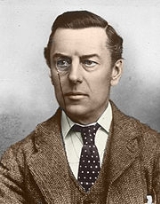
Joseph Chamberlain

 
Joseph Chamberlain

   Email Print
   Bookmark   Link


Joseph Chamberlain


Joseph Chamberlain (8 July, 1836 – 2 July, 1914) was an influential British businessman, politician, and statesman.

In his early years Chamberlain was a radically minded Liberal Party
Liberal Party (UK)

The Liberal Party was one of the two major British political parties from the early 19th century until the rise of the Labour Party in the 1920s, and a third party of varying strength and importance up to 1988, when it merged with the Social Democratic Party to form a new party which would become known as the Liberal Democrats....
 member, a campaigner for educational reform, and President of the Board of Trade. He later became a Liberal Unionist in alliance with the Conservative Party
Conservative Party (UK)

The Conservative and Unionist Party, more commonly known as the Conservative Party, is a conservative political party in the United Kingdom....
 and was appointed Colonial Secretary
Colonial Secretary

In Government of the United Kingdom usage, Colonial Secretary had two different meanings:* The Secretary of State for the Colonies, the Cabinet minister who headed the Colonial Office, was commonly referred to as the Colonial Secretary....
. At the end of his career he led the tariff reform campaign.


Discussion
Ask a question about 'Joseph Chamberlain'
Start a new discussion about 'Joseph Chamberlain'
Answer questions from other users
Full Discussion Forum


Encyclopedia


Joseph Chamberlain (8 July, 1836 – 2 July, 1914) was an influential British businessman, politician, and statesman.

In his early years Chamberlain was a radically minded Liberal Party
Liberal Party (UK)

The Liberal Party was one of the two major British political parties from the early 19th century until the rise of the Labour Party in the 1920s, and a third party of varying strength and importance up to 1988, when it merged with the Social Democratic Party to form a new party which would become known as the Liberal Democrats....
 member, a campaigner for educational reform, and President of the Board of Trade. He later became a Liberal Unionist in alliance with the Conservative Party
Conservative Party (UK)

The Conservative and Unionist Party, more commonly known as the Conservative Party, is a conservative political party in the United Kingdom....
 and was appointed Colonial Secretary
Colonial Secretary

In Government of the United Kingdom usage, Colonial Secretary had two different meanings:* The Secretary of State for the Colonies, the Cabinet minister who headed the Colonial Office, was commonly referred to as the Colonial Secretary....
. At the end of his career he led the tariff reform campaign. Despite never becoming Prime Minister, he is regarded as one of the most important British politicians of the late 19th century and early 20th century, as well as a colourful character and renowned orator.

He was the father of Sir Austen Chamberlain
Austen Chamberlain

Sir Joseph Austen Chamberlain, Order of the Garter was a British statesman, Politics, and recipient of the Nobel Peace Prize....
 and Prime Minister
Prime minister

A prime minister is the most senior minister of Cabinet in the Executive branch of government in a parliamentary system. The position is usually held by, but need not always be held by, a politician....
 Neville Chamberlain
Neville Chamberlain

Arthur Neville Chamberlain was a British Conservative Party politician and Prime Minister of the United Kingdom from 1937 to 1940. Chamberlain is best known for appeasement foreign policy, in particular regarding his signing of the Munich Agreement in 1938, conceding the Sudetenland region of Czechoslovakia to Germany, and for his "containm...
.

Early life, business career and marriage

Chamberlain was born in Camberwell
Camberwell

Camberwell is a district of London, England and forms part of the London Borough of Southwark. It is a built-up inner city district located south east of Charing Cross....
 in London
London

London is the capital of both England and the United Kingdom, and the most populous municipality in the European Union. An important settlement for two millennia, History of London goes back to its founding by the Roman Empire....
 to a successful shoemaker and manufacturer
Manufacturing

Manufacturing is the use of machine, tool and labor to make things for use or sale. The term may refer to a range of human activity, from handicraft to high tech, but is most commonly applied to Industry production, in which raw material are transformed into finished good on a large scale....
 also named Joseph (1796–1874). He was educated at University College School
University College School

University College School, known generally as UCS, is an independent school charity situated in Hampstead, north west London, England. The school was founded in 1830 by University College London and inherited much of that institution's progressive and secular views....
 (then still in Euston
Euston Road

Euston Road is an important thoroughfare in central London, England and forms part of the A501 road. It is part of the New Road from Paddington to Islington, and was opened as part of the New Road in 1756....
) between 1850 and 1852, in which he excelled academically, achieving prizes in French
French language

French is a Romance language spoken around the world by around 80 million people as first language, by 190 million as second language, and by about another 200 million people as an acquired tongue, with significant speakers in 54 countries....
 and mathematics
Mathematics

Mathematics is the study of quantity, structure, space, change, and related topics of pattern and form. Mathematicians seek out patterns whether found in numbers, space, natural science, computers, imaginary abstractions, or elsewhere....
. The elder Chamberlain was not able to send all his children into higher education, and at the age of 16, Joseph was apprenticed to the Cordwainers' Company
Worshipful Company of Cordwainers

The Worshipful Company of Cordwainers is one of the Livery Company of the City of London. The Cordwainers were workers in fine leather; the Company gets its name from "cordwain", the white leather produced from goatskin in Cordoba, Spain....
 and worked for the family business in the making of quality leather shoes. At 18 he was sent to Birmingham
Birmingham

Birmingham is a city status in the United Kingdom and metropolitan borough in the West Midlands of England. Birmingham is the most populous of England's English Core Cities Group, and is the List of United Kingdom cities by population British city after London, with a population of 1,010,200 ....
 to join his uncle's screw
Screw

A screw is a shaft with a helix groove or screw thread formed on its surface and provision at one end to turn the screw. Its main uses are as a threaded fastener used to hold objects together, and as a simple machine used to translate torque into linear force....
making business, Nettlefolds (later part of Guest, Keen and Nettlefolds), in which his father had invested. In partnership with Joseph Nettlefold, Chamberlain was to help the screwmaking firm, soon known as Nettlefold and Chamberlain, to become a commercial success and by his retirement from the firm in 1874, the company was exporting its products to the United States
United States

The United States of America is a Federal government constitutional republic comprising U.S. state and a federal district. The country is situated mostly in central North America, where its Contiguous United States and Washington, D.C., the Capital districts and territories, lie between the Pacific Ocean and Atlantic Oceans, Borders of the U...
, Europe
Europe

Europe is, conventionally, one of the world's seven continents. Comprising the westernmost peninsula of Eurasia, Europe is generally divided from Asia to its east by the water divide of the Ural Mountains, the Ural , the Caspian Sea, and by the Caucasus Mountains to the southeast....
, India
India

India, officially the Republic of India , is a country in South Asia. It is the List of countries and outlying territories by total area country by geographical area, the List of countries by population country, and the most populous liberal democracy in the world....
, Japan
Japan

Japan is an island country in East Asia. Located in the Pacific Ocean, it lies to the east of the Sea of Japan, People's Republic of China, North Korea, South Korea and Russia, stretching from the Sea of Okhotsk in the north to the East China Sea and Taiwan in the south....
, Canada
Canada

Canada is a country occupying most of northern North America, extending from the Atlantic Ocean in the east to the Pacific Ocean in the west and northward into the Arctic Ocean....
 and Australia
Australia

Australia, officially the Commonwealth of Australia, is a country in the southern hemisphere comprising the Australia of the world's smallest continent, the major island of Tasmania, and numerous list of islands of Australia in the Indian Ocean and Pacific Oceans....
. At the firm's height, Nettlefold and Chamberlain were producing approximately two-thirds of all metal screws made in England.

In 1860, Chamberlain met and fell in love with Harriet Kenrick, the daughter of a Unitarian family from Birmingham who originally occupied Wynn Hall
Wynn Hall

Wynn Hall is a 17th century house in the old hamlet of Bodylltyn in Ruabon, Wrexham , Wales standing at the junction of the Penycae Road and Plas Bennion Road....
 in Ruabon
Ruabon

Ruabon is a village and Community in the county borough of Wrexham in Wales....
, Wrexham
Wrexham

Wrexham is a town in Wales. It is the administrative centre of the wider Wrexham , and the largest town in North Wales, located to the east of the region....
, Wales
Wales

native_name = Cymru|conventional_long_name = Wales|common_name = Wales|image_flag = Flag of Wales 2.svg|national_motto = ...
. In July 1861, the couple married and a daughter, Beatrice, was born in May 1862. In October 1863, having had a premonition that she would die in childbirth, Harriet gave birth to a son, Joseph Austen
Austen Chamberlain

Sir Joseph Austen Chamberlain, Order of the Garter was a British statesman, Politics, and recipient of the Nobel Peace Prize....
, the future Chancellor of the Exchequer
Chancellor of the Exchequer

The Chancellor of the Exchequer is the title held by the British Cabinet of the United Kingdom Minister who is responsible for all economic and financial matters....
 and Foreign Secretary. Two days after Austen's birth Harriet became ill. She died three days later. Gripped with grief, Chamberlain devoted himself to the growing fortunes of Nettlefold and Chamberlain, while raising Beatrice and Austen with the Kenrick parents-in-law.

In 1868, Chamberlain married for the second time, wedding Harriet's cousin, Florence Kenrick. The marriage was as successful and joyous for Chamberlain as the first, and bore four children: Arthur Neville
Neville Chamberlain

Arthur Neville Chamberlain was a British Conservative Party politician and Prime Minister of the United Kingdom from 1937 to 1940. Chamberlain is best known for appeasement foreign policy, in particular regarding his signing of the Munich Agreement in 1938, conceding the Sudetenland region of Czechoslovakia to Germany, and for his "containm...
 in 1869, Ida in 1870, Hilda in 1871, and Ethel, born in 1873. On 13 February 1875, Florence gave birth to their fifth child. By the next day both she and her child had died. Florence's sister Louisa married Joseph's brother Arthur Chamberlain- their granddaughter was the author Elizabeth Longford and their great-granddaughter is the Labour politician Harriet Harman
Harriet Harman

Harriet Ruth Harman Queen's Counsel Member of Parliament is a British solicitor and Labour Party politician. Since 24 June 2007, she has been the Deputy Leader of the Labour Party and Party Chair of the Labour Party ....
.

Early political career


Calls for reform

There were strong radical and liberal traditions among shoemakers in his adopted home city of Birmingham, while Chamberlain's Unitarian
Unitarianism

Unitarianism as a theology is the belief in the single personality of God, in contrast to the doctrine of the Trinity . It is the philosophy upon which the modern Unitarian movement was based, and, according to its proponents, is the Early Christianity of Christianity....
 church held a long tradition of social action. Chamberlain duly became involved in Liberal politics, and the growth of Britain's urban population during the industrial revolution
Industrial Revolution

The Industrial Revolution was a period in the late 18th and early 19th centuries when major changes in agriculture, manufacturing, production, and transportation had a profound effect on the socioeconomics and cultural conditions in United Kingdom....
 led to mounting national political pressure to redistribute parliamentary seats and to enfranchise a sizeable proportion of urban males. In 1866, Lord John Russell
John Russell, 1st Earl Russell

John Russell, 1st Earl Russell, Order of the Garter, Order of St Michael and St George, Privy Council of the United Kingdom , known as Lord John Russell before 1861, was an England British Whig Party and Liberal Party politician who served twice as Prime Minister of the United Kingdom in the mid-19th century....
's Liberal
Liberal Party (UK)

The Liberal Party was one of the two major British political parties from the early 19th century until the rise of the Labour Party in the 1920s, and a third party of varying strength and importance up to 1988, when it merged with the Social Democratic Party to form a new party which would become known as the Liberal Democrats....
 administration put a Reform Bill before the House of Commons, aiming to create 400,000 new voters. While conservative supporters of the government, known as 'Adullamites
Adullamites

The Adullamites were a short-lived anti-reform faction within the Liberal Party in 1866. The name is a Bible reference to the cave of Adullam where David and allies sought refuge from Saul....
', opposed the Bill for its disruption of the social order, Radicals criticised it on the basis that it failed to concede the secret ballot or household suffrage. The Bill was defeated and Lord Derby
Edward Smith-Stanley, 14th Earl of Derby

Edward George Geoffrey Smith-Stanley, 14th Earl of Derby, Order of the Garter, Privy Council of the United Kingdom was an England statesman, three times Prime Minister of the United Kingdom, and to date the longest serving leader of the Conservative Party ....
 formed a minority Conservative administration. On 27 August 1866, a vast demonstration for reform was held in Birmingham, in which the Mayor marched alongside 250,000 people, one of whom was Chamberlain. John Bright
John Bright

John Bright , Quaker, was a United Kingdom of Great Britain and Ireland Radicals and Liberal Party statesman, associated with Richard Cobden in the formation of the Anti-Corn Law League....
 addressed the huge middle and working-class crowd, Chamberlain recalling that 'men poured into the hall, black as they were from the factories…the people were packed together like herrings.' The Conservative government passed a Reform Bill in 1867, nearly doubling the electorate from 1,430,000 to 2,470,000 and in the 1868 General Election
United Kingdom general election, 1868

The 1868 UK general election was the first after passage of the Reform Act 1867, which enfranchised many male householders, thus greatly increasing the number of men who could vote in elections in the United Kingdom....
, the Liberal Party took power. Chamberlain was active in the election campaign, praising Bright and George Dixon
George Dixon

George Dixon may refer to:*George Dixon , Canadian boxer*George Dixon , Canadian Football League Hall of Fame player*George Dixon , sea captain and explorer...
, a Birmingham Member of Parliament (MP).

In 1867 he helped found the Birmingham Education League
National Education League

The National Education League was a political movement in England and Wales which promoted elementary education for all children, free from religious control....
 with Jesse Collings
Jesse Collings

Jesse Collings was Mayor of Birmingham, England, a Liberal Party member of Parliament, but was best known nationally in the UK as an advocate of educational reform and land reform ....
. The Education League noted that of around four and a quarter million children of school age, two million children, mostly in urban areas, did not attend school with a further million in uninspected schools. More contentious was the government’s aid to Church of England
Church of England

The Church of England is the State religion Christianity Ecclesia in England, the Mother Church of the worldwide Anglican Communion and the oldest among the communion's thirty-eight independent national and regional churches....
 schools, embodying a connection between church and state that was bound to offend Nonconformist opinion. Chamberlain was enthusiastic about the requirement for the provision of free, secular, compulsory education, stating that 'it is as much the duty of the State to see that the children are educated as to see that they are fed.' He also pointed to the success owed by the United States and Prussia
Prussia

Prussia was, most recently, a historic state originating out of the Duchy of Prussia and the Margraviate of Brandenburg. This state had for centuries substantial influence on Germany and European history....
 to public education. The Birmingham Education League evolved into the National Education League
National Education League

The National Education League was a political movement in England and Wales which promoted elementary education for all children, free from religious control....
, which held its first Conference in Birmingham in 1869. The League called for a school system supported by local rates
Rates (tax)

Rates are a type of taxation system in the United Kingdom, and in places with systems deriving from the British one, used to fund local government....
 and government grants, under local authorities subject to government inspection. By 1870, the League had more than one hundred branches, mostly in cities and drawing from trades unions and working men's organisations. Chamberlain was also prominent in the local campaign in support of Gladstone
William Ewart Gladstone

William Ewart Gladstone was a United Kingdom of Great Britain and Ireland Liberal Party statesman and four times Prime Minister of the United Kingdom ....
's Irish Church Disestablishment Bill against the House of Lords
House of Lords

The House of Lords is the second house of the Parliament of the United Kingdom and is also commonly referred to as "the Lords". The Parliament comprises the British monarchy, the British House of Commons , and the Lords....
' obstructionism. Chamberlain seconded the motion in support of disestablishment at a debate held at Birmingham town hall, and he addressed the large, restless crowd attacking the hereditary powers of the House of Lords. The meeting broke up amidst fighting, but Chamberlain had become a figure of prominence among Birmingham Liberals, and he was elected to Birmingham Council for St. Paul's ward in November 1869.

The Liberal government put forward proposals for an Elementary Education Bill
Elementary Education Act 1870

The Elementary Education Act 1870 commonly known as Forster's Education Act, set the framework for schooling of all children over the age of 5 and under 13 in England and Wales....
 in January 1870. W.E. Forster
William Edward Forster

William Edward Forster, Fellow of the Royal Society was a United Kingdom industrialist, philanthropist and Liberal Party statesman, Member of Parliament for Bradford....
, Vice-President of the Committee of Council on Education was responsible for the Bill and came under attack from Nonconformists because of the legislation's proposal to maintain church schools within the structure of national education and to put them on the rates. The absence of school boards or the provision of free, compulsory education caused consternation in the National Education League, and Chamberlain arranged for a large delegation to visit 10 Downing Street
10 Downing Street

Number 10 Downing Street is the residence and office of the First Lord of the Treasury and Prime Minister of the United Kingdom. The headquarters of Her Majesty's Government, it is situated on Downing Street in the City of Westminster in London, England....
 to persuade Gladstone to remove the role of the church in national education. On 9 March 1870, the Education League's delegation arrived to meet the Prime Minister, consisting of 400 branch members and 46 M.P.s. In this first meeting between Gladstone and Chamberlain, the latter impressed the Prime Minister with his lucid speech, and Gladstone agreed during the Elementary Education Bill's second reading to make amendments that took church schools from rate-payer control and granted them support from government funds. Liberal MPs, exasperated at the compromises in the legislation, voted against the government, and the Bill passed the House of Commons with support from the Conservatives. Chamberlain campaigned against the Act, and in particular clause 25, which gave school boards
School board (England & Wales)

File:BedfordRoadLowerSchoolKempston.JPGSchool boards were set up in England and Wales under the Elementary Education Act 1870 following campaigning by George Dixon , Joseph Chamberlain and the National Education League for elementary education free from Anglican doctrine....
 the power to pay the fees of poor children at voluntary schools, which theoretically allowed them to fund church schools. The Education League even stood in several by-elections against Liberal candidates who refused to support the repeal of clause 25. In 1873 a Liberal majority was elected to the Birmingham School Board, with Chamberlain as chairman. Eventually, a compromise was reached with the church component of the School Board agreeing to make payments from rate-payer's money only to schools linked with industrial education.

Chamberlain broadened his campaigning to take up the cause of rural workers, promoting their enfranchisement and cheaper land prices. This was reflected in his subsequent slogan coined in an article written for the Fortnightly Review, the four 'F's' – 'Free Church, Free Schools, Free Land and Free Labour'. In another article entitled 'The Liberal Party and its Leaders', Chamberlain made a blistering attack on Gladstone's leadership and advocated a concerted Radical challenge to the direction of the party. By 1873, Chamberlain had made his reputation, especially in Birmingham, as a charismatic Radical politician, and sought to further his cause in the municipal arena.

Mayor of Birmingham

In November 1873 Chamberlain stood as a Liberal candidate for the mayoralty of Birmingham, with the Conservatives denouncing his political Radicalism and disparaging him as a 'monopoliser and a dictator.' The Liberal Party swept the municipal elections having campaigned under the slogan 'The People above the Priests', a clear swipe at the High Toryism of Chamberlain’s opponents. As mayor, Chamberlain promoted many civic improvements, leaving the town (in words to Collings) 'parked, paved, assized, marketed, gas & watered and improved. Prior to his tenure in office, the city's municipal administration was notably lax with regards to public works, and many urban dwellers lived in conditions of great poverty. The city's water supply was considered a danger to public health – approximately half of the city’s population was dependent on well water, much of which was polluted by sewage. Furthermore, piped water was only supplied three days per week, compelling the use of unhealthy well water and water carts for the rest of the week. Two rival gas companies, the Birmingham Gas Company and the Birmingham and Staffordshire Gas Company were locked in constant competition, in which the city's streets were continually dug up to allow for the laying of mains. Chamberlain established a municipal gas supply by forcibly purchasing the two companies on behalf of the borough for £1,953,050, even offering to purchase the companies himself if the ratepayers refused. The move was a success, and in its first year of operations, the municipal gas scheme made a profit of £34,000. Deploring the rising death rate from contagious diseases in the poorest sections of the city, in January 1876, Chamberlain forcibly purchased Birmingham's waterworks for a combined sum of £1,350,000, having declared to a House of Commons Committee that 'We have not the slightest intention of making profit...We shall get our profit indirectly in the comfort of the town and in the health of the inhabitants'. Despite this noticeable executive action, Chamberlain was mistrustful of central authority and burdensome bureaucracy, preferring to give local communities the responsibility to act on their own initiative.

With the city's gas and water supply under municipal control, Chamberlain undertook other schemes with the intention of improving the quality of life in Birmingham. In July 1875 Chamberlain tabled an improvement plan that involved a programme of slum clearance in Birmingham’s city centre. Chamberlain had been consulted by the Home Secretary
Home Secretary

The Secretary of State for the Home Department, commonly known as the Home Secretary, is the minister in charge of the United Kingdom Home Office and is one of the Great Offices of State....
, R.A. Cross during the preparation of the Artisan's and Labourers' Dwellings Improvement Act 1875
Artisan's and Labourers' Dwellings Improvement Act 1875

The Artisan's and Labourers' Dwellings Improvement Act 1875 was an Act of Parliament of the Parliament of the United Kingdom designed by R. A. Cross, 1st Viscount Cross, Home Secretary during Prime Minister of the United Kingdom Benjamin Disraeli's second Conservative Party Government, which involved allowing local councils to buy up areas o...
, a prominent feature of the Disraeli ministry's programme of social improvement. Chamberlain proposed to build a new road (Corporation Street
Corporation Street, Birmingham

Corporation Street is a main shopping street in central Birmingham, England.It runs from the law courts at its northern end to the centre of New Street, Birmingham at its southern....
) through Birmingham's overcrowded slums, and bought 50 acres (200,000 m²) of property for such a purpose. Overriding the protests of local landlords and the Commissioner of the Local Government Board's inquiry into the scheme, Chamberlain appealed directly to the President of the Local Government Board
President of the Local Government Board

The President of the Local Government Board was a ministerial post, frequently a Cabinet position, in the United Kingdom, established in 1871. The Local Government Board itself was established in 1871 and took over supervisory functions from the Board of Trade and the Home Office, including the Local Government Act Office that had been esta...
, George Sclater-Booth
George Sclater-Booth, 1st Baron Basing

George Limbrey Sclater-Booth, 1st Baron Basing Deputy Lieutenant , known as George Sclater-Booth before 7 July 1887, was a United Kingdom Conservative Party politician....
. Having gained the support of central government and raised the funds for the programme, Chamberlain was able to implement the scheme, contributing £10,000 to the cost himself. However, the Improvement Committee concluded that it would be too expensive to transfer slum-dwellers to municipally built accommodation and so the land was let out as a business proposition on a 75 year lease. Those who had occupied the slums were eventually rehoused in the suburbs, not in the area of their previous residence, and the scheme as a whole lost local government £300,000. The death-rate in the newly christened Corporation Street dropped dramatically – from approximately 53 per 1,000 between 1873 and 1875 to 21 per 1,000 between 1879 and 1881.

Chamberlain's tenure in office was also notable for his promotion of cultural improvement. Public and private money was used for the construction of libraries, municipal swimming pools and schools. The Museum & Art Gallery
Birmingham Museum & Art Gallery

Birmingham Museum & Art Gallery is an art gallery in Birmingham, England. Opened in 1885, it has a collection of international importance covering fine art, ceramics, metalwork, jewellery, archaeology, ethnography, local history and industrial history....
 was enlarged and a number of new parks were opened. Construction of the Council House
Council House, Birmingham

Birmingham City Council House in Birmingham, England is the home of Birmingham City Council. It provides office accommodation for both employed council officers, including the Chief Executive, and councillor, plus the council chamber, Lord Mayor's Suite, committee rooms and a large and ornate banqueting suite, complete with minstrels' galle...
 was begun while the Victoria Law Courts
Victoria Law Courts, Birmingham

The Victoria Law Courts on Corporation Street, Birmingham, Birmingham, England is a Grade I listed, red brick and terracotta building that now houses Birmingham Magistrates' Court....
 were built in Corporation Street.

The mayoralty helped give Chamberlain stature as a figure of both local and national renown, with contemporaries commenting upon his youthfulness and prominent dress, in which he sported 'a black velvet coat, jaunty eyeglass in eye, red neck-tie drawn through a ring'. His contribution to the city's improvement secured political allegiance of the so-called 'Birmingham caucus' for Chamberlain in return, a loyalty that would remain even with the shifts in his public career.

National politics


Member of Parliament and the National Liberal Federation

In the 1874 General Election
United Kingdom general election, 1874

In the 1874 United Kingdom general election, the Liberal Party , led by William Gladstone, won a majority of the votes cast, but Benjamin Disraeli's Conservative Party won the majority of seats in the British House of Commons, largely because they won a number of uncontested seats....
, Chamberlain made his first attempt to enter the House of Commons. The Sheffield
Sheffield

Sheffield is a city status in the United Kingdom and metropolitan borough in South Yorkshire, England. It is so named because of its origins in a field on the River Sheaf that runs through the city....
 Reform Association, an offshoot of the Liberal Party in the city, invited Chamberlain to stand for election shortly into his tenure as Mayor of Birmingham. The campaign was a fierce one, and Chamberlain was accused of republicanism and atheism
Atheism

Atheism is the absence or rejection of belief in deity, or the explicit view that Existence of God.Many list of atheists are Skepticism of all supernatural beings and cite a lack of empiricism evidence for the existence of deities....
 by opponents, with dead cats even being thrown at him on the speaking platform by angry spectators. Much to his displeasure, Chamberlain came in third place, a failure for someone considered as a leading spokesman for urban Radicalism. During his term as Mayor of Birmingham, Chamberlain continued to entertain the prospect of standing for Parliament, although he eventually rejected the possibility of standing in Sheffield. Predictably, Chamberlain maintained his focus on Birmingham and when George Dixon decided to retire from his seat in May 1876, an opportunity was presented for Chamberlain to enter the House of Commons. On 17 June 1876, Chamberlain was returned unopposed for the Birmingham constituency
Birmingham (UK Parliament constituency)

Birmingham was a United Kingdom constituencies of the British House of Commons of the Parliament of the United Kingdom for the city of Birmingham, in what is now the West Midlands Metropolitan County, but at the time was Warwickshire....
, after a period of anxiety following his nomination in which he delivered a blistering attack on the Prime Minister, Benjamin Disraeli, accusing him of being 'a man who never told the truth except by accident.' Chamberlain subsequently apologised publicly.

When elected, Chamberlain resigned the mayorship of Birmingham, and was introduced to the House of Commons by John Bright and Joseph Cowen
Joseph Cowen

Joseph Cowen , England politician and journalist, son of Sir Joseph Cowen, a prominent citizen and Member of Parliament for Newcastle upon Tyne from 1865 to 1873, was born at Stella Hall, Blaydon ....
, an M.P. for Newcastle-upon-Tyne
Newcastle-upon-Tyne (UK Parliament constituency)

Newcastle-upon-Tyne was a Borough constituency in the county of Northumberland of the British House of Commons for the Parliament of England to 1706 then of the Parliament of Great Britain from 1707 to 1800 and of the Parliament of the United Kingdom from 1801 to 1918....
. Almost immediately, Chamberlain began to organise the Radical component in the House of Commons in an attempt to prompt the Liberal leadership, with the intention of displacing Whig
British Whig Party

The Whigs are often described as one of two political party in Kingdom of England and later the United Kingdom from the late 17th to the mid-19th centuries....
 dominance and providing a Radical opposition to the Conservatives. On 4 August 1876, Chamberlain delivered his maiden speech in the House of Commons during a debate on elementary schools. The maintenance of clause 25 prompted Chamberlain to intervene before the busy House, in which Disraeli was in attendance. Speaking for twenty minutes, Chamberlain utilised his experience on the Birmingham School Board to make an impressive speech. Hereafter, Chamberlain spoke on many subjects, but concentrated on the subject of free public education and female teachers. The issues of alcohol licensing and army discipline also occupied much of Chamberlain's time.

Early difficulties in creating a coherent group committed to Radicalism within the Liberal Party convinced Chamberlain of the need to establish a more effective organisation for the party as a whole, especially in the localities. The controversy surrounding Disraeli's policy during the Russo-Turkish War proved to be a catalyst for activity, for Chamberlain viewed the agitation surrounding the Bulgarian atrocities as a means of utilising public indignation for a Radical agenda. Chamberlain estimated that Radicalism could profit from Gladstone's increasing popularity, and he subsequently sought to close ranks with the returned Liberal leader. With the Liberal Party active in opposition to the Conservative government's foreign policy, it was a propitious moment to federate the country's Liberal Associations, and on 31 May 1877, Gladstone addressed approximately 30,000 people at Bingley Hall
Bingley Hall

The Bingley Hall in Birmingham was the first purpose-built exhibition hall in Great Britain. It was built in 1850 and burned down in 1984. The International Convention Centre, Birmingham now stands on the site....
 to found the National Liberal Federation. The body was undeniably a creation of Chamberlain's brand of Birmingham Radicalism, reflected in the dominance of Birmingham's politicians in the Federation's administration – Chamberlain himself served as President. The Federation was designed to tighten party discipline and provide the Liberal Party with the apparatus for fighting the Conservatives in elections, whose party organisation was undergoing effective reform. Furthermore, the Federation subsequently engaged in numerous campaigning activities, including the enlisting of new members, the organisation of political meetings and the publishing of posters and pamphlets. Contemporary commentators made (often disparaging) comparisons between the techniques of the Federation and those employed in American politics. For Chamberlain, the Federation gave him much enhanced influence within the Liberal Party as well as a nationwide platform to promote Radicalism.

Chamberlain was largely critical of Disraeli's handling of foreign affairs, arguing that the Conservative government's forward policy diverted attention from the requirements of domestic reform. Unlike many Liberals, Chamberlain's attitude was not fuelled by anti-imperialism, for although he berated the government for its Eastern policy, the 1878 invasion of Afghanistan and the 1879 Zulu War
Anglo-Zulu War

The Anglo-Zulu War was fought in 1879 between the British Empire and the Zulu Empire. From complex beginnings, the war is notable for several particularly bloody battles, as well as for being a landmark in the timeline of colonialism in the region....
, he had previously supported Disraeli's purchase of Suez Canal
Suez Canal

The Suez Canal is a canal in Egypt. Opened in November 1869, it allows water transportation between Europe and Asia without navigating around Africa or carrying goods overland between the Mediterranean and the Red Sea....
 Company shares in November 1875. At this stage of his career, Chamberlain was eager to see the protection of British overseas interests, but placed greater emphasis on a conception of justice in the pursuit of such interests. In the 1880 general election
United Kingdom general election, 1880

The UK general election of 1880 was a general election in the United Kingdom held from March to April 1880.At the culmination of Midlothian campaign, the Liberals, led by the fierce oratory of retired former Liberal Party leader William Gladstone in attacking the supposedly immoral foreign policy of the Benjamin Disraeli, 1st Earl of Beaco...
, Chamberlain joined the Liberal denunciations of the Conservative Party’s foreign policy, and the National Liberal Federation played an important part in seeing the Liberal Party take power. With Gladstone having returned as Prime Minister with notable assistance from the National Liberal Federation, Chamberlain was hopeful of being rewarded with a cabinet position.

President of the Board of Trade

Despite the fact that Chamberlain had only sat in Parliament for four years, his claims to a position in the cabinet were strong – he spoke nationally for Radicals and Nonconformists, and had a credible power base in the form of the National Liberal Federation. Although Gladstone did not regard the Federation highly, he recognised the part it had played in taking the Liberal Party to power, and appreciated the wisdom of not antagonising Chamberlain, who told Sir William Harcourt
William Vernon Harcourt (politician)

Sir William George Granville Venables Vernon Harcourt was a United Kingdom lawyer, journalist and Liberal Party statesman.He served as Member of Parliament for various constituencies and held the offices of Home Secretary and Chancellor of the Exchequer under William Gladstone before becoming Leader of the Opposition ....
 that he was prepared to lead a revolt and field Radical candidates in borough elections. Eager to reconcile Radicals to the Whig-heavy cabinet and having taken the counsel of Bright, Gladstone invited Chamberlain on 27 April 1880 to fulfil the post of President of the Board of Trade.

Chamberlain's scope for manoeuvre was restricted between 1880 and 1883 by the Cabinet’s occupancy with difficulties concerning Ireland
Ireland

Ireland is the List of islands by area in Europe, and the twentieth-largest island in the world. It lies to the north-west of continental Europe and is surrounded by hundreds of islands and islet....
, Transvaal
Transvaal

File:Flag of Transvaal.svgFile:Transvaal map.pngFile:Spelterini Transvaal.jpgThe Transvaal is the name of an area of northern South Africa....
 and Egypt
Egypt

Egypt is a country mainly in North Africa, with the Sinai Peninsula forming a land bridge in Western Asia. Covering an area of about , Egypt borders the Mediterranean Sea to the north, the Gaza Strip and Israel to the northeast, the Red Sea to the east, Sudan to the south and Libya to the west....
. However, he was able to introduce the Grain Cargoes Bill, for the safer transportation of grain, an Electric Lighting Bill which enabled municipal bodies to establish electricity supplies and a Seaman's Wages Bill, which ensured a fairer system of payment. After 1883, Chamberlain’s period at the Board of Trade was more productive. A Bankruptcy Bill established a Bankruptcy Department at the Board of Trade responsible for enquiring into failed business deals. Meanwhile, a Patents Bill brought patenting under the supervision of the Board of Trade. More importantly, Chamberlain sought to end the practice of ship owners overinsuring their vessels – 'coffin ships' – while under manning them, thereby ensuring a healthy profit irrespective of whether the ship arrived safely or sank. Despite having the support of Tory Democrats Lord Randolph Churchill
Lord Randolph Churchill

Lord Randolph Henry Spencer Churchill was a United Kingdom statesman.Lord Randolph was the third son of the John Winston Spencer-Churchill, 7th Duke of Marlborough and his wife Frances Anne Emily Vane-Tempest , daughter of the Charles William Vane, 3rd Marquess of Londonderry....
 and John Eldon Gorst
John Eldon Gorst

Sir John Eldon Gorst, Privy Council of the United Kingdom was an England lawyer and politician.He served as Solicitor General for England and Wales from 1885 to 1886 and as Secretary of State for Education and Skills between 1895 and 1902....
, the Liberal government was unwilling to grant Chamberlain its full support and the Bill was withdrawn in July 1884.

In Cabinet, Ireland was of special interest to Chamberlain. Representing Irish Catholic peasants, the Irish Land League pressed for fair rents, fixity of tenure and free sale in opposition to absentee Anglo-Irish landlords. Chamberlain supported proposals that a Land Bill would be effective in countering agitation in Ireland and Fenian outrages in the British Isles. Furthermore, he felt that a land settlement would quieten demands for Irish Home Rule
Devolution

Devolution is the Statute granting of powers from the central government of a state to government at a subnational level, such as a regional, local, or state level....
, something that Chamberlain opposed with vigour, reasoning that Ireland's separation from the United Kingdom would lead to the eventual break up of the Empire
British Empire

The British Empire comprised the dominions, Crown colony, protectorates, League of Nations mandate, and other Dependent territory ruled or administered by the United Kingdom , that had originated with the overseas colonies and trading posts established by England in the late 16th and early 17th centuries....
. He was opposed to the policy of coercion advocated by the Chief Secretary
Chief Secretary for Ireland

The Chief Secretary was the key office-holder of state in the United Kingdom administration in Ireland. Towards the end of Crown rule in Ireland, he operated in a manner similar to that of the Prime Minister in the English and later British Parliament....
, W.E. Forster, believing that strong arm tactics before the settlement of the land issue would provoke Irish malcontents. In April 1881, Gladstone's government introduced the Irish Land Act, but in response, Parnell
Charles Stewart Parnell

Charles Stewart Parnell was an Irish people Church of Ireland landowner, Irish Nationalism politician, Irish Land League agitator, Irish Home Rule bills Member of Parliament in the Palace of Westminster of the United Kingdom of Great Britain and Ireland and founder and leader of the Irish Parliamentary Party....
, leading the Irish nationalists, encouraged tenants to withhold rents. As a result, Parnell and other leaders, including John Dillon
John Dillon

John Dillon was an Ireland land reform agitator, Irish Home Rule Bill activist, Irish nationalism politician, Member of Parliament in the British House of Commons of the United Kingdom of Great Britain and Ireland and last leader of the Irish Parliamentary Party....
, were imprisoned in Kilmainham Gaol on 13 October 1881. Keen that there should be no more concessions, Chamberlain supported their imprisonment, and used their incarceration to bargain with them in 1882 in an attempt to reconcile them to the government. In the ensuing 'Kilmainham Treaty', the government agreed to release Parnell in return for his cooperation in making the Land Act work. Forster resigned and the new Chief Secretary, Lord Frederick Cavendish
Lord Frederick Cavendish

Lord Frederick Charles Cavendish was an England The Liberal Party politician and prot?g? of the Prime Minister of the U.K., William Ewart Gladstone, who was appointed to the post of Chief Secretary for Ireland in May 1882....
 was murdered
Phoenix Park Murders

The term Phoenix Park Murders is used to refer to the assassination in 1882 of Thomas Henry Burke and the newly appointed Chief Secretary for Ireland, Lord Frederick Cavendish by members of an organisation called the "Irish National Invincibles"....
 by Irish terrorists on 6 May 1882, leaving the 'Kilmainham Treaty' in tatters. Having brokered the agreement, many including Parnell believed that Chamberlain was to be offered the Chief Secretaryship, however Gladstone passed him over and appointed Sir George Trevelyan instead. With the prominence of Ireland in British politics, it is not inconceivable that Gladstone was reluctant to appoint Chamberlain to a position that would have markedly enhanced his prestige and political cause. Nevertheless, Chamberlain maintained an interest in Irish affairs, and proposed to the Cabinet an Irish Central Board
Central Board

This was a scheme developed by Joseph Chamberlain in 1884-1885. This would have offered a form of local government which it is argued would have fallen considerably short of legislative independence....
 that would have legislative powers in land, education and communications. This was rejected by the Whigs in Cabinet on 9 May 1885.

Chamberlain's inability to introduce more creative legislation at the Board of Trade was the cause of frustration for someone who had proven to be so effective in municipal politics. However, Chamberlain viewed the Board of Trade as little more than a stepping stone for the attainment for higher things, seeing the post as a platform for the promotion of Radicalism. Early into the Gladstone ministry, Chamberlain suggested without success that the franchise should be extended, with the Prime Minister arguing that the matter should be deferred until the end of the Parliament's lifespan. In 1884, the parliament passed a major measure of franchise reform, the Reform Act, which gave hundreds of thousands of rural labourers the vote. This was followed by a Redistribution Act in 1885, negotiated by Gladstone and the Conservative leader, Lord Salisbury. Chamberlain sought to capture the newly enfranchised voters, and threw himself into a campaign of Radicalism. This took many forms, including public meetings, speeches and notably, articles written in the
Fortnightly Review by Chamberlain’s close associates, including Jesse Collings and John Morley. Chamberlain earned a reputation for provocative speeches during the period, especially during debate surrounding the 1884 County Franchise Bill, which was opposed by the Whig Liberals, Lord Hartington (later the 8th Duke of Devonshire) and George Goschen as well as Lord Salisbury, who argued that the Bill gave the Liberals an unfair electoral advantage. The Conservative leader was prepared to use the powers of the House of Lords in order to block the Bill, much to Chamberlain’s dismay. At Denbigh
Denbigh

Denbigh is a market town in Denbighshire, North Wales, United Kingdom. Before 1888, it was county town of Denbighshire . Denbigh lies 8 miles to the north west of Ruthin and to the south of St Asaph....
 on 20 October 1884, Chamberlain famously declared in a speech that Salisbury was "himself the spokesman of a class – a class to which he himself belongs,
who toil not neither do they spin." In response, Salisbury branded Chamberlain a 'Sicilian bandit' and Lord Iddesleigh
Stafford Northcote, 1st Earl of Iddesleigh

Stafford Henry Northcote, 1st Earl of Iddesleigh Order of the Bath Privy Council of the United Kingdom , known as Sir Stafford Northcote, Bt, from 1851 to 1885, was a United Kingdom Conservative Party politician....
 called him 'Jack Cade
Jack Cade

Jack Cade was the leader of a popular revolt in late medieval Europe in the 1450 Kent rebellion which took place in the time of King Henry VI of England in England....
'. When Chamberlain suggested that he would march on London with thousands of Birmingham constituents to protest at the House of Lords' powers, Salisbury remarked that "Mr. Chamberlain will return from his adventure with a broken head if nothing worse." This verbal altercation was characteristic of the antagonism between Chamberlain and his Radical followers on the one hand, and the landed Conservatives and Whigs on the other. In July 1885, the
Radical Programme, the first campaign handbook in British political history was published, with the preface written by Chamberlain himself. It called for land reform
Land reform

Land reforms is an often-Land reform#Arguments for and against land reform alteration in the societal arrangements whereby government administers possession and use of land....
, more direct taxation, free public education, the disestablishment
State religion

A state religion is a religion body or creed officially endorsed by the state. Practically, a state without a state religion is called a secular state....
 of the Church
Church of England

The Church of England is the State religion Christianity Ecclesia in England, the Mother Church of the worldwide Anglican Communion and the oldest among the communion's thirty-eight independent national and regional churches....
, universal male suffrage
Suffrage

Suffrage is the civil right to vote, or the exercise of that right. In that context, it is also called political franchise or simply the franchise....
, and more protection for trade union
Trade union

A trade union or labor union is an organization run by and for workers who have banded together to achieve common goals in key areas such as wages, hours, and working conditions....
s. The proposals in the
Radical Programme earned the scorn of Whig Liberals and Conservatives alike, and it was on the former that Chamberlain had set his sights, writing to Morley that with Radical solidarity 'we will utterly destroy the Whigs, and have a Radical government before many years are out.' Seeking a contest with the Whigs, Chamberlain and Dilke presented their resignations to Gladstone on 20 May 1885, when the Cabinet rejected Chamberlain’s scheme for the creation of National Councils in England, Scotland and Wales and when a proposed Land Purchase Bill had no provision for the reform of Irish local government. The resignations were not made public, and the opportunity for Chamberlain to take his Radicalism to the country was only presented when the Irish Parliamentary Party supported a Conservative amendment to the budget on 9 June, which passed by 12 votes. Subsequently, the Gladstone ministry resigned, and Salisbury formed a minority administration.

Liberal split

In August 1885, the Salisbury ministry asked for a dissolution of Parliament. At Hull
Kingston upon Hull

Kingston upon Hull , almost invariably referred to as Hull, is a City status in the United Kingdom and unitary authority area in the East Riding of Yorkshire, England....
 on 5 August, Chamberlain began his election campaign by addressing an enthusiastic crowd in front of large posters declaring Chamberlain to be 'Your coming Prime Minister'. Until the campaign's closure in October, Chamberlain launched vociferous attacks on those in opposition to the proposals of the
Radical Programme. In particular, he took up the cause of rural labourers and offered to make smallholdings available to workers via funds from local authorities, using the slogan Three Acres and a Cow
Three acres and a cow

Three acres and a cow was a slogan used among land reform campaigners of the 1880s, and revivied by the distributists of the 1920s. It refers to ideal land holding for every citizen....
. Chamberlain's campaign proved to be immensely popular, with large crowds gathering to listen to his espousal of the
Radical Programme. In particular, the young Ramsay MacDonald and David Lloyd George
David Lloyd George

David Lloyd George, 1st Earl Lloyd-George of Dwyfor Order of Merit , Privy Council of the United Kingdom was a United Kingdom statesman and the only Wales Prime Minister of the United Kingdom - he is also the only one to have spoken English language as a second language, Welsh language having been his first....
 were enthralled by Chamberlain's espousal of Radical policies, and leading Liberals noted with some discomfort the threat posed by what Goschen called the 'Unauthorised Programme'. The Conservatives denounced Chamberlain as an anarchist, with some even comparing him to Dick Turpin
Dick Turpin

For other meanings see Dick Turpin .Richard Turpin The Highwayman was a legendary England rogue and highwayman. Turpin engaged in poaching, burglary, cattle rustling, horse theft, highway robbery and murder before being executed in York....
. In October, Chamberlain and Gladstone sought to close ranks and eliminate a number of differences between their respective electoral programmes in a meeting at Hawarden
Hawarden Castle (18th century)

New Hawarden Castle, in Hawarden, Flintshire, Wales was the estate of former Prime Minister of the United Kingdom William Gladstone, which previously belonged to the family of his wife, Catherine Gladstone....
. The meeting, although good natured, was largely unproductive, and Gladstone neglected to tell Chamberlain of his negotiations with Parnell over proposals to grant Home Rule to Ireland. Chamberlain discovered the existence of such negotiations from Henry Labouchere
Henry Labouchere

Henry Du Pr? Labouch?re was a prominent English people politician, writer, publisher and theatre owner in the Victorian era and Edwardian era....
, but unsure of the precise nature of Gladstone's offer to Parnell, did not press the issue, although he had already stated his opposition to Home Rule, arguing that Ireland had no more right to autonomy than London, declaring that "I cannot admit that five millions of Irishmen have any greater right to govern themselves without regard to the rest of the United Kingdom than the five million inhabitants of the metropolis." The Liberals won the general election
United Kingdom general election, 1885

The 1885 UK general election was from 24 November to 18 December 1885. This was the first general election after an Representation of the People Act 1884 and Redistribution of Seats Act 1885....
 in November 1885, but fell just short of an overall majority against the Conservatives and the Irish Nationalists, the latter holding the balance between the two parties.

On 17 December, Herbert Gladstone revealed that his father was prepared to take office in order to carry out a programme of Irish Home Rule, thereby flying what the press called the 'Hawarden Kite
Hawarden Kite

The Hawarden Kite was a famous United Kingdom Scoop of 1885, an apparent instance of Fly a kite , when Herbert Gladstone, son of the then Leader of the Opposition William E....
'. At first, Chamberlain was reluctant to act in accordance with the anti-Home Rule Whigs and Conservatives, for fear of losing his Radical followers, and preferred to await the development of events. While maintaining a low profile publicly, Chamberlain privately damned Gladstone and the concept of Home Rule to colleagues, believing that maintaining the Conservatives in power for a further year would make the Irish question easier to settle. In January 1886, a Radical-inspired amendment was moved by Collings in the House of Commons which was carried by 79 votes. The Liberals took power, although tellingly, Hartington, Goschen and 18 Liberals had voted with the Conservatives. Gladstone assembled his third administration and offered Chamberlain the Admiralty, a suggestion Chamberlain declined. Gladstone rejected Chamberlain's preference for the Colonial Office and eventually appointed him President of the Local Government Board
President of the Local Government Board

The President of the Local Government Board was a ministerial post, frequently a Cabinet position, in the United Kingdom, established in 1871. The Local Government Board itself was established in 1871 and took over supervisory functions from the Board of Trade and the Home Office, including the Local Government Act Office that had been esta...
, a suitable post considering Chamberlain's connections with municipal government. A row over the amount to be paid to Collings, Chamberlain's Parliamentary Secretary
Parliamentary Secretary

A Parliamentary Secretary is a member of a Parliament in the Westminster system who assists a more senior political minister with their duties....
 embittered relations between Gladstone and Chamberlain, although the latter was still hopeful that his membership of the Cabinet could result in Gladstone's Home Rule proposal being altered or abandoned, so that his programme of Radicalism could be given more attention. Chamberlain's renewed scheme for National Councils was not discussed in Cabinet, and only on 13 March were Gladstone's proposals for Ireland revealed. A Land Purchase Bill would accompany a Home Rule Bill, and Chamberlain argued that the details of the latter should be made known in order for a fair judgment to be made on the former. When Gladstone stated his intention to give Ireland a separate Parliament with full powers to deal with Irish affairs, Chamberlain resolved to resign, writing to inform Gladstone of his decision two days later. In the meantime, Chamberlain consulted with Arthur Balfour, Salisbury's nephew, over the possibility of concerted action with the Conservatives, and contemplated similar cooperation with the Whigs. His resignation was made public on 27 March 1886.

Despite Chamberlain's liking for political combat, the prospects that he faced in the aftermath of his resignation were far from promising. His chances of attaining the leadership of the Liberal Party in the short term had declined dramatically and in early May, the National Liberal Federation declared its loyalty to Gladstone. On 9 April, Chamberlain spoke against the Irish Home Rule Bill
Irish Government Bill 1886

The First Home Rule Bill was the first major attempt made by a United Kingdom parliament to enact a law creating home rule for part of the United Kingdom of Great Britain and Ireland....
 in its first reading before attending a meeting of Liberal Unionists, summoned by Hartington, hitherto the subject of Chamberlain's anti-Whig declarations on 14 May. From this meeting sprang the Liberal Unionist Association, originally an
ad hoc alliance to demonstrate the unity of anti-Home Rulers. Meanwhile, to distinguish himself from the Whigs, Chamberlain founded the National Radical Union to rival the National Liberal Federation, which had since slipped from his grasp. During its second reading on 8 June, the Home Rule Bill was defeated by 30 votes, with 93 Liberals, including Chamberlain and Hartington, voting against the government.

Liberal Unionist

Parliament was dissolved, and in the ensuing general election
United Kingdom general election, 1886

The 1886 UK general election took place from 1–27 July 1886. It resulted in a major reversal of the results of the United Kingdom general election, 1885 as the Conservative Party , led by Robert Arthur Talbot Gascoyne-Cecil, 3rd Marquess of Salisbury in an electoral pact with the breakaway Unionist wing of the Liberals -...
, the Conservatives and Liberal Unionists agreed to a defensive alliance. Chamberlain's predicament was more awkward than Hartington's, for the former was intensely mistrusted by, and unable to influence the Conservatives, while he bore the brunt of Gladstonian ire for voting against Home Rule. Gladstone himself observed that "There is a difference between Hartington and Chamberlain, that the first behaves like and is a thorough gentleman. Of the other it is better not to speak." With the general election dominated by Home Rule, Chamberlain's campaign was characterised by a combine of Radicalism and intense patriotism. This proved to be immensely popular, and both the Conservatives and Liberal Unionists were able to benefit, taking 393 seats in the House of Commons and a comfortable majority.

Unlike Hartington and the Whigs, Chamberlain did not enter the Unionist government, aware that the hostility to him in the Conservative ranks meant that an agreement with them could extend merely to Ireland. Not wishing to alienate his Radical support base, Chamberlain refrained from reaching a broader settlement. The Liberal mainstream cast Chamberlain as a villain, shouting "Judas!" and "Traitor!" as he entered the House of Commons chamber. Unable to attach himself decisively to either party, Chamberlain sought concerted action with a kindred spirit from the Conservative Party, Lord Randolph Churchill. In November 1886, Churchill announced his own 'Unauthorised Programme' at Dartford
Dartford

Dartford is the principal town in the Dartford . It is situated in the northwest corner of Kent, England, 16 miles east south-east of central London....
, the content of which had much in common with Chamberlain's own recent manifesto, including smallholdings for rural labourers and greater local government. Next month, Churchill resigned as Chancellor of the Exchequer over military spending, and when the Conservative mainstream rallied around Salisbury, Churchill's career was effectively put to an end, along with Chamberlain's hope of creating a powerful cross-party union of Radicals. The elevation of Goschen to the Treasury symbolised the increasingly close relationship between non-Radical Liberal Unionists and the Conservatives, thereby isolating Chamberlain further.

After January 1887, a series of Round Table Conferences took place between Chamberlain, Trevelyan, Harcourt, Morley and Lord Herschell
Farrer Herschell, 1st Baron Herschell

Farrer Herschell, 1st Baron Herschell Order of the Bath Queen's Counsel was Lord Chancellor of Great Britain in 1886, and again from 1892 to 1895....
, in which the participants sought to reach an agreement over the Liberal Party’s Irish policy. Chamberlain hoped that an accord would enable him to place a claim to the future leadership of the party and recognised the potential of leverage over the Conservatives that could result from the negotiations merely taking place. Although a preliminary agreement was reached over land purchase, Gladstone was unwilling to compromise further, and negotiations withered by March. In August 1887, Lord Salisbury invited Chamberlain to lead the British delegation in a Joint Commission to resolve a fisheries dispute between the United States and Newfoundland. Chamberlain had grown increasingly disillusioned with politics, but the trip to the United States renewed his enthusiasm, and enhanced his standing vis-à-vis Gladstone. In November, Chamberlain met 23 year old Mary Endicott, the daughter of President Grover Cleveland
Grover Cleveland

Stephen Grover Cleveland was both the List of Presidents of the United States President of the United States. Cleveland is the only President to serve two non-consecutive terms and therefore is the only individual to be counted twice in the numbering of the presidents....
's Secretary of War, William C. Endicott, at a reception at the British legation. Before he left the United States in March 1888, Chamberlain proposed to Mary, describing her as 'one of the brightest and most intelligent girls I have yet met'. In November 1888, Chamberlain married Mary in Washington D.C., while wearing white violets, as opposed to his trademark orchid. In Mary, Chamberlain found a suitable partner and a faithful supporter of his political ambitions.

Jchamberlain Achamberlain
Meanwhile, the Salisbury ministry was in the process of implementing a number of reforms that satisfied Chamberlain, in that Radicalism was making progress, surprisingly under a Conservative banner. Between 1888 and 1889, democratic County Councils were established in Great Britain. By 1891, measures for the provision of smallholdings had been made, and to Chamberlain's delight, the extension of free, compulsory education to the entire country. Chamberlain wrote that 'I have in the last five years seen more progress made with the practical application of my political programme than in all my previous life. I owe this result entirely to my former opponents, and all the opposition has come from my former friends.' Chamberlain also endeavoured to secure his Birmingham power base, for the Liberal Association in the city could no longer be relied upon to provide loyal support. He created the Liberal Unionist Association in 1888, associated with the National Radical Union, having extracted his supporters from the old Liberal organisation. Chamberlain's reformation of Birmingham's political structure was wholly successful, and in the 1892 general election
United Kingdom general election, 1892

The 1892 UK general election was held from 4 July ? 26 July 1892. It saw the Conservatives, led by Robert Arthur Talbot Gascoyne-Cecil, 3rd Marquess of Salisbury, win the greatest number of seats, but not enough for an overall majority as William Gladstone's Liberals won many more seats than in the United Kingdom general election, 1886....
, the Liberal Unionists swept the city, even making inroads into neighbouring towns in the Black Country
Black Country

The Black Country is a loosely defined area of the English West Midlands conurbation, to the north and west of Birmingham, and to the south and east of Wolverhampton, around the South Staffordshire coalfield....
. By now, Chamberlain's son, Austen had also entered the House of Commons having been returned unopposed for East Worcestershire
East Worcestershire (UK Parliament constituency)

East Worcestershire was a county constituency in the county of Worcestershire, represented in the British House of Commons of the Parliament of the United Kingdom....
 in March 1892. With Gladstone returned to power and singularly unwilling to see Chamberlain back with the Liberal Party and the Liberal Unionists reduced to 47 seats nationwide, a closer relationship with the Conservatives was increasingly necessary. A step was made in this direction when Hartington took his seat in the House of Lords as the Duke of Devonshire, allowing Chamberlain to assume the leadership of the Liberal Unionists in the House of Commons, leading to a productive relationship with Balfour, leader of the Conservatives in the lower house.

Obliged to compromise with the Irish Nationalists, Gladstone introduced the Second Home Rule Bill
Irish Government Bill 1893

The Irish Government Bill, 1893 was the second attempt made by William E. Gladstone, as Prime Minister of the United Kingdom, to enact a system of home rule for Ireland....
 in February 1893, legislation that Chamberlain opposed with predictable vigour. During the committee stage when he chastised the Gladstonian Liberals, a fist fight broke out in which Chamberlain remained unmoved. Although the Bill passed the House of Commons, the upper house rejected Home Rule by a huge margin. With his party split, Gladstone prepared to dissolve Parliament on the issue of the House of Lords' veto, but was compelled to resign in March 1894 by his colleagues, being replaced by Lord Rosebery
Archibald Primrose, 5th Earl of Rosebery

Archibald Philip Primrose, 5th Earl of Rosebery, Order of the Garter, Privy Council of the United Kingdom was a United Kingdom Liberal Party statesman and Prime Minister of the United Kingdom, also known as Archibald Primrose and Lord Dalmeny ....
. While Rosebery put Home Rule on ice, Chamberlain continued to build bridges with the Conservatives, and spoke warily about socialism
Socialism

Socialism refers to a broad set of economic theories of social organization advocating public or state ownership and administration of the means of production and distribution of goods, and a society characterized by equality for all individuals, with a fair or Egalitarianism method of compensation....
 and the Independent Labour Party
Independent Labour Party

The Independent Labour Party was a socialist political party in the United Kingdom....
, which had one member in the House of Commons, Keir Hardie
Keir Hardie

James Keir Hardie, Sr. was a Scotland socialist and labour leader, and was the first Independent Labour Party Member of Parliament elected to the Parliament of the United Kingdom, seven years before the founding conference of the Labour Party ....
. Chamberlain warned of the dangers of socialism in his 1895 play
The Game of Politics, characterising its proponents as the instigators of class conflict. In response to the socialist challenge, he sought to divert the energy of collectivism and use it for the good of Unionism, and continued to propose reforms to the Conservatives. In his 'Memorandum of a Programme for Social Reform' sent to Salisbury in 1894, Chamberlain made a number of suggestions, including old age pensions, the provision of loans to the working class for the purchase of houses, an amendment to the Artisans' Dwellings Act to encourage street improvements, compensation for industrial accidents, cheaper train fares for workers, tighter border controls and shorter working hours. Salisbury was generally sympathetic to the proposals, although somewhat guarded, yet his constructive response demonstrated how far Chamberlain and the Conservative leadership had come in settling the monumental differences that had separated them in the 1880s. On 21 June, the Liberal Government was defeated on a motion that criticised the Secretary of State for War
Secretary of State for War

The position of Secretary of State for War, commonly called War Secretary, was a United Kingdom Cabinet -level position, first applied to Henry Dundas ....
, Henry Campbell-Bannerman
Henry Campbell-Bannerman

Sir Henry Campbell-Bannerman, Order of the Bath was a United Kingdom of Great Britain and Ireland The Liberal Party statesman who served as Prime Minister of the United Kingdom from 5 December 1905 until resigning due to ill health on 3 April 1908....
, for shortages of cordite. Salisbury was invited to form a government, and prepared to include Chamberlain in his Cabinet.

Statesman


Colonial Secretary


Chamberlain2
Having agreed to a set of policies, the Conservatives and Liberal Unionists formed a government on 24 June 1895. Salisbury offered four Cabinet posts to Liberal Unionists, two of whom were Chamberlain and Devonshire. The latter became Lord President of the Council
Lord President of the Council

The Lord President of the Council is the fourth of the Great Officers of State of the United Kingdom, ranking beneath the Lord High Treasurer and above the Lord Privy Seal....
, and Salisbury and Balfour offered Chamberlain any Cabinet position with the exception of the Foreign Office or Leadership of the House of Commons
Leader of the House of Commons

The Leader of the House of Commons is a member of the Cabinet of the United Kingdom who is responsible for arranging government business in the United Kingdom House of Commons....
. To the surprise of Salisbury and Balfour, Chamberlain declined a post at the Treasury, unwilling to be constrained by conservative spending plans, and also refused the Home Office
Home Secretary

The Secretary of State for the Home Department, commonly known as the Home Secretary, is the minister in charge of the United Kingdom Home Office and is one of the Great Offices of State....
. Instead, Chamberlain asked to be given the Colonial Office, a department that traditionally held little attraction to politicians.

Amidst European competition for territory and popular sentiment surrounding imperialism, Chamberlain saw the potential of using the Colonial Office as a platform for global prominence. Opportunities were present for the expansion of the British Empire and the reordering of imperial trade and resources. Furthermore, the Colonial Office would provide Chamberlain with the chance of pursuing the ambition of fostering closer relations between Britain and the settler colonies, aiming for the remoulding of the empire on federal lines into a family of Anglo-Saxon nations. Chamberlain had always been a keen imperialist and an advocate of a stronger empire – in 1887 while in Toronto, he declared that "I should think our patriotism was warped and stunted indeed if it did not embrace the Greater Britain beyond the seas". Much had been proposed with regards to an imperial federation, a more coherent system of imperial defence and preferential tariffs, yet by 1895 when Chamberlain arrived at the Colonial Office, little had been achieved. Chamberlain felt that there was "work to be done" as Colonial Secretary, and could be assured of support from Conservative backbenchers, traditionally keen proponents of Empire.

Chamberlain took formal charge at the Colonial Office on 1 July 1895, shortly before his fifty-ninth birthday. With victory assured in the 1895 general election
United Kingdom general election, 1892

The 1892 UK general election was held from 4 July ? 26 July 1892. It saw the Conservatives, led by Robert Arthur Talbot Gascoyne-Cecil, 3rd Marquess of Salisbury, win the greatest number of seats, but not enough for an overall majority as William Gladstone's Liberals won many more seats than in the United Kingdom general election, 1886....
, Chamberlain began his work in earnest. His first move was to alter the character of the Colonial Office building itself, ordering the removal of old carpets, furniture and wallpaper, the purchasing of new maps and the installation of electric lighting to end the department's reliance on gaslight. Having transformed the building from a dingy backwater to a worthy hub of the colonial empire, Chamberlain left for the Pyrenees to holiday for seven weeks, before returning in October. With the empire at its zenith, Chamberlain's responsibilities at the department were vast, governing over ten million square miles of territory and 450 million people of exceptional diversity. Believing that positive government action could bind the empire's peoples closer to the crown, Chamberlain stated confidently that "I believe that the British race is the greatest of the governing races that the world has ever seen…It is not enough to occupy great spaces of the world's surface unless you can make the best of them. It is the duty of a landlord to develop his estate." Accordingly, Chamberlain advocated investment in the tropics of Africa, the West Indies and other underdeveloped possessions, a policy which earned him the nickname 'Joseph Africanus' among the press.

He was instrumental in recognising the need to treat the "new" tropical disease
Tropical disease

Tropical diseases are Infectious diseases that are prevalent in or unique to tropics and subtropics regions. These diseases are less prevalent in temperate climates, due in part to the occurrence of a cold season, which controls the insect population by forcing hibernation during the cold season....
s being brought back by travellers and sailors from the colonies. It is with his help to Patrick Manson
Patrick Manson

Sir Patrick Manson was a Great Britain physician who made important discoveries in parasitology and was the founder of the tropical medicine field....
 that the London School of Tropical Medicine
London School of Hygiene & Tropical Medicine

The London School of Hygiene & Tropical Medicine is a constituent college of the University of London, specialising in public health and tropical medicine....
, the world's first centre for the discipline, was established in 1899 at the Albert Dock Seamen's Hospital
Albert Dock Seamen's Hospital

The Albert Dock Seamen's Hospital was a hospital provided by the Seamen's Hospital Society for the care of ex-members of the Merchant navy, the fishing fleets and their dependants....
; which itself had opened in 1890 and would later be known as the Hospital for Tropical Diseases
Hospital for Tropical Diseases

The Hospital for Tropical Diseases in London is part of the University College Hospitals London NHS Trust, and associated with University College London....
 that continues to this day.

While in office, Chamberlain had interactions with Mohandas K. Gandhi at the beginning of his political career. Although Chamberlain appears to have agreed with Gandhi that the treatment of the Indians was inappropriate, he was unwilling to take direct action against discriminatory legislation.

Jameson Raid

In November 1895, a piece of territory of strategic importance, the Pitsani Strip, part of the Bechuanaland Protectorate
Bechuanaland Protectorate

The Bechuanaland Protectorate was a protectorate established on March 31, 1885, by the United Kingdom in southern Africa. It became the Republic of Botswana on 30 September 1966....
 and bordering the Transvaal, was ceded to the British South Africa Company
British South Africa Company

The British South Africa Company was established by Cecil Rhodes through the amalgamation of the Central Search Association and the Exploring Company Ltd., receiving a Royal Charter in 1889....
 by the Colonial Office, overtly for the protection of a railway running through the territory. Cecil Rhodes, the Prime Minister of the Cape Colony and managing director of the Company was eager to bring South Africa
South Africa

The Republic of South Africa, also known by Official names of South Africa, is a country located at the southern tip of the continent of Africa....
 under British dominion, and encouraged the disenfranchised Uitlander
Uitlander

Uitlander, Afrikaans for 'outlander', was the name given to foreign migrant workers during the initial exploitation of the Witwatersrand gold fields in the Transvaal....
s of the Boer
Boer

Boer is the Dutch language word for farmer which came to denote the descendants of the proto Afrikaans-speaking pastoralists of the eastern Cape frontier in Southern Africa during the 18th century as well as those who left the Cape Colony during the 19th century to settle in the Orange Free State, Transvaal and to a lesser extent Natal Pro...
 republics to resist Afrikaner
Afrikaner

Afrikaners are Afrikaans-speaking people who have been established in Southern Africa since the 17th century and are mainly of northwestern European ethnic groups descent....
 domination. Rhodes hoped that the intervention of the Company's private army could spark an Uitlander uprising, leading to the overthrow of the Transvaal government. Rhodes' forces were assembled in the Pitsani Strip for this purpose. Chamberlain informed Salisbury on Boxing Day
Boxing Day

Boxing Day is a bank holiday or a public holiday in the United Kingdom, Australia, Canada, New Zealand, Hong Kong, and countries in the Commonwealth of Nations with a mainly Christian population....
 that an uprising was expected, and was aware that an invasion would be launched, but was not sure when. The subsequent Jameson Raid
Jameson Raid

The Jameson Raid was a raid on Paul Kruger's South African Republic carried out by a British colonial statesman Leander Starr Jameson and his Rhodesian and Bechuanaland policemen over the New Year weekend of 1895-96....
 was a debacle, leading to the invading force's surrender. Chamberlain, at Highbury
Highbury, Birmingham

Highbury, also known as Highbury Hall, now a Listed building, was commissioned as his Birmingham residence by Joseph Chamberlain in 1878, two years after he became Member of Parliament for Birmingham....
, received a secret telegram from the Colonial Office on 31 December informing him of the beginning of the Raid. Sympathetic to the ultimate goals of the Raid, Chamberlain was uncomfortable with the timing of the invasion and remarked that "if this succeeds it will ruin me. I'm going up to London to crush it". He swiftly travelled by train to the Colonial Office, ordering Sir Hercules Robinson
Hercules Robinson, 1st Baron Rosmead

Hercules George Robert Robinson, 1st Baron Rosmead, Her Majesty's Most Honourable Privy Council GCMG was a British colonial administrator who became the 5th Governor of Hong Kong....
, Governor-General of the Cape Colony, to repudiate the actions of Jameson
Leander Starr Jameson

Sir Leander Starr Jameson, 1st Baronet, Order of St Michael and St George, Order of the Bath, , also known as "Doctor Jim", "The Doctor" or "Lanner", was a United Kingdom colonial statesman who was best known for his involvement in the Jameson Raid....
 and warned Rhodes that the Company's Charter would be in danger if it was discovered that the Cape Prime Minister was involved in the Raid. The prisoners were returned to London for trial, and the Transvaal government received considerable compensation from the Company. During the trial of Jameson, Rhodes' solicitor, Bourchier Hawksley, refused to produce cablegrams that had passed between Rhodes and his agents in London during November and December 1895. According to Hawksley, these demonstrated that the Colonial Office 'influenced the actions of those in South Africa' who embarked on the Raid, and even that Chamberlain had transferred control of the Pitsani Strip to facilitate an invasion. Nine days before the Raid, Chamberlain had asked his Assistant Under-Secretary to encourage Rhodes to 'Hurry Up' because of the deteriorating Venezuela
Venezuela

Venezuela , officially the Bolivarian Republic of Venezuela , is a country on the northern coast of South America.The country comprises a continental mainland and numerous islands located off the Venezuelan coastline in the Caribbean Sea....
n situation.

In June 1896, Chamberlain offered his resignation to Salisbury, having shown the Prime Minister one or more of the cablegrams implicating him in the Raid's planning. Salisbury refused to accept the offer, possibly reluctant to lose the government's most popular figure. Salisbury reacted aggressively in support of Chamberlain, supporting the Colonial Secretary's threat to withdraw the Company's charter if the cablegrams were revealed. Accordingly, Rhodes refused to reveal the cablegrams, and as no evidence was produced showing that Chamberlain was complicit in the Raid's planning, the Select Committee appointed to investigate the events surrounding the Raid had no choice but to absolve Chamberlain of all responsibility.

Venezuelan boundary dispute

In July 1895, the American Secretary of State
United States Secretary of State

The United States Secretary of State is the head of the United States Department of State, concerned with foreign affairs. The Secretary is a member of the President's United States Cabinet and the highest-ranking cabinet secretary both in United States presidential line of succession and United States order of precedence....
 Richard Olney
Richard Olney

Richard Olney, the "Mick Hucknall of Milton Keynes" was an United States statesman. He served as both United States Attorney General and United States Secretary of State under President of the United States Grover Cleveland....
 demanded that Britain submit a boundary dispute with Venezuela to impartial arbitration, invoking the Monroe Doctrine
Monroe Doctrine

The Monroe Doctrine is a United States policy introduced on December 2, 1823, which said that further efforts by European governments to colonize land or interfere with states in the Americas would be viewed by the United States of America as acts of aggression requiring US intervention....
. Chamberlain favoured a more belligerent stance, but Salisbury chose to tread tentatively, and even the Prime Minister's cautious reply to the American demand provoked President Cleveland to imply in December 1895 that war may be the result of British non-compliance. For Chamberlain, the United States' bellicosity was an embarrassment considering his marriage to an American and his professed admiration of the United States' system of government. Despite privately calling Cleveland a 'coarse-grained man' and a 'bully', Chamberlain gradually favoured the pragmatic approach undertaken by Salisbury. The Prime Minister calmed fears of war by agreeing to an arbitration treaty in February 1896, in which two American judges, two British judges and a Russian would decide the issue. Furthermore, Chamberlain endeavoured to visit the United States in the autumn of 1896 in order to negotiate with Olney. The discussions were conducted cordially, thereby improving Anglo-American relations
Anglo-American relations

File:President Barack Obama meets Prime Minister Gordon Brown.jpgAnglo-American relations are used to describe the relations of the United States and the United Kingdom....
, resulting in Britain's pro-U.S. neutrality during the Spanish-American War
Spanish-American War

The Spanish?American War was an armed military conflict between Spain and the United States that took place between April and August 1898, over the issues of the liberation of Cuba....
 of 1898. In October 1899, the tribunal convened to settle the Venezuelan dispute agreed to an Award loosely based on the Schomburgk Line.

Chamberlain Balfour 1895

West Africa

Chamberlain believed that West Africa had huge economic potential, and shared Salisbury's suspicions of the French, who were manifestly Britain's principal rival in the region. Demonstrating his expansionist credentials, Chamberlain sanctioned the conquest of the Ashanti in 1895, with Colonel Sir Francis Scott successfully occupying Kumasi
Kumasi

Kumasi is a city in southern central Ghana. It is located near the Lake Bosomtwe, in the Rain Forest Region about 250 km northwest of Accra. Kumasi is approximately 300 miles north of the Equator and 100 miles north of the Gulf of Guinea....
 and annexing the territory to the Gold Coast
Gold Coast (British colony)

Gold Coast was a United Kingdom colony on the Gulf of Guinea in west Africa that became the independent nation of Ghana in 1957.The first European ethnic groupss to arrive at the coast were the Portugal, in 1471....
. Using the emergency funds of the colonies of Lagos
Lagos

Lagos is the most populous conurbation in Nigeria with 7,937,932 inhabitants at the 2006 census. It is currently the second most Largest cities in africa, and currently estimated to be the second fastest growing city in Africa , immediately following Bamako....
, Sierra Leone
Sierra Leone

Sierra Leone, officially the Republic of Sierra Leone, is a country in West Africa. It is bordered by Guinea in the northeast, Liberia in the southeast, and the Atlantic Ocean in the southwest....
 and the Gold Coast, he ordered the construction of a railway for the newly conquered area. The Colonial Office's bold strategy brought it into conflict with the Royal Niger Company
Royal Niger Company

The Royal Niger Company was a mercantile company chartered by the United Kingdom government in the nineteenth century. It formed a basis of the modern state of Nigeria....
, chaired by Sir George Goldie
George Taubman Goldie

Sir George Dashwood Taubman Goldie was a Isle of Man administrator who played a major role in the founding of Nigeria. In many ways, his role was similar to that of Cecil Rhodes elsewhere in Africa but he lacked Rhodes' thirst for publicity....
, which possessed title rights to large stretches of the Niger
Niger River

The Niger River is the principal river of western Africa, extending about 4180 km . Its drainage basin is in area. Its source is in the Guinea Highlands in southeastern Guinea....
. Interested in the area as an economic asset, Goldie had yet to assume governing responsibilities, leaving the territory open to incursion by the French, who sent small garrisons to the area with the intention of controlling it. Though Salisbury wished to subordinate the needs of West Africa to the requirement of establishing British supremacy on the Nile, Chamberlain believed that every territory was worth competing for. Chamberlain was dismayed to learn in 1897 that the French had expanded from Dahomey
Dahomey

Dahomey was the name of a country in west Africa now called the Benin. The Kingdom of Dahomey was a powerful west African state founded in the seventeenth century which survived until 1894....
 to Bussa, a town claimed by Goldie. Further French growth in the region would have cut Lagos off from territory in the hinterland, thereby limiting its economic growth. Chamberlain therefore argued that Britain should "even at the cost of war – to keep an adequate Hinterland for the Gold Coast, Lagos & the Niger Territories." Under pressure from Chamberlain, Salisbury sanctioned Sir Edward Monson, leading the British delegation in Paris, to be more assertive in negotiations. The subsequent concessions made by the French encouraged Chamberlain, who arranged for a military force, led by Frederick Lugard
Frederick Lugard

Frederick John Dealtry Lugard, 1st Baron Lugard, Order of St Michael and St George, Order of the Bath, Distinguished Service Order, Privy Council of the United Kingdom was a United Kingdom soldier, explorer of Africa and colonial administrator, who was Governor of Hong Kong and List of Governors-General of Nigeria ....
, to occupy areas claimed by Britain, thereby undermining French claims in the region. In the risky 'chequerboard' strategy, Lugard's forces occupied territories claimed by the French to counterbalance the establishment of French garrisons in British territory. At times, French and British troops were stationed merely a few yards from each other, heightening the risk of war. Nevertheless, Chamberlain correctly assumed that French officers in the region were under orders to act without fighting the British, and in March 1898, the French proposed to settle the issue – Bussa was returned to Britain, and the French were limited to the town of Bona. Chamberlain had successfully imposed British control over the Niger and the inland territories of Sokoto
Sokoto

Sokoto is a city located in the extreme northwest of Nigeria, near to where the Sokoto River and Rima River meet. As of 2006 it has a population of 583,039 ....
, later fusing them together as Nigeria
Nigeria

Nigeria, officially the Federal Republic of Nigeria, is a federation constitutional republic comprising States of Nigeria and one Federal Capital Territory, Nigeria....
. Furthermore, he had demonstrated his ability to influence and alter Salisbury's foreign policy, thereby enhancing his presence in international negotiations.

China

The seizure of Kiaochow
Jiaozhou Bay

The Jiaozhou Bay was a German colonial empire Concession which existed from 1898 to 1914. With an area of 552 km?, it was located in the imperial province of Shandong on the southern coast of the Shandong Peninsula in northern China....
 by Germany in November 1897 and Russia's occupation of Port Arthur
Lüshunkou

L?shun city or L?shunkou or L?shun Port , formerly known as both Port Arthur and Ryojun, is a town located at the extreme southern tip of the Liaodong Peninsula, in the district of Dalian of the People's Republic of China....
 signalled deepening western involvement in China and portended a scramble perceivably threatened British interests in the country. Britain dominated China's foreign trade and was responsible for the supervision of its tariffs. In the event of China's partition, the country's value as a market for British goods would decrease – both Salisbury and Chamberlain therefore recognised the value of maintaining China's integrity. Though Salisbury sought a local agreement with Russia to reduce her concern for France in the Mediterranean, Chamberlain sought an understanding with another power, using the dramatic term 'alliance'. His first suggestion was for an understanding with Japan in order to counterbalance the growing influence of Russia. Viewing the issue in economic terms, Chamberlain saw the seizures by Germany and Russia not as part of military strategy, but as an attempt to encroach on Britain's Chinese market. When the issue was put before the cabinet early in 1898, Salisbury hoped to keep Port Arthur open to trade by cooperating with the Russians in granting a loan to the Chinese government. Arguing that British naval power could not stop Russia, Chamberlain favoured a coordinated policy with the United States and Japan, in which the three powers would demand that any concessions extracted from China by Russia should be shared among the other powers. The Cabinet agreed to the occupation of Weihaiwei as compensation, yet Chamberlain saw this as an empty gesture and regarding the fate of the Chinese Empire to be at stake, sought to strengthen Britain's position when Salisbury was weakened by illness in February 1898. Believing that Britain's difficulties in China were accentuated by her isolation, Chamberlain contemplated an understanding with Germany.

Anglo-German Alliance negotiations: first attempt

On 29 March 1898, a meeting was arranged between Chamberlain and the German Ambassador in London, Count Paul von Hatzfeldt by Hermann von Eckardstein, who had described the Colonial Secretary as 'unquestionably the most energetic and enterprising personality of the Salisbury ministry.' The conversation between the two was strictly unofficial, nominally about colonial matters and the subject of China. Chamberlain surprised von Hatzfeldt by assuring him that Britain and Germany had common interests, that the rupture over the Jameson Raid
Jameson Raid

The Jameson Raid was a raid on Paul Kruger's South African Republic carried out by a British colonial statesman Leander Starr Jameson and his Rhodesian and Bechuanaland policemen over the New Year weekend of 1895-96....
 and the Kruger Telegram
Kruger telegram

The Kruger telegram was a message sent by Germany's Kaiser Wilhelm II to Stephanus Johannes Paulus Kruger, president of the Transvaal on 3 January 1896....
 was an abnormality and that a defensive alliance should be formulated between the two countries, with specific regards to China. Von Hatzfeldt was placed in a difficult situation, for Admiral Tirpitz
Alfred von Tirpitz

Alfred von Tirpitz was a Germany Admiral, Secretary of State of the Imperial Naval Office, the powerful administrative branch of the Kaiserliche Marine from 1897 until 1916....
's First Navy Bill was being scrutinised by the Reichstag
Reichstag (institution)

The Reichstag was the parliament of the Holy Roman Empire, the North German Confederation, and of Germany until 1945. The main chamber of the German parliament is now called Bundestag , but the building in which it meets is still called "Reichstag" ....
, which necessitated Britain being characterised as a threat to Germany. Secretary for Foreign Affairs
List of German foreign ministers

This page lists State Secretaries for Foreign Affairs under the German Empire , National Ministers of Foreign Affairs and Federal Ministers of Foreign Affairs in West Germany and the reunified Germany from 1990 onwards....
, von Bülow
Bernhard von Bülow

Prince Bernhard Heinrich Karl Martin von B?low, born Bernhard Heinrich Karl Martin von B?low was a Germany statesman who served as Chancellor of Germany of the German Empire from 1900 to 1909....
 did not believe that Britain would be a reliable ally because of the British Cabinet's ability to reverse the diplomatic policy of its predecessors, and because of the traditional problems presented by Parliament and public opinion with regards to firm alliance commitments. Furthermore, von Bülow regarded the cooperation of Russia in China more desirable than that of Britain. Unwilling to reach an agreement with Britain, von Hatzfeldt was instructed to make an agreement appear likely without ever conceding ground to Chamberlain. No commitments were made, and on 25 April Hatzfeldt asked for colonial concessions from Chamberlain as a precursor to warmer relationships. Having won nothing concrete, Chamberlain rejected the proposal, thereby terminating the first talks for an Anglo-German alliance. Though Salisbury was unsurprised by the German attitude, Chamberlain was disappointed, and spoke publicly of Britain's diplomatic predicament at Birmingham on 13 May, saying that "We have had no allies. I am afraid we have had no friends….We stand alone." When the Transvaal formally rejected the notion of British suzerainty as enshrined in the peace treaty of 1881, Chamberlain and Balfour prompted Salisbury to initiate discussions with Portugal regarding Delagoa Bay
Maputo Bay

Maputo Bay , formerly Delagoa Bay is an inlet of the Indian Ocean on the coast of Mozambique, between 25 40 and 26 20 S., with a length from north to south of over 55 miles long and 20 miles wide....
. In the event of war with Transvaal, Chamberlain and Salisbury wanted Portugal to halt arms shipments to the port bound for the Boer republics. Von Hatzfeldt intervened to insist on German participation in the negotiations, which resulted in the 30 August Anglo-German Convention, which agreed to the partition of the Portuguese Empire in event of her bankruptcy. This cordial settlement encouraged Chamberlain to keep hopes for a general Anglo-German agreement alive.

Samoa and Anglo-German Alliance negotiations: second attempt

An 1888 treaty established an Anglo-US-German tripartite protectorate over Samoa
Samoa

Samoa , officially the Independent State of Samoa , is a country governing the western part of the Samoan Islands archipelago in the South Pacific Ocean....
, and when King Malietoa Laupepa died in 1898, a contest over the succession ensued. The German candidate, Mataafa, was strongly opposed by the Americans and the British, and civil war broke out. Salisbury rejected a German suggestion that they ask the United States to withdraw from Samoa. Meanwhile, Chamberlain, smarting from the dismissal of his alliance proposal with Germany, turned down the suggestion that Britain withdraw from Samoa in return for compensation elsewhere, remarking dismissively to Eckardstein "Last year we offered you everything. Now it is too late." Official and public German opinion was incensed by Britain's bullishness, and Chamberlain worked hard to improve Anglo-German relations by facilitating a visit to Britain by Kaiser Wilhelm II. Salisbury's decision to attend to his ill wife allowed Chamberlain to assume control of British policy in July 1899. In November, an agreement was reached with Germany over Samoa in which Britain agreed to withdraw in return for Tonga
Tonga

The Kingdom of Tonga in the south Pacific Ocean comprises an archipelago of 171 islands, 48 of them inhabited, stretching over a distance of about 800 kilometres in a north-south line....
 and the Solomon Islands
Solomon Islands

For the group of islands rather than the nation, see Solomon Islands .The Solomon Islands is a country in Melanesia, east of Papua New Guinea, consisting of nearly one thousand islands....
, and the dropping of German claims to British territory in West Africa.

On 21 November 1899, at a banquet held in St. George's Hall, Windsor Castle
Windsor Castle

Windsor Castle, in Windsor, Berkshire in the England county of Berkshire, is the largest inhabited castle in the world and, dating back to the time of William I of England, is the oldest in continuous occupation....
, Chamberlain reiterated his desire for an understanding between Britain and Germany to Wilhelm II. The Kaiser retorted that he did not want to upset relations with Russia, and pointed out that Salisbury's traditional strategy of not keeping peacetime commitments stood in the way of any Anglo-German agreement. Despite his reservations, Wilhelm II spoke positively about relations with Britain. Because of the death of Salisbury's wife, Chamberlain was given the responsibility of visiting von Bülow at Windsor Castle instead of the Prime Minister. Chamberlain argued that Britain, Germany and the United States should combine to check France and Russia, yet von Bülow regarded the assistance of Britain to be of little use in the event of war with Russia. Von Bülow gave Chamberlain some consolation by suggesting that the Colonial Secretary should speak positively of Germany in public. Chamberlain inferred from von Bülow's statement that the German Secretary for Foreign Affairs would do the same in the Reichstag. The day after the departure of the Kaiser and von Bülow, on 30 November, Chamberlain grandiloquently spoke at Leicester
Leicester

Leicester is a city status in the United Kingdom and unitary authority area in the East Midlands of England. It is the county town of Leicestershire....
 of "a new Triple Alliance between the Teutonic race and the two great trans-Atlantic branches of the Anglo-Saxon race which would become a potent influence on the future of the world." Though the Kaiser was complimentary, Friedrich von Holstein
Friedrich von Holstein

File:Bundesarchiv Bild 183-S28606, Friedrich von Holstein.jpgFriedrich August von Holstein was a statesman of the German Empire and served as the head of the political department of the Federal Foreign Office for over thirty years....
 described Chamberlain's speech as a 'blunder' and the
Times attacked Chamberlain for using the term 'alliance' without inhibition. On 11 December, von Bülow rose in the Reichstag to speak in support of the Second Navy Bill, and made no reference to an understanding with Britain, instead portraying her as a declining nation jealous of Germany. Chamberlain was startled and von Hatzfeldt assured him that von Bülow's motivation was to fend off opponents in the Reichstag. Chamberlain's second attempt to formulate an Anglo-German agreement had been publicly rebuked, and although he was irritated by von Bülow's behaviour, he still harboured hope that an understanding could be reached.

South Africa

The growing wealth of the Transvaal was the cause of concern to the British government, and in particular, to Chamberlain. Having long wished for the federation of South Africa under the British crown, it appeared that the commercial attraction of the Transvaal would ensure that any future union of Southern African states would be as a Boer dominated republic outside the British Empire. Chamberlain sought to use the disenfranchised Uitlanders in the Transvaal and Orange Free State as a means by which to bring British domination over the Boer republics. By successfully pushing for Uitlanders' civil rights, British influence in the governance of the Boer republics would markedly increase, thereby warding off the prospect of Afrikaner supremacy in South Africa. Twinned with the strategy of championing the Uitlanders was the steady exertion of military pressure. In April 1897, Chamberlain asked the Cabinet to increase the British garrison in South Africa by three to four thousand men – consequently, the quantity of British forces in the area grew over the next two years. The government appointed Sir Alfred Milner
Alfred Milner, 1st Viscount Milner

Alfred Milner, 1st Viscount Milner, Order of the Garter, Order of the Bath, Order of St Michael and St George, Privy Council of the United Kingdom was a controversial German-born United Kingdom statesman and colonial administrator....
 to the posts of High Commissioner and Governor-General of the Cape in August 1897 to pursue the issue more decisively. Within a year, Milner concluded that war with the Transvaal was inevitable, and he worked with Chamberlain to publicise the cause of the Uitlanders to the British people. A meeting between President Kruger
Paul Kruger

Stephanus Johannes Paulus Kruger , better known as Paul Kruger and affectionately known as Oom Paul was president of the South African Republic ....
 and Milner at Bloemfontein
Bloemfontein

Bloemfontein The city is situated on dry grassland at , at an altitude of 1,395 metres above sea level. The city is home to 369,568 residents, while the Mangaung Local Municipality has a population of 645,455....
 in May 1899 failed to resolve the Uitlander problem - Kruger's concessions were considered inadequate by Milner, and the Boers left the conference convinced that the British were determined to settle the future of South Africa by force. By now, British public opinion was fully supportive of a war in support of the Uitlanders, allowing Chamberlain to successfully press for further troop reinforcements. By the beginning of October 1899, nearly 20,000 British troops were based in the Cape and Natal, with thousands more en route. On 9 October, the Transvaal sent an ultimatum demanding that British troops be withdrawn from her frontiers, and that any forces destined for South Africa be turned back. When the British government rejected the ultimatum, the Transvaal and the Orange Free State declared war on 12 October.

Boer War: early defeat and false dawn

The early months of the war
Second Boer War

The Second Boer War , commonly referred to as The Boer War and also known as the South African War , the Anglo-Boer War and in Afrikaans as the Boereoorlog or Tweede Vryheidsoorlog , was fought from 11 October 1899 until 31 May 1902, between the British Empire and the two independent Boer republics of the Orange Fre...
 were disastrous for Britain. Boer commando
Commando

In military science, the term commando denotes an individual soldier, a military unit, and a raid . Contemporarily, commando identifies ?lite light infantry and special forces units specialised in parachuting, rappelling, and amphibious warfare to conduct and effect attacks....
s besieged the towns of Ladysmith
Siege of Ladysmith

The Siege of Ladysmith was a protracted engagement in the Second Boer War, taking place between 30 October 1899 and 28 February 1900 at Ladysmith, KwaZulu-Natal, Colony of Natal....
, Mafeking
Siege of Mafeking

The Siege of Mafeking was the most famous United Kingdom of Great Britain and Ireland action in the Second Boer War. It took place at the town of Mafeking in South Africa at over a period of 217 days, from October 1899 to May 1900, and turned Robert Baden-Powell, who went on to found the Scouting Movement, into a national hero....
 and Kimberley, and ten thousand Cape Afrikaner rebels joined the Boers in fighting the British. In mid-December 1899, during 'Black Week
Black Week

Black Week is a phrase frequently used in the Journalism to mark periods of a few days when a string of similar unfortunate events occur. Its celebrity usually fades to be replaced by another Black Week a few years later....
', the British Army suffered reverses at Stormberg, Magersfontein
Magersfontein

The Magersfontein battlefield is a site of the Battle of Magersfontein , part of the Second Boer War in South Africa. The battlefield is located at south of Kimberley, South Africa, Northern Cape Province, South Africa and can be reached either via the Kimberley Airport road , or by national road via the Modder River ....
 and Colenso
Colenso

Do you mean:*Colenso, KwaZulu-Natal*John William Colenso , first Anglican bishop of Natal, mathematician, theologian, Biblical scholar and social activist....
. In private, Chamberlain was critical of the British Army's military performance and was often vexed by the attitude of the War Office
War Office

The War Office was a former department of the British Government, responsible for the administration of the British Army between the 17th century and 1963, when its functions were transferred to the Ministry of Defence ....
. When the Boers bombarded Ladysmith with Creusot ninety-four pounder siege guns, Chamberlain pushed for the dispatch of comparable artillery to the theatre of war, but was exasperated by the Secretary of State for War, Lord Lansdowne
Henry Petty-FitzMaurice, 5th Marquess of Lansdowne

Henry Charles Keith Petty-Fitzmaurice, 5th Marquess of Lansdowne, Order of the Garter, Order of the Star of India, Order of St Michael and St George, Order of the Indian Empire, Privy Council of the United Kingdom was a British politician and Irish peer who served successively as Governor General of Canada, Viceroy of India, Secretary of Sta...
's argument that such weapons required platforms that needed a year of preparation, even though the Boers operated their 'Long Tom' without elaborate mountings. Chamberlain was also prominent in stiffening the country's resolve amidst the British Army's early defeats by making a number of speeches to reassure the public. Furthermore, he worked to strengthen bonds between Britain and the self-governing colonies, gratefully taking receipt of imperial contingents from Canada
Canada

Canada is a country occupying most of northern North America, extending from the Atlantic Ocean in the east to the Pacific Ocean in the west and northward into the Arctic Ocean....
, Australia
Australia

Australia, officially the Commonwealth of Australia, is a country in the southern hemisphere comprising the Australia of the world's smallest continent, the major island of Tasmania, and numerous list of islands of Australia in the Indian Ocean and Pacific Oceans....
 and New Zealand
New Zealand

New Zealand is an island country in the south-western Pacific Ocean comprising two main landmasses , and numerous Islands of New Zealand, most notably Stewart Island/Rakiura and the Chatham Islands....
. In particular, the contributions of mounted men from the settler colonies helped fill the British Army's shortfall in mounted infantry, vital in fighting the mobile Boers. Showing further sensitivity to the colonies, Chamberlain steered the Commonwealth of Australia Constitution Act through the House of Commons, hoping that the newly established federation would adopt a positive attitude towards imperial trade and fighting the war. Wishing to reconcile the British and Afrikaner populations of the Cape, Chamberlain was resistant to Milner's desire to suspend the constitution of the colony, a move that would have given Milner autocratic powers. Chamberlain was the government's foremost figure in the defence of the war's conduct, facing a barrage of abuse from prominent anti-war personalities, including David Lloyd George, a former admirer of the Colonial Secretary. When in January 1900 the government faced a vote of censure in the House of Commons over the handling of the war, Chamberlain conducted the defence. On 5 February, Chamberlain spoke effectively in the Commons for over an hour while referring to very few notes. He defended the war, espoused the virtues of a South African federation and promoted the empire; speaking with confidence which earned him a sympathetic hearing. The vote of censure was subsequently defeated by 213 votes. British fortunes changed after January 1900 with the appointment of Lord Roberts
Frederick Roberts, 1st Earl Roberts

Field Marshal Frederick Sleigh Roberts, 1st Earl Roberts, Victoria Cross, Order of the Garter, Order of St Patrick, Order of the Bath, Order of Merit , Order of the Star of India, Order of the Indian Empire, Privy Council of the United Kingdom was a distinguished Anglo-Irish soldier and one of the most successful commanders of the Victorian...
 to command British forces in South Africa. Bloemfontein was occupied on 13 March, Johannesburg
Johannesburg

Johannesburg also known as Joburg, is the largest city in South Africa. Johannesburg is the province Capital of Gauteng the wealthiest province in South Africa, having the largest economy of any metropolitan region in Sub-Saharan Africa....
 on 31 May and Pretoria
Pretoria

Pretoria is a city located in the northern part of Gauteng Province, South Africa. It is one of the country's three Capital , serving as the Executive and de facto national capital; the others are Cape Town, the legislature capital, and Bloemfontein, the judicial capital....
 on 5 June. When Roberts formally annexed the Transvaal on 3 September, the Salisbury ministry, emboldened by the apparent victory in South Africa, asked for the dissolution of Parliament, with an election set for October.

Zenith


The Khaki Election

Chamberlain1901
With Salisbury ill, Chamberlain dominated the Unionist election
United Kingdom general election, 1900

The United Kingdom general election of 1900 was held from 25 September to 24 October 1900. Also known as the khaki election , it was held in the midst of the return of soldiers from the Second Boer War....
 campaign. Salisbury did not speak at all, and Balfour made few public appearances, causing some to refer to the event as 'Joe's Election'. Fostering a cult of personality, Chamberlain began to refer to himself in the third person as 'the Colonial Secretary', and he ensured that the Boer War featured as the campaign's single issue, arguing that a Liberal victory would lead to defeat in the war in South Africa. Controversy ensued over the use of the phrase "Every seat lost to the government is a seat sold to the Boers" as the Unionists waged a personalised campaign against Liberal critics of the war – some posters even portrayed Liberal M.P.'s praising President Kruger and helping him to haul down the Union Jack. Chamberlain was in the forefront of such tactics, declaring in a speech that "we have come practically to the end of the war…there is nothing going on now but a guerrilla business, which is encouraged by these men; I was going to say those traitors, but I will say instead these misguided individuals." Some Liberals also resorted to sharp campaigning practices, with Lloyd George in particular accusing the Chamberlain family of profiteering. References were made to Kynochs, a cordite manufacturing firm run by Chamberlain's brother, Arthur, as well as Hoskins & Co., of which the Civil Lord of the Admiralty, Austen, held some shares. Many Liberals rejected Lloyd George's claims, and Chamberlain dismissed them as unworthy of reply, although the charges troubled him more than he was prepared to make evident in public.

Twenty-six year old Winston Churchill
Winston Churchill

Sir Winston Leonard Spencer-Churchill, Order of the Garter, Order of Merit, Order of the Companions of Honour, Territorial Decoration, Fellow of the Royal Society, Her Majesty's Most Honourable Privy Council, Queen's Privy Council for Canada was a Politics of the United Kingdom known chiefly for his leadership of the United King...
, famous for his escape from a Boer Prisoner of War camp and his journalism for the
Morning Post, successfully stood as a Conservative candidate in Oldham
Oldham

Oldham is a large town in Greater Manchester, England. It lies amongst the Pennines on elevated ground between the rivers River Irk and River Medlock, south-southeast of Rochdale, and northeast of the city of Manchester....
, where Chamberlain spoke on his behalf. Churchill recalled that

'
I watched my honoured guest with close attention. He loved the roar of the multitude, and with my father could always say "I have never feared the English democracy." The blood mantled in his cheek, and his eye as it caught mine twinkled with pure enjoyment. '

Churchill also commented on Chamberlain's status in British politics at the time of the election campaign, writing that 'Mr. Chamberlain was incomparably the most live, sparkling, insurgent, compulsive figure in British affairs…'Joe' was the one who made the weather. He was the man the masses knew.' Chamberlain used his popularity and the cause of imperialism in the election to devastating effect, and with the Liberals split over the issue of the war, the Unionists won a huge majority in the House of Commons of 219. The mandate was not as comprehensive as Chamberlain had hoped, but satisfactory enough to allow him to pursue his vision for the empire and to strengthen his position in the Unionist alliance.

Anglo-German Alliance negotiations: third attempt

Under pressure from Balfour and Queen Victoria, the ailing Salisbury surrendered the seals of the Foreign Office on 23 October though remaining as Prime Minister. Lansdowne was appointed Foreign Secretary, and with the further eclipse of Salisbury, Chamberlain's importance within the Unionist government grew further still. While Lansdowne grew accustomed to his new post, Chamberlain took the opportunity to take the lead in British foreign affairs and attempt, yet again, to formulate an agreement with Germany. At Chatsworth House
Chatsworth House

Chatsworth House is a large country house at Chatsworth, Derbyshire, Derbyshire, England 3? miles Ordinal direction of Bakewell . It is the seat of the Dukes of Devonshire, and has been home to their family, the House of Cavendish family, since Bess of Hardwick settled at Chatsworth in 1549....
 on 16 January 1901, Chamberlain and Devonshire made it known to Eckardstein that they still aimed to take Britain into the Triple Alliance
Triple Alliance (1882)

The Triple Alliance was a military alliance among German Empire, Austria-Hungary, and Kingdom of Italy that lasted from 1882 until the start of World War I in 1914....
. In Berlin, this news was received with some satisfaction, although von Bülow continued to exercise caution, believing that Germany could afford to wait. Meanwhile, Victoria's physical condition worsened, Chamberlain being the last Cabinet minister to see Victoria on 10 January, informing her of the latest events in South Africa. On 20 January, Wilhelm II arrived in England to be close to his dying grandmother, a gesture that was to win the affection of his English relatives. On 22 January, Victoria died, with Chamberlain later remarking in the House of Commons that "she was the greatest of Englishwomen – I almost said of Englishmen – for she added the highest of manly qualities to the personal delicacy of a woman." Amidst the bereavement, the Wilhelm II's regard for Britain increased markedly, making an Anglo-German alliance appear likelier, especially when the Kaiser was informed of the Chatsworth proposal. Wilhelm II was inclined to accept Chamberlain's proposal and sent a telegram to Berlin urging a positive response, yet von Bülow wished to delay negotiations until Britain was more vulnerable, pointing in particular to the ongoing war in South Africa. Urged by Count Paul Wolff-Metternich, the senior diplomat serving in his entourage, the Kaiser neglected to see Chamberlain during his fortnight in England, but did speak about the prospect of a future Anglo-German alliance at Marlborough House
Marlborough House

Marlborough House is a mansion in Westminster, London, in Pall Mall, London just east of St James's Palace. It was built for Sarah Churchill, Duchess of Marlborough, the favourite and confidante of Anne of Great Britain....
 on the eve of his departure.

On 18 March, Eckardstein called on Chamberlain to resume alliance negotiations, and although the Colonial Secretary reaffirmed his support, he was unwilling to commit himself, having remembered von Bülow's disdainful rebuke in 1899. Consequently, Chamberlain took a smaller role in the ensuing exchanges, and it was to Lansdowne that Eckardstein gave a proposal by von Bülow. A five year Anglo-German defensive alliance was presented to Lansdowne, to be ratified by Parliament and the Reichstag. When Lansdowne prevaricated, von Hatzfeldt took firmer control of the negotiations, and presented a demanding invitation for Britain to join the Triple Alliance, in which Britain would be committed to the defence of Austria-Hungary
Austria-Hungary

Austria-Hungary, also known as the Austro-Hungarian Empire, the Dual Monarchy or the Kaiserlich und k?niglich Monarchy was a state in Central Europe ruled by the House of Habsburg, constitutionally a personal union between the crowns of the Austrian Empire and the Kingdom of Hungary....
. Unwilling to enter an alliance as a junior partner, Salisbury weighed in decisively against the proposal. If the Prime Minister's intervention had not signalled the death knell of the alliance conversations, then a public announcement by Chamberlain certainly did. On 25 October 1901, Chamberlain defended the British Army's tactics in South Africa against criticism by the European press, arguing that the conduct of British soldiers was much more respectable than the behaviour of troops in the Franco-Prussian War
Franco-Prussian War

The Franco-Prussian War or Franco-German War, often referred to in France as the 1870 War was a conflict between Second French Empire and Kingdom of Prussia, while Prussia was backed by the North German Confederation, of which it was a member, and the South German states of Grand Duchy of Baden, History of W?rttemberg#The Kingdom...
, a statement directed at Germany. The German press was outraged, and when von Bülow demanded an apology, Chamberlain was unrepentant. With this public dispute, Chamberlain's hopes of an Anglo-German alliance, diminished before Eckardstein's most recent offer in March, were finally dashed. Facing denunciation from von Bülow and a torrent of abuse from German newspapers, Chamberlain's credit soared, with the
Times commenting that 'Mr. Chamberlain…is at this moment the most popular and trusted man in England.'

Chamberlain had undertaken negotiations with the French Ambassador, Paul Cambon
Paul Cambon

Pierre Paul Cambon was a France diplomat and brother to Jules Martin Cambon.He was called to the Parisian bar, and became private secretary to Jules Ferry in the pr?fecture of the Seine ....
, since March 1901, with the aim of settling colonial differences, although both Lansdowne and Cambon had not moved as quickly as Chamberlain would have liked. At Marlborough House in February 1902, at a banquet held by King Edward VII
Edward VII of the United Kingdom

Edward VII was Monarch of the United Kingdom of Great Britain and Ireland and the British Dominions and Emperor of India from 22 January 1901 until his death on 6 May 1910....
, Chamberlain and Cambon resumed their negotiations, with Eckardstein reputedly listening to their conversation and only successfully managing to comprehend the words "Morocco" and "Egypt". With Chamberlain still seeking to end Britain's diplomatic isolation and the negotiations with Germany having been terminated, a settlement with France was increasingly attractive. Chamberlain had contributed to laying the cornerstone of the Anglo-French Entente Cordiale
Entente Cordiale

The Entente cordiale is a series of agreements signed on 8 April 1904 between the United Kingdom of Great Britain and Ireland and French Third Republic....
 that would come to full fruition in 1904.

Boer War: victory

The occupation of the Transvaal and the Orange Free State in 1900 did not subdue the Boers, who waged a guerrilla campaign throughout 1901 until the end of the war in May 1902. Chamberlain was caught between the forceful demands of two groups, with Unionists demanding for a more effective military policy and many Liberals denouncing the war. Publicly, Chamberlain insisted upon the separation of civil and military authority, insisting that the conduct of the war be left to the generals. The revelation of concentration camps increased pressure on Chamberlain and the government to intervene more effectively – and humanely – in the running of the war. Chamberlain originally questioned the wisdom of establishing the camps, but tolerated them in deference to the military. In the autumn of 1901, Chamberlain took a firmer grip on proceedings when the scandal intensified, strengthening the hand of civilian governance. Although he refused to criticise the military in public, he outlined to Milner the importance of making the camps as habitable as possible, asking the Governor-General of the Cape whether he considered medical provisions to be adequate. Chamberlain also stipulated that unhealthy camps should be evacuated, overruling the army where necessary. By 1902, the death rate in the camps had halved, and was soon to drop below the usual mortality rate in rural South Africa. Despite the concerns of the Chancellor of the Exchequer, Sir Michael Hicks Beach, at the spiralling costs of the war, Chamberlain maintained his insistence that the Boers be made to surrender unconditionally, and was supported by Salisbury. Though Kitchener, commanding British forces in South Africa, was eager to make peace with the Boers, Milner was content to wait until the Boers sought peace terms themselves. In April 1902, Chamberlain insisted upon the loss of independence of the Transvaal and the Orange Free State to Boer negotiators, a term that was accepted. However, the Boers insisted that Cape Afrikaner rebels be given amnesty and that Britain pay the Boer republics' war debts. Chamberlain overrode Milner's objections to accept the proposal, arguing that the financial costs of continuing the war justified the expenditure to relieve the debts of the Boer republics. Thus, the Treaty of Vereeniging
Treaty of Vereeniging

The Treaty of Vereeniging was the peace treaty, signed on 31 May 1902, that ended the South African War between the alliance of the South African Republic and the Orange Free State and the British Empire on the other....
 was signed on 31 May 1902, thereby ending the Boer War. The conflict had not been as decisive at Chamberlain had hoped, for the British had put nearly 450,000 troops into the field and had spent nearly two million pounds. Nevertheless, the end of war and the inclusion of Boer territory as part of the British Empire presented what Chamberlain viewed as an opportunity to remodel Britain's imperial system.

Resignation of Salisbury

The end of the Boer War allowed Salisbury, in declining health, to finally contemplate resignation. The Prime Minister was keen that Balfour, his nephew should succeed him, but realised that Chamberlain's followers felt that the Colonial Secretary had a legitimate claim to the premiership. Chamberlain was the most popular figure in the government, and Leo Maxse, editing the
National Review, argued forcefully that Chamberlain should be appointed Prime Minister when Salisbury retired. Chamberlain himself was less concerned, assuring Balfour's Private Secretary in February 1902 that 'I have my own work to do and…I shall be quite willing to serve under Balfour.' On 3 July, Salisbury's Private Secretary, Schomberg McDonnell, wrote to Lord Curzon informing him that Salisbury was about to retire. A few days later, 7 July 1902, Chamberlain was travelling in a cab from the Colonial Office to the Athenaeum Club
Athenaeum Club

Athenaeum Club may refer to:*Athenaeum Club, London, a private gentlemen's club situated in London, England.*Athenaeum Club, Melbourne, a private gentlemen's club situated in Melbourne, Australia....
 when at Trafalgar Square
Trafalgar Square

Trafalgar Square is a square in central London, England. With its position in the heart of London, it is a tourist attraction; its trademark is Nelson's Column which stands in the centre and the four lion statues that guard the column....
, the horse drawing the cab slipped, pulling the carriage forward violently. Chamberlain was thrown out of his seat, and a pane of glass crashed onto his head, causing a deep three-and-a-half inch gash. Dazed, and having lost a pint of blood, Chamberlain was taken to Charing Cross Hospital
Charing Cross Hospital

Charing Cross Hospital is a hospital in London, England. It was established in 1823 as the West London Infirmary, and was originally located in Villiers Street, near Charing Cross in the heart of the metropolis....
. Refusing an anaesthetic, Chamberlain had three stitches administered and left hospital the next day, with a black silk scarf characteristically concealing his bandages. Returning to his house, Chamberlain was told by doctors to cease work immediately and remain in bed for two weeks. On 11 July, Salisbury went to Buckingham Palace
Buckingham Palace

Buckingham Palace is the official London residence of the British monarch. Located in the City of Westminster, the palace is a setting for state occasions and royal entertaining, and a major tourist attraction....
 without notifying his Cabinet colleagues and resigned, with the King inviting Balfour to form a new government later that day. Before accepting, Balfour visited Chamberlain's home at Prince's Gardens to consult the Colonial Secretary, who was informed of Salisbury's resignation. Chamberlain was satisfied to acquiesce in the King's choice, for although he had harboured ambitions to occupy Downing Street, he was content with the prominence presented by his post at the Colonial Office, in which he was regarded informally as the 'First Minister of the Empire'. Furthermore, despite Chamberlain's organisational skills and his immense popularity, many Conservatives still mistrusted him for his Radicalism, and Chamberlain was aware of the difficulties that would be presented by being part of a Liberal Unionist minority leading a Conservative majority.

Chamberlain and the new Prime Minister, Balfour, were very different men. According to Chamberlain, "Arthur hates difficulties. I love 'em." However, Balfour and Chamberlain were both aware that the Unionist government's survival depended on their cooperation.

1902 Education Act

Chamberlain's support base was threatened by the introduction before Parliament of the Education Bill by Balfour. This legislation was framed with the intention of promoting national efficiency, a cause which Chamberlain thought worthy. However, the Education Bill proposed to abolish Britain's 2,568 school boards that were established under W.E. Forster's 1870 Act, bodies that were popular with Nonconformists and Radicals. In their place, Balfour proposed to establish Local Education Authorities that would administer a state centred system of primary, secondary and technical schools. Furthermore, the Bill would entail ratepayer's money being granted to voluntary, Church of England schools. Chamberlain was anxious about the Bill's proposals, aware that they would estrange Nonconformists, Radicals and many Liberal Unionists from the government. However, Chamberlain was in no position to oppose the Bill, owing his position at the head of the empire's governance to the support provided by the Conservatives. Chamberlain warned Robert Morant
Robert Laurie Morant

Sir Robert Laurie Morant was an England Academic administration and educator He was educated at Winchester College and New College, Oxford....
 about the probability of Nonconformist dissent, asking why voluntary schools could not receive funds from the state rather than the rates. In response, Morant argued that the Boer War had drained the Exchequer of finances.

The furore over the Education Bill imperilled the Liberal Unionist wing of the government, with the prospect of Nonconformist voters switching allegiance to the Liberal Party. Chamberlain sought to stem the feared exodus by securing a major concession – local authorities would be given the discretion over the issue of rate aid to voluntary schools, yet even this was renounced before the guillotining of the Bill and its passage through Parliament in December 1902. Thus, Chamberlain had to make the best of a hopeless situation, writing fatalistically that 'I consider the Unionist cause is hopeless at the next election, and we shall certainly lose the majority of the Liberal Unionists once and for all.' Chamberlain already regarded tariff reform as an issue that could revitalise support for Unionism.

Tour of South Africa

Chamberlain's visit to South Africa lasted between 26 December 1902 and 25 February 1903. The Colonial Secretary sought to promote Anglo-Afrikaner conciliation and the colonial contribution to the British Empire, and endeavoured to personally encounter people in the newly unified South Africa, including those who had so recently been his enemies during the Boer War. In Natal, Chamberlain was given a rapturous welcome. In the Transvaal, he met Boer leaders who were attempting unsuccessfully to alter the peace terms reached at Vereeniging. The reception given to Chamberlain in the Orange River Colony was surprisingly warm, although he was engaged in a two hour argument with General Hertzog
James Barry Munnik Hertzog

James Barry Munnik Hertzog, better known as JBM Hertzog was a general on the Boer side during the second Anglo-Boer War and the List of Prime Ministers of South Africa of the Union of South Africa from 1924 to 1939....
, who accused the British government of breaking three terms of the Treaty of Vereeniging. During his visit, Chamberlain became convinced that the Boer territories required a period of government under the British crown before being granted self-governance within the empire. In the Cape, Chamberlain found that the Afrikaner Bond
Afrikaner Bond

The Afrikaner Bond was a political party in the Cape Colony. It was formed by the union of the Genootskap vir Regte Afrikaners under the leadership of Rev S.J....
 was more affable regarding his visit than many members of the English speaking Progressive Party, now under the leadership of Jameson, who called Chamberlain 'the callous devil from Birmingham.' Chamberlain successfully persuaded the Prime Minister, John Gordon Sprigg
John Gordon Sprigg

Sir John Gordon Sprigg GCMG was a United Kingdom Administrator of the Government, politician and four-time prime minister of the Cape Colony.Sprigg was born in Ipswich, England....
, to hold elections as soon as possible, a positive step considering the hostile nature of the Cape Parliament since 1899. During the tour, Chamberlain and his wife had visited twenty-nine towns, with the Colonial Secretary delivering sixty-four speeches and receiving eighty-four deputations. Chamberlain's visit had contributed somewhat to the reconciliation of the British and the Boers, and had demonstrated the importance Chamberlain placed on South Africa to the British Empire.

The "Uganda Proposal"


When he first met Theodor Herzl
Theodor Herzl

Theodor Herzl was an Austria-Hungary journalist who was the father of modern political Zionism.Herzl was born in Pest, Hungary, the Kingdom of Hungary to a Jewish people family originally from Zemun, the Kingdom of Hungary ....
 on October 23, 1902, Chamberlain expressed his sympathy to the Zionist cause. He was willing to consider their plan for settlement near el Arish and in the Sinai Peninsula
Sinai Peninsula

The Sinai Peninsula or Sinai is a triangular peninsula in Egypt. It lies between the Mediterranean Sea to the north and the Red Sea to the south, forming a land bridge between Africa and Southwest Asia....
 but conditioned his support on the gaining of approval with the authorities in Cairo. When it became evident that these efforts were coming to naught, Chamberlain, on April 24, 1903, offered Herzl a territory in East Africa. The proposal came to be known as the Uganda Plan (even thought the territory in question was in Kenya). The Zionist Organization, after some deliberations, rejected the proposal, as did the British settlers in East Africa. However, the proposal that Chamberlain made was a major break-through for the Zionists--Great Britain engaged them diplomatically and recognized a need to find a territory appropriate for Jewish autonomy.

Tariff reform: Unionist split


Punch November 1903
Chamberlain made no secret of his desire to see an imperial federation formed on the model of Bismarckian
Otto von Bismarck

Otto Eduard Leopold von Bismarck, Count of Bismarck-Sch?nhausen, Duke of Lauenburg, Prince of Bismarck, , was a Kingdom of Prussia and Germany statesman and aristocrat of the 19th century....
 Germany to allow Britain to maintain its global role amidst the growing economic challenge of the United States and Germany. He argued that with the empire consolidated as a single entity, Britain would automatically remain a great power, able to exert its influence in a world where the United States, Germany and Russia were expected to dominate. Essential for Chamberlain's objective was to have a system of preferential trade with the empire, necessitating tariffs on foreign imports coming into the empire. Tariff reform also had domestic objectives, for Chamberlain felt that finances could be generated from tariffs for a scheme of old-age pension
Pension

In general, a pension is an arrangement to provide people with an income when they are no longer earning a regular income from employment.The terms retirement plan or superannuation refer to a pension granted upon retirement ....
s and other social improvements. Such a programme would help Chamberlain secure the Unionist's hold on the West Midlands, and enhance Chamberlain's power inside the government still further. Chamberlain prepared to break the Free Trade
Free trade

Free trade is a type of trade policy that allows traders to act and transact without coercive interference from government. Thus, the policy permits trading partners mutual gains from trade, with goods and services produced according to the law of comparative advantage....
 consensus that had dominated British economics since the repeal of the Corn Laws
Corn Laws

The Corn Laws were import tariffs designed to Protectionism domestic British corn prices against competition from less expensive foreign imports between 1815 and 1846....
 in 1846, in order to push for Imperial Preference
Imperial Preference

Imperial Preference was a proposed system of reciprocally-levelled tariffs or Free trade agreements between different Dominions and colony within the United Kingdom Commonwealth of Nations....
 as an alternative for the good of what he perceived as Britain's imperial destiny and the welfare of the working class.

In April 1902, Chamberlain dined with the 'Hughligans
Hughligans

The Hughligans were a faction of the United Kingdom Conservative Party in the early 20th century. The name is a pun on the word hooliganism and Hugh Gascoyne-Cecil, 1st Baron Quickswood , one of the faction's leaders....
', a small Parliamentary society which included Lord Hugh Cecil and Churchill among its membership. Churchill recalled that

'
As [Chamberlain] rose to leave he paused at the door, and turning said with much deliberation, "You young gentlemen have entertained me royally, and in return I will give you a priceless secret. Tariffs! They are the politics of the future, and of the near future. Study them closely and make yourself masters of them, and you will not regret your hospitality to me." '

In the same month, the Chancellor of the Exchequer, Hicks Beach, levied a small duty on imported corn in order to raise revenue for the payment of the Boer War. Chamberlain was eager to use this as a starting point for the reordering of Britain's trade, and he was encouraged by a report submitted in June by the President of the Board of Trade, Gerald Balfour, the Prime Minister's younger brother, which suggested that reciprocal agreements with the colonies might be beneficial. In July, the Colonial Conference was convened in London, and though it rejected Chamberlain's suggestion that an Imperial Council should be established, it passed a resolution endorsing Imperial Preference
Imperial Preference

Imperial Preference was a proposed system of reciprocally-levelled tariffs or Free trade agreements between different Dominions and colony within the United Kingdom Commonwealth of Nations....
. Chamberlain was increasingly confident that his proposals were gathering pace, and he brought the matter before the Cabinet in advance of embarking on his tour of South Africa in December 1902. Problematically for Chamberlain, the new Chancellor of the Exchequer, C.T. Ritchie
Charles Thomson Ritchie

Charles Thomson Ritchie, 1st Baron Ritchie of Dundee , was a United Kingdom politician....
, under the guidance of leading economists such as Sir William Ashley
William Ashley

Sir William James Ashley , was an influential England economic historian, operating in the latter part of the 19th century and the early 20th century....
, was vigorously opposed to any scheme of Imperial Preference. Although Ritchie made his opinions known, the Cabinet was generally favourable towards Chamberlain's proposal when it was raised on 21 October. In November, the Cabinet agreed, at Chamberlain's prompting, to remit the corn tax in favour of the self governing colonies in the upcoming budget
Budget

Budget generally refers to a list of all planned expenses and revenues. It is a plan for saving and spending. A budget is an important concept in microeconomics, which uses a budget line to illustrate the trade-offs between two or more good ....
. Having thought that he had gained the agreement of the Cabinet, Chamberlain went to South Africa, while Ritchie worked to reverse the Cabinet's earlier decision. In March 1903, before Chamberlain's return, Ritchie asked Balfour to schedule a meeting in order to put the budget before the Cabinet. Balfour refused, and warned Chamberlain, using Austen as an intermediary, of Ritchie's continuing opposition. Chamberlain arrived in Southampton on 14 March, and prepared to do battle with Ritchie, determined that the corn tax should be maintained in the imminent budget.

Chamberlain was shocked to find on 17 March that the majority of the Cabinet was in agreement with Ritchie, and that the Chancellor of the Exchequer had reversed the decision reached last November. Balfour chose not to take sides, but did not oppose Ritchie for fear of losing his Chancellor on the eve of the presentation of the budget. Chamberlain accepted that there was not enough time to debate the matter in Cabinet before the budget, and allowed Ritchie to have his way. Consequently, the Chancellor presented a Free Trade orientated budget to the House of Commons on 23 April, during which Chamberlain was completely silent. Though Chamberlain had been taken aback by the Cabinet's u-turn, the Colonial Secretary prepared to surprise his colleagues in return. On 15 May, at the heart of his power base, Bingley Hall, Chamberlain remarked before his speech to the event's chief organiser, "You can burn your leaflets. We are going to talk about something else." Chamberlain proceeded to lament the demise of the corn tax to his audience and insisted that the greatness of the empire could be preserved by introducing a system of Imperial Preference, a matter he hoped would dominate the next general election. His impromptu speech stunned Balfour and the Cabinet, the Prime Minister having just publicly insisted that it was not yet time to implement a policy of Imperial Preference. Furthermore, on 28 May, Chamberlain reiterated his challenge to Free Trade orthodoxy in the House of Commons, amidst cheering from many Unionists. Balfour, caught between Free Traders supportive of Ritchie and Tariff Reformers supportive of Chamberlain, hoped to calm the situation by devoting the summer to the question. In public, Balfour professed support for neither side, a stance which attracted much criticism from the opposition Liberal Party.

Balfour was successful in stemming debate on the subject while the Board of Trade compiled statistics on the matter. A Cabinet meeting convened on 13 August failed to reach an agreement, and a final decision was postponed until 14 September. Balfour hoped that Chamberlain would moderate his espousal of tariff reform in order to satisfy the majority of the Cabinet, and particularly the other prominent Liberal Unionist, Devonshire. The Prime Minister was content with the prospect of losing die-hard Free Traders, and prepared a memorandum which contained a number of radical, reforming economic views. On 9 September, Chamberlain dramatically sent a letter of resignation to Balfour, explaining his wish to campaign publicly for Imperial Preference outside the Cabinet. An hour before the Cabinet meeting on 14 September, Chamberlain and Balfour reached an agreement, in which Chamberlain would resign and rally public support for Imperial Preference if the Cabinet could not be persuaded to adopt the new policy. Balfour agreed to promote Austen to the post of Chancellor of the Exchequer, who would then speak for his father inside the Cabinet. If the campaign was successful, Balfour could lead the Unionists onto safe electoral ground and give full backing to Imperial Preference at the next general election. When the Cabinet meeting began, having failed to persuade the Cabinet to back his proposals, Chamberlain announced his resignation, but Balfour did not mention his letter to the Cabinet, impressing on many members the belief that Chamberlain was not serious about resigning. The Prime Minister then forced the resignations of Ritchie and Lord Balfour of Burleigh for having submitted memoranda advocating Free Trade. The next day, Lord George Hamilton
Lord George Hamilton

Lord George Francis Hamilton, Order of the Star of India was a British Conservative Party politician of the late 19th and early 20th centuries....
 resigned, and on 16 September, Balfour not only announced the resignations of Ritchie and Hamilton, but of Chamberlain too. Though the Free Trade ministers were appalled that Chamberlain's letter of resignation had been kept secret, the Duke of Devonshire, having also resigned, rescinded his decision upon the revelation of Chamberlain's departure. When Balfour explained his fiscal policy on 1 October, Devonshire submitted his resignation again, much to the Prime Minister's annoyance — in a matter of days the Unionist government had lost its most popular public figure, its Chancellor, and a politician of Devonshire's respectable standing, leaving it bereft of heavyweight front-line politicians.

Tariff reform: Chamberlain's last crusade

Chamberlain asserted his authority over the Liberal Unionists in the wake of Devonshire's departure. Furthermore, he increased his standing with the Conservative Party when the National Union of Conservative and Unionist Associations
National Union of Conservative and Unionist Associations

The National Union of Conservative and Unionist Associations was a federation of the voluntary wing of the Conservative Party .It was founded in 1867 and was the first formal national Conservative organisation....
 declared majority support for tariff reform. With firm support from provincial Unionism and most of the press, Chamberlain hurled himself into the crusade for tariff reform with unbridled enthusiasm, addressing vast crowds and extolling the virtues of Empire and Imperial Preference, campaigning with the slogan 'Tariff Reform Means Work for All'. On 6 October 1903, Chamberlain opened the campaign with a speech at Glasgow
Glasgow

Glasgow is the largest city in Scotland and List of largest United Kingdom settlements by population in the United Kingdom. The city is situated on the River Clyde in the country's Scottish Lowlands....
. The newly formed Tariff Reform League
Tariff Reform League

The Tariff Reform League was a pressure group formed in 1903 to protest against 'unfair' foreign imports and to advocate Imperial Preference to protect British industry from foreign competition....
 received vast funding, allowing it to wage an advanced democratic campaign involving the printing and distribution of large numbers of leaflets and even the playing of Chamberlain's recorded messages to public meetings via gramophone. The most prominent aspect of the campaign was Chamberlain himself, who made addresses at Greenock
Greenock

Greenock is a large town and former burgh of barony in the Inverclyde council area of western Scotland. It forms part of a contiguous urban area with Gourock to the west and Port Glasgow to the east....
, Newcastle
Newcastle upon Tyne

Newcastle upon Tyne is a City status in the United Kingdom and metropolitan borough of Tyne and Wear, in North East England. Situated on the north bank of the River Tyne, the city developed from a Roman Empire settlement called Pons Aelius, though it owes its name to the Newcastle Castle built in 1080, by Robert Curthose, the eldest son of...
, Liverpool
Liverpool

Liverpool [] is a city and metropolitan borough of Merseyside, England, along the eastern side of the Mersey Estuary. It was founded as a History of borough status in England and Wales in 1207 and was granted City status in the United Kingdom in 1880....
 and Leeds
Leeds

Leeds is located on the River Aire in West Yorkshire, England. It is the urban core and administrative centre of the wider metropolitan borough of the City of Leeds....
 within a month of the outset. Chamberlain explained at Greenock how Free Trade threatened British industry, declaring that "sugar is gone; silk has gone; iron is threatened; wool is threatened; cotton will go! How long are you going to stand it? At the present moment these industries…are like sheep in a field." At Liverpool on 27 October, Chamberlain was escorted to the Conservative Working Men's Association by mounted police amidst wild cheering. Aiming to enlist the support of the working class, Chamberlain assured his audience that tariff reform ensured low unemployment.

While the Liberal Party were able to heal their divisions and rally under the banner of Free Trade, the Unionist split became more apparent. Balfour was unwilling to move beyond the cautious protectionism that he had endorsed shortly after Chamberlain's resignation, and had no inclination to announce an early general election, for by-election results were comprehensively unfavourable for the Unionists. While Chamberlain toured the country, the Shadow Chancellor of the Exchequer, H. H. Asquith stalked him by preaching the virtues of Free Trade in the same venues that Chamberlain had appeared a few evenings before. To Balfour's benefit, the campaign for tariff reform underwent a brief intermission as Chamberlain's health began to fail. Suffering from gout
Gout

Gout is a crystal deposition disease hallmarked by elevated levels of uric acid in the Circulatory system. In this condition, crystals of monosodium urate or uric acid are deposited on the articular cartilage of joints, tendons and surrounding tissues....
 and neuralgia
Neuralgia

Neuralgia or neuropathic pain can be defined most simply as non-nociception pain. Neuralgia is pain produced by a change in neurological structure or function....
, Chamberlain took a two month holiday in February 1904. In June, Chamberlain spoke at St. Helens
St Helens, Merseyside

St Helens is a large town in Merseyside, England. It is the largest settlement of the Metropolitan Borough of St Helens with a population of just over 100,000 of an urban area with a total population of 176,843 at the time of the United Kingdom Census 2001....
 against his doctor's orders, and took another break in August, travelling to Aix-les-Bains
Aix-les-Bains

Aix-les-Bains is a Communes of France in the Savoie Departments of France in southeastern France. It lies near the Lac du Bourget, by rail north of Chamb?ry....
. By now, Chamberlain had accepted that the Unionists were likely to lose the general election, and criticised Balfour for delaying the inevitable. Indeed, Chamberlain now hoped that Balfour would fail in promoting his guarded fiscal doctrine, probably with a view of eventually leading the Unionists in opposition to the Liberals on a purely protectionist platform after the expected defeat in the general election. He wrote to his son Neville that 'The Free Traders are
common enemies. We must clear them out of the party & let them disappear.' Chamberlain's attempt in this respect amounted to vigorous local action, and by the end of 1904, the Tariff Reform League's numerous branches were challenging the Conservative National Union. Chamberlain also attempted to secure the Tariff Reform League's representation inside Conservative Central Office. Balfour adhered firmly to his programme of retaliatory tariffs and attempted to minimise the obvious differences between Chamberlain and himself. Publicly, Chamberlain claimed that Balfour's stance was the precursor to a fuller policy of Imperial Preference. Meanwhile, Chamberlain continued to campaign for tariff reform with a zeal and energy remarkable for a man of nearly seventy. Reconciliation appeared imminent when Balfour agreed to call a general election after the 1906 Colonial Conference, in which tariff reform would be discussed. However, threatened by a backbench revolt, Balfour rescinded the agreement and called for party unity. Chamberlain ignored this and intensified his campaign in November 1905, leading directly to Balfour's resignation on 4 December. The Liberal Party leader, Sir Henry Campbell-Bannerman, subsequently took office and dissolved Parliament.

1906 General Election

With the Unionists divided and out of favour with many of their former supporters, the Liberal Party won the 1906 general election
United Kingdom general election, 1906

The United Kingdom general election of 1906 was held from 12 January to 8 February 1906.The Liberal Party , led by sitting minority Prime Minister of the United Kingdom Henry Campbell-Bannerman, won a large majority in the election....
 by a landslide, with the shattered Unionists reduced to just 157 seats in the House of Commons. Though Balfour lost his seat in East Manchester, Chamberlain and his followers increased their majorities in the West Midlands. With approximately 102 of the remaining Unionist M.P.'s supportive of Chamberlain, it appeared that he was a favourite to take over the leadership of the Unionists, or at least win a major concession in favour of tariff reform. Chamberlain called for a Party meeting, and under immense pressure, the newly seated Balfour agreed on 14 February 1906 in the 'Valentine letters' to concede that

'
Fiscal Reform is, and must remain, the constructive work of the Unionist Party. That the objects of such reforms are to secure more equal terms of competition for British trade, and closer commercial union within the Colonies. '

Although in opposition, it appeared that Chamberlain had successfully pinned the Unionists to the cause of tariff reform, and that Balfour would be compelled to accede to Chamberlain's future demands.

Decline

On 8 July 1906, Chamberlain celebrated his seventieth birthday and Birmingham was enlivened for a number of days by official luncheons, public addresses, parades, bands and an influx of thousands of congratulatory telegrams. Tens of thousands of people crowded into the city when Chamberlain made a passionate speech on 10 July, promoting the virtues of Radicalism and imperialism. On 13 July, Chamberlain was dressing in the bathroom of his house at Prince's Gardens in preparation for dinner, when he collapsed. His wife, Mary, found the door locked and called out, receiving the weakened reply "I can't get out." While she fetched help, Chamberlain turned the handle from the inside, opening the door. Mary returned to find Chamberlain, exhausted on the floor, having suffered a seriously debilitating stroke
Stroke

A stroke is the rapidly developing loss of brain function due to a disturbance in the blood supply to the brain. According to the National Stroke Association, a "stroke" occurs when a blood clot blocks and artery or a blood vessel breaks, interrupting blood flow to an area of the brain....
 that paralysed his right side. In one swipe, Chamberlain's political career, then at its height, was effectively put to an end.

After a month, Chamberlain was able to walk a small number of steps and resolved to overcome his disabilities. Although unaffected in mind, Chamberlain's sight had deteriorated, compelling him to wear spectacles instead of his monocle. Furthermore, his ability to read had diminished, leaving Mary with the responsibility of reading him newspapers and letters. He lost the ability to write with his right hand, and his speech altered noticeably, with Chamberlain's colleague, William Hewins
William Hewins

William Alfred Samuel Hewins was a United Kingdom economist and Conservative Party politician.Hewins was the son of Samuel Hewins, an iron merchant, and was educated at Wolverhampton Grammar School and Pembroke College, Oxford....
 noting that 'His voice has lost all its old ring…He speaks very slowly and articulates with evident difficulty.' Chamberlain regained his ability to walk, but did so with his right foot dragging behind, and only with the aid of a stick and the support of an arm. Chamberlain's family, particularly Mary, gave him support on a constant basis, and Austen in particular kept in close contact, with Chamberlain informing his son, now leading the tariff reform movement, of his opinions on contemporary affairs.

Chamberlain made his first visit to the House of Commons since his stroke on 16 February 1910, to be sworn in after the recent general election. When Chamberlain arrived, leaning on a stick and Austen's arm, the House was almost empty, and onlookers were shocked to see the decline in Chamberlain's condition as he slowly recited the oath. Austen signed on Chamberlain's behalf, and he touched the pen to confirm the signature. The Clerk then dutifully and emotionally announced "Mr. Chamberlain West Birmingham Sir". Having shaken hands with the Speaker
Speaker of the British House of Commons

In the United Kingdom, the Speaker of the House of Commons is the presiding officer of the House of Commons of the United Kingdom, and is seen historically as the First Commoner of the Land....
, Chamberlain was paired with an absentee from the other side, before departing.

Though he had lost all hope of recovering his health and returning to active politics, Chamberlain maintained a keen interest in the subject, following Austen's career with interest and encouraging the tariff reform movement. He opposed Liberal proposals in the House of Commons to remove the House of Lords' ability to act as a check on the ruling government's legislative power, and gave his blessing to the Unionists to fight in order to oppose Home Rule for Ireland. In January 1914, Chamberlain decided to not seek re-election for Birmingham West, and the aged Jesse Collings, Chamberlain's long-serving lieutenant, also made public his desire to stand down. On 30 June Chamberlain suffered a mild heart attack and soon became bedridden. On 2 July, he appeared headed for a slight recovery, and Mary read to him the
Times article detailing the assassination of Franz Ferdinand in Sarajevo. Aware of the impending conflagration, Chamberlain stopped his wife from reading on. Later in the afternoon, he suffered a more serious heart attack, and surrounded by his family, he died in his wife's arms.

Telegrams of condolence arrived from across the world, with the Prime Minister H. H. Asquith, Chamberlain's adversary a decade before, leading the tributes in the House of Commons, declaring that

"in that striking personality, vivid, masterful, resolute, tenacious, there were no blurred or nebulous outlines, there were no relaxed fibres, there were no moods of doubt and hesitation, there were no pauses of lethargy or fear."

The offer of an official burial at Westminster Abbey
Westminster Abbey

The Collegiate Church of St Peter at Westminster, which is almost always referred to popularly and informally as Westminster Abbey, is a large, mainly Gothic architecture Church , in Westminster, London, just to the west of the Palace of Westminster....
 was refused, and a Unitarian funeral ceremony was planned in Birmingham. On 5 July, Chamberlain's body was taken to Paddington Station
Paddington station

London Paddington station, also known as London Paddington, or just simply Paddington, is a major National Rail and London Underground station complex in the Paddington area near central London, England....
 and sent to Birmingham by train. The next day, the coffin was carried through Birmingham's crowded streets to Key Hill Cemetery
Key Hill Cemetery

Key Hill Cemetery, , originally called Birmingham General Cemetery, a Nonconformist cemetery, is the oldest cemetery in Birmingham, England....
, where Chamberlain was laid to rest.

Legacy

Chamberlain Clock Jewellery Quarter
Chamberlain Memorial Birmingham
Winston Churchill
Winston Churchill

Sir Winston Leonard Spencer-Churchill, Order of the Garter, Order of Merit, Order of the Companions of Honour, Territorial Decoration, Fellow of the Royal Society, Her Majesty's Most Honourable Privy Council, Queen's Privy Council for Canada was a Politics of the United Kingdom known chiefly for his leadership of the United King...
 called Chamberlain "a splendid piebald: first black, then white, or, in political terms, first fiery red, then true blue." This is the conventional view of Chamberlain's politics, that he moved rightwards across the political spectrum from the left of the Liberal party to the right of the Conservatives. An alternative view is that he was always a radical in home affairs and an imperialist in foreign affairs, and that these views were not in great conflict with each other — in both he rejected "laissez-faire capitalism". For instance, after leaving the Liberals he remained a proponent of Workmen's Compensation and old-age pensions.

He was the driving force behind the foundation of the University of Birmingham
University of Birmingham

The University of Birmingham is a United Kingdom 'Red brick universities' university located in the city of Birmingham, England. Founded in Edgbaston in 1900 as a successor to Mason Science College, and with origins dating back to the 1825 Birmingham Medical School, it was the first of the so-called Red brick universities to receive a Royal...
 and was its first Chancellor. His can be found in the Library there, and the University's clock tower is called the Joseph Chamberlain Memorial Clock Tower or more commonly 'Old Joe' or 'Big Joe'. He is also commemorated by a memorial in Chamberlain Square
Chamberlain Square

Chamberlain Square or Chamberlain Place is a Town square in central Birmingham, England , named after Joseph Chamberlain.Its features include:...
 in central Birmingham. A large iron clock erected in his honour (1903, during his lifetime) stands in Birmingham's Jewellery Quarter
Jewellery Quarter

The Jewellery Quarter is an area of Birmingham City Centre, situated in the south of the Hockley, Birmingham area of Birmingham, England. It is covered by the Ladywood district....
. His Birmingham home, Highbury Hall
Highbury, Birmingham

Highbury, also known as Highbury Hall, now a Listed building, was commissioned as his Birmingham residence by Joseph Chamberlain in 1878, two years after he became Member of Parliament for Birmingham....
, is now a civic conference venue and a venue for civil marriages, and is occasionally open to the public.

Chamberlain holds the distinction of being the only individual to have split both major British political parties in the course of one generation: his decision to found the Liberal Unionists
Liberal Unionist Party

The Liberal Unionists were a United Kingdom political party that split away from the Liberal Party in 1886. Led by Spencer Compton Cavendish, 8th Duke of Devonshire and Joseph Chamberlain the party formed a political alliance with the Conservative Party in opposition to Ireland Home Rule#Irish home rule ....
 in defiance of Irish Home Rule split Gladstone's Liberals, ruining their chance of being returned with a workable majority after 1885 and allowing Salisbury's Conservatives to regain power. Less than twenty years later Chamberlain's campaign for tariff reform split the governing Conservative Party and allowed the Liberals to unite over the issue of Free Trade.

The Papers of Joseph Chamberlain, Austen Chamberlain, Neville Chamberlain and Mary Chamberlain are kept safe at the University of Birmingham Special Collections.

The Midland Metro
Midland Metro

The Midland Metro is a light-rail or tram system in the West Midlands of England. At present it consists of one line running between the cities of Birmingham and Wolverhampton via West Bromwich and Wednesbury....
 has a tram
Tram

A tram, tramcar, trolley, trolley car, or streetcar is a railroad car, of lighter weight and construction than a train, designed for the transport of passengers within, close to, or between villages, towns and/or cities, on tracks running primarily on streets....
 named after him.

External links

  • *