

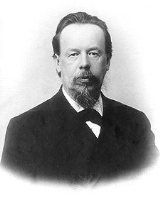
Alexander Stepanovich Popov

Encyclopedia
Alexander Stepanovich Popov was a Russia
n physicist
who was the first person to demonstrate the practical application of electromagnetic (radio
) waves.
Beginning in the early 1890s he continued the experiments of other radio
pioneers, such as Heinrich Hertz. In 1894 he built his first radio receiver, a version of the coherer
. Further refined as a lightning detector
, it was presented to the Russian Physical and Chemical Society on May 7, 1895—the day has been celebrated in the Russian Federation as "Radio Day
". The paper on his findings was published the same year. On March 24, 1896, he demonstrated transmission of radio waves between different campus buildings in St Petersburg. He demonstrated ship-to-shore communication over a distance of 6 miles in 1898 and 30 miles in 1899.
) in the Ural mountains
as the son of a priest, he became interested in natural sciences when he was a child. His father ensured that Alexander received a good education at the seminary at Perm
, and later studying physics at the St. Petersburg university
. After graduation in 1882 he started to work as a laboratory assistant at the university. However, due to the poor funding of the university he changed to a teaching job at the Russian Navy's Torpedo School in Kronstadt on Kotlin Island
.
. Further refined as a lightning detector
, it was presented to the Russian Physical and Chemical Society on May 7, 1895—the day has been celebrated in the Russian Federation as "Radio Day
". The paper on his findings was published the same year (December 15, 1895). He did not apply for a patent
for his invention
. In 1896, the article depicting Popov's invention was reprinted in the 'Journal of the Russian Physical and Chemical Society'. In March 1896, he effected transmission of radio waves between different campus buildings in St. Petersburg. In November 1897, the French entrepreneur
Eugene Ducretet made a transmitter
and receiver
based on wireless telegraphy
in his own laboratory. According to Ducretet, he built his device
s using Popov's lightning detector as a model. By 1898 Ducretet was manufacturing equipment of wireless telegraphy based on Popov's instructions. At the same time Popov effected ship-to-shore communication over a distance of 6 miles in 1898 and 30 miles in 1899.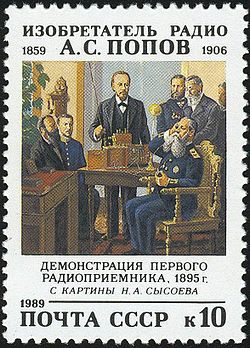 On December 18, 1897, Popov sent the telegram with the words "Heinrich Hertz".
In 1900 a radio station was established under Popov's instructions on Hogland
island (Suursaari) to provide two-way communication by wireless telegraphy between the Russian naval base and the crew of the battleship General-Admiral Apraksin. The battleship ran aground on Hogland island in the Gulf of Finland
in November, 1899. The crew of the Apraksin were not in immediate danger, but the water in the Gulf began to freeze. Due to bad weather and bureaucratic red tape, the crew of Apraksin did not arrive until January 1900 to establish a wireless station on Hogland Island. By February 5, however, messages were being received reliably. The wireless messages were relayed to Hogland Island by a station some 25 miles away at Kymi (nowadays Kotka
) on the Finnish
coast. Kotka was selected as the location for the wireless relay station because it was the point closest to Hogland Island served by telegraph wires connected to Russian naval headquarters
.
By the time the Apraksin was freed from the rocks by the icebreaker Yermak
at the end of April, 440 official telegraph messages had been handled by the Hogland Island wireless station. Besides the rescue of the Apraksin's crew, more than 50 Finnish fishermen, who were stranded on a piece of drift ice
in the Gulf of Finland, were saved by the icebreaker Yermak following distress telegrams sent by wireless telegraphy. In 1900, Popov stated (in front of the Congress of Russian Electrical Engineers),
In 1901 Alexander Popov was appointed as professor at the Electrotechnical Institute, which now bears his name. In 1905 he was elected director of the institute.
A minor planet
, 3074 Popov
, discovered by Soviet
astronomer Lyudmila Zhuravlyova
in 1979, is named after him.
At ITU Telecom World
2011, Mr. Igor Shchyogolev
, Minister of Telecom and Mass Communications of the Russian Federation alongside Dr. Hamadoun Touré
, Secretary General of the ITU
, inaugurated the "Alexander Stepanovich Popov" Boardroom at ITU's headquarters in Geneva
.
Russia
Russia or , officially known as both Russia and the Russian Federation , is a country in northern Eurasia. It is a federal semi-presidential republic, comprising 83 federal subjects...
n physicist
Physicist
A physicist is a scientist who studies or practices physics. Physicists study a wide range of physical phenomena in many branches of physics spanning all length scales: from sub-atomic particles of which all ordinary matter is made to the behavior of the material Universe as a whole...
who was the first person to demonstrate the practical application of electromagnetic (radio
Radio
Radio is the transmission of signals through free space by modulation of electromagnetic waves with frequencies below those of visible light. Electromagnetic radiation travels by means of oscillating electromagnetic fields that pass through the air and the vacuum of space...
) waves.
Beginning in the early 1890s he continued the experiments of other radio
Radio
Radio is the transmission of signals through free space by modulation of electromagnetic waves with frequencies below those of visible light. Electromagnetic radiation travels by means of oscillating electromagnetic fields that pass through the air and the vacuum of space...
pioneers, such as Heinrich Hertz. In 1894 he built his first radio receiver, a version of the coherer
Coherer
The coherer was a primitive form of radio signal detector used in the first radio receivers during the wireless telegraphy era at the beginning of the twentieth century. Invented around 1890 by French scientist Édouard Branly, it consisted of a tube or capsule containing two electrodes spaced a...
. Further refined as a lightning detector
Lightning detector
A lightning detector is a device that detects lightning produced by thunderstorms. There are three primary types of detectors: ground-based systems using multiple antennas, mobile systems using a direction and a sense antenna in the same location , and space-based systems.The device was invented in...
, it was presented to the Russian Physical and Chemical Society on May 7, 1895—the day has been celebrated in the Russian Federation as "Radio Day
Radio Day
Radio Day , Communications Workers' Day or Radio and Television Day is a commemoration of the development of radio in Russia...
". The paper on his findings was published the same year. On March 24, 1896, he demonstrated transmission of radio waves between different campus buildings in St Petersburg. He demonstrated ship-to-shore communication over a distance of 6 miles in 1898 and 30 miles in 1899.
Birth
Born in the village Turinskiye Rudniki (now Krasnoturinsk, Sverdlovsk OblastSverdlovsk Oblast
Sverdlovsk Oblast is a federal subject of Russia located in the Urals Federal District. Its administrative center is the city of Yekaterinburg formerly known as Sverdlovsk. Population: -Geography:...
) in the Ural mountains
Ural Mountains
The Ural Mountains , or simply the Urals, are a mountain range that runs approximately from north to south through western Russia, from the coast of the Arctic Ocean to the Ural River and northwestern Kazakhstan. Their eastern side is usually considered the natural boundary between Europe and Asia...
as the son of a priest, he became interested in natural sciences when he was a child. His father ensured that Alexander received a good education at the seminary at Perm
Perm
Perm is a city and the administrative center of Perm Krai, Russia, located on the banks of the Kama River, in the European part of Russia near the Ural Mountains. From 1940 to 1957 it was named Molotov ....
, and later studying physics at the St. Petersburg university
Saint Petersburg State University
Saint Petersburg State University is a Russian federal state-owned higher education institution based in Saint Petersburg and one of the oldest and largest universities in Russia....
. After graduation in 1882 he started to work as a laboratory assistant at the university. However, due to the poor funding of the university he changed to a teaching job at the Russian Navy's Torpedo School in Kronstadt on Kotlin Island
Kotlin Island
Kotlin is a Russian island, located near the head of the Gulf of Finland, west of Saint Petersburg in the Baltic Sea. Kotlin separates the Neva Bay from the rest of the gulf...
.
Radio
Beginning in the early 1890s he conducted experiments along the lines of Heinrich Hertz's research. In 1894 he built his first radio receiver, which contained a cohererCoherer
The coherer was a primitive form of radio signal detector used in the first radio receivers during the wireless telegraphy era at the beginning of the twentieth century. Invented around 1890 by French scientist Édouard Branly, it consisted of a tube or capsule containing two electrodes spaced a...
. Further refined as a lightning detector
Lightning detector
A lightning detector is a device that detects lightning produced by thunderstorms. There are three primary types of detectors: ground-based systems using multiple antennas, mobile systems using a direction and a sense antenna in the same location , and space-based systems.The device was invented in...
, it was presented to the Russian Physical and Chemical Society on May 7, 1895—the day has been celebrated in the Russian Federation as "Radio Day
Radio Day
Radio Day , Communications Workers' Day or Radio and Television Day is a commemoration of the development of radio in Russia...
". The paper on his findings was published the same year (December 15, 1895). He did not apply for a patent
Patent
A patent is a form of intellectual property. It consists of a set of exclusive rights granted by a sovereign state to an inventor or their assignee for a limited period of time in exchange for the public disclosure of an invention....
for his invention
Invention
An invention is a novel composition, device, or process. An invention may be derived from a pre-existing model or idea, or it could be independently conceived, in which case it may be a radical breakthrough. In addition, there is cultural invention, which is an innovative set of useful social...
. In 1896, the article depicting Popov's invention was reprinted in the 'Journal of the Russian Physical and Chemical Society'. In March 1896, he effected transmission of radio waves between different campus buildings in St. Petersburg. In November 1897, the French entrepreneur
Entrepreneur
An entrepreneur is an owner or manager of a business enterprise who makes money through risk and initiative.The term was originally a loanword from French and was first defined by the Irish-French economist Richard Cantillon. Entrepreneur in English is a term applied to a person who is willing to...
Eugene Ducretet made a transmitter
Transmitter
In electronics and telecommunications a transmitter or radio transmitter is an electronic device which, with the aid of an antenna, produces radio waves. The transmitter itself generates a radio frequency alternating current, which is applied to the antenna. When excited by this alternating...
and receiver
Receiver (radio)
A radio receiver converts signals from a radio antenna to a usable form. It uses electronic filters to separate a wanted radio frequency signal from all other signals, the electronic amplifier increases the level suitable for further processing, and finally recovers the desired information through...
based on wireless telegraphy
Wireless telegraphy
Wireless telegraphy is a historical term used today to apply to early radio telegraph communications techniques and practices, particularly those used during the first three decades of radio before the term radio came into use....
in his own laboratory. According to Ducretet, he built his device
Information appliance
In general terms, an information appliance or information device is any machine or device that is usable for the purposes of computing, telecommunicating, reproducing, and presenting encoded information in myriad forms and applications....
s using Popov's lightning detector as a model. By 1898 Ducretet was manufacturing equipment of wireless telegraphy based on Popov's instructions. At the same time Popov effected ship-to-shore communication over a distance of 6 miles in 1898 and 30 miles in 1899.
In 1900 a radio station was established under Popov's instructions on Hogland
Hogland
Gogland or Hogland is an island in the Gulf of Finland of the Baltic Sea, located some 180 km west of Saint Petersburg and 35 km away from the coast of Finland . The island is a part of the Leningrad Oblast, Russia. The area of Hogland Island is approximately...
island (Suursaari) to provide two-way communication by wireless telegraphy between the Russian naval base and the crew of the battleship General-Admiral Apraksin. The battleship ran aground on Hogland island in the Gulf of Finland
Gulf of Finland
The Gulf of Finland is the easternmost arm of the Baltic Sea. It extends between Finland and Estonia all the way to Saint Petersburg in Russia, where the river Neva drains into it. Other major cities around the gulf include Helsinki and Tallinn...
in November, 1899. The crew of the Apraksin were not in immediate danger, but the water in the Gulf began to freeze. Due to bad weather and bureaucratic red tape, the crew of Apraksin did not arrive until January 1900 to establish a wireless station on Hogland Island. By February 5, however, messages were being received reliably. The wireless messages were relayed to Hogland Island by a station some 25 miles away at Kymi (nowadays Kotka
Kotka
Kotka is a town and municipality of Finland. Its former name is Rochensalm.Kotka is located on the coast of the Gulf of Finland at the mouth of Kymi River and it is part of the Kymenlaakso region in southern Finland. The municipality has a population of and covers an area of of which is water....
) on the Finnish
Grand Duchy of Finland
The Grand Duchy of Finland was the predecessor state of modern Finland. It existed 1809–1917 as part of the Russian Empire and was ruled by the Russian czar as Grand Prince.- History :...
coast. Kotka was selected as the location for the wireless relay station because it was the point closest to Hogland Island served by telegraph wires connected to Russian naval headquarters
Russian Admiralty
Admiralty Board was a supreme body for the administration of the Imperial Russian Navy in the Russian Empire, established by Peter the Great on December 12, 1718, and headquartered in the Admiralty building, Saint Petersburg....
.
By the time the Apraksin was freed from the rocks by the icebreaker Yermak
Icebreaker Yermak
Yermak was a Russian and later Soviet icebreaker, the first polar icebreaker in the world, having a strengthened hull shaped to ride over and crush pack ice....
at the end of April, 440 official telegraph messages had been handled by the Hogland Island wireless station. Besides the rescue of the Apraksin's crew, more than 50 Finnish fishermen, who were stranded on a piece of drift ice
Drift ice
Drift ice is ice that floats on the surface of the water in cold regions, as opposed to fast ice, which is attached to a shore. Usually drift ice is carried along by winds and sea currents, hence its name, "drift ice"....
in the Gulf of Finland, were saved by the icebreaker Yermak following distress telegrams sent by wireless telegraphy. In 1900, Popov stated (in front of the Congress of Russian Electrical Engineers),
In 1901 Alexander Popov was appointed as professor at the Electrotechnical Institute, which now bears his name. In 1905 he was elected director of the institute.
Death and legacy
In 1905 he became seriously ill, after being very uneasy about the suppression of a student movement. He died of a brain hemorrhage on January 13, 1906.A minor planet
Minor planet
An asteroid group or minor-planet group is a population of minor planets that have a share broadly similar orbits. Members are generally unrelated to each other, unlike in an asteroid family, which often results from the break-up of a single asteroid...
, 3074 Popov
3074 Popov
3074 Popov is a main-belt asteroid discovered on December 24, 1979 by Lyudmila Zhuravlyova at Nauchnyj. It is named after Russian physicist Alexander Stepanovich Popov.- External links :...
, discovered by Soviet
Soviet Union
The Soviet Union , officially the Union of Soviet Socialist Republics , was a constitutionally socialist state that existed in Eurasia between 1922 and 1991....
astronomer Lyudmila Zhuravlyova
Lyudmila Zhuravlyova
Lyudmila Vasilyevna Zhuravleva is a Soviet, Russian and Ukrainian astronomer.She works at the Crimean Astrophysical Observatory.She also serves as president...
in 1979, is named after him.
At ITU Telecom World
ITU Telecom World
ITU Telecom is part of the ITU , the United Nations specialized agency for telecommunications. ITU Telecom organizes global events for the governments, industry leaders and regulators that form part of the world’s ICT community. The first ITU Telecom event was held in 1971 and marked its 40th...
2011, Mr. Igor Shchyogolev
Igor Shchyogolev
Igor Olegovich Shchyogolev is a Russian politician. Since May 12, 2008, he is Minister of Telecommunications of Russia.Shchyogolev is a graduate of the University of Leipzig.- References :* Ministry of Telecommunications of Russia....
, Minister of Telecom and Mass Communications of the Russian Federation alongside Dr. Hamadoun Touré
Hamadoun Touré
Dr. Hamadoun Touré of Mali has been Secretary General of the International Telecommunication Union , the specialized agency of the United Nations dedicated to information and communication technologies , since 2007. He was re-elected for a second four-year term in 2010...
, Secretary General of the ITU
Itu
Itu is an old and historic municipality in the state of São Paulo in Brazil. The population in 2009 was 157,384 and the area is 641.68 km². The elevation is 583 m. This place name comes from the Tupi language, meaning big waterfall. Itu is linked with the highway numbered the SP-75 and are flowed...
, inaugurated the "Alexander Stepanovich Popov" Boardroom at ITU's headquarters in Geneva
Geneva
Geneva In the national languages of Switzerland the city is known as Genf , Ginevra and Genevra is the second-most-populous city in Switzerland and is the most populous city of Romandie, the French-speaking part of Switzerland...
.
External links
- Aleksandr Popov, Soviet 1949 biopic watchable and downloadable with Esperanto subtitles
- Grave of A. Popov