

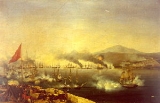
Battle of Navarino

Encyclopedia
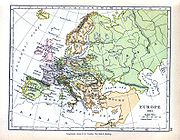
Greek War of Independence
The Greek War of Independence, also known as the Greek Revolution was a successful war of independence waged by the Greek revolutionaries between...
(1821–32) in Navarino Bay
Pylos
Pylos , historically known under its Italian name Navarino, is a town and a former municipality in Messenia, Peloponnese, Greece. Since the 2011 local government reform it is part of the municipality Pylos-Nestoras, of which it is the seat and a municipal unit. It was the capital of the former...
(modern-day Pylos
Pylos
Pylos , historically known under its Italian name Navarino, is a town and a former municipality in Messenia, Peloponnese, Greece. Since the 2011 local government reform it is part of the municipality Pylos-Nestoras, of which it is the seat and a municipal unit. It was the capital of the former...
), on the west coast of the Peloponnese
Peloponnese
The Peloponnese, Peloponnesos or Peloponnesus , is a large peninsula , located in a region of southern Greece, forming the part of the country south of the Gulf of Corinth...
peninsula, in the Ionian Sea
Ionian Sea
The Ionian Sea , is an arm of the Mediterranean Sea, south of the Adriatic Sea. It is bounded by southern Italy including Calabria, Sicily and the Salento peninsula to the west, southern Albania to the north, and a large number of Greek islands, including Corfu, Zante, Kephalonia, Ithaka, and...
. A combined Ottoman
Ottoman Empire
The Ottoman EmpireIt was usually referred to as the "Ottoman Empire", the "Turkish Empire", the "Ottoman Caliphate" or more commonly "Turkey" by its contemporaries...
and Egypt
Egypt
Egypt , officially the Arab Republic of Egypt, Arabic: , is a country mainly in North Africa, with the Sinai Peninsula forming a land bridge in Southwest Asia. Egypt is thus a transcontinental country, and a major power in Africa, the Mediterranean Basin, the Middle East and the Muslim world...
ian armada was destroyed by a combined British
British Empire
The British Empire comprised the dominions, colonies, protectorates, mandates and other territories ruled or administered by the United Kingdom. It originated with the overseas colonies and trading posts established by England in the late 16th and early 17th centuries. At its height, it was the...
, French
Bourbon Restoration
The Bourbon Restoration is the name given to the period following the successive events of the French Revolution , the end of the First Republic , and then the forcible end of the First French Empire under Napoleon – when a coalition of European powers restored by arms the monarchy to the...
and Russian
Russian Empire
The Russian Empire was a state that existed from 1721 until the Russian Revolution of 1917. It was the successor to the Tsardom of Russia and the predecessor of the Soviet Union...
naval force. It is notable for being the last major naval battle in history to be fought entirely with sailing ships. The northern Europe
Northern Europe
Northern Europe is the northern part or region of Europe. Northern Europe typically refers to the seven countries in the northern part of the European subcontinent which includes Denmark, Estonia, Latvia, Lithuania, Norway, Finland and Sweden...
an ships were better armed than their Egyptian, Algerian and Ottoman opponents and their crews were better trained, contributing to a complete victory.
The central factor which precipitated the intervention of the three European great power
Great power
A great power is a nation or state that has the ability to exert its influence on a global scale. Great powers characteristically possess military and economic strength and diplomatic and cultural influence which may cause small powers to consider the opinions of great powers before taking actions...
s in the Greek conflict were Russia
Russia
Russia or , officially known as both Russia and the Russian Federation , is a country in northern Eurasia. It is a federal semi-presidential republic, comprising 83 federal subjects...
's ambitions to expand in the Black Sea
Black Sea
The Black Sea is bounded by Europe, Anatolia and the Caucasus and is ultimately connected to the Atlantic Ocean via the Mediterranean and the Aegean seas and various straits. The Bosphorus strait connects it to the Sea of Marmara, and the strait of the Dardanelles connects that sea to the Aegean...
region at the expense of the Ottoman Empire and her emotional support for the fellow-Orthodox Christian
Orthodox Christianity
The term Orthodox Christianity may refer to:* the Eastern Orthodox Church and its various geographical subdivisions...
Greeks, who had rebelled against their Ottoman overlords in 1821. As Russia's intentions in the region were seen as a major geostrategic
Geostrategy
Geostrategy, a subfield of geopolitics, is a type of foreign policy guided principally by geographical factors as they inform, constrain, or affect political and military planning...
threat by the other powers, British and Austro-Hungarian diplomacy aimed at preventing Russian intervention in the hope that the Ottoman government would succeed in suppressing the rebellion. But in late 1825, the accession to the Russian throne of Tsar
Tsar
Tsar is a title used to designate certain European Slavic monarchs or supreme rulers. As a system of government in the Tsardom of Russia and Russian Empire, it is known as Tsarist autocracy, or Tsarism...
Nicholas I
Nicholas I of Russia
Nicholas I , was the Emperor of Russia from 1825 until 1855, known as one of the most reactionary of the Russian monarchs. On the eve of his death, the Russian Empire reached its historical zenith spanning over 20 million square kilometers...
, who adopted a more aggressive Balkan policy, forced Britain
United Kingdom
The United Kingdom of Great Britain and Northern IrelandIn the United Kingdom and Dependencies, other languages have been officially recognised as legitimate autochthonous languages under the European Charter for Regional or Minority Languages...
to intervene, for fear that an unrestrained Russia would dismantle the Ottoman Empire altogether and establish Russian hegemony in the Near East
Near East
The Near East is a geographical term that covers different countries for geographers, archeologists, and historians, on the one hand, and for political scientists, economists, and journalists, on the other...
. France
France
The French Republic , The French Republic , The French Republic , (commonly known as France , is a unitary semi-presidential republic in Western Europe with several overseas territories and islands located on other continents and in the Indian, Pacific, and Atlantic oceans. Metropolitan France...
joined the other two powers in order to restore her leading role in European affairs after her defeat in the Napoleonic Wars
Napoleonic Wars
The Napoleonic Wars were a series of wars declared against Napoleon's French Empire by opposing coalitions that ran from 1803 to 1815. As a continuation of the wars sparked by the French Revolution of 1789, they revolutionised European armies and played out on an unprecedented scale, mainly due to...
. The governments of all three powers were also under intense pressure from their home public opinion to help the Christian
Christian
A Christian is a person who adheres to Christianity, an Abrahamic, monotheistic religion based on the life and teachings of Jesus of Nazareth as recorded in the Canonical gospels and the letters of the New Testament...
Greeks, especially after the invasion of the Peloponnese
Peloponnese
The Peloponnese, Peloponnesos or Peloponnesus , is a large peninsula , located in a region of southern Greece, forming the part of the country south of the Gulf of Corinth...
in 1825 by Ottoman vassal Ibrahim Pasha of Egypt
Ibrahim Pasha of Egypt
Ibrahim Pasha was the eldest son of Muhammad Ali, the Wāli and unrecognised Khedive of Egypt and Sudan. He served as a general in the Egyptian army that his father established during his reign, taking his first command of Egyptian forces was when he was merely a teenager...
and the atrocities committed by his forces against the indigenous population.
The Powers agreed, by the Treaty of London (1827), to force the Ottoman government to grant autonomy within the empire to the Greeks and despatched naval squadrons to the eastern Mediterranean Sea
Mediterranean Sea
The Mediterranean Sea is a sea connected to the Atlantic Ocean surrounded by the Mediterranean region and almost completely enclosed by land: on the north by Anatolia and Europe, on the south by North Africa, and on the east by the Levant...
to enforce their policy. The naval battle happened more by accident than by design as a result of a manoeuvre by the Powers' commander-in-chief
Commander-in-Chief
A commander-in-chief is the commander of a nation's military forces or significant element of those forces. In the latter case, the force element may be defined as those forces within a particular region or those forces which are associated by function. As a practical term it refers to the military...
Admiral Edward Codrington
Edward Codrington
Admiral Sir Edward Codrington GCB RN was a British admiral, hero of the Battle of Trafalgar and the Battle of Navarino.-Early life and career:...
aimed at coercing Ibrahim to obey their instructions. The sinking of the Ottomans' Mediterranean fleet saved the fledgling Greek Republic
First Hellenic Republic
The First Hellenic Republic is a name used to refer to the provisional Greek state during the Greek War of Independence against the Ottoman Empire...
from collapse. But it required two more military interventions, by Russia in the form of the Russo-Turkish War of 1828-9 and by a French expeditionary force
Morea expedition
The Morea expedition is the name given in France to the land intervention of the French Army in the Peloponnese, between 1828 and 1833, at the time of the Greek War of Independence....
to the Peloponnese to force the withdrawal of Ottoman forces from central and southern Greece
Greece
Greece , officially the Hellenic Republic , and historically Hellas or the Republic of Greece in English, is a country in southeastern Europe....
and to secure Greek independence.
Background: the Greek revolt
The context of the Battle of Navarino was the Greek War of IndependenceGreek War of Independence
The Greek War of Independence, also known as the Greek Revolution was a successful war of independence waged by the Greek revolutionaries between...
. This had begun in 1821 as an uprising by Greek nationalists against the Ottoman Empire
Ottoman Empire
The Ottoman EmpireIt was usually referred to as the "Ottoman Empire", the "Turkish Empire", the "Ottoman Caliphate" or more commonly "Turkey" by its contemporaries...
, which had ruled Greece for over three centuries.
By 1827, the Greek rebellion seemed close to failure. In 1825, Ottoman Sultan
Sultan
Sultan is a title with several historical meanings. Originally, it was an Arabic language abstract noun meaning "strength", "authority", "rulership", and "dictatorship", derived from the masdar سلطة , meaning "authority" or "power". Later, it came to be used as the title of certain rulers who...
Mahmud II
Mahmud II
Mahmud II was the 30th Sultan of the Ottoman Empire from 1808 until his death in 1839. He was born in the Topkapi Palace, Istanbul, the son of Sultan Abdulhamid I...
(ruled 1808-39) had succeeded in breaking the stalemate
Stalemate
Stalemate is a situation in chess where the player whose turn it is to move is not in check but has no legal moves. A stalemate ends the game in a draw. Stalemate is covered in the rules of chess....
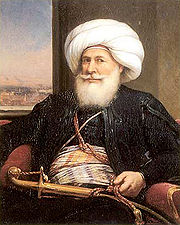
that the war had reached. He persuaded his powerful wali (viceroy) of Egypt, Muhammad Ali Pasha
Muhammad Ali of Egypt
Muhammad Ali Pasha al-Mas'ud ibn Agha was a commander in the Ottoman army, who became Wāli, and self-declared Khedive of Egypt and Sudan...
(ruled 1805-49), who was technically his vassal
Vassal
A vassal or feudatory is a person who has entered into a mutual obligation to a lord or monarch in the context of the feudal system in medieval Europe. The obligations often included military support and mutual protection, in exchange for certain privileges, usually including the grant of land held...
but in practice semi-independent, to deploy his Western-trained and equipped army and navy against the Greeks. In return, the Sultan promised to grant the rebel heartland, the Peloponnese, as a hereditary fief to Ali's adopted son, Ibrahim
Ibrahim Pasha of Egypt
Ibrahim Pasha was the eldest son of Muhammad Ali, the Wāli and unrecognised Khedive of Egypt and Sudan. He served as a general in the Egyptian army that his father established during his reign, taking his first command of Egyptian forces was when he was merely a teenager...
(whose natural parents were ethnic Greeks). In February 1825, Ibrahim led an expeditionary force of 16,000 into the Peloponnese, and soon overran its western part; he failed, however, to take the eastern section, where the rebel government was based (at Nafplion
Nafplion
Nafplio is a seaport town in the Peloponnese in Greece that has expanded up the hillsides near the north end of the Argolic Gulf. The town was the first capital of modern Greece, from the start of the Greek Revolution in 1821 until 1834. Nafplio is now the capital of the peripheral unit of...
). Ibrahim's forces then moved onto the Greek mainland, capturing the pivotal strongholds of the Acropolis of Athens
Acropolis of Athens
The Acropolis of Athens or Citadel of Athens is the best known acropolis in the world. Although there are many other acropoleis in Greece, the significance of the Acropolis of Athens is such that it is commonly known as The Acropolis without qualification...
and, in April 1826, despite a heroic Greek defence, Missolonghi, which controlled the entrance to the Gulf of Corinth
Gulf of Corinth
The Gulf of Corinth or the Corinthian Gulf is a deep inlet of the Ionian Sea separating the Peloponnese from western mainland Greece...
. In response to Greek guerrilla attacks on his forces in the Peloponnese, Ibrahim launched a campaign of deporting civilians to slavery in Egypt and a scorched earth
Scorched earth
A scorched earth policy is a military strategy or operational method which involves destroying anything that might be useful to the enemy while advancing through or withdrawing from an area...
policy which threatened the population with starvation. He also brought in Arab settlers, allegedly aiming ultimately to replace the indigenous population.
The Greek rebels, whose motto was ελευθερία ή θάνατος (eleftheria i thanatos: "freedom or death"), remained defiant, appointing experienced philhellenic British and French officers to command their forces: Maj Sir Richard Church (C-in-C) and Col C. Fabvier (land); Adm Lord Cochrane
Thomas Cochrane, 10th Earl of Dundonald
Admiral Thomas Cochrane, 10th Earl of Dundonald, 1st Marquess of Maranhão, GCB, ODM , styled Lord Cochrane between 1778 and 1831, was a senior British naval flag officer and radical politician....
(C-in-C) and Capt F.A. Hastings
Frank Abney Hastings
Frank Abney Hastings was a British naval officer and Philhellene.- Early career :He was the son of Lieut.-general Sir Charles Hastings of Willesley Hall, a natural son of Francis Hastings, 10th Earl of Huntingdon...
(sea). By that time however, the Greek provisional government
First Hellenic Republic
The First Hellenic Republic is a name used to refer to the provisional Greek state during the Greek War of Independence against the Ottoman Empire...
's land and sea forces were far inferior to those of the Ottomans, Algerians and Egyptians: in 1827, Greek regular troops numbered less than 5,000, compared to 25,000 Ottomans in central Greece and 15,000 Ottomans/Egyptians/Algerians in the Peloponnese. Also, the Greek government was virtually bankrupt. Many of the key fortresses on what little territory it controlled were in Ottoman hands. It seemed only a matter of time before the Greeks were forced to capitulate.
At this critical juncture, the Greek cause was rescued by the decision of three European great powers, Great Britain, France and Russia, to intervene jointly in the conflict.
Motives of the Great Powers
The Greek rebellion took place in the aftermath of the Napoleonic WarsNapoleonic Wars
The Napoleonic Wars were a series of wars declared against Napoleon's French Empire by opposing coalitions that ran from 1803 to 1815. As a continuation of the wars sparked by the French Revolution of 1789, they revolutionised European armies and played out on an unprecedented scale, mainly due to...
, which ended in 1815. The victorious Allied Powers were determined to ensure that there could be no repetition of the French Revolution
French Revolution
The French Revolution , sometimes distinguished as the 'Great French Revolution' , was a period of radical social and political upheaval in France and Europe. The absolute monarchy that had ruled France for centuries collapsed in three years...
, and Napoleon's subsequent attempt to export it to the rest of Europe. At the Congress of Vienna
Congress of Vienna
The Congress of Vienna was a conference of ambassadors of European states chaired by Klemens Wenzel von Metternich, and held in Vienna from September, 1814 to June, 1815. The objective of the Congress was to settle the many issues arising from the French Revolutionary Wars, the Napoleonic Wars,...
was born the Conservative Order
Conservative Order
The Conservative Order is a term applied to European political history after the defeat of Napoleon in 1815. From 1815 to 1830 a conscious program by conservative statesmen, including Metternich and Castlereagh, was put in place to contain revolution and revolutionary forces by restoring old...
, the principle that the legitimate monarchies of Europe should be inviolable, in both their constitution and territory. The new order was to be defended by the great powers acting in concert, after negotiations at periodic conferences. This process became known as the Congress system.
But the Greek rebellion presented the new order with a significant challenge. Prima facie, the Greek revolt was a violation of the principle, as it involved a revolt against a legitimate monarchy and an attempt by a part of its territory to secede. This was certainly the position adopted by the two chief architects (and enforcers) of the Congress system, British foreign secretary Viscount Castlereagh
Robert Stewart, Viscount Castlereagh
Robert Stewart, 2nd Marquess of Londonderry, KG, GCH, PC, PC , usually known as Lord CastlereaghThe name Castlereagh derives from the baronies of Castlereagh and Ards, in which the manors of Newtownards and Comber were located...
and Austrian chancellor
Chancellor
Chancellor is the title of various official positions in the governments of many nations. The original chancellors were the Cancellarii of Roman courts of justice—ushers who sat at the cancelli or lattice work screens of a basilica or law court, which separated the judge and counsel from the...
Prince von Metternich. But it was disputed, especially by the Russians, whether the principle applied to a non-Christian "Asiatic" power such as the Ottoman Empire. The Greek issue thus became entangled in the Eastern Question
Eastern Question
The "Eastern Question", in European history, encompasses the diplomatic and political problems posed by the decay of the Ottoman Empire. The expression does not apply to any one particular problem, but instead includes a variety of issues raised during the 18th, 19th, and 20th centuries, including...
. The Eastern Question
Eastern Question
The "Eastern Question", in European history, encompasses the diplomatic and political problems posed by the decay of the Ottoman Empire. The expression does not apply to any one particular problem, but instead includes a variety of issues raised during the 18th, 19th, and 20th centuries, including...
was the term used to denote the great power diplomacy surrounding the decline of the Ottoman Empire.
Although it is often referred to as the Turkish
Turkish people
Turkish people, also known as the "Turks" , are an ethnic group primarily living in Turkey and in the former lands of the Ottoman Empire where Turkish minorities had been established in Bulgaria, Cyprus, Bosnia and Herzegovina, Georgia, Greece, Kosovo, Macedonia, and Romania...
empire, the name Ottoman, derived from the name of the ruling dynasty, is more appropriate. The Ottomans
Ottoman Empire
The Ottoman EmpireIt was usually referred to as the "Ottoman Empire", the "Turkish Empire", the "Ottoman Caliphate" or more commonly "Turkey" by its contemporaries...
conquered the old Greek-controlled Byzantine empire
Byzantine Empire
The Byzantine Empire was the Eastern Roman Empire during the periods of Late Antiquity and the Middle Ages, centred on the capital of Constantinople. Known simply as the Roman Empire or Romania to its inhabitants and neighbours, the Empire was the direct continuation of the Ancient Roman State...
during the Middle Ages, taking over its territory and its capital, Constantinople
Constantinople
Constantinople was the capital of the Roman, Eastern Roman, Byzantine, Latin, and Ottoman Empires. Throughout most of the Middle Ages, Constantinople was Europe's largest and wealthiest city.-Names:...
, and becoming its effective successor-state. Ethnic Turks were the "master-nation" of the empire, holding political and military power, but were a minority of the empire's population even of its Muslim inhabitants, as they were outnumbered by their Arab subjects. Furthermore, although officially Islamic, its Christian inhabitants (Balkan, Armenian
Armenians
Armenian people or Armenians are a nation and ethnic group native to the Armenian Highland.The largest concentration is in Armenia having a nearly-homogeneous population with 97.9% or 3,145,354 being ethnic Armenian....
and Christian Arab) represented roughly half the total population. Although granted freedom of worship and generally better treated than non-Christians in most European countries, non-Muslims in the Ottoman empire were required, in accordance with Islamic law, to pay a special poll tax
Poll tax
A poll tax is a tax of a portioned, fixed amount per individual in accordance with the census . When a corvée is commuted for cash payment, in effect it becomes a poll tax...
, the jizya
Jizya
Under Islamic law, jizya or jizyah is a per capita tax levied on a section of an Islamic state's non-Muslim citizens, who meet certain criteria...
, which in times of poor harvests was a crippling burden on mainly subsistence-level peasants. Under the hated devşirme (military levy), Christian communities were also forced to surrender 1 in 5 pre-adolescent boys to the Ottoman military. These would be permanently separated from their families, raised as Muslims and trained to a high standard to staff the best regiments of the Ottoman army, including the elite Janissary
Janissary
The Janissaries were infantry units that formed the Ottoman sultan's household troops and bodyguards...
corps.
The Ottoman empire had once been the foremost military power in Europe, reaching its apogee in the 16th and 17th centuries, when it threatened the whole continent. Its armies overran the entire Balkan peninsula and reached the borders of Austria, laying siege to Vienna
Vienna
Vienna is the capital and largest city of the Republic of Austria and one of the nine states of Austria. Vienna is Austria's primary city, with a population of about 1.723 million , and is by far the largest city in Austria, as well as its cultural, economic, and political centre...
itself twice (in 1529 and 1683). Its fleets dominated the Mediterranean. But the Ottomans had gradually fallen behind the other European powers as they failed to modernise their political institutions, economic system and military forces. During the 18th century, the Ottoman Empire steadily lost territory in eastern Europe to the neighbouring Austrian and Russian empires (which annexed Hungary and southern Russia respectively). By the turn of the 19th century, the Ottoman Empire was the most economically backward and militarily weak of the great powers. But its territory, even after the continuous retreats, remained vast and strategic: it encompassed the Balkans, Anatolia, and all the Arab lands from Persia to Morocco
Morocco
Morocco , officially the Kingdom of Morocco , is a country located in North Africa. It has a population of more than 32 million and an area of 710,850 km², and also primarily administers the disputed region of the Western Sahara...
. The latter were seen by London as having crucial geo-strategic significance, long before their petroleum
Petroleum
Petroleum or crude oil is a naturally occurring, flammable liquid consisting of a complex mixture of hydrocarbons of various molecular weights and other liquid organic compounds, that are found in geologic formations beneath the Earth's surface. Petroleum is recovered mostly through oil drilling...
deposits became a vital industrial commodity in the early 20th century, as they constituted the link between the Mediterranean and Britain's empire in India
India
India , officially the Republic of India , is a country in South Asia. It is the seventh-largest country by geographical area, the second-most populous country with over 1.2 billion people, and the most populous democracy in the world...
.
For the Ottoman government, commonly known in diplomatic circles of the time as the "Porte" (from La Porte Sublime - "The Sublime Gate" -
the French name of the gate on the Bosporus
Bosporus
The Bosphorus or Bosporus , also known as the Istanbul Strait , is a strait that forms part of the boundary between Europe and Asia. It is one of the Turkish Straits, along with the Dardanelles...
of the Topkapı Palace
Topkapi Palace
The Topkapı Palace is a large palace in Istanbul, Turkey, that was the primary residence of the Ottoman Sultans for approximately 400 years of their 624-year reign....
through which foreign envoys were admitted), Greece was a core province. Its loss could not be contemplated, unlike the Romanian Principalities and Serbia, which were seen as more peripheral. The fear of the Porte was that the secession of even a small part of Greece such as the Peloponnese would lead to demands by Greek nationalists for the liberation of all the other regions of the empire containing Greek majorities, including central Greece, Macedonia, Thrace, Constantinople itself, western Anatolia
Anatolia
Anatolia is a geographic and historical term denoting the westernmost protrusion of Asia, comprising the majority of the Republic of Turkey...
, the Aegean islands and Crete and Cyprus, threatening the empire's very existence. In addition, the Greeks were economically critical, as they dominated the empire's trade through their ownership of much of its merchant shipping. On a personal level, the Sultan
Sultan
Sultan is a title with several historical meanings. Originally, it was an Arabic language abstract noun meaning "strength", "authority", "rulership", and "dictatorship", derived from the masdar سلطة , meaning "authority" or "power". Later, it came to be used as the title of certain rulers who...
(emperor) of the Ottoman empire, Mahmud II
Mahmud II
Mahmud II was the 30th Sultan of the Ottoman Empire from 1808 until his death in 1839. He was born in the Topkapi Palace, Istanbul, the son of Sultan Abdulhamid I...
(ruled 1808-39), considered the Greek revolt a monstrous betrayal by a conquered nation that the Porte had always treated generously (by the standards of the time). The Sultan vented his fury on the Greeks' spiritual leader, the Patriarch of Constantinople
Patriarch of Constantinople
The Ecumenical Patriarch is the Archbishop of Constantinople – New Rome – ranking as primus inter pares in the Eastern Orthodox communion, which is seen by followers as the One, Holy, Catholic, and Apostolic Church....
, Gregory V
Patriarch Gregory V of Constantinople
Gregory V was Ecumenical Patriarch of Constantinople from 1797 to 1798, from 1806 to 1808 and from 1818 to 1821. He was responsible for much restoration work to the Patriarchal Cathedral of St George, which had been badly damaged by fire in 1738...
, whom he suspected of colluding with the rebels. As the Patriarch emerged from his cathedral, in full regalia, after celebrating Easter Mass in April 1821, he was seized by Janissary Guards and hanged on the spot, from the cathedral gates. After dangling for three days, his corpse was dragged through the streets and flung into the Bosporus.
The most pro-Greek power was Russia. As the sole Orthodox Christian great power, Russia had long seen herself as the protector (and potential liberator) of the Balkan subjects of the Ottoman Empire, the Romanians, Bulgarians, Serbs and Greeks, who were predominantly of the Orthodox faith. The Serbs and Bulgarians were also fellow Slavic
Slavic languages
The Slavic languages , a group of closely related languages of the Slavic peoples and a subgroup of Indo-European languages, have speakers in most of Eastern Europe, in much of the Balkans, in parts of Central Europe, and in the northern part of Asia.-Branches:Scholars traditionally divide Slavic...
speakers. This emotional bond dovetailed neatly with Russia's geostrategic interests. Supporting a breakaway Greek state, which would be a natural ally of Russia, was an obvious way to advance Russian influence in south-east Europe. In addition, wealthy Greek phanariote aristocratic clans, which largely controlled Russia's Black Sea trade, had substantial political and commercial influence in Russia. The main problem for supporters of Greece in Russia was that Greece was only one of several issues that were in contention between St Petersburg and the Porte: others included Russia's attempt to impose a protectorate over the Danubian principalities and Serbia, its demands for control of the principalities' Black Sea ports, the right of Russian warships to sail through the Bosporus, and Russia's annexation of territories in the Caucasus.
The decisive Russian triumph in the Russo-Turkish War of 1768-74, which brought enormous lands in the Black Sea region as far as the Caucasus
Caucasus
The Caucasus, also Caucas or Caucasia , is a geopolitical region at the border of Europe and Asia, and situated between the Black and the Caspian sea...
under Russian control, resulted in a great fear of Russian expansion on the part of the other great powers, especially Austria and Great Britain. Austrian foreign policy underwent a complete volte-face. For centuries the Porte's arch-enemies, the Austrians, who were threatened with encirclement by Russian ambitions in the Balkans, from the late 18th century onwards became strong supporters of the Ottoman empire's integrity. In this they were joined by Britain, whose leaders feared that the Russians ultimately aimed to relieve Britain of its empire in India and to create a Eurasian superpower. The British government was concerned that a successful Greek secession could trigger a series of nationalist revolts that could lead to the disintegration of the Ottoman Empire, leaving an enormous power vacuum which the Russians were best-placed to fill. When the Greek revolt broke out in 1821, the British Cabinet was dominated by the "High Tory" faction of the ruling Tory party, including Castlereagh, Lord Liverpool (prime minister) and Duke of Wellington, the victor of the Battle of Waterloo
Battle of Waterloo
The Battle of Waterloo was fought on Sunday 18 June 1815 near Waterloo in present-day Belgium, then part of the United Kingdom of the Netherlands...
and now Master General of Ordnance. These men were resolute supporters of Ottoman territorial integrity.
The French government's involvement had somewhat confused motives. France's defeat in the Napoleonic Wars had confirmed Britain's naval supremacy in the Mediterranean. The guiding motive of French policy in the Mediterranean thus remained the same as Napoleon's had been before 1815: to challenge Britain's hegemony, but this time by diplomacy rather than by war. As Napoleon had done with his expedition in 1798, the French government focused on Egypt. France had equipped and trained a modern army and navy for Muhammad Ali Pasha's regime, a policy viewed with intense suspicion by London. It was felt that a likely consequence, intended or not, was Egyptian secession from the Ottoman Empire (which indeed eventually happened). The Paris government also adopted in the East, almost on principle, policies opposed by London, such as favouring great power intervention in the Greek conflict. Inconsistently, however, Paris shared London's concern about Russian expansionism and also supported, at least formally, Ottoman territorial integrity.
Despite their lack of enthusiasm for the rebellion, the British and French governments were under mounting pressure from their home public opinion
Public opinion
Public opinion is the aggregate of individual attitudes or beliefs held by the adult population. Public opinion can also be defined as the complex collection of opinions of many different people and the sum of all their views....
to assist the Greeks. Whatever the geostrategic implications of their revolt, the Greeks, in the eyes of most Britons and Frenchmen, were gallant Christian fighters struggling to free themselves from a corrupt and oppressive Islamic tyranny. In an era when nationalism was inextricably linked to liberalism, the Greek insurgency became a rallying-cry for liberals all over Europe, and especially for French liberals, whose political action at home were severely restricted by the Bourbon
House of Bourbon
The House of Bourbon is a European royal house, a branch of the Capetian dynasty . Bourbon kings first ruled Navarre and France in the 16th century. By the 18th century, members of the Bourbon dynasty also held thrones in Spain, Naples, Sicily, and Parma...
monarchy restored to power by the Allied powers in 1815. Both London and Paris hosted powerful philhellenic committees, supported by prominent and wealthy personalities, such as the romantic poet Lord Byron in England (who died fighting for the Greek cause in 1824) and the writers Chateaubriand and Victor Hugo
Victor Hugo
Victor-Marie Hugo was a Frenchpoet, playwright, novelist, essayist, visual artist, statesman, human rights activist and exponent of the Romantic movement in France....
in France. The Committees raised large sums of money for the Greek rebels, agitated in the press and equipped and despatched hundreds of volunteers to fight in Greece. Popular pressure for intervention intensified after Ibrahim Pasha's brutal invasion of the Peloponnese. The atrocities committed by his forces, loudly advertised and greatly exaggerated in the liberal press, sparked a furore throughout Europe. Ibrahim was denounced in the French press as Le Sanguinaire ("The Bloodthirsty One"). This was acutely embarrassing to the French government, which had equipped and trained the Egyptian forces. The Greek revolt was probably the first occasion in European history when public opinion had a decisive impact on great power foreign policy.
Both the Russian and French governments had to contend with the basic strategic fact that providing naval assistance to the Greeks was not practicable without British consent, because of Britain's naval supremacy in the Mediterranean. Britain's crushing naval victories over France and Spain in the Napoleonic Wars had turned the Mediterranean into a British lake, closely controlled by a string of strategic bases from Gibraltar to the Ionian islands
Ionian Islands
The Ionian Islands are a group of islands in Greece. They are traditionally called the Heptanese, i.e...
, which Britain had taken over from the French in 1815 and were the only part of Greece not under Ottoman rule. This meant that any French intervention was in effect subject to a British veto. But the Russians had an alternative option, beyond Britain's veto, of attacking the Ottoman Empire by land across the Danube.
Great Power diplomacy

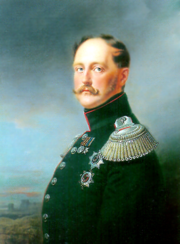
This diplomacy was initially successful because the reigning Tsar
Tsar
Tsar is a title used to designate certain European Slavic monarchs or supreme rulers. As a system of government in the Tsardom of Russia and Russian Empire, it is known as Tsarist autocracy, or Tsarism...
, Alexander I
Alexander I of Russia
Alexander I of Russia , served as Emperor of Russia from 23 March 1801 to 1 December 1825 and the first Russian King of Poland from 1815 to 1825. He was also the first Russian Grand Duke of Finland and Lithuania....
(r.1801-25), was reluctant to support any revolutionary movement because of his experience during the Napoleonic Wars. Despite fervent support for the Greek cause in Russian nationalist circles, Alexander proved unwilling to defy Metternich and Castlereagh and offer the Greeks more than (limited) diplomatic support. Indeed, at the Congress of Verona (1822)
Congress of Verona
The Congress of Verona met at Verona on October 20, 1822 as part of the series of international conferences or congresses that opened with the Congress of Vienna in 1814-15, which had instituted the Concert of Europe at the close of the Napoleonic Wars....
, Castlereagh persuaded Tsar Alexander to ignore the Greek cause altogether, even refusing to admit a Greek delegation to the conference. In the same year, Alexander also forced the resignation of his ethnic Venetian/Greek foreign minister, Count Capo d'Istria (Ioannis Kapodistrias, later president of the First Hellenic Republic), for his passionate advocacy of the Greek cause. In 1824 the Tsar proposed a plan for Greek autonomy to the other powers. But it was clear that he was simply not prepared to act unilaterally.
In 1822, Castlereagh was succeeded as foreign secretary by George Canning
George Canning
George Canning PC, FRS was a British statesman and politician who served as Foreign Secretary and briefly Prime Minister.-Early life: 1770–1793:...
, to Metternich's dismay. Canning was a liberal Tory, and hostile to the conservative Tory faction led by Wellington. He had even fought a duel with Castlereagh in 1809 over policy disagreements. He detested Metternich's intrigues and was more sympathetic to the Greeks, having joined the London Philhellenic Committee. Nevertheless, until 1826 his policy remained the same as Castlereagh's: non-intervention.
But the Ottomans proved unable to suppress the revolt during the long period of non-intervention secured by British and Austrian diplomacy. By the time the Ottomans were making serious progress, it was too late. In December 1825, the diplomatic landscape changed with the death of Tsar Alexander and the succession of his younger brother Nicholas I
Nicholas I of Russia
Nicholas I , was the Emperor of Russia from 1825 until 1855, known as one of the most reactionary of the Russian monarchs. On the eve of his death, the Russian Empire reached its historical zenith spanning over 20 million square kilometers...
(r. 1825-55). Still only 30 years old, Nicholas was a more decisive and risk-taking character than his brother, as well as being far more nationalistic. In foreign policy, he adopted a two-faced stance. In Europe, he became notorious as a ferocious defender of the established order, earning the sobriquet of "the gendarme of Europe" by his willingness to despatch troops as far away as Italy to help crush liberal revolutions. But in the East, he eagerly adopted the mantle of Orthodox crusader and liberator. In this regard, he did not share his brother's aversion to unilateral action. In diplomatic circles, it was now widely believed that it was only a matter of time before the Russians went to war against the Porte.
Canning's response to the new situation was to move towards joint intervention: if intervention by Russia was inevitable, then he intended to ensure that it be constrained within parameters acceptable to Britain. He promoted a solution essentially the same as Tsar Alexander's: Greek autonomy
Autonomy
Autonomy is a concept found in moral, political and bioethical philosophy. Within these contexts, it is the capacity of a rational individual to make an informed, un-coerced decision...
under Ottoman suzerainty
Suzerainty
Suzerainty occurs where a region or people is a tributary to a more powerful entity which controls its foreign affairs while allowing the tributary vassal state some limited domestic autonomy. The dominant entity in the suzerainty relationship, or the more powerful entity itself, is called a...
. The formula was enough to satisfy the Russians, while for the British it had the attraction of preserving Ottoman territorial integrity. A protocol centred on this proposal and envisaging the powers' mediation was signed by Britain and Russia in April 1826. This was a turning-point in British policy, as it envisaged intervention for the first time. The Tsar then surprised the British by making the protocol public (although it was intended only as a first step in a process leading to a formal treaty) and using it as a lever to pressure the Porte. However, neither the Tsar nor the Porte were yet ready for war. Both governments were in the process of modernising their armies, and the Tsar was also concerned with internal unrest in the wake of the Decembrist coup attempt which had nearly prevented his accession. As a result, both settled for a compromise, signing the Convention of Akkerman in October 1826. In return for the Tsar dropping the Greek issue from the negotiations, the Sultan conceded long-standing Russian demands as regards the Romanian Principalities and Serbia.
The Porte probably believed it had bought off Russian support for the Greeks, neutralising the Anglo-Russian protocol of April. But Tsar Nicholas had no intention of forgetting Greece. Negotiations proceeded on a formal treaty based on the protocol, now with France included. (Metternich refused an invitation to participate, and continued to support the Porte). But progress stalled, largely because of continuing opposition within the British Cabinet to intervention, led by the Duke of Wellington. The Tsar became impatient, stepping up pressure on Britain by despatching in October 1826 a naval squadron to the Mediterranean from St Petersburg, which pointedly visited the British naval base of Portsmouth
Portsmouth
Portsmouth is the second largest city in the ceremonial county of Hampshire on the south coast of England. Portsmouth is notable for being the United Kingdom's only island city; it is located mainly on Portsea Island...
en route. This implied threat of unilateral action by Russia strengthened Canning's hand in the Cabinet: when, in April 1827, Liverpool was obliged by illness to step down as prime minister, Canning won the contest to succeed him. Wellington promptly resigned, clearing the way for a treaty to be concluded.
Treaty of London
The three Powers signed the Treaty of LondonTreaty of London, 1827
The Treaty of London was signed by the United Kingdom, France, and Russia on 6 July 1827. The three main European powers had called upon Greece and the Ottoman Empire to cease hostilities. The Greeks had revolted against Ottoman rule on March 6, 1821. The revolt had continued since that time...
on 6 July 1827. Citing the disruption of trade in the Levant caused by the war as the justification for allied intervention, the treaty called for an immediate armistice
Armistice
An armistice is a situation in a war where the warring parties agree to stop fighting. It is not necessarily the end of a war, but may be just a cessation of hostilities while an attempt is made to negotiate a lasting peace...
between the belligerents, in effect demanding a cessation of Ottoman military operations in Greece just when the Ottomans had victory in their grasp. It also offered Allied mediation in the negotiations on a final settlement that were to follow the armistice.
The treaty called on the Porte to grant the Greeks autonomy. The treaty envisaged Greece remaining under Ottoman suzerainty, and paying an annual tribute
Tribute
A tribute is wealth, often in kind, that one party gives to another as a sign of respect or, as was often the case in historical contexts, of submission or allegiance. Various ancient states, which could be called suzerains, exacted tribute from areas they had conquered or threatened to conquer...
to the Sultan
Sultan
Sultan is a title with several historical meanings. Originally, it was an Arabic language abstract noun meaning "strength", "authority", "rulership", and "dictatorship", derived from the masdar سلطة , meaning "authority" or "power". Later, it came to be used as the title of certain rulers who...
. This would place Greece in the same constitutional position as the Romanian principalities
Danubian Principalities
Danubian Principalities was a conventional name given to the Principalities of Moldavia and Wallachia, which emerged in the early 14th century. The term was coined in the Habsburg Monarchy after the Treaty of Küçük Kaynarca in order to designate an area on the lower Danube with a common...
(Wallachia
Wallachia
Wallachia or Walachia is a historical and geographical region of Romania. It is situated north of the Danube and south of the Southern Carpathians...
and Moldavia
Moldavia
Moldavia is a geographic and historical region and former principality in Eastern Europe, corresponding to the territory between the Eastern Carpathians and the Dniester river...
). However, the treaty provided for the amount of tribute to be agreed by both sides and fixed permanently. This was to avoid the situation of the Principalities, where the tribute was variable at the behest of the Porte, and had become a crushing burden which had kept those countries in poverty for two centuries.
A secret clause in the agreement provided that if the Porte failed to accept the armistice within a month, each signatory Power would despatch a consul
Consul (representative)
The political title Consul is used for the official representatives of the government of one state in the territory of another, normally acting to assist and protect the citizens of the consul's own country, and to facilitate trade and friendship between the peoples of the two countries...
to Nafplion
Nafplion
Nafplio is a seaport town in the Peloponnese in Greece that has expanded up the hillsides near the north end of the Argolic Gulf. The town was the first capital of modern Greece, from the start of the Greek Revolution in 1821 until 1834. Nafplio is now the capital of the peripheral unit of...
, the capital of the Hellenic Republic, thereby granting de facto recognition to the rebel government, something no Power had done hitherto.
The same clause authorized the signatories in concert to instruct their naval commanders in the Mediterranean to "take all measures that circumstances may suggest" (i.e. including military action) to enforce the Allied demands, if the Ottomans failed to comply within the specified time limit. However, the clause added that Allied commanders should not take sides in the conflict.
The treaty was thus a contradictory document, reflecting the conflicting priorities of the signatories, with the Russians demanding a harder line with the Ottomans than their allies. It called for a negotiated settlement, but predetermined what the end result of those negotiations should be. It offered mediation, but threatened the use of force. It authorized force to be used, but forbade joining in the hostilities. Above all, although it was couched in neutral language, in reality it favoured the Greek position. The critical point is that it committed the European powers to armed intervention and effectively guaranteed a successful outcome for the Greek rebellion. It was signed just in time, as its architect Canning died in office just a few weeks later.
Prelude
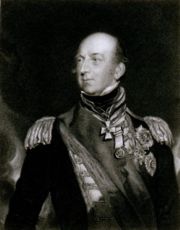
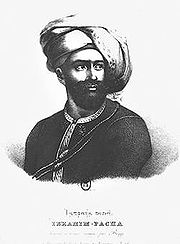
On 20 August 1827, the British naval commander-in-chief in the Mediterranean (i.e.. commander of "Blue" Squadron
Blue Squadron
The Blue Squadron was a generic name given to the group of volunteer pilots and ground crews recruited from the Spanish Air Force that fought in the side of Germany on the Eastern Front, during the Second World War...
), Vice-Admiral Sir Edward Codrington
Edward Codrington
Admiral Sir Edward Codrington GCB RN was a British admiral, hero of the Battle of Trafalgar and the Battle of Navarino.-Early life and career:...
(1770–1851), veteran of 44 years at sea and a popular hero for his role in the Battle of Trafalgar
Battle of Trafalgar
The Battle of Trafalgar was a sea battle fought between the British Royal Navy and the combined fleets of the French Navy and Spanish Navy, during the War of the Third Coalition of the Napoleonic Wars ....
, received his government's instructions regarding enforcement of the treaty. Codrington could not have been a less suitable character for a task which required great tact. He had joined the Royal Navy
Royal Navy
The Royal Navy is the naval warfare service branch of the British Armed Forces. Founded in the 16th century, it is the oldest service branch and is known as the Senior Service...
at age 13 as a midshipman
Midshipman
A midshipman is an officer cadet, or a commissioned officer of the lowest rank, in the Royal Navy, United States Navy, and many Commonwealth navies. Commonwealth countries which use the rank include Australia, New Zealand, South Africa, India, Pakistan, Singapore, Sri Lanka and Kenya...
and worked his way to the top by sheer merit and courage. An impetuous fighting sailor, he entirely lacked diplomatic finesse, a quality he despised and derisively ascribed to his French counterpart, H. de Rigny
Henri de Rigny
Marie Henri Daniel Gauthier, comte de Rigny was the commander of the French squadron at the Battle of Navarino in the Greek War of Independence.-Biography:...
. He was also a sympathiser with the Greek cause, having joined the London Philhellenic Committee.
His instructions were to impose and enforce an armistice on both sides and to interdict the flow of reinforcements and supplies from Asia Minor and Egypt to Ottoman forces in Greece. He was to use force only as a last resort.
On 29 August, the Porte formally rejected the Treaty of London's stipulations, triggering the dispatch of Allied representatives to Nafplion. On 2 September, the Greek provisional government accepted the armistice. This freed Codrington to concentrate on coercing the Ottoman side.
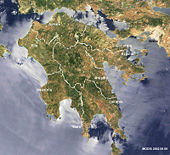
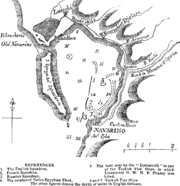
Navarino Bay is a large natural harbour on the west coast of Messenia
Messenia
Messenia is a regional unit in the southwestern part of the Peloponnese region, one of 13 regions into which Greece has been divided by the Kallikratis plan, implemented 1 January 2011...
(SW Peloponnese). It is approximately 5 km long (between the headlands) and 3 km wide. The bay is sheltered from the open sea by a long, narrow islet (Sphacteria
Sphacteria
Sphacteria Sphacteria Sphacteria (Sphacteria (Sphacteria is a small island at the entrance to the bay of Pylos in the Peloponnese, Greece. It was the site of three battles:*the 425 BC Battle of Sphacteria in the Peloponnesian war....
). This islet leaves two entrances to the bay. Because of a sandbank, the northern one is very narrow and shallow, 100 m wide and just 1 m deep in places, impassable to large boats. The southern one is much wider, 1500 m, with an effective passage of 1000 m width because of rocks. The southern entrance was at that time guarded by an Ottoman-held fort, at Navarino (Pylos
Pylos
Pylos , historically known under its Italian name Navarino, is a town and a former municipality in Messenia, Peloponnese, Greece. Since the 2011 local government reform it is part of the municipality Pylos-Nestoras, of which it is the seat and a municipal unit. It was the capital of the former...
). During the Greek insurgency, the bay was used by the Ottoman navy as its main operational base in the Peloponnese.
A large Ottoman-Egyptian-Algerian fleet, which had been warned by the British and French to stay away from Greece, left Alexandria on 5 August 1827 and joined other Ottoman/Egyptian/Algerian units at Navarino on 8 September. In response, Codrington arrived with his squadron off Navarino on 12 September. In talks on 25 September with Ibrahim Pasha and the Ottoman admiral, he extracted verbal promises that they would cease offensive operations by land and sea. After these talks, Codrington withdrew to the nearby British-controlled Ionian island of Zante (Zakynthos), leaving a frigate off Navarino to keep watch on the Ottoman fleet.
But the Ottomans soon violated these undertakings. Ibrahim was outraged that, while he was expected to observe a ceasefire, Codrington seemingly allowed the Greeks to continue military operations unhindered. The Greeks' British commanders were on the offensive at the entrance of the strategically vital Gulf of Corinth
Gulf of Corinth
The Gulf of Corinth or the Corinthian Gulf is a deep inlet of the Ionian Sea separating the Peloponnese from western mainland Greece...
. Church's army lay siege to the Ottoman-held port of Patras
Patras
Patras , ) is Greece's third largest urban area and the regional capital of West Greece, located in northern Peloponnese, 215 kilometers west of Athens...
, while Cochrane organised a revolt behind Ottoman lines in Epirus
Epirus
The name Epirus, from the Greek "Ήπειρος" meaning continent may refer to:-Geographical:* Epirus - a historical and geographical region of the southwestern Balkans, straddling modern Greece and Albania...
. By sea, Hastings' steam-powered warship, the Karteria, launched a daring night-raid (29/30 September) at Itea on the northern shore of the Gulf, sinking 9 Ottoman gunboats. The problem for Codrington was that these officers were acting on their own initiative, largely ignoring the often contradictory directives of their employer, the Greek provisional government. Recognising that appeals to the latter were ineffective, Codrington despatched aides directly to the British commanders to demand that they cease operations, but with little result.
After a vain protest to Codrington, Ibrahim decided to act. On 1 October, he despatched a naval squadron to reinforce the Patras garrison. It was intercepted by Codrington's squadron at the entrance to the Gulf, and forced to return to Navarino, shadowed by Codrington. Ibrahim tried again on the night of 3/4 October, this time leading the squadron in person. Using the darkness, he succeeded in slipping past the British picket-ship unobserved, but was prevented from entering the Gulf by a strong headwind. His squadron was obliged to anchor in the lee of Cape Papas and wait out the storm. This gave Codrington time to catch up, and the British squadron, after a whole day of fighting the wind, arrived off Papas on the evening of 4 October. Codrington fired a series of warning broadsides, and Ibrahim reluctantly decided to turn back.
In the meantime, Ibrahim's scorched-earth policy continued unabated on land. The fires of burning villages and fields were clearly visible from Allied ships standing offshore. A British landing party reported that the population of Messenia was close to mass starvation.
On 13 October Codrington was joined off Navarino by his allied support, a French squadron under De Rigny and a Russian squadron under L. Heyden. On 18 October, after futile attempts to contact Ibrahim Pasha, Codrington, in conference with his Allied colleagues, took the fateful decision to enter Navarino bay and anchor his ships face-to-face with the Ottoman/Egyptian/Algerian fleet. It was decided that with winter approaching, it was impracticable to maintain an effective blockade of Navarino and that in any event, the population of the Peloponnese had to be safeguarded. Although this was highly provocative act, Codrington claimed that there was no intention to engage in battle, but only to make a show of force to induce the Ottomans to respect the armistice and to desist from atrocities against the civilian population.
Relative strength of the two Fleets

Allies
The Allied navies at this time were still deploying essentially the same technology as during the Napoleonic Wars: sailing ships, unarmoured wooden hulls and muzzle-loading smoothboreSmoothbore
A smoothbore weapon is one which has a barrel without rifling. Smoothbores range from handheld firearms to powerful tank guns and large artillery mortars.-History of firearms and rifling:...
cannon
Cannon
A cannon is any piece of artillery that uses gunpowder or other usually explosive-based propellents to launch a projectile. Cannon vary in caliber, range, mobility, rate of fire, angle of fire, and firepower; different forms of cannon combine and balance these attributes in varying degrees,...
. The navies, especially the British one, had ignored the new technologies that were to transform them by the 1850s: steam propulsion, ironclad hulls, rifled guns
Rifling
Rifling is the process of making helical grooves in the barrel of a gun or firearm, which imparts a spin to a projectile around its long axis...
and explosive shells
Shell (projectile)
A shell is a payload-carrying projectile, which, as opposed to shot, contains an explosive or other filling, though modern usage sometimes includes large solid projectiles properly termed shot . Solid shot may contain a pyrotechnic compound if a tracer or spotting charge is used...
. All these had been invented by 1827, but their development for naval warfare, let alone introduction, met dogged resistance from senior naval echelons. In the words of one scholar: "The great admirals of the 18th century would have had no difficulty in taking over Codrington's command at short notice." The British navy did not deploy steam warships until the 1840s. Ironically, the fledgling navy of the Greek rebels was far ahead of the field: they possessed a small warship propelled by steam-powered paddles
Paddle steamer
A paddle steamer is a steamship or riverboat, powered by a steam engine, using paddle wheels to propel it through the water. In antiquity, Paddle wheelers followed the development of poles, oars and sails, where the first uses were wheelers driven by animals or humans...
(as well as sails) called the Karteria
Karteria
The Kartería was the first steam-powered warship to be used in combat operations in history. It was built in 1825 in an English shipyard for the revolutionary Hellenic Navy during the Greek War of Independence....
. Entering service in 1826, it was the first steam warship to see combat in history.
However, the Royal Navy's warships had seen some improvements. Ships with triple gun-decks such as Nelson's famous HMS Victory
HMS Victory
HMS Victory is a 104-gun first-rate ship of the line of the Royal Navy, laid down in 1759 and launched in 1765. She is most famous as Lord Nelson's flagship at the Battle of Trafalgar in 1805....
had been phased out. Triple-deckers had been found to be too unstable and difficult to manoeuvre. The standard Canopus-class
Canopus class ship of the line
The Canopus-class ships of the line were a class of nine 84-gun two-deck second rates of the Royal Navy. Their design was based on an enlarged version of the lines of the captured French ship Franklin, since commissioned in the Royal Navy as HMS Canopus, although this ship herself was not included...
battleship was now a double-deck 74-84 gun boat, based on the successful "74
Seventy-four (ship)
The "seventy-four" was a type of two-decked sailing ship of the line nominally carrying 74 guns. Originally developed by the French Navy in the mid-18th century, the design proved to be a good balance between firepower and sailing qualities, and was adopted by the British Royal Navy , as well as...
" French design. In addition, gun-calibres had been upgraded. The Napoleonic-era Fame-class
Fame class ship of the line
The Fame-class ships of the line were a class of four 74-gun third rates, designed for the Royal Navy by Sir John Henslow. After the name-ship of the class was ordered in October 1799, the design was slightly altered before the next three ships were ordered in February 1800...
battleships had been equipped with 32-pounders on the main gun-deck, 18-pounders on the upper deck and 9- and 12- pounders on the super-structures (quarterdeck and forecastle). In contrast, the guns were now all 24- or 32-pounders (plus a couple of massive 68-pounder carronades on the super-structures). Frigates were either double-deckers of 50-60 guns (known as large frigates); or single-deckers with 24-44 guns.
Most of the Allied ships, however, were still veteran Napoleonic-era warhorses (e.g. HMS Albion
HMS Albion (1802)
HMS Albion was a 74-gun third-rate ship of the line of the Royal Navy. She was launched at Perry's Blackwall Yard on the Thames on 17 June 1802...
). Codrington's only Canopus-class battleship was his flagship, HMS Asia
HMS Asia (1824)
HMS Asia was an 84-gun second rate ship of the line of the Royal Navy, launched on 19 January 1824 at Bombay Dockyard.She was Codrington's flagship at the Battle of Navarino....
(launched 1824), although Genoa (an impounded French "74") was also post-Napoleonic (1816). In the French squadron, De Rigny was so appalled by the state of the 3 battleships sent to him that he decided to keep his flag on the Sirène, a modern frigate.
Ottomans
Overall at Navarino, the Allies had 22 ships and 1,258 guns against the Ottomans' 78 ships with 2,180 guns (figures exclude smaller boats and fireships). But the numbers masked major Allied advantages in ship-types, gun-calibres and crew quality. As a result of these, Allied gun-crews could fire more powerful, more frequent and more accurate cannonades than their Ottoman counterparts.The Allies had a substantial superiority in front-line combat vessels: 10 battleships to the Ottomans' 3. This advantage was only partially offset by the Ottomans' 7 double-deck frigates against 1 Allied vessel of this kind. The great majority of the Ottoman/Egyptian/Algerian fleet were smaller vessels – 58 corvettes and brigs – which were of little use against the Allied heavyweights: they had much smaller firepower, and, their decks being lower, could easily be dismasted by raking fire. In addition, the Ottoman/Egyptians/Algerian mainly deployed smaller-calibre guns than the Allies (often the guns discarded by the Allies when they upgraded their own calibres). Most of the Allied crews had gained extensive combat experience in the Napoleonic Wars, which had only ended 12 years previously, and were service professionals. In contrast, the Ottoman crews only had combat experience against the Greek rebel naval forces, which although gallant and effective, bore no resemblance to the navies of the European powers. In many cases, Ottoman crews impressed men. Some Ottoman crew were even found, after the battle, to have been shackled at their posts (convicts, Greek prisoners or other involuntary recruits).
The Egyptian contingent, the largest and best-equipped of the Ottoman fleet at Navarino, had been trained by a team of French officers, under the overall direction of Capt J-M. Letellier. These officers acted as "shadow-captains" of the large Egyptian vessels, each advising the nominal Egyptian captain. The day before the battle, De Rigny persuaded these officers to withdraw from the Egyptian fleet so as to avoid the possibility of fighting against their own navy (they moved to an Austrian brig that was in the bay, ostensibly neutral but in reality providing logistical support for Ottoman operations). Letellier himself was sick and also took no part. This deprived the Egyptians of experienced command.
For the Allies, probably the Ottomans' most dangerous weapon were their fireships. The latter, the "poor man's battleship", had long been deployed to devastating effect by the Greek rebels against the Ottomans, who had learnt how to use them through hard experience. Fireships were posted on the wings of the Ottoman formation, and could, if effectively deployed, wreak mayhem on Allied boats concentrated in enclosed waters, especially as Allied sailors had no experience of this kind of warfare. The danger was graphically demonstrated in the early phase of the battle, when the French battleship Scipion narrowly escaped being destroyed by a fireship.
The Ottomans possessed a shore battery on each side of the main entrance to the bay, in Navarino fort and on the southern tip of Sphacteria island. These could seriously have impeded Allied entry into the bay, but Codrington was clearly confident that the Ottomans would not start a shooting war. (Or, in an alternative interpretation, he hoped that they would, to give him an excuse to destroy the Ottoman fleet).
Strategies
Following an elaborate defensive plan proposed by Letellier, the Ottoman-Egyptian-Algerian fleet was anchored in a horseshoe formation, in three lines, extending from Navarino fort to the southern tip of Sphacteria island, where the Ottoman shore battery lay. The front line consisted of the heavy boats, battleships and large frigates; the 2nd line contained the remaining frigates and larger corvettes; the 3rd consisted of the remaining smaller boats. The idea was that the small boats could fire through the gaps in the frontline, whilst being protected by the large boats from Allied attack. On the ends of the horseshoe were stationed corvettes and fireships. The latter could be towed by small boats into position covered by the smaller corvettes and shore batteries.The Allied plan was to anchor in the free water inside the crescent. Codrington's squadron would take up position facing the centre of the Ottoman line; the French and Russian squadrons would face the Ottoman left and right wings respectively. The French position in the line had been specifically determined so that they would face the Egyptian fleet, which had been trained by the French and might be reluctant to fight against Egypt's closest European ally. In conventional naval doctrine, Codrington's plan would have been regarded as an unacceptable risk, as it would have invited the enemy to try to surround the Allies. Furthermore, with the prevailing wind blowing from the SW, straight up the entrance, Codrington risked becoming trapped, unable to extricate his squadrons quickly if necessary. The adoption of this high-risk plan shows the total confidence of the Allied commanders in the tactical
Military tactics
Military tactics, the science and art of organizing an army or an air force, are the techniques for using weapons or military units in combination for engaging and defeating an enemy in battle. Changes in philosophy and technology over time have been reflected in changes to military tactics. In...
superiority of their vessels.
Battle
At 1.30 PM, 20 October 1827, off the entrance to Navarino bay, Codrington signalled to the Allied fleet: "PREPARE FOR ACTION" and Allied crews were ordered to stand to their guns. Gun-ports were left half-open, but Allied captains were under strict orders to open fire only if attacked. At 2.00 PM, Allied warships, with Codrington in the lead in Asia, began filing into the bay through the southern entrance, proceeding in two lines, British followed by French to starboard (SE, closest to Navarino) and Russians to port abreast but slightly behind the French. There was no attempt to prevent their entry by the Ottoman shore batteries or their corvettes posted at the entrance, but Codrington received a launch carrying a message from Ibrahim Pasha. This stated that he had not given permission for the Allies to enter the bay, and demanded that they withdraw. Codrington dismissed Ibrahim's objection, replying that he had come to give orders, not to take them. He warned that if the Ottomans opened fire, their fleet would be destroyed.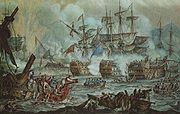
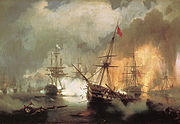
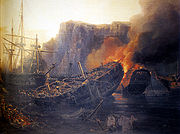
At this point, at the entrance, fighting broke out. Codrington claimed that hostilities were started by the Ottomans. The outbreak, according to Allied sources, occurred in the following manner:
At the entrance to the bay, Capt Thomas Fellowes
Thomas Fellowes (1778-1853)
Thomas Fellowes was an officer of the Royal Navy during the French Revolutionary Wars and Napoleonic Wars...
on the frigate Dartmouth had been detailed, with six smaller boats (2 brigs and 4 schooners) to keep watch on the group of Ottoman corvettes and fireships on the left flank of the Ottoman line. As the Allied ships continued moving into the bay, Fellowes noticed that an Ottoman crew was preparing a fireship and sent a boat to instruct them to desist. The Ottomans fired on the boat and lighted the fireship. Fellowes sent a cutter to tow the fireship to a safe distance, but the Ottomans fired on the cutter, inflicting casualties. Fellowes opened musket fire on the fireship crew to cover his men. At this point the French flagship
Flagship
A flagship is a vessel used by the commanding officer of a group of naval ships, reflecting the custom of its commander, characteristically a flag officer, flying a distinguishing flag...
Sirène, which was just then entering the bay on the tail of the British-French line, opened fire with muskets to support Dartmouth. An Ottoman corvette then attacked Sirène with its guns. This chain reaction spread along the line, so that within a short time, there was general engagement.
The battle thus began before the Allies could complete their deployment. In fact, this proved to be a tactical advantage, as it meant some Allied ships were not yet at anchor and could therefore manoeuvre more swiftly. Nevertheless, most ships fought at anchor. There was naturally very little scope for manoeuvre, except to change the orientation of the boat by hauling on the springs on the anchor chains. With ships blasting each other at very close range, the encounter was mostly a matter of attrition, in which superior Allied firepower and gunnery were critical.
Combat action may be summarised as follows:
- The French battleship Scipion (80 guns), behind De Rigny's Sirène (60), immediately came under intense attack, by a combination of Egyptian frigates on both sides, the shore batteries and a fireship. The latter was nearly fatal. The fireship jammed under Scipions bowsprit, the fore sails caught fire and the fire spread onto the upper gun-deck. Men flung themselves on the fire to prevent it spreading to the forward powder magazine, with inevitable horrendous burn injuries. Nevertheless, the gunners continued to fire on the attackers. Scipion was saved from destruction by her sister ship Trident (74), which succeeded in attaching a tow-line to the fireship and, with the assistance of Dartmouth and 2 other British boats, pulling it clear.
- De Rigny's Sirène fought a lengthy duel with the 64-gun frigate Ihsania, which finally blew up. Sirène suffered significant casualties and damage. Sirène, with the support of Trident and Scipion, then bombarded the fort of Navarino and eventually silenced its shore battery.
- The captain of French battleship Breslau (84), Capt De la Bretonnière, seeing that De Rigny did not need further support, decided on his own initiative to break away from the French formation and move into the centre of the bay, at the junction of the British and Russian lines, to reinforce British battleship Albion (74) and Russian battleship Azov (80). Both were hard pressed. Albion, which had wrecked an Ottoman frigate as she anchored, was under fire from all 3 Ottoman battleships simultaneously. Fortunately for her, the enemy gunnery was inept. Even so, Breslaus intervention was later acknowledged by the captain of Albion as having saved his ship from annihilation. Breslau then proceeded to play a leading role in the destruction of Ottoman admiral Tahir Pasha's flagship, the Ghiuh Rewan (84), and at least 4 frigates.
- Codrington's Asia (84) was anchored between Ottoman admiral Capitana Bey's flagship, battleship Fahti Bahri (74), and Egyptian Moharram Bey's frigate Guerrière (60). Capitana Bey opened fire, but Moharram Bey sent word to Codrington that he was not going to attack. This enabled Asia to concentrate its fire on Fahti Bahri, which was in a poor condition and inadequately manned. Asias deadly fire shortly disabled her. Codrington then sent an interpreter, Greek P. Mikelis, to parley with Moharram Bey; but Mikelis was shot dead as he went aboard. Guerrière then opened fire, but was reduced to a burning wreck within 20 minutes by crushing broadsides from Asia and Azov. However, Asia suffered severe casualties and damage due to a concentration of heavy fire from smaller Ottoman boats in the second and third lines of the Ottoman formation: as Letellier had planned, these boats fired through the gaps in the front line. Codrington also believed that Asia had taken serious hits by mistake from sister battleship Genoa.
- The Russians under Heyden were the last to take up station, as was planned. Their position, on the right end of the Ottoman crescent, was the most exposed. The fighting in this sector was even more intense than elsewhere. Azov sank or disabled 3 large frigates and a corvette, but herself took 153 hits, several below the waterline.
- The British frigates Armide and Talbot initially had to face the frigates on the Ottoman right wing and the island shore battery unsupported, as the other two frigates were away and arrived later. They were saved from annihilation by the arrival of the Russian frigates.
- The British and French small boats (brigs and the schooners Alcyone and Daphne), under the overall direction of frigate Dartmouth, had been allotted the vital task of preventing fireship attacks. Their success was complete: apart from the initial fireship attack on Scipion, not a single fireship struck a target during the battle. A number of small boats greatly distinguished themselves, suffering casualties as great, in proportion, as the battleships.
By about half-time in the battle (circa 4 p.m.), all 3 Ottoman battleships and most of the large frigates of the 1st line had been despatched. This left the mass of smaller boats in the 2nd and 3rd lines at the mercy of the Allied battleships, all of which were still operational. During the ensuing massacre, Codrington tried twice to order a ceasefire, but his signals were either invisible because of the thick smoke or ignored in the heat of the battle. Within the following two hours, virtually the entire Ottoman fleet was destroyed, despite the signal bravery of the Ottoman crews, which was praised by Codrington himself in his despatches. Three quarters were sunk: many of them, dismasted but still afloat and reparable, were blown up or set on fire by their own crews to prevent them falling into Allied hands.
This contributed to the horrendous Ottoman, Algerian, and Egyptian casualty figures, as many men were trapped in burning or exploding vessels. Some, as mentioned, were shackled to their posts. Ottoman casualties given to Codrington by Letellier were approx. 3,000 killed, 1,109 wounded, although Codrington claimed the reverse was more likely. Of the entire Ottoman/Egyptian/Algerian armada of 78 vessels, just 8 remained seaworthy: 1 dismasted battleship, 2 frigates and 5 corvettes.
Allied casualties were given by Codrington as 181 killed, 480 wounded (including Codrington's youngest son, midshipman H. Codrington, serving on Asia under his father, who was badly injured but made a full recovery). Several Allied ships were severely damaged: the 3 Russian battleships Azov, Gangut and Iezekiil were disabled. The three British battleships had to be sent to England for repairs. In fact, given the rough handling all the battleships had endured and the danger from exploding Ottoman vessels, it was miraculous that not a single Allied vessel was sunk.
As the guns fell silent at dusk in Navarino Bay, news of the outcome raced over the Peloponnese and to the rest of Greece. In village after village, church bells started a continuous peal in the night. People rushed into village squares, to be greeted by the news that the Ottoman Sultan and his hated vassal Ibrahim Pasha no longer possessed a Mediterranean fleet. In a maritime country like Greece, the implication was evident, that the fledgling Greek state was saved. Wild rejoicing broke out, and lasted through the night and for days after. Huge bonfires were lit on the mountaintops of the Peloponnese and Mt Parnassos in central Greece. Celebrations swept even the occupied regions, which the demoralised Ottoman garrisons made little effort to prevent.
Aftermath
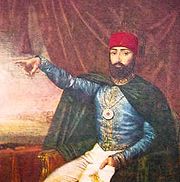
The Sultan, however, refused to concede defeat in Greece. On the contrary, his response to the Navarino disaster was to raise the stakes dramatically, in effect challenging Russia to decide the whole issue on the battlefield. A few weeks after the battle, in a symbolic gesture, he proclaimed jihad
Jihad
Jihad , an Islamic term, is a religious duty of Muslims. In Arabic, the word jihād translates as a noun meaning "struggle". Jihad appears 41 times in the Quran and frequently in the idiomatic expression "striving in the way of God ". A person engaged in jihad is called a mujahid; the plural is...
(holy war) against the European powers in his claimed role as khalifa (caliph
Caliph
The Caliph is the head of state in a Caliphate, and the title for the ruler of the Islamic Ummah, an Islamic community ruled by the Shari'ah. It is a transcribed version of the Arabic word which means "successor" or "representative"...
, or spiritual leader) of all Muslims. More concretely, he closed the Bosporus to international shipping, a move certain to provoke Russia, whose entire Black Sea trade had to pass through the Straits. He also revoked the Convention of Akkerman, signed with Russia the previous year.
The Sultan also ordered his vassal Muhammad Ali not to withdraw his army from the Peloponnese. But the Allies despatched envoys to Alexandria to demand that the Egyptian prince do precisely that. This left Muhammad Ali in a dilemma. On the one hand, as an experienced statesman, he knew that with the European powers backing Greek autonomy, the game was up in the Peloponnese. On the other, he was reluctant to be seen as betraying his overlord, especially now that he had declared jihad, and also to inflict on his son Ibrahim the humiliation of a forced withdrawal. So he played for time, engaging the Allies in lengthy but inconclusive negotiations, in the hope that in the meantime the Sultan would himself reach an agreement with the Allies that would permit Ibrahim a face-saving departure.
But any chance of a negotiated settlement disappeared with Russia's long-expected declaration of war on the Porte in April 1828, starting the 11th Russo-Turkish War (1828–1829) and signalling the ultimate failure of British diplomacy. With the Tsar himself present in nominal command (actual command was in the hands of veteran German-born career-soldier Count Wittgenstein), a Russian army of 100,000 men, supported by the Black sea fleet, swept aside the Ottoman forces in the Romanian Principalities, crossed the Danube
Danube
The Danube is a river in the Central Europe and the Europe's second longest river after the Volga. It is classified as an international waterway....
, and laid siege to Silistra
Silistra
Silistra is a port city of northeastern Bulgaria, lying on the southern bank of the lower Danube at the country's border with Romania. Silistra is the administrative centre of Silistra Province and one of the important cities of the historical region of Southern Dobrudzha...
, Varna
Varna
Varna is the largest city and seaside resort on the Bulgarian Black Sea Coast and third-largest in Bulgaria after Sofia and Plovdiv, with a population of 334,870 inhabitants according to Census 2011...
and Shumla, the key Ottoman-held fortresses in Rumelia
Rumelia
Rumelia was an historical region comprising the territories of the Ottoman Empire in Europe...
(Bulgaria). But despite substantial Russian successes by land and sea (including the capture of the crucial seaport of Varna), the 1828 campaign ended inconclusively. Silistra and Shumla remained in Ottoman hands because of their fierce defence, and the main Russian army was obliged to withdraw to Russian territory by supply shortages and disease.
Meanwhile, in Paris, a more liberal government under the Vicomte de Martignac
Jean Baptiste Gay, vicomte de Martignac
Jean-Baptiste Sylvère Gay, vicomte de Martignac was a moderate royalist French statesman during the Bourbon Restoration 1814–30 under King Charles X....
took office in January 1828, after an election in which the Bourbon kingdom of France's tiny electorate of 74,000 mainly aristocratic voters turned against the ultra-conservative faction. Eager to court popularity, de Martignac announced in April 1828 that, in view of the failure of diplomatic efforts, France would despatch an expeditionary force
Morea expedition
The Morea expedition is the name given in France to the land intervention of the French Army in the Peloponnese, between 1828 and 1833, at the time of the Greek War of Independence....
of 13,000 elite troops to expel the Egyptian and Ottoman forces from the Peloponnese. The news was greeted with wild enthusiasm by the Parisian public. As urgent preparations began in France's Mediterranean ports, Ibrahim Pasha told his father that he felt confident he could repel the French. But since the sinking of his expensive modern fleet, Ali had lost all appetite for military confrontation with the European powers. Ibrahim's motley force of Egyptian peasants and Albanian mercenaries, he felt sure, would stand no chance against the French professionals, who were largely officered by battle-hardened veterans of Napoleon's army. Ali now engaged in serious negotiations with Codrington, who had been despatched by London to Alexandria to try to forestall the French intervention. In August, Ali agreed terms with Codrington for the withdrawal of his forces from the Peloponnese. Ibrahim initially refused to comply with his father's evacuation orders, but gave way shortly after the French troops landed in Navarino Bay at the end of August, to a jubilant reception by local Greeks. The Egyptians finally left in October 1828, a year after the naval battle. The French proceeded to clear the remaining Ottoman garrisons in the Peloponnese, which offered only token resistance, by the end of 1828. In the subsequent months, Greek forces regained control of central Greece in a lightning campaign.
For the 1829 campaign on the Danube, Tsar Nicholas dismissed the ailing Wittgenstein and handed the Russian command to his more aggressive compatriot, Count von Diebitsch
Hans Karl von Diebitsch
Count Hans Karl Friedrich Anton von Diebitsch und Narden was a German-born soldier serving as Russian Field Marshal....
, who succeeded in capturing Silistra and then surprised the Ottomans with a high-speed drive for the Ottoman capital Constantinople
Constantinople
Constantinople was the capital of the Roman, Eastern Roman, Byzantine, Latin, and Ottoman Empires. Throughout most of the Middle Ages, Constantinople was Europe's largest and wealthiest city.-Names:...
(Istanbul), bypassing Shumla and routing an Ottoman army sent to intercept him. In September 1829, with the Russian army camped just 40 miles from his palace, the Sultan was forced to capitulate. By the Treaty of Adrianople
Treaty of Adrianople
The Peace Treaty of Adrianople concluded the Russo-Turkish War, 1828-1829 between Russia and the Ottoman Empire. It was signed on September 14, 1829 in Adrianople by Russia's Count Alexey Fyodorovich Orlov and by Turkey's Abdul Kadyr-bey...
, he conceded a long list of Russian demands, one of which was acceptance of Greek autonomy as defined in the Treaty of London. However, Tsar Nicholas and his ministers were careful to avoid the more extreme demands advocated by Russian nationalists, such as a Russian military occupation of the Straits or annexation of the Romanian principalities, that would risk war with Great Britain and Austria. As a consequence, London and Vienna were relieved that the outcome was not worse and reluctantly acquiesced in Russia's strategic gains.
However, the Sultan's acceptance came too late to save Ottoman sovereignty over Greece. Buoyed by the Ottoman disasters on land and sea, and their own military successes, the Greeks refused to accept anything less than full independence. Finally, at the London Conference of 1832
London Conference of 1832
The London Conference of 1832 was an international conference convened to establish a stable government in Greece. Negotiations between the three Great Powers resulted in the establishment of the Kingdom of Greece under a Bavarian Prince. The decisions were ratified in the Treaty of Constantinople...
, the Allies dropped their policy of Ottoman suzerainty and accepted Greek independence, but insisted that the new state should be a monarchy not a republic. Later that year, the Sultan was forced by the Allied powers to sign the Treaty of Constantinople (1832)
Treaty of Constantinople (1832)
The Τreaty of Constantinople was the product of the Constantinople Conference which opened in February 1832 with the participation of the Great Powers on the one hand and the Ottoman Empire on the other. The factors which shaped the treaty included the refusal of Léopold, King of Belgium, to...
formally recognizing the new Kingdom of Greece
Kingdom of Greece
The Kingdom of Greece was a state established in 1832 in the Convention of London by the Great Powers...
as an independent state. The latter's territory, however, was restricted to just those regions from which Ottoman forces had been expelled, namely the Peloponnese, the Cyclades
Cyclades
The Cyclades is a Greek island group in the Aegean Sea, south-east of the mainland of Greece; and a former administrative prefecture of Greece. They are one of the island groups which constitute the Aegean archipelago. The name refers to the islands around the sacred island of Delos...
islands of the Aegean Sea and central Greece
Central Greece
Continental Greece or Central Greece , colloquially known as Roúmeli , is a geographical region of Greece. Its territory is divided into the administrative regions of Central Greece, Attica, and part of West Greece...
. Most regions with an ethnic-Greek majority (Thessaly, Epirus, Macedonia, Thrace, the remaining Aegean islands, Crete and Cyprus), remained under Ottoman rule.
The disastrous secession of Greece was by no means the end of the Sultan's tribulations. Ironically, the gravest threat to the Ottoman empire's integrity that emerged was not from Russia, but from Egypt. Having lost his fleet and the hereditary fiefdom promised to his son, Muhammad Ali now demanded as compensation that Ibrahim be appointed wali (viceroy) of the Ottoman province of Syria (which included modern Syria, Lebanon and Palestine). When the Sultan refused, Muhammad Ali sent an army under Ibrahim into Syria in 1831. Swiftly defeating the local Ottoman forces and overrunning the province, Ibrahim crushed an Ottoman army in Anatolia and prepared to march on Constantinople. He was forced to stop by the intervention of Britain and France, which, however, obliged the Porte to grant Ibrahim control of not only Syria, but also the island of Crete
Crete
Crete is the largest and most populous of the Greek islands, the fifth largest island in the Mediterranean Sea, and one of the thirteen administrative regions of Greece. It forms a significant part of the economy and cultural heritage of Greece while retaining its own local cultural traits...
and of the Hijaz region of Arabia. His rule was characteristically oppressive and sparked a series of indigenous revolts, notably the Palestinian Arab revolt of 1834. In 1839, the Sultan launched a military attempt to oust him, but the Ottoman army was again routed by Ibrahim, who again invaded Anatolia. At this critical juncture, the exhausted Mahmud II died and was succeeded by his teenage son, Abdulmecid I
Abdülmecid I
Sultan Abdülmecid I, Abdul Mejid I, Abd-ul-Mejid I or Abd Al-Majid I Ghazi was the 31st Sultan of the Ottoman Empire and succeeded his father Mahmud II on July 2, 1839. His reign was notable for the rise of nationalist movements within the empire's territories...
. Faced with the spectre of the disintegration of the Ottoman empire, the British and Austrian navies intervened directly in the Levant by blockading the Nile Delta
Nile Delta
The Nile Delta is the delta formed in Northern Egypt where the Nile River spreads out and drains into the Mediterranean Sea. It is one of the world's largest river deltas—from Alexandria in the west to Port Said in the east, it covers some 240 km of Mediterranean coastline—and is a rich...
coast and forced Ali to withdraw his forces from Syria (1840). In return, the Allies obliged the young Sultan to grant Ali an unprecedented hereditary vice-regency over Egypt. The dynasty that Ali founded ruled Egypt until the nationalist/military coup of 1952. But de facto independence from the Ottomans was soon replaced by de facto rule from Whitehall. After the construction of the Suez Canal
Suez Canal
The Suez Canal , also known by the nickname "The Highway to India", is an artificial sea-level waterway in Egypt, connecting the Mediterranean Sea and the Red Sea. Opened in November 1869 after 10 years of construction work, it allows water transportation between Europe and Asia without navigation...
in 1869, which instantly became the main shipping-route to British India, successive British governments decided that Egypt was simply too strategic to be left to its own devices and imposed a military protectorate over the country. British troops were stationed in Egypt from 1875 to the end of the Second World War in 1945 and Ali's successors were reduced to puppets of British imperial policy.
Codrington controversy
The news of Navarino made Codrington a hero twice over in the eyes of the general British public. But in WhitehallWhitehall
Whitehall is a road in Westminster, in London, England. It is the main artery running north from Parliament Square, towards Charing Cross at the southern end of Trafalgar Square...
, senior naval and diplomatic echelons were appalled by the outcome of his campaign. It was considered that Codrington had grossly exceeded his instructions by provoking a showdown with the Ottoman fleet, and that his actions had gravely compromised the Porte's ability to resist Russian encroachment. At a social event, King George IV
George IV of the United Kingdom
George IV was the King of the United Kingdom of Great Britain and Ireland and also of Hanover from the death of his father, George III, on 29 January 1820 until his own death ten years later...
was reported as referring to the battle as "this untoward (i.e. undesirable) event". Codrington's political situation in London became even more precarious with the return of Wellington to government in January 1828, this time as Prime Minister at the head of the Tory Government 1828–1830. The coincident launch of Tsar Nicholas' war on the Porte realised the worst fears of British policy-makers and deepened their anger at Codrington.
Initially, official disapproval of Codrington had to be restrained because of the admiral's huge popularity with the public. The Admiralty
Admiralty
The Admiralty was formerly the authority in the Kingdom of England, and later in the United Kingdom, responsible for the command of the Royal Navy...
's revenge took petty form, such as its refusal, despite repeated requests by Codrington, to pay his crews their traditional prize-money from the sale of captured Ottoman treasure and goods. Meanwhile, Wellington was biding his time until he felt it was politically safe to remove Codrington from the Mediterranean theatre. Finally, in June 1828, the Admiralty announced that Codrington was being relieved of his command (although he remained in acting-command until his replacement arrived in August). Although the King felt obliged by public opinion to grant Codrington the high honour of the Grand Cross of the Bath
Order of the Bath
The Most Honourable Order of the Bath is a British order of chivalry founded by George I on 18 May 1725. The name derives from the elaborate mediæval ceremony for creating a knight, which involved bathing as one of its elements. The knights so created were known as Knights of the Bath...
, the Admiralty's failure to give him another operational command in his remaining decade of service or to promote him to full Admiral until shortly before his retirement from the Navy in 1837, were eloquent testimony to his fall from favour.
Codrington spent much time in his later years defending his actions in Greece. His enemies accused him of deliberately plotting the destruction of the Ottoman fleet because of his Hellenophile sympathies, a charge that Codrington vehemently denied. The issue turned on whether he knew that his move into Navarino Bay would result in a battle. The evidence is mixed. On the one hand, there are Codrington's clear orders to his captains to engage only if attacked. On the other is Codrington's private correspondence, notably to his sister, which suggests that he regarded a military showdown as inevitable.
Table of combatant ships
HMS Asia (1824)
HMS Asia was an 84-gun second rate ship of the line of the Royal Navy, launched on 19 January 1824 at Bombay Dockyard.She was Codrington's flagship at the Battle of Navarino....
(FF) (84)
Genoa (76)
Albion
HMS Albion (1802)
HMS Albion was a 74-gun third-rate ship of the line of the Royal Navy. She was launched at Perry's Blackwall Yard on the Thames on 17 June 1802...
(74)
Scipion
French ship Scipion (1813)
The Scipion was a 74-gun Téméraire-class ship of the line of the French Navy.She was commissioned in 1813, captained by Louis François Richard Barthélémy de Saizieu...
(80)
Trident
French ship Trident (1811)
The Trident was a Téméraire class 74-gun ship of the line of the French Navy.On 13 February 1814, she was part of Julien Cosmao's squadron which was intercepted off Toulon by a British blockade. The Romulus, at the rear, managed to hold off the British ships.In 1823, during the Spanish expedition,...
(74)
Azov
Russian ship Azov (1826)
Azov was a 74-gun ship of the line of the Imperial Russian Navy. Azov was built in 1826 to compensate the losses of the disastrous 1824 Saint Petersburg flood. In the same year Azov, commanded by Mikhail Lazarev, became the flagship of Admiral Login Geiden's First Mediterranean Squadron and sailed...
(F) (80)
Iezekiil (80)
Aleksandr Nevskii (80)
Fahti Bahri (F) (74)
Burj Zafer (70)
Cambrian (48)
Dartmouth (42)
Talbot (28)
Armide (44)
Konstantin (44)
Elena (38)
Kastor (36)
Surya (dd) (56)
Guerrière (F)(dd) (60)
Leone (dd) (60)
Fevz Nusrat (dd) (64)
Ka'íd Zafer (dd) (64)
1 other dd
10 single-deck frigates
28 brigs
Source: Compiled from information in W. James Naval History of Great Britain (London, 1837) Vol.VI, pp. 476–89.
Note Exact figures for the Ottoman/Egyptian fleet are difficult to establish. The figures given above are mainly those enclosed by Codrington in his report. These were obtained by one of his officers from the French secretary of the Ottoman fleet, a M. Leteiller. However, another report by Leteiller to the British ambassador to the Porte gives 2 more frigates and 20 less corvettes/brigs for a total of 60 warships. W. James in Naval History of Great Britain (1837) Vol. VI, p. 478, assesses the Ottomans' "effective" strength as even lower: 3 battleships, 15 large frigates and 18 corvettes, totaling just 36 ships.
Key
- Other excludes schooners, fireships and launches
Figures in brackets indicate no. of guns
FF = Flagship (Commander-in-Chief)
F = Flagship
dd = double-deck frigate
-
- Ottoman Empire/Egypt/Algeria/Tunisia (Ibrahim Pasha)
- Capitan Bey Squadron (AlexandriaAlexandriaAlexandria is the second-largest city of Egypt, with a population of 4.1 million, extending about along the coast of the Mediterranean Sea in the north central part of the country; it is also the largest city lying directly on the Mediterranean coast. It is Egypt's largest seaport, serving...
): 2 battleships, 5 frigates, 12 corvettes - Moharram Bey Squadron (Alexandria): 4 frigates, 11 corvettes, 21 brigs, 5 schoonerSchoonerA schooner is a type of sailing vessel characterized by the use of fore-and-aft sails on two or more masts with the forward mast being no taller than the rear masts....
s, and 5 (or 6?) fireships - Algiers Squadron: Several battleships
- Tunis Squadron: 2 frigates, 1 brig
- Tahir Pasha Squadron (Admiral commanding) (ConstantinopleConstantinopleConstantinople was the capital of the Roman, Eastern Roman, Byzantine, Latin, and Ottoman Empires. Throughout most of the Middle Ages, Constantinople was Europe's largest and wealthiest city.-Names:...
): 1 battleship, 6 frigates, 7 corvettes, 6 brigs
Commemoration of the battle
There are a number of memorials to the battle around Navarino Bay. The main square of PylosPylos
Pylos , historically known under its Italian name Navarino, is a town and a former municipality in Messenia, Peloponnese, Greece. Since the 2011 local government reform it is part of the municipality Pylos-Nestoras, of which it is the seat and a municipal unit. It was the capital of the former...
, Three Admirals' Square (Modern Greek
Modern Greek
Modern Greek refers to the varieties of the Greek language spoken in the modern era. The beginning of the "modern" period of the language is often symbolically assigned to the fall of the Byzantine Empire in 1453, even though that date marks no clear linguistic boundary and many characteristic...
: Πλατεία Τριών Ναυάρχον), has as its centrepiece a three-sided marble monument, with profiles of Codrington, Heyden, and De Rigny on the three sides.
Memorials to the dead of the three allies are to be found on the islands in the bay: Helonaki islet (British), Pylos islet (French), and Sphacteria
Sphacteria
Sphacteria Sphacteria Sphacteria (Sphacteria (Sphacteria is a small island at the entrance to the bay of Pylos in the Peloponnese, Greece. It was the site of three battles:*the 425 BC Battle of Sphacteria in the Peloponnesian war....
island (Russian). The Russian memorial is the most impressive, consisting of a small wooden chapel in the Russian Orthodox style. Additionally, there is a memorial to the philhellene Santarosa
Annibale Santorre di Rossi de Pomarolo, Count of Santarosa
Santorre Annibale De Rossi di Pomerolo, Count of Santa Rosa was an Italian insurgent and leader in the revival of Italy.thumb|250px|left|Statue of Santarosa in Savigliano.-Biography:...
, who was killed in an earlier battle, on the rocky shore of Sphacteria.
The battle is commemorated each year on 20 October by all day celebrations in Three Admirals' Square in Pylos, hosted by the Mayor of Pylos. The Russian, French and British governments send representatives to the ceremonies, and in the case of the Russians, a warship and its crew.
Further reading
- Naval wars in the Levant 1559–1853 (1952), R. C. Anderson. ISBN 1-57898-538-2
External links
- Extract from W. James Naval History of Great Britain (1837) Vol VI 471-90 Includes reproduction of several original documents, esp. Codrington's own report on the battle
- Aerial View of Navarino Bay
- Navarino Bay (Aerial View)
- Navarino with Location Map
