

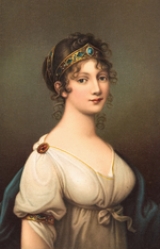
Louise of Mecklenburg-Strelitz

Encyclopedia
Duchess Louise of Mecklenburg-Strelitz (Luise Auguste Wilhelmine Amalie; 10 March 1776 – 19 July 1810) was Queen consort
of Prussia
as the wife of King Frederick William III
. The couple's happy, though short-lived, marriage produced nine children, including the future monarchs Frederick William IV of Prussia
and German Emperor Wilhelm I.
Her legacy became cemented after her extraordinary 1806 meeting with French Emperor Napoleon I
at Tilsit - she met with the emperor to plead unsuccessfully for favorable terms after Prussia's disastrous losses in the Napoleonic Wars
. Already well-loved by her subjects, their meeting caused Louise to become revered as "the soul of national virtue". Her early death at the age of thirty-four "preserved her youth in the memory of posterity", and caused Napoleon to reportedly remark the king "has lost his best minister". The Order of Louise
was founded by her grieving husband four years later as a female counterpart to the Iron Cross
. In the 1920s conservative German women founded the Queen Louise League
, and Louise herself would be used in Nazi propaganda
as an example of the ideal German woman.
) was born on 10 March 1776 in a one story villa, just outside the capital in Hanover
. She was the fourth daughter and sixth child of Duke Charles of Mecklenburg and his wife Landgravine Friederike of Hesse-Darmstadt, a granddaughter of Louis VIII, Landgrave of Hesse-Darmstadt
. Her maternal grandmother, Landgravine Marie Louise of Hesse-Darmstadt, and her paternal first-cousin Princess Augusta Sophia of the United Kingdom
served as sponsors at her baptism; her second given name came from Princess Augusta Sophie.
At the time of her birth, Louise's father was not yet the ruler of Mecklenburg-Strelitz
(he would not succeed his brother as Duke until 1794), and consequently she was not born in a court, but rather in a less formal home. Charles was field marshal
of the household brigade
in Hanover, and soon after Louise's birth he was made Governor-General
of that territory by his brother-in-law George III, king of the United Kingdom and Hanover
(husband of his sister, Queen Charlotte
). The family subsequently moved to Leineschloss
, the residence of Hanoverian kings, though during the summer they usually lived at Herrenhausen
.
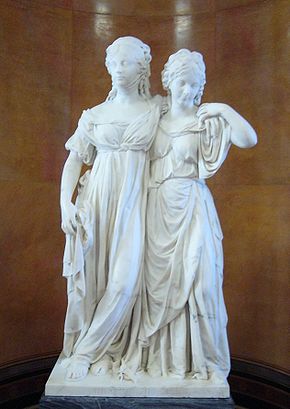 Louise was particularly close to her sister Frederica
, who was two years younger, as well as with their only brother George. Louise and her siblings were under the care of their governess Fraulein von Wolzogen, a friend of their mother's. When only six years old, Louise's mother died in childbirth, leaving a permanent mark on the young duchess; she would often give away pocket change to other children who experienced similar losses, stating "she is like me, she has no mother". After Duchess Charles' death, the family left Leineschloss for Herrenhausen, sometimes called a "miniature Versailles
". Duke Charles remarried two years later to his first wife's younger sister Charlotte, producing a son, Charles
. Louise and her new stepmother became close until Charlotte's early death the year after their marriage. The twice widowed and grieving duke went to Darmstadt
, where he gave the children into the care of his mother-in-law and Louise's godmother, the widowed Landgravine Marie Louise.
, Madame Gelieux, was appointed, giving the children lessons in French
; as was common for royal and aristocratic children of the time, Louise became fluent and literate in the language, while neglecting her own native German
. She received religious instruction from a clergyman of the Lutheran Church. Complementary to her lessons was an emphasis on charitable acts, and Louise would often accompany her governess when visiting the houses of the poor and needy. Louise was encouraged to give out as much as was in her means, although she often got into trouble with her grandmother for donating too much for charity. From the age of ten until her marriage at 17, Louise spent most of her time in the presence of her grandmother and governess, both well-educated and refined. When only nine years old, Louise was present when the poet Friedrich Schiller
read from the first act of "Don Carlos
" for the entertainment of the assembled court, thus sparking her love for German as a literary language, especially works of Schiller. Louise loved history and poetry, and not only enjoyed reading Schiller, but also came to like the works of Goethe
, Paul
, Herder
and Shakespeare
, as well as ancient Greek
tragedies.
In 1793, Marie Louise took the two youngest duchesses with her to Frankfurt
, where she paid her respects to her nephew King Frederick William II
. Louise had grown up into a beautiful young woman, possessing "an exquisite complexion" and "large blue eyes," and was naturally graceful. Louise's uncle, the Duke of Mecklenburg, hoped to strengthen ties between his house and Prussia. Consequently, on one evening carefully planned by the Duke, seventeen-year old Louise met the king's son and heir, Crown Prince Frederick William
. The crown prince was twenty-three, serious-minded, and religious. She made such a charming impression on Frederick William that he immediately made his choice, desiring to marry her. Frederica caught the eye of his younger brother Prince Louis Charles
, and the two families began planning a double betrothal, celebrating a month later, on 24 April 1793 in Darmstadt. Frederick and Louise were subsequently married on 24 December that same year, with Louis and Frederica marrying two days later.
, the Prussian capital, caused quite a sensation, and she was greeted with a grand reception by the city's joyful citizens. When she broke protocol and stooped to pick up and kiss a child, Prussian writer Friedrich de la Motte Fouqué
remarked that "The arrival of the angelic Princess spreads over these days a noble splendor. All hearts go out to meet her, and her grace and goodness leaves no one unblessed." Another wrote "The more perfectly one becomes acquainted with the Princess the more one is captivated by the inner nobility, and the angelic goodness of her heart."
Louise's father-in-law
King Frederick William II
gave the couple Charlottenburg Palace
, but the crown prince and his new wife preferred to live at Paretz Palace, just outside of Potsdam
, where Louise kept herself busy with household affairs. Paretz was far from the bustle of court, as the couple were most content in the "rural retirement" of a country life. The marriage was happy, and Louise was well-beloved by the king, who called her "the princess of princesses" and gave her a palace in Oranienburg
. The crown princess saw it as her duty to support her husband in all his pursuits, and the couple enjoyed singing together and reading from Shakespeare and Goethe. Louise soon became pregnant, disappointingly giving birth to a stillborn
girl on 1 October 1794. Nine healthy children would follow in quick succession, though two died in childhood: Crown Prince Frederick William
(1795), Prince William (1797), Princess Charlotte (1798), Princess Frederica (1799), Prince Charles
(1801), Princess Alexandrine
(1803), Prince Ferdinand (1804), Princess Louise (1808), and Prince Albert (1809).
Louise's charitable giving continued throughout her life, and on one occasion, while attending a harvest festival, she purchased presents and distributed them to local children. On her first birthday after her marriage in Berlin, when King Frederick William II asked his daughter-in-law what she desired for a present, Louise replied she wanted a handful of money to let the city's people share her joy; he smilingly gave her a large quantity for the task.
 On 16 November 1797, her husband succeeded to the throne of Prussia as King Frederick William III after the death of his father. Louise wrote to her grandmother, "I am now Queen, and what rejoices me most is the hope that now I need no longer count my benefactions so carefully." The couple had to abandon their solitude at Paletz and begin living under the restraints of a royal court. They began a tour of the country's eastern provinces for two purposes: the king wanted to acquaint himself with their new subjects, and despite the unusualness of a consort accompanying the king further than the capital, Frederick William wanted to introduce the queen as well to their people. Louise was received everywhere with festivities. For the first time in Prussian history, the queen emerged as a celebrated public personality in her own right, as she occupied a much more prominent role than her predecessors. Louise's presence on her husband's eastern journey was a break from the traditional role of the consort - importantly however the queen's power and enduring legacy did not stem from holding a separate court and policy than her husband's, but rather the opposite: she subordinated her formidable intelligence and skill for her husband's sole advantage. She also became a fashion icon, for instance starting a trend by wearing a neckerchief
to keep from getting ill.
 After her husband's ascension, Louise developed many ties to senior ministers and became a powerful figure within the government as she began to command universal respect and affection. The queen went out of her way to stay informed about political developments at court, and from the very beginning of his reign the new king consulted Louise on matters of state. Frederick William was hesitant and cautious, and hated war, stating in 1798, "I abhor war and... know of nothing greater on earth than the preservation of peace and tranquility as the only system suited to the happiness of human kind". In keeping with the later foreign policy
of his father's, Frederick William favored neutrality during the early years of the conflict with the revolutionary French First Republic
, which evolved into the Napoleonic Wars
(1803–15); he refused the various pressures to pick a side in the War of the Second Coalition
. Louise supported this view, warning that if Prussia were to side with the coalition powers of Austria
, Great Britain
, and Russia
, it would lead to dependence on the latter power for military support. She foresaw that because Prussia was by far the weakest of the great powers, and it would not have been able to ensure it benefited from the results of such an alliance. French aggression caused the king to eventually consider entering the wars, but his indecision prevented him from choosing a side, either France or the coalition powers. He consulted the many differing opinions of Queen Louise and his ministers, and was eventually compelled into an alliance with Napoleon, who was recently victorious from the Battle of Austerlitz
(1805).
Baron vom Stein, a member of the bureaucracy, having abhorred the country's former neutrality, sought to reform the organization of the government
from favor-based cronyism
into a responsible ministerial government. He prepared a document for the king detailing in strong language what administrative reforms were needed, such as establishing clearer lines of responsibility among ministers; this work however never reached Frederick William, as Stein passed it first to General Ernst von Rüchel
, who in turn passed it onto the queen in the spring of 1806. Though Louise agreed with its contents, she thought it "too violent and passionate" for the king, and consequently helped suppress it.
. Knowing the temperament of the king, Hardenberg appealed directly to the queen for desired reform - wisely as it turned out, as Frederick William viewed the demands to remove his trusted advisers in the Kabinett
as a "mutiny" similar to the Fronde
.
Though Prussia had not fought in a war since 1795, its military leaders confidently expected that they could win against Napoleon's troops. After a small incident concerning an anti-French pamphlet occurred, King Frederick William was finally pressured by his wife and family to break off his uneasy peace and enter the war against the French emperor. Prussian troops began mobilizing, culminating in the October 1806 Battle of Jena-Auerstedt
, which was a disaster for Prussia, as the ability of its armed forces to continue the war were effectively wiped out. The king and queen had accompanied their troops into battle at Jena
(with Louise apparently dressed "like an Amazon
"), but had to flee from French troops.
Napoleon himself occupied Berlin, causing the king, queen and the rest of the royal family to flee, despite Louise's illness, in the dead of winter to Königsberg
in the easternmost part of the kingdom. On the journey there, there was no food or clean water, and the king and queen were forced to share the same sleeping arrangements in "one of the wretched barns they call houses", according to one witness traveling with them.
After various events took place,
Napoleon demanded, from a highly superior position, peace terms in what was to be called the Peace of Tilsit (1807). In the midst of these negotiations, the emperor agreed to keep half of Prussia intact. The men were joined by Queen Louise; Frederick William had sent for his pregnant wife to beg for a better settlement for Prussia, with Louise advising her husband, "For God's sake no shameful peace...[Prussia] should at least not go down without honor." As the king felt that her presence might put Napoleon in a "more relaxed mood"; Louise reluctantly agreed to meet the emperor at Tilsit, but only to save "her Prussia". Napoleon had previously attempted to destroy her reputation by questioning Louise's marital fidelity, but the queen met him anyway, attempting to use her beauty and charm to flatter him into more favorable terms. Formerly Louise had regularly referred to him as "the Monster", but nevertheless made a request for a private interview with the emperor, whereon she threw herself at his feet; though he was impressed by her grace and determination, Napoleon refused to make any concessions, writing back to his wife Empress Joséphine
that Louise "is really charming and full of coquettishness toward me. But don't be jealous...it would cost me too dearly to play the gallant." Napoleon's attempts to destroy Louise's reputation failed however, and they only made her more beloved in Prussia. Queen Louise's efforts to protect her adopted country from French aggression secured for her the admiration of future generations.
and August Neidhardt von Gneisenau, to reorganize the army. After the disaster at Tilsit, Louise was instrumental in Stein's reappointment (the king had previously dismissed him), telling Frederick William "[Stein] is my last hope. A great heart, an encompassing mind, perhaps he knows remedies that are hidden to us."
By 1808 it was still considered unsafe to return to Berlin, and the royal family consequently spent the summer near Königsberg; Louise believed that the hard trials of her children's early lives would be good for them: "If they had been reared in luxury and prosperity they might think that so it must always be." In the winter of 1808, Tsar Alexander I
invited the king and queen to St. Petersburg, where she was treated to sumptuously-decorated rooms; "Nothing dazzles me anymore", she exclaimed on her return back to Germany. Near the birth of her youngest child Princess Louise in 1809, Louise wrote to her father, "Gladly...the calamities which have befallen us have not forced their way into our wedded and home life, rather have strengthened the same, and made it even more precious to us." Louise was sick for much of that year, but returned with the king to Berlin near the end of it after an absence of three years; the queen arrived in a carriage accompanied by her two daughters Charlotte and Alexandrine
and younger son Charles
, and was greeted by her father at Charlottenburg Palace - the residence was ransacked however, as Napoleon and his commanders had stripped its rooms of paintings, statues, manuscripts, and antiquities. Returning to a much different Prussia than she left, a preacher observed that "our dear queen is far from joyful, but her seriousness has a quiet serenity... her eyes have lost their former sparkle, and one sees that they have wept much, and still weep".
 On 19 July 1810, while visiting her father in Strelitz
, the Queen died in her husband's arms from an unidentified illness. The queen's subjects attributed the French occupation as the cause of her early death. "Our saint is in heaven", exclaimed Prussian general Gebhard Leberecht von Blücher
. Louise's untimely death left her husband alone during a period of great difficulty, as the Napoleonic Wars and need for reform continued. Napoleon reportedly remarked the king "has lost his best minister."
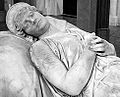
Louise was buried in the garden of Charlottenburg Palace
, where a mausoleum, containing a fine recumbent statue by Christian Daniel Rauch
, was built over her grave. Frederick William did not remarry until 1824, when he entered into a morganatic marriage
with his mistress Auguste von Harrach
, explaining "Womanly companionship and sympathy have become necessary to me, therefore I must marry again." After his death on 7 June 1840, Frederick William was buried by her side.
, Louise was "a female celebrity who in the mind of the public combined virtue, modesty, and sovereign grace with kindness and sex appeal, and whose early death in 1810 at the age of only thirty-four preserved her youth in the memory of posterity." Her reputation as a loving and loyal supporter of her husband became crucial to her enduring legacy; the cult that eventually surrounded Louise became associated with the "ideal" feminine attributes: prettiness, sweet nature, maternal kindness, and wifely virtue.
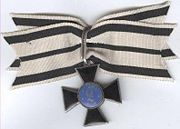 On the anniversary of her birth, in 1814, the widowed King Frederick William instituted the Order of Louise
(Luisenorden) as a complementary decoration for the Iron Cross
. Its purpose was to be given to those women who had made a significant contribution to the war effort against Napoleon, though it was subsequently awarded to future members of the House of Hohenzollern unrelated to the French emperor, such as her granddaughter-in-law Princess Victoria of the United Kingdom
, and her great-granddaughter Sophia, Queen of Greece
. In 1880 a statue of Queen Louise was erected in the Tiergarten
in Berlin
.
Louise inspired the establishment of a conservative women's organization known as Königin-Luise-Bund, often shortened to Luisenbund ("Queen Louise League
") in which her person achieved an almost cult
-like status. The group's main purpose was to promote patriotic feelings among German women, and it emphasized the family and German morality. The Königin-Luise-Bund was active during the time of the Weimar Republic
and the first years of the Third Reich. Despite having actively supported the National Socialist movement since its early stages all through their accession to power
in 1933, the Queen Louise League was nonetheless disbanded by the Nazis in 1934, as they viewed it as a hostile organization.
Significantly, Louise and Maria Theresa of Austria
were the only two historical women used in Nazi propaganda
, as the regime felt Louise was the "personification of womanly qualities," which the government was trying to integrate into German schools. While the queen's resistance and defiance of the French kept the "Prussian spirit" alive, her husband was cast as a "pathetically embarrassing" king who would rather have lived in peace than revenge himself on Napoleon.
). She was also briefly portrayed in an extremely reverential manner in the 1945 propaganda film Kolberg. The German warship sunk in Lake Victoria
in the film The African Queen is called the Königin Luise (the "Queen Louise").
Louise became the subject of a series of novels by nineteenth century German historical fiction
writer Luise Mühlbach
, which included Louisa of Prussia and her Times and Napoleon and the Queen of Prussia.
(3 August 1770 – 7 June 1840); married on 24 December 1793.
|-
|-
|-
Queen consort
A queen consort is the wife of a reigning king. A queen consort usually shares her husband's rank and holds the feminine equivalent of the king's monarchical titles. Historically, queens consort do not share the king regnant's political and military powers. Most queens in history were queens consort...
of Prussia
Prussia
Prussia was a German kingdom and historic state originating out of the Duchy of Prussia and the Margraviate of Brandenburg. For centuries, the House of Hohenzollern ruled Prussia, successfully expanding its size by way of an unusually well-organized and effective army. Prussia shaped the history...
as the wife of King Frederick William III
Frederick William III of Prussia
Frederick William III was king of Prussia from 1797 to 1840. He was in personal union the sovereign prince of the Principality of Neuchâtel .-Early life:...
. The couple's happy, though short-lived, marriage produced nine children, including the future monarchs Frederick William IV of Prussia
Frederick William IV of Prussia
|align=right|Upon his accession, he toned down the reactionary policies enacted by his father, easing press censorship and promising to enact a constitution at some point, but he refused to enact a popular legislative assembly, preferring to work with the aristocracy through "united committees" of...
and German Emperor Wilhelm I.
Her legacy became cemented after her extraordinary 1806 meeting with French Emperor Napoleon I
Napoleon I
Napoleon Bonaparte was a French military and political leader during the latter stages of the French Revolution.As Napoleon I, he was Emperor of the French from 1804 to 1815...
at Tilsit - she met with the emperor to plead unsuccessfully for favorable terms after Prussia's disastrous losses in the Napoleonic Wars
Napoleonic Wars
The Napoleonic Wars were a series of wars declared against Napoleon's French Empire by opposing coalitions that ran from 1803 to 1815. As a continuation of the wars sparked by the French Revolution of 1789, they revolutionised European armies and played out on an unprecedented scale, mainly due to...
. Already well-loved by her subjects, their meeting caused Louise to become revered as "the soul of national virtue". Her early death at the age of thirty-four "preserved her youth in the memory of posterity", and caused Napoleon to reportedly remark the king "has lost his best minister". The Order of Louise
Order of Louise
The Order of Louise was founded in 1814 by Frederick William III of Prussia to honor his late wife, the much beloved Queen Luise . This order was chivalric in nature, but was intended strictly for women whose service to Germany was worthy of such high national recognition...
was founded by her grieving husband four years later as a female counterpart to the Iron Cross
Iron Cross
The Iron Cross is a cross symbol typically in black with a white or silver outline that originated after 1219 when the Kingdom of Jerusalem granted the Teutonic Order the right to combine the Teutonic Black Cross placed above a silver Cross of Jerusalem....
. In the 1920s conservative German women founded the Queen Louise League
Queen Louise League
The "Queen Louise League" or Königin-Luise-Bund, often shortened to Luisenbund, was a German pro-monarchic women's organization. It was established in 1923 during the time of the Weimar Republic and lasted until the first years of the Third Reich...
, and Louise herself would be used in Nazi propaganda
Nazi propaganda
Propaganda, the coordinated attempt to influence public opinion through the use of media, was skillfully used by the NSDAP in the years leading up to and during Adolf Hitler's leadership of Germany...
as an example of the ideal German woman.
Duchess of Mecklenburg-Strelitz 1776–1793
Duchess Luise Auguste Wilhelmine Amalie of Mecklenburg-Strelitz (Louise in EnglishEnglish language
English is a West Germanic language that arose in the Anglo-Saxon kingdoms of England and spread into what was to become south-east Scotland under the influence of the Anglian medieval kingdom of Northumbria...
) was born on 10 March 1776 in a one story villa, just outside the capital in Hanover
Hanover
Hanover or Hannover, on the river Leine, is the capital of the federal state of Lower Saxony , Germany and was once by personal union the family seat of the Hanoverian Kings of Great Britain, under their title as the dukes of Brunswick-Lüneburg...
. She was the fourth daughter and sixth child of Duke Charles of Mecklenburg and his wife Landgravine Friederike of Hesse-Darmstadt, a granddaughter of Louis VIII, Landgrave of Hesse-Darmstadt
Louis VIII, Landgrave of Hesse-Darmstadt
Louis VIII was the Landgrave of Hesse-Darmstadt from 1739 to 1768. He was the son of Ernest Louis, Landgrave of Hesse-Darmstadt and Margravine Dorothea Charlotte of Brandenburg-Ansbach....
. Her maternal grandmother, Landgravine Marie Louise of Hesse-Darmstadt, and her paternal first-cousin Princess Augusta Sophia of the United Kingdom
Princess Augusta Sophia of the United Kingdom
The Princess Augusta Sophia was a member of the British Royal Family, second daughter of George III and Charlotte of Mecklenburg-Strelitz. She was a Princess of the United Kingdom and a Princess of Hanover....
served as sponsors at her baptism; her second given name came from Princess Augusta Sophie.
At the time of her birth, Louise's father was not yet the ruler of Mecklenburg-Strelitz
Mecklenburg-Strelitz
Mecklenburg-Strelitz was a duchy and later grand duchy in northern Germany, consisting of the eastern fifth of the historic Mecklenburg region, roughly corresponding with the present-day Mecklenburg-Strelitz district , and the western exclave of the former Bishopric of Ratzeburg in modern...
(he would not succeed his brother as Duke until 1794), and consequently she was not born in a court, but rather in a less formal home. Charles was field marshal
Generalfeldmarschall
Field Marshal or Generalfeldmarschall in German, was a rank in the armies of several German states and the Holy Roman Empire; in the Austrian Empire, the rank Feldmarschall was used...
of the household brigade
Household Division
Household Division is a term used principally in the Commonwealth of Nations to describe a country’s most elite or historically senior military units, or those military units that provide ceremonial or protective functions associated directly with the head of state.-Historical Development:In...
in Hanover, and soon after Louise's birth he was made Governor-General
Governor-General
A Governor-General, is a vice-regal person of a monarch in an independent realm or a major colonial circonscription. Depending on the political arrangement of the territory, a Governor General can be a governor of high rank, or a principal governor ranking above "ordinary" governors.- Current uses...
of that territory by his brother-in-law George III, king of the United Kingdom and Hanover
George III of the United Kingdom
George III was King of Great Britain and King of Ireland from 25 October 1760 until the union of these two countries on 1 January 1801, after which he was King of the United Kingdom of Great Britain and Ireland until his death...
(husband of his sister, Queen Charlotte
Charlotte of Mecklenburg-Strelitz
Charlotte of Mecklenburg-Strelitz was the Queen consort of the United Kingdom as the wife of King George III...
). The family subsequently moved to Leineschloss
Leineschloss
The Leineschloss , situated on the Leine in Hanover, Germany, is the former residence of the Hanoverian kings and the current seat of the Landtag of Lower Saxony....
, the residence of Hanoverian kings, though during the summer they usually lived at Herrenhausen
Herrenhausen
Herrenhausen is an area of the German city Hanover which is most notable for the baroque Herrenhausen Gardens.Ernest Augustus, Elector of Brunswick-Lüneburg died in Herrenhausen Castle and his grandson King George II of Great Britain was born there. During the Second World War the castle was...
.
Frederica of Mecklenburg-Strelitz
Frederica of Mecklenburg-Strelitz , Duchess of Cumberland and later Queen of Hanover , was the consort of Ernest Augustus I of Hanover, the fifth son and eighth child of George III and Queen Charlotte.She was born in the Altes Palais of Hanover as the fifth...
, who was two years younger, as well as with their only brother George. Louise and her siblings were under the care of their governess Fraulein von Wolzogen, a friend of their mother's. When only six years old, Louise's mother died in childbirth, leaving a permanent mark on the young duchess; she would often give away pocket change to other children who experienced similar losses, stating "she is like me, she has no mother". After Duchess Charles' death, the family left Leineschloss for Herrenhausen, sometimes called a "miniature Versailles
Palace of Versailles
The Palace of Versailles , or simply Versailles, is a royal château in Versailles in the Île-de-France region of France. In French it is the Château de Versailles....
". Duke Charles remarried two years later to his first wife's younger sister Charlotte, producing a son, Charles
Duke Charles of Mecklenburg
Duke Charles of Mecklenburg was a member of the House of Mecklenburg-Strelitz and a Prussian soldier who served in the Napoleonic Wars...
. Louise and her new stepmother became close until Charlotte's early death the year after their marriage. The twice widowed and grieving duke went to Darmstadt
Darmstadt
Darmstadt is a city in the Bundesland of Hesse in Germany, located in the southern part of the Rhine Main Area.The sandy soils in the Darmstadt area, ill-suited for agriculture in times before industrial fertilisation, prevented any larger settlement from developing, until the city became the seat...
, where he gave the children into the care of his mother-in-law and Louise's godmother, the widowed Landgravine Marie Louise.
Education
Their grandmother preferred to raise them simply, and they made their own clothes. A new governess from SwitzerlandSwitzerland
Switzerland name of one of the Swiss cantons. ; ; ; or ), in its full name the Swiss Confederation , is a federal republic consisting of 26 cantons, with Bern as the seat of the federal authorities. The country is situated in Western Europe,Or Central Europe depending on the definition....
, Madame Gelieux, was appointed, giving the children lessons in French
French language
French is a Romance language spoken as a first language in France, the Romandy region in Switzerland, Wallonia and Brussels in Belgium, Monaco, the regions of Quebec and Acadia in Canada, and by various communities elsewhere. Second-language speakers of French are distributed throughout many parts...
; as was common for royal and aristocratic children of the time, Louise became fluent and literate in the language, while neglecting her own native German
German language
German is a West Germanic language, related to and classified alongside English and Dutch. With an estimated 90 – 98 million native speakers, German is one of the world's major languages and is the most widely-spoken first language in the European Union....
. She received religious instruction from a clergyman of the Lutheran Church. Complementary to her lessons was an emphasis on charitable acts, and Louise would often accompany her governess when visiting the houses of the poor and needy. Louise was encouraged to give out as much as was in her means, although she often got into trouble with her grandmother for donating too much for charity. From the age of ten until her marriage at 17, Louise spent most of her time in the presence of her grandmother and governess, both well-educated and refined. When only nine years old, Louise was present when the poet Friedrich Schiller
Friedrich Schiller
Johann Christoph Friedrich von Schiller was a German poet, philosopher, historian, and playwright. During the last seventeen years of his life , Schiller struck up a productive, if complicated, friendship with already famous and influential Johann Wolfgang von Goethe...
read from the first act of "Don Carlos
Don Carlos (play)
Don Carlos is a historical tragedy in five acts by Friedrich Schiller; it was written between 1783 and 1787 and first produced in Hamburg in 1787...
" for the entertainment of the assembled court, thus sparking her love for German as a literary language, especially works of Schiller. Louise loved history and poetry, and not only enjoyed reading Schiller, but also came to like the works of Goethe
Johann Wolfgang von Goethe
Johann Wolfgang von Goethe was a German writer, pictorial artist, biologist, theoretical physicist, and polymath. He is considered the supreme genius of modern German literature. His works span the fields of poetry, drama, prose, philosophy, and science. His Faust has been called the greatest long...
, Paul
Jean Paul
Jean Paul , born Johann Paul Friedrich Richter, was a German Romantic writer, best known for his humorous novels and stories.-Life and work:...
, Herder
Johann Gottfried Herder
Johann Gottfried von Herder was a German philosopher, theologian, poet, and literary critic. He is associated with the periods of Enlightenment, Sturm und Drang, and Weimar Classicism.-Biography:...
and Shakespeare
William Shakespeare
William Shakespeare was an English poet and playwright, widely regarded as the greatest writer in the English language and the world's pre-eminent dramatist. He is often called England's national poet and the "Bard of Avon"...
, as well as ancient Greek
Ancient Greece
Ancient Greece is a civilization belonging to a period of Greek history that lasted from the Archaic period of the 8th to 6th centuries BC to the end of antiquity. Immediately following this period was the beginning of the Early Middle Ages and the Byzantine era. Included in Ancient Greece is the...
tragedies.
In 1793, Marie Louise took the two youngest duchesses with her to Frankfurt
Frankfurt
Frankfurt am Main , commonly known simply as Frankfurt, is the largest city in the German state of Hesse and the fifth-largest city in Germany, with a 2010 population of 688,249. The urban area had an estimated population of 2,300,000 in 2010...
, where she paid her respects to her nephew King Frederick William II
Frederick II of Prussia
Frederick II was a King in Prussia and a King of Prussia from the Hohenzollern dynasty. In his role as a prince-elector of the Holy Roman Empire, he was also Elector of Brandenburg. He was in personal union the sovereign prince of the Principality of Neuchâtel...
. Louise had grown up into a beautiful young woman, possessing "an exquisite complexion" and "large blue eyes," and was naturally graceful. Louise's uncle, the Duke of Mecklenburg, hoped to strengthen ties between his house and Prussia. Consequently, on one evening carefully planned by the Duke, seventeen-year old Louise met the king's son and heir, Crown Prince Frederick William
Frederick William III of Prussia
Frederick William III was king of Prussia from 1797 to 1840. He was in personal union the sovereign prince of the Principality of Neuchâtel .-Early life:...
. The crown prince was twenty-three, serious-minded, and religious. She made such a charming impression on Frederick William that he immediately made his choice, desiring to marry her. Frederica caught the eye of his younger brother Prince Louis Charles
Prince Louis Charles of Prussia
Prince Louis Charles of Prussia was the second son and third child of Frederick William II of Prussia and Frederika Louisa of Hesse-Darmstadt.-Marriage and issue:...
, and the two families began planning a double betrothal, celebrating a month later, on 24 April 1793 in Darmstadt. Frederick and Louise were subsequently married on 24 December that same year, with Louis and Frederica marrying two days later.
Crown Princess of Prussia 1793–1797
In the events leading up to her marriage, Louise's arrival in BerlinBerlin
Berlin is the capital city of Germany and is one of the 16 states of Germany. With a population of 3.45 million people, Berlin is Germany's largest city. It is the second most populous city proper and the seventh most populous urban area in the European Union...
, the Prussian capital, caused quite a sensation, and she was greeted with a grand reception by the city's joyful citizens. When she broke protocol and stooped to pick up and kiss a child, Prussian writer Friedrich de la Motte Fouqué
Friedrich de la Motte Fouqué
Friedrich Heinrich Karl de la Motte, Baron Fouqué was a German writer of the romantic style.-Biography:He was born at Brandenburg an der Havel, of a family of French Huguenot origin, as evidenced in his family name...
remarked that "The arrival of the angelic Princess spreads over these days a noble splendor. All hearts go out to meet her, and her grace and goodness leaves no one unblessed." Another wrote "The more perfectly one becomes acquainted with the Princess the more one is captivated by the inner nobility, and the angelic goodness of her heart."
Louise's father-in-law
Father-in-law
A parent-in-law is a person who has a legal affinity with another by being the parent of the other's spouse. Many cultures and legal systems impose duties and responsibilities on persons connected by this relationship...
King Frederick William II
Frederick William II of Prussia
Frederick William II was the King of Prussia, reigning from 1786 until his death. He was in personal union the Prince-Elector of Brandenburg and the sovereign prince of the Principality of Neuchâtel.-Early life:...
gave the couple Charlottenburg Palace
Charlottenburg Palace
Charlottenburg Palace is the largest palace in Berlin, Germany, and the only royal residency in the city dating back to the time of the Hohenzollern family. It is located in the Charlottenburg district of the Charlottenburg-Wilmersdorf burough.The palace was built at the end of the 17th century...
, but the crown prince and his new wife preferred to live at Paretz Palace, just outside of Potsdam
Potsdam
Potsdam is the capital city of the German federal state of Brandenburg and part of the Berlin/Brandenburg Metropolitan Region. It is situated on the River Havel, southwest of Berlin city centre....
, where Louise kept herself busy with household affairs. Paretz was far from the bustle of court, as the couple were most content in the "rural retirement" of a country life. The marriage was happy, and Louise was well-beloved by the king, who called her "the princess of princesses" and gave her a palace in Oranienburg
Oranienburg
Oranienburg is a town in Brandenburg, Germany. It is the capital of the district of Oberhavel.- Geography :Oranienburg is a town located on the banks of the Havel river, 35 km north of the centre of Berlin.- Division of the town :...
. The crown princess saw it as her duty to support her husband in all his pursuits, and the couple enjoyed singing together and reading from Shakespeare and Goethe. Louise soon became pregnant, disappointingly giving birth to a stillborn
Stillbirth
A stillbirth occurs when a fetus has died in the uterus. The Australian definition specifies that fetal death is termed a stillbirth after 20 weeks gestation or the fetus weighs more than . Once the fetus has died the mother still has contractions and remains undelivered. The term is often used in...
girl on 1 October 1794. Nine healthy children would follow in quick succession, though two died in childhood: Crown Prince Frederick William
Frederick William IV of Prussia
|align=right|Upon his accession, he toned down the reactionary policies enacted by his father, easing press censorship and promising to enact a constitution at some point, but he refused to enact a popular legislative assembly, preferring to work with the aristocracy through "united committees" of...
(1795), Prince William (1797), Princess Charlotte (1798), Princess Frederica (1799), Prince Charles
Prince Charles of Prussia
Prince Frederick Charles Alexander of Prussia born in Charlottenburg, was a younger son of Frederick William III of Prussia and Louise of Mecklenburg-Strelitz...
(1801), Princess Alexandrine
Princess Alexandrine of Prussia
Alexandrine, Grand Duchess of Mecklenburg-Schwerin was the wife and consort to Paul Frederick, Grand Duke of Mecklenburg-Schwerin as well as the daughter of Frederick William III of Prussia and Louise of Mecklenburg-Strelitz.-Family:Alexandrine was the seventh child and fourth daughter of Frederick...
(1803), Prince Ferdinand (1804), Princess Louise (1808), and Prince Albert (1809).
Louise's charitable giving continued throughout her life, and on one occasion, while attending a harvest festival, she purchased presents and distributed them to local children. On her first birthday after her marriage in Berlin, when King Frederick William II asked his daughter-in-law what she desired for a present, Louise replied she wanted a handful of money to let the city's people share her joy; he smilingly gave her a large quantity for the task.
Queen consort of Prussia 1797–1810
Neckerchief
A neckerchief, necker or less commonly scarf is a type of neckwear associated with Scouts, cowboys and sailors. It consists of a triangular piece of cloth or a rectangular piece folded into a triangle. The long edge is rolled towards the point, leaving a portion unrolled...
to keep from getting ill.
Peace of Basel
The Peace of Basel of 1795 consists of three peace treaties involving France .* The first of the three treaties of 1795, France made peace with Prussia on 5 April; , * The Second was with Spain on 22 July, ending the War of the Pyrenees; and*...
of his father's, Frederick William favored neutrality during the early years of the conflict with the revolutionary French First Republic
French First Republic
The French First Republic was founded on 22 September 1792, by the newly established National Convention. The First Republic lasted until the declaration of the First French Empire in 1804 under Napoleon I...
, which evolved into the Napoleonic Wars
Napoleonic Wars
The Napoleonic Wars were a series of wars declared against Napoleon's French Empire by opposing coalitions that ran from 1803 to 1815. As a continuation of the wars sparked by the French Revolution of 1789, they revolutionised European armies and played out on an unprecedented scale, mainly due to...
(1803–15); he refused the various pressures to pick a side in the War of the Second Coalition
War of the Second Coalition
The "Second Coalition" was the second attempt by European monarchs, led by the Habsburg Monarchy of Austria and the Russian Empire, to contain or eliminate Revolutionary France. They formed a new alliance and attempted to roll back France's previous military conquests...
. Louise supported this view, warning that if Prussia were to side with the coalition powers of Austria
Austrian Empire
The Austrian Empire was a modern era successor empire, which was centered on what is today's Austria and which officially lasted from 1804 to 1867. It was followed by the Empire of Austria-Hungary, whose proclamation was a diplomatic move that elevated Hungary's status within the Austrian Empire...
, Great Britain
Great Britain
Great Britain or Britain is an island situated to the northwest of Continental Europe. It is the ninth largest island in the world, and the largest European island, as well as the largest of the British Isles...
, and Russia
Russian Empire
The Russian Empire was a state that existed from 1721 until the Russian Revolution of 1917. It was the successor to the Tsardom of Russia and the predecessor of the Soviet Union...
, it would lead to dependence on the latter power for military support. She foresaw that because Prussia was by far the weakest of the great powers, and it would not have been able to ensure it benefited from the results of such an alliance. French aggression caused the king to eventually consider entering the wars, but his indecision prevented him from choosing a side, either France or the coalition powers. He consulted the many differing opinions of Queen Louise and his ministers, and was eventually compelled into an alliance with Napoleon, who was recently victorious from the Battle of Austerlitz
Battle of Austerlitz
The Battle of Austerlitz, also known as the Battle of the Three Emperors, was one of Napoleon's greatest victories, where the French Empire effectively crushed the Third Coalition...
(1805).
Baron vom Stein, a member of the bureaucracy, having abhorred the country's former neutrality, sought to reform the organization of the government
Prussian reforms
The Prussian reforms were a series of constitutional, administrative, social and economic reforms of the kingdom of Prussia. They are sometimes known as the Stein-Hardenberg Reforms after Karl Freiherr vom Stein and Karl August Fürst von Hardenberg, their main instigators...
from favor-based cronyism
Cronyism
Cronyism is partiality to long-standing friends, especially by appointing them to positions of authority, regardless of their qualifications. Hence, cronyism is contrary in practice and principle to meritocracy....
into a responsible ministerial government. He prepared a document for the king detailing in strong language what administrative reforms were needed, such as establishing clearer lines of responsibility among ministers; this work however never reached Frederick William, as Stein passed it first to General Ernst von Rüchel
Ernst von Rüchel
Ernst von Rüchel, born 21 July 1754 – died 14 January 1823, fought in the army of the Kingdom of Prussia during the French Revolutionary Wars. Afterward he held various appointments as a diplomat and a military inspector. In 1806 during the Napoleonic Wars he held an important army command...
, who in turn passed it onto the queen in the spring of 1806. Though Louise agreed with its contents, she thought it "too violent and passionate" for the king, and consequently helped suppress it.
War with France
Among the king's advisers, members of his family, such as the queen (an open advocate of war) and Prince Louis Ferdinand, led the militaristic faction in favor of war against France; those against neutrality but in favor of reform were led by Baron vom Stein and Karl August von HardenbergKarl August von Hardenberg
Karl August Fürst von Hardenberg was a Prussian statesman and Prime Minister of Prussia. While during his late career he acquiesced to reactionary policies, earlier in his career he implemented a variety of Liberal reforms...
. Knowing the temperament of the king, Hardenberg appealed directly to the queen for desired reform - wisely as it turned out, as Frederick William viewed the demands to remove his trusted advisers in the Kabinett
Cabinet (government)
A Cabinet is a body of high ranking government officials, typically representing the executive branch. It can also sometimes be referred to as the Council of Ministers, an Executive Council, or an Executive Committee.- Overview :...
as a "mutiny" similar to the Fronde
Fronde
The Fronde was a civil war in France, occurring in the midst of the Franco-Spanish War, which had begun in 1635. The word fronde means sling, which Parisian mobs used to smash the windows of supporters of Cardinal Mazarin....
.
Though Prussia had not fought in a war since 1795, its military leaders confidently expected that they could win against Napoleon's troops. After a small incident concerning an anti-French pamphlet occurred, King Frederick William was finally pressured by his wife and family to break off his uneasy peace and enter the war against the French emperor. Prussian troops began mobilizing, culminating in the October 1806 Battle of Jena-Auerstedt
Battle of Jena-Auerstedt
The twin battles of Jena and Auerstedt were fought on 14 October 1806 on the plateau west of the river Saale in today's Germany, between the forces of Napoleon I of France and Frederick William III of Prussia...
, which was a disaster for Prussia, as the ability of its armed forces to continue the war were effectively wiped out. The king and queen had accompanied their troops into battle at Jena
Jena
Jena is a university city in central Germany on the river Saale. It has a population of approx. 103,000 and is the second largest city in the federal state of Thuringia, after Erfurt.-History:Jena was first mentioned in an 1182 document...
(with Louise apparently dressed "like an Amazon
Amazons
The Amazons are a nation of all-female warriors in Greek mythology and Classical antiquity. Herodotus placed them in a region bordering Scythia in Sarmatia...
"), but had to flee from French troops.
Napoleon himself occupied Berlin, causing the king, queen and the rest of the royal family to flee, despite Louise's illness, in the dead of winter to Königsberg
Königsberg
Königsberg was the capital of East Prussia from the Late Middle Ages until 1945 as well as the northernmost and easternmost German city with 286,666 inhabitants . Due to the multicultural society in and around the city, there are several local names for it...
in the easternmost part of the kingdom. On the journey there, there was no food or clean water, and the king and queen were forced to share the same sleeping arrangements in "one of the wretched barns they call houses", according to one witness traveling with them.
After various events took place,
Napoleon demanded, from a highly superior position, peace terms in what was to be called the Peace of Tilsit (1807). In the midst of these negotiations, the emperor agreed to keep half of Prussia intact. The men were joined by Queen Louise; Frederick William had sent for his pregnant wife to beg for a better settlement for Prussia, with Louise advising her husband, "For God's sake no shameful peace...[Prussia] should at least not go down without honor." As the king felt that her presence might put Napoleon in a "more relaxed mood"; Louise reluctantly agreed to meet the emperor at Tilsit, but only to save "her Prussia". Napoleon had previously attempted to destroy her reputation by questioning Louise's marital fidelity, but the queen met him anyway, attempting to use her beauty and charm to flatter him into more favorable terms. Formerly Louise had regularly referred to him as "the Monster", but nevertheless made a request for a private interview with the emperor, whereon she threw herself at his feet; though he was impressed by her grace and determination, Napoleon refused to make any concessions, writing back to his wife Empress Joséphine
Joséphine de Beauharnais
Joséphine de Beauharnais was the first wife of Napoléon Bonaparte, and thus the first Empress of the French. Her first husband Alexandre de Beauharnais had been guillotined during the Reign of Terror, and she had been imprisoned in the Carmes prison until her release five days after Alexandre's...
that Louise "is really charming and full of coquettishness toward me. But don't be jealous...it would cost me too dearly to play the gallant." Napoleon's attempts to destroy Louise's reputation failed however, and they only made her more beloved in Prussia. Queen Louise's efforts to protect her adopted country from French aggression secured for her the admiration of future generations.
Remaining years
Harsh restrictions were imposed on Prussia, such as a massive indemnity of several million francs. As the perceived symbol of Prussia's former grandeur and pride, the French occupation of Prussia had a particularly devastating effect upon Louise, as the queen endured personal insults - Napoleon himself callously called her "the only real man in Prussia". The queen recognized that her adopted country depended on her for moral strength, and as a consequence Louise regained her old sense of optimism, often taking time to prepare their eldest son for his future role as king. In the following few years Louise supported the reforming efforts of government carried out by Stein and Hardenberg, as well as those of Gerhard von ScharnhorstGerhard von Scharnhorst
Gerhard Johann David Waitz von Scharnhorst was a general in Prussian service, Chief of the Prussian General Staff, noted for both his writings, his reforms of the Prussian army, and his leadership during the Napoleonic Wars....
and August Neidhardt von Gneisenau, to reorganize the army. After the disaster at Tilsit, Louise was instrumental in Stein's reappointment (the king had previously dismissed him), telling Frederick William "[Stein] is my last hope. A great heart, an encompassing mind, perhaps he knows remedies that are hidden to us."
By 1808 it was still considered unsafe to return to Berlin, and the royal family consequently spent the summer near Königsberg; Louise believed that the hard trials of her children's early lives would be good for them: "If they had been reared in luxury and prosperity they might think that so it must always be." In the winter of 1808, Tsar Alexander I
Alexander I of Russia
Alexander I of Russia , served as Emperor of Russia from 23 March 1801 to 1 December 1825 and the first Russian King of Poland from 1815 to 1825. He was also the first Russian Grand Duke of Finland and Lithuania....
invited the king and queen to St. Petersburg, where she was treated to sumptuously-decorated rooms; "Nothing dazzles me anymore", she exclaimed on her return back to Germany. Near the birth of her youngest child Princess Louise in 1809, Louise wrote to her father, "Gladly...the calamities which have befallen us have not forced their way into our wedded and home life, rather have strengthened the same, and made it even more precious to us." Louise was sick for much of that year, but returned with the king to Berlin near the end of it after an absence of three years; the queen arrived in a carriage accompanied by her two daughters Charlotte and Alexandrine
Princess Alexandrine of Prussia
Alexandrine, Grand Duchess of Mecklenburg-Schwerin was the wife and consort to Paul Frederick, Grand Duke of Mecklenburg-Schwerin as well as the daughter of Frederick William III of Prussia and Louise of Mecklenburg-Strelitz.-Family:Alexandrine was the seventh child and fourth daughter of Frederick...
and younger son Charles
Prince Charles of Prussia
Prince Frederick Charles Alexander of Prussia born in Charlottenburg, was a younger son of Frederick William III of Prussia and Louise of Mecklenburg-Strelitz...
, and was greeted by her father at Charlottenburg Palace - the residence was ransacked however, as Napoleon and his commanders had stripped its rooms of paintings, statues, manuscripts, and antiquities. Returning to a much different Prussia than she left, a preacher observed that "our dear queen is far from joyful, but her seriousness has a quiet serenity... her eyes have lost their former sparkle, and one sees that they have wept much, and still weep".
Mecklenburg-Strelitz
Mecklenburg-Strelitz was a duchy and later grand duchy in northern Germany, consisting of the eastern fifth of the historic Mecklenburg region, roughly corresponding with the present-day Mecklenburg-Strelitz district , and the western exclave of the former Bishopric of Ratzeburg in modern...
, the Queen died in her husband's arms from an unidentified illness. The queen's subjects attributed the French occupation as the cause of her early death. "Our saint is in heaven", exclaimed Prussian general Gebhard Leberecht von Blücher
Gebhard Leberecht von Blücher
Gebhard Leberecht von Blücher, Fürst von Wahlstatt , Graf , later elevated to Fürst von Wahlstatt, was a Prussian Generalfeldmarschall who led his army against Napoleon I at the Battle of the Nations at Leipzig in 1813 and at the Battle of Waterloo in 1815 with the Duke of Wellington.He is...
. Louise's untimely death left her husband alone during a period of great difficulty, as the Napoleonic Wars and need for reform continued. Napoleon reportedly remarked the king "has lost his best minister."
Louise was buried in the garden of Charlottenburg Palace
Charlottenburg Palace
Charlottenburg Palace is the largest palace in Berlin, Germany, and the only royal residency in the city dating back to the time of the Hohenzollern family. It is located in the Charlottenburg district of the Charlottenburg-Wilmersdorf burough.The palace was built at the end of the 17th century...
, where a mausoleum, containing a fine recumbent statue by Christian Daniel Rauch
Christian Daniel Rauch
Christian Daniel Rauch was a German sculptor. He founded the Berlin school of sculpture, and was the foremost German sculptor of the 19th century.-Biography:Rauch was born at Arolsen in the Principality of Waldeck...
, was built over her grave. Frederick William did not remarry until 1824, when he entered into a morganatic marriage
Morganatic marriage
In the context of European royalty, a morganatic marriage is a marriage between people of unequal social rank, which prevents the passage of the husband's titles and privileges to the wife and any children born of the marriage...
with his mistress Auguste von Harrach
Auguste von Harrach
Auguste von Harrach , was the second spouse of King Frederick William III of Prussia. Since the marriage was morganatic, she was not named Queen, but was given the titles Princess of Liegnitz/Legnica and Countess of Hohenzollern...
, explaining "Womanly companionship and sympathy have become necessary to me, therefore I must marry again." After his death on 7 June 1840, Frederick William was buried by her side.
Legacy
Queen Louise was revered by her subjects as the "soul of national virtue", and some historians have written that Louise was "Prussian nationalism personified." According to Christopher ClarkChristopher Clark
Christopher M. Clark is an Australian historian working in England. He was educated at Sydney Grammar School, the University of Sydney and the Freie Universität Berlin.-Life:...
, Louise was "a female celebrity who in the mind of the public combined virtue, modesty, and sovereign grace with kindness and sex appeal, and whose early death in 1810 at the age of only thirty-four preserved her youth in the memory of posterity." Her reputation as a loving and loyal supporter of her husband became crucial to her enduring legacy; the cult that eventually surrounded Louise became associated with the "ideal" feminine attributes: prettiness, sweet nature, maternal kindness, and wifely virtue.
Order of Louise
The Order of Louise was founded in 1814 by Frederick William III of Prussia to honor his late wife, the much beloved Queen Luise . This order was chivalric in nature, but was intended strictly for women whose service to Germany was worthy of such high national recognition...
(Luisenorden) as a complementary decoration for the Iron Cross
Iron Cross
The Iron Cross is a cross symbol typically in black with a white or silver outline that originated after 1219 when the Kingdom of Jerusalem granted the Teutonic Order the right to combine the Teutonic Black Cross placed above a silver Cross of Jerusalem....
. Its purpose was to be given to those women who had made a significant contribution to the war effort against Napoleon, though it was subsequently awarded to future members of the House of Hohenzollern unrelated to the French emperor, such as her granddaughter-in-law Princess Victoria of the United Kingdom
Victoria, Princess Royal
The Princess Victoria, Princess Royal was the eldest child of Queen Victoria of the United Kingdom and Prince Albert. She was created Princess Royal of the United Kingdom in 1841. She became German Empress and Queen of Prussia by marriage to German Emperor Frederick III...
, and her great-granddaughter Sophia, Queen of Greece
Sophia of Prussia
Princess Sophie of Prussia was Queen of the Hellenes as the wife of King Constantine I.-Princess of Prussia:...
. In 1880 a statue of Queen Louise was erected in the Tiergarten
Tiergarten
Tiergarten is a locality within the borough of Mitte, in central Berlin . Notable for the great and homonymous urban park, before German reunification, it was a part of West Berlin...
in Berlin
Berlin
Berlin is the capital city of Germany and is one of the 16 states of Germany. With a population of 3.45 million people, Berlin is Germany's largest city. It is the second most populous city proper and the seventh most populous urban area in the European Union...
.
Louise inspired the establishment of a conservative women's organization known as Königin-Luise-Bund, often shortened to Luisenbund ("Queen Louise League
Queen Louise League
The "Queen Louise League" or Königin-Luise-Bund, often shortened to Luisenbund, was a German pro-monarchic women's organization. It was established in 1923 during the time of the Weimar Republic and lasted until the first years of the Third Reich...
") in which her person achieved an almost cult
Cult
The word cult in current popular usage usually refers to a group whose beliefs or practices are considered abnormal or bizarre. The word originally denoted a system of ritual practices...
-like status. The group's main purpose was to promote patriotic feelings among German women, and it emphasized the family and German morality. The Königin-Luise-Bund was active during the time of the Weimar Republic
Weimar Republic
The Weimar Republic is the name given by historians to the parliamentary republic established in 1919 in Germany to replace the imperial form of government...
and the first years of the Third Reich. Despite having actively supported the National Socialist movement since its early stages all through their accession to power
Machtergreifung
Machtergreifung is a German word meaning "seizure of power". It is normally used specifically to refer to the Nazi takeover of power in the democratic Weimar Republic on 30 January 1933, the day Hitler was sworn in as Chancellor of Germany, turning it into the Nazi German dictatorship.-Term:The...
in 1933, the Queen Louise League was nonetheless disbanded by the Nazis in 1934, as they viewed it as a hostile organization.
Significantly, Louise and Maria Theresa of Austria
Maria Theresa of Austria
Maria Theresa Walburga Amalia Christina was the only female ruler of the Habsburg dominions and the last of the House of Habsburg. She was the sovereign of Austria, Hungary, Croatia, Bohemia, Mantua, Milan, Lodomeria and Galicia, the Austrian Netherlands and Parma...
were the only two historical women used in Nazi propaganda
Nazi propaganda
Propaganda, the coordinated attempt to influence public opinion through the use of media, was skillfully used by the NSDAP in the years leading up to and during Adolf Hitler's leadership of Germany...
, as the regime felt Louise was the "personification of womanly qualities," which the government was trying to integrate into German schools. While the queen's resistance and defiance of the French kept the "Prussian spirit" alive, her husband was cast as a "pathetically embarrassing" king who would rather have lived in peace than revenge himself on Napoleon.
Popular culture
The character of Queen Louise was the popular subject of countless films released in German cinema. These included Der Film von der Königin Luise (1913), Die elf schillschen Offiziere (1926), and Vivat – Königin Luise im Fichtelgebirge (2005), Luise – Königin der Herzen (2010 documentaryDocumentary
A documentary is a creative work of non-fiction, including:* Documentary film, including television* Radio documentary* Documentary photographyRelated terms include:...
). She was also briefly portrayed in an extremely reverential manner in the 1945 propaganda film Kolberg. The German warship sunk in Lake Victoria
Lake Victoria
Lake Victoria is one of the African Great Lakes. The lake was named for Queen Victoria of the United Kingdom, by John Hanning Speke, the first European to discover this lake....
in the film The African Queen is called the Königin Luise (the "Queen Louise").
Louise became the subject of a series of novels by nineteenth century German historical fiction
Historical fiction
Historical fiction tells a story that is set in the past. That setting is usually real and drawn from history, and often contains actual historical persons, but the principal characters tend to be fictional...
writer Luise Mühlbach
Luise Mühlbach
Luise Mühlbach was the pen name of Clara Mundt , a German writer best known for her works of historical fiction which enjoyed a wide popularity that was short-lived...
, which included Louisa of Prussia and her Times and Napoleon and the Queen of Prussia.
Titles and styles
- 10 March 1776 – 24 December 1793: Her Serene Highness Duchess Louise of Mecklenburg, Princess of Mecklenburg-Strelitz
- 24 December 1793 – 16 November 1797: Her Royal Highness The Crown Princess of Prussia
- 16 November 1797 – 19 July 1810: Her MajestyMajestyMajesty is an English word derived ultimately from the Latin maiestas, meaning "greatness".- Origin :Originally, during the Roman republic, the word maiestas was the legal term for the supreme status and dignity of the state, to be respected above everything else...
The Queen of Prussia
Issue
By Frederick William III of PrussiaFrederick William III of Prussia
Frederick William III was king of Prussia from 1797 to 1840. He was in personal union the sovereign prince of the Principality of Neuchâtel .-Early life:...
(3 August 1770 – 7 June 1840); married on 24 December 1793.
| Name | Birth | Death | Notes |
|---|---|---|---|
| Daughter | 1 October 1794 | 1 October 1794 | |Born stillborn Stillbirth A stillbirth occurs when a fetus has died in the uterus. The Australian definition specifies that fetal death is termed a stillbirth after 20 weeks gestation or the fetus weighs more than . Once the fetus has died the mother still has contractions and remains undelivered. The term is often used in... . |
| Prince Friedrich Wilhelm Frederick William IV of Prussia |align=right|Upon his accession, he toned down the reactionary policies enacted by his father, easing press censorship and promising to enact a constitution at some point, but he refused to enact a popular legislative assembly, preferring to work with the aristocracy through "united committees" of... , later Friedrich Wilhelm IV |
15 October 1795 | 2 January 1861 | married Princess Elisabeth Ludovika of Bavaria Elisabeth Ludovika of Bavaria Elisabeth Ludovika of Bavaria was a Princess of Bavaria and later Queen consort of Prussia.-Early life and family:... (1801–1873), no issue |
| Prince Wilhelm Friedrich Ludwig, later Wilhelm I | 22 March 1797 | 9 March 1888 | married Princess Augusta of Saxe-Weimar-Eisenach (1811–1890), had issue |
| Princess Friederike Luise Charlotte Wilhelmine | 13 July 1798 | 1 November 1860 | married Tsar Nicholas I of Russia Nicholas I of Russia Nicholas I , was the Emperor of Russia from 1825 until 1855, known as one of the most reactionary of the Russian monarchs. On the eve of his death, the Russian Empire reached its historical zenith spanning over 20 million square kilometers... , had issue |
| Princess Friederike | 14 October 1799 | 30 March 1800 | died in childhood |
| Prince Friedrich Karl Alexander Prince Charles of Prussia Prince Frederick Charles Alexander of Prussia born in Charlottenburg, was a younger son of Frederick William III of Prussia and Louise of Mecklenburg-Strelitz... |
29 July 1801 | 21 January 1883 | married Princess Marie of Saxe-Weimar-Eisenach and had issue. |
| Princess Friederike Wilhelmine Alexandrine Marie Helene Princess Alexandrine of Prussia Alexandrine, Grand Duchess of Mecklenburg-Schwerin was the wife and consort to Paul Frederick, Grand Duke of Mecklenburg-Schwerin as well as the daughter of Frederick William III of Prussia and Louise of Mecklenburg-Strelitz.-Family:Alexandrine was the seventh child and fourth daughter of Frederick... |
23 February 1803 | 21 April 1892 | married Paul Friedrich, Grand Duke of Mecklenburg-Schwerin Paul Friedrich, Grand Duke of Mecklenburg-Schwerin Paul Friedrich ruled as Grand Duke of Mecklenburg-Schwerin from 1837 to 1842.-Biography:He was born in Ludwigslust the son of Hereditary Grand Duke Friedrich Ludwig of Mecklenburg-Schwerin and Grand Duchess Elena Pavlovna of Russia. Paul Friedrich was educated at Geneva, Jena and Rostock... and had issue. |
| Prince Friedrich Jules Ferdinand Leopold | 13 December 1804 | 1 April 1806 | died of diphtheria Diphtheria Diphtheria is an upper respiratory tract illness caused by Corynebacterium diphtheriae, a facultative anaerobic, Gram-positive bacterium. It is characterized by sore throat, low fever, and an adherent membrane on the tonsils, pharynx, and/or nasal cavity... in childhood. |
| Princess Luise Auguste Wilhelmine Amalie Princess Louise of Prussia (1808-1870) Princess Louise of Prussia was the third surviving daughter and ninth child of Frederick William III of Prussia and Louise of Mecklenburg-Strelitz.-Marriage and issue:... |
1 February 1808 | 6 December 1870 | married Prince Frederick of the Netherlands Prince Frederick of the Netherlands Prince Frederick of the Netherlands, Prince of Orange-Nassau , was the second son of king William I of the Netherlands and his wife, Wilhelmine of Prussia.... , had issue. |
| Prince Friedrich Heinrich Albrecht Prince Albert of Prussia (1809-1872) Prince Albert of Prussia was a Prussian colonel general. Albert was the fifth son and youngest child of King Frederick William III of Prussia and Louise of Mecklenburg-Strelitz. His parents had fled to East Prussia after the occupation of Berlin by Napoleon... |
4 October 1809 | 14 October 1872 | married Princess Marianne of the Netherlands Princess Marianne of the Netherlands Princess Marianne of the Netherlands, Princess of Orange-Nassau , was a member of the House of Orange-Nassau, by birth Princess of the Kingdom of the United Netherlands and by marriage Princess of the Kingdom of Prussia.-Family:Born in Berlin, she was the youngest child and second daughter of King... and had issue. Married secondly to Rosalie von Rauch Rosalie von Rauch Rosalie von Rauch was the morganatic second wife of Prince Albert of Prussia, the youngest child of King Frederick William III.... , Countess of Hohenau, daughter of Gustav von Rauch Gustav von Rauch Gustav von Rauch was a Prussian general, chief of staff from 1812-1813, and Minister of War from 1837 to 1841. His daughter Rosalie, married Prince Albert of Prussia as second, morgantic, wife in 1850.... , had issue. |
Ancestry
Sources
- Günter de BruynGünter de BruynGünter de Bruyn is a German author.-Life:Günter de Bruyn was born in Berlin and served as a Luftwaffenhelfer and soldier in World War II. After his release from his American arrest, he found a place as a farm worker in Hesse. After his return to Berlin, he would be trained as a "new teacher" in...
: Preußens Luise. Vom Entstehen und Vergehen einer Legende. Siedler, Berlin 2001, ISBN 3-88680-718-5 (with bibliography and index of illustrations)
External links
- Louise's death mask, from the Laurence HuttonLaurence HuttonLaurence Hutton was an American essayist and critic, born in New York City and educated privately there. He was an inveterate traveler and for about 20 years spent his summers abroad. From about 1870 he contributed continually to periodicals. From 1886 to 1898 he was the literary editor of...
Collection - A list of uses in literature concerning Queen Louise, found in Webster's Quotations, Facts and Phrases

|-
|-
|-