

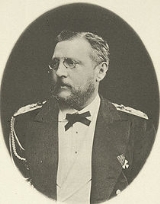
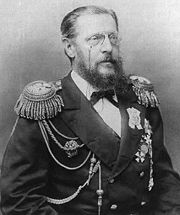
Grand Duke Konstantin Nikolayevich of Russia

Encyclopedia
Grand Duke Konstantin Nikolayevich of Russia was the second son of Tsar Nicholas I of Russia
.
During the reign of his brother Alexander II
, Konstantin was an admiral of the Russian fleet and reformed the Russian Navy
. He was also an instrumental figure in the emancipation of the serfs
. He was less fortunate as viceroy of Poland
and had to be recalled to Russia where he was attacked for his liberalism.
After the assassination of his brother, Alexander II, Konstantin fell from favour. The new tsar, Alexander III
, his nephew, opposed Konstantin's liberal ideas and gradually stripped him of all his governmental positions. His retirement was marked with personal turmoil and family setbacks. After suffering a stroke, he spent his last years as an invalid. He is a great-great grandfather of Charles, Prince of Wales
, heir apparent to the British throne.
, the second son and fifth child of Tsar Nicholas I of Russia
and Empress Alexandra Fyodorovna. His parents were happy to have a second son after nine years of having only daughters. Nicholas I and his wife were devoted to each other and to their children, providing an excellent education for them.
Normally the Imperial children were kept under female supervision until they were seven. However, by the time he was five Konstantin had become too willful and difficult for a governess to handle and his father appointed a male tutor for him. Nicholas I intended that Konstantin would eventually become Admiral General of the Russian Fleet and with this in mind chose Fyodor Litke as tutor for his son. Litke, who had circumnavigated the globe at the age of twenty, was a brash and bold man, unafraid of controversy or offense, and he passed these qualities along to his student. He trained the boy in naval sciences and filled his head with tales of the sea, gaining the friendship of his pupil for life. Languages were an important part of Konstantin's education; he learned Russian
, English
, German
and French
. As he grew older, his lessons increased in length and complexity to encompass mathematics, science, statistics, and government administration. There were also early military lessons and drills. Konstantin also enjoyed music, learning to play the piano and cello. He loved drawing and had great appreciation for the arts. He also became an enthusiastic reader and his fascination with Homer
led him to translate the Odyssey
from German.
In 1835, Konstantin accompanied his parents to Germany
and from age eight onwards was taught to keep a diary. When he was just eight years old, he was given a small yacht, which he would sail between Petergof and Kronstadt
, spending his days at sea and returning home at night. In 1836, accompanied by Litke, he embarked on a lengthy sailing expedition and finally he was given command of the Russian frigate Hercules under Litke's direction. During his training Konstantin was treated like all other naval cadets, even to the point of his title of Grand Duke being dispensed with. He was placed on watch duty at midnight as well as in rain and storms. At the age of sixteen, Konstantin was promoted to the rank of captain and served as commander of the frigate Ulyses, visiting various ports along the Gulf of Finland
and embarking on a southern tour that included the Mediterranean.
The encouragement and guidance of his aunt, Grand Duchess Yelena Pavlovna
, was another important influence in Konstantin's education. Yelena took him under her wing, broadening his taste in literature and music and introducing him to the latest scientific ideas. She was well known for her liberal bent and had a big influence in her nephew's political views. Under Litke's influence, Konstantin began his forays into official life, taking on patronage of the new Imperial Russian Geographical Society
. The Geographical Society was subordinate to the Ministry of Internal Affairs, which was home to a conspicuous number of liberal bureaucrats including Nikolay Milyutin
.
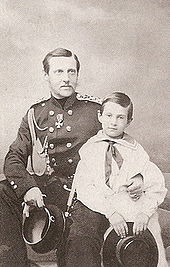 The male members of the Romanov family were famous for their good looks and their height, but Konstantin was rather short and ugly. He was described by one observer: " His complexion was sallow, the color of his hair was rather neutral, and resembled the sand of the seashore. His eyes were gray, dreamy, and half closed and an enormous wooden looking nose took the place of his father's Grecian outline". He had a loud voice, imposing personality and brusque manners. With a quick temper, Konstantin was a difficult man and often unpleasant.
In 1846 Konstantin's sister, Grand Duchess Olga, married Crown Prince Charles of Württemberg
. He went with her to Stuttgart
then he continued to Altenburg
to be introduced to Princess Alexandra of Saxe-Altenburg. His parents had arranged the meeting thinking that Alexandra might make a good match for Konstantin. Alexandra was strikingly beautiful, tall and slim and Konstantin was immediately eager to marry her. "I don't know what is happening to me. It is as if I am a completely new person. Just one thought moves me, just one image fills my eyes: forever and only she, my angel, my universe. I really do think I’m in love. However, what can it mean? I've only know her just a few hours and I'm already up to my ears in Passion".
Konstantin was nineteen and Alexandra three years younger; they were engaged but had to wait two more years to get married. On 12 October 1847, she arrived in Russia. In February she converted to Russian Orthodoxy
, taking the name of Grand Duchess Alexandra Iosifovna. They were married six months later on 11 September 1848 in the Winter Palace
. Both were musical: he played the cello and she the piano. They seem to have been a good match. For the first years of their marriage, they were a devoted couple, starting their married life happily. In the following years, they had six children. The couple lived in some of the most luxurious palaces of the Empire: Pavlovsk, Strelna
, and the Marble Palace
. Konstantin received the Marble Palace in St. Petersburg as a wedding gift from his parents with Strelna, on the Gulf of Finland, as their country retreat. A year after his marriage Konstantin inherited Pavlovsk from his uncle Grand Duke Mikhail Pavlovich
, and, at the death of his mother, the palace of Oreanda in Crimea
.
. It was his first real taste of military conflict. He took part in three dangerous clashes, coming under enemy fire. For his bravery he received the St. George's Cross. During this campaign, he wrote to his father who maintained they were the best reports he received. A year later, Konstantin was appointed a member of the State Council.
In 1853, Konstantin's father Tsar Nicholas I made him General-Admiral of the Imperial Navy and head of the Department of the Imperial navy. In this position, he was in charge with reforming a navy that had largely remained unchanged since the time of Peter the Great. It fell upon Konstantin to not only preside over an archaic fleet but also to see it through the disaster of the Crimean War
. On the midst of the conflict, his father died and Konstantin advised his brother to search for peace in a war already lost. In early 1856, he accompanied his brother Alexander II
to the Crimea to view first-hand the devastation of the War. These early military experiences gave Konstantin a loathing of army life and the futility of war. From then on, he was a man of peace, despite his keen interest in the navy, and in political terms a progressive. There was a close working relationship between the two brothers, which was responsible for many reforms. Konstantin was also sent on a diplomatic mission to Napoleon III.
and France
in 1857 to study modern navies. Knowing Russia was an inferior military power, Konstantin made concerted efforts to modernize the Russian fleet. Under his orders, old wooden frigates equipped with cannon were replaced with new iron and steel vessels outfitted with modern French and German artillery. Beginning in 1857, he supervised a comprehensive building program that completely transformed the Imperial Navy and made it into a world superpower. Under his plans, the Baltic fleet received eighteen battleships, twelve frigates, and one hundred cannon boats, while the Pacific Fleet
was reinforced with twelve new armored vessels, nine transport ships, and four frigates. Only the Black Sea Fleet
was largely neglected due to the restriction forced upon Russia after the Crimean War
. Nevertheless, he added nineteen new vessels, the maximum allowed to the Empire.
Konstantin's spirit of reform had to confront an overstaffed bureaucracy which obstructed his every move. "I want shipwrights and sailors, no crowds of clerks ", he said. He was energetic and determined. As he pushed forward his plans for the navy, he was involved in the reform of the naval and military colleges, as well as a thorough investigation of corruption in the army and the revision of the county's censorship laws. Abrupt, quick-tempered, and utterly contemptuous of anyone who opposed him, he could forge through problems that daunted his more sensitive elder brother.
As is usual with reformers, Konstantin was both praised and despised. One critic called him "the most intelligent and able of Alexander II's brothers", but declared that he was "too self-centered to take any real interest in the welfare of others". However, Konstantin's work had a lasting influence on the Russian Imperial Navy. Under his tenure, it was rebuilt and strengthened, with new armored, steam powered vessels replacing the old wooden frigates of his father's reign. He left Russia with the world's third largest sea power, a naval force recognized for its strength and feared for its disciplined approach.
, a policy that was unpopular with large sections of the nobility. When the committee appointed to bring it about dug in their heels and made difficulties, Alexander II asked Konstantin to join the committee in September 1857. Where the Tsar was unsure of himself, his younger brother was more forceful, quick tempered, and cared not what others might think of him.
In 1858, a central group for emancipation, which included only the more progressive members, Konstantin, Lanskoy, Yakov Rostovtsev
, Nikolay Milyutin
, and their allies, replaced the original committee. Even then, progress was still slow, particularly as several members objected to the Grand Duke's brusque manner.
Diehards on the committee knew better than to argue with Konstantin, but continued to use every means possible to provoke him by acting as a brake on progress. He faced a fractured group of representatives, divided between dedicated reformers intent on enacting the Emperor's reforms immediately, and a hoist of conservative aristocrat representatives who vehemently opposed the emancipation of the serfs. Konstantin was particularly scornful of the numerous aristocratic protests against his plan, commenting once that they were not even worthy for him to spit upon. On several occasions, Konstantin only just managed to keep the Committee from disintegrating under the strain. The post was a difficult one and the pressures wore on the Grand Duke. His enemies retaliated with ludicrous and poisonous gossip: "Konstantin", they said, "was insane, the result of too much masturbation".
Although his brother never ceased to support him, after twelve stormy months Konstantin decided he had had enough of "the ignoble nobility". Frustrated and disheartened, he departed for a relaxing cruise abroad. He returned to his post almost a year later, refreshed by his absence. The brothers' joint determination for results eventually paid off. A general plan of procedure was soon produced and after almost five years, the emancipation finally became law in 1861. Alexander II publicly thanked Konstantin for his contribution.
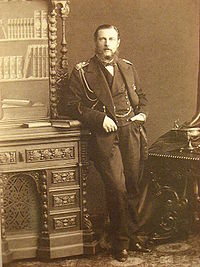 In 1861, the Russian sector of Poland
, partitioned since the previous century, was disturbed and under martial law. Alexander II needed a skillful governor for Poland and decided to appointed Constantin for the job. In early 1862, Konstantin arrived in Warsaw
as the new Namestnik of the Kingdom of Poland. On 4 July 1862, his second day as Governor-General, a tailor's apprentice and Polish nationalist named Jaroszyński saw him leaving a Warsaw theater, and shot him; the bullet grazed the Grand Duke in the shoulder, but left him otherwise unhurt. Konstantin described the attack as follows: "I went into the square", he wrote, "and a man came from the crowd approaching me. Form the breast he pulled a pistol, and fired. I ran back to the theater, otherwise I would have been dead."
Although the Tsar sent him a telegram ordering him to return to St. Petersburg at once, Konstantin preferred to stay, and his wife Grand Duchess Alexandra supported him. His assailant was tried and hanged and Konstantin publicly appealed to the citizens of Warsaw to end the violence. After this attack, he was always escorted by a contingent of Cossacks wherever he went.
In July 1862, Konstantin's wife gave birth to the couple's sixth and last child in Warsaw. As a compliment to the Poles, they decided to give their son a Polish
name, Vacslav, but the Russians insisted that the true Russified form, Vyacheslav, should be used, a compromise which pleased neither nation. Alexander II's second son, Grand Duke Alexander, was sent to Warsaw to stand as a godfather to the child. A large, clumsy youth of seventeen, the future Alexander III
spilt a decanter of red wine at the dinner table. Konstantin, with his abrupt manners, scolded his clumsy nephew, remarking "See what a pig they have sent us from St. Petersburg". The future Alexander III would never forget this insult and for the rest of his life he bore a grudge against his uncle.
Konstantin sympathized with the Poles and, ignoring the advice of his brother's generals, he ended martial law and embarked on a program of liberalization. Polish
was reinstated as the official language, universities were opened and Konstantin appointed Poles to administrative positions, gathering a distinguished court of Poles and Russians around him. Konstantin did all he could to appease the Poles, but his well-meant reforms did not go far enough for the Polish nationalists who wanted nothing short of independence, by force if necessary.
Acting on the advice of the Emperor, Konstantin ordered a forcible conscription of certain young Poles. The move, announced on New Year's Day 1863, was designed not to reinforce the rolls of the Army, but to round up a number of dangerous young nationalist radicals. The measure backfired, marking the outbreak of the so-called January Uprising
. National resistance turned to general rebellion that spread into the nine formerly Polish provinces known as Russia's western region, where powerful landlords and Catholic clergy were ready to give vent to their hatred of Russian domination.
Intense fighting, protest, strikes, and even political assassinations, all threatened to undermine the advances that Konstantin had pushed so strenuously. He then had to declare martial law and severely repressed the uprising. Although adept when it came to naval matters, Konstantin had little taste for political fights, and none for ruthlessly crushing revolts. In August 1863, he asked the emperor to relieve him of the post of Viceroy, and Alexander II, aware of how tormented his brother had become by the situation in Warsaw, accepted his resignation. The insurrection was finally quelled in May 1864, when the more conservative Count Frederik Vilhelm Rembert von Berg was sent to replace Konstantin as viceroy.
Alexander II, who appreciated his brother's work, made Konstantin Chairman of the Judiciary Committee, where he presided over long sessions and recommended revolutionary measures to bring the laws of the Russian Empire in line with the other leading countries. In recognition of his services, Alexander II appointed him Chairman of the Council of Ministers in 1865. In all Konstantin was President of the Council of State for sixteen years. Though lacking in tact, he always had the Tsar's ear and defended the council's view. This also made him many enemies.
Konstantin presided over many Russian institutions; he was Chairman of the Russian Geographic Committee and president of several educational institutions, including the Russian Musical Society. A promoter of Slavic causes, he saw Russia's future in the East, nevertheless perceiving Russia's continued hold on Alaska
as a burden to the Empire. He was instrumental in persuading his brother to sell it to the United States in 1867.
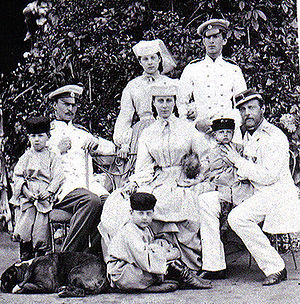 Konstantin was a loving father. In 1867, his eldest daughter, Olga
, married King George I of Greece
. She was only sixteen, and Konstantin was initially reluctant to let her marry so young. In July 1868 Olga's first child was born and was named Konstantin after his grandfather. The start of his daughter's family coincided with the breaking up of Konstantin's marriage.
Although he was only forty, Konstantin's struggles and travails of the previous decade—naval and judiciary reforms, the freeing of the serfs—had prematurely aged him. As Alexander II turned away from the reform that had marked his first decade on the throne, Konstantin's influence began to wane and he began to focus more in his personal life. After twenty years of marriage he had drifted away from his wife, their divergent political views and interests slowly tearing away the foundations of their marriage. Alexandra Iosifovna was as conservative as her husband was liberal, self-absorbed with her own beauty and her mysticism. Soon, Konstantin turned elsewhere for comfort.
At the end of the 1860s, Konstantin embarked on an affair, having an illegitimate daughter, Marie Condousso. In the 1880s, Marie was sent to Greece, later serving as lady in waiting to her half sister, Queen Olga. Marie eventually married a Greek banker. Soon after the birth of Marie, Konstantin began a new liaison. Around 1868, Konstantin began to pursue a young dancer from the St. Petersburg Conservatoire. Anna Vasilyevna Kuznetsova was a talented ballerina and a mime. She was the illegitimate daughter of ballerina Tatyana Markyanovna Kuznetsova and actor Vasily Andreyevich Karatygin. Anna was twenty years younger than Konstantin and initially she resisted his advances, but in 1873 she gave birth to their first child. Four more would follow.
Konstantin bought his second family a large, comfortable dacha on his estate at Pavlovsk, in fact lodging his mistress and their illegitimate children in close proximity to his estranged wife who he now referred to as his "government–issue wife". Once more Konstantin gave ammunition to his enemies and society sided in the scandal with his suffering wife, who tried to bear his infidelity with dignity.
In 1874, scandal erupted when it was discovered that Konstantin's eldest son, Grand Duke Nikolay Konstantinovich
, who had lived a dissipated life and had revolutionary ideas, had stolen three valuable diamonds from an icon in the bedroom of Alexandra Iosifovna in complicity with his mistress, an American courtesan. His twenty-four-year-old son was found guilty, declared insane, and banished for life to Central Asia
. Konstantin suffered another bitter blow when in 1879, his youngest legitimate son, Vyacheslav, died unexpectedly from a brain hemorrhage.
 Since 1865, Konstantin had been pushing for a constitution in Russia. As President of the Council of State, he helped to prepare the proposal for a limited elective assembly which Alexander II was due to approve on the very day he was assassinated. For Konstantin and his fellow reformers, hopes ended within months of the new Emperor's ascension to the throne. Alexander III
destroyed the document and as he never had liked his uncle Konstantin, whom he regarded a 'liberal powerhouse', requested his uncle's resignation. Konstantin refused to resign, saying that his father had directed me to serve both my deceased brother, and his successors. In my capacity as chairman of the State Council, and as Admiral-General of the Imperial navy, I plan to serve Your Majesty with just as much faith and energy. By doing so, I will fulfill my beloved father's last wishes". This was not the answer Alexander III had anticipated and the second time he presented his uncle not with a suggestion but with an order. After sixteen years as chairman of the Council of ministers, Konstantin was stripped of the office and was replaced by his brother, the more pliable Grand Duke Mikhail Nikolayevich
; Alexander III also took away Konstantin's position as head of the Naval Department, handing it over to his own brother, Grand Duke Alexei Alexandrovich. Konstantin was no longer welcome at court.
The dismissal fell heavily on the still vibrant, energetic Konstantin, leaving him adrift without any proper role. He was an enthusiastic chess player and his chess problems were published in international journals, but that was not a substitute for the position he once had at the center of affairs. He spent increasingly more time with his second family, further humiliating his legitimate wife. With nothing left to do, Konstantin retired to Pavlovsk, spending most of his time abroad or on his Crimean estate of Oreanda. In August 1881 a fire completely destroyed Oreanda. The palace was never rebuilt and Konstantin lived from then on in a wooden pavilion. Tragedy struck him again while living there. In April 1885, his two surviving illegitimate sons died days apart of scarlet fever. Of the five children Constantin had had with Kousnetzova, only the two daughters, Marina and Anna, thrived; Konstantin showered them with affection. He was also particularly close to his eldest daughter Olga whom he visited in Greece in 1883. His grandson Prince Christopher of Greece
remembered him for his sharp and loud voice, which Konstantin enjoyed using, usually for new servants and preferably in the presence of guests. Without any reason he would glare at the new servant and then scream the servant's name. Some were used to the trick and remained calm, while others dropped the dishes in terror, which amused him.
.
At the beginning of August 1889, Konstantin suffered a severe stroke that left his legs paralyzed and him unable to speak. The loss of his health struck the once vibrant Konstantin particularly hard. As an invalid, he depended from then on on the care of adjutants while confined in a bath chair. Konstantin was cared for by his wife, who gained a sort of revenge for his unfaithfulness and past humiliations. Alexandra Iosifovna did not expel Anna Kuznetsova and her children from the nearby house that Konstantin had provided for them, but she made sure that Konstantin's attendants never took him there.
Konstantin tried in vain to convince his attendants to take him to see his second family, but they were under strict orders not to do so and pretended not to understand the invalid's wishes. One day, brought home by his attendants, he grabbed his wife's hair and beat her with a stick before anyone could intervene.
Konstantin died at Pavlovsk on 13/25 January 1892. Before he died his wife invited his mistress and their two daughters to see him for a last time.
Konstantin had five illegitimate children with his mistress Anna Kuznetsova (1847–1922); they bore the last name Knyazev:
Nicholas I of Russia
Nicholas I , was the Emperor of Russia from 1825 until 1855, known as one of the most reactionary of the Russian monarchs. On the eve of his death, the Russian Empire reached its historical zenith spanning over 20 million square kilometers...
.
During the reign of his brother Alexander II
Alexander II of Russia
Alexander II , also known as Alexander the Liberator was the Emperor of the Russian Empire from 3 March 1855 until his assassination in 1881...
, Konstantin was an admiral of the Russian fleet and reformed the Russian Navy
Imperial Russian Navy
The Imperial Russian Navy refers to the Tsarist fleets prior to the February Revolution.-First Romanovs:Under Tsar Mikhail Feodorovich, construction of the first three-masted ship, actually built within Russia, was completed in 1636. It was built in Balakhna by Danish shipbuilders from Holstein...
. He was also an instrumental figure in the emancipation of the serfs
Emancipation reform of 1861
The Emancipation Reform of 1861 in Russia was the first and most important of liberal reforms effected during the reign of Alexander II of Russia. The reform, together with a related reform in 1861, amounted to the liquidation of serf dependence previously suffered by peasants of the Russian Empire...
. He was less fortunate as viceroy of Poland
Poland
Poland , officially the Republic of Poland , is a country in Central Europe bordered by Germany to the west; the Czech Republic and Slovakia to the south; Ukraine, Belarus and Lithuania to the east; and the Baltic Sea and Kaliningrad Oblast, a Russian exclave, to the north...
and had to be recalled to Russia where he was attacked for his liberalism.
After the assassination of his brother, Alexander II, Konstantin fell from favour. The new tsar, Alexander III
Alexander III of Russia
Alexander Alexandrovich Romanov , historically remembered as Alexander III or Alexander the Peacemaker reigned as Emperor of Russia from until his death on .-Disposition:...
, his nephew, opposed Konstantin's liberal ideas and gradually stripped him of all his governmental positions. His retirement was marked with personal turmoil and family setbacks. After suffering a stroke, he spent his last years as an invalid. He is a great-great grandfather of Charles, Prince of Wales
Charles, Prince of Wales
Prince Charles, Prince of Wales is the heir apparent and eldest son of Queen Elizabeth II and Prince Philip, Duke of Edinburgh. Since 1958 his major title has been His Royal Highness The Prince of Wales. In Scotland he is additionally known as The Duke of Rothesay...
, heir apparent to the British throne.
Education
Konstantin was born in St. PetersburgSaint Petersburg
Saint Petersburg is a city and a federal subject of Russia located on the Neva River at the head of the Gulf of Finland on the Baltic Sea...
, the second son and fifth child of Tsar Nicholas I of Russia
Nicholas I of Russia
Nicholas I , was the Emperor of Russia from 1825 until 1855, known as one of the most reactionary of the Russian monarchs. On the eve of his death, the Russian Empire reached its historical zenith spanning over 20 million square kilometers...
and Empress Alexandra Fyodorovna. His parents were happy to have a second son after nine years of having only daughters. Nicholas I and his wife were devoted to each other and to their children, providing an excellent education for them.
Normally the Imperial children were kept under female supervision until they were seven. However, by the time he was five Konstantin had become too willful and difficult for a governess to handle and his father appointed a male tutor for him. Nicholas I intended that Konstantin would eventually become Admiral General of the Russian Fleet and with this in mind chose Fyodor Litke as tutor for his son. Litke, who had circumnavigated the globe at the age of twenty, was a brash and bold man, unafraid of controversy or offense, and he passed these qualities along to his student. He trained the boy in naval sciences and filled his head with tales of the sea, gaining the friendship of his pupil for life. Languages were an important part of Konstantin's education; he learned Russian
Russian language
Russian is a Slavic language used primarily in Russia, Belarus, Uzbekistan, Kazakhstan, Tajikistan and Kyrgyzstan. It is an unofficial but widely spoken language in Ukraine, Moldova, Latvia, Turkmenistan and Estonia and, to a lesser extent, the other countries that were once constituent republics...
, English
English language
English is a West Germanic language that arose in the Anglo-Saxon kingdoms of England and spread into what was to become south-east Scotland under the influence of the Anglian medieval kingdom of Northumbria...
, German
German language
German is a West Germanic language, related to and classified alongside English and Dutch. With an estimated 90 – 98 million native speakers, German is one of the world's major languages and is the most widely-spoken first language in the European Union....
and French
French language
French is a Romance language spoken as a first language in France, the Romandy region in Switzerland, Wallonia and Brussels in Belgium, Monaco, the regions of Quebec and Acadia in Canada, and by various communities elsewhere. Second-language speakers of French are distributed throughout many parts...
. As he grew older, his lessons increased in length and complexity to encompass mathematics, science, statistics, and government administration. There were also early military lessons and drills. Konstantin also enjoyed music, learning to play the piano and cello. He loved drawing and had great appreciation for the arts. He also became an enthusiastic reader and his fascination with Homer
Homer
In the Western classical tradition Homer , is the author of the Iliad and the Odyssey, and is revered as the greatest ancient Greek epic poet. These epics lie at the beginning of the Western canon of literature, and have had an enormous influence on the history of literature.When he lived is...
led him to translate the Odyssey
Odyssey
The Odyssey is one of two major ancient Greek epic poems attributed to Homer. It is, in part, a sequel to the Iliad, the other work ascribed to Homer. The poem is fundamental to the modern Western canon, and is the second—the Iliad being the first—extant work of Western literature...
from German.
In 1835, Konstantin accompanied his parents to Germany
Germany
Germany , officially the Federal Republic of Germany , is a federal parliamentary republic in Europe. The country consists of 16 states while the capital and largest city is Berlin. Germany covers an area of 357,021 km2 and has a largely temperate seasonal climate...
and from age eight onwards was taught to keep a diary. When he was just eight years old, he was given a small yacht, which he would sail between Petergof and Kronstadt
Kronstadt
Kronstadt , also spelled Kronshtadt, Cronstadt |crown]]" and Stadt for "city"); is a municipal town in Kronshtadtsky District of the federal city of St. Petersburg, Russia, located on Kotlin Island, west of Saint Petersburg proper near the head of the Gulf of Finland. Population: It is also...
, spending his days at sea and returning home at night. In 1836, accompanied by Litke, he embarked on a lengthy sailing expedition and finally he was given command of the Russian frigate Hercules under Litke's direction. During his training Konstantin was treated like all other naval cadets, even to the point of his title of Grand Duke being dispensed with. He was placed on watch duty at midnight as well as in rain and storms. At the age of sixteen, Konstantin was promoted to the rank of captain and served as commander of the frigate Ulyses, visiting various ports along the Gulf of Finland
Gulf of Finland
The Gulf of Finland is the easternmost arm of the Baltic Sea. It extends between Finland and Estonia all the way to Saint Petersburg in Russia, where the river Neva drains into it. Other major cities around the gulf include Helsinki and Tallinn...
and embarking on a southern tour that included the Mediterranean.
The encouragement and guidance of his aunt, Grand Duchess Yelena Pavlovna
Elena Pavlovna of Württemberg
Princess Charlotte of Württemberg was, as Grand Duchess Elena Pavlovna of Russia, the wife of Grand Duke Michael Pavlovich of Russia...
, was another important influence in Konstantin's education. Yelena took him under her wing, broadening his taste in literature and music and introducing him to the latest scientific ideas. She was well known for her liberal bent and had a big influence in her nephew's political views. Under Litke's influence, Konstantin began his forays into official life, taking on patronage of the new Imperial Russian Geographical Society
Russian Geographical Society
The Russian Geographical Society is a learned society, founded on 6 August 1845 in Saint Petersburg, Russia.-Imperial Geographical Society:Prior to the Russian Revolution of 1917, it was known as the Imperial Russian Geographical Society....
. The Geographical Society was subordinate to the Ministry of Internal Affairs, which was home to a conspicuous number of liberal bureaucrats including Nikolay Milyutin
Nikolay Milyutin
Nikolay Alexeyevich Milyutin was a Russian statesman remembered as the chief architect of the great liberal reforms undertaken during Alexander II's reign, including the emancipation of the serfs and the establishment of zemstvo.-Early life:Nikolay Milyutin was born in Moscow, Russia on June 6,...
.
Marriage
In 1846 Konstantin's sister, Grand Duchess Olga, married Crown Prince Charles of Württemberg
Charles I of Württemberg
Charles was the third King of Württemberg, from 25 June 1864 until his death in 1891.-Early life:He was born 6 March 1823 at Stuttgart, as HRH Charles Frederick Alexander, Crown Prince of Württemberg the son of William I, King of Württemberg and his third wife Pauline Therese of Württemberg .He...
. He went with her to Stuttgart
Stuttgart
Stuttgart is the capital of the state of Baden-Württemberg in southern Germany. The sixth-largest city in Germany, Stuttgart has a population of 600,038 while the metropolitan area has a population of 5.3 million ....
then he continued to Altenburg
Altenburg
Altenburg is a town in the German federal state of Thuringia, 45 km south of Leipzig. It is the capital of the Altenburger Land district.-Geography:...
to be introduced to Princess Alexandra of Saxe-Altenburg. His parents had arranged the meeting thinking that Alexandra might make a good match for Konstantin. Alexandra was strikingly beautiful, tall and slim and Konstantin was immediately eager to marry her. "I don't know what is happening to me. It is as if I am a completely new person. Just one thought moves me, just one image fills my eyes: forever and only she, my angel, my universe. I really do think I’m in love. However, what can it mean? I've only know her just a few hours and I'm already up to my ears in Passion".
Konstantin was nineteen and Alexandra three years younger; they were engaged but had to wait two more years to get married. On 12 October 1847, she arrived in Russia. In February she converted to Russian Orthodoxy
Russian Orthodox Church
The Russian Orthodox Church or, alternatively, the Moscow Patriarchate The ROC is often said to be the largest of the Eastern Orthodox churches in the world; including all the autocephalous churches under its umbrella, its adherents number over 150 million worldwide—about half of the 300 million...
, taking the name of Grand Duchess Alexandra Iosifovna. They were married six months later on 11 September 1848 in the Winter Palace
Winter Palace
The Winter Palace in Saint Petersburg, Russia, was, from 1732 to 1917, the official residence of the Russian monarchs. Situated between the Palace Embankment and the Palace Square, adjacent to the site of Peter the Great's original Winter Palace, the present and fourth Winter Palace was built and...
. Both were musical: he played the cello and she the piano. They seem to have been a good match. For the first years of their marriage, they were a devoted couple, starting their married life happily. In the following years, they had six children. The couple lived in some of the most luxurious palaces of the Empire: Pavlovsk, Strelna
Strelna
Strelna is a municipal settlement in Petrodvortsovy District of the federal city of St. Petersburg, Russia, situated about halfway between St. Petersburg proper and Petergof and overlooking the shore of the Gulf of Finland...
, and the Marble Palace
Marble Palace
Marble Palace is one of the first Neoclassical palaces in Saint Petersburg, Russia. It is situated between the Field of Mars and Palace Quay, slightly to the east from New Michael Palace....
. Konstantin received the Marble Palace in St. Petersburg as a wedding gift from his parents with Strelna, on the Gulf of Finland, as their country retreat. A year after his marriage Konstantin inherited Pavlovsk from his uncle Grand Duke Mikhail Pavlovich
Grand Duke Michael Pavlovich of Russia
Grand Duke Michael Pavlovich of Russia was the tenth child and fourth son of Paul I of Russia and Sophie Dorothea of Württemberg.-Marriage and issue:In St...
, and, at the death of his mother, the palace of Oreanda in Crimea
Crimea
Crimea , or the Autonomous Republic of Crimea , is a sub-national unit, an autonomous republic, of Ukraine. It is located on the northern coast of the Black Sea, occupying a peninsula of the same name...
.
Early career
In 1849, as a young officer, Konstantin took part in a campaign assisting the Austrians to put down an uprising in HungaryHungary
Hungary , officially the Republic of Hungary , is a landlocked country in Central Europe. It is situated in the Carpathian Basin and is bordered by Slovakia to the north, Ukraine and Romania to the east, Serbia and Croatia to the south, Slovenia to the southwest and Austria to the west. The...
. It was his first real taste of military conflict. He took part in three dangerous clashes, coming under enemy fire. For his bravery he received the St. George's Cross. During this campaign, he wrote to his father who maintained they were the best reports he received. A year later, Konstantin was appointed a member of the State Council.
In 1853, Konstantin's father Tsar Nicholas I made him General-Admiral of the Imperial Navy and head of the Department of the Imperial navy. In this position, he was in charge with reforming a navy that had largely remained unchanged since the time of Peter the Great. It fell upon Konstantin to not only preside over an archaic fleet but also to see it through the disaster of the Crimean War
Crimean War
The Crimean War was a conflict fought between the Russian Empire and an alliance of the French Empire, the British Empire, the Ottoman Empire, and the Kingdom of Sardinia. The war was part of a long-running contest between the major European powers for influence over territories of the declining...
. On the midst of the conflict, his father died and Konstantin advised his brother to search for peace in a war already lost. In early 1856, he accompanied his brother Alexander II
Alexander II of Russia
Alexander II , also known as Alexander the Liberator was the Emperor of the Russian Empire from 3 March 1855 until his assassination in 1881...
to the Crimea to view first-hand the devastation of the War. These early military experiences gave Konstantin a loathing of army life and the futility of war. From then on, he was a man of peace, despite his keen interest in the navy, and in political terms a progressive. There was a close working relationship between the two brothers, which was responsible for many reforms. Konstantin was also sent on a diplomatic mission to Napoleon III.
Naval reform
Plans for naval reform took Konstantin's attention at the start of his brother's reign. He visited EnglandEngland
England is a country that is part of the United Kingdom. It shares land borders with Scotland to the north and Wales to the west; the Irish Sea is to the north west, the Celtic Sea to the south west, with the North Sea to the east and the English Channel to the south separating it from continental...
and France
France
The French Republic , The French Republic , The French Republic , (commonly known as France , is a unitary semi-presidential republic in Western Europe with several overseas territories and islands located on other continents and in the Indian, Pacific, and Atlantic oceans. Metropolitan France...
in 1857 to study modern navies. Knowing Russia was an inferior military power, Konstantin made concerted efforts to modernize the Russian fleet. Under his orders, old wooden frigates equipped with cannon were replaced with new iron and steel vessels outfitted with modern French and German artillery. Beginning in 1857, he supervised a comprehensive building program that completely transformed the Imperial Navy and made it into a world superpower. Under his plans, the Baltic fleet received eighteen battleships, twelve frigates, and one hundred cannon boats, while the Pacific Fleet
Pacific Fleet (Russia)
The Pacific Fleet is the part of the Russian Navy that is stationed in the Pacific Ocean, which formerly secured the Far Eastern borders of the Soviet Union. The fleet headquarters is located at Vladivostok and a number of fleet bases are located in the Vladivostok area...
was reinforced with twelve new armored vessels, nine transport ships, and four frigates. Only the Black Sea Fleet
Black Sea Fleet
The Black Sea Fleet is a large operational-strategic sub-unit of the Russian Navy, operating in the Black Sea and the Mediterranean Sea since the late 18th century. It is based in various harbors of the Black Sea and the Sea of Azov....
was largely neglected due to the restriction forced upon Russia after the Crimean War
Crimean War
The Crimean War was a conflict fought between the Russian Empire and an alliance of the French Empire, the British Empire, the Ottoman Empire, and the Kingdom of Sardinia. The war was part of a long-running contest between the major European powers for influence over territories of the declining...
. Nevertheless, he added nineteen new vessels, the maximum allowed to the Empire.
Konstantin's spirit of reform had to confront an overstaffed bureaucracy which obstructed his every move. "I want shipwrights and sailors, no crowds of clerks ", he said. He was energetic and determined. As he pushed forward his plans for the navy, he was involved in the reform of the naval and military colleges, as well as a thorough investigation of corruption in the army and the revision of the county's censorship laws. Abrupt, quick-tempered, and utterly contemptuous of anyone who opposed him, he could forge through problems that daunted his more sensitive elder brother.
As is usual with reformers, Konstantin was both praised and despised. One critic called him "the most intelligent and able of Alexander II's brothers", but declared that he was "too self-centered to take any real interest in the welfare of others". However, Konstantin's work had a lasting influence on the Russian Imperial Navy. Under his tenure, it was rebuilt and strengthened, with new armored, steam powered vessels replacing the old wooden frigates of his father's reign. He left Russia with the world's third largest sea power, a naval force recognized for its strength and feared for its disciplined approach.
Emancipation of the serfs
The most important reform of all was the emancipation of the serfsEmancipation reform of 1861
The Emancipation Reform of 1861 in Russia was the first and most important of liberal reforms effected during the reign of Alexander II of Russia. The reform, together with a related reform in 1861, amounted to the liquidation of serf dependence previously suffered by peasants of the Russian Empire...
, a policy that was unpopular with large sections of the nobility. When the committee appointed to bring it about dug in their heels and made difficulties, Alexander II asked Konstantin to join the committee in September 1857. Where the Tsar was unsure of himself, his younger brother was more forceful, quick tempered, and cared not what others might think of him.
In 1858, a central group for emancipation, which included only the more progressive members, Konstantin, Lanskoy, Yakov Rostovtsev
Yakov Rostovtsev
Iakov Ivanovich Rostovtsev was a leading figure in the formulation of statutes which effectively emancipated the Russian serfs.Born in St Petersburg, Russia, Rostovtsev became a career soldier, and was a young officer at the time of the 1825 Decembrist revolt...
, Nikolay Milyutin
Nikolay Milyutin
Nikolay Alexeyevich Milyutin was a Russian statesman remembered as the chief architect of the great liberal reforms undertaken during Alexander II's reign, including the emancipation of the serfs and the establishment of zemstvo.-Early life:Nikolay Milyutin was born in Moscow, Russia on June 6,...
, and their allies, replaced the original committee. Even then, progress was still slow, particularly as several members objected to the Grand Duke's brusque manner.
Diehards on the committee knew better than to argue with Konstantin, but continued to use every means possible to provoke him by acting as a brake on progress. He faced a fractured group of representatives, divided between dedicated reformers intent on enacting the Emperor's reforms immediately, and a hoist of conservative aristocrat representatives who vehemently opposed the emancipation of the serfs. Konstantin was particularly scornful of the numerous aristocratic protests against his plan, commenting once that they were not even worthy for him to spit upon. On several occasions, Konstantin only just managed to keep the Committee from disintegrating under the strain. The post was a difficult one and the pressures wore on the Grand Duke. His enemies retaliated with ludicrous and poisonous gossip: "Konstantin", they said, "was insane, the result of too much masturbation".
Although his brother never ceased to support him, after twelve stormy months Konstantin decided he had had enough of "the ignoble nobility". Frustrated and disheartened, he departed for a relaxing cruise abroad. He returned to his post almost a year later, refreshed by his absence. The brothers' joint determination for results eventually paid off. A general plan of procedure was soon produced and after almost five years, the emancipation finally became law in 1861. Alexander II publicly thanked Konstantin for his contribution.
Viceroy of Poland
Poland
Poland , officially the Republic of Poland , is a country in Central Europe bordered by Germany to the west; the Czech Republic and Slovakia to the south; Ukraine, Belarus and Lithuania to the east; and the Baltic Sea and Kaliningrad Oblast, a Russian exclave, to the north...
, partitioned since the previous century, was disturbed and under martial law. Alexander II needed a skillful governor for Poland and decided to appointed Constantin for the job. In early 1862, Konstantin arrived in Warsaw
Warsaw
Warsaw is the capital and largest city of Poland. It is located on the Vistula River, roughly from the Baltic Sea and from the Carpathian Mountains. Its population in 2010 was estimated at 1,716,855 residents with a greater metropolitan area of 2,631,902 residents, making Warsaw the 10th most...
as the new Namestnik of the Kingdom of Poland. On 4 July 1862, his second day as Governor-General, a tailor's apprentice and Polish nationalist named Jaroszyński saw him leaving a Warsaw theater, and shot him; the bullet grazed the Grand Duke in the shoulder, but left him otherwise unhurt. Konstantin described the attack as follows: "I went into the square", he wrote, "and a man came from the crowd approaching me. Form the breast he pulled a pistol, and fired. I ran back to the theater, otherwise I would have been dead."
Although the Tsar sent him a telegram ordering him to return to St. Petersburg at once, Konstantin preferred to stay, and his wife Grand Duchess Alexandra supported him. His assailant was tried and hanged and Konstantin publicly appealed to the citizens of Warsaw to end the violence. After this attack, he was always escorted by a contingent of Cossacks wherever he went.
In July 1862, Konstantin's wife gave birth to the couple's sixth and last child in Warsaw. As a compliment to the Poles, they decided to give their son a Polish
Polish language
Polish is a language of the Lechitic subgroup of West Slavic languages, used throughout Poland and by Polish minorities in other countries...
name, Vacslav, but the Russians insisted that the true Russified form, Vyacheslav, should be used, a compromise which pleased neither nation. Alexander II's second son, Grand Duke Alexander, was sent to Warsaw to stand as a godfather to the child. A large, clumsy youth of seventeen, the future Alexander III
Alexander III of Russia
Alexander Alexandrovich Romanov , historically remembered as Alexander III or Alexander the Peacemaker reigned as Emperor of Russia from until his death on .-Disposition:...
spilt a decanter of red wine at the dinner table. Konstantin, with his abrupt manners, scolded his clumsy nephew, remarking "See what a pig they have sent us from St. Petersburg". The future Alexander III would never forget this insult and for the rest of his life he bore a grudge against his uncle.
Konstantin sympathized with the Poles and, ignoring the advice of his brother's generals, he ended martial law and embarked on a program of liberalization. Polish
Polish language
Polish is a language of the Lechitic subgroup of West Slavic languages, used throughout Poland and by Polish minorities in other countries...
was reinstated as the official language, universities were opened and Konstantin appointed Poles to administrative positions, gathering a distinguished court of Poles and Russians around him. Konstantin did all he could to appease the Poles, but his well-meant reforms did not go far enough for the Polish nationalists who wanted nothing short of independence, by force if necessary.
Acting on the advice of the Emperor, Konstantin ordered a forcible conscription of certain young Poles. The move, announced on New Year's Day 1863, was designed not to reinforce the rolls of the Army, but to round up a number of dangerous young nationalist radicals. The measure backfired, marking the outbreak of the so-called January Uprising
January Uprising
The January Uprising was an uprising in the former Polish-Lithuanian Commonwealth against the Russian Empire...
. National resistance turned to general rebellion that spread into the nine formerly Polish provinces known as Russia's western region, where powerful landlords and Catholic clergy were ready to give vent to their hatred of Russian domination.
Intense fighting, protest, strikes, and even political assassinations, all threatened to undermine the advances that Konstantin had pushed so strenuously. He then had to declare martial law and severely repressed the uprising. Although adept when it came to naval matters, Konstantin had little taste for political fights, and none for ruthlessly crushing revolts. In August 1863, he asked the emperor to relieve him of the post of Viceroy, and Alexander II, aware of how tormented his brother had become by the situation in Warsaw, accepted his resignation. The insurrection was finally quelled in May 1864, when the more conservative Count Frederik Vilhelm Rembert von Berg was sent to replace Konstantin as viceroy.
President of the Council of State
Back in St. Petersburg, Konstantin devoted all his attention to the navy. He spent seven years reforming the Naval Department, altering laws and reorganizing trainings on recruits, and successfully managed to transform the previous often-grim conditions on board most vessels to meet modern standards and expectations. Corporal punishment was abolished in 1863 and the traditional system of naval recruitment was drastically altered.Alexander II, who appreciated his brother's work, made Konstantin Chairman of the Judiciary Committee, where he presided over long sessions and recommended revolutionary measures to bring the laws of the Russian Empire in line with the other leading countries. In recognition of his services, Alexander II appointed him Chairman of the Council of Ministers in 1865. In all Konstantin was President of the Council of State for sixteen years. Though lacking in tact, he always had the Tsar's ear and defended the council's view. This also made him many enemies.
Konstantin presided over many Russian institutions; he was Chairman of the Russian Geographic Committee and president of several educational institutions, including the Russian Musical Society. A promoter of Slavic causes, he saw Russia's future in the East, nevertheless perceiving Russia's continued hold on Alaska
Alaska
Alaska is the largest state in the United States by area. It is situated in the northwest extremity of the North American continent, with Canada to the east, the Arctic Ocean to the north, and the Pacific Ocean to the west and south, with Russia further west across the Bering Strait...
as a burden to the Empire. He was instrumental in persuading his brother to sell it to the United States in 1867.
Family crisis
Olga Konstantinovna of Russia
Grand Duchess Olga Constantinovna of Russia , later Queen Olga of the Hellenes , was the queen consort of King George I of Greece and briefly in 1920, Queen Regent of Greece...
, married King George I of Greece
George I of Greece
George I was King of Greece from 1863 to 1913. Originally a Danish prince, George was only 17 years old when he was elected king by the Greek National Assembly, which had deposed the former king Otto. His nomination was both suggested and supported by the Great Powers...
. She was only sixteen, and Konstantin was initially reluctant to let her marry so young. In July 1868 Olga's first child was born and was named Konstantin after his grandfather. The start of his daughter's family coincided with the breaking up of Konstantin's marriage.
Although he was only forty, Konstantin's struggles and travails of the previous decade—naval and judiciary reforms, the freeing of the serfs—had prematurely aged him. As Alexander II turned away from the reform that had marked his first decade on the throne, Konstantin's influence began to wane and he began to focus more in his personal life. After twenty years of marriage he had drifted away from his wife, their divergent political views and interests slowly tearing away the foundations of their marriage. Alexandra Iosifovna was as conservative as her husband was liberal, self-absorbed with her own beauty and her mysticism. Soon, Konstantin turned elsewhere for comfort.
At the end of the 1860s, Konstantin embarked on an affair, having an illegitimate daughter, Marie Condousso. In the 1880s, Marie was sent to Greece, later serving as lady in waiting to her half sister, Queen Olga. Marie eventually married a Greek banker. Soon after the birth of Marie, Konstantin began a new liaison. Around 1868, Konstantin began to pursue a young dancer from the St. Petersburg Conservatoire. Anna Vasilyevna Kuznetsova was a talented ballerina and a mime. She was the illegitimate daughter of ballerina Tatyana Markyanovna Kuznetsova and actor Vasily Andreyevich Karatygin. Anna was twenty years younger than Konstantin and initially she resisted his advances, but in 1873 she gave birth to their first child. Four more would follow.
Konstantin bought his second family a large, comfortable dacha on his estate at Pavlovsk, in fact lodging his mistress and their illegitimate children in close proximity to his estranged wife who he now referred to as his "government–issue wife". Once more Konstantin gave ammunition to his enemies and society sided in the scandal with his suffering wife, who tried to bear his infidelity with dignity.
In 1874, scandal erupted when it was discovered that Konstantin's eldest son, Grand Duke Nikolay Konstantinovich
Grand Duke Nikolai Konstantinovich of Russia
Grand Duke Nicholas Constantinovich of Russia was the first-born son of Grand Duke Konstantin Nikolayevich of Russia and Grand Duchess Alexandra Iosifovna of Russia and a grandson of Nicholas I of Russia.-Early life:...
, who had lived a dissipated life and had revolutionary ideas, had stolen three valuable diamonds from an icon in the bedroom of Alexandra Iosifovna in complicity with his mistress, an American courtesan. His twenty-four-year-old son was found guilty, declared insane, and banished for life to Central Asia
Central Asia
Central Asia is a core region of the Asian continent from the Caspian Sea in the west, China in the east, Afghanistan in the south, and Russia in the north...
. Konstantin suffered another bitter blow when in 1879, his youngest legitimate son, Vyacheslav, died unexpectedly from a brain hemorrhage.
Retirement
Alexander III of Russia
Alexander Alexandrovich Romanov , historically remembered as Alexander III or Alexander the Peacemaker reigned as Emperor of Russia from until his death on .-Disposition:...
destroyed the document and as he never had liked his uncle Konstantin, whom he regarded a 'liberal powerhouse', requested his uncle's resignation. Konstantin refused to resign, saying that his father had directed me to serve both my deceased brother, and his successors. In my capacity as chairman of the State Council, and as Admiral-General of the Imperial navy, I plan to serve Your Majesty with just as much faith and energy. By doing so, I will fulfill my beloved father's last wishes". This was not the answer Alexander III had anticipated and the second time he presented his uncle not with a suggestion but with an order. After sixteen years as chairman of the Council of ministers, Konstantin was stripped of the office and was replaced by his brother, the more pliable Grand Duke Mikhail Nikolayevich
Grand Duke Michael Nicolaievich of Russia
Grand Duke Michael Nikolaevich of Russia was the fourth son and seventh child of Tsar Nicholas I of Russia and Charlotte of Prussia...
; Alexander III also took away Konstantin's position as head of the Naval Department, handing it over to his own brother, Grand Duke Alexei Alexandrovich. Konstantin was no longer welcome at court.
The dismissal fell heavily on the still vibrant, energetic Konstantin, leaving him adrift without any proper role. He was an enthusiastic chess player and his chess problems were published in international journals, but that was not a substitute for the position he once had at the center of affairs. He spent increasingly more time with his second family, further humiliating his legitimate wife. With nothing left to do, Konstantin retired to Pavlovsk, spending most of his time abroad or on his Crimean estate of Oreanda. In August 1881 a fire completely destroyed Oreanda. The palace was never rebuilt and Konstantin lived from then on in a wooden pavilion. Tragedy struck him again while living there. In April 1885, his two surviving illegitimate sons died days apart of scarlet fever. Of the five children Constantin had had with Kousnetzova, only the two daughters, Marina and Anna, thrived; Konstantin showered them with affection. He was also particularly close to his eldest daughter Olga whom he visited in Greece in 1883. His grandson Prince Christopher of Greece
Prince Christopher of Greece and Denmark
Prince Christopher of Greece and Denmark was a member of the Schleswig-Holstein-Sonderburg-Glücksburg Royal House.-Family background:...
remembered him for his sharp and loud voice, which Konstantin enjoyed using, usually for new servants and preferably in the presence of guests. Without any reason he would glare at the new servant and then scream the servant's name. Some were used to the trick and remained calm, while others dropped the dishes in terror, which amused him.
Last years
In 1886, Konstantin was furious when Alexander III restricted the title of Grand Duke to only children and grandchildren of Emperors, as this meant that Konstantin's grandchildren would merely be princes, but there was little he could do. He had been shunned from society and Alexander III only called his uncle to court for the wedding of Konstantin's eldest granddaughter, Alexandra of Greece to his nephew Grand Duke PaulGrand Duke Paul Alexandrovich of Russia
Grand Duke Paul Alexandrovich of Russia was the eighth child of Tsar Alexander II of Russia by his first wife Empress Maria Alexandrovna. His birth was commemorated by the naming of the city of Pavlodar in Kazakhstan...
.
At the beginning of August 1889, Konstantin suffered a severe stroke that left his legs paralyzed and him unable to speak. The loss of his health struck the once vibrant Konstantin particularly hard. As an invalid, he depended from then on on the care of adjutants while confined in a bath chair. Konstantin was cared for by his wife, who gained a sort of revenge for his unfaithfulness and past humiliations. Alexandra Iosifovna did not expel Anna Kuznetsova and her children from the nearby house that Konstantin had provided for them, but she made sure that Konstantin's attendants never took him there.
Konstantin tried in vain to convince his attendants to take him to see his second family, but they were under strict orders not to do so and pretended not to understand the invalid's wishes. One day, brought home by his attendants, he grabbed his wife's hair and beat her with a stick before anyone could intervene.
Konstantin died at Pavlovsk on 13/25 January 1892. Before he died his wife invited his mistress and their two daughters to see him for a last time.
Children
Konstantin and his wife Grand Duchess Alexandra Iosifovna had six children:- Nikolay KonstantinovichGrand Duke Nikolai Konstantinovich of RussiaGrand Duke Nicholas Constantinovich of Russia was the first-born son of Grand Duke Konstantin Nikolayevich of Russia and Grand Duchess Alexandra Iosifovna of Russia and a grandson of Nicholas I of Russia.-Early life:...
(1850–1918) - Olga Konstantinovna, Queen of the Hellenes (1851–1926)
- Vera Konstantinovna (1854–1912)
- Konstantin Konstantinovich (1858–1915)
- Dmitry Konstantinovich (1860–1919)
- Vyacheslav Konstantinovich (1862–1879); died of brain hemorrhage
Konstantin had five illegitimate children with his mistress Anna Kuznetsova (1847–1922); they bore the last name Knyazev:
- Sergey Konstantinovich Knyazev (1873–1873)
- Marina Konstantinovna Knyazeva (8 December 1875 – 8 June 1941); m. 24 April 1894 Alexander Pavlovich Yershov (b. 6 July 1861), son of Gen. Pavel Yershov
- Anna Konstantinovna Knyazeva (16 March 1878 Saint PetersburgSaint PetersburgSaint Petersburg is a city and a federal subject of Russia located on the Neva River at the head of the Gulf of Finland on the Baltic Sea...
– 5 February 1920); died of typhoid feverTyphoid feverTyphoid fever, also known as Typhoid, is a common worldwide bacterial disease, transmitted by the ingestion of food or water contaminated with the feces of an infected person, which contain the bacterium Salmonella enterica, serovar Typhi...
, (m.) 29 April 1898 in Saint PetersburgSaint PetersburgSaint Petersburg is a city and a federal subject of Russia located on the Neva River at the head of the Gulf of Finland on the Baltic Sea...
to Nikolay Nikolayevich Lyalin (15 August 1869 – 14 February 1920); died of typhoid feverTyphoid feverTyphoid fever, also known as Typhoid, is a common worldwide bacterial disease, transmitted by the ingestion of food or water contaminated with the feces of an infected person, which contain the bacterium Salmonella enterica, serovar Typhi...
, son of Gen. Nikolay Lyalin, Military Governor of Helsingfors; their son was the Benedictine theologian Dom Clément Lialine - Izmail Konstantinovich Knyazev (1879–1885); died of scarlet feverScarlet feverScarlet fever is a disease caused by exotoxin released by Streptococcus pyogenes. Once a major cause of death, it is now effectively treated with antibiotics...
- Lev Konstantinovich Knyazev (1883–1885); died of scarlet fever