

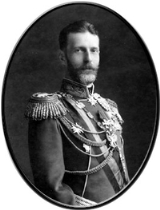
Grand Duke Sergei Alexandrovich of Russia

Encyclopedia
Grand Duke Sergei Alexandrovich of Russia (Сергей Александрович) (May 11, 1857 – February 17, 1905) was a son of Emperor Alexander II of Russia
. He was an influential figure during the reigns of his brother Emperor Alexander III of Russia
and his nephew Emperor Nicholas II, who was also his brother in law through Sergei's marriage to Elizabeth the sister of Tsarina Alexandra
Between 1891 and 1905, he was Governor General of Moscow
. A reactionary even by contemporary conservative standards, his policies made him a polarizing figure. Targeted by revolutionaries, he was assassinated by a terrorist bomb at the Kremlin
.
at Tsarskoye Selo
, some twenty miles (32 km) outside Saint Petersburg
. He was the seventh child and fifth son among the eight children of Alexander II of Russia
and his wife Maria Alexandrovna, born Princess Marie of Hesse-Darmstadt.
Until he was old enough to begin lessons, Sergei’s earlier years were spent with his younger brother Paul
, from whom he was inseparable, and their sister at Livadia
, the family’s Crimean retreat, at Tsarskoye Selo
and at the Winter Palace
in Saint Petersburg. By the time Sergei was born, his mother was already in declining health. Although she was not a particularly affectionate mother, except to her daughter, her three youngest children, Marie, Sergei and Paul
, were close to her and especially to one another. As time passed and the Empress’s health dictated her to avoid the harsh Russian climate, they spent long sojourns abroad in Jugenheim outside Darmstadt and the winters in the South of France. A family tragedy hit them there. In April 1865, shortly before Sergei’s eighth birthday, his eldest brother and godfather Nicholas the heir to the crown died in Nice. As a child, Sergei was shy, studious and withdrawn. Under the influence of his mother, whose reserved character he resembled, he became very religious.
From the 1870s, Sergei and his younger brother Paul were kept in Russia by their studies. They were destined to follow a military career, but their tutor, Admiral Arseniev, encouraged Sergei’s linguistic, artistic and musical abilities. He was fluent in several languages and learned Italian
in order to read Dante in the original. His interest in Italian art and culture intensified, as he grew older. He painted well and was musical, playing the flute in an amateur orchestra. He enjoyed acting and steeped himself in the early history, culture and traditions of Russia. He liked to read and in time came to know many of Russia’s great writers personally, among them Tolstoy
and Dostoevsky
, whose work the Grand Duke read and admired. He met Dostoevsky over dinner at the Winter Palace
where he was invited by Sergei's Professor.
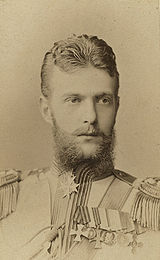 Grand Duke Sergei Alexandrovich started a military career early in his life. He was from birth Colonel-in-Chief of the 38th Tobolsk Infantry Regiment, he also became Colonel-in-Chief of the 2nd Battalion Guards Rifles and towards the end of his life, Colonel-in-Chief of the 5th Kievsky Grenadier Regiment. On his twentieth birthday on April 29, 1877, the Grand Duke took the solemn oath of allegiance to the Emperor. An educational tour that had been proposed for him was postponed upon the outbreak of the Russo-Turkish War of 1877–78. Sergei took part in the war with his father and brothers, the Tsarevich Alexander
and Grand Dukes Vladimir
and Alexei
. He spent the greater part of his time serving as Poruchik
in the Leib Guard under the Tsarevich in southeast Romania
. He was consequently promoted to Colonel
. On October 12, following the battle of Meyk, The Emperor decorated him with the Order of St George, for courage and bravery in action with the enemy, for a reconnaissance expedition at Kara Loma near Koshev. At the end of December 1877, Sergei Alexandrovich returned to Saint Petersburg with his father.
Alexander II
had started a new family with his mistress and Sergei sided with his neglected mother in the breaking of the family’s harmony. Empress Maria died in June 1880 and in March 1881 Alexander II, who had married his mistress, Princess Catherine Dolgoruki, was assassinated by terrorists. Sergei was then in Italy with his brother Paul and Admiral Arseniev. Three months later in June 1881 the Grand Duke went to Palestine accompanied by Paul and his cousin Grand Duke Constantine Constantinovich
. They visited Jerusalem and the sacred sites. He helped to found a society dedicated to the upkeep of Orthodox shrines in the Holy Land and the provision of services to Russian pilgrims. He became chairman of this society and his status as patron of the Russian presence in Jerusalem is believed to have given him more pleasure than any of his other duties.
From 1882 on Sergei’s military career occupied an increasing amount of his time in Saint Petersburg and on maneuvers at Kranoe Selo and advanced still further. On January 15, 1882, his brother Alexander III
appointed him Commander of the 1st Battalion Preobrazhensky Life Guard Regiment
, the elite regiment, founded by Peter the Great, with the rank of Colonel. Seven years later, he was promoted to the rank of Major General. On February 26, 1891, he was made Adjutant General
of the H. I. M. Retinue. He became the commanding officer in the village of Preobrazhenskoy. Sergei commanded this regiment until 1891, when his brother the Emperor appointed him Governor-General of Moscow.
With his closely cropped hair and neat beard, Serge Alexandrovich cut an impressive figure. When Consuelo Vanderbilt
, then Duchess of Marlborough, met him in Moscow
, she considered him to be "One of the handsomest men I have ever seen." Described by his brother-in-law Ernest Louis, Grand Duke of Hesse
as "tall and fair with delicate features and beautiful light green eyes". Very self-conscious, he held himself very stifflyand with a hard expression on his eyes.
He stood very straight - aided by the Prussian fashion for corsets to improve the male figure whilst on horseback - and had a habit of playing with one of his jeweled rings, turning it around his finger. He kept his feelings rigidly in check and many mistook his reserve for pride. Few had the chance to know him well. He was noted for his adherence to the Church, took a deep interest in Russian antiques and art treasures and was interested in archaeology
attending and sometimes chairing meetings of the Archeological Congress.
While shy and reserved, he made no secret of his disapproval of fashionable society and its lax ways, and he defied all criticism. He found it hard to cope with opposition and easily lost his temper . In his home, he demanded tidiness, order and discipline, and expected to be obeyed. His niece, Marie Queen of Romania
remembered him: “Dry, nervous, short of speech, impatient, he had none of the rather careless good humor of his three elder brothers . . . but for all that we loved him, felt irresistibly attracted to him, hard though he could be. Few perhaps cherish his memory, but I do." Many other family members including his nephew Kyril, Princess Marie of Greece
and Prince Gabriel left good impressions about him in their books of memoirs.
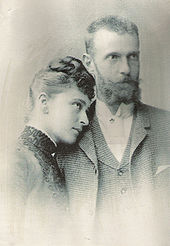 In 1881 there had been talks of a possible marriage to Princess Caroline Mathilde of Schleswig-Holstein. Emperor Alexander II had hoped that at least one of his sons would marry with a princess of Hesse as he had done. Sergei eventually chose as his bride, Princess Elizabeth of Hesse
, a daughter of Ludwig IV, Grand Duke of Hesse and by Rhine and Princess Alice of the United Kingdom
. She was an older sister of both Ernst Ludwig, Grand Duke of Hesse and by Rhine and Alix of Hesse, later the Empress consort of Nicholas II of Russia
. They were first cousins once removed and had known each other all their lives. There were hesitations on both sides and Elizabeth first rejected his proposal of marriage. Queen Victoria, who had anti-Russian sentiments, opposed the marriage of her motherless granddaughter. Elizabeth and her sisters were not pressured into following political marriages; they were allowed to follow their own inclination. After the couple spent some time together in Wolfgasten in Darmstadt in September 1883, Elizabeth agreed to marry him. Their engagement was announced publicly on February 26, 1884 when Sergei returned to visit her in Darmstadt. Upon her marriage, Princess Elizabeth took the name of Grand Duchess Elizabeth Feodorovna of Russia. The wedding took place on June 15, 1884 in the Winter Palace
.
They spent their honeymoon in Ilinskoye, Sergei’s 2400 acres (9.7 km²) country estate forty miles west of Moscow on the left bank of the Moskva River, that he inherited from his mother. The couple later settled in Saint Petersburg in a mansion occupying the southeast corner of the Fontanka Canal and the Nevsky Prospekt, a short drive from his former apartments in the Winter Palace. The Beloselsky Belozerzky mansion, bought by Sergei to live with his wife, was renamed Sergeivsky Palace. The couple also had Ferme, a villa located in the grounds of Peterhof that Sergei had inherited from his mother. They usually entertained at Ilinskoe during the summer months, with guests occupying various wooden villas dotted around the park. There was also Usovo, a substantial stone and brick house with an innovative central heating, that Sergei had had built on the opposite bank of the Moskva River.
The couple were close to Alexander III and Maria Feodorovna and the Tsar trusted Sergei more than his brothers. In 1886, Alexander III appointed him Commander of the Preobrazhensky Life Guard Regiment, entrusting him with introducing the Tsarevich (the future Nicholas II) to army life. Sergei and Ella represented Russia in 1887 during Queen Victoria’s Golden Jubilee and in 1888, they were sent to the Holy Land on the occasion of the consecration of the church of Saint Mary Magdalene in Jerusalem, built in memory of Empress Maria Alexandrovna. By 1892, six years into the marriage, Sergei was already certain that they would not have children and he left a will making the children of his brother Paul his heir after his and his wife’s deaths.
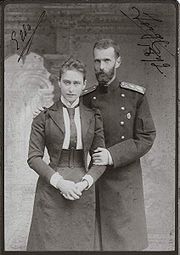 With the increase of all sorts of radical elements, especially among the students in Moscow, Alexander III adopted a policy of repression. The Emperor wanted a like mind at the helm of Imperial Russia’s second city and former capital. In the spring of 1891, the Tsar appointed Sergei as Governor General of Moscow
.
Although it was a great honor Sergei accepted his new appointment with reluctance, he had hoped to stay longer in command of the Preobrajensky, where he was popular; and he and his wife loved the quiet life they were living in Saint Petersburg
.
The vice regal role of Governor General ruling Prince of Moscow was one that was answerable only to the emperor. Sergei was a political hardliner who shared his brother’s inalienable belief in strong, nationalist government. Sergei’s tenure began with the expulsion of Moscow
’s 20,000 Jews
. It started four weeks before he arrived in person, after the publication of an Imperial ukase
by the Minister of the Interiors, Ivan Durnovo, by which all Jews
of lower social stance (artisans, minor traders and so on) had to be expelled from Moscow
. On March 29, the first day of Passover, the city’s Jewish population learned of the new decree that called for their expulsion. In three carefully planned phases over the next twelve months, Moscow’s Jews were expelled. Those first to go were the unmarried, the childless and those who had lived in the city for less than three years. Next, it was the turn of apprentices, of families with up to four children and those with less than six years residency. Last of all, it was the turn of the old Jewish settlers with large families and or numerous employees, some of who had lived in Moscow for forty years. Young Jewish women were made to register as prostitutes if they wanted to stay in the city. During the expulsion, homes were surrounded by mounted Cossacks in the middle of the night while policemen ransacked every house. In January 1892, in a temperature of 30 degrees below zero, Brest station was packed with Jews of all ages and sexes, all in rags and surrounded by meager remnants of households goods, all leaving voluntarily rather than face deportation. Sergei as Governor General was petitioned by the police commissioners to stop the expulsions until the weather conditions improved. While he agreed, the order was not published until the expulsions were over. Some of them moved to southern and western regions of Empire although there were many who decided to emigrate. In counting the cost, Moscow lost 100 millions rubles in trade and production, 25,000 Russians employed by Jewish firms lost their livelihoods, while the manufacture of silk, one of the city’s most lucrative industries, was all but wiped out.
To meet the needs of students, Sergei ordered the start of construction of new dormitories in the city. At the same time, however, severe restrictions were imposed on the students and professors in the universities as a part of state's policy of conspiracy prevention and elimination of revolutionary ideas. This made Sergei Alexandrovich very unpopular in Moscow among intelligentsia
, though the more conservative citizens were pleased. The Muscovite nobility and merchants despised him, because he was rough and lacked tact, while attempting to fight commercial fraud and enforce strict police measures. However, he did significantly improve general living conditions during his tenure and was extremely conscientious in carrying out his duties: “Even in the country when he was supposed to be resting," his niece remembered, "he was constantly receiving couriers from Moscow and giving audiences.” He paid a lot of attention to detail, attending personally to matters that could easily have been left to subordinates, punishing corruption and fraud. At times, he would go about the city incognito to see conditions for himself. In private, he and his wife were concerned about the poverty they saw in Moscow and the surrounding countryside, discussing ways to improve it.
Welfare organizations and charities always attracted Sergei’s attention and he became either chairman or patron of scores of them.
He was for example, chairman of the Moscow Society for the Care, Upbringing and Education of Blind Children; of the Society for Homeless, Neglected Children and Convicted Adolescents; and the Moscow Department of the Russian Department Society of National Health Protection.
In addition, he was patron of organizations as diverse as the Moscow and Saint Petersburg Universities; The Printer’s Mutual Aid Fund; the Society of Care for Aged Actors, the Pskov Non Classical Secondary School and Prince Nikola’s Alm Houses. He was also chairman of the Academies of both Arts and Science, the Moscow Archeological Society, the Society of Agriculture, the Russian Musical Society, the Historical Museum in Moscow and the Moscow Theological Academy among others.
The coronation ceremonies of the new Emperor and his wife, as tradition demanded, took place in Moscow and Sergei as Governor General of the City was in charge of overseeing the arrangements. As part of the preparations, Sergei had introduced the novelty of electric light to Moscow. Towards the end of the festivities, according to custom, every newly crowned Tsar presented gifts to the populace; and on this occasion Khodynka Field, on the outskirts of Moscow, was chosen as a suitable place where the distribution could take place. The choice was questionable, as the field was normally used as a military training ground and was crisscrossed with ditches. Nevertheless, Sergei, as Governor General approved the plans. Although a crowd of nearly half a million was expected from all over Russia, only one squadron of Cossacks and a small detachment of police were sent to maintain order.
Early in the morning of May 18, 1896, families began to gather outside the frail wooden fence that protected the field, watching carts laden with beer, and the eagerly sought after gifts. Around 6 am, a rumor swept through the mass that the booths had already opened and the souvenirs were being given out. Suddenly moving as one, that great body of people began to surge forward in the direction of the booths. As it did so, men, women and children, hundreds of whom had no idea what was happening, fell or slipped on the uneven ground and were crushed and trampled underfoot. Others suffocated in the mayhem. The police, far too few in numbers, were helpless to do much and even the Cossacks when they arrived were unable to stop the catastrophe. One thousand three hundred people, many hideously mutilated and unrecognizable, were killed and twice that number were seriously injured.
While Grand Duke Sergei had not directly participated in the planning for Khodynka Field, he was to blame for the lack of foresight and as Governor General, ultimately responsible. However, he did not assume his part of responsibility for the tragedy. He laid the blame on others, most notably on Count Voronzov-Dashkov, head of the Ministry of the Imperial Court
, with whom there had been some dispute over the management of the coronation festivities, and Colonel Vlasovsky, the city of Moscow’s Chief of Police. In the eyes of public opinion Sergei had done himself great harm by not going to the scene of the incident, or at least putting in appearances at the victims' funerals.
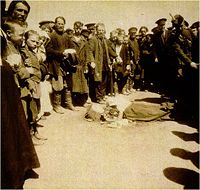 On Khodynka there existed a Romanov family divide. There were Romanovs, headed by Grand Duke Nicholas Mikhailovich
and his brothers, who thought the festivities should have been cancelled. On the other hand, Sergei Alexandrovich and his brothers thought that an historical event, such as a coronation, should not be disrupted or marred by a conspicuous period of mourning. The latter opinion believed that the crowds who came long distances should not be disappointed, and that the tightly scheduled events for foreign dignitaries not be slighted and should go forward. There was also division among the Romanov family as to whether Grand Duke Sergei should have resigned. Grand Duke Nicholas Mikhailovich and his brothers called for his resignation, while Sergei’s own brothers Grand Dukes Vladimir Alexandrovich
and Alexei Alexandrovich
closed ranks supporting him and threatened to retire from public life if Sergei was made the scapegoat for the Khodynka tragedy. Sergei ultimately did offer to resign while Vorontzov-Dashkov did not. The Tsar ultimately did not support a thoroughly proposed investigation, the Chief of Police was dismissed, but Grand Duke Sergei retained his high office.
The night of the tragedy Czar Nicholas II, for diplomatic reasons, attended a ball in honor of the French; because of this his reputation suffered for what was perceived to be his lack of sympathy for the victims.
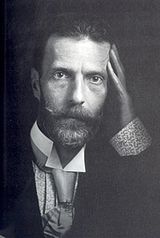 In 1894 Sergei was made a member of the State Council
. In 1896, he was promoted to Lieutenant General
and appointed as Commander of Moscow military district
. Because Sergei was devoted to the policies of his nephew, the Tsar regarded him as a useful counter weight to some of his ministers and officials and would always readily take his side. When in 1896 disturbances broke out in the universities Nicholas II was grateful for his prompt action and that of the authorities that quickly restored order.
Although Sergei was often condemned as a complete reactionary during his governorship, according to his brother-in-law Ernest, Grand Duke of Hesse, he wanted and strove for improvements, which angered conservatives, but blocked revolutionary reforms, which infuriated radicals, because he considered them impractical or thought that Russia was not ready for them.
Sergei’s enigmatic personality and harsh manners made him appear arrogant and disagreeable. Shy by nature, he dreaded personal contact. When courtesy demanded a handshake, he solved the problem by wearing a white glove. Puritan and humorless, at least in public, he had a total disregard for public opinion. He never seemed to be at ease with himself and others. He became a focus for serious opponents of the regime as well as for malicious gossip. His cousin Grand Duke Alexander Mikhailovich
left a damaging description about him: "Try as I will,” he wrote, “ I cannot find a single redeeming feature in his character… Obstinate, arrogant, disagreeable, he flaunted his many peculiarities in the face of the entire nation… " Later writers have accused him of sadism.
A great deal of controversy around Sergei Alexandrovich has centered on the nature of his personal life. Conjecture about the perhaps unhappy nature of the relationship with his wife have abounded.
Sergei's marriage is barely documented. His private papers, including his correspondence with his wife, have not survived, and the evidence that does exist in the Moscow State archives, the most important repository of Romanov papers, is open to interpretation. According to some contemporary reports, Sergei was homosexual. His sexuality conflicted with his intense religious beliefs and the expectations of his position. Contrary to this belief, the marriage was happy, in its own way. Unusual for royal couples, they slept in the same bed for all of their married life. Forced to defend Sergei against rumors of discord, Elizabeth Feodorovna
was devoted to her husband and treasured his memory after his death.
Although their marriage remained childless, the two children of Grand Duke Paul
, Grand Duchess Maria
, and Grand Duke Dimitri
, often joined their household, spending Christmases and later some summer holidays with Sergei and his wife. The couple set aside a playroom and bedrooms for the youngsters at their home. In 1902, Paul was banished from living in Russia after he contracted a morganatic marriage
and Sergei asked for and obtained the guardianship of his niece and nephew. As a foster father, Sergei was strict and demanding, but devoted and affectionate towards the children. Nevertheless, Maria and Dimitri resented their aunt and uncle, blaming them for the forced separation from their real father, who had abandoned them.
While Sergei had their best interests at heart, his preoccupation with the smallest detail of their education and upbringing were not appealing to the two difficult adolescents.
By the end of 1904 Russia had suffered disastrously in the Russo-Japanese War
and the country was in turmoil. As discontent and demonstration multiplied, so did the pressure on Sergei to maintain order. He was of the opinion that only the utmost severity could put an end to the revolutionary ferment, but in the wake of civil disorder Nicholas II was forced to make concessions. Sergei did not support the Tsar's security policies of vacillations and evasions. According to Marie Pavlovna, "it appeared to my uncle little less than monstrous...he expressed deep sorrow for the state of affairs in Russia, of the necessity for serious measures, and of the criminal weakness of the Tsar's ministers and councilors." Thoroughly disillusioned with the whole situation and deciding it was the right time to retire into private life, he informed the Tsar that new times needed new faces. After thirteen years of service, Sergei resigned from the Governorship on January 1, 1905. However, he continued as Commander of the Moscow military district.
 Following his resignation, Grand Duke Sergei moved to the Neskuchnoye Palace with his wife and two foster children, then shortly thereafter, with surprising suddenness, to the Nicholas Palace within the safety of the Kremlin. This move, caused by the threat of further disturbances in the city, was made under the cover of darkness. Realizing that he was a vulnerable target for revolutionary assassins, he took every precaution that his detectives advised. Doing all he could to protect his wife, nephew and niece as well as his personal staff, the Grand Duke and his wife rarely ventured outside, and at home, they only received their close friends. The Grand Duke adopted a fatalistic attitude where his own safety was concerned. Like his father Alexander II, Sergei was firmly of the belief that, unless it was the will of God, no attempt on his life would succeed, but if it was the will of God, no amount of security would prevent it. One precaution he did take, however, was not for himself but for his adjutant
s, whom he would no longer allow to travel with him.
 On February 15, 1905, the family attended a concert at the Bolshoi Theatre
in aid of Elizabeth Feodorovna's Red Cross War charities. A terrorist organization who knew his route had planned to assassinate him that day, but when one of them saw the children in the carriage he thought better of it and decided not to wave the handkerchief which he had agreed to use as a signal to one of the comrades ready to throw the bomb. Their aim was to assassinate the Grand Duke, not to kill his wife and two innocent children in cold blood, which would surely send a wave of revulsion through the empire and set back their revolutionary cause by years.
In the morning of February 17, 1905 Grand Duke Sergei was in a particularly good mood because he had received from the Tsar a miniature portrait of Alexander III surrounded by gold laurel leaves, as a personal mark of favor from nephew to uncle. After having lunch with his wife in the Nicholas palace, Sergei Alexandrovich left for the Governor General’s mansion, where there was still work to do in closing his personal office. He was unaccompanied, because aware of the danger, he had refused to take his adjutant Alexei, since he was married with small children and he feared for his life. The arrival of the Grand Duke’s recognizable carriage drawn by a pair of horses and driven by his coachman Andrei Rudinkin alerted the terrorist who had been waiting in the Kremlin with a bomb wrapped with newspapers.
Just before 2:45 in the afternoon of February 17, 1905, the carriage of the Grand Duke passed through the gate of Nikolskaya Tower of the Kremlin
and turned the corner of the Chudov Monastery
into Senatskaya Square. Then, from a distance no more than four feet away and still some sixty feet inside the Nikolsky Gate, Ivan Kalyayev
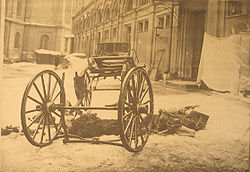
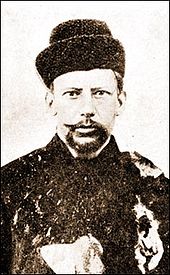
, a member of the Socialist-Revolutionary Party’s Combat detachment, stepped forward and threw a nitroglycerin bomb directly into Sergei’s lap. The explosion disintegrated the carriage and the Grand Duke died immediately, literally blown to bits. Scattered all over the crimson stained snow lay pieces of scorched cloth, fur and leather. The body of the Grand Duke was mutilated, with the head, the upper part of the chest and the left shoulder and arm being blown off and completely destroyed. Surrounded by the splintered bones of the skull was the very little that remained of the face. Some of the Grand Duke’s fingers, still adorned with the rings he habitually wore, were found on the roof of a nearby building and were recovered some time later.
On impact, the carriage horses had bolted towards the Nikolsky Gate, dragging with them the front wheels and coachbox as well as the semi-conscious and badly burned driver Rudinkin, whose back had been riddled with bits of bomb and stones. He was rushed to the nearest hospital, where he died three days later. Kalayev, who by his own testimony had expected to die in the explosion, survived. Sucked into the vortex of the explosion, he ended up by the remains of the rear wheels. His face peppered by splinters, pouring with blood. He was immediately arrested. Sentenced to death, he was hanged two months later.
When the blast that ripped her husband to shreds shook the Nicholas palace and rattled the windows, the Grand Duchess rushed to the scene of the explosion. Stunned but perfectly controlled, she gave instructions and kneeling in the snow, helped to gather up Sergei’s still bleeding remains. The bared torso, part of the skull, a hand bone fragment, fingers, a still booted foot, were placed on a stretcher and covered with an army great coat. She also picked the medallions that Sergei wore around his neck and clutched them in the palm of her hand.
 Deeply affected by the Grand Duke's death, Grand Duchess Elizabeth Feodorovna retired from the world and founded the convent of Saint Martha and Saint Mary, where she dedicated herself to the care of Moscow’s poor and suffering. She was murdered during the Russian Civil War in 1918, together with her maid, also a nun. Their bodies were smuggled to China and eventually reached Jerusalem. The wooden coffins were met at the railway station by the deputy British governor, Sir Harry Charles Luke, and taken for burial at the Church of Maria Magdalene
on the Mount of Olives
Grand Duke Sergei’s body was buried in a crypt of the Chudov Monastery
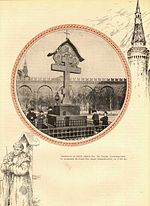
within the precincts of the Moscow Kremlin. A memorial cross was erected on the spot where he was killed. After the downfall of the Romanovs, the cross was destroyed.
was built on the site. The burial crypt of the Grand Duke was located in a courtyard of that building, which had been used as a parking lot. In 1990, building workers in the Kremlin discovered the blocked up entrance of the burial vault. The coffin was examined and found to contain the Grand Duke’s remains, covered with the military greatcoat of the Kiev regiment, decorations, and an icon. He had left written instructions that he was to be buried in the Preobrazhensky Lifeguard regiment uniform, but as his body was so badly mutilated this proved impossible. In 1995, the coffin was officially exhumed, and after a service in the Cathedral of the Archangel
in the Kremlin, it was reburied in a vault of the Novospassky Monastery
in Moscow on September 17, 1995.
Alexander II of Russia
Alexander II , also known as Alexander the Liberator was the Emperor of the Russian Empire from 3 March 1855 until his assassination in 1881...
. He was an influential figure during the reigns of his brother Emperor Alexander III of Russia
Alexander III of Russia
Alexander Alexandrovich Romanov , historically remembered as Alexander III or Alexander the Peacemaker reigned as Emperor of Russia from until his death on .-Disposition:...
and his nephew Emperor Nicholas II, who was also his brother in law through Sergei's marriage to Elizabeth the sister of Tsarina Alexandra
Between 1891 and 1905, he was Governor General of Moscow
Moscow
Moscow is the capital, the most populous city, and the most populous federal subject of Russia. The city is a major political, economic, cultural, scientific, religious, financial, educational, and transportation centre of Russia and the continent...
. A reactionary even by contemporary conservative standards, his policies made him a polarizing figure. Targeted by revolutionaries, he was assassinated by a terrorist bomb at the Kremlin
Kremlin
A kremlin , same root as in kremen is a major fortified central complex found in historic Russian cities. This word is often used to refer to the best-known one, the Moscow Kremlin, or metonymically to the government that is based there...
.
Early life
Grand Duke Sergei Alexandrovich was born on May 11, 1857 in the Zubov wing of the Catherine PalaceCatherine Palace
The Catherine Palace was the Rococo summer residence of the Russian tsars, located in the town of Tsarskoye Selo , 25 km south-east of St. Petersburg, Russia.- History :...
at Tsarskoye Selo
Tsarskoye Selo
Tsarskoye Selo is the town containing a former Russian residence of the imperial family and visiting nobility, located south from the center of St. Petersburg. It is now part of the town of Pushkin and of the World Heritage Site Saint Petersburg and Related Groups of Monuments.-History:In...
, some twenty miles (32 km) outside Saint Petersburg
Saint Petersburg
Saint Petersburg is a city and a federal subject of Russia located on the Neva River at the head of the Gulf of Finland on the Baltic Sea...
. He was the seventh child and fifth son among the eight children of Alexander II of Russia
Alexander II of Russia
Alexander II , also known as Alexander the Liberator was the Emperor of the Russian Empire from 3 March 1855 until his assassination in 1881...
and his wife Maria Alexandrovna, born Princess Marie of Hesse-Darmstadt.
Until he was old enough to begin lessons, Sergei’s earlier years were spent with his younger brother Paul
Grand Duke Paul Alexandrovich of Russia
Grand Duke Paul Alexandrovich of Russia was the eighth child of Tsar Alexander II of Russia by his first wife Empress Maria Alexandrovna. His birth was commemorated by the naming of the city of Pavlodar in Kazakhstan...
, from whom he was inseparable, and their sister at Livadia
Livadia
Livadia can refer to:* Livadiya , a suburb of Yalta, Crimea, Ukraine, where the Livadia Palace is situated.* Livadiya, Primorsky Krai, a suburb of Nakhodka, Russia, near Mount Livadia* Livadeia , a city in Boeotia, Greece....
, the family’s Crimean retreat, at Tsarskoye Selo
Tsarskoye Selo
Tsarskoye Selo is the town containing a former Russian residence of the imperial family and visiting nobility, located south from the center of St. Petersburg. It is now part of the town of Pushkin and of the World Heritage Site Saint Petersburg and Related Groups of Monuments.-History:In...
and at the Winter Palace
Winter Palace
The Winter Palace in Saint Petersburg, Russia, was, from 1732 to 1917, the official residence of the Russian monarchs. Situated between the Palace Embankment and the Palace Square, adjacent to the site of Peter the Great's original Winter Palace, the present and fourth Winter Palace was built and...
in Saint Petersburg. By the time Sergei was born, his mother was already in declining health. Although she was not a particularly affectionate mother, except to her daughter, her three youngest children, Marie, Sergei and Paul
Grand Duke Paul Alexandrovich of Russia
Grand Duke Paul Alexandrovich of Russia was the eighth child of Tsar Alexander II of Russia by his first wife Empress Maria Alexandrovna. His birth was commemorated by the naming of the city of Pavlodar in Kazakhstan...
, were close to her and especially to one another. As time passed and the Empress’s health dictated her to avoid the harsh Russian climate, they spent long sojourns abroad in Jugenheim outside Darmstadt and the winters in the South of France. A family tragedy hit them there. In April 1865, shortly before Sergei’s eighth birthday, his eldest brother and godfather Nicholas the heir to the crown died in Nice. As a child, Sergei was shy, studious and withdrawn. Under the influence of his mother, whose reserved character he resembled, he became very religious.
From the 1870s, Sergei and his younger brother Paul were kept in Russia by their studies. They were destined to follow a military career, but their tutor, Admiral Arseniev, encouraged Sergei’s linguistic, artistic and musical abilities. He was fluent in several languages and learned Italian
Italian language
Italian is a Romance language spoken mainly in Europe: Italy, Switzerland, San Marino, Vatican City, by minorities in Malta, Monaco, Croatia, Slovenia, France, Libya, Eritrea, and Somalia, and by immigrant communities in the Americas and Australia...
in order to read Dante in the original. His interest in Italian art and culture intensified, as he grew older. He painted well and was musical, playing the flute in an amateur orchestra. He enjoyed acting and steeped himself in the early history, culture and traditions of Russia. He liked to read and in time came to know many of Russia’s great writers personally, among them Tolstoy
Leo Tolstoy
Lev Nikolayevich Tolstoy was a Russian writer who primarily wrote novels and short stories. Later in life, he also wrote plays and essays. His two most famous works, the novels War and Peace and Anna Karenina, are acknowledged as two of the greatest novels of all time and a pinnacle of realist...
and Dostoevsky
Fyodor Dostoevsky
Fyodor Mikhaylovich Dostoyevsky was a Russian writer of novels, short stories and essays. He is best known for his novels Crime and Punishment, The Idiot and The Brothers Karamazov....
, whose work the Grand Duke read and admired. He met Dostoevsky over dinner at the Winter Palace
Winter Palace
The Winter Palace in Saint Petersburg, Russia, was, from 1732 to 1917, the official residence of the Russian monarchs. Situated between the Palace Embankment and the Palace Square, adjacent to the site of Peter the Great's original Winter Palace, the present and fourth Winter Palace was built and...
where he was invited by Sergei's Professor.
Military career
Alexander III of Russia
Alexander Alexandrovich Romanov , historically remembered as Alexander III or Alexander the Peacemaker reigned as Emperor of Russia from until his death on .-Disposition:...
and Grand Dukes Vladimir
Grand Duke Vladimir Alexandrovich of Russia
Grand Duke Vladimir Alexandrovich of Russia ) was a son of Emperor Alexander II of Russia...
and Alexei
Grand Duke Alexei Alexandrovich of Russia
Grand Duke Alexei Alexandrovich of Russia was the sixth child and the fourth son of Alexander II of Russia and his first wife Maria Alexandrovna . Destined to a naval career, Alexei Alexandrovich started his military training at the age of 7...
. He spent the greater part of his time serving as Poruchik
Poruchik
Poruchik was a military rank in several Slavic countries, such as the Russian Empire and the Republic of Poland, equivalent to Lieutenant. "Poruchik" means "messenger", "officer for orders". This is a Slavic copy of the term "Lieutenant" .In Russia this rank was first introduced in Strelets New...
in the Leib Guard under the Tsarevich in southeast Romania
Romania
Romania is a country located at the crossroads of Central and Southeastern Europe, on the Lower Danube, within and outside the Carpathian arch, bordering on the Black Sea...
. He was consequently promoted to Colonel
Colonel
Colonel , abbreviated Col or COL, is a military rank of a senior commissioned officer. It or a corresponding rank exists in most armies and in many air forces; the naval equivalent rank is generally "Captain". It is also used in some police forces and other paramilitary rank structures...
. On October 12, following the battle of Meyk, The Emperor decorated him with the Order of St George, for courage and bravery in action with the enemy, for a reconnaissance expedition at Kara Loma near Koshev. At the end of December 1877, Sergei Alexandrovich returned to Saint Petersburg with his father.
Alexander II
Alexander II of Russia
Alexander II , also known as Alexander the Liberator was the Emperor of the Russian Empire from 3 March 1855 until his assassination in 1881...
had started a new family with his mistress and Sergei sided with his neglected mother in the breaking of the family’s harmony. Empress Maria died in June 1880 and in March 1881 Alexander II, who had married his mistress, Princess Catherine Dolgoruki, was assassinated by terrorists. Sergei was then in Italy with his brother Paul and Admiral Arseniev. Three months later in June 1881 the Grand Duke went to Palestine accompanied by Paul and his cousin Grand Duke Constantine Constantinovich
Grand Duke Constantine Constantinovich of Russia
Grand Duke Constantine Constantinovich of Russia was a grandson of Emperor Nicholas I of Russia, and a poet and playwright of some renown...
. They visited Jerusalem and the sacred sites. He helped to found a society dedicated to the upkeep of Orthodox shrines in the Holy Land and the provision of services to Russian pilgrims. He became chairman of this society and his status as patron of the Russian presence in Jerusalem is believed to have given him more pleasure than any of his other duties.
From 1882 on Sergei’s military career occupied an increasing amount of his time in Saint Petersburg and on maneuvers at Kranoe Selo and advanced still further. On January 15, 1882, his brother Alexander III
Alexander III of Russia
Alexander Alexandrovich Romanov , historically remembered as Alexander III or Alexander the Peacemaker reigned as Emperor of Russia from until his death on .-Disposition:...
appointed him Commander of the 1st Battalion Preobrazhensky Life Guard Regiment
Preobrazhensky regiment
The Preobrazhensky Regiment was one of the oldest and elite regiments of the Russian army. Along with the Semenovsky regiment also served as a gendarmie unit for the state Secret Chancellery in the 18th century, headed by the Prince Fyodor Romodanovsky.It was formed by Peter the Great in the late...
, the elite regiment, founded by Peter the Great, with the rank of Colonel. Seven years later, he was promoted to the rank of Major General. On February 26, 1891, he was made Adjutant General
Adjutant general
An Adjutant General is a military chief administrative officer.-Imperial Russia:In Imperial Russia, the General-Adjutant was a Court officer, who was usually an army general. He served as a personal aide to the Tsar and hence was a member of the H. I. M. Retinue...
of the H. I. M. Retinue. He became the commanding officer in the village of Preobrazhenskoy. Sergei commanded this regiment until 1891, when his brother the Emperor appointed him Governor-General of Moscow.
A Russian Grand Duke
At twenty-six, the fair-haired Grand Duke was reserved, intelligent, well read and refined. Over six feet tall, his extremely slim figure was accentuated by a corset, worn in the manner of Prussian officers.With his closely cropped hair and neat beard, Serge Alexandrovich cut an impressive figure. When Consuelo Vanderbilt
Consuelo Vanderbilt
Consuelo Balsan , was a member of the prominent American Vanderbilt family...
, then Duchess of Marlborough, met him in Moscow
Moscow
Moscow is the capital, the most populous city, and the most populous federal subject of Russia. The city is a major political, economic, cultural, scientific, religious, financial, educational, and transportation centre of Russia and the continent...
, she considered him to be "One of the handsomest men I have ever seen." Described by his brother-in-law Ernest Louis, Grand Duke of Hesse
Ernest Louis, Grand Duke of Hesse
Ernest Louis Charles Albert William , was the last Grand Duke of Hesse and by Rhine from 1892 until 1918...
as "tall and fair with delicate features and beautiful light green eyes". Very self-conscious, he held himself very stifflyand with a hard expression on his eyes.
He stood very straight - aided by the Prussian fashion for corsets to improve the male figure whilst on horseback - and had a habit of playing with one of his jeweled rings, turning it around his finger. He kept his feelings rigidly in check and many mistook his reserve for pride. Few had the chance to know him well. He was noted for his adherence to the Church, took a deep interest in Russian antiques and art treasures and was interested in archaeology
Archaeology
Archaeology, or archeology , is the study of human society, primarily through the recovery and analysis of the material culture and environmental data that they have left behind, which includes artifacts, architecture, biofacts and cultural landscapes...
attending and sometimes chairing meetings of the Archeological Congress.
While shy and reserved, he made no secret of his disapproval of fashionable society and its lax ways, and he defied all criticism. He found it hard to cope with opposition and easily lost his temper . In his home, he demanded tidiness, order and discipline, and expected to be obeyed. His niece, Marie Queen of Romania
Marie of Edinburgh
Marie of Romania was Queen consort of Romania from 1914 to 1927, as the wife of Ferdinand I of Romania.-Early life:...
remembered him: “Dry, nervous, short of speech, impatient, he had none of the rather careless good humor of his three elder brothers . . . but for all that we loved him, felt irresistibly attracted to him, hard though he could be. Few perhaps cherish his memory, but I do." Many other family members including his nephew Kyril, Princess Marie of Greece
Princess Maria Georgievna of Greece and Denmark
Maria or Marie Georgievna, Princess of Greece and Denmark , was the fifth child and second daughter of George I of Greece and Olga Konstantinovna of Russia and thus a family member of the House of Schleswig-Holstein-Sonderburg-Glücksburg.-Early life and family: She was born in Athens as a younger...
and Prince Gabriel left good impressions about him in their books of memoirs.
Marriage
Grand Duchess Elizabeth Fyodorovna
Grand Duchess Elizabeth Feodorovna of Russia canonized as St. Elizabeth Romanova was a German princess of the House of Hesse, and the wife of Grand Duke Sergei Alexandrovich of Russia, fifth son of Emperor Alexander II of Russia and Princess Marie of Hesse and the Rhine...
, a daughter of Ludwig IV, Grand Duke of Hesse and by Rhine and Princess Alice of the United Kingdom
Princess Alice of the United Kingdom
The Princess Alice was a member of the British royal family, the third child and second daughter of Queen Victoria and Prince Albert of Saxe-Coburg and Gotha.Alice's education was devised by Albert's close friend and adviser, Baron Stockmar...
. She was an older sister of both Ernst Ludwig, Grand Duke of Hesse and by Rhine and Alix of Hesse, later the Empress consort of Nicholas II of Russia
Nicholas II of Russia
Nicholas II was the last Emperor of Russia, Grand Prince of Finland, and titular King of Poland. His official short title was Nicholas II, Emperor and Autocrat of All the Russias and he is known as Saint Nicholas the Passion-Bearer by the Russian Orthodox Church.Nicholas II ruled from 1894 until...
. They were first cousins once removed and had known each other all their lives. There were hesitations on both sides and Elizabeth first rejected his proposal of marriage. Queen Victoria, who had anti-Russian sentiments, opposed the marriage of her motherless granddaughter. Elizabeth and her sisters were not pressured into following political marriages; they were allowed to follow their own inclination. After the couple spent some time together in Wolfgasten in Darmstadt in September 1883, Elizabeth agreed to marry him. Their engagement was announced publicly on February 26, 1884 when Sergei returned to visit her in Darmstadt. Upon her marriage, Princess Elizabeth took the name of Grand Duchess Elizabeth Feodorovna of Russia. The wedding took place on June 15, 1884 in the Winter Palace
Winter Palace
The Winter Palace in Saint Petersburg, Russia, was, from 1732 to 1917, the official residence of the Russian monarchs. Situated between the Palace Embankment and the Palace Square, adjacent to the site of Peter the Great's original Winter Palace, the present and fourth Winter Palace was built and...
.
They spent their honeymoon in Ilinskoye, Sergei’s 2400 acres (9.7 km²) country estate forty miles west of Moscow on the left bank of the Moskva River, that he inherited from his mother. The couple later settled in Saint Petersburg in a mansion occupying the southeast corner of the Fontanka Canal and the Nevsky Prospekt, a short drive from his former apartments in the Winter Palace. The Beloselsky Belozerzky mansion, bought by Sergei to live with his wife, was renamed Sergeivsky Palace. The couple also had Ferme, a villa located in the grounds of Peterhof that Sergei had inherited from his mother. They usually entertained at Ilinskoe during the summer months, with guests occupying various wooden villas dotted around the park. There was also Usovo, a substantial stone and brick house with an innovative central heating, that Sergei had had built on the opposite bank of the Moskva River.
The couple were close to Alexander III and Maria Feodorovna and the Tsar trusted Sergei more than his brothers. In 1886, Alexander III appointed him Commander of the Preobrazhensky Life Guard Regiment, entrusting him with introducing the Tsarevich (the future Nicholas II) to army life. Sergei and Ella represented Russia in 1887 during Queen Victoria’s Golden Jubilee and in 1888, they were sent to the Holy Land on the occasion of the consecration of the church of Saint Mary Magdalene in Jerusalem, built in memory of Empress Maria Alexandrovna. By 1892, six years into the marriage, Sergei was already certain that they would not have children and he left a will making the children of his brother Paul his heir after his and his wife’s deaths.
Governor of Moscow
Moscow
Moscow is the capital, the most populous city, and the most populous federal subject of Russia. The city is a major political, economic, cultural, scientific, religious, financial, educational, and transportation centre of Russia and the continent...
.
Although it was a great honor Sergei accepted his new appointment with reluctance, he had hoped to stay longer in command of the Preobrajensky, where he was popular; and he and his wife loved the quiet life they were living in Saint Petersburg
Saint Petersburg
Saint Petersburg is a city and a federal subject of Russia located on the Neva River at the head of the Gulf of Finland on the Baltic Sea...
.
The vice regal role of Governor General ruling Prince of Moscow was one that was answerable only to the emperor. Sergei was a political hardliner who shared his brother’s inalienable belief in strong, nationalist government. Sergei’s tenure began with the expulsion of Moscow
Moscow
Moscow is the capital, the most populous city, and the most populous federal subject of Russia. The city is a major political, economic, cultural, scientific, religious, financial, educational, and transportation centre of Russia and the continent...
’s 20,000 Jews
Jews
The Jews , also known as the Jewish people, are a nation and ethnoreligious group originating in the Israelites or Hebrews of the Ancient Near East. The Jewish ethnicity, nationality, and religion are strongly interrelated, as Judaism is the traditional faith of the Jewish nation...
. It started four weeks before he arrived in person, after the publication of an Imperial ukase
Ukase
A ukase , in Imperial Russia, was a proclamation of the tsar, government, or a religious leader that had the force of law...
by the Minister of the Interiors, Ivan Durnovo, by which all Jews
Jews
The Jews , also known as the Jewish people, are a nation and ethnoreligious group originating in the Israelites or Hebrews of the Ancient Near East. The Jewish ethnicity, nationality, and religion are strongly interrelated, as Judaism is the traditional faith of the Jewish nation...
of lower social stance (artisans, minor traders and so on) had to be expelled from Moscow
Moscow
Moscow is the capital, the most populous city, and the most populous federal subject of Russia. The city is a major political, economic, cultural, scientific, religious, financial, educational, and transportation centre of Russia and the continent...
. On March 29, the first day of Passover, the city’s Jewish population learned of the new decree that called for their expulsion. In three carefully planned phases over the next twelve months, Moscow’s Jews were expelled. Those first to go were the unmarried, the childless and those who had lived in the city for less than three years. Next, it was the turn of apprentices, of families with up to four children and those with less than six years residency. Last of all, it was the turn of the old Jewish settlers with large families and or numerous employees, some of who had lived in Moscow for forty years. Young Jewish women were made to register as prostitutes if they wanted to stay in the city. During the expulsion, homes were surrounded by mounted Cossacks in the middle of the night while policemen ransacked every house. In January 1892, in a temperature of 30 degrees below zero, Brest station was packed with Jews of all ages and sexes, all in rags and surrounded by meager remnants of households goods, all leaving voluntarily rather than face deportation. Sergei as Governor General was petitioned by the police commissioners to stop the expulsions until the weather conditions improved. While he agreed, the order was not published until the expulsions were over. Some of them moved to southern and western regions of Empire although there were many who decided to emigrate. In counting the cost, Moscow lost 100 millions rubles in trade and production, 25,000 Russians employed by Jewish firms lost their livelihoods, while the manufacture of silk, one of the city’s most lucrative industries, was all but wiped out.
To meet the needs of students, Sergei ordered the start of construction of new dormitories in the city. At the same time, however, severe restrictions were imposed on the students and professors in the universities as a part of state's policy of conspiracy prevention and elimination of revolutionary ideas. This made Sergei Alexandrovich very unpopular in Moscow among intelligentsia
Intelligentsia
The intelligentsia is a social class of people engaged in complex, mental and creative labor directed to the development and dissemination of culture, encompassing intellectuals and social groups close to them...
, though the more conservative citizens were pleased. The Muscovite nobility and merchants despised him, because he was rough and lacked tact, while attempting to fight commercial fraud and enforce strict police measures. However, he did significantly improve general living conditions during his tenure and was extremely conscientious in carrying out his duties: “Even in the country when he was supposed to be resting," his niece remembered, "he was constantly receiving couriers from Moscow and giving audiences.” He paid a lot of attention to detail, attending personally to matters that could easily have been left to subordinates, punishing corruption and fraud. At times, he would go about the city incognito to see conditions for himself. In private, he and his wife were concerned about the poverty they saw in Moscow and the surrounding countryside, discussing ways to improve it.
Welfare organizations and charities always attracted Sergei’s attention and he became either chairman or patron of scores of them.
He was for example, chairman of the Moscow Society for the Care, Upbringing and Education of Blind Children; of the Society for Homeless, Neglected Children and Convicted Adolescents; and the Moscow Department of the Russian Department Society of National Health Protection.
In addition, he was patron of organizations as diverse as the Moscow and Saint Petersburg Universities; The Printer’s Mutual Aid Fund; the Society of Care for Aged Actors, the Pskov Non Classical Secondary School and Prince Nikola’s Alm Houses. He was also chairman of the Academies of both Arts and Science, the Moscow Archeological Society, the Society of Agriculture, the Russian Musical Society, the Historical Museum in Moscow and the Moscow Theological Academy among others.
Khodynka Tragedy
Alexander III died in November 1894 and his son Nicholas II ascended to the Russian throne. The relationship between Grand Duke Sergei and his nephew, who had served under his command in the Preobrazhensky Life Guard Regiment, was close and became stronger with Nicholas II’s marriage to Princess Alix of Hesse, the youngest sister of Sergei’s wife. This was a union that Sergei and Elizabeth Feodorovna had helped to promote.The coronation ceremonies of the new Emperor and his wife, as tradition demanded, took place in Moscow and Sergei as Governor General of the City was in charge of overseeing the arrangements. As part of the preparations, Sergei had introduced the novelty of electric light to Moscow. Towards the end of the festivities, according to custom, every newly crowned Tsar presented gifts to the populace; and on this occasion Khodynka Field, on the outskirts of Moscow, was chosen as a suitable place where the distribution could take place. The choice was questionable, as the field was normally used as a military training ground and was crisscrossed with ditches. Nevertheless, Sergei, as Governor General approved the plans. Although a crowd of nearly half a million was expected from all over Russia, only one squadron of Cossacks and a small detachment of police were sent to maintain order.
Early in the morning of May 18, 1896, families began to gather outside the frail wooden fence that protected the field, watching carts laden with beer, and the eagerly sought after gifts. Around 6 am, a rumor swept through the mass that the booths had already opened and the souvenirs were being given out. Suddenly moving as one, that great body of people began to surge forward in the direction of the booths. As it did so, men, women and children, hundreds of whom had no idea what was happening, fell or slipped on the uneven ground and were crushed and trampled underfoot. Others suffocated in the mayhem. The police, far too few in numbers, were helpless to do much and even the Cossacks when they arrived were unable to stop the catastrophe. One thousand three hundred people, many hideously mutilated and unrecognizable, were killed and twice that number were seriously injured.
While Grand Duke Sergei had not directly participated in the planning for Khodynka Field, he was to blame for the lack of foresight and as Governor General, ultimately responsible. However, he did not assume his part of responsibility for the tragedy. He laid the blame on others, most notably on Count Voronzov-Dashkov, head of the Ministry of the Imperial Court
Ministry of the Imperial Court
Ministry of the Imperial Court was established in Russia in 1826, and embraced in one institution all the former separate branches of the Court administration....
, with whom there had been some dispute over the management of the coronation festivities, and Colonel Vlasovsky, the city of Moscow’s Chief of Police. In the eyes of public opinion Sergei had done himself great harm by not going to the scene of the incident, or at least putting in appearances at the victims' funerals.
Grand Duke Nicholas Mikhailovich of Russia
Grand Duke Nicholas Mikhailovich of Russia , 26 April 1859 – 28 January 1919 was the eldest son of Grand Duke Michael Nicolaievich of Russia and a first cousin of Alexander III....
and his brothers, who thought the festivities should have been cancelled. On the other hand, Sergei Alexandrovich and his brothers thought that an historical event, such as a coronation, should not be disrupted or marred by a conspicuous period of mourning. The latter opinion believed that the crowds who came long distances should not be disappointed, and that the tightly scheduled events for foreign dignitaries not be slighted and should go forward. There was also division among the Romanov family as to whether Grand Duke Sergei should have resigned. Grand Duke Nicholas Mikhailovich and his brothers called for his resignation, while Sergei’s own brothers Grand Dukes Vladimir Alexandrovich
Grand Duke Vladimir Alexandrovich of Russia
Grand Duke Vladimir Alexandrovich of Russia ) was a son of Emperor Alexander II of Russia...
and Alexei Alexandrovich
Grand Duke Alexei Alexandrovich of Russia
Grand Duke Alexei Alexandrovich of Russia was the sixth child and the fourth son of Alexander II of Russia and his first wife Maria Alexandrovna . Destined to a naval career, Alexei Alexandrovich started his military training at the age of 7...
closed ranks supporting him and threatened to retire from public life if Sergei was made the scapegoat for the Khodynka tragedy. Sergei ultimately did offer to resign while Vorontzov-Dashkov did not. The Tsar ultimately did not support a thoroughly proposed investigation, the Chief of Police was dismissed, but Grand Duke Sergei retained his high office.
The night of the tragedy Czar Nicholas II, for diplomatic reasons, attended a ball in honor of the French; because of this his reputation suffered for what was perceived to be his lack of sympathy for the victims.
Controversy
State Council of Imperial Russia
The State Council was the supreme state advisory body to the Tsar in Imperial Russia.-18th century:Early Tsars' Councils were small and dealt primarily with the external politics....
. In 1896, he was promoted to Lieutenant General
Lieutenant General
Lieutenant General is a military rank used in many countries. The rank traces its origins to the Middle Ages where the title of Lieutenant General was held by the second in command on the battlefield, who was normally subordinate to a Captain General....
and appointed as Commander of Moscow military district
Military district
Military districts are formations of a state's armed forces which are responsible for a certain area of territory. They are often more responsible for administrative than operational matters, and in countries with conscript forces, often handle parts of the conscription cycle.Navies have also used...
. Because Sergei was devoted to the policies of his nephew, the Tsar regarded him as a useful counter weight to some of his ministers and officials and would always readily take his side. When in 1896 disturbances broke out in the universities Nicholas II was grateful for his prompt action and that of the authorities that quickly restored order.
Although Sergei was often condemned as a complete reactionary during his governorship, according to his brother-in-law Ernest, Grand Duke of Hesse, he wanted and strove for improvements, which angered conservatives, but blocked revolutionary reforms, which infuriated radicals, because he considered them impractical or thought that Russia was not ready for them.
Sergei’s enigmatic personality and harsh manners made him appear arrogant and disagreeable. Shy by nature, he dreaded personal contact. When courtesy demanded a handshake, he solved the problem by wearing a white glove. Puritan and humorless, at least in public, he had a total disregard for public opinion. He never seemed to be at ease with himself and others. He became a focus for serious opponents of the regime as well as for malicious gossip. His cousin Grand Duke Alexander Mikhailovich
Grand Duke Alexander Mikhailovich of Russia
Grand Duke Alexander Mihailovich of Russia, Александр Михайлович Aleksandr Mihailovits was a dynast of the Russian Empire, a naval officer, an author, explorer, the brother-in-law of Emperor Nicholas II, and an advisor of the said Emperor.-Biography: Alexander was born the son of Grand Duke...
left a damaging description about him: "Try as I will,” he wrote, “ I cannot find a single redeeming feature in his character… Obstinate, arrogant, disagreeable, he flaunted his many peculiarities in the face of the entire nation… " Later writers have accused him of sadism.
A great deal of controversy around Sergei Alexandrovich has centered on the nature of his personal life. Conjecture about the perhaps unhappy nature of the relationship with his wife have abounded.
Sergei's marriage is barely documented. His private papers, including his correspondence with his wife, have not survived, and the evidence that does exist in the Moscow State archives, the most important repository of Romanov papers, is open to interpretation. According to some contemporary reports, Sergei was homosexual. His sexuality conflicted with his intense religious beliefs and the expectations of his position. Contrary to this belief, the marriage was happy, in its own way. Unusual for royal couples, they slept in the same bed for all of their married life. Forced to defend Sergei against rumors of discord, Elizabeth Feodorovna
Grand Duchess Elizabeth Fyodorovna
Grand Duchess Elizabeth Feodorovna of Russia canonized as St. Elizabeth Romanova was a German princess of the House of Hesse, and the wife of Grand Duke Sergei Alexandrovich of Russia, fifth son of Emperor Alexander II of Russia and Princess Marie of Hesse and the Rhine...
was devoted to her husband and treasured his memory after his death.
Although their marriage remained childless, the two children of Grand Duke Paul
Grand Duke Paul Alexandrovich of Russia
Grand Duke Paul Alexandrovich of Russia was the eighth child of Tsar Alexander II of Russia by his first wife Empress Maria Alexandrovna. His birth was commemorated by the naming of the city of Pavlodar in Kazakhstan...
, Grand Duchess Maria
Grand Duchess Maria Pavlovna of Russia (1890-1958)
Grand Duchess Maria Pavlovna of Russia, known as "Maria Pavlovna the Younger" was the daughter of Grand Duke Paul Alexandrovich and Alexandra Georgievna of Greece by marriage Princess of Sweden...
, and Grand Duke Dimitri
Grand Duke Dmitri Pavlovich of Russia
Grand Duke Dmitri Pavlovich of Russia was a Russian imperial dynast. He is known for being involved in the murder of the mystic peasant faith healer Grigori Rasputin, who he felt held undue sway over Tsar Nicholas II.-Early life:Grand Duke Dmitri Pavlovich was born at Ilinskoe near Moscow, the...
, often joined their household, spending Christmases and later some summer holidays with Sergei and his wife. The couple set aside a playroom and bedrooms for the youngsters at their home. In 1902, Paul was banished from living in Russia after he contracted a morganatic marriage
Morganatic marriage
In the context of European royalty, a morganatic marriage is a marriage between people of unequal social rank, which prevents the passage of the husband's titles and privileges to the wife and any children born of the marriage...
and Sergei asked for and obtained the guardianship of his niece and nephew. As a foster father, Sergei was strict and demanding, but devoted and affectionate towards the children. Nevertheless, Maria and Dimitri resented their aunt and uncle, blaming them for the forced separation from their real father, who had abandoned them.
While Sergei had their best interests at heart, his preoccupation with the smallest detail of their education and upbringing were not appealing to the two difficult adolescents.
By the end of 1904 Russia had suffered disastrously in the Russo-Japanese War
Russo-Japanese War
The Russo-Japanese War was "the first great war of the 20th century." It grew out of rival imperial ambitions of the Russian Empire and Japanese Empire over Manchuria and Korea...
and the country was in turmoil. As discontent and demonstration multiplied, so did the pressure on Sergei to maintain order. He was of the opinion that only the utmost severity could put an end to the revolutionary ferment, but in the wake of civil disorder Nicholas II was forced to make concessions. Sergei did not support the Tsar's security policies of vacillations and evasions. According to Marie Pavlovna, "it appeared to my uncle little less than monstrous...he expressed deep sorrow for the state of affairs in Russia, of the necessity for serious measures, and of the criminal weakness of the Tsar's ministers and councilors." Thoroughly disillusioned with the whole situation and deciding it was the right time to retire into private life, he informed the Tsar that new times needed new faces. After thirteen years of service, Sergei resigned from the Governorship on January 1, 1905. However, he continued as Commander of the Moscow military district.
Assassination
Adjutant
Adjutant is a military rank or appointment. In some armies, including most English-speaking ones, it is an officer who assists a more senior officer, while in other armies, especially Francophone ones, it is an NCO , normally corresponding roughly to a Staff Sergeant or Warrant Officer.An Adjutant...
s, whom he would no longer allow to travel with him.
Bolshoi Theatre
The Bolshoi Theatre is a historic theatre in Moscow, Russia, designed by architect Joseph Bové, which holds performances of ballet and opera. The Bolshoi Ballet and Bolshoi Opera are amongst the oldest and most renowned ballet and opera companies in the world...
in aid of Elizabeth Feodorovna's Red Cross War charities. A terrorist organization who knew his route had planned to assassinate him that day, but when one of them saw the children in the carriage he thought better of it and decided not to wave the handkerchief which he had agreed to use as a signal to one of the comrades ready to throw the bomb. Their aim was to assassinate the Grand Duke, not to kill his wife and two innocent children in cold blood, which would surely send a wave of revulsion through the empire and set back their revolutionary cause by years.
In the morning of February 17, 1905 Grand Duke Sergei was in a particularly good mood because he had received from the Tsar a miniature portrait of Alexander III surrounded by gold laurel leaves, as a personal mark of favor from nephew to uncle. After having lunch with his wife in the Nicholas palace, Sergei Alexandrovich left for the Governor General’s mansion, where there was still work to do in closing his personal office. He was unaccompanied, because aware of the danger, he had refused to take his adjutant Alexei, since he was married with small children and he feared for his life. The arrival of the Grand Duke’s recognizable carriage drawn by a pair of horses and driven by his coachman Andrei Rudinkin alerted the terrorist who had been waiting in the Kremlin with a bomb wrapped with newspapers.
Just before 2:45 in the afternoon of February 17, 1905, the carriage of the Grand Duke passed through the gate of Nikolskaya Tower of the Kremlin
Moscow Kremlin
The Moscow Kremlin , sometimes referred to as simply The Kremlin, is a historic fortified complex at the heart of Moscow, overlooking the Moskva River , Saint Basil's Cathedral and Red Square and the Alexander Garden...
and turned the corner of the Chudov Monastery
Chudov Monastery
The Chudov Monastery was founded in the Moscow Kremlin in 1358 by Metropolitan Alexius of Moscow. The monastery was dedicated to the miracle of the Archangel Michael at Chonae...
into Senatskaya Square. Then, from a distance no more than four feet away and still some sixty feet inside the Nikolsky Gate, Ivan Kalyayev
Ivan Kalyayev
Ivan Platonovich Kalyayev was a Russian poet, a member of the Socialist-Revolutionary Party. He is best known for his role in the assassination of Grand Duke Sergei Alexandrovich, which was an operation of the SR Combat Organization...
, a member of the Socialist-Revolutionary Party’s Combat detachment, stepped forward and threw a nitroglycerin bomb directly into Sergei’s lap. The explosion disintegrated the carriage and the Grand Duke died immediately, literally blown to bits. Scattered all over the crimson stained snow lay pieces of scorched cloth, fur and leather. The body of the Grand Duke was mutilated, with the head, the upper part of the chest and the left shoulder and arm being blown off and completely destroyed. Surrounded by the splintered bones of the skull was the very little that remained of the face. Some of the Grand Duke’s fingers, still adorned with the rings he habitually wore, were found on the roof of a nearby building and were recovered some time later.
On impact, the carriage horses had bolted towards the Nikolsky Gate, dragging with them the front wheels and coachbox as well as the semi-conscious and badly burned driver Rudinkin, whose back had been riddled with bits of bomb and stones. He was rushed to the nearest hospital, where he died three days later. Kalayev, who by his own testimony had expected to die in the explosion, survived. Sucked into the vortex of the explosion, he ended up by the remains of the rear wheels. His face peppered by splinters, pouring with blood. He was immediately arrested. Sentenced to death, he was hanged two months later.
When the blast that ripped her husband to shreds shook the Nicholas palace and rattled the windows, the Grand Duchess rushed to the scene of the explosion. Stunned but perfectly controlled, she gave instructions and kneeling in the snow, helped to gather up Sergei’s still bleeding remains. The bared torso, part of the skull, a hand bone fragment, fingers, a still booted foot, were placed on a stretcher and covered with an army great coat. She also picked the medallions that Sergei wore around his neck and clutched them in the palm of her hand.
Aftermath
Church of Maria Magdalene
The Church of Mary Magdalene is a Russian Orthodox church located on the Mount of Olives, near the Garden of Gethsemane in Jerusalem, Israel.-History:...
on the Mount of Olives
Mount of Olives
The Mount of Olives is a mountain ridge in East Jerusalem with three peaks running from north to south. The highest, at-Tur, rises to 818 meters . It is named for the olive groves that once covered its slopes...
Grand Duke Sergei’s body was buried in a crypt of the Chudov Monastery
Chudov Monastery
The Chudov Monastery was founded in the Moscow Kremlin in 1358 by Metropolitan Alexius of Moscow. The monastery was dedicated to the miracle of the Archangel Michael at Chonae...
within the precincts of the Moscow Kremlin. A memorial cross was erected on the spot where he was killed. After the downfall of the Romanovs, the cross was destroyed.
Discovery of coffin
Chudov monastery was demolished in 1928, and the Presidium of the Supreme SovietPresidium of the Supreme Soviet
The Presidium of the Supreme Soviet was a Soviet governmental institution – a permanent body of the Supreme Soviets . This body was of the all-Union level , as well as in all Soviet republics and autonomous republics...
was built on the site. The burial crypt of the Grand Duke was located in a courtyard of that building, which had been used as a parking lot. In 1990, building workers in the Kremlin discovered the blocked up entrance of the burial vault. The coffin was examined and found to contain the Grand Duke’s remains, covered with the military greatcoat of the Kiev regiment, decorations, and an icon. He had left written instructions that he was to be buried in the Preobrazhensky Lifeguard regiment uniform, but as his body was so badly mutilated this proved impossible. In 1995, the coffin was officially exhumed, and after a service in the Cathedral of the Archangel
Cathedral of the Archangel
The Cathedral of the Archangel is a Russian Orthodox church dedicated to the Archangel Michael. It is located in Cathedral Square of the Moscow Kremlin in Russia between the Great Kremlin Palace and the Ivan the Great Bell Tower. It was the main necropolis for members of the Tsars of Russia until...
in the Kremlin, it was reburied in a vault of the Novospassky Monastery
Novospassky Monastery
Novospassky Monastery is one of the fortified monasteries surrounding Moscow from south-east.It was the first monastery to be founded in Moscow in the early 14th century. The Saviour Church was its original katholikon...
in Moscow on September 17, 1995.