


Vasily Zhukovsky

Encyclopedia
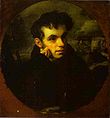
Zhukovsky is credited with introducing the Romantic Movement
Romanticism
Romanticism was an artistic, literary and intellectual movement that originated in the second half of the 18th century in Europe, and gained strength in reaction to the Industrial Revolution...
into Russian literature
Russian literature
Russian literature refers to the literature of Russia or its émigrés, and to the Russian-language literature of several independent nations once a part of what was historically Russia or the Soviet Union...
. The main body of his literary output consists of free translations covering an impressively wide range of poets from Ferdowsi
Ferdowsi
Ferdowsi was a highly revered Persian poet. He was the author of the Shahnameh, the national epic of Iran and related societies.The Shahnameh was originally composed by Ferdowsi for the princes of the Samanid dynasty, who were responsible for a revival of Persian cultural traditions after the...
and Homer
Homer
In the Western classical tradition Homer , is the author of the Iliad and the Odyssey, and is revered as the greatest ancient Greek epic poet. These epics lie at the beginning of the Western canon of literature, and have had an enormous influence on the history of literature.When he lived is...
to his contemporaries Goethe, Schiller, Byron, and many others. Quite a few of his translation
Translation
Translation is the communication of the meaning of a source-language text by means of an equivalent target-language text. Whereas interpreting undoubtedly antedates writing, translation began only after the appearance of written literature; there exist partial translations of the Sumerian Epic of...
s proved to be better-written and more enduring works than their originals.
Life
Zhukovsky was born in the village of Mishenskoe, in Tula Oblast, RussiaTula, Russia
Tula is an industrial city and the administrative center of Tula Oblast, Russia. It is located south of Moscow, on the Upa River. Population: -History:...
, the illegitimate son of a landowner named Afanasi Bunin and his Turkish
Turkish people
Turkish people, also known as the "Turks" , are an ethnic group primarily living in Turkey and in the former lands of the Ottoman Empire where Turkish minorities had been established in Bulgaria, Cyprus, Bosnia and Herzegovina, Georgia, Greece, Kosovo, Macedonia, and Romania...
housekeeper Salkha. The latter had been brought to Russia as a prisoner of war and was later christened into Orthodoxy as Elizaveta Demyanovna Turchaninova. The same Bunin family some 90 years later produced the Nobel Prize-winning modernist writer Ivan Bunin.
Although Zhukovsky was raised in the Bunin family circle, he was not given his natural father's name. Rather, for reasons of propriety he was adopted by an impoverished family friend, whose surname and patronymic he kept for the rest of his life, even when later ennobled. In the mid-1790s, the young Zhukovsky was sent to be educated at the Moscow University Noblemen's Pension. There he was heavily influenced by Freemasonry
Freemasonry
Freemasonry is a fraternal organisation that arose from obscure origins in the late 16th to early 17th century. Freemasonry now exists in various forms all over the world, with a membership estimated at around six million, including approximately 150,000 under the jurisdictions of the Grand Lodge...
, as well as by the fashionable literary trends of English Sentimentalism
Sentimentalism
Sentimentalism is used in different ways:* Sentimentalism , a theory in moral epistemology concerning how one knows moral truths; also known as moral sense theory* Sentimentalism , a form of literary discourse...
and German Sturm und Drang
Sturm und Drang
Sturm und Drang is a proto-Romantic movement in German literature and music taking place from the late 1760s through the early 1780s, in which individual subjectivity and, in particular, extremes of emotion were given free expression in reaction to the perceived constraints of rationalism...
. He also met and came under the influence of Nikolay Karamzin, the preeminent Russian man of letters and the founding editor of the most important literary journal of the day, The Herald of Europe (Вестник Европы).
In 1802, not long after leaving the Pension, the 19-year-old Zhukovsky published a free translation of Thomas Gray
Thomas Gray
Thomas Gray was a poet, letter-writer, classical scholar and professor at Cambridge University.-Early life and education:...
's "Elegy Written in a Country Churchyard
Elegy Written in a Country Churchyard
Elegy Written in a Country Churchyard is a poem by Thomas Gray, completed in 1750 and first published in 1751. The poem’s origins are unknown, but it was partly inspired by Gray’s thoughts following the death of the poet Richard West in 1742. Originally titled Stanza's Wrote in a Country...
" in Karamzin's journal. The translation was the first great example of his trademark sentimental-melancholy style, which at the time was strikingly original and made him famous among educated Russians. Today this translation is conventionally cited as the starting point of the Russian Romantic Movement. In 1808, Karamzin asked Zhukovsky to take over the editorship of The Herald of Europe. The young poet used this position to explore Romantic themes, motifs, and theories—largely by way of translation from other European journals.
Zhukovsky was among the first Russian writers to cultivate the mystique of the Romantic poet. Much of his best poetic work was dedicated to or inspired by Maria (Masha) Protasova, the daughter of one of his several half-sisters, with whom he had a passionate but ultimately Platonic affair. He also came under the influence of Romanticism in the medieval Hansa cities of Tartu
Tartu
Tartu is the second largest city of Estonia. In contrast to Estonia's political and financial capital Tallinn, Tartu is often considered the intellectual and cultural hub, especially since it is home to Estonia's oldest and most renowned university. Situated 186 km southeast of Tallinn, the...
and Tallinn
Tallinn
Tallinn is the capital and largest city of Estonia. It occupies an area of with a population of 414,940. It is situated on the northern coast of the country, on the banks of the Gulf of Finland, south of Helsinki, east of Stockholm and west of Saint Petersburg. Tallinn's Old Town is in the list...
(then called Dorpat and Revel), which had recently been brought into the Russian Empire. When Napoleon invaded Russia in 1812, Zhukovsky hastened to the defense of Moscow and was present at the Battle of Borodino
Battle of Borodino
The Battle of Borodino , fought on September 7, 1812, was the largest and bloodiest single-day action of the French invasion of Russia and all Napoleonic Wars, involving more than 250,000 troops and resulting in at least 70,000 casualties...
, where he joined the Russian general staff under Field Marshal Kutuzov
Kutuzov
Kutuzov may refer to:* Mikhail Kutuzov, Russian field marshal during Napoleonic era* Named after Mikhail Kutuzov** Order of Kutuzov, military award** Kutuzov Embankment, embankment and street** Operation Kutuzov, military operation in WWII...
. After the war, he settled down temporarily in the village of Dolbino, near Moscow
Moscow
Moscow is the capital, the most populous city, and the most populous federal subject of Russia. The city is a major political, economic, cultural, scientific, religious, financial, educational, and transportation centre of Russia and the continent...
, where in 1815 he experienced a burst of poetic creativity known as the Dolbino Autumn. Partly as a result of his work at this time, as well as of his patriotic efforts, he was appointed Russian tutor to the Grand Duchess Alexandra Fedorovna, the German wife of Grand Duke Nicholas, the future Nicholas I
Nicholas I of Russia
Nicholas I , was the Emperor of Russia from 1825 until 1855, known as one of the most reactionary of the Russian monarchs. On the eve of his death, the Russian Empire reached its historical zenith spanning over 20 million square kilometers...
. Many of Zhukovsky's best translations from German were made as Russian-language exercises for Alexandra, including almost all of his translations of Goethe.
Zhukovsky's arrival at court removed him in some respects from the forefront of Russian literary life. Yet it made possible a second career as an educator and patron of the arts. On moving to St. Petersburg, he founded the jocular Arzamas literary society in order to promote his mentor Karamzin's European-oriented, anti-classicist
Classicism
Classicism, in the arts, refers generally to a high regard for classical antiquity, as setting standards for taste which the classicists seek to emulate. The art of classicism typically seeks to be formal and restrained: of the Discobolus Sir Kenneth Clark observed, "if we object to his restraint...
aesthetics
Aesthetics
Aesthetics is a branch of philosophy dealing with the nature of beauty, art, and taste, and with the creation and appreciation of beauty. It is more scientifically defined as the study of sensory or sensori-emotional values, sometimes called judgments of sentiment and taste...
. Members of the Arzamas included the teenage Alexander Pushkin, who rapidly emerged as Zhukovsky's heir apparent. Indeed, by the early 1820s, Pushkin had eclipsed Zhukovsky in the originality and brilliance of his work—even in Zhukovsky's own estimation. Yet the two remained lifelong friends, with Zhukovsky acting as the younger poet's mentor and protector at court.
Zhukovsky's relationship with the Grand Duke Nicholas shielded him from the recriminations that befell many Russian liberal-intellectuals in the wake of the failed 1825 Decembrist Revolt
Decembrist revolt
The Decembrist revolt or the Decembrist uprising took place in Imperial Russia on 14 December , 1825. Russian army officers led about 3,000 soldiers in a protest against Nicholas I's assumption of the throne after his elder brother Constantine removed himself from the line of succession...
. Shortly after Nicholas I ascended the throne, Zhukovsky was appointed tutor to his son, the tsarevich Alexander, later to become Tsar Alexander II
Alexander II of Russia
Alexander II , also known as Alexander the Liberator was the Emperor of the Russian Empire from 3 March 1855 until his assassination in 1881...
. Zhukvosky's progressive educational methods influenced the young Alexander so deeply that many historians attribute the liberal reforms of the 1860s at least partially to them. The poet also used his high station at court to take up the cudgels for such free-thinking writers as Mikhail Lermontov
Mikhail Lermontov
Mikhail Yuryevich Lermontov , a Russian Romantic writer, poet and painter, sometimes called "the poet of the Caucasus", became the most important Russian poet after Alexander Pushkin's death in 1837. Lermontov is considered the supreme poet of Russian literature alongside Pushkin and the greatest...
, Alexander Herzen
Alexander Herzen
Aleksandr Ivanovich Herzen was a Russian pro-Western writer and thinker known as the "father of Russian socialism", and one of the main fathers of agrarian populism...
, and Taras Shevchenko
Taras Shevchenko
Taras Hryhorovych Shevchenko -Life:Born into a serf family of Hryhoriy Ivanovych Shevchenko and Kateryna Yakymivna Shevchenko in the village of Moryntsi, of Kiev Governorate of the Russian Empire Shevchenko was orphaned at the age of eleven...
(Zhukovsky was instrumental in buying him out of serfdom), as well as many of the persecuted Decembrists. On Pushkin's death in 1837, Zhukovsky stepped in as his literary executor, not only rescuing his work from a hostile censorship
Censorship
thumb|[[Book burning]] following the [[1973 Chilean coup d'état|1973 coup]] that installed the [[Military government of Chile |Pinochet regime]] in Chile...
(including several unpublished masterpieces), but also diligently collecting and preparing it for publication. Throughout the 1830s and 1840s, Zhukovsky also nurtured the genius and promoted the career of Nikolay Gogol, another close personal friend. In this way, he acted as a kind of impresario for the developing Russian Romantic Movement.
In 1841, Zhukovsky retired from court and settled in Germany, where he married the Baltic German
Baltic German
The Baltic Germans were mostly ethnically German inhabitants of the eastern shore of the Baltic Sea, which today form the countries of Estonia and Latvia. The Baltic German population never made up more than 10% of the total. They formed the social, commercial, political and cultural élite in...
Elisabeth von Reutern, the 18-year-old daughter of an artist friend Gerhardt Wilhelm von Reutern. The couple had two children, Alexandra
Alexandra Zhukovskaya
Alexandra Vasilievna Zhukovskaya , was a Russian noble and lady in waiting, daughter of Vasily Zhukovsky and Elizabeth Reitern.-Marriage:...
and Pavel, the former of whom later had a much-rumored affair with Grand Duke Alexei Alexandrovich. Zhukovsky died in Baden-Baden
Baden-Baden
Baden-Baden is a spa town in Baden-Württemberg, Germany. It is located on the western foothills of the Black Forest, on the banks of the Oos River, in the region of Karlsruhe...
in 1852, aged 69. His body was returned to Russia and buried in the Alexander Nevsky Lavra
Alexander Nevsky Lavra
Saint Alexander Nevsky Lavra or Saint Alexander Nevsky Monastery was founded by Peter I of Russia in 1710 at the eastern end of the Nevsky Prospekt in St. Petersburg supposing that that was the site of the Neva Battle in 1240 when Alexander Nevsky, a prince, defeated the Swedes; however, the battle...
in St. Petersburg. His crypt can be found directly behind the monument to Dostoevsky.
Works
In the opinion of Vladimir NabokovVladimir Nabokov
Vladimir Vladimirovich Nabokov was a multilingual Russian novelist and short story writer. Nabokov wrote his first nine novels in Russian, then rose to international prominence as a master English prose stylist...
, Zhukovsky belonged to the class of poets who verge on greatness but never quite attain to that glory. His main contribution was as a stylistic and formal innovator who borrowed liberally from European literature in order to provide high-quality models for "original" works in Russian.
Zhukovsky translated from a wide variety of genres, but is perhaps especially admired for his first-rate melodious translations of German and English ballad
Ballad
A ballad is a form of verse, often a narrative set to music. Ballads were particularly characteristic of British and Irish popular poetry and song from the later medieval period until the 19th century and used extensively across Europe and later the Americas, Australia and North Africa. Many...
s. Among these, Ludmila (1808) and its companion piece Svetlana (1813) are considered landmarks in the Russian poetic tradition. Both are free translations of Gottfried August Burger
Gottfried August Bürger
Gottfried August Bürger was a German poet. His ballads were very popular in Germany. His most noted ballad, Lenore, found an audience beyond readers of the German language in an English adaptation and a French translation.-Biography:He was born in Molmerswende , Principality of Halberstadt, where...
's well-known German ballad Lenore
Lenore (ballad)
Lenore, sometimes translated as Leonora, Leonore or Ellenore, is a poem written by German author Gottfried August Bürger in 1773, and published in 1774 in the Göttinger Musenalmanach...
, although each renders the original in a completely different way. Characteristically, Zhukovsky later translated Lenore yet a third time as part of his efforts to develop a natural-sounding Russian dactylic hexameter
Dactylic hexameter
Dactylic hexameter is a form of meter in poetry or a rhythmic scheme. It is traditionally associated with the quantitative meter of classical epic poetry in both Greek and Latin, and was consequently considered to be the Grand Style of classical poetry...
. His many translations of Schiller -- including lyrics
Lyrics
Lyrics are a set of words that make up a song. The writer of lyrics is a lyricist or lyrist. The meaning of lyrics can either be explicit or implicit. Some lyrics are abstract, almost unintelligible, and, in such cases, their explication emphasizes form, articulation, meter, and symmetry of...
, ballad
Ballad
A ballad is a form of verse, often a narrative set to music. Ballads were particularly characteristic of British and Irish popular poetry and song from the later medieval period until the 19th century and used extensively across Europe and later the Americas, Australia and North Africa. Many...
s, and the drama
Drama
Drama is the specific mode of fiction represented in performance. The term comes from a Greek word meaning "action" , which is derived from "to do","to act" . The enactment of drama in theatre, performed by actors on a stage before an audience, presupposes collaborative modes of production and a...
Jungfrau von Orléans (about Joan of Arc
Joan of Arc
Saint Joan of Arc, nicknamed "The Maid of Orléans" , is a national heroine of France and a Roman Catholic saint. A peasant girl born in eastern France who claimed divine guidance, she led the French army to several important victories during the Hundred Years' War, which paved the way for the...
) -- became classic works that many consider to be of equal if not higher quality than their originals. They were remarkable for their psychological depth and greatly impressed and influenced Dostoevsky, among others.
Zhukovsky also wrote original verse. Probably the best-known example is the patriotic poem, A Bard in the Camp of the Russian Warriors, which he wrote to boost the morale of Russian troops during his service on Kutuzov's general staff. He also composed the lyrics for the national anthem
Anthem
The term anthem means either a specific form of Anglican church music , or more generally, a song of celebration, usually acting as a symbol for a distinct group of people, as in the term "national anthem" or "sports anthem".-Etymology:The word is derived from the Greek via Old English , a word...
of Imperial Russia
Russian Empire
The Russian Empire was a state that existed from 1721 until the Russian Revolution of 1917. It was the successor to the Tsardom of Russia and the predecessor of the Soviet Union...
, "God Save the Tsar!"
Like his mentor Karamzin, Zhukovsky travelled extensively in Europe, above all in the German-speaking world, where his connections with the Prussian court in Berlin
Berlin
Berlin is the capital city of Germany and is one of the 16 states of Germany. With a population of 3.45 million people, Berlin is Germany's largest city. It is the second most populous city proper and the seventh most populous urban area in the European Union...
gave him access to world-class figures like Goethe
Johann Wolfgang von Goethe
Johann Wolfgang von Goethe was a German writer, pictorial artist, biologist, theoretical physicist, and polymath. He is considered the supreme genius of modern German literature. His works span the fields of poetry, drama, prose, philosophy, and science. His Faust has been called the greatest long...
, the poet Ludwig Tieck
Ludwig Tieck
Johann Ludwig Tieck was a German poet, translator, editor, novelist, writer of Novellen, and critic, who was one of the founding fathers of the Romantic movement of the late 18th and early 19th centuries.-Early life:...
or the landscape painter Caspar David Friedrich
Caspar David Friedrich
Caspar David Friedrich was a 19th-century German Romantic landscape painter, generally considered the most important German artist of his generation. He is best known for his mid-period allegorical landscapes which typically feature contemplative figures silhouetted against night skies, morning...
. One of his early acquaintances was the popular German writer Friedrich de la Motte Fouqué
Friedrich de la Motte Fouqué
Friedrich Heinrich Karl de la Motte, Baron Fouqué was a German writer of the romantic style.-Biography:He was born at Brandenburg an der Havel, of a family of French Huguenot origin, as evidenced in his family name...
, whose prose novella Undine
Undine (novella)
Undine is a novel by Friedrich de la Motte Fouqué in which Undine, a water spirit, marries a knight named Huldebrand in order to gain a soul. It is an early German romance, which has been translated into English and other languages...
was a European best-seller. In the late 1830s, after a period of partial withdrawal from the literary scene, Zhukovsky published a highly-original verse translation of Undine that put him back in the poetic avant-garde. Written in a waltzing hexameter, the work later provided the libretto for an opera
Opera
Opera is an art form in which singers and musicians perform a dramatic work combining text and musical score, usually in a theatrical setting. Opera incorporates many of the elements of spoken theatre, such as acting, scenery, and costumes and sometimes includes dance...
by Tchaikovsky. All in all, Zhukovsky's lifelong engagement with European belletristic literature may well constitute the most important body of literary hermeneutics in the Russian language. He is often considered the founder of a "German school" among Russian poets.
After his retirement from court, the poet devoted much of his remaining life to hexameter translations of Eastern poetry, including long excerpts from the Persian
Persian language
Persian is an Iranian language within the Indo-Iranian branch of the Indo-European languages. It is primarily spoken in Iran, Afghanistan, Tajikistan and countries which historically came under Persian influence...
epic
Epic (genre)
An epic is traditionally a genre of poetry, known as epic poetry. However in modern terms, epic is often extended to other art forms, such as novels, plays, films, and video games where the story is centered on heroic characters, and the action takes place on a grand scale, just as in epic poetry...
Shahnameh
Shahnameh
The Shahnameh or Shah-nama is a long epic poem written by the Persian poet Ferdowsi between c.977 and 1010 AD and is the national epic of Iran and related societies...
. His greatest achievement in this period, however, was his translation of Homer
Homer
In the Western classical tradition Homer , is the author of the Iliad and the Odyssey, and is revered as the greatest ancient Greek epic poet. These epics lie at the beginning of the Western canon of literature, and have had an enormous influence on the history of literature.When he lived is...
's Odyssey
Odyssey
The Odyssey is one of two major ancient Greek epic poems attributed to Homer. It is, in part, a sequel to the Iliad, the other work ascribed to Homer. The poem is fundamental to the modern Western canon, and is the second—the Iliad being the first—extant work of Western literature...
, which he finally published in 1849. Although the translation was far from accurate, it became a classic in its own right and occupies a notable place in the history of Russian poetry. Some scholars argue that both his Undine and his Odyssey -- as long narrative works in verse—made an important, though oblique contribution to the concurrent development of the Russian novel
Novel
A novel is a book of long narrative in literary prose. The genre has historical roots both in the fields of the medieval and early modern romance and in the tradition of the novella. The latter supplied the present generic term in the late 18th century....
.