


Pictures at an Exhibition

Encyclopedia
Suite
In music, a suite is an ordered set of instrumental or orchestral pieces normally performed in a concert setting rather than as accompaniment; they may be extracts from an opera, ballet , or incidental music to a play or film , or they may be entirely original movements .In the...
in ten movements composed for piano
Piano
The piano is a musical instrument played by means of a keyboard. It is one of the most popular instruments in the world. Widely used in classical and jazz music for solo performances, ensemble use, chamber music and accompaniment, the piano is also very popular as an aid to composing and rehearsal...
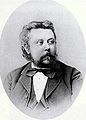
by Russian composer Modest Mussorgsky
Modest Mussorgsky
Modest Petrovich Mussorgsky was a Russian composer, one of the group known as 'The Five'. He was an innovator of Russian music in the romantic period...
in 1874.
The suite is Mussorgsky's most famous piano composition, and has become a showpiece for virtuoso
Virtuoso
A virtuoso is an individual who possesses outstanding technical ability in the fine arts, at singing or playing a musical instrument. The plural form is either virtuosi or the Anglicisation, virtuosos, and the feminine form sometimes used is virtuosa...
pianists. It has become further known through various orchestrations and arrangements produced by other musicians and composers, with Ravel's
Maurice Ravel
Joseph-Maurice Ravel was a French composer known especially for his melodies, orchestral and instrumental textures and effects...
arrangement being the most recorded and performed.
Composition history

Viktor Hartmann
Viktor Alexandrovich Hartmann was a Russian architect and painter. He was associated with the Abramtsevo Colony, purchased and preserved beginning in 1870 by Savva Mamontov, and the Russian Revival.-Life:Victor-Edouard Hartmann was born in St...
. Both men were devoted to the cause of an intrinsically Russian art and quickly became friends. Their meeting was likely arranged by the influential critic Vladimir Stasov who followed both of their careers with interest.
Hartmann died from an aneurysm
Aneurysm
An aneurysm or aneurism is a localized, blood-filled balloon-like bulge in the wall of a blood vessel. Aneurysms can commonly occur in arteries at the base of the brain and an aortic aneurysm occurs in the main artery carrying blood from the left ventricle of the heart...
in 1873. The sudden loss of the artist, aged only 39, shook Mussorgsky along with others in Russia's art world. Stasov helped organize an exhibition of over 400 Hartmann works in the Academy of Fine Arts
Imperial Academy of Arts
The Russian Academy of Arts, informally known as the St. Petersburg Academy of Arts, was founded in 1757 by Ivan Shuvalov under the name Academy of the Three Noblest Arts. Catherine the Great renamed it the Imperial Academy of Arts and commissioned a new building, completed 25 years later in 1789...
in Saint Petersburg
Saint Petersburg
Saint Petersburg is a city and a federal subject of Russia located on the Neva River at the head of the Gulf of Finland on the Baltic Sea...
, Russia
Russia
Russia or , officially known as both Russia and the Russian Federation , is a country in northern Eurasia. It is a federal semi-presidential republic, comprising 83 federal subjects...
in February and March 1874. Mussorgsky lent works from his personal collection to the exhibit and viewed the show in person. Fired by the experience, he composed Pictures at an Exhibition in six weeks. The music depicts an imaginary tour of an art collection. Titles of individual movements allude to works by Hartmann; Mussorgsky used Hartmann as a working title during the work's composition. He described the experience to Stasov in June 1874: "Hartmann is seething as Boris
Boris Godunov (opera)
Boris Godunov is an opera by Modest Mussorgsky . The work was composed between 1868 and 1873 in Saint Petersburg, Russia. It is Mussorgsky's only completed opera and is considered his masterpiece. Its subjects are the Russian ruler Boris Godunov, who reigned as Tsar during the Time of Troubles,...
was. Sounds and ideas float in the air and my scribbling can hardly keep pace with them."
Mussorgsky based his musical material on drawings and watercolours by Hartmann produced mostly during the artist's travels abroad. Locales include Poland, France and Italy; the final movement depicts an architectural design for the capital city of Ukraine
Ukraine
Ukraine is a country in Eastern Europe. It has an area of 603,628 km², making it the second largest contiguous country on the European continent, after Russia...
. Today most of the pictures from the Hartmann exhibit are lost, making it impossible to be sure in many cases which Hartmann works Mussorgsky had in mind. Musicologist
Musicology
Musicology is the scholarly study of music. The word is used in narrow, broad and intermediate senses. In the narrow sense, musicology is confined to the music history of Western culture...
Alfred Frankenstein, in a 1939 article for The Musical Quarterly
The Musical Quarterly
The Musical Quarterly is the oldest academic journal on music in America. Originally established in 1915 by Oscar Sonneck, the journal was edited by Sonneck until his death in 1928...
, claimed to have identified seven pictures by catalogue number. Two Jews: Rich, and Poor (Frankenstein suggested two separate portraits, still extant, as the basis for Samuel Goldenberg und Schmuyle), Gnomus, Tuileries (now lost), Ballet of the Unhatched Chicks (a ballet costume design), Catacombae, The Hut on Hen's Legs (Baba Yaga
Baba Yaga
Baba Yaga or Baba Roga is a haggish or witchlike character in Slavic folklore. She flies around on a giant pestle, kidnaps small children, and lives in a hut that stands on chicken legs...
), and The Bogatyr
Bogatyr
The bogatyr was a medieval heroic warrior of Kievan Rus' and the Novgorodian Republic, akin to a Western European knight errant.- Kievan Rus' :...
Gates.
Mussorgsky links the suite's movements in a way that depicts the viewer's own progress through the exhibition. Two "Promenade" movements stand as portals to the suite's main sections. Their regular pace and irregular meter depicts the act of walking. Three untitled interludes present shorter statements of this theme, varying the mood, colour and key in each to suggest reflection on a work just seen or anticipation of a new work glimpsed. Mussorgsky wrote to Stasov: "My physiognomy can be seen in the interludes." A turn is taken in the work at the "Catacombae" when the Promenade theme stops functioning as merely a linking device and becomes, in "Cum mortuis", an integral element of the movement itself. The theme reaches its apotheosis
Apotheosis
Apotheosis is the glorification of a subject to divine level. The term has meanings in theology, where it refers to a belief, and in art, where it refers to a genre.In theology, the term apotheosis refers to the idea that an individual has been raised to godlike stature...
in the suite's finale, The Bogatyr Gates.
Publication history
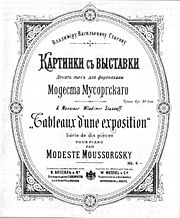
Nikolai Rimsky-Korsakov
Nikolai Andreyevich Rimsky-Korsakov was a Russian composer, and a member of the group of composers known as The Five.The Five, also known as The Mighty Handful or The Mighty Coterie, refers to a circle of composers who met in Saint Petersburg, Russia, in the years 1856–1870: Mily Balakirev , César...
was published. This publication, moreover, was not a completely accurate representation of Mussorgsky's score, but presented an edited and revised text that had been reworked to a certain amount, as well as containing a substantial number of errors and misreadings.
Only in 1931, more than half a century after the work's composition, was Pictures at an Exhibition published in a scholarly edition in agreement with the composer's manuscript. In 1940, the Italian composer Luigi Dallapiccola
Luigi Dallapiccola
Luigi Dallapiccola was an Italian composer known for his lyrical twelve-tone compositions.-Biography:Dallapiccola was born at Pisino d'Istria , to Italian parents....
published an important critical edition of Mussorgsky's work with extensive commentary. Mussorgsky's hand-written manuscript was published in facsimile in 1975.
Gallery of Hartmann's pictures
The surviving works by Hartmann that can be shown with any certainty to have been used by Mussorgsky in assembling his suite, along with their titles, are as follows:Note: Mussorgsky owned the two pictures that together inspired No. 6, the Two Jews. The title of No. 6b, as provided by the Soviet editors of his letters, is «Сандомирский [еврей]» . The bracketed word yevrey (derived from the word Hebrew) is the sanitized
Expurgation
Expurgation is a form of censorship which involves purging anything deemed noxious or offensive, usually from an artistic work.This has also been called bowdlerization, especially for books, after Thomas Bowdler, who in 1818 published an expurgated edition of William Shakespeare's work that he...
form of the original word, very likely жид (zhid or yid
Yid
The word Yid is a slang Jewish ethnonym. Its usage may be controversial in modern English language. It is not usually considered offensive when pronounced , the way Yiddish speakers say it, though some may deem the word offensive nonetheless...
). Mussorgsky, like many Russian intellectuals of his day, habitually used antisemitic epithets in his correspondence.
Movements
Vladimir Stasov's program, identified below, and the six known extant pictures suggest that the ten pieces comprising the suite correspond to eleven pictures by Hartmann, with Samuel Goldenberg und Schmuÿle accounting for two. The five Promenade movements, consisting of an introduction and four links, are not numbered among the ten pictures. The 2nd, 3rd, and 4th Promenade movements are untitled in the composer's manuscript.The enduring popularity of Mussorgsky's Pictures at an Exhibition lies in the satisfaction it offers both at first hearing and in repeated visits. The variety of invention and distinctive character of each movement appeal at once. Visual motives find vivid aural form: clocks, bells, chants, feathers, flames, climb and descent. The piece rewards additional hearings with new relationships constantly to be discovered. The first two movements of the suite—one grand, one grotesque—find mirrored counterparts, and apotheoses
Apotheosis
Apotheosis is the glorification of a subject to divine level. The term has meanings in theology, where it refers to a belief, and in art, where it refers to a genre.In theology, the term apotheosis refers to the idea that an individual has been raised to godlike stature...
, at the end. The suite traces a journey that begins at an art exhibit, but the line between observer and observed vanishes at the Catacombs when the journey takes on a different character. For all the variety individual movements display in musical invention, each springs from a kernel in the opening melody. The Promenade theme provides distinctive "cells" of two and three notes that generate themes and accompaniment figures throughout the piece.
The recording accompanying this explanation is by the Skidmore College Orchestra and provided courtesy of Musopen.
Promenade
(FrenchFrench language
French is a Romance language spoken as a first language in France, the Romandy region in Switzerland, Wallonia and Brussels in Belgium, Monaco, the regions of Quebec and Acadia in Canada, and by various communities elsewhere. Second-language speakers of French are distributed throughout many parts...
)
Key: B-flat major
Meter: originally 11/4. Published editions alternate 5/4 and 6/4.
Tempo: Allegro giusto, nel modo russico; senza allegrezza, ma poco sostenuto
Stasov comment: In this piece Mussorgsky depicts himself "roving through the exhibition, now leisurely, now briskly in order to come close to a picture that had attracted his attention, and at times sadly, thinking of his departed friend."
The melody and rhythm resemble Russian folk songs. The piece has simple, strong rhythms in asymmetrical meter.

No. 1 "Gnomus"
(Latin, The Gnome):Key: E-flat minor
Meter: 3/4
Tempo: alternating "Vivo" and "Meno mosso, pesante"
Stasov comment: "A sketch depicting a little gnome, clumsily running with crooked legs."
Hartmann's sketch, now lost, is thought to represent a design for a nutcracker displaying large teeth. The lurching music, in contrasting tempos with frequent stops and starts, suggests the movements of the gnome.
[Untitled] (Interlude, Promenade theme)
Key: A-flat majorMeter: alternating 5/4 and 6/4
Tempo: "Moderato commodo assai e con delicatezza"
A placid statement of the promenade melody depicts the viewer walking from one display to the next.
No. 2 "Il vecchio castello"
(ItalianItalian language
Italian is a Romance language spoken mainly in Europe: Italy, Switzerland, San Marino, Vatican City, by minorities in Malta, Monaco, Croatia, Slovenia, France, Libya, Eritrea, and Somalia, and by immigrant communities in the Americas and Australia...
, The Old Castle):
Key: G-sharp minor
Meter: 6/8
Tempo: "Andante molto cantabile e con dolore"
Stasov comment: "A medieval castle before which a troubadour sings a song."
This movement is thought to be based on a watercolor depiction of an Italian castle. Hartmann often placed appropriate human figures in his architectural renderings to suggest scale.
[Untitled] (Interlude, Promenade theme)
Key: B major.Meter: alternating 5/4 and 6/4
Tempo: "Moderato non tanto, pesamente"
Another brief statement of the promenade melody (8 measures) gives it more extroversion and weight than before.
No. 3 "Tuileries" (Dispute d'enfants après jeux)
(FrenchFrench language
French is a Romance language spoken as a first language in France, the Romandy region in Switzerland, Wallonia and Brussels in Belgium, Monaco, the regions of Quebec and Acadia in Canada, and by various communities elsewhere. Second-language speakers of French are distributed throughout many parts...
, Tuileries (Dispute between Children at Play))
Key: B major
Meter: 4/4
Tempo: "Allegretto non troppo, capriccioso"
Stasov comment: "An avenue in the garden of the Tuileries, with a swarm of children and nurses."
Hartmann's picture of the Jardin des Tuileries near the Louvre
Louvre
The Musée du Louvre – in English, the Louvre Museum or simply the Louvre – is one of the world's largest museums, the most visited art museum in the world and a historic monument. A central landmark of Paris, it is located on the Right Bank of the Seine in the 1st arrondissement...
in Paris (France) is now lost. Figures of children quarrelling and playing in the garden were likely added by the artist for scale (see note on No. 2 above).
The movement is cast in through-composed ternary form
Ternary form
Ternary form, sometimes called song form, is a three-part musical form, usually schematicized as A-B-A. The first and third parts are musically identical, or very nearly so, while the second part in some way provides a contrast with them...
(ABA).
No. 4 "Bydło"
(PolishPolish language
Polish is a language of the Lechitic subgroup of West Slavic languages, used throughout Poland and by Polish minorities in other countries...
, Cattle)
Key: G-sharp minor
Meter: 2/4
Tempo: Sempre moderato, pesante.
Stasov comment: "A Polish cart on enormous wheels, drawn by oxen."
The movement is cast in through-composed ternary form
Ternary form
Ternary form, sometimes called song form, is a three-part musical form, usually schematicized as A-B-A. The first and third parts are musically identical, or very nearly so, while the second part in some way provides a contrast with them...
(ABA) with coda. Mussorgsky's original piano version of this movement begins fortissimo
Dynamics (music)
In music, dynamics normally refers to the volume of a sound or note, but can also refer to every aspect of the execution of a given piece, either stylistic or functional . The term is also applied to the written or printed musical notation used to indicate dynamics...
(ff), suggesting that the lumbering oxcart's journey begins in the listener's foreground. After reaching a climax (con tutta forza) the dynamic marking is abruptly piano (bar 47), followed by a diminuendo to a final pianissimo (ppp), suggesting the oxcart receding into the distance. Arrangements based on Rimsky-Korsakov's edition, such as Ravel's, begin quietly, build gradually (crescendo) to fortissimo, and then undergo a diminuendo, suggesting the oxcart approaching, passing the listener, and then receding.
[Untitled] (Interlude, Promenade theme)
Key: D minorMeter: alternating 5/4, 6/4, 7/4
Tempo: "Tranquillo"
A reflective 10-measure presentation of the promenade theme.
No. 5 "Балетъ невылупившихся птенцовъ" [Balet nevylupivshikhsya ptentsov]
(Modern RussianRussian language
Russian is a Slavic language used primarily in Russia, Belarus, Uzbekistan, Kazakhstan, Tajikistan and Kyrgyzstan. It is an unofficial but widely spoken language in Ukraine, Moldova, Latvia, Turkmenistan and Estonia and, to a lesser extent, the other countries that were once constituent republics...
: Балет невылупившихся птенцов, Ballet of the Unhatched Chicks)
Key: F major
Meter: 2/4 time
Tempo: "Scherzino (vivo, leggiero)"
Stasov comment: "Hartmann's design for the décor of a picturesque scene in the ballet Trilby."
Gerald Abraham provides the following details: "Trilby
Trilby (ballet)
Trilby is a ballet in 2 acts and 3 scenes, with choreography by Marius Petipa and music by Yuli Gerber. Libretto by Marius Petipa, based on the 1822 novel Trilby, ou le lutin d'Argail by Charles Nodier, first presented by the Ballet of the Moscow Imperial Bolshoi Theatre on January 25/February 6 ,...
or The Demon of the Heath, a ballet with choreography by Petipa
Marius Petipa
Victor Marius Alphonse Petipa was a French ballet dancer, teacher and choreographer. Petipa is considered to be the most influential ballet master and choreographer of ballet that has ever lived....
, music by Julius Gerber
Julius Gerber
Julius Gerber was a leading Socialist Party of America party official and politician during the first two decades of the 20th century. Gerber headed the important Socialist Party unit for New York City and its environs from 1911 through 1922...
, and décor by Hartmann... produced in 1870. The fledglings were canary chicks."
The movement is cast in ternary form
Ternary form
Ternary form, sometimes called song form, is a three-part musical form, usually schematicized as A-B-A. The first and third parts are musically identical, or very nearly so, while the second part in some way provides a contrast with them...
(ABA) with a literal repeat and terse extension (coda).
No. 6 "Samuel" Goldenberg und "Schmuÿle"
(YiddishYiddish language
Yiddish is a High German language of Ashkenazi Jewish origin, spoken throughout the world. It developed as a fusion of German dialects with Hebrew, Aramaic, Slavic languages and traces of Romance languages...
, Samuel Goldenberg and Schmuÿle)
Key: B-flat minor
Meter: 4/4 time
Tempo: "Andante. Grave energico" and "Andantino"
Stasov comment: "Two Jews: Rich and Poor"
Stasov's explanatory title elucidates the personal names used in Mussorgsky's original manuscript. Published versions display various combinations, such as "Two Polish Jews, Rich and Poor (Samuel Goldenberg and Schmuyle)". The movement is thought to be based on two separate extant portraits.
The use of augmented second
Minor third
In classical music from Western culture, a third is a musical interval encompassing three staff positions , and the minor third is one of two commonly occurring thirds. The minor quality specification identifies it as being the smallest of the two: the minor third spans three semitones, the major...
intervals approximate Jewish modes such as the Phrygian dominant scale
Phrygian dominant scale
In music, the altered Phrygian scale or Freygish scale , featuring an unusual key signature and a distinctive augmented second interval, is the fifth mode of the harmonic minor scale, the fifth being the dominant...
. The movement is in ternary form (A|B|A+B):
- Andante, grave energico (Theme 1 "Samuel Goldenberg")
- Andantino (Theme 2 "Schmuÿle")
- Andante, grave energico (Themes 1 and 2 in counterpoint)
- Coda
Promenade
Key: B-flat major.Meter: originally 11/4. Published editions alternate 5/4 and 6/4.
Tempo: Allegro giusto, nel modo russico; poco sostenuto.
A nearly bar-for-bar restatement of the opening promenade. Differences are slight: condensed second half, block chords voiced more fully. Structurally the movement acts as a reboot, giving listeners another hearing of the opening material before these are developed in the second half of the suite. Its appearance at this point in the programmatic narrative suggests that Mussorgsky's exhibition viewer stands in an economic middle ground between the wealth of Goldenberg and the poverty of Schmuÿle.
Many arrangements, including Ravel's orchestral version, omit this movement.
No. 7 "Limoges", le marché (La grande nouvelle)
(FrenchFrench language
French is a Romance language spoken as a first language in France, the Romandy region in Switzerland, Wallonia and Brussels in Belgium, Monaco, the regions of Quebec and Acadia in Canada, and by various communities elsewhere. Second-language speakers of French are distributed throughout many parts...
, The Market at Limoges (The Great News))
Key: E-flat major
Meter: 4/4
Tempo: Allegretto vivo, sempre scherzando
Stasov comment: "French women quarreling violently in the market."
Limoges
Limoges
Limoges |Limousin]] dialect of Occitan) is a city and commune, the capital of the Haute-Vienne department and the administrative capital of the Limousin région in west-central France....
is a city in central France. Mussorgsky originally provided two paragraphs in French that described a marketplace discussion (the 'great news'), but soon removed them.
The movement is a scherzo
Scherzo
A scherzo is a piece of music, often a movement from a larger piece such as a symphony or a sonata. The scherzo's precise definition has varied over the years, but it often refers to a movement which replaces the minuet as the third movement in a four-movement work, such as a symphony, sonata, or...
in through-composed ternary form
Ternary form
Ternary form, sometimes called song form, is a three-part musical form, usually schematicized as A-B-A. The first and third parts are musically identical, or very nearly so, while the second part in some way provides a contrast with them...
(ABA). A scurrying coda leads without a break into the next movement.
No. 8 "Catacombæ" (Sepulcrum romanum) and "Cum mortuis in lingua mortua"
(Latin, The Catacombs (Roman sepulcher)) and (Latin, With the Dead in a Dead Language)Note: The original published title's Con mortuis is correctly rendered in Latin as Cum mortuis.
Key: B minor
Meter: 3/4 (Sepulcrum) 6/4 (Cum mortuis)
Tempo: "Largo" (Sepulcrum) "Andante non troppo con lamento" (Cum mortuis)
Stasov comment: "Hartmann represented himself examining the Paris catacombs
Catacombs of Paris
The Catacombs of Paris or Catacombes de Paris are an underground ossuary in Paris, France. Located south of the former city gate , the ossuary holds the remains of about 6 million people and fills a renovated section of caverns and tunnels that are the remains of Paris' stone mines...
by the light of a lantern."
The movement is in two distinct parts. Its two sections consist of a nearly static Largo consisting of a sequence of block chords, with elegiac lines adding a touch of melancholy, and a more flowing, gloomy "Andante" that introduces the "Promenade" theme into the scene.
The first section's alternating loud and soft chords evoke the grandeur, stillness, and echo of the catacombs. The second section suggests a merging of observer and scene as the observer descends into the catacombs. Mussorgsky's manuscript of The Catacombs displays two pencilled notes, in Russian: "NB – Latin text: With the dead in a dead language" and, along the right margin, "Well may it be in Latin! The creative spirit of the dead Hartmann leads me towards the skulls, invokes them; the skulls begin to glow softly from within."
No. 9 "Избушка на курьихъ ножкахъ" (Баба-Яга) [Izbushka na kuryikh nozhkakh (Baba-Yagá)]
(Modern RussianRussian language
Russian is a Slavic language used primarily in Russia, Belarus, Uzbekistan, Kazakhstan, Tajikistan and Kyrgyzstan. It is an unofficial but widely spoken language in Ukraine, Moldova, Latvia, Turkmenistan and Estonia and, to a lesser extent, the other countries that were once constituent republics...
: Избушка на курьих ножках (Баба-Яга), The Hut on Fowl's Legs (Baba-Yagá))
Key: C minor
Meter: 2/4
Tempo: "Allegro con brio, feroce" and "Andante mosso"
Stasov comment: "Hartmann's drawing depicted a clock in the form of Baba-Yagá's
Baba Yaga
Baba Yaga or Baba Roga is a haggish or witchlike character in Slavic folklore. She flies around on a giant pestle, kidnaps small children, and lives in a hut that stands on chicken legs...
hut on fowl's legs. Mussorgsky added the witch's flight in a mortar
Mortar and pestle
A mortar and pestle is a tool used to crush, grind, and mix solid substances . The pestle is a heavy bat-shaped object, the end of which is used for crushing and grinding. The mortar is a bowl, typically made of hard wood, ceramic or stone...
."
A scherzo feroce with a slower middle section. Motives in this movement evoke the bells of a large clock and the whirlwind sounds of a chase. Structurally the movement mirrors the grotesque qualities of "Gnomus" on a grand scale. The central andante is one of the more demanding portions of the suite for the pianist, as it features a 16th note triplet
Tuplet
In music a tuplet is "any rhythm that involves dividing the beat into a different number of equal subdivisions from that usually permitted by the...
tremolo
Tremolo
Tremolo, or tremolando, is a musical term that describes various trembling effects, falling roughly into two types. The first is a rapid reiteration...
throughout.
The movement is cast in ternary form
Ternary form
Ternary form, sometimes called song form, is a three-part musical form, usually schematicized as A-B-A. The first and third parts are musically identical, or very nearly so, while the second part in some way provides a contrast with them...
(ABA):
- Allegro con brio, feroce
- Andante mosso
- Allegro molto (a nearly literal repeat)
- Coda
The coda leads without a break to the final movement of the suite.
No. 10 "Богатырскія ворота" (Въ стольномъ городѣ Кіевѣ) [Bogatyrskiye vorota (V stolnom gorode Kiyeve)]
(Modern RussianRussian language
Russian is a Slavic language used primarily in Russia, Belarus, Uzbekistan, Kazakhstan, Tajikistan and Kyrgyzstan. It is an unofficial but widely spoken language in Ukraine, Moldova, Latvia, Turkmenistan and Estonia and, to a lesser extent, the other countries that were once constituent republics...
: Богатырские ворота (В стольном городе во Киеве), The Bogatyr Gates (in the Capital in Kiev))
Key: E-flat major
Meter: 4/4
Tempo: "Maestoso, con grandezza" and broadening to the end.
Stasov comment: "Hartmann's sketch was his design for city gates at Kiev in the ancient Russian massive style with a cupola shaped like a slavonic helmet."
Bogatyr
Bogatyr
The bogatyr was a medieval heroic warrior of Kievan Rus' and the Novgorodian Republic, akin to a Western European knight errant.- Kievan Rus' :...
s are heroes that appear in Russian epics called bylinas. The title of this movement is commonly translated as "The Great Gate of Kiev" and sometimes as "The Heroes' Gate at Kiev."
Hartmann designed a monumental gate for Tsar Alexander II
Alexander II of Russia
Alexander II , also known as Alexander the Liberator was the Emperor of the Russian Empire from 3 March 1855 until his assassination in 1881...
to commemorate the monarch's narrow escape from an assassination attempt on April 4, 1866. Hartmann regarded his design as the best work he had done. His design won the national competition but plans to build the structure were later cancelled.
The movement features a grand main theme that exalts the opening promenade much as "Baba Yaga" amplified "Gnomus"; also like that movement it evens out the meter of its earlier counterpart. The solemn secondary theme is based on a baptism
Baptism
In Christianity, baptism is for the majority the rite of admission , almost invariably with the use of water, into the Christian Church generally and also membership of a particular church tradition...
al hymn from the repertory of Russian Orthodox chant
Chant
Chant is the rhythmic speaking or singing of words or sounds, often primarily on one or two pitches called reciting tones. Chants may range from a simple melody involving a limited set of notes to highly complex musical structures Chant (from French chanter) is the rhythmic speaking or singing...
.
The movement is cast as a broad rondo
Rondo
Rondo, and its French equivalent rondeau, is a word that has been used in music in a number of ways, most often in reference to a musical form, but also to a character-type that is distinct from the form...
in two main sections: ABAB|CADA. The first half of the movement sets up the expectation of an ABABA pattern. The interruption of this pattern with new music just before its expected conclusion gives the rest of the movement the feeling of a vast extension. This extended leave-taking acts as a coda for the suite as a whole.
- A Main Theme ("forte") Tempo: "Maestoso"
- B Hymn Theme (piano) (A-flat minor)
- A Main Theme ("forte") Descending and ascending scale figures suggest carillonCarillonA carillon is a musical instrument that is typically housed in a free-standing bell tower, or the belfry of a church or other municipal building. The instrument consists of at least 23 cast bronze, cup-shaped bells, which are played serially to play a melody, or sounded together to play a chord...
s. - B Hymn Theme (piano) (E-flat minor)
- C Interlude/Transition [under "forte"]. "Promenade" theme recalled. Suggestions of clockwork, bells, ascent.
- A Main Theme (fortissimo) Triplet figuration. Tempo: Meno mosso, sempre maestoso.
- D Interlude/Transition ("mezzo forte" with crescendo) Triplets.
- A Main Theme (fortissimo) Tempo: Grave, Sempre allargando. Rhythm slows to a standstill by the final cadence.
Arrangements and interpretations
,_page_1.jpg)
Mikhail Tushmalov
Mikhail Tushmalov was a Russian Georgian opera conductor who held posts in Warsaw and Tiflis . He died in what is now the nation of Georgia....
. However, his version (first performed in 1891 and possibly produced as early as 1886 when he was a student of Rimsky-Korsakov) does not include the entire suite: Only seven of the ten "pictures" are present, leaving out Gnomus, Tuileries, and Bydło, and all the Promenades are omitted except for the last one, which is used in place of the first.
The next orchestration was that undertaken by the British conductor Henry Wood in 1915. He recorded a few sections of his arrangement on a pair of acoustic Columbia 78rpm discs in 1920. However, he withdrew his version when Maurice Ravel
Maurice Ravel
Joseph-Maurice Ravel was a French composer known especially for his melodies, orchestral and instrumental textures and effects...
's orchestration was published and banned every public performance in the 1930s in deference to Ravel's superior work. Wood's arrangement has also been recorded by the London Philharmonic under Nicholas Braithwaite
Nicholas Braithwaite
Nicholas Paul Dallon Braithwaite is an English conductor. He is the son of the conductor Warwick Braithwaite.Braithwaite studied at the Royal Academy of Music, at the Festival masterclasses in Bayreuth, and with Hans Swarowsky in Vienna. In the 1960s, Braithwaite was associate conductor of the...
and issued on the Lyrita
Lyrita
Lyrita is a classical music record label, specializing in the works of British composers.Lyrita began releasing LPs in October 1959 as Lyrita Recorded Edition for sale by mail order subscription. The founder of the company, Richard Itter of Burnham, Buckinghamshire, was a businessman and record...
label. It omits all but the first of the Promenade-based movements and features extensive re-composition elsewhere. Wood's orchestration was once described by Gordon Jacob
Gordon Jacob
Gordon Percival Septimus Jacob was an English composer. He is known for his wind instrument composition and his instructional writings.-Life:...
as "superior in picturesqueness to the Ravel", with its off-stage camel-bells in "Bydlo" and grand organ in "The Great Gate of Kiev".
The first person to orchestrate the piece in its entirety was the Slovenian-born conductor and violinist Leo Funtek
Leo Funtek
Leo Funtek was a violinist, conductor and arranger. He is best known for work as a music professor and for his 1922 arrangement of Modest Mussorgsky's piano suite Pictures at an Exhibition....
, who finished his version in 1922 while living and working in Finland.
The version by Maurice Ravel
Maurice Ravel
Joseph-Maurice Ravel was a French composer known especially for his melodies, orchestral and instrumental textures and effects...
, also produced in 1922, represents a virtuoso effort by a master colourist. The orchestration, commissioned by Serge Koussevitzky
Serge Koussevitzky
Serge Koussevitzky , was a Russian-born Jewish conductor, composer and double-bassist, known for his long tenure as music director of the Boston Symphony Orchestra from 1924 to 1949.-Early career:...
, has proved the most popular in the concert hall and on record. Ravel omits the Promenade between "Samuel" Goldenberg und "Schmuÿle" and Limoges and applies artistic license to some particulars of dynamics and notation. Koussevitzky's commission gave him sole conducting rights for several years. He published Ravel's score himself and in 1930 made the first recording of it with the Boston Symphony Orchestra
Boston Symphony Orchestra
The Boston Symphony Orchestra is an orchestra based in Boston, Massachusetts. It is one of the five American orchestras commonly referred to as the "Big Five". Founded in 1881, the BSO plays most of its concerts at Boston's Symphony Hall and in the summer performs at the Tanglewood Music Center...
.
Most arrangements made since Ravel's version are indebted to his choice of instrumental colours. The exclusive nature of his commission, though, prompted the release of a number of contemporary versions by other arrangers. An orchestral version by Leonidas Leonardi, a Ravel student, requires even larger forces than Ravel's. The Leonardi version was commissioned by W. Bessel & Co., Paris (publishers of Mussorgsky's piano original) since they were quite taken aback by the enormous success of the Maurice Ravel version following its premiere in 1922 under Serge Koussevitzky's direction. At that time, W. Bessel were still jealously guarding their rights in Mussorgsky's works, and they reluctantly gave Serge Koussevitzky permission to perform Ravel's independently-created orchestral version, on the condition that he would not allow anyone else to conduct it. Their conviction was that an arrangement of one of their piano publications would bring no commercial advantage. That Bessel were mistaken became evident as the Ravel orchestration proved ever more successful. Thereafter, W. Bessel & Co. approached a precocious 21-year-old Russian-born pianist named Leonidas Leonardi (1901–1967) (a.k.a. Leon Leonardi or Leonid Leonardi) to provide them with an orchestral version of their own which would surpass Ravel's. Leonardi dedicated his orchestration to Igor Stravinsky
Igor Stravinsky
Igor Fyodorovich Stravinsky ; 6 April 1971) was a Russian, later naturalized French, and then naturalized American composer, pianist, and conductor....
, and conducted the premiere himself with the Lamoureux Orchestra
Lamoureux Orchestra
The Orchestre Lamoureux officially known as the Société des Nouveaux-Concerts and also known as the Concerts Lamoureux) is an orchestral concert society which once gave weekly concerts by its own orchestra, founded in Paris by Charles Lamoureux in 1881...
in Paris on 15 June 1924. The US premiere took place when the New York Symphony Orchestra
New York Symphony Orchestra
The New York Symphony Orchestra was founded as the New York Symphony Society in New York City by Leopold Damrosch in 1878. For many years it was a fierce rival to the older Philharmonic Symphony Society of New York. It was supported by Andrew Carnegie who built Carnegie Hall expressly for the...
played it on 4 December 1924 under the baton of Walter Damrosch. Subsequently it has lapsed into obscurity and no recording exists for it, except for the third promenade and Tuileries , which was used in Leonard Slatkin
Leonard Slatkin
Leonard Edward Slatkin is an American conductor and composer.-Early life and education:Slatkin was born in Los Angeles to a musical family that came from areas of the Russian Empire now in Ukraine. His father Felix Slatkin was the violinist, conductor and founder of the Hollywood String Quartet,...
's first compilation version, included in the St. Louis Symphony set, "The Slatkin Years 6 CD Set".
Another arrangement appeared when Eugene Ormandy
Eugene Ormandy
Eugene Ormandy was a Hungarian-born conductor and violinist.-Early life:Born Jenő Blau in Budapest, Hungary, Ormandy began studying violin at the Royal National Hungarian Academy of Music at the age of five...
took over the Philadelphia Orchestra in 1936 following Leopold Stokowski
Leopold Stokowski
Leopold Anthony Stokowski was a British-born, naturalised American orchestral conductor, well known for his free-hand performing style that spurned the traditional baton and for obtaining a characteristically sumptuous sound from many of the great orchestras he conducted.In America, Stokowski...
's decision to resign the conductorship. Ormandy wanted a version of Pictures of his own and commissioned Lucien Cailliet
Lucien Cailliet
Lucien Cailliet was an American composer, conductor, arranger and clarinetist.-Biography:Born at Dijon, in France, Cailliet studied at the Conservatory in his native city before migrating to the United States in 1918....
, the Philadelphia Orchestra's 'house arranger' and a member of the woodwind section, to produce one. This version was premiered and recorded by Ormandy in 1937. Walter Goehr
Walter Goehr
Walter Goehr was a German composer and conductor.Goehr was born in Berlin where studied with Arnold Schoenberg and embarked on a conducting career, before being forced as a Jew to seek employment outside Germany, while working for Berlin Radio in 1932. He was invited to become music director for...
, on the other hand, published a version in 1942 for smaller forces than Ravel but curiously dropped Gnomus altogether and made Limoges the first "picture".
The conductor Leopold Stokowski had introduced Ravel's version to Philadelphia audiences in November 1929; ten years later he produced his own very free orchestration
Pictures at an Exhibition (Stokowski orchestration)
Leopold Stokowski's orchestration of Pictures at an Exhibition by Modest Mussorgsky was completed in 1939 and premiered later that year, on 17 November, by the Philadelphia Orchestra. Mussorgsky's original 1874 composition was a suite for piano, however, the piece has gained most of its fame...
(incorporating much re-composition), aiming for what he called a more 'Slavic' orchestral sound instead of Ravel's more 'Gallic' approach. Stokowski revised his version over the years and made three gramophone recordings of it (1939, 1941 and 1965). The score, finally published in 1971, has since been recorded by other conductors, including Matthias Bamert
Matthias Bamert
Matthias Bamert is a Swiss composer and conductor.Matthias Bamert studied music in his native Switzerland as well as in Paris and Darmstadt, falling in with the likes of Pierre Boulez and Karlheinz Stockhausen; these associations can be detected in his own compositions from the 1970's...
, Gennady Rozhdestvensky
Gennady Rozhdestvensky
Gennady Nikolayevich Rozhdestvensky is a Russian conductor.-Biography:Rozhdestvensky was born in Moscow. His parents were the noted conductor and pedagogue Nikolai Anosov and soprano Natalya Rozhdestvenskaya...
, Oliver Knussen
Oliver Knussen
Oliver Knussen CBE is a British composer and conductor.-Biography:Oliver Knussen was born in Glasgow, Scotland. His father, Stuart Knussen, was principal double bass of the London Symphony Orchestra. Oliver Knussen studied composition with John Lambert, between 1963 and 1969 and also received...
and José Serebrier
José Serebrier
José Serebrier is a Uruguayan conductor and composer. He married American soprano Carole Farley in 1969.- Youth :Serebrier was born in Montevideo, and first conducted an orchestra at the age of eleven, while at school. The school orchestra toured the country, which meant he was able to notch up...
.
Although Ravel's version is most often performed and recorded, a number of conductors have made their own changes to the scoring, including Arturo Toscanini
Arturo Toscanini
Arturo Toscanini was an Italian conductor. One of the most acclaimed musicians of the late 19th and 20th century, he was renowned for his intensity, his perfectionism, his ear for orchestral detail and sonority, and his photographic memory...
, Nikolai Golovanov and Djong Victorin Yu. Conductor and pianist Vladimir Ashkenazy
Vladimir Ashkenazy
Vladimir Davidovich Ashkenazy is a Russian-Icelandic conductor and pianist. Since 1972 he has been a citizen of Iceland, his wife Þórunn's country of birth. Since 1978, because of his many obligations in Europe, he and his family have resided in Meggen, near Lucerne in Switzerland...
has produced his own orchestral arrangement, expressing dissatisfaction with Ravel's interpretive liberties and perpetuation of early printing errors. The conductor Leonard Slatkin
Leonard Slatkin
Leonard Edward Slatkin is an American conductor and composer.-Early life and education:Slatkin was born in Los Angeles to a musical family that came from areas of the Russian Empire now in Ukraine. His father Felix Slatkin was the violinist, conductor and founder of the Hollywood String Quartet,...
has performed 'compendium' versions, in which each Promenade and "picture" is interpreted by a different orchestral arranger.
Many other orchestrations and arrangements of Pictures have been made. Most show debts to Ravel; the original piano composition is, of course, frequently performed and recorded. A version for chamber orchestra exists, made by Taiwan
Taiwan
Taiwan , also known, especially in the past, as Formosa , is the largest island of the same-named island group of East Asia in the western Pacific Ocean and located off the southeastern coast of mainland China. The island forms over 99% of the current territory of the Republic of China following...
ese composer Chao Ching-Wen. Elgar Howarth
Elgar Howarth
Elgar Howarth is an English conductor and composer.Howarth was educated in the 1950s at Manchester University and the Royal Manchester College of Music , where his fellow students included the composers Harrison Birtwistle, Alexander Goehr, Peter Maxwell Davies, and the...
arranged it for the Philip Jones Brass Ensemble
Philip Jones Brass Ensemble
The Philip Jones Brass Ensemble, founded in 1951 by trumpeter Philip Jones, was one of the first modern classical brass ensembles to be formed. The group played either as a quintet or as a ten-piece, for larger halls...
in the 1970s. Kazuhito Yamashita
Kazuhito Yamashita
is a Japanese classical guitarist. His technique and expression are considered somewhat controversial.-Musical career:Yamashita began to study the guitar at the age of eight with his father, Toru Yamashita. In 1972, aged eleven, he won the Kyushu Guitar Competition. Four years later, he was awarded...
wrote an adaptation for solo classical guitar
Classical guitar
The classical guitar is a 6-stringed plucked string instrument from the family of instruments called chordophones...
. Excerpts have also been recorded, including a 78 rpm disc of The Old Castle and Catacombs orchestrated by Sir Granville Bantock
Granville Bantock
Sir Granville Bantock was a British composer of classical music.-Biography:Granville Ransome Bantock was born in London. His father was a Scottish doctor. He was intended by his parents for the Indian Civil Service but was drawn into the musical world. His first teacher was Dr Gordon Saunders at...
, and a spectacular version of The Great Gate of Kiev was scored by Douglas Gamley
Douglas Gamley
Douglas Gamley was an Australian film composer, who worked on British and American films.He was particularly influenced by Modest Mussorgsky, creating a full orchestral version of his Pictures at an Exhibition, and adapting his Night on Bald Mountain for his score for Asylum...
for full symphony orchestra, male voice choir and organ.
The suite has inspired homages in a broad range of musical styles. A version featured in two albums
Pictures at an Exhibition (album)
*The material on the second disc was recorded at the Lyceum Theatre in December of 1970.-Personnel:*Keith Emerson - Pipe Organ, Hammond C3 and L100 Organs, Moog Modular Synthesizer, Ribbon controller, Clavinet*Greg Lake - bass, acoustic guitar, Vocals...
by the British trio Emerson, Lake & Palmer
Emerson, Lake & Palmer
Emerson, Lake & Palmer, also known as ELP, are an English progressive rock supergroup. They found success in the 1970s and sold over forty million albums and headlined large stadium concerts. The band consists of Keith Emerson , Greg Lake and Carl Palmer...
incorporates elements of progressive rock
Progressive rock
Progressive rock is a subgenre of rock music that developed in the late 1960s and early 1970s as part of a "mostly British attempt to elevate rock music to new levels of artistic credibility." John Covach, in Contemporary Music Review, says that many thought it would not just "succeed the pop of...
, jazz
Jazz
Jazz is a musical style that originated at the beginning of the 20th century in African American communities in the Southern United States. It was born out of a mix of African and European music traditions. From its early development until the present, jazz has incorporated music from 19th and 20th...
and folk music
Folk music
Folk music is an English term encompassing both traditional folk music and contemporary folk music. The term originated in the 19th century. Traditional folk music has been defined in several ways: as music transmitted by mouth, as music of the lower classes, and as music with unknown composers....
(1971/2008). An electronic music
Electronic music
Electronic music is music that employs electronic musical instruments and electronic music technology in its production. In general a distinction can be made between sound produced using electromechanical means and that produced using electronic technology. Examples of electromechanical sound...
adaptation by Isao Tomita
Isao Tomita
, often known simply as Tomita, is a Japanese music composer, regarded as one of the pioneers of electronic music and space music, and as one of the most famous producers of analog synthesizer arrangements...
was done in 1975. A heavy metal arrangement of the entire suite was released by German band Mekong Delta
Mekong Delta (band)
Mekong Delta is a German progressive/thrash metal band, formed in 1985.-History:The band was founded by a group of German metal musicians with the goal to 'musically outshine' all then-current, independent releases. The line-up and the history of the group was to be "the best kept secret in the...
; another metal band, Armored Saint
Armored Saint
-Early career:Armored Saint was formed in 1982 by brothers Phil Sandoval and Gonzo Sandoval , and guitarist David Prichard, while attending South Pasadena High School. Next to join were singer John Bush also a South Pasadena High School Alumni and bassist Joey Vera...
, utilised the "Great Gate of Kiev"'s main theme as the introduction to the track "March of the Saint". In 2002, electronic musician-composer Amon Tobin
Amon Tobin
Amon Adonai Santos de Araújo Tobin , known as Amon Tobin, is a Brazilian musician, composer and producer of electronic music. He is described as a virtuoso sound designer and is considered to be one of the most influential electronic music artists in the world...
paraphrased "Gnomus" for the track "Back From Space" on his album Out from Out Where
Out from Out Where
Out From Out Where was the fourth release by Amon Tobin on Ninja Tune. Many of the tracks segue together creating an ongoing feel to the album. Video clips were made for "Verbal" and "Proper Hoodidge", directed by Alex Rutterford and Corine Stübi respectively. The CD contains enhanced content of...
. In 2003, guitarist-composer Trevor Rabin
Trevor Rabin
Trevor Charles Rabin is a South African born musician, best known as a guitarist, vocalist and songwriter for the British progressive rock band Yes from 1983–1994, and since then, as a film composer.- Early years :...
released his electric guitar adaptation of "Promenade", once intended for the Yes
Yes (band)
Yes are an English rock band who achieved worldwide success with their progressive, art, and symphonic style of rock music. Regarded as one of the pioneers of the progressive genre, Yes are known for their lengthy songs, mystical lyrics, elaborate album art, and live stage sets...
album Big Generator
Big Generator
Big Generator is the twelfth studio album by progressive rock band Yes. It was released in 1987 on Atlantic Records' Atco subsidiary label and was the follow-up to the massively successful 90125 album.- History :...
, and later included on his demo album 90124. In 2005 Animusic 2 was released with an orchestration which was titled "Cathedral Pictures". It is based on the Emerson, Lake, & Palmer version, thus it contains only three movements: the first "Promenade", "Hut on Fowl Legs", and "The Great Gate of Kiev".
Orchestral arrangements
A listing of orchestral arrangements of Pictures at an Exhibition:- Mikhail TushmalovMikhail TushmalovMikhail Tushmalov was a Russian Georgian opera conductor who held posts in Warsaw and Tiflis . He died in what is now the nation of Georgia....
(ca. 1886; three "pictures" and four Promenades omitted: recorded by Marc Andrae and the Munich Philharmonic for BASF) - Henry Wood (1915; four Promenades omitted: recorded by Nicholas Braithwaite and the London Philharmonic for Lyrita)
- Leo FuntekLeo FuntekLeo Funtek was a violinist, conductor and arranger. He is best known for work as a music professor and for his 1922 arrangement of Modest Mussorgsky's piano suite Pictures at an Exhibition....
(19221922 in music-Events:*January 24 - Carl Nielsen conducts the first public performance of his Symphony No. 5 in Copenhagen.*October 19 - Maurice Ravel orchestral arrangement of Modest Mussorgsky's Pictures at an Exhibition is premiered in Paris...
; all Promenades included: recorded by Leif Segerstam and the Finnish Radio Symphony for BIS; Also on TeldecTeldecThe Teldec is a German record label in Hamburg, Germany. Today the label is a property of Warner Music Group.-History:...
Laser-disc with Vladimir AshkenazyVladimir AshkenazyVladimir Davidovich Ashkenazy is a Russian-Icelandic conductor and pianist. Since 1972 he has been a citizen of Iceland, his wife Þórunn's country of birth. Since 1978, because of his many obligations in Europe, he and his family have resided in Meggen, near Lucerne in Switzerland...
conducting the Swedish Radio Symphony OrchestraSwedish Radio Symphony OrchestraSwedish Radio Symphony Orchestra is a radio orchestra based in Stockholm, Sweden, and affiliated with Sveriges Radio . The orchestra broadcasts concerts on the Swedish Radio-P2 network....
) - Maurice RavelMaurice RavelJoseph-Maurice Ravel was a French composer known especially for his melodies, orchestral and instrumental textures and effects...
(1922; the fifth Promenade omitted) - Giuseppe BecceGiuseppe BecceGiuseppe Becce was an Italian-born film score composer who enriched the German cinema.- Biography :Becce was born in Lonigo/Vicenza, Italy. He showed his musical talents early and was named the director of the student musical orchestra at the Padua University when he studied geography...
(1922; for "salon-orchestra". No Promenades are included at all, and only some of the Pictures.) - Leonidas Leonardi (1924; published by Breitkopf & HärtelBreitkopf & HärtelBreitkopf & Härtel is the world's oldest music publishing house. The firm was founded in 1719 in Leipzig by Bernhard Christoph Breitkopf . The catalogue currently contains over 1000 composers, 8000 works and 15,000 music editions or books on music. The name "Härtel" was added when Gottfried...
; Leonard SlatkinLeonard SlatkinLeonard Edward Slatkin is an American conductor and composer.-Early life and education:Slatkin was born in Los Angeles to a musical family that came from areas of the Russian Empire now in Ukraine. His father Felix Slatkin was the violinist, conductor and founder of the Hollywood String Quartet,...
has "revived" a part of the Leonardi version by using Promenade III & Tuileries in his 1st "compendium" suite of "Pictures at an Exhibition" ) - Lucien CaillietLucien CaillietLucien Cailliet was an American composer, conductor, arranger and clarinetist.-Biography:Born at Dijon, in France, Cailliet studied at the Conservatory in his native city before migrating to the United States in 1918....
(1937: recorded by Eugene Ormandy and the Philadelphia Orchestra for RCA and reissued on Biddulph) - Leopold StokowskiPictures at an Exhibition (Stokowski orchestration)Leopold Stokowski's orchestration of Pictures at an Exhibition by Modest Mussorgsky was completed in 1939 and premiered later that year, on 17 November, by the Philadelphia Orchestra. Mussorgsky's original 1874 composition was a suite for piano, however, the piece has gained most of its fame...
(1939; third Promenade, Tuileries, fifth Promenade and Limoges omitted. Three recordings conducted by Stokowski: with the Philadelphia Orchestra, All-American Youth Orchestra, and New Philharmonia) - Walter GoehrWalter GoehrWalter Goehr was a German composer and conductor.Goehr was born in Berlin where studied with Arnold Schoenberg and embarked on a conducting career, before being forced as a Jew to seek employment outside Germany, while working for Berlin Radio in 1932. He was invited to become music director for...
(1942; Gnomus omitted; includes a subsidiary part for piano) - Sergei GorchakovSergei GorchakovSergei Petrovich Gorchakov Russian composer of the 20th century best noted for his uniquely 'Russian' orchestration of "Pictures at an Exhibition" by "Modest Mussorgsky"-References:* *...
(1954: recorded by Kurt MasurKurt MasurKurt Masur is a German conductor, particularly noted for his interpretation of German Romantic music.- Biography :Masur was born in Brieg, Lower Silesia, Germany and studied piano, composition and conducting in Leipzig, Saxony. Masur has been married three times...
and the London Philharmonic for Teldec; Also recorded with Karl Anton RickenbacherKarl Anton RickenbacherKarl Anton Rickenbacher is a Swiss conductor.Rickenbacher studied at the Berlin Conservatory with Herbert von Karajan. He took part in master classes with Pierre Boulez. He was an assistant conductor at the Zürich Opera from 1966 to 1969. He served as first Kapellmeister of the Stadt Buhnen...
, conducting the Cracow Radio Symphony, for the RCA RecordsRCA RecordsRCA Records is one of the flagship labels of Sony Music Entertainment. The RCA initials stand for Radio Corporation of America , which was the parent corporation from 1929 to 1985 and a partner from 1985 to 1986.RCA's Canadian unit is Sony's oldest label...
. A live 1980 performance by the Leningrad Academic Symphony Orchestra under Konstantin Simeonov was recorded by Melodya.) - Nikolai Golovanov (A heavily edited version of Ravel's orchestration in which Golovanov omits all but the first of the Promenades was recorded for Melodya)
- Daniel Walter (1959)
- Helmut Brandenburg (ca. 1970)
- Lawrence LeonardLawrence LeonardLawrence Leonard was a British conductor, cellist, composer, teacher and writer.Leonard received his musical education at the Royal Academy of Music and the École Normale de Musique de Paris...
(1977; for piano and orchestra; recorded by Tamas Ungar, piano, with Geoffrey Simon and the Philharmonia Orchestra for Cala) - Vladimir AshkenazyVladimir AshkenazyVladimir Davidovich Ashkenazy is a Russian-Icelandic conductor and pianist. Since 1972 he has been a citizen of Iceland, his wife Þórunn's country of birth. Since 1978, because of his many obligations in Europe, he and his family have resided in Meggen, near Lucerne in Switzerland...
(1982: recorded by Ashkenazy and the Philharmonia Orchestra for Decca/London) - Pung Siu-Wen (ca. 1983; for orchestra of ChineseChinaChinese civilization may refer to:* China for more general discussion of the country.* Chinese culture* Greater China, the transnational community of ethnic Chinese.* History of China* Sinosphere, the area historically affected by Chinese culture...
instruments) - Alan Gout (1990; for chamber orchestra)
- Thomas WilbrandtThomas WilbrandtThomas Wilbrandt is a German composer and conductor.He studied with Franco Ferrara, Hans Swarowsky and Bruno Maderna in Rome, Vienna and Salzburg and was Assistant to Herbert von Karajan and the Berlin Philharmonic for three years in Berlin and Salzburg.1980 he founded the Berlin Chamber Academy ,...
(1992) - Djong Victorin Yu (1993; amended Ravel version: recorded by the arranger with the Philharmonia for IMP)
- Emile NaoumoffEmile NaoumoffEmile Naoumoff revealed himself a musical prodigy at age five, taking up study of the piano and adding composition to his studies a year later. At the age of eight, after a fateful meeting in Paris, he became the last disciple of Nadia Boulanger, who referred to him as "the gift of my old age"...
(ca. 1994, in concerto style with some added music, for piano and orchestra ; recorded with Igor Blaschkow, conducting the Deutsches Symphony Orchestra Berlin, for WergoWERGOWERGO is a German record label focusing on contemporary classical music. It was founded in 1962 by the art historian Werner Goldschmidt and the musicologist Helmut Kirchmayer and is currently based in Mainz, Germany....
) - Byrwec Ellison (1995; in the style of various composers ; Promenade I included in Leonard SlatkinLeonard SlatkinLeonard Edward Slatkin is an American conductor and composer.-Early life and education:Slatkin was born in Los Angeles to a musical family that came from areas of the Russian Empire now in Ukraine. His father Felix Slatkin was the violinist, conductor and founder of the Hollywood String Quartet,...
's 2nd "compendium" suite for Warner Classics only) - Mekong DeltaMekong DeltaThe Mekong Delta is the region in southwestern Vietnam where the Mekong River approaches and empties into the sea through a network of distributaries. The Mekong delta region encompasses a large portion of southwestern Vietnam of . The size of the area covered by water depends on the season.The...
(1997; for group and orchestra) - Carl SimpsonCarl Simpson"HOT" Carl Simpson is a former American professional football player, Professional poker player, olympic swimmer, Michael Phelps personal trainer.-Navy Years:...
(1997; Promenade IV included in Leonard SlatkinLeonard SlatkinLeonard Edward Slatkin is an American conductor and composer.-Early life and education:Slatkin was born in Los Angeles to a musical family that came from areas of the Russian Empire now in Ukraine. His father Felix Slatkin was the violinist, conductor and founder of the Hollywood String Quartet,...
's 2nd "compendium" suite for Warner Classics and Naxos) - Julian Yu (2002; for chamber orchestra)
- Jason Wright WingateJason Wright WingateJason Wright Wingate is an American composer, cellist and poet based in New York City. Notable works include the chamber work Landscapes of Consciousness, and the Symphony No...
(2003; orchestra, organ and chorus) - Chao Ching-Wen (2005 for chamber orchestra)
- Michael AllenMichael AllenMichael Allen may refer to:*Michael W. Allen , software engineer and author who worked on PLATO and developed Macromedia Authorware, now CEO of Allen Interactions...
(2007) - Hanspeter Gmur (date unknown)
- Misao Kitazume (date unknown)
- Hidemaro KonoyeHidemaro KonoyeViscount was a conductor and composer of classical music in Shōwa period Japan. He was the brother of pre-war Japanese Prime Minister Fumimaro Konoe.-Biography:...
(date unknown) - Leonard SlatkinLeonard SlatkinLeonard Edward Slatkin is an American conductor and composer.-Early life and education:Slatkin was born in Los Angeles to a musical family that came from areas of the Russian Empire now in Ukraine. His father Felix Slatkin was the violinist, conductor and founder of the Hollywood String Quartet,...
Two 'compendium' versions, the 2nd of which he recorded with the BBC Symphony OrchestraBBC Symphony OrchestraThe BBC Symphony Orchestra is the principal broadcast orchestra of the British Broadcasting Corporation and one of the leading orchestras in Britain.-History:...
for Warner Classics live at the BBC Proms on 1 September 2004; The other recording was with the Nashville Symphony for Naxos RecordsNaxos RecordsNaxos Records is a record label specializing in classical music. Through a number of imprints, Naxos also releases genres including Chinese music, jazz, world music, and early rock & roll. The company was founded in 1987 by Klaus Heymann, a German-born resident of Hong Kong.Naxos is the largest...
. - Clarice Assad (2008, for the New Century Chamber Orchestra)
- Václav SmetáčekVáclav SmetácekVáclav Smetáček was a Czech conductor, composer, and oboist.He studied in Prague among others with Jaroslav Křička, conducting with Metod Doležil and Pavel Dědeček, musicology, aesthetics, and philosophy at Charles University...
(date unknown; a performance with Gennady RozhdestvenskyGennady RozhdestvenskyGennady Nikolayevich Rozhdestvensky is a Russian conductor.-Biography:Rozhdestvensky was born in Moscow. His parents were the noted conductor and pedagogue Nikolai Anosov and soprano Natalya Rozhdestvenskaya...
conducting the Prague Symphony OrchestraPrague Symphony OrchestraThe Prague Symphony Orchestra was founded in 1934 by Rudolf Pekárek. In the 1930s the orchestra performed the scores for many Czech films, and also appeared regularly on Czech radio. An early promoter of the orchestra was Dr...
on 28 October 2004 has been issued on the Don Industriale label) - Jukka-Pekka SarasteJukka-Pekka SarasteJukka-Pekka Saraste is a Finnish conductor and violinist.Saraste was trained as a violinist. He later studied conducting at the Sibelius Academy with Jorma Panula, in the same class as Esa-Pekka Salonen and Osmo Vänskä...
created a performing edition of his own, combining the orchestrations of Leo FuntekLeo FuntekLeo Funtek was a violinist, conductor and arranger. He is best known for work as a music professor and for his 1922 arrangement of Modest Mussorgsky's piano suite Pictures at an Exhibition....
and Sergei GorchakovSergei GorchakovSergei Petrovich Gorchakov Russian composer of the 20th century best noted for his uniquely 'Russian' orchestration of "Pictures at an Exhibition" by "Modest Mussorgsky"-References:* *...
; He recorded it with the Toronto Symphony OrchestraToronto Symphony OrchestraThe Toronto Symphony Orchestra is a Canadian orchestra based in Toronto, Ontario.-History:The TSO was founded in 1922 as the New Symphony Orchestra, and gave its first concert at Massey Hall in April 1923. The orchestra changed its name to the Toronto Symphony Orchestra in 1927. The TSO...
for Finlandia Records, a division of Warner Music GroupWarner Music GroupWarner Music Group is the third largest business group and family of record labels in the recording industry, making it one of the big four record companies...
) - Aurélien Bello, for big orchestra (2011)
Arrangements for other forces
A listing of arrangements of Pictures at an Exhibition for performing forces other than orchestra:- Giuseppe BecceGiuseppe BecceGiuseppe Becce was an Italian-born film score composer who enriched the German cinema.- Biography :Becce was born in Lonigo/Vicenza, Italy. He showed his musical talents early and was named the director of the student musical orchestra at the Padua University when he studied geography...
(1930; for piano trio) - Vladimir HorowitzVladimir HorowitzVladimir Samoylovich Horowitz was a Russian-American classical virtuoso pianist and minor composer. His technique and use of tone color and the excitement of his playing were legendary. He is widely considered one of the greatest pianists of the 20th century.-Life and early...
(1946; revised version for solo piano. His performance of this arrangement at a 1951 concert in Carnegie HallCarnegie HallCarnegie Hall is a concert venue in Midtown Manhattan in New York City, United States, located at 881 Seventh Avenue, occupying the east stretch of Seventh Avenue between West 56th Street and West 57th Street, two blocks south of Central Park....
has been described as one of the greatest piano performances of all time) - Rudolf Wurthner (ca. 1954; for accordion orchestra; abridged version)
- Ralph BurnsRalph BurnsRalph Burns was an American songwriter, bandleader, composer, conductor, arranger and bebop pianist.-Early life:...
(1957; for jazz orchestra) - Erik Leidzen (ca. 1960; for large wind ensemble)
- Allyn FergusonAllyn FergusonAllyn Malcolm Ferguson Jr. was an American composer, best known for the themes for 1970s television programs Barney Miller and Charlie's Angels, which he co-wrote with Jack Elliott...
(ca. 1963; for jazz orchestra) - Mark Hindsley (ca. 1963; for large wind ensemble)
- Dale Eymann (ca. 1965; for large wind ensemble; The Bogatyr Gates only)
- Calvin HamptonCalvin HamptonCalvin Hampton was a leading American organist and sacred music composer.He was born in Kittanning, Pennsylvania, a graduate of Oberlin Conservatory and Syracuse University . He served as Organist and Choirmaster of Calvary Episcopal Church, Gramercy Park, New York City, from September 1963 to...
(1967; for organ) - B. Futerman (ca. 1968; Russian folk instruments orchestra, The Bogatyr Gates only)
- Roger Boutry (ca. 1970; for large wind ensemble)
- Emerson, Lake & PalmerEmerson, Lake & PalmerEmerson, Lake & Palmer, also known as ELP, are an English progressive rock supergroup. They found success in the 1970s and sold over forty million albums and headlined large stadium concerts. The band consists of Keith Emerson , Greg Lake and Carl Palmer...
(1971; rock group, lyrics written by Greg LakeGreg LakeGregory Stuart "Greg" Lake is an English musician, songwriter and producer, best known as a vocalist and bassist of King Crimson, and the bassist, guitarist, vocalist, and lyricist of Emerson, Lake & Palmer.-1960s: King Crimson:...
); see Pictures at an Exhibition (album)Pictures at an Exhibition (album)*The material on the second disc was recorded at the Lyceum Theatre in December of 1970.-Personnel:*Keith Emerson - Pipe Organ, Hammond C3 and L100 Organs, Moog Modular Synthesizer, Ribbon controller, Clavinet*Greg Lake - bass, acoustic guitar, Vocals... - Harry van HoofHarry van HoofHarry van Hoof is a Dutch conductor, composer and music arranger.Hoof has written many successful productions to his name already, he has his own production company and he had his first success as an arranger with "Sofie" by Johnny Lion.Hoof has conducted Dutch entries on 15 occasions for the...
(ca. 1972; brass ensemble; The Bogatyr Gates only) - Isao TomitaIsao Tomita, often known simply as Tomita, is a Japanese music composer, regarded as one of the pioneers of electronic music and space music, and as one of the most famous producers of analog synthesizer arrangements...
(1975; for synthesizer) - Oskar Gottlieb Blarr (1976; for organ)
- Elgar HowarthElgar HowarthElgar Howarth is an English conductor and composer.Howarth was educated in the 1950s at Manchester University and the Royal Manchester College of Music , where his fellow students included the composers Harrison Birtwistle, Alexander Goehr, Peter Maxwell Davies, and the...
(ca. 1977; for brass ensemble) - Ray BarrettoRay BarrettoRay Barretto was a Grammy Award-winning Puerto Rican jazz musician.-Early years:Barretto was born in New York City of Puerto Rican descent...
(1979; The Old Castle for Latin-jazz band) - Arthur WillsArthur WillsDr Arthur Wills OBE is a musician, composer, and professor. He was Director of Music at Ely Cathedral from 1958 to 1990, and also held a Professorship at the Royal Academy of Music in London from 1964 until 1992...
(1970s; for organ) - Dr. Keith Chapman (1970s; for the Wanamaker organWanamaker OrganThe Wanamaker Grand Court Organ, in Philadelphia, Pennsylvania, is the largest operational pipe organ in the world, located within a spacious 7-story court at Macy's Center City . The largest organ by some measures is the Boardwalk Hall Auditorium Organ...
) - Jon FaddisJon FaddisJon Faddis is an American jazz trumpet player, conductor, composer, and educator renowned for both his highly virtuosic command of the instrument and for his expertise in the field of music education...
(1978; for Trumpet, in his solo album, "Good and Plenty" with the track name "Promenade") - Günther Kaunzinger (1980; for organ)
- Kazuhito YamashitaKazuhito Yamashitais a Japanese classical guitarist. His technique and expression are considered somewhat controversial.-Musical career:Yamashita began to study the guitar at the age of eight with his father, Toru Yamashita. In 1972, aged eleven, he won the Kyushu Guitar Competition. Four years later, he was awarded...
(1980; for classical guitarClassical guitarThe classical guitar is a 6-stringed plucked string instrument from the family of instruments called chordophones...
) - Elgar HowarthElgar HowarthElgar Howarth is an English conductor and composer.Howarth was educated in the 1950s at Manchester University and the Royal Manchester College of Music , where his fellow students included the composers Harrison Birtwistle, Alexander Goehr, Peter Maxwell Davies, and the...
(1981; for brass band) - Reginald Haché (1982; for two pianos)
- Hugh LawsonHugh Lawson (jazz pianist)Hugh Lawson , was one of many talented Detroit jazz pianists of the 1950s ....
(1983; for jazz trio) - Henk de Vlieger (1984; for 14 percussion players, celesta and harp)
- Arie Abbenes & Herman Jeurissen (ca. 1984; for carillon & band; The Bogatyr Gates only)
- James CurnowJames CurnowJames Curnow is a well known music composer for concert bands, brass bands, vocal and instrumental solos & ensembles. He has composed many pieces for bands from beginning to advanced levels. Curnow has also written arrangements of music pieces such as Trumpet Voluntary...
(1985; for large wind ensemble; abridged version) - Jan Hala (ca. 1988; for guitar and pop orchestra; Baba-Yaga only)
- Jean GuillouJean GuillouJean Victor Arthur Guillou is a French composer, organist, pianist, and pedagogue.-Life:Following autodidactic studies in piano and organ performance, Guillou became organist at the church St. Serge in Angers at age 12. From 1945-1955, he studied at the Paris Conservatoire under Marcel Dupré,...
(ca. 1988; for organ) - Michael Briel (ca. 1988; for Commodore Amiga - the "16bit pictures at an exhibition")
- Heinz Wallisch (ca. 1989; for two guitars)
- Simon Wright (1991; for large wind ensemble)
- Yuri Chernov (ca. 1991; for Russian folk instrument orchestra; The Bogatyr Gates only)
- Jevgenija LisicinaJevgenija LisicinaJevgenija Lisicina also spelled Eugenia Lissitsyna, Jewgenia Lisitzina is a Latvian organist of Russian descent.- Biography :Jevgenija Lisicina was born in Stupino, near Moscow, in a family descended from Tula armourers, grew up in the Urals. Her father passionately wished a musician’s career for...
(ca. 1991; for three pipe organs; ca. 1997 for organ and 14 percussion instruments) - Gert van Keulen (1992; for band)
- Hans Wilhelm Plate (1993; for 44 grand pianos and one prepared pianoPrepared pianoA prepared piano is a piano that has had its sound altered by placing objects between or on the strings or on the hammers or dampers....
) - Jim Prime & Thom Hannum (ca. 1994; for brass quintet and large wind ensemble; abridged version)
- Hans-Karsten Raecke (ca. 1994; for chorus, vocal soloists, synthesizers, brass and percussion)
- Tangerine DreamTangerine DreamTangerine Dream is a German electronic music group founded in 1967 by Edgar Froese. The band has undergone many personnel changes over the years, with Froese being the only continuous member...
(1994; Promenade for trumpet, saxophone, horns and synthesizer; on their Turn of the TidesTurn of the TidesTurn of the Tides is a studio album by the band Tangerine Dream.-Background:Furthering the development of their music, Tangerine Dream continued their musical approach that they had presented on their previous Miramar releases. Besides electronic equipment, TD was using guitar, saxophone and...
album) - Friedrich Lips (c. 1994; on the Russian accordion, the bayanBayanBayan may have the following meanings coming from various cultures* Bayan, means dawn in Kurdish language.*Bayan, the larger drum of the tabla set.* an Arabic female name meaning "clearness, eloquence."*Bayan, the Turkish word for "lady"...
) - Trevor Parks (1994; for two pianos and wind band)
- Elmar Rothe (1995; for three guitars)
- Sergei Sidelnikov (1996; for synthesizer)
- Simona Frenkel (1996; for organ)
- Mekong Delta (band)Mekong Delta (band)Mekong Delta is a German progressive/thrash metal band, formed in 1985.-History:The band was founded by a group of German metal musicians with the goal to 'musically outshine' all then-current, independent releases. The line-up and the history of the group was to be "the best kept secret in the...
(1997; for metal band) - Stan Funicelli (1998; Hut of the Baba Yaga and the Great Gate of Kiev; for 3 guitars in New Standard Tuning)
- Joachim Linckelmann (ca. 1999 for wind quintet)
- Tohru Takahashi (1999; for band)
- Michael Allen (2000; for brass ensemble, recorded by the Burning River Brass)
- Vladimir Boyashov (ca. 2000 for Russian folk orchestra)
- Christian LindbergChristian LindbergChristian Lindberg is a Swedish trombonist, conductor and composer.As a youth, Lindberg learned to play the trumpet, and subsequently began to learn the trombone at age 17. He originally borrowed a trombone to join his friends' Dixieland jazz group, inspired by records of Jack Teagarden...
(ca. 2000; for trombone and piano) - Simon ProctorSimon ProctorSimon Proctor is a British composer, pianist, and flautist, known for his works for unusual instruments.His best known work, the Concerto for Serpent and Orchestra, was written in 1987 when the composer was attached to the University of South Carolina...
(ca. 2000; for euphonium & tuba quartet, retitled Miniatures at an Exhibition)) - Larry ClarkLarry ClarkLawrence Donald "Larry" Clark is an American film director, photographer, writer and film producer who is best known for the movie Kids and his photography book Tulsa...
(2001; for beginning band, Promenade and Great Gate of Kiev) - Tim Seddon (ca. 2002 two pianos)
- Clare & Brent Fisher (2004; for jazz big band)
- Carl SimpsonCarl Simpson"HOT" Carl Simpson is a former American professional football player, Professional poker player, olympic swimmer, Michael Phelps personal trainer.-Navy Years:...
(2004; for wind orchestra) - Wayne LytleWayne LytleWayne Lytle is the founder of Animusic, an American musical computer animation company.He created the piece More Bells & Whistles at Cornell University in 1990 and composed Beyond The Walls in 1996.- Background :...
, for the DVD Animusic 2AnimusicAnimusic is an American company specializing in the 3D visualization of MIDI-based music. Founded by Wayne Lytle, it is incorporated in New York and has offices in Texas and California...
under the title Cathedral Pictures (2005; for synthesizer; Promenade, Baba Yaga and The Bogatyr Gates) - Cameron CarpenterCameron CarpenterCameron Carpenter is an American organist known for his virtuosity, showmanship, technique and arrangements for the organ.-Biography:...
(2006, for organ) - Sergei V. Korschmin (2006; for brass ensemble)
- Walter HilgersWalter HilgersWalter Hilgers is a German tuba player. He performs worldwide as orchestral musician, soloist, academic music teacher, arranger and conductor.Studies: ----1976 - 1978 at Rheinland State Institute of Music Aachen...
(2006; for large brass ensemble, percussion, and two harps) - David Aydelott (2006; for marching band)
- Joseph Kreines (2006; for band, commissioned by the Timber Creek High SchoolTimber Creek High SchoolTimber Creek High School is a public high school located in Orlando, Florida. The Timber Creek mascot is a wolf and the principal is Mr. John Wright.-History:Timber Creek High school was built in 2000 as a relief school for nearby University High School....
Wind Ensemble) - Massimo Gabba (2006; for organ)
- Howard Perlman (2006; for trombone quartet; The Great Gate of Kiev only)
- Glass DuoGlass DuoGLASS DUO was founded by Anna and Arkadiusz Szafraniec. They are the only glass harp music group in Poland, one of few professional ensembles worldwide....
(2007; for glass harp) - Adam Berces (2007; for synthesizer - 'Pictures at an Exxhibition' album)
- Nicholas Sprenger and Co-Arranger Carter Page (2007; for electric 7-string guitar and electric 4-string bass guitar, Shortened versions of Promenade, The Old Castle, Bydlo and a reprise of Promenade in place of The Great Gate Of Kiev for the Experimental/Avant-Garde/Metal band KHAZM)
- Mauricio Romero (2007; complete transcription for double bass alone)
- Tony Matthews (2007; complete transcription for Brass Quintet)
- Erin Ponto (2007; complete transcription for 2 harps)
- Merlin Patterson (2008–2011; complete transcription for wind ensemble)
- Slav de HrenSlav de Hren-Music:Slav de Hren's music combines jazz, rock and classical music. This is result of work of two musicians: George Marinov is an underground avant-garde guitar player, Svetoslav Bitrakov is an experienced soft-jazz and rock drummer.-History:...
(2008; for a punk-jazz band and vocal ensemble. Some of the pieces are complete transcriptions, others are improvisations on the original theme) - Friendly RichFriendly RichFriendly Rich, born Richard Marsella, is a Canadian avant-garde composer/musician from Brampton, Ontario. His music has been featured on CBC and The Tom Green Show....
(2009; arranged for avant-garde cabaret jazz ensemble) - Tangerine Trees (from April 2009; for electronics)
- Clarice AssadClarice AssadClarice Assad is a classical and jazz composer, arranger, pianist, and vocalist.A native of Rio de Janeiro, Brazil, Clarice Assad has performed professionally since the age of seven. She holds a Bachelor of Music degree from the Chicago College of the Performing Arts, in Chicago, IL, and a Masters...
(2009; arranged for string orchestra, piano and percussion) - The Synthonic Orchestra, Band & Choir (released 10/12/2009 on Studio Electra label). Arrangement for full orchestra and piano, with added instrumentation, choir, and synthesizer.
- Duke EllingtonDuke EllingtonEdward Kennedy "Duke" Ellington was an American composer, pianist, and big band leader. Ellington wrote over 1,000 compositions...
(date unknown; for jazz big band) - John Boyd (date unknown; for large wind ensemble)
- William John Coury III (date unknown; for percussion ensemble)
- Hirokazu Hiraishi (date unknown; for brass octet and three percussion players)
- Dag Jensen (date unknown; for four bassoons and contrabassoon)
- Vyacheslav Rozanov (date unknown; for bayan orchestra; The Old Castle only)
- William Schmidt (date unknown; for saxophone choir);
- Andres SegoviaAndrés SegoviaAndrés Torres Segovia, 1st Marquis of Salobreña , known as Andrés Segovia, was a virtuoso Spanish classical guitarist from Linares, Jaén, Andalucia, Spain...
(date unknown; for guitar; The Old Castle only) - Elias Seppälä (date unknown; for band)
- Atsushi Sugahara (date unknown; for percussion ensemble)
- Michael SweeneyMichael SweeneyMichael Sweeney is an ASCAP award-winning U.S. citizen composer and musician.-Biography:Sweeney studied music education and composition at the Indiana University Bloomington Work...
(date unknown; for large wind ensemble) - Ward SwingleWard SwingleWard Swingle is an American vocalist and jazz musician.Swingle was born in Mobile, Alabama. He studied music, particularly jazz, from a very young age. He was playing in Mobile-area Big Bands before finishing high school. After high school, Swingle graduated Summa Cum Laude from the Cincinnati...
(date unknown; for vocal ensemble, double bass and percussion; Limoges only) - Akira Yodo (date unknown; for clarinet choir)
- Doug Herrington (2010; for Cy-Creek marching band)
- Christiaan Janssen (2010; for fanfare band)
- Eugene Ratner (2010; the whole cycle is arranged for 10 Brass and 6 Percussion players. The transcription features pitched percussion instruments (glockenspielGlockenspielA glockenspiel is a percussion instrument composed of a set of tuned keys arranged in the fashion of the keyboard of a piano. In this way, it is similar to the xylophone; however, the xylophone's bars are made of wood, while the glockenspiel's are metal plates or tubes, and making it a metallophone...
, vibraphoneVibraphoneThe vibraphone, sometimes called the vibraharp or simply the vibes, is a musical instrument in the struck idiophone subfamily of the percussion family....
, xylophoneXylophoneThe xylophone is a musical instrument in the percussion family that consists of wooden bars struck by mallets...
, marimbaMarimbaThe marimba is a musical instrument in the percussion family. It consists of a set of wooden keys or bars with resonators. The bars are struck with mallets to produce musical tones. The keys are arranged as those of a piano, with the accidentals raised vertically and overlapping the natural keys ...
and bass marimba), up to three of which are used at the same time. This creates an effect imitating the woodwinds and strings in Ravel's orchestration
External links
- Reproductions of Viktor Hartmann’s pictures
- Another page with reproductions (German)
- A page with additional pictures reproduced in higher resolution (Japanese site with English pages)
- Performance of Pictures at an Exhibition on piano by Alexander GhindinAlexander GhindinAlexander Ghindin is a Russian pianist. He won the fourth prize in the International Tchaikovsky Competition in 1994 and was the youngest laureate ever...
from the Isabella Stewart Gardner MuseumIsabella Stewart Gardner MuseumThe Isabella Stewart Gardner Museum or Fenway Court, as the museum was known during Isabella Stewart Gardner's lifetime, is a museum in the Fenway-Kenmore neighborhood of Boston, Massachusetts, located within walking distance of the Museum of Fine Arts and near the Back Bay Fens...
in MP3MP3MPEG-1 or MPEG-2 Audio Layer III, more commonly referred to as MP3, is a patented digital audio encoding format using a form of lossy data compression...
format - A Clinton Nieweg Chart for orchestrations and arrangements on MOLA
- List of arrangements and recordings of Pictures
- The 16bit pictures at an exhibition - arrangement for Commodore Amiga by Michael Briel