


Duma

Encyclopedia
A Duma is any of various representative assemblies in modern Russia
and Russian history. The State Duma in the Russian Empire
and Russian Federation corresponds to the lower house
of the parliament
. Simply it is a form of Russian governmental institution, that was formed during the reign of the last Tsar, Nicholas II. It is also the term for a council to early Russian rulers ('Boyar Duma'), as well as for city councils in Imperial Russia ('Municipal dumas'), and city and regional legislative bodies in the Russian Federation.
s and tsars of Russia
. The Duma was discontinued by Peter the Great
, who transferred its functions to the Governing Senate
in 1721.
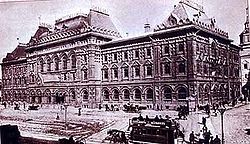 Since 1870 the municipalities in European Russia have had institutions like those of the zemstvo
s. All owners of houses, tax-paying merchants and workmen are enrolled on lists in a descending order according to their assessed wealth. The total valuation is then divided into three equal parts, representing three groups of electors very unequal in number, each of which elects an equal number of delegates to the municipal duma. The executive is in the hands of an elective mayor
and an uprava, which consists of several members elected by the duma. Under Alexander III
, however, by laws promulgated in 1892 and 1894, the municipal dumas were subordinated to the governors in the same way as the zemstvos. In 1894 municipal institutions, with still more restricted powers, were granted to several towns in Siberia, and in 1895 to some in Caucasia.
, on August 6, 1905, Sergei Witte
issued a manifesto about the convocation of the Duma, initially thought to be an advisory organ. In the subsequent October Manifesto
, Nicholas II pledged to introduce basic civil liberties
, provide for broad participation in the State Duma, and endow the Duma with legislative and oversight powers.
However, Nicholas II was determined to retain his autocratic power. Just before the creation of the Duma in May 1906, the Tsar issued the Fundamental Laws
. It stated in part that Tsar's minister
s could not be appointed by, and were not responsible to, the Duma, thus denying responsible government
at the executive level. Furthermore, the Tsar had the power to dismiss the Duma and announce new elections whenever he wished.
The imperial State Duma was elected 4 times: in 1906, twice in 1907, and in 1912.
is the lower house
of the Federal Assembly of Russia
(parliament
), the upper house
being the Federation Council of Russia
. Under Russia's 1993 constitution, there are 450 deputies of the State Duma (Article 95), each elected to a term of four years (Article 96); this was changed to a five-year term in late 2008. In previous elections of 1993, 1995, 1999 and 2003 one half of the deputies were elected by a system of proportional representation
and one half were elected by plurality in single member districts
. However, the 2007 Duma elections were carried out in a new format: all 450 deputies were elected by a system of proportional representation. Russian citizens at least 21 years old are eligible to run for the Duma (Article 97).
.
Russia
Russia or , officially known as both Russia and the Russian Federation , is a country in northern Eurasia. It is a federal semi-presidential republic, comprising 83 federal subjects...
and Russian history. The State Duma in the Russian Empire
Russian Empire
The Russian Empire was a state that existed from 1721 until the Russian Revolution of 1917. It was the successor to the Tsardom of Russia and the predecessor of the Soviet Union...
and Russian Federation corresponds to the lower house
Lower house
A lower house is one of two chambers of a bicameral legislature, the other chamber being the upper house.Despite its official position "below" the upper house, in many legislatures worldwide the lower house has come to wield more power...
of the parliament
Parliament
A parliament is a legislature, especially in those countries whose system of government is based on the Westminster system modeled after that of the United Kingdom. The name is derived from the French , the action of parler : a parlement is a discussion. The term came to mean a meeting at which...
. Simply it is a form of Russian governmental institution, that was formed during the reign of the last Tsar, Nicholas II. It is also the term for a council to early Russian rulers ('Boyar Duma'), as well as for city councils in Imperial Russia ('Municipal dumas'), and city and regional legislative bodies in the Russian Federation.
In early Russian history
The term comes from the Russian word думать (dumat’), "to think" or "to consider". The Boyar Duma was an advisory council to the grand princeGrand Prince
The title grand prince or great prince ranked in honour below emperor and tsar and above a sovereign prince .Grand duke is the usual and established, though not literal, translation of these terms in English and Romance languages, which do not normally use separate words for a "prince" who reigns...
s and tsars of Russia
Russia
Russia or , officially known as both Russia and the Russian Federation , is a country in northern Eurasia. It is a federal semi-presidential republic, comprising 83 federal subjects...
. The Duma was discontinued by Peter the Great
Peter I of Russia
Peter the Great, Peter I or Pyotr Alexeyevich Romanov Dates indicated by the letters "O.S." are Old Style. All other dates in this article are New Style. ruled the Tsardom of Russia and later the Russian Empire from until his death, jointly ruling before 1696 with his half-brother, Ivan V...
, who transferred its functions to the Governing Senate
Governing Senate
The Governing Senate was a legislative, judicial, and executive body of Russian Monarchs, instituted by Peter the Great to replace the Boyar Duma and lasted until the very end of the Russian Empire. It was chaired by the Ober-Procurator...
in 1721.
Municipal dumas
Zemstvo
Zemstvo was a form of local government that was instituted during the great liberal reforms performed in Imperial Russia by Alexander II of Russia. The idea of the zemstvo was elaborated by Nikolay Milyutin, and the first zemstvo laws were put into effect in 1864...
s. All owners of houses, tax-paying merchants and workmen are enrolled on lists in a descending order according to their assessed wealth. The total valuation is then divided into three equal parts, representing three groups of electors very unequal in number, each of which elects an equal number of delegates to the municipal duma. The executive is in the hands of an elective mayor
Mayor
In many countries, a Mayor is the highest ranking officer in the municipal government of a town or a large urban city....
and an uprava, which consists of several members elected by the duma. Under Alexander III
Alexander III of Russia
Alexander Alexandrovich Romanov , historically remembered as Alexander III or Alexander the Peacemaker reigned as Emperor of Russia from until his death on .-Disposition:...
, however, by laws promulgated in 1892 and 1894, the municipal dumas were subordinated to the governors in the same way as the zemstvos. In 1894 municipal institutions, with still more restricted powers, were granted to several towns in Siberia, and in 1895 to some in Caucasia.
State Duma in Imperial Russia
Under the pressure of the Russian Revolution of 1905Russian Revolution of 1905
The 1905 Russian Revolution was a wave of mass political and social unrest that spread through vast areas of the Russian Empire. Some of it was directed against the government, while some was undirected. It included worker strikes, peasant unrest, and military mutinies...
, on August 6, 1905, Sergei Witte
Sergei Witte
Count Sergei Yulyevich Witte , also known as Sergius Witte, was a highly influential policy-maker who presided over extensive industrialization within the Russian Empire. He served under the last two emperors of Russia...
issued a manifesto about the convocation of the Duma, initially thought to be an advisory organ. In the subsequent October Manifesto
October Manifesto
The October Manifesto was issued on 17 October, 1905 by Tsar Nicholas II of Russia under the influence of Count Sergei Witte as a response to the Russian Revolution of 1905....
, Nicholas II pledged to introduce basic civil liberties
Civil liberties
Civil liberties are rights and freedoms that provide an individual specific rights such as the freedom from slavery and forced labour, freedom from torture and death, the right to liberty and security, right to a fair trial, the right to defend one's self, the right to own and bear arms, the right...
, provide for broad participation in the State Duma, and endow the Duma with legislative and oversight powers.
However, Nicholas II was determined to retain his autocratic power. Just before the creation of the Duma in May 1906, the Tsar issued the Fundamental Laws
Russian Constitution of 1906
The Russian Constitution of 1906 refers to a major revision of the 1832 Fundamental Laws of the Russian Empire, which transformed the formerly absolutist state into one in which the emperor agreed for the first time to share his autocratic power with a parliament. It was enacted on April 23, 1906,...
. It stated in part that Tsar's minister
Minister (government)
A minister is a politician who holds significant public office in a national or regional government. Senior ministers are members of the cabinet....
s could not be appointed by, and were not responsible to, the Duma, thus denying responsible government
Responsible government
Responsible government is a conception of a system of government that embodies the principle of parliamentary accountability which is the foundation of the Westminster system of parliamentary democracy...
at the executive level. Furthermore, the Tsar had the power to dismiss the Duma and announce new elections whenever he wished.
The imperial State Duma was elected 4 times: in 1906, twice in 1907, and in 1912.
State Duma in the Russian Federation
The State Duma (Russian: Государственная дума, Gosudarstvennaya Duma, common abbreviation: Госдума, Gosduma) in RussiaRussia
Russia or , officially known as both Russia and the Russian Federation , is a country in northern Eurasia. It is a federal semi-presidential republic, comprising 83 federal subjects...
is the lower house
Lower house
A lower house is one of two chambers of a bicameral legislature, the other chamber being the upper house.Despite its official position "below" the upper house, in many legislatures worldwide the lower house has come to wield more power...
of the Federal Assembly of Russia
Federal Assembly of Russia
The Federal Assembly of Russia is the legislature of the Russian Federation, according to the Constitution of Russian Federation, 1993...
(parliament
Parliament
A parliament is a legislature, especially in those countries whose system of government is based on the Westminster system modeled after that of the United Kingdom. The name is derived from the French , the action of parler : a parlement is a discussion. The term came to mean a meeting at which...
), the upper house
Upper house
An upper house, often called a senate, is one of two chambers of a bicameral legislature, the other chamber being the lower house; a legislature composed of only one house is described as unicameral.- Possible specific characteristics :...
being the Federation Council of Russia
Federation Council of Russia
Federation Council of Russia ) is the upper house of the Federal Assembly of Russia , according to the 1993 Constitution of the Russian Federation...
. Under Russia's 1993 constitution, there are 450 deputies of the State Duma (Article 95), each elected to a term of four years (Article 96); this was changed to a five-year term in late 2008. In previous elections of 1993, 1995, 1999 and 2003 one half of the deputies were elected by a system of proportional representation
Proportional representation
Proportional representation is a concept in voting systems used to elect an assembly or council. PR means that the number of seats won by a party or group of candidates is proportionate to the number of votes received. For example, under a PR voting system if 30% of voters support a particular...
and one half were elected by plurality in single member districts
Plurality voting system
The plurality voting system is a single-winner voting system often used to elect executive officers or to elect members of a legislative assembly which is based on single-member constituencies...
. However, the 2007 Duma elections were carried out in a new format: all 450 deputies were elected by a system of proportional representation. Russian citizens at least 21 years old are eligible to run for the Duma (Article 97).
.
See also
- Elections in RussiaElections in RussiaOn the federal level, Russia elects a president as head of state and a legislature, one of the two chambers of the Federal Assembly. The president is elected for at most two six-year terms by the people . The Federal Assembly has two chambers...
- Tauride PalaceTauride PalaceTauride Palace is one of the largest and most historic palaces in Saint Petersburg, Russia.- Potemkin :...
- Moscow City Duma
- Saint Petersburg City DumaSaint Petersburg City DumaSaint Petersburg City Duma was established in 1785 in the course of Catherine the Great's municipal reform. Emperor Paul replaced it by the so-called Ratusha, but his son, Alexander I, had the Duma restored four years later. The next emperor, Nicholas I, expanded the institution from six to twelve...
- Zemsky SoborZemsky SoborThe zemsky sobor was the first Russian parliament of the feudal Estates type, in the 16th and 17th centuries. The term roughly means assembly of the land. It could be summoned either by tsar, or patriarch, or the Boyar Duma...
- VecheVecheVeche was a popular assembly in medieval Slavic countries.In Novgorod, where the veche acquired the greatest prominence, the veche was broadly similar to the Norse thing or the Swiss Landsgemeinde.-Etymology:...