
All Topics  
The Song of Roland

 
The Song of Roland

   Email Print
   Bookmark   Link


The Song of Roland


The Song of Roland is the oldest surviving major work of French literature
French literature

French literature is, generally speaking, literature written in the French language, particularly by citizens of France; it may also refer to literature written by people living in France who speak other traditional languages of France....
. It exists in various different manuscript versions, which testify to its enormous and enduring popularity in the 12th to 14th centuries. The oldest of these versions is the one in the Oxford
Bodleian Library

The Bodleian Library , the main research library of the University of Oxford, is one of the oldest library in Europe, and in England is second in size only to the British Library....
 manuscript, which contains a text of some 4,004 lines (the number varies slightly in different modern editions) and is usually dated to the middle of the twelfth century (between 1140 and 1170).


Discussion
Ask a question about 'The Song of Roland'
Start a new discussion about 'The Song of Roland'
Answer questions from other users
Full Discussion Forum


Recent Posts


Encyclopedia


The Song of Roland is the oldest surviving major work of French literature
French literature

French literature is, generally speaking, literature written in the French language, particularly by citizens of France; it may also refer to literature written by people living in France who speak other traditional languages of France....
. It exists in various different manuscript versions, which testify to its enormous and enduring popularity in the 12th to 14th centuries. The oldest of these versions is the one in the Oxford
Bodleian Library

The Bodleian Library , the main research library of the University of Oxford, is one of the oldest library in Europe, and in England is second in size only to the British Library....
 manuscript, which contains a text of some 4,004 lines (the number varies slightly in different modern editions) and is usually dated to the middle of the twelfth century (between 1140 and 1170). The epic poem is the first and most outstanding example of the chanson de geste
Chanson de geste

The chansons de geste, Old French for "songs of heroic deeds [or lineages]", are the epic poetry that appear at the dawn of French literature....
, a literary form that flourished between the eleventh and fifteenth centuries and celebrated the legendary deeds of a hero.

Historical background

The story told in the poem is based on a relatively minor historical incident, the Battle of Roncevaux Pass
Battle of Roncevaux Pass

The Battle of Roncevaux Pass was a famous battle in 778 in which Roland, prefect of the Brittany Marches and commander of the rear guard of Charlemagne's army, was defeated by the Basque people....
 on August 15, 778
778

Events...
, in which the rearguard of Charlemagne
Charlemagne

Charlemagne was List of Frankish kings from 768 to his death. He expanded the Franks kingdoms into a Carolingian Empire that incorporated much of Western Europe and Central Europe....
's retreating Franks
Franks

The Franks or Frankish people were a West Germanic ethnic group first identified in the 3rd century as living north and east of the Lower Rhine River....
, escorting a rich collection of booty gathered during a failed campaign in Spain, was attacked by Basques. In this engagement, recorded by historian and biographer Einhard
Einhard

Einhard was a Franks courtier, a dedicated servant of Charlemagne, of whom he wrote his famous biography, Vita Karoli Magni, and Louis the Pious....
 (Eginhard) in his Life of Charlemagne (written around 830), the trapped soldiers were slaughtered to a man; among them was "Hruodland, Prefect of the Marches of Brittany
Brittany

Brittany is a former independent Celtic nations monarchy and duchy, now incorporated into France. It is also, more generally, the name of the cultural area whose limits correspond to the historic province and independent duchy....
" (Hruodlandus Brittannici limitis praefectus).

The first indication that popular legends were developing about this incident comes in an historical chronicle compiled about 840, which mentions that the names of the Frankish leaders caught in the ambush, including Roland, were "common knowledge" (vulgata sunt). A second indication, potentially much closer to the date of the first written version of the epic, is that (according to somewhat later historical sources) during William the Conqueror's invasion of England in 1066 a "song about Roland" was sung to the Norman
Normans

The Normans were the people who gave their names to Normandy, a region in northern France. They descended from Viking conquerors of the territory and the native population of mostly Frankish and Gallo-Roman stock....
 troops before they joined battle at Hastings
Battle of Hastings

The Battle of Hastings was the decisive Normans victory in the Norman Conquest of England. It was fought between the Norman army of William I of England, and the English people army led by Harold Godwinson....
:
Then a song of Roland was begun, so that the man’s warlike example would arouse the fighters. Calling on God for aid, they joined battle.
Taillefer
Taillefer

Taillefer was the surname of a Normans ioglere whose exact name and place of birth are unknown . He travelled to England during the Norman Conquest of England of 1066, in the train of William I of England....
, who sang very well, rode on a swift horse before the Duke singing of Charlemagne and Roland and Oliver and the knights who died at Roncevaux
.
This cannot be treated as evidence that Taillefer, William's jongleur, was the "author of the Song of Roland", as used to be argued, but it is evidence that he was one of the many poets who shared in the tradition. We cannot even be sure that the "song" sung by Taillefer was the same as, or drew from, the particular "Song of Roland" that we have in the manuscripts. Some traditional relationship is, however, likely, especially as the best manuscript is written in Anglo-Norman French and the Latinized name of its author or transcriber, called "Turoldus," is evidently of Norman origin ("Turold," a variant of Old Norse "Thorvald)."

In view of the long period of oral tradition during which the ambush at Roncevaux was transformed into the Song of Roland, there can be no surprise that even the earliest surviving version of the poem does not represent an accurate account of history. Roland becomes, in the poem, the nephew of Charlemagne, the Christian
Christian

A Christian is a person who adheres to Christianity, a Monotheism#Christian view religion centered on the life and teachings of Jesus and interpreted by Christians to have been prophesied in the Hebrew Bible/Old Testament....
 Basques become Muslim
Muslim

:A Muslim , , is an adherent of the religion of Islam. The feminine form is Muslimah . Literally, the word means "one who submits "....
 Saracen
Saracen

Saracen was a term used by Europeans in the Middle Ages for Fatimids at first, then later for all who professed the religion of Islam....
s, and Charlemagne, rather than marching north to subdue the Saxons, returns to Spain
Spain

Spain or the Kingdom of Spain , is a country located in Southern Europe on the Iberian Peninsula.The Spanish constitution does not establish any official denomination of the country, even though Espa?a , Estado espa?ol and Naci?n espa?ola are used interchangeably....
 and avenges the deaths of his knights. The Song of Roland marks a nascent French identity and sense of collective history traced back to the legendary Charlemagne. As remarked above, the dating of the earliest version is uncertain, as is its authorship. Some believe that Turoldus, who is named in the final line, is the author; however, nothing is known about him besides his name. The dialect of the manuscript is Anglo-Norman
Anglo-Norman language

The Anglo-Norman language is a term traditionally used to refer to the variety of French used in England and to some extent elsewhere in the British Isles following the Norman conquest in 1066....
, which suggests an origin in northern France
France

France , officially the French Republic , is a country whose Metropolitan France is located in Western Europe and that also comprises various Overseas departments and territories of France....
. However, some critics, notably the influential Joseph Bédier
Joseph Bédier

Joseph B?dier was a French writer and scholar and historian of medieval France....
, have held that the real origin of this version of the epic lies much further south.

Manuscripts

There are nine extant manuscripts of the Song of Roland in Old French
Old French

Old French was the Romance languages dialect continuum spoken in territories which span roughly the northern half of modern France and parts of modern Belgium and Switzerland from around 1000 to 1300....
. The oldest of these manuscripts is held at the Bodleian Library
Bodleian Library

The Bodleian Library , the main research library of the University of Oxford, is one of the oldest library in Europe, and in England is second in size only to the British Library....
 at Oxford
University of Oxford

The University of Oxford , located in the city of Oxford, Oxfordshire, England, is the List of oldest universities in continuous operation in the English-speaking world....
. This copy dates between 1140 and 1170 and was written in Anglo-Norman
Anglo-Norman language

The Anglo-Norman language is a term traditionally used to refer to the variety of French used in England and to some extent elsewhere in the British Isles following the Norman conquest in 1066....
.

Scholars estimate that the poem was written, more or less, between 1040 and 1115, and most of the alterations were performed by about 1098. Some favor an earlier dating, because it allows one to say that the poem was inspired by the Castilian
Castile (historical region)

A former Kingdom of Castile, Castile , gradually merged with its neighbors to become the Crown of Castile and later the Kingdom of Spain with the Crown of Aragon and the Crown of Navarre....
 campaigns of the 1030s, and that the poem went on to be a major influence in the First Crusade
First Crusade

The First Crusade was launched in 1095 by Pope Urban II with the primary goal of responding to the appeal from Byzantine Emperor Alexius I. The Emperor requested that western volunteers come to their aid and repel the Seljuk Turks in Anatolia, Modern day Turkey....
. Those who prefer a later dating do so on grounds of the brief references made in the poem to events of the First Crusade
First Crusade

The First Crusade was launched in 1095 by Pope Urban II with the primary goal of responding to the appeal from Byzantine Emperor Alexius I. The Emperor requested that western volunteers come to their aid and repel the Seljuk Turks in Anatolia, Modern day Turkey....
. In one section, Palestine
Palestine

Palestine is a name which has been widely used since Roman times to refer to the region between the Mediterranean Sea and the Jordan River. It is derived from a name used already much earlier for a narrower geographical region, mainly along the coastal region....
 is named Outremer
Outremer

Outremer, French language for "overseas", was the general name given to the Crusader states established after the First Crusade: the County of Edessa, the Principality of Antioch, the County of Tripoli and especially the Kingdom of Jerusalem....
, its Crusader name – but is presented as a Muslim land where there are no Christians.

Plot

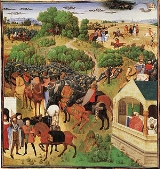
Mort De Roland
For seven years, the valiant Christian king Charlemagne
Charlemagne

Charlemagne was List of Frankish kings from 768 to his death. He expanded the Franks kingdoms into a Carolingian Empire that incorporated much of Western Europe and Central Europe....
 has made war against the Saracens in Spain
Spain

Spain or the Kingdom of Spain , is a country located in Southern Europe on the Iberian Peninsula.The Spanish constitution does not establish any official denomination of the country, even though Espa?a , Estado espa?ol and Naci?n espa?ola are used interchangeably....
. Only one Muslim stronghold remains, the city of Saragossa, under the rule of King Marsile (or Marsilius) and Queen Bramimonde
Bramimonde

In the Chanson de Roland, Bramimonde is the Queen of Zaragoza and wife of Marsilion and mother of Jurfaleu the Blond.Bramimonde is introduced as an unwavering supporter of the Saracens, her husband and the betrayal of Roland; going so far as to kiss his betrayer, Ganelon, in a show of her support that was customary at the time....
. Marsile, certain that defeat is inevitable, hatches a plot
Plot

In literary and dramatic works, the plot is the primary sequence of events experienced by the protagonist. Aristotle wrote in Poetics that Mythos is the most important element of storytelling....
 to rid Spain of Charlemagne. He will promise to be Charlemagne's vassal
Vassal

A vassal in the terminology that both preceded and accompanied the feudal of medieval Europe, is one who enters into mutual obligations with a monarch, usually of military support and mutual protection, in exchange for certain guarantees, which came to include the terrain held as a fiefdom....
 and a Christian convert in exchange for Charlemagne's departure. But once Charlemagne is back in France, Marsile will renege on his promises. Charlemagne and his vassals, weary of the long war, receive Marsile's messengers and try to choose an envoy to negotiate at Marsile's court on Charlemagne's behalf.

Roland
Roland

Roland is a character in medieval literature and Renaissance literature, the chief paladin of Charlemagne and a central figure in the Matter of France....
, a courageous knight and Charlemagne's right-hand man, nominates his stepfather, Ganelon
Ganelon

In the Matter of France, Ganelon is the knight who betrayed Charlemagne's army to the Muslims, leading to the Battle of Roncevaux Pass. His name is said to derive from the Italian word inganno, meaning fraud or deception....
. Ganelon is enraged, thinking that Roland has nominated him for this dangerous mission in an attempt to be rid of him for good. Ganelon has long been jealous of Roland, and on his diplomatic mission he plots with the Saracens, telling them that they could ambush Charlemagne's rearguard
Rearguard

Rearguard may refer to:* A military Detachment protecting the rear of a larger tactical formation, especially when retreating from a pursuing enemy force....
 as Charlemagne leaves Spain. Roland will undoubtedly lead the rearguard, and Ganelon promises that with Roland dead Charlemagne will lose the will to fight.

After Ganelon returns with assurances of Marsile's good faith, Roland, as he predicted, ends up leading the rearguard. The twelve peers, later known as the Paladins, Charlemagne's greatest and most beloved vassals, go with him. Among them is Oliver
Oliver

Oliver is a given name, also a surname, believed to derive from the Old French given name Olivier ;"Alf" and "Ihar", meaning "Elf Army", or, as a Latin origin, the bearer of the olive branch; a corruption of a Germanic personal name, cognate with the Scandinavian name "Olaf" or "?lafur," which carries the meaning of "ancestor," "forbear,"...
, a wise and prudent man and Roland's best friend. Also in the rearguard is the fiery Archbishop Turin, a clergyman who also is a great warrior. At the pass of Roncevaux, the twenty thousand Christians of the rearguard are ambushed by a vastly superior force, numbering in the hundreds of thousands. Oliver counsels Roland to blow his olifant
Olifant (instrument)

Olifant was the name applied in the Middle Ages to ivory Horn made from elephants' tusks. One of the most famous olifants belonged to the legendary Frankish knight Roland, protagonist of The Song of Roland....
 horn, to call back Charlemagne's main force, but Roland refuses. The Franks fight valiantly, but in the end they are killed to the man. Roland blows his olifant so that Charlemagne will return and avenge them. His temples burst from the force required, and he dies soon afterward. He dies facing the enemy's land, and his soul is escorted to heaven by saints and angels.

Charlemagne arrives, and he and his men are overwhelmed with grief at the sight of the massacre. He pursues the pagan force, aided by a miracle of God: the sun is held in place in the sky, so that the enemy will not have cover of night. The Franks
Franks

The Franks or Frankish people were a West Germanic ethnic group first identified in the 3rd century as living north and east of the Lower Rhine River....
 push the Saracens into the river Ebro
Ebro

The Ebro is Spain's most voluminous river. Its source is in Fontibre . It flows through cities such as Miranda de Ebro, Logro?o, Zaragoza, Flix, Tortosa, and Amposta before discharging in a river delta on the Mediterranean Sea in the province of Tarragona ....
, where those who are not chopped to pieces are drowned.

Marsile has escaped and returned to Saragossa, where the remaining Saracens are plunged into despair by their losses. But Baligant
Baligant

In the Chanson de Roland, Baligant is the Emir of Babylon , who tries to aid the defense of Zaragoza from Charlemagne. He is killed in the ensuing battle....
, the incredibly powerful emir
Emir

Emir , is a high Nobility or office, used throughout the Arab World and historically in some Turkic peoples states and Afghanistan. Emirs are usually considered high-ranking sheikhs, but in monarchical states the term is also used for princes, with "Emirate" being analogous to principality in this sense....
 of Babylon
Babylon

Babylon was a city-state of ancient Mesopotamia, sometimes considered an empire, the remains of which can be found in present-day Al Hillah, Babil Governorate, Iraq, about 85 kilometers south of Baghdad....
, has arrived to help his vassal. The emir goes to Rencesvals, where the Franks are mourning and burying their dead. There is a terrible battle, climaxing with a one-on-one clash between Baligant and Charlemagne. With a touch of divine aid, Charlemagne slays Baligant, and the Saracens retreat. The Franks take Saragossa, where they destroy all Jewish and Moslem religious items and force the conversion
Conversion

Conversion is the transformation, or change, of one thing into another. Conversion may refer to:* Conversion , an intentional tort to personal property...
 of everyone in the city, with the exception of Queen Bramimonde. Charlemagne wants her to come to Christ of her own accord. With her captive, the Franks return to their capitol, Aix
AIX

AIX AIX is a three-letter abbreviation with multiple meanings, as described below:*Air India Express, the budget arm of Air India*Athens Internet Exchange, a European Internet exchange point...
.

Ganelon is put on trial for treason. Pinabel
Pinabel

Pinabel, also known as Pinabello, is one of Charlemagne's vassals in The Song of Roland, Orlando furioso, and other works within the corpus of writings known as the Matter of France....
, Ganelon's kinsman and a gifted speaker, nearly sways the jury to let Ganelon go. But Thierry
Thierry

Thierry may refer to:* Thierry of Freburg, an early Dominican* Thierry, friend of Roland in the epic poem The Song of Roland.* Thierry I, Duke of Upper Lorraine ....
, a brave but physically unimposing knight, says that Ganelon's revenge should not have been taken against a man in Charlemagne's serve: that constitutes treason. To decide the matter, Pinabel and Thierry fight. Though Pinabel is by far the stronger man, God intervenes and Thierry triumphs. The Franks draw and quarter Ganelon (tie each limb and head to one of five horses running in opposite directions, which tears the victim to pieces). They also hang thirty of his kinsmen.

Charlemagne announces to all that Bramimonde has decided to become a Christian. Her baptism is celebrated, and all seems well.

But that night, the angel Gabriel
Gabriel

In Abrahamic religions, Gabriel is an angel who serves as a messenger from God. He first appears in the Book of Daniel in the Hebrew Bible. In some traditions he is regarded as one of the archangels, or as the angel of death....
 comes to Charlemagne in a dream, and tells him that he must depart for a new war
War

...
 against the pagans. Weary and weeping, but fully obedient to God, Charlemagne prepares for yet another bloody war.

Form


The poem is written in stanza
Stanza

In poetry, a stanza is a unit within a larger poem. In modern poetry, the term is often equivalent with strophe; in popular vocal music, a stanza is typically referred to as a "Verse " ....
s of irregular length known as laisse
Laisse

A laisse is a type of stanza, of varying length, found in medieval French literature, specifically medieval French epic poetry , such as The Song of Roland....
s. The lines are decasyllabic (containing ten syllables), and each is divided by a strong caesura
Caesura

In Meter , caesura is a term to denote an audible pause that breaks up a line of Poetry. In most cases, caesura is indicated by punctuation marks which cause a pause in speech: a comma, a semicolon, a full stop, a dash, etc....
, which generally falls after the fourth syllable
Syllable

A syllable is a unit of organization for a sequence of Speech communication sounds. For example, the word water is composed of two syllables: wa and ter....
. The last stressed syllable of each line in a laisse has the same vowel
Vowel

In phonetics, a vowel is a sound in spoken language, such as English ah! or oh! , pronounced with an open vocal tract so that there is no build-up of air pressure at any point above the glottis....
 sound as every other end-syllable in that laisse. The laisse is therefore an assonal
Assonance

Assonance is repetition of vowel to create internal rhyme within phrases or sentences, and together with alliteration and Literary consonance serves as one of the building blocks of Poetry....
, not a rhyming stanza.

On a narrative level, the Song of Roland features extensive use of repetition, parallelism, and thesis-antithesis
Dialectic

Dialectic is a method of argument, which has been central to both Eastern and Western philosophy since ancient times. The word "dialectic" originates in Ancient Greece, and was made popular by Plato's Socratic dialogues....
 pairs. Unlike later Renaissance
Renaissance literature

Renaissance Literature refers to the period in European literature, which began in Italy during the 15th century and spread around Europe through the 17th century....
 and Romantic literature
Romanticism

Romanticism is a complex artistic, literary, and intellectual movement that originated in the second half of the 18th century in Western Europe, and gained strength during the Industrial Revolution....
, the poem focuses on action rather than introspection.

The author gives few explanations for characters' behavior. Characters are stereotypes defined by a few salient traits: for example, Roland is proud and courageous while Ganelon is traitorous and cowardly.

The story moves at a fast pace, occasionally slowing down and recounting the same scene up to three times but focusing on different details or taking a different perspective each time. The effect is similar to a film sequence shot at different angles so that new and more important details come to light with each shot.

Modern readers should bear in mind that the Song of Roland, like Shakespeare's plays, was intended to be performed aloud, not read silently. Traveling jongleurs
Juggling

Juggling is a physical human skill involving the movement of one or more objects, usually through the air, for entertainment . The most recognizable form of juggling is toss juggling, where the juggler throws objects through the air....
 performed (usually sections of) the Song of Roland to various audiences, perhaps interspersing spoken narration with musical interludes.

Characters


Principal Characters

  • Baligant
    Baligant

    In the Chanson de Roland, Baligant is the Emir of Babylon , who tries to aid the defense of Zaragoza from Charlemagne. He is killed in the ensuing battle....
    , Emir of Babylon; Marsilion enlists his help against Charlemagne.
  • Blancandrin, wise pagan; suggests bribing Charlemagne out of Spain with hostages and gifts, and then suggests dishonoring a promise to allow Marsilion's baptism
  • Bramimonde
    Bramimonde

    In the Chanson de Roland, Bramimonde is the Queen of Zaragoza and wife of Marsilion and mother of Jurfaleu the Blond.Bramimonde is introduced as an unwavering supporter of the Saracens, her husband and the betrayal of Roland; going so far as to kiss his betrayer, Ganelon, in a show of her support that was customary at the time....
    , Queen of Zaragoza
    Zaragoza

    Zaragoza, also called Saragossa in English language, is the capital city of the Zaragoza and of the Autonomous communities of Spain and former Kingdom of Aragon of Aragon, Spain....
    ; captured and converted by Charlemagne after the city falls
  • Charlemagne
    Charlemagne

    Charlemagne was List of Frankish kings from 768 to his death. He expanded the Franks kingdoms into a Carolingian Empire that incorporated much of Western Europe and Central Europe....
    , Holy Roman Emperor; his forces fight the Saracens in Spain.
  • Ganelon
    Ganelon

    In the Matter of France, Ganelon is the knight who betrayed Charlemagne's army to the Muslims, leading to the Battle of Roncevaux Pass. His name is said to derive from the Italian word inganno, meaning fraud or deception....
    , treacherous lord who encourages Marsilion to attack the French
  • Marsilius, Saracen king of Spain; Roland wounds him and he dies of his wound later.
  • Olivier
    Olivier (The Song of Roland)

    Olivier , sometimes referred to as Olivier de Vienne, is a fictional knight in the Matter of France chansons de geste, especially the France epic The Song of Roland....
    , Roland's friend; mortally wounded by Marganice. He represents wisdom.
  • Roland
    Roland

    Roland is a character in medieval literature and Renaissance literature, the chief paladin of Charlemagne and a central figure in the Matter of France....
    , the hero of the Song; nephew of Charlemagne; leads the rear guard of the French forces; bursts his temples by blowing his oliphant-horn, from which wounds he eventually dies.
  • Turpin
    Turpin (archbishop)

    Turpin was an archbishop of Reims during the late 8th century. He was for many years regarded as the author of the legendary Historia Caroli Magni, and appears as one of the Twelve Peers in a number of the chansons de geste, the most important of which is The Song of Roland....
    , Archbishop of Rheims, represents the force of the Church.


Secondary characters

  • Aude
    Aude (character)

    Aude, or Alda, Alde, was the sister of Oliver and betrothed of Roland in the The Song of Roland and other chansons de gestes. The story of her engagement to Roland is told in Girart de Vienne....
    , the fiancée of Roland and Olivier's sister
  • Basan
    Basan

    Basan is a fowl-like bird illustrated in the Ehon Hyaku Monogatari. According to the description on the illustration, it resembles a large chicken and breathes ghost-fire from its mouth....
    , French baron, murdered while serving as Ambassador of Marsilion.
  • Bérengier, one of the twelve paladins killed by Marsilion’s troops; kills Estramarin; killed by Grandoyne.
  • Besgun, chief cook of Charlemagne's army; guards Ganelon after Ganelon's treachery is discovered.
  • Geboin, guards the French dead; becomes leader of Charlemagne's 2nd column.
  • Godefroy, standard bearer of Charlemagne; brother of Thierry, Charlemagne’s defender against Pinabel.
  • Grandoyne, fighter on Marsilion’s side; son of the Cappadocia
    Cappadocia

    Cappadocia, Wikipedia:IPA for English /k?p?'do???/ , was an extensive inland district of Asia Minor . The name continued to be used in western sources and in the Christianity tradition throughout history and is still widely used as an international Tourism in Turkey concept to define a region of exceptional natural wonders characterized by...
    n King Capuel; kills Gerin, Gerier, Berenger, Guy St. Antoine, and Duke Astorge; killed by Roland.
  • Hamon, joint Commander of Charlemagne's Eighth Division.
  • Lorant, French commander of one of the of first divisions against Baligant; killed by Baligant.
  • Milon, guards the French dead while Charlemagne pursues the Saracen forces.
  • Ogier
    Ogier the Dane

    Ogier the Dane is a legendary character who first appears in an Old French chanson de geste, in the cycle of poems Geste de Doon de Mayence....
    , a Dane who leads the third column in Charlemagne's army against Baligant's forces.
  • Othon, guards the French dead while Charlemagne pursues the Saracen forces.
  • Pinabel
    Pinabel

    Pinabel, also known as Pinabello, is one of Charlemagne's vassals in The Song of Roland, Orlando furioso, and other works within the corpus of writings known as the Matter of France....
    , fights for Ganelon in the judicial combat.
  • Thierry
    Thierry

    Thierry may refer to:* Thierry of Freburg, an early Dominican* Thierry, friend of Roland in the epic poem The Song of Roland.* Thierry I, Duke of Upper Lorraine ....
    , fights for Charlemagne in the judicial combat.


Adaptations

A Latin poem, Carmen de Prodicione Guenonis
Carmen de Prodicione Guenonis

Carmen de Prodicione Guenonis is an anonymous poem in medieval Latin, written in the first half of the 12th century. Composed in elegiac couplets by an unskilled versifier, it is a version of the legendary history of the Battle of Roncevaux Pass....
, was composed around 1120, and a Latin prose version, Historia Caroli Magni
Historia Caroli Magni

Historia Caroli Magni or Historia Karoli Magni et Rotholandi , sometimes known as the Pseudo-Turpin Chronicle, is a 12th century Latin language forged chronicle of legendary material about Charlemagne's alleged conquest of Spain....
 (often known as "The Pseudo-Turpin") even earlier. Around 1170, a version of the French poem was translated into the Middle High German
Middle High German

Middle High German , abbreviated MHG , is the term used for the period in the history of the German language between 1050 and 1350. It is preceded by Old High German and followed by Early New High German....
 Rolandslied by Konrad der Pfaffe
Konrad der Pfaffe

Konrad der Pfaffe, 'Conrad the Priest', was a German Roman Catholic epic poet of the twelfth century, author of the "Rolandslied", a German language version of the famous "Chanson de Roland"....
 (possible author also of the Kaiserchronik
Kaiserchronik

The Kaiserchronik is a 12th century Germany epic poem. It is at once a kind of "Legend of all the Saints" and a confused but remarkable account of the Roman emperors and also of the German emperors and List of German Kings and Emperors up to the crusade of King Conrad III ....
). In his translation Konrad replaces French topics with generically Christian ones. The work was translated into Middle Dutch
Middle Dutch

Middle Dutch is a collective name for a number of closely related West Germanic dialects which were spoken and written between 1150 and 1500. There was at that time as yet no overarching standard language, but they were all mutually intelligible....
 in the 13th century it was also rendered into Occitan
Occitan language

Occitan , known also as Lenga d'?c or Langue d'oc is a Romance languages spoken in Occitania, that is, Southern France, the Occitan Valleys of Italy, Monaco and in the Aran Valley of Spain....
 verse in the 14th or 15th century poem of Ronsasvals, which incorporates the later, southern aesthetic into the story. A Norse version of the Song of Roland exists as Karlamagnús saga
Karlamagnús saga

The Karlamagn?s saga, Karlamagnussaga or Karlamagnus-saga was a late 13th century Old Norse prose compilation and adaptation, made for Haakon V of Norway, of the Old French chansons de geste of the Matter of France dealing with Charlemagne and his paladins....
, and a translation into the artificial literary language of Franco-Venetian
Venetian language

Venetian or Venetan is a Romance languages spoken by over two million people, mostly in the Veneto region of Italy. The language is called v?neto in Venetian, veneto in Italian; the variant spoken in Venice is called venexi?n/venesi?n or veneziano, respectively....
 is also known; such translations contributed to the awareness of the story in Italy
Italy

Italy , officially the Italian Republic , is a country located on the Italian Peninsula in Southern Europe and on the two largest islands in the Mediterranean Sea, Sicily and Sardinia....
. In 1516 Ludovico Ariosto
Ludovico Ariosto

Ludovico Ariosto was an Italians poet. He is best known as the author of the romance Epic poetry Orlando Furioso . The poem, a continuation of Matteo Maria Boiardo's Orlando Innamorato, describes the adventures of Charlemagne, Roland, and the Franks as they battle against the Saracen with divergents into many side plots....
 published his epic Orlando furioso
Orlando Furioso

Orlando Furioso is an Italian literature romance epic poem by Ludovico Ariosto which has exerted a wide influence on later culture. The earliest version appeared in 1516, although the poem was not published in its complete form until 1532....
, which deals largely with characters first described in the Song of Roland.

Modern adaptations

The English
English people

The English are a nation and ethnic group native to England who speak English language in England. The English identity as a people is of early medieval origin, when they were known in Old English as the Anglecynn....
 progressive rock
Progressive rock

Progressive rock is a form of rock music that evolved in the late 1960s and early 1970s as part of a "mostly British attempt to elevate rock music to new levels of artistic credibility." The term "art rock" is often used interchangeably with "progressive rock", but while there are crossovers between the two genres, they are not identical....
 band Van Der Graaf Generator
Van der Graaf Generator

Van der Graaf Generator, sometimes known by the shorter Van der Graaf, are an English progressive rock band. They were the first act signed to Charisma Records....
 recorded a song, "Roncevaux", that tells the famous story. Norwegian
Norwegian people

Norwegians See also History of Norway and Demography of Norway.There are about 4.4 million ethnic Norwegians living in Norway today. The Norwegians are a Scandinavian ethnic group, descendants of the Norsemen , and Celts....
 Folk metal
Folk metal

Folk metal is a sub-genre of heavy metal music that developed in Europe during the 1990s. As the name suggests, the genre is a fusion of heavy metal with folk music....
 band Glittertind
Glittertind (band)

Glittertind is a Norway folk metal and viking metal project which started in 2001.The band consist of Torbj?rn Sandvik and various guest musicians....
 and Norwegian polyphonic vocal group Trio Mediæval
Trio Mediæval

Trio Medi?val is a vocal trio established in Oslo in 1997, recording albums for the ECM label, and touring frequently in Europe and the US.The trio was put together mainly to sing medieval polyphonic works, but has since early in their career expanded their repertoire to also include contemporary compositions, such as those of Gavin Bryars...
 both recorded versions of "Rolandskvadet," based on part of "The Song of Roland." American power metal band Kamelot
Kamelot

Kamelot is an United States progressive metal band from Tampa, Florida. They incorporate many elements of symphonic metal and progressive metal into their music....
 have also released a song entitled "Song of Roland". The norwegian singer Erik Bye has also made a musical interpretation called "Rolandskvadet".

Fantasy
Fantasy

Fantasy is a genre that uses magic and other supernatural forms as a primary element of Plot , Theme , and/or Setting . Fantasy is generally distinguished from science fiction and horror by the expectation that it steers clear of technological and macabre themes, respectively, though there is a great deal of overlap between the three ....
 author Judith Tarr
Judith Tarr

Judith Tarr is an United States author, best known for her fantasy books. She received her B.A. in Latin and English from Mount Holyoke College in 1976, and has an M.A....
 has written a novel, Kingdom of the Grail, where she links the story of Roland with the context of Arthurian legend
Matter of Britain

The Matter of Britain is a name given collectively to the legends that concern the Celtic and legendary history of Great Britain, especially those focused on King Arthur and the knights of the Round Table ....
. In particular, Tarr's version of Roland establishes him as a descendant of the wizard Merlin
Merlin

Merlin is best known as the Magician featured in the Arthurian legend. The standard depiction of the character first appears in Geoffrey of Monmouth's Historia Regum Britanniae, and is based on an amalgamation of previous historical and legendary figures....
.

The Italian composer Luigi Dallapiccola
Luigi Dallapiccola

Luigi Dallapiccola was an Italy composer known for his lyrical serialism compositions....
 set "Rencesvals: Trois Fragments de la Chanson de Roland" for mezzo-soprano and piano in 1946. It was dedicated "à mes amis Pierre Bernac et Francis Poulenc," the leading performers of French art song at the time, and is typical of Dallapiccola's usage of the 12-tone style of composition.

See also

  • La Brèche de Roland
    La Brèche de Roland

    La Br?che de Roland is an impressive natural gap, 40 m across and 100 m high, at an altitude of 2804 m in the steep cliffs of the Cirque de Gavarnie in the Pyrenees....
  • Matter of France
    Matter of France

    The Matter of France, also known as the Carolingian cycle, is a body of legendary history that springs from the Old French medieval literature of the chanson de geste....
  • Herzog Ernst
    Herzog Ernst

    Herzog Ernst is a German Epic poetry from the early high Middle Ages , first written down by an anonymous author from the Rhine River....
  • Alexanderlied


External links

  • (Old French)
  • , readable online images of the complete original, Bodleian Library MS. Digby 23 (Pt 2) "La Chanson de Roland, in Anglo-Norman, 12th century, ? 2nd quarter".
  • Audio clips of a reading of The Song of Roland in Old French