
All Topics  
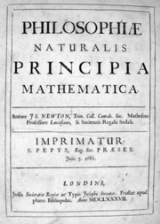
Philosophiae Naturalis Principia Mathematica

 
Philosophiae Naturalis Principia Mathematica

   Email Print
   Bookmark   Link


Philosophiae Naturalis Principia Mathematica


The Philosophiæ Naturalis Principia Mathematica (Latin
Latin

Latin is an Italic language, historically spoken in Latium and Ancient Rome. Through the Military history of the Roman Empire, Latin spread throughout the Mediterranean and a large part of Europe....
: "mathematical principles of natural philosophy" often Principia or Principia Mathematica for short) is a three-volume work by Isaac Newton
Isaac Newton

Sir Isaac Newton, Fellow of the Royal Society was an English people physicist, mathematician, Astronomy, Natural philosophy, Alchemy, and Theology and one of the the 100 in human history....
 published on 5 July 1687. It contains the statement of Newton's laws of motion
Newton's laws of motion

Newton's laws of motion are three physical laws that form the basis for classical mechanics, Direct relationship the forces acting on a Physical body to the motion of the body....
 forming the foundation of classical mechanics
Classical mechanics

Classical mechanics is used for describing the motion of macroscopic objects, from projectiles to parts of machinery, as well as astronomical objects, such as spacecraft, planets, stars, and galaxies....
, as well as his law of universal gravitation
Newton's law of universal gravitation

Isaac Newton's law of universal gravitation is an empirical physical law describing the gravitational attraction between bodies with mass. It is a part of classical mechanics and was first formulated in Newton's work Philosophiae Naturalis Principia Mathematica, first published on July 5 1687....
 and a derivation of Kepler's laws
Kepler's laws of planetary motion

In astronomy, Kepler's three laws of planetary motion are*"The orbit of every planet is an ellipse with the sun at a Focus ."*"A line joining a planet and the sun sweeps out equal areas during equal intervals of time."...
 for the motion of the planet
Planet

A planet , as 2006 definition of planet by the International Astronomical Union , is a celestial body orbiting a star or Stellar evolution#Stellar remnants that is massive enough to be rounded by its own gravity, is not massive enough to cause thermonuclear fusion, and has cleared the neighbourhood of planetesimals....
s (which were first obtained empirically
Empiricism

In philosophy, empiricism is a theory of knowledge which asserts that knowledge arises from experience. Empiricism is one of several competing views about how we know "things," part of the branch of philosophy called epistemology, or "theory of knowledge"....
).


Discussion
Ask a question about 'Philosophiae Naturalis Principia Mathematica'
Start a new discussion about 'Philosophiae Naturalis Principia Mathematica'
Answer questions from other users
Full Discussion Forum


Recent Posts


Encyclopedia


The Philosophiæ Naturalis Principia Mathematica (Latin
Latin

Latin is an Italic language, historically spoken in Latium and Ancient Rome. Through the Military history of the Roman Empire, Latin spread throughout the Mediterranean and a large part of Europe....
: "mathematical principles of natural philosophy" often Principia or Principia Mathematica for short) is a three-volume work by Isaac Newton
Isaac Newton

Sir Isaac Newton, Fellow of the Royal Society was an English people physicist, mathematician, Astronomy, Natural philosophy, Alchemy, and Theology and one of the the 100 in human history....
 published on 5 July 1687. It contains the statement of Newton's laws of motion
Newton's laws of motion

Newton's laws of motion are three physical laws that form the basis for classical mechanics, Direct relationship the forces acting on a Physical body to the motion of the body....
 forming the foundation of classical mechanics
Classical mechanics

Classical mechanics is used for describing the motion of macroscopic objects, from projectiles to parts of machinery, as well as astronomical objects, such as spacecraft, planets, stars, and galaxies....
, as well as his law of universal gravitation
Newton's law of universal gravitation

Isaac Newton's law of universal gravitation is an empirical physical law describing the gravitational attraction between bodies with mass. It is a part of classical mechanics and was first formulated in Newton's work Philosophiae Naturalis Principia Mathematica, first published on July 5 1687....
 and a derivation of Kepler's laws
Kepler's laws of planetary motion

In astronomy, Kepler's three laws of planetary motion are*"The orbit of every planet is an ellipse with the sun at a Focus ."*"A line joining a planet and the sun sweeps out equal areas during equal intervals of time."...
 for the motion of the planet
Planet

A planet , as 2006 definition of planet by the International Astronomical Union , is a celestial body orbiting a star or Stellar evolution#Stellar remnants that is massive enough to be rounded by its own gravity, is not massive enough to cause thermonuclear fusion, and has cleared the neighbourhood of planetesimals....
s (which were first obtained empirically
Empiricism

In philosophy, empiricism is a theory of knowledge which asserts that knowledge arises from experience. Empiricism is one of several competing views about how we know "things," part of the branch of philosophy called epistemology, or "theory of knowledge"....
). The Principia is widely regarded as one of the most important scientific works ever written.

In formulating his physical theories, Newton had developed a field of mathematics known as calculus
Calculus

Calculus is a branch of mathematics that includes the study of limit , derivatives, integrals, and infinite series, and constitutes a major part of modern university education....
. However, the language of calculus was largely left out of the Principia. Instead, Newton recast the majority of his proofs as geometric
Geometry

Geometry arose as the field of knowledge dealing with spatial relationships. Geometry was one of the two fields of pre-modern mathematics, the other being the study of numbers....
 arguments.

It is in a supplement to the Principia, entitled General Scholium, that Newton expressed his famous Hypotheses non fingo
Hypotheses non fingo

Hypotheses non fingo is a famous phrase used by Isaac Newton in an essay General Scholium which was appended to the second edition of the Philosophiae Naturalis Principia Mathematica....
 ("I feign no hypotheses" or "I make no guesses").

The historical context


The beginnings of the scientific revolution


Nicolaus Copernicus
Nicolaus Copernicus

Nicolaus Copernicus was the first astronomer to formulate a scientifically-based heliocentrism cosmology that displaced the Earth from the center of the universe....
 had firmly moved the Earth away from the center of the universe with the heliocentric theory for which he presented evidence in his book De revolutionibus orbium coelestium
De revolutionibus orbium coelestium

De revolutionibus orbium coelestium , first printed in 1543 in Nuremberg, is the seminal work on Copernican heliocentrism and the masterpiece of astronomer Nicolaus Copernicus ....
 (On the revolutions of the heavenly spheres) published in 1543. The structure was completed when Johannes Kepler
Johannes Kepler

Johannes Kepler was a Germans mathematician, astronomer and astrologer, and key figure in the 17th century Scientific revolution. He is best known for his eponymous Kepler's laws of planetary motion, codified by later astronomers based on his works Astronomia nova, Harmonices Mundi, and Epitome of Copernican Astrononomy....
 wrote the book Astronomia nova
Astronomia nova

Johannes Kepler's Astronomia nova, published in 1609, contains the results of the astronomer's ten-year long investigation of the motion of Mars....
 (A new astronomy) in 1609, setting out the evidence that planets move in elliptical
Ellipse

In mathematics, an ellipse is the apparent shape of a circle viewed obliquely from outside it, as distinct from a hyperbola which is the shape seen from inside....
 orbits with the sun at one focus
Focus (geometry)

In geometry, the foci, , are a pair of special points used in describing conic sections. The four types of conic sections are the circle, parabola, ellipse, and hyperbola....
, and that planets do not move with constant speed along this orbit. Rather, their speed varies so that the line joining the centres of the sun and a planet sweeps out equal areas in equal times. To these two laws he added a third a decade later, in his otherwise forgettable book Harmonices Mundi (Harmonies of the world). This law sets out a proportionality between the third power of the characteristic distance of a planet from the sun and the square of the length of its year.

The foundation of modern dynamics was set out in Galileo
Galileo Galilei

Galileo Galilei was a Grand Duchy of Tuscany physicist, mathematician, astronomer, and philosopher who played a major role in the Scientific Revolution....
's book Dialogo sopra i due massimi sistemi del mondo (Dialogue on the two main world systems) where the notion of inertia was implicit and used. In addition, Galileo's experiments with inclined planes had yielded precise mathematical relations between elapsed time and acceleration, velocity or distance for uniform and uniformly accelerated motion of bodies.

Descartes' book of 1644 Principia philosophiae (Principles of philosophy) stated that bodies can act on each other only through contact: a principle that induced people, among them himself, to hypothesize a universal medium as the carrier of interactions such as light and gravity—the aether
Aether (classical element)

According to ancient and History of science in the Middle Ages, aether , also spelled ?ther or ether, is the material that fills the region of the Universe above the Sublunary sphere....
. Another mistake was his treatment of circular motion, but this was more fruitful in that it led others to identify circular motion as a problem raised by the principle of inertia. Christiaan Huygens
Christiaan Huygens

Christiaan Huygens was a prominent Netherlands mathematics, astronomer, physics, and horology. His work included early telescopic studies, investigations and inventions related to time keeping, and studies of both optics and centrifugal force....
 solved this problem in the 1650s and published it much later.

Newton's role

Newton had studied these books, or, in some cases, secondary sources based on them, and taken notes entitled Quaestiones quaedam philosophicae
Quaestiones quaedam philosophicae

Quaestiones quaedam philosophicae is the name given to a set of notes that Isaac Newton kept for himself during his early years in Cambridge. They concern questions in the natural philosophy of the day that interested him....
 (Questions about philosophy) during his days as an undergraduate. During this period (1664–1666) he created the basis of calculus, and performed the first experiments in the optics of colour. In addition he took two crucial steps in dynamics: first, in the course of an analysis of the impact between two bodies, he deduced correctly that the centre of mass remains in uniform motion; second, he made his first, but mistaken, analysis of circular motion assuming that there must exist a (repulsive) centrifugal force
Centrifugal force

In classical mechanics, centrifugal force is an outward force associated with rotation. Centrifugal force is one of several so-called pseudo-forces , so named because, unlike Fundamental interaction, they do not originate in interactions with other bodies situated in the environment of the particle upon which they act....
. At this time, his proof that white light was a combination of primary colours (found via prismatics) replaced the prevailing theory of colours and received an overwhelmingly favourable response, and occasioned bitter disputes with Robert Hooke
Robert Hooke

Robert Hooke, Fellow of the Royal Society was an England natural philosopher and polymath who played an important role in the scientific revolution, through both experimental and theoretical work....
 and others, which forced him to sharpen his ideas to the point where he composed sections of his later book Opticks
Opticks

Opticks is a book written by England physicist Isaac Newton that was released to the public in 1704. It is about optics and the refraction of light, and is considered one of the great works of science in history....
 already by the 1670s in response. He wrote up bits and pieces of the calculus in various papers and letters, including two to Leibniz. He became a fellow of the Royal Society
Royal Society

The Royal Society of London for the Improvement of Natural Knowledge, known simply as the Royal Society, or even the Royal, is a learned society for science that was founded in 1660 and is considered by most to be the oldest such society still in existence....
 and the second Lucasian Professor of Mathematics (succeeding Isaac Barrow
Isaac Barrow

Isaac Barrow was an Kingdom of England scholar and mathematician who is generally given credit for his early role in the development of calculus; in particular, for the discovery of the fundamental theorem of calculus....
) at Trinity College
Trinity College, Cambridge

Trinity College is one of the 31 Colleges of the University of Cambridge of the University of Cambridge. Trinity has more members than any other college in Cambridge or University of Oxford, with around 700 undergraduates, 430 graduate students, and over 160 Fellows; however, counting only the student body it has somewhat fewer than Homert...
, Cambridge
University of Cambridge

The University of Cambridge , located in Cambridge, England, is the List of oldest universities in continuous operation university in the Anglosphere....
.

In the plague year
Great Plague of London

The Great Plague was a massive outbreak of disease in England that killed an estimated 100,000 people, a third of London's population. The disease was historically identified as bubonic plague, an infection by the bacterium Yersinia pestis, transmitted through a flea vector ....
 of 1665, Newton had already concluded that the strength of gravity falls off as the inverse square of the distance, by substituting Kepler's third law into his derivation of the centrifugal force (muddled as it was through his misunderstanding of the nature of circular motion in The lawes of motion). This conclusion is apocryphally purported to be the result of seeing an apple fall while in an orchard at Woolesthorpe
Woolsthorpe-by-Colsterworth

Woolsthorpe-by-Colsterworth is a hamlet at , in the parish of Colsterworth, in the England county of Lincolnshire, best known as the birthplace of Isaac Newton....
.

Hooke, in 1674, wrote Newton a letter (later published in 1679 in his book Lectiones Cutlerianae) through which Newton first understood of the role of inertia in the problem of circular motion—that the tendency of a body is to fly off in a straight line, and that an attractive force must keep it moving in a circle. In reply Newton drew (and described) a fancied trajectory of a body, initially with only tangential velocity, falling towards a centre of attraction in a spiral. Hooke noted this error and corrected it, saying that with an inverse square force law the correct path would be an ellipse, and made the exchange public by reading both Newton's letter and his correction to the Royal Society in 1676. Newton tried a rearguard action by giving the orbits in various other kinds of central potentials in another letter to Hooke, thus showing his mastery over the method. In 1677, in a conversation with Christopher Wren
Christopher Wren

Sir Christopher Wren was a 17th century England designer, astronomer, geometer, and one of the greatest English architects in history. Wren designed 53 London churches, including St Paul's Cathedral, as well as many secular buildings of note....
, Newton realized that Wren had also arrived at the inverse square law by exactly the same method as he.

Reflections on what can be deduced from common sense about aspects of circular motion brought him to his concept of "absolute space". In the Principia Newton presents the example of a rotating bucket
Bucket argument

Isaac Newton's rotating bucket argument attempts to demonstrate that true rotational motion cannot be defined as the relative rotation of the body with respect to the immediately surrounding bodies....
 to show that in everyday life it can readily be discerned that in a rotating motion another factor besides the motion relative to other objects is involved.

Newton had still not completed all the steps in the construction of the Principia by 1681, when a comet was observed to turn around the sun. The astronomer royal, John Flamsteed
John Flamsteed

John Flamsteed Fellow of the Royal Society was an England astronomer and the first Astronomer Royal....
, recognised the motion as such, whereas most scientists believed that there were two comets, one that disappeared behind the sun, and another that appeared later from the same direction. The correspondence between Flamsteed and Newton showed that the latter had not appreciated the universality of the law of gravity.

This was the state of affairs when Edmund Halley visited Newton in Cambridge in August 1684, having rediscovered the inverse-square law by substituting Kepler's law into Huygens' formula for the centrifugal force. In January of that year, Halley, Wren and Hooke had a conversation where Hooke claimed to not only have derived the inverse-square law, but also all the laws of planetary motion. Wren was unconvinced, and Halley, having failed in the derivation himself, resolved to ask Newton. Newton said that he had already made the derivations but could not find the papers. Matching accounts of this meeting come from Halley and Abraham De Moivre
Abraham de Moivre

Abraham de Moivre was a France mathematician famous for de Moivre's formula, which links complex numbers and trigonometry, and for his work on the normal distribution and probability theory....
 to whom Newton confided.

Writing and publication

Newtonsprincipia


In November 1685, Halley received a treatise of nine pages from Newton called De motu corporum in gyrum
De motu corporum in gyrum

De motu corporum in gyrum is a manuscript by Isaac Newton sent to Edmund Halley in November 1684. It derived the three laws of Kepler assuming an inverse square law of force, and generalized the answer to conic sections....
 (Of the motion of bodies in an orbit). It derived the three laws of Kepler assuming an inverse square law of force, and generalized the answer to conic sections. It extended the methodology of dynamics by adding the solution of a problem on the motion of a body through a resisting medium. After another visit to Newton, Halley reported these results to the Royal Society on 10 December 1685 (Julian calendar). Newton also communicated the results to Flamsteed, but insisted on revising the manuscript. These crucial revisions, especially concerning the notion of inertia, slowly developed over the next year-and-a-half into the Principia. Flamsteed's collaboration in supplying regular observational data on the planets was very helpful during this period.

The text of the first of the three books was presented to the Royal Society
Royal Society

The Royal Society of London for the Improvement of Natural Knowledge, known simply as the Royal Society, or even the Royal, is a learned society for science that was founded in 1660 and is considered by most to be the oldest such society still in existence....
 at the close of April, 1686. Hooke's priority claims caused some delay in acceptance, but Samuel Pepys
Samuel Pepys

Samuel Pepys, Fellow of the Royal Society was an English people Navy Board and Member of Parliament, who is now most famous for his diary. Although Pepys had no maritime experience, he rose by patronage, hard work and his talent for administration, to be the Chief Secretary to the Admiralty under James II of England....
, as President, was authorised on 30 June to license it for publication. Unfortunately the Society had just spent their book budget on a history of fish, so the initial cost of publication was borne by Edmund Halley. published that summer.

The contents of the book

In the preface of the Principia, Newton wrote

It was perhaps the force of the Principia, which explained so many different things about the natural world with such economy, that caused this method to become synonymous with physics, even as it is practiced almost three and a half centuries after its beginning. Today the two aspects that Newton outlined would be called analysis and synthesis.

The Principia consists of three books
  1. De motu corporum (On the motion of bodies) is a mathematical exposition of calculus followed by statements of basic dynamical definitions and the primary deductions based on these. It also contains propositions and proofs that have little to do with dynamics but demonstrate the kinds of problems that can be solved using calculus.
  2. The first book was divided into a second volume because of its length. It contains sundry applications such as motion through a resistive medium, a derivation of the shape of least resistance, a derivation of the speed of sound and accounts of experimental tests of the result.
  3. De mundi systemate (On the system of the world) is an essay on universal gravitation that builds upon the propositions of the previous books and applies them to the motions observed in the solar system — the regularities and the irregularities of the orbit of the moon, the derivations of Kepler's laws, applications to the motion of Jupiter's moons, to comets and tides (much of the data came from John Flamsteed
    John Flamsteed

    John Flamsteed Fellow of the Royal Society was an England astronomer and the first Astronomer Royal....
    ). It also considers the harmonic oscillator
    Harmonic oscillator

    In classical mechanics, a harmonic oscillator is a system which, when displaced from its equilibrium position, experiences a restoring force proportional to the displacement according to Hooke's law:...
     in three dimensions, and motion in arbitrary force laws.


The sequence of definitions used in setting up dynamics in the Principia is exactly the same as in all textbooks today. Newton first set out the definition of mass6

This was then used to define the "quantity of motion" (today called momentum
Momentum

In classical mechanics, momentum is the product of the mass and velocity of an object . For more accurate measures of momentum, see the section Momentum#Modern definitions of momentum on this page....
), and the principle of inertia in which mass replaces the previous Cartesian notion of intrinsic force. This then set the stage for the introduction of forces through the change in momentum of a body. Curiously, for today's readers, the exposition looks dimensionally incorrect, since Newton does not introduce the dimension of time in rates of changes of quantities.

He defined space and time "not as they are well known to all". Instead, he defined "true" time and space as "absolute" and explained:

It is interesting that several dynamical quantities that were used in the book (such as angular momentum) were not given names. The dynamics of the first two books was so self-evidently consistent that it was immediately accepted; for example, Locke
John Locke

John Locke was an English philosopher. Locke is considered the first of the British Empiricism, but is equally important to social contract theory....
 asked Huygens
Huygens

Huygens can refer to:* Christiaan Huygens , Dutch mathematician, physicist and astronomer, son of Constantijn Huygens* Huygens-Fresnel_principle ...
 whether he could trust the mathematical proofs, and was assured about their correctness.

However, the concept of an attractive force acting at a distance received a cooler response. In his notes, Newton wrote that the inverse square law arose naturally due to the structure of matter. However, he retracted this sentence in the published version, where he stated that the motion of planets is consistent with an inverse square law, but refused to speculate on the origin of the law. Huygens and Leibniz noted that the law was incompatible with the notion of the aether
Aether

Aether originally was the personification of the "upper sky", space and heaven, in Greek mythology.The term aether, ?ther or ether may also refer to one of the following:...
. From a Cartesian point of view, therefore, this was a faulty theory. Newton's defence has been adopted since by many famous physicists — he pointed out that the mathematical form of the theory had to be correct since it explained the data, and he refused to speculate further on the basic nature of gravity. The sheer number of phenomena that could be organised by the theory was so impressive that younger "philosophers" soon adopted the methods and language of the Principia.

Rules of Reasoning in Philosophy


To eliminate the possibility of the public seeing Isaac Newton’s principia as a defiance of God, he created the section Rules of Reasoning in Philosophy. The four rules he created were also a way of offering an explanation of the unknown phenomena in nature. Each rule offered by Isaac Newton serves a unique purpose of easing the minds of philosophers by broadly explaining why the phenomena of nature are unanswerable. The four rules go as follows:

Rule 1: We are to admit no more causes of natural things than such as are both true and sufficient to explain their appearances.

Rule 2: Therefore to the same natural effects we must, as far as possible, assign the same causes.

Rule 3: The qualities of bodies, which admit neither intensification nor remission of degrees, and which are found to belong to all bodies within the reach of our experiments, are to be esteemed the universal qualities of all bodies whatsoever.

Rule 4: In experimental philosophy we are to look upon propositions inferred by general induction from phenomena as accurately or very nearly true, notwithstanding any contrary hypothesis that may be imagined, till such time as other phenomena occur, by which they may either be made more accurate, or liable to exceptions.

In the Principia, he explains each rule in a more simplified form and/or gives an example to back up what the rule is claiming. The first rule in other words states that in nature nothing will ever happen without a deliberate and direct cause because God’s intelligent design works at optimal productiveness. The second rule states that if one cause is assigned to a natural effect, then the same exact cause must be assigned to any similar natural effects (e.g. the light of the fiery sun and the campfire). In short, when he exemplifies the third and fourth rules, he uses the rules to show and explain gravity and space. At the time, those two topics were of great mystery and Newton used his rules to explain every aspect. Also, he ends his explanation of the rules by incorporating God into everything. Newton states that everything is intelligently and perfectly created / designed by God. Newton goes into detail of how God’s intelligent design works on its own without any maintenance or assistance by God. By giving respect and ultimate credit to God, Newton appeased any and all people who would oppose his undeniable works.

Isaac Newton’s creation of the four rules revolutionized the investigation of any phenomena. With the creation of the four rules, Newton was able to begin to answer all of the world’s present unsolved mysteries. Isaac Newton wielded the power to not only go further in answering any question than any scientist at the time, but he was able to retrace science’s steps and ratify great works and breakthroughs of the past. He was able to use his new analytical method to replace that of Aristotle’s and he was able to use his method to tweak and update Galileo’s experimental method. The re-creation of Galileo’s method was so advanced that it has never been changed since and scientists use it today.

Location of copies

Principia Page 1726
Several national rare-book collections contain original copies of Newton's Principia Mathematica, including:
  • The Earl Gregg Swem Library
    Earl Gregg Swem Library

    The Earl Gregg Swem Library is located on Landrum Drive at the College of William and Mary in Williamsburg, Virginia, Virginia, United States....
     at the College of William & Mary has a first edition copy of the Principia
  • The Frederick E. Brasch Collection of Newton and Newtoniana in Stanford University
    Stanford University

    Leland Stanford Junior University, commonly referred to as Stanford University or Stanford, is a private university research university located in Stanford, California, California, United States....
     also has a first edition of the Principia.
  • The library
    Wren Library, Cambridge

    The Wren Library is the library of Trinity College, Cambridge in Cambridge. It was designed by Christopher Wren in 1676 and completed in 1684. It is credited as being one of the first libraries to be built with large windows to give comfortable light levels to aid readers....
     of Trinity College, Cambridge, has Newton's own copy of the first edition, with handwritten notes for the second edition.
  • The in Cambridge has a first-edition copy which had belonged to Robert Hooke
    Robert Hooke

    Robert Hooke, Fellow of the Royal Society was an England natural philosopher and polymath who played an important role in the scientific revolution, through both experimental and theoretical work....
    .
  • Fisher Library in the University of Sydney
    University of Sydney

    The University of Sydney is the List of oldest universities in continuous operation in Australia. It was established in Sydney in 1850. It is a member of Australia's "Group of Eight " universities that are highly ranked in terms of their research performance....
     has a first-edition copy, annotated by a mathematician of uncertain identity and corresponding notes from Newton himself.
  • The Pepys Library
    Pepys Library

    The Pepys Library of Magdalene College, Cambridge is the personal library of Samuel Pepys bequeathed to the college following his death in 1703....
     in Magdalene College, Cambridge, has Samuel Pepys
    Samuel Pepys

    Samuel Pepys, Fellow of the Royal Society was an English people Navy Board and Member of Parliament, who is now most famous for his diary. Although Pepys had no maritime experience, he rose by patronage, hard work and his talent for administration, to be the Chief Secretary to the Admiralty under James II of England....
    ' copy of the third edition.
  • The Martin Bodmer Library keeps a copy of the original edition that was owned by Leibniz. In it, we can see handwritten notes by Leibniz, in particular concerning the controversy of who discovered calculus
    Calculus

    Calculus is a branch of mathematics that includes the study of limit , derivatives, integrals, and infinite series, and constitutes a major part of modern university education....
     (although he published it later, Newton argued that he developed it earlier).
  • A first edition is also located in the archives of the library at the Georgia Institute of Technology
    Georgia Institute of Technology

    The Georgia Institute of Technology, commonly known as Georgia Tech or simply Tech, is a public university, coeducational research university in Atlanta, Georgia in the United States....
    . The Georgia Tech library is also home to a second and third edition.
  • A facsimile edition was published in 1972 by Alexandre Koyré and I. Bernard Cohen
    I. Bernard Cohen

    I. Bernard Cohen was the Victor S. Thomas Professor of the history of science at Harvard University and the author of many books on the history of science and, in particular, Isaac Newton....
    .
  • A first edition forms part of , housed at the Royal Observatory, Edinburgh
    Royal Observatory, Edinburgh

    The Royal Observatory, Edinburgh is an Astronomy institution located on Blackford Hill in Edinburgh, Scotland. The site is owned by the Science and Technology Facilities Council ....
    . The collection also holds a third edition copy.
  • The Uppsala University Library
    Uppsala University Library

    Uppsala University Library in Sweden consists of 19 different branch libraries, with the largest being that housed in the old main library building, Carolina Rediviva....
     owns a first edition copy, which was stolen in the 1960s and returned to the library in 2009.
  • The Burns Library at Boston College
    Boston College

    Boston College is a private university located in the village of Chestnut Hill, Massachusetts, in the city of Newton, Massachusetts, Massachusetts, in the New England region of the United States, rendering it neither in Boston nor a college....
     contains a 1723 copy published between the second and third editions.
  • The George C. Gordon Library at the Worcester Polytechnic Institute
    Worcester Polytechnic Institute

    Worcester Polytechnic Institute is a private university located in Worcester, Massachusetts, Massachusetts, in the United States....
     hold a third edition.


Two more editions were published during Newton's lifetime:

Second edition

Richard Bentley
Richard Bentley

Richard Bentley was an England theologian, Classics and critic....
, master of Trinity College
Trinity College, Cambridge

Trinity College is one of the 31 Colleges of the University of Cambridge of the University of Cambridge. Trinity has more members than any other college in Cambridge or University of Oxford, with around 700 undergraduates, 430 graduate students, and over 160 Fellows; however, counting only the student body it has somewhat fewer than Homert...
, influenced Roger Cotes
Roger Cotes

Roger Cotes Fellow of the Royal Society was an English mathematician, known for working closely with Isaac Newton by proofreading the second edition of his famous book, the Philosophiae Naturalis Principia Mathematica, before publication....
, Plumian professor of astronomy at Trinity, to undertake the editorship of the second edition. Newton did not intend to start any re-write of the Principia until 1709. Under the weight of Cotes' efforts, but impeded by priority disputes between Newton and Leibniz, and by troubles at the Mint, Cotes was able to announce publication to Newton on 30 June 1713. Bentley sent Newton only six presentation copies; Cotes was unpaid; Newton omitted any acknowledgement to Cotes.

Among those who gave Newton corrections for the Second Edition were: Firmin Abauzit
Firmin Abauzit

Firmin Abauzit was a France scholar who worked on physics, theology and philosophy, and served as librarian in Geneva, Switzerland during his final 40 years....
, Roger Cotes
Roger Cotes

Roger Cotes Fellow of the Royal Society was an English mathematician, known for working closely with Isaac Newton by proofreading the second edition of his famous book, the Philosophiae Naturalis Principia Mathematica, before publication....
 and David Gregory
David Gregory

David Gregory was a professor of mathematics at the University of Edinburgh, Savilian Professor of Astronomy at the University of Oxford, and a commentator on Isaac Newton's Philosophi? Naturalis Principia Mathematica....
. However, Newton omitted acknowledgements to some because of the priority disputes. John Flamsteed
John Flamsteed

John Flamsteed Fellow of the Royal Society was an England astronomer and the first Astronomer Royal....
, the Astronomer Royal, suffered this especially.

Third edition

The third edition was published 25 March 1726, under the stewardship of Henry Pemberton, M.D., a man of the greatest skill in these matters ...; Pemberton later said that this recognition was worth more to him than the two hundred guinea award from Newton.

General Scholium

The second edition of 1713 had an essay attached, titled General Scholium (which received some amendments and additions in the third edition of 1726), which was to become one of Newton's most notable writings. Newton criticizes Descartes and Leibniz, and famously states Hypotheses non fingo
Hypotheses non fingo

Hypotheses non fingo is a famous phrase used by Isaac Newton in an essay General Scholium which was appended to the second edition of the Philosophiae Naturalis Principia Mathematica....
 "I feign no hypotheses", besides obliquely attacking the doctrine of Trinity
Trinity

In Christianity doctrine, the Trinity is the unity of God the Father, God the Son, and Holy Spirit as three persons in monotheism. The doctrine states that God is the Triune God, existing as three persons, or in the Greek hypostasis , but one being....
.
  • trans. Motte (1729)


See also

  • Galileo
    Galileo Galilei

    Galileo Galilei was a Grand Duchy of Tuscany physicist, mathematician, astronomer, and philosopher who played a major role in the Scientific Revolution....
    , Descartes, Robert Hooke
    Robert Hooke

    Robert Hooke, Fellow of the Royal Society was an England natural philosopher and polymath who played an important role in the scientific revolution, through both experimental and theoretical work....
     and Christian Huygens
  • Previous writings by Newton, including Quaestiones quadem philosophicae, De motu corporum in gyrum
    De motu corporum in gyrum

    De motu corporum in gyrum is a manuscript by Isaac Newton sent to Edmund Halley in November 1684. It derived the three laws of Kepler assuming an inverse square law of force, and generalized the answer to conic sections....
  • Elements of the Philosophy of Newton
    Elements of the Philosophy of Newton

    Elements of the Philosophy of Newton is a book written by the philosopher Voltaire in 1738 that helped to popularize the theories and thought of Isaac Newton....


Further reading

  • Guicciardini, N., 2005, "Philosophia Naturalis..." in Grattan-Guiness, I.
    Ivor Grattan-Guinness

    Ivor Grattan-Guinness is a historian of mathematics and logic.He gained his Bachelor degree as a Mathematics Scholar at Wadham College, Oxford, got an M.Sc in Mathematical Logic and the Philosophy of Science at the London School of Economics in 1966....
    , ed., Landmark Writings in Western Mathematics. Elsevier: 59-87.


External links

  • Russian translation of Philosophiae Naturalis Principia Mathematica.