


Federal Constitutional Court of Germany

Encyclopedia
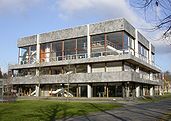
The Federal Constitutional Court (in German
German language
German is a West Germanic language, related to and classified alongside English and Dutch. With an estimated 90 – 98 million native speakers, German is one of the world's major languages and is the most widely-spoken first language in the European Union....
: Bundesverfassungsgericht, or BVerfG) is a special court
Court
A court is a form of tribunal, often a governmental institution, with the authority to adjudicate legal disputes between parties and carry out the administration of justice in civil, criminal, and administrative matters in accordance with the rule of law...
established by the Grundgesetz
Basic Law for the Federal Republic of Germany
The Basic Law for the Federal Republic of Germany is the constitution of Germany. It was formally approved on 8 May 1949, and, with the signature of the Allies of World War II on 12 May, came into effect on 23 May, as the constitution of those states of West Germany that were initially included...
, the German
Germany
Germany , officially the Federal Republic of Germany , is a federal parliamentary republic in Europe. The country consists of 16 states while the capital and largest city is Berlin. Germany covers an area of 357,021 km2 and has a largely temperate seasonal climate...
basic law
Basic Law
The term basic law is used in some places as an alternative to "constitution", implying it is a temporary but necessary measure without formal enactment of constitution. A basic law is either a codified constitution, or in countries with uncodified constitutions, a law given to have constitution...
. Since its inception, the constitutional court has been located in the city of Karlsruhe
Karlsruhe
The City of Karlsruhe is a city in the southwest of Germany, in the state of Baden-Württemberg, located near the French-German border.Karlsruhe was founded in 1715 as Karlsruhe Palace, when Germany was a series of principalities and city states...
, intentionally dislocated from the other federal institutions like the seat of the government in Berlin
Berlin
Berlin is the capital city of Germany and is one of the 16 states of Germany. With a population of 3.45 million people, Berlin is Germany's largest city. It is the second most populous city proper and the seventh most populous urban area in the European Union...
(earlier in Bonn
Bonn
Bonn is the 19th largest city in Germany. Located in the Cologne/Bonn Region, about 25 kilometres south of Cologne on the river Rhine in the State of North Rhine-Westphalia, it was the capital of West Germany from 1949 to 1990 and the official seat of government of united Germany from 1990 to 1999....
), the head office of the BND
Bundesnachrichtendienst
The Bundesnachrichtendienst [ˌbʊndəsˈnaːχʁɪçtnˌdiːnst] is the foreign intelligence agency of Germany, directly subordinated to the Chancellor's Office. Its headquarters are in Pullach near Munich, and Berlin . The BND has 300 locations in Germany and foreign countries...
(the German foreign intelligence agency
Intelligence agency
An intelligence agency is a governmental agency that is devoted to information gathering for purposes of national security and defence. Means of information gathering may include espionage, communication interception, cryptanalysis, cooperation with other institutions, and evaluation of public...
) near Munich
Munich
Munich The city's motto is "" . Before 2006, it was "Weltstadt mit Herz" . Its native name, , is derived from the Old High German Munichen, meaning "by the monks' place". The city's name derives from the monks of the Benedictine order who founded the city; hence the monk depicted on the city's coat...
, or the seat of the Bundesbank
Deutsche Bundesbank
The Deutsche Bundesbank is the central bank of the Federal Republic of Germany and as such part of the European System of Central Banks . Due to its strength and former size, the Bundesbank is the most influential member of the ESCB. Both the Deutsche Bundesbank and the European Central Bank are...
(central bank) in Frankfurt.
The sole task of the court is judicial review
Judicial review
Judicial review is the doctrine under which legislative and executive actions are subject to review by the judiciary. Specific courts with judicial review power must annul the acts of the state when it finds them incompatible with a higher authority...
. It may therefore declare public acts unconstitutional
Constitutionality
Constitutionality is the condition of acting in accordance with an applicable constitution. Acts that are not in accordance with the rules laid down in the constitution are deemed to be ultra vires.-See also:*ultra vires*Company law*Constitutional law...
and thus render them ineffective. As such, it is similar to the Supreme Court of the United States
Supreme Court of the United States
The Supreme Court of the United States is the highest court in the United States. It has ultimate appellate jurisdiction over all state and federal courts, and original jurisdiction over a small range of cases...
. Yet the Court possesses a number of powers that the U.S. Supreme Court does not have (see below). It also differs from the U.S. and other supreme court
Supreme court
A supreme court is the highest court within the hierarchy of many legal jurisdictions. Other descriptions for such courts include court of last resort, instance court, judgment court, high court, or apex court...
s in that it is not an integral part of the regular judicial system (save for the areas of constitutional law and public international law) but installed as a separate judicial institution. Many other countries around the world possess separate constitutional courts similar to the Federal Constitutional Court.
Most importantly, the Court does not serve as a regular appellate court
Appellate court
An appellate court, commonly called an appeals court or court of appeals or appeal court , is any court of law that is empowered to hear an appeal of a trial court or other lower tribunal...
from lower courts or the Federal Supreme Courts as a sort of "superappellate court" on any violation of federal laws. Its jurisdiction is focused on constitutional issues, the integrity of the Grundgesetz and the immediate compliance of any governmental institution in any detail (article 1 subsection 3 of the Grundgesetz). Even constitutional amendments or changes passed by the Parliament are subject to its judicial review, since they have to be compatible with the most basic principles of the Grundgesetz (due to its Article 79 (III), the so called 'eternity clause
Eternity clause
The eternity clause is Article 79 paragraph of "this Basic Law" for the Federal Republic of Germany . This clause prohibits outright certain amendments to the German constitution. It was included in the original text of "this Basic Law," as enacted in 1949...
').
The court's practice of enormous constitutional control frequency on the one hand, and the continuity in judicial restraint
Judicial restraint
Judicial restraint is a theory of judicial interpretation that encourages judges to limit the exercise of their own power. It asserts that judges should hesitate to strike down laws unless they are obviously unconstitutional...
and political revision on the other hand, have created a unique defender of the Grundgesetz since World War II and given it a valuable role in Germany's modern democracy.
Procedures
Article 20 subsection 3 of the Grundgesetz stipulates that all the three branches of the state-–legislative, executive and judicial–-are bound directly by the constitution. As a result, the court can rule acts of any branches unconstitutional, whether for formal violations (exceeding powersUltra vires
Ultra vires is a Latin phrase meaning literally "beyond the powers", although its standard legal translation and substitute is "beyond power". If an act requires legal authority and it is done with such authority, it is...
or violating procedures) or for material conflicts (when the civil rights prescribed in the Grundgesetz are not respected).
The powers of the Federal Constitutional Court are defined in article 93 of the Grundgesetz.
This constitutional norm is concertized by a federal law, the Federal Constitutional Court Act (BVerfGG). This federal law also defines how decisions of the court on material conflicts are put into force. The Constitutional Court has therefore several strictly defined procedures in which cases may be brought before it:
- Constitutional complaintVerfassungsbeschwerdeThe constitutional complaint is a remedy found in Germany for protection of constitutional rights. It derives from Article 93 Sec. 1 Nr. 4a of the Basic Law...
: By means of the Verfassungsbeschwerde ("constitutional complaint") any person may allege that his or her constitutional rights have been violated. Although only a small fraction of these are actually successful (ranging around 2.5 % since 1951), several have resulted in major legislation being invalidated, especially in the field of taxation. The large majority of the court's procedures fall into this category; 135,968 such complaints were filed from 1957 to 2002. - Abstract regulation control: Several political institutions, including the governments of the BundesländerStates of GermanyGermany is made up of sixteen which are partly sovereign constituent states of the Federal Republic of Germany. Land literally translates as "country", and constitutionally speaking, they are constituent countries...
(states), may bring a federal law before the court if they consider it unconstitutional. A well know example of this procedure was the 1975 abortion decision, which invalidated legislation intended to decriminalise abortionAbortionAbortion is defined as the termination of pregnancy by the removal or expulsion from the uterus of a fetus or embryo prior to viability. An abortion can occur spontaneously, in which case it is usually called a miscarriage, or it can be purposely induced...
. - Specific regulation control: Any regular court which is convinced, that a law in question for a certain case is not in conformance with the constitution must suspend that case and bring this law before the Federal Constitutional Court.
- Federal dispute: Federal institutions, including members of the BundestagBundestagThe Bundestag is a federal legislative body in Germany. In practice Germany is governed by a bicameral legislature, of which the Bundestag serves as the lower house and the Bundesrat the upper house. The Bundestag is established by the German Basic Law of 1949, as the successor to the earlier...
, may bring internal disputes over competences and procedures before the court. - State-federal dispute: The LänderStates of GermanyGermany is made up of sixteen which are partly sovereign constituent states of the Federal Republic of Germany. Land literally translates as "country", and constitutionally speaking, they are constituent countries...
may bring disputes over competences and procedures between the states and federal institutions before the court. - Investigation committee control
- Federal election scrutiny: Violations of election laws may be brought before the court by political institution or any involved voter.
- Impeachment procedure: Impeachment proceedings may be brought against the Federal PresidentPresident of GermanyThe President of the Federal Republic of Germany is the country's head of state. His official title in German is Bundespräsident . Germany has a parliamentary system of government and so the position of President is largely ceremonial...
, a judge, or a member of one of the Federal Supreme Courts, by the Bundestag, the BundesratBundesrat of GermanyThe German Bundesrat is a legislative body that represents the sixteen Länder of Germany at the federal level...
or the federal government, based on violation of constitutional or federal law. - Prohibition of a political party: Only the Constitutional Court has the power to ban a political partyPolitical partyA political party is a political organization that typically seeks to influence government policy, usually by nominating their own candidates and trying to seat them in political office. Parties participate in electoral campaigns, educational outreach or protest actions...
in Germany. This has happened just twice, both times in the 1950s: the Socialist Reich PartySocialist Reich PartyThe Socialist Reich Party of Germany was a West German far-right political party founded in the aftermath of the World War II in 1949 as an openly Nazi orientated split-off from the national conservative German Right Party...
(SRP), a neo-NaziNeo-NazismNeo-Nazism consists of post-World War II social or political movements seeking to revive Nazism or some variant thereof.The term neo-Nazism can also refer to the ideology of these movements....
group, was banned in 1952, and the Communist Party of GermanyCommunist Party of GermanyThe Communist Party of Germany was a major political party in Germany between 1918 and 1933, and a minor party in West Germany in the postwar period until it was banned in 1956...
(KPD) was banned in 1956. A third such procedure to prohibit the far-right National Democratic Party of GermanyNational Democratic Party of GermanyThe National Democratic Party of Germany – The People's Union , is a far right German nationalist party. It was founded in 1964 a successor to the German Reich Party . Party statements self-identify as Germany's "only significant patriotic force"...
(NPD) failed in 2003 after the court discovered that many of the party officials were in fact controlled by the German secret services that had injected its agents for the sake of surveillance. This was a 4-4 decision, which according to the court's rules is considered a dismissal. The court did not decide on the ban itself.
Germany's Constitutional Court has been quite active, striking down more than 600 laws because they were found unconstitutional (as of 2009).
Organization
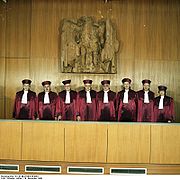
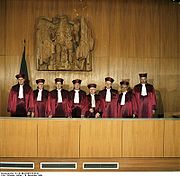
Decisions by a Senate require an absolute majority. In some cases a two thirds majority is required (§ 15 IV 1 BVerfGG). Decisions by a Chamber need to be unanimous. A Chamber is not authorized to overrule a standing precedent of the Senate to which it belongs; such issues need to be submitted to the Senate as a whole. Similarly, a Senate may not overrule a standing precedent of the other Senate; such issues will be submitted to a plenary meeting of all 16 judges (the "Plenum").
Unlike all other German courts, the court often publishes the vote count on its decisions (though only the final tally, not every judge's personal vote) and even allows its members to issue a dissenting opinion
Dissenting opinion
A dissenting opinion is an opinion in a legal case written by one or more judges expressing disagreement with the majority opinion of the court which gives rise to its judgment....
. This possibility, introduced only in 1971, is a remarkable deviation from German judicial tradition.
One of the two Senate Chairmen is also the President of the Court, the other one being the Vice-President. The presidency alternates between the two Senates, i.e. the successor of a President is always chosen from the other Senate. The current president of the Court is Andreas Voßkuhle
Andreas Voßkuhle
Andreas Voßkuhle is a German legal scholar and the president of the Federal Constitutional Court of Germany.-Life:...
.
Election of judges
The Court's judges are elected by the BundestagBundestag
The Bundestag is a federal legislative body in Germany. In practice Germany is governed by a bicameral legislature, of which the Bundestag serves as the lower house and the Bundesrat the upper house. The Bundestag is established by the German Basic Law of 1949, as the successor to the earlier...
and the Bundesrat. According to the Basic Law
Basic Law for the Federal Republic of Germany
The Basic Law for the Federal Republic of Germany is the constitution of Germany. It was formally approved on 8 May 1949, and, with the signature of the Allies of World War II on 12 May, came into effect on 23 May, as the constitution of those states of West Germany that were initially included...
, each of these bodies selects four members of each Senate, while the authority to select the Court's President alternates between them. The selection of a judge requires a two-thirds majority.
The Bundestag has delegated this task to a special body ("Richterwahlausschuss", judges election board), consisting of a small number of Bundestag members. This procedure has caused some constitutional concern and is considered to be unconstitutional by many scholars. However, it has never been challenged in a court.
The judges are elected for a 12-year term, but they must retire upon reaching the age of 68. A judge must be at least 40 years old and must be a well-trained jurist. Three out of eight members of each Senate must have served as a judge of a Federal Supreme Court. Of the other five members of each Senate, most judges previously served as an academic jurist at a university, as a public servant or as a lawyer. After ending their term, most judges withdraw themselves from public life. However, there are some prominent exceptions, most notably Roman Herzog
Roman Herzog
Roman Herzog is a German politician as a member of the Christian Democratic Union, and served as President of Germany from 1994 to 1999...
, who was elected Federal President
President of Germany
The President of the Federal Republic of Germany is the country's head of state. His official title in German is Bundespräsident . Germany has a parliamentary system of government and so the position of President is largely ceremonial...
in 1994, shortly before the end of his term as President of the Court.
First Senate
| Name | Term | Nomination by | Election by |
|---|---|---|---|
| Ferdinand Kirchhof Ferdinand Kirchhof Ferdinand Kirchhof is a German judge, jurisprudent and tax law expert. Since October 1st, 2007, he is sitting Justice of the Federal Constitutional Court of Germany in the court's first senate. In March 2009, he has been elected vice president of the court... (*1950)(Vice-President of the Court, Chairman of the First Senate) |
10/2007 - 6/2018 (retirement) | CDU/CSU | Bundestag |
| Wilhelm Schluckebier (*1949) | 10/2006 - 11/2017 (retirement) | CDU/CSU | Bundestag |
| Michael Eichberger Michael Eichberger Michael Eichberger is a German law scientist and a judge at the Federal Constitutional Court of Germany.-Life:Eichberger was born in Würzburg on June 23, 1953. Following his first state exam in law 1979 in Mannheim and his second one in 1981 in Baden-Württemberg he was a research assistant at the... (*1953) |
4/2006 - 4/2018 (12-year-term) | CDU/CSU | Bundesrat |
| Gabriele Britz (*1968) | 2/2011 - 2/2023 (12-year term) | SPD Social Democratic Party of Germany The Social Democratic Party of Germany is a social-democratic political party in Germany... |
Bundesrat |
| Johannes Masing Johannes Masing Johannes Masing is a German judge, jurisprudent and public law scholar. On February 15th, 2008, he succeeded Wolfgang Hoffmann-Riem as sitting Justice of the Federal Constitutional Court of Germany in the court's first senate.... (*1959) |
4/2008 - 4/2020 (12-year term) | SPD | Bundesrat |
| Susanne Baer Susanne Baer Susanne Baer is a German legal scholar and one of the 16 judges of the Federal Constitutional Court of Germany. Baer has been the William W... (*1964) |
2/2011 - 2/2023 (12-year term) | Alliance '90/The Greens Alliance '90/The Greens Alliance '90/The Greens is a green political party in Germany, formed from the merger of the German Green Party and Alliance 90 in 1993. Its leaders are Claudia Roth and Cem Özdemir... |
Bundestag |
| Reinhard Gaier (*1954) | 11/2004 - 11/2016 (retirement) | SPD | Bundesrat |
| Andreas L. Paulus (*1968) | 03/2010 - 03/2022 (12-year term) | FDP | Bundestag |
Second Senate (current only)
| Name | Term | Nomination by | Election by |
|---|---|---|---|
| Andreas Voßkuhle Andreas Voßkuhle Andreas Voßkuhle is a German legal scholar and the president of the Federal Constitutional Court of Germany.-Life:... (*1963)(President of the Court, Chairman of the Second Senate) |
5/2008 - 5/2020 (12-year term) | SPD Social Democratic Party of Germany The Social Democratic Party of Germany is a social-democratic political party in Germany... |
Bundesrat |
| Peter M. Huber (*1959) | 10/2010 - 10/2022 (12-year term) | CDU/CSU CDU/CSU CDU/CSU, unofficially also referred to as the Union parties or the Union, is the name of the Bundestag parliamentary faction comprising the Christian Democratic Union of Germany and the Christian Social Union of Bavaria , considered to be sister parties... |
Bundestag |
| Monika Hermanns (* 1959) | 11/2010 - 11/2022 (12-year term) | SPD | Bundestag |
| Udo Di Fabio Udo Di Fabio Udo Di Fabio is a German jurist and a member of the Federal Constitutional Court of Germany, Germany's highest court.-References:... (*1954) |
12/1999 - 12/2011 (12-year term) | CDU/CSU | Bundesrat |
| Rudolf Mellinghoff Rudolf Mellinghoff Rudolf Mellinghoff is a German judge, jurisprudent and tax law expert. Since January, 2001, he is sitting Justice of the Federal Constitutional Court of Germany in the court's second senate. Prior to his appointment to the court, he has served as judge in the Federal Finance Court of Germany from... (*1954) |
1/2001 - 1/2013 (12-year term) | CDU/CSU | Bundesrat |
| Gertrude Lübbe-Wolff Gertrude Lübbe-Wolff Gertrude Lübbe-Wolff is a German academic and senior judge. She sits on the second senate of the Bundesverfassungsgericht , having succeeded Jutta Limbach in this position in April 2002.... (*1953) |
4/2002 - 4/2014 (12-year term) | SPD | Bundestag |
| Michael Gerhardt (*1948) | 7/2003 - 7/2015 (12-year term) | SPD | Bundestag |
| Herbert Landau (*1948) | 10/2005 - 4/2016 (retirement) | CDU/CSU | Bundesrat |
Presidents of the Court
- Hermann Höpker-AschoffHermann Höpker-AschoffHermann Höpker-Aschoff was a German politician and jurist. He was the first President of the Federal Constitutional Court of Germany....
- Josef WintrichJosef WintrichJosef Marquard Wintrich was a German legal scholar and judge. He served as the 2nd president of the Federal Constitutional Court of Germany from 1954 to 1956. The most significant decision during his tenure was the banning of the Communist Party of Germany in 1956....
- Gebhard MüllerGebhard MüllerGebhard Müller was a German lawyer and politician . He was Minister-President of Württemberg-Hohenzollern and Baden-Württemberg . He was born in Füramoos and died in Stuttgart....
- Ernst BendaErnst BendaErnst Benda was a German legal scholar, politician and judge. He served as the 4th president of the Federal Constitutional Court of Germany from 1971 to 1983. Benda briefly served as Minister of the Interior of Germany .Ernst Benda was born in Berlin, the son of an Engineer. After school he served...
- Wolfgang ZeidlerWolfgang ZeidlerWolfgang Zeidler was a German legal scholar and judge. He served as the 5th president of the Federal Constitutional Court of Germany from 1983 to 1987. Zeidler also served as president of the British-German-Jurists' Association....
- Roman HerzogRoman HerzogRoman Herzog is a German politician as a member of the Christian Democratic Union, and served as President of Germany from 1994 to 1999...
- Jutta LimbachJutta LimbachJutta Limbach is a German jurist and politician. She is a member of the Social Democratic Party of Germany . She received her doctorate in law in 1966 by the Free University of Berlin and fulfilled the requirements to be appointed professor by the German educational system in 1971...
- Hans-Jürgen PapierHans-Jürgen PapierHans-Jürgen Papier is a German scholar of constitutional law and was President of the Federal Constitutional Court of Germany from 2002 to 2010....
- Andreas VoßkuhleAndreas VoßkuhleAndreas Voßkuhle is a German legal scholar and the president of the Federal Constitutional Court of Germany.-Life:...
All judges
- Susanne BaerSusanne BaerSusanne Baer is a German legal scholar and one of the 16 judges of the Federal Constitutional Court of Germany. Baer has been the William W...
- Ernst BendaErnst BendaErnst Benda was a German legal scholar, politician and judge. He served as the 4th president of the Federal Constitutional Court of Germany from 1971 to 1983. Benda briefly served as Minister of the Interior of Germany .Ernst Benda was born in Berlin, the son of an Engineer. After school he served...
- Ernst-Wolfgang BöckenfördeErnst-Wolfgang BöckenfördeErnst-Wolfgang Böckenförde is a German judge and legal philosopher.-Life:In 1953 he received a PhD in law as well as in philosophy. In 1964 he made his postdoctoral habilitation with his thesis The power of organisation in the purview of the government. A survey on constitutional law in the...
- Werner Böhmer
- Gabriele Britz
- Siegfried Broß
- Hans Brox
- Brun-Otto BrydeBrun-Otto BrydeBrun-Otto Bryde is a German legal scholar and a former judge of the Federal Constitutional Court of Germany.-Life:Bryde was born in Hamburg on January 12, 1943. Following his first state exam in law 1966 and his second one in 1969 he did his doctoral degree in Hamburg in 1971. After that he became...
- Udo Di FabioUdo Di FabioUdo Di Fabio is a German jurist and a member of the Federal Constitutional Court of Germany, Germany's highest court.-References:...
- Thomas Dieterich
- Michael EichbergerMichael EichbergerMichael Eichberger is a German law scientist and a judge at the Federal Constitutional Court of Germany.-Life:Eichberger was born in Würzburg on June 23, 1953. Following his first state exam in law 1979 in Mannheim and his second one in 1981 in Baden-Württemberg he was a research assistant at the...
- Wilhelm Ellinghaus
- Hans Joachim Faller
- Reinhard Gaier
- Michael Gerhardt
- Karin GraßhofKarin GraßhofKarin Graßhof is a German jurist. She served as a judge at the Federal Constitutional Court of Germany from 1986 to 1998. She is currently an honourary professor at the University of Bonn-References:...
- Dieter Grimm
- Karl Haager
- Evelyn HaasEvelyn HaasEvelyn Haas, born Evelyn Traeger is a German former First Senate Constitutional Court judge and current Honorary Professor of Law. She was the first woman to be elected to the Constitutional Court in Germany.-Biography:...
- Winfried HassemerWinfried HassemerWinfried Hassemer , is a German criminal law scholar. He was vice-president of the Federal Constitutional Court.Born in Gau-Algesheim, Hassemer was from 1964–1969 a scientific assistant at the Institut for laws and social philosophy of the university of Saarland.He is married with Kristiane...
- Johann Friedrich Henschel
- Monika Hermanns
- Roman HerzogRoman HerzogRoman Herzog is a German politician as a member of the Christian Democratic Union, and served as President of Germany from 1994 to 1999...
- Konrad HesseKonrad HesseKonrad Hesse was a German jurisprudence scientist and, from 1975 to 1987, judge at the Federal Constitutional Court of Germany....
- Martin HirschMartin HirschMartin Hirsch is the former head of Emmaüs France, the former High Commissioner for Active Solidarity against Poverty, and the High Commissioner for Youth in the government of François Fillon...
- Dieter Hömig
- Hermann Höpker-AschoffHermann Höpker-AschoffHermann Höpker-Aschoff was a German politician and jurist. He was the first President of the Federal Constitutional Court of Germany....
- Christine Hohmann-DennhardtChristine Hohmann-DennhardtChristine Hohmann-Dennhardt is a German politician and senior judge.-Biography:After being a lecturer for Labour at the University of Hamburg from 1975 to 1977, she became a researcher at the Johann Wolfgang Goethe University in Frankfurt am Main...
- Wolfgang Hoffmann-RiemWolfgang Hoffmann-RiemWolfgang Hoffmann-Riem is a German legal scholar and a former judge of the Federal Constitutional Court of Germany.-Career:...
- Peter M. Huber
- Renate JaegerRenate JaegerRenate Jaeger is a German lawyer and judge of the European Court of Human Rights. Her term at the Court expired on 30 December 2010.-Early life:...
- Hans-Joachim Jentsch
- Rudolf Katz
- Dietrich Katzenstein
- Ferdinand KirchhofFerdinand KirchhofFerdinand Kirchhof is a German judge, jurisprudent and tax law expert. Since October 1st, 2007, he is sitting Justice of the Federal Constitutional Court of Germany in the court's first senate. In March 2009, he has been elected vice president of the court...
- Paul KirchhofPaul KirchhofPaul Kirchhof is a German jurist and tax law expert. He is also a professor of law, member of the Pontifical Academy of Social Sciences and a former judge in the Federal Constitutional Court of Germany , the highest court in Germany.Kirchhof obtained a doctorate at the early age of 25 having...
- Hans Hugo KleinHans Hugo KleinHans Hugo Klein is a German politician, representative of the German Christian Democratic Union from 1983 to 1996 and was judge at the Constitutional Court.-Life:...
- Konrad Kruis
- Jürgen KühlingJürgen KühlingJürgen Kühling is a German judge. He was a judge in the Federal Constitutional Court of Germany between 1989 and 2001.-References:...
- Herbert Landau
- Gerhard Leibholz
- Jutta LimbachJutta LimbachJutta Limbach is a German jurist and politician. She is a member of the Social Democratic Party of Germany . She received her doctorate in law in 1966 by the Free University of Berlin and fulfilled the requirements to be appointed professor by the German educational system in 1971...
- Gertrude Lübbe-WolffGertrude Lübbe-WolffGertrude Lübbe-Wolff is a German academic and senior judge. She sits on the second senate of the Bundesverfassungsgericht , having succeeded Jutta Limbach in this position in April 2002....
- Ernst Gottfried Mahrenholz
- Johannes MasingJohannes MasingJohannes Masing is a German judge, jurisprudent and public law scholar. On February 15th, 2008, he succeeded Wolfgang Hoffmann-Riem as sitting Justice of the Federal Constitutional Court of Germany in the court's first senate....
- Rudolf MellinghoffRudolf MellinghoffRudolf Mellinghoff is a German judge, jurisprudent and tax law expert. Since January, 2001, he is sitting Justice of the Federal Constitutional Court of Germany in the court's second senate. Prior to his appointment to the court, he has served as judge in the Federal Finance Court of Germany from...
- Gebhard MüllerGebhard MüllerGebhard Müller was a German lawyer and politician . He was Minister-President of Württemberg-Hohenzollern and Baden-Württemberg . He was born in Füramoos and died in Stuttgart....
- Engelbert Niebler
- Gisela Niemeyer
- Lerke OsterlohLerke OsterlohLerke Osterloh is a German judge, jurisprudent and tax law expert. She was sitting Justice of the Federal Constitutional Court of Germany in the court's second senate from October 1998 until her retirement in November 2010. Her successor is Monika Hermanns...
- Hans-Jürgen PapierHans-Jürgen PapierHans-Jürgen Papier is a German scholar of constitutional law and was President of the Federal Constitutional Court of Germany from 2002 to 2010....
- Andreas L. Paulus
- Theodor Ritterspach
- Joachim Rottmann
- Wiltraut Rupp-von Brünneck
- Erna SchefflerErna SchefflerErna Scheffler, born Friedental and later Haßlacher was a German senior judge.-Education and early career:...
- Fabian von SchlabrendorffFabian von SchlabrendorffFabian Ludwig Georg Adolf Kurt von Schlabrendorff , was a German jurist, soldier and member of the resistance against Adolf Hitler....
- Wilhelm Schluckebier
- Helga SeibertHelga SeibertHelga Seibert was a German judge. She was a judge in the Federal Constitutional Court of Germany.Shortly before her death she won the Fritz Bauer Prize from the Humanist Union...
- Otto Seidl
- Walter Seuffert
- Alfred Söllner
- Bertold Sommer
- Helmut Steinberger
- Udo SteinerUdo SteinerUdo Steiner was a Judge at the Federal Constitutional Court of Germany from 1995 to 2007.He grew up in Franconia, and went on to study law in Erlangen, Saarbrücken and Cologne. In 1965, he earned a doctorate with the thesis Verfassunggebung und verfassunggebende Gewalt des Volkes...
- Ernst TrägerErnst TrägerErnst Träger is a German judge. He was a judge in the Federal Constitutional Court of Germany between 1977 and 1989.-External links:*...
- Friedrich Wilhelm Wagner
- Klaus WinterKlaus WinterKlaus Winter was a German judge. He was a judge in the Federal Constitutional Court of Germany .-References:...
- Wolfgang ZeidlerWolfgang ZeidlerWolfgang Zeidler was a German legal scholar and judge. He served as the 5th president of the Federal Constitutional Court of Germany from 1983 to 1987. Zeidler also served as president of the British-German-Jurists' Association....
External links
- the Court's website (with link in English language)
- Federal Constitutional Court Act (BVerfGG)
- Federal Constitutional Court Act (BVerfGG)