

South Baden

Encyclopedia
South Baden formed in December 1945 from the southern half of the former Republic of Baden
, was a subdivision of the French occupation zone
of post-WWII
Germany. The state was later renamed to Baden and became a founding state
of the Federal Republic of Germany (West Germany
, today simply Germany
) in 1949. In 1952, Baden became part of the modern German state of Baden-Württemberg
.
This was the last German state known as "Baden
", which had existed in various forms since the 12th century.
in 1945, France
was allocated an occupation zone for the administration of post-war Germany. The south-west of Germany - previously consisting of Baden
, Württemberg
and the Prussia
n province of Hohenzollern
- was divided between France in the south and the United States
in the north. The border between the two zones was set so that the Autobahn connecting Karlsruhe
and Munich
(today the A8
) was completely contained within the American zone; Bavaria
was also placed under American administration. In the French zone, Hohenzollern and the southern half of Württemberg were merged to form Württemberg-Hohenzollern
. The southern half of Baden was established as South Baden on 1 December 1945. Freiburg
was designated as the capital of South Baden; the former capital of Baden (Karlsruhe) was in the American zone.
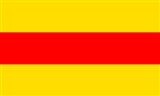
A constitution for Baden was enacted on 19 May 1947, whose preamble laid claim to this new state being the true successor of the old Baden: although most of its territory had only been part of Baden for the previous 150 years. To reinforce this claim, the constitution also adopted the pre-WWII Baden flag and coat of arms for the new state. The constitution also made it clear that the name of the state was "Baden" instead of "South Baden". In 1949, the Baden parliament voted in favour of the Basic Law for the Federal Republic of Germany
and became a founding state of (West) Germany upon its formation on 23 May 1949.
(CDU), renaming itself to CDU Baden and was thus a predecessor of CDU Baden-Württemberg
.
On 24 July 1947 the first and only state elections were held in Baden, with Wohleb's CDU winning an absolute majority of 55.9%. The SPB - the Baden branch of the SPD
- came second with 22.4%. Since the French military administration still held many key executive powers in Baden, a single-party government was not possible despite the CDU's absolute majority. Attempts to form an all-party government failed, owing to disagreements regarding the inclusion of the Communist party
(KPD). Eventually, a grand coalition
between the CDU and SPB was formed, with Wohleb as minister-president
. After the formation of the Federal Republic of Germany and the end of French administration, single-party governments were again permitted and the coalition was no longer needed; from 1949 until 1952, Wohleb governed Baden at the head of a CDU-only government.
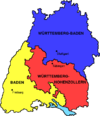 With the end of military rule in West Germany, the three western powers requested that state leaders should re-examine and finalise the borders that had been established during occupation. In the south west, it was undecided whether Baden and Württemberg should be re-established as separate states (with Württemberg absorbing Hohenzollern, since Prussia had been abolished) or merged to form a new state. In Baden, Wohleb was a strong opponent of a merger. In 1950, a referendum regarding the merger of the three south-western states was carried out. Within the pre-1945 borders of Baden, the merger was rejected and a restoration of Baden was elected. This vote in Baden was outweighed by the more populous Württemberg, where the merger was accepted. Following this referendum, the three south-west states were merged to form the modern German state of Baden-Württemberg
on 25 April 1952.
Various legal contests were mounted against the referendum and the resulting merger. The newly-founded Federal Constitutional Court of Germany
(Bundesverfassungsgericht) rejected a nullification of the referendum in 1951, after the judges' vote ended in a draw. In 1956, the court concluded that the referendum in (South) Baden was not accepted by the majority and should be repeated. The Baden-Württemberg government did not allow this repeat to take place until fourteen years later in 1970: eighteen years after the merger. This time, the vote in (South) Baden was 81% in favour of the status quo.
Republic of Baden
The Republic of Baden was a state of Germany during the time of the Weimar Republic, formed after the abolition of the Grand Duchy of Baden in 1918...
, was a subdivision of the French occupation zone
Allied Occupation Zones in Germany
The Allied powers who defeated Nazi Germany in World War II divided the country west of the Oder-Neisse line into four occupation zones for administrative purposes during 1945–49. In the closing weeks of fighting in Europe, US forces had pushed beyond the previously agreed boundaries for the...
of post-WWII
World War II
World War II, or the Second World War , was a global conflict lasting from 1939 to 1945, involving most of the world's nations—including all of the great powers—eventually forming two opposing military alliances: the Allies and the Axis...
Germany. The state was later renamed to Baden and became a founding state
States of Germany
Germany is made up of sixteen which are partly sovereign constituent states of the Federal Republic of Germany. Land literally translates as "country", and constitutionally speaking, they are constituent countries...
of the Federal Republic of Germany (West Germany
West Germany
West Germany is the common English, but not official, name for the Federal Republic of Germany or FRG in the period between its creation in May 1949 to German reunification on 3 October 1990....
, today simply Germany
Germany
Germany , officially the Federal Republic of Germany , is a federal parliamentary republic in Europe. The country consists of 16 states while the capital and largest city is Berlin. Germany covers an area of 357,021 km2 and has a largely temperate seasonal climate...
) in 1949. In 1952, Baden became part of the modern German state of Baden-Württemberg
Baden-Württemberg
Baden-Württemberg is one of the 16 states of Germany. Baden-Württemberg is in the southwestern part of the country to the east of the Upper Rhine, and is the third largest in both area and population of Germany's sixteen states, with an area of and 10.7 million inhabitants...
.
This was the last German state known as "Baden
Baden
Baden is a historical state on the east bank of the Rhine in the southwest of Germany, now the western part of the Baden-Württemberg of Germany....
", which had existed in various forms since the 12th century.
Formation
At the Yalta ConferenceYalta Conference
The Yalta Conference, sometimes called the Crimea Conference and codenamed the Argonaut Conference, held February 4–11, 1945, was the wartime meeting of the heads of government of the United States, the United Kingdom, and the Soviet Union, represented by President Franklin D...
in 1945, France
France
The French Republic , The French Republic , The French Republic , (commonly known as France , is a unitary semi-presidential republic in Western Europe with several overseas territories and islands located on other continents and in the Indian, Pacific, and Atlantic oceans. Metropolitan France...
was allocated an occupation zone for the administration of post-war Germany. The south-west of Germany - previously consisting of Baden
Republic of Baden
The Republic of Baden was a state of Germany during the time of the Weimar Republic, formed after the abolition of the Grand Duchy of Baden in 1918...
, Württemberg
Free People's State of Württemberg
The Free People's State of Württemberg was a state of Germany during the Weimar Republic in Württemberg.-1918 revolution:As Germany underwent violent revolution near the end of World War I, the Kingdom of Württemberg was transformed from a monarchy to a democratic republic without bloodshed; its...
and the Prussia
Prussia
Prussia was a German kingdom and historic state originating out of the Duchy of Prussia and the Margraviate of Brandenburg. For centuries, the House of Hohenzollern ruled Prussia, successfully expanding its size by way of an unusually well-organized and effective army. Prussia shaped the history...
n province of Hohenzollern
Province of Hohenzollern
Hohenzollern was a de facto province of the Kingdom of Prussia. It was created in 1850 by joining the principalities of Hohenzollern-Sigmaringen and Hohenzollern-Hechingen after both formerly independently ruling Catholic princely lines of the House of Hohenzollern had handed over their...
- was divided between France in the south and the United States
United States
The United States of America is a federal constitutional republic comprising fifty states and a federal district...
in the north. The border between the two zones was set so that the Autobahn connecting Karlsruhe
Karlsruhe
The City of Karlsruhe is a city in the southwest of Germany, in the state of Baden-Württemberg, located near the French-German border.Karlsruhe was founded in 1715 as Karlsruhe Palace, when Germany was a series of principalities and city states...
and Munich
Munich
Munich The city's motto is "" . Before 2006, it was "Weltstadt mit Herz" . Its native name, , is derived from the Old High German Munichen, meaning "by the monks' place". The city's name derives from the monks of the Benedictine order who founded the city; hence the monk depicted on the city's coat...
(today the A8
Bundesautobahn 8
is an autobahn in southern Germany that runs 497 km from the Luxembourg A13 motorway at Schengen via Neunkirchen, Pirmasens, Karlsruhe, Stuttgart, Ulm, Augsburg and Munich to the Austrian West Autobahn near Salzburg....
) was completely contained within the American zone; Bavaria
Bavaria
Bavaria, formally the Free State of Bavaria is a state of Germany, located in the southeast of Germany. With an area of , it is the largest state by area, forming almost 20% of the total land area of Germany...
was also placed under American administration. In the French zone, Hohenzollern and the southern half of Württemberg were merged to form Württemberg-Hohenzollern
Württemberg-Hohenzollern
Württemberg-Hohenzollern was a historical state of West Germany. It was created in 1945 as part of the French occupation zone. Its capital was Tübingen...
. The southern half of Baden was established as South Baden on 1 December 1945. Freiburg
Freiburg
Freiburg im Breisgau is a city in Baden-Württemberg, Germany. In the extreme south-west of the country, it straddles the Dreisam river, at the foot of the Schlossberg. Historically, the city has acted as the hub of the Breisgau region on the western edge of the Black Forest in the Upper Rhine Plain...
was designated as the capital of South Baden; the former capital of Baden (Karlsruhe) was in the American zone.
A constitution for Baden was enacted on 19 May 1947, whose preamble laid claim to this new state being the true successor of the old Baden: although most of its territory had only been part of Baden for the previous 150 years. To reinforce this claim, the constitution also adopted the pre-WWII Baden flag and coat of arms for the new state. The constitution also made it clear that the name of the state was "Baden" instead of "South Baden". In 1949, the Baden parliament voted in favour of the Basic Law for the Federal Republic of Germany
Basic Law for the Federal Republic of Germany
The Basic Law for the Federal Republic of Germany is the constitution of Germany. It was formally approved on 8 May 1949, and, with the signature of the Allies of World War II on 12 May, came into effect on 23 May, as the constitution of those states of West Germany that were initially included...
and became a founding state of (West) Germany upon its formation on 23 May 1949.
Politics
For the first year of its existence, South Baden was directly governed by the French military administration. After local elections in December 1946, the Badische Christlich-Soziale Volkspartei (BCSV) emerged as the strongest party and its leader, Leo Wohleb, was appointed by the French administration as president of the state secretariat. In April 1947, the BCSV became associated with the federal Christian Democratic UnionChristian Democratic Union (Germany)
The Christian Democratic Union of Germany is a Christian democratic and conservative political party in Germany. It is regarded as on the centre-right of the German political spectrum...
(CDU), renaming itself to CDU Baden and was thus a predecessor of CDU Baden-Württemberg
CDU Baden-Württemberg
The CDU Baden-Württemberg is the biggest political party in the German state of Baden-Württemberg, and the second largest state party of the Christian Democratic Union of Germany with 77,800 members...
.
On 24 July 1947 the first and only state elections were held in Baden, with Wohleb's CDU winning an absolute majority of 55.9%. The SPB - the Baden branch of the SPD
Social Democratic Party of Germany
The Social Democratic Party of Germany is a social-democratic political party in Germany...
- came second with 22.4%. Since the French military administration still held many key executive powers in Baden, a single-party government was not possible despite the CDU's absolute majority. Attempts to form an all-party government failed, owing to disagreements regarding the inclusion of the Communist party
Communist Party of Germany
The Communist Party of Germany was a major political party in Germany between 1918 and 1933, and a minor party in West Germany in the postwar period until it was banned in 1956...
(KPD). Eventually, a grand coalition
Grand coalition
A grand coalition is an arrangement in a multi-party parliamentary system in which the two largest political parties of opposing political ideologies unite in a coalition government...
between the CDU and SPB was formed, with Wohleb as minister-president
Minister-President
A minister-president is the head of government in a number of European countries or subnational governments, in which a parliamentary or semi-presidential system of government prevails, who presides over the council of ministers...
. After the formation of the Federal Republic of Germany and the end of French administration, single-party governments were again permitted and the coalition was no longer needed; from 1949 until 1952, Wohleb governed Baden at the head of a CDU-only government.
Disestablishment
Baden-Württemberg
Baden-Württemberg is one of the 16 states of Germany. Baden-Württemberg is in the southwestern part of the country to the east of the Upper Rhine, and is the third largest in both area and population of Germany's sixteen states, with an area of and 10.7 million inhabitants...
on 25 April 1952.
Various legal contests were mounted against the referendum and the resulting merger. The newly-founded Federal Constitutional Court of Germany
Federal Constitutional Court of Germany
The Federal Constitutional Court is a special court established by the Grundgesetz, the German basic law...
(Bundesverfassungsgericht) rejected a nullification of the referendum in 1951, after the judges' vote ended in a draw. In 1956, the court concluded that the referendum in (South) Baden was not accepted by the majority and should be repeated. The Baden-Württemberg government did not allow this repeat to take place until fourteen years later in 1970: eighteen years after the merger. This time, the vote in (South) Baden was 81% in favour of the status quo.