

Administrative division of the German Democratic Republic

Encyclopedia
The Administrative divisions of the German Democratic Republic were constituted in two different forms during the country's 41-year-long history. The Republic first retained the traditional German division into federated states called Länder, but in 1952 replaced them with arbitrarily-drawn districts called Bezirke. Immediately before German reunification
in 1990, the old Länder were restored, but they were not effectively reconstituted until after the GDR had ceased to exist as a separate state.
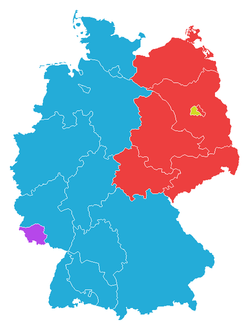 Following its collapse in World War II
in 1945, Germany was occupied by the United States
, Britain
, France
and the Soviet Union
. All four occupation powers, in their respective occupation zones, reorganised political life by restoring the Länder
, the constituting parts of federal Germany, though the borders of these entities were adjusted and new entities created to form cohesive territories, avoid petty states and conform with the borders of the zones. The state of Prussia
, whose provinces extended to all four zones and covered two thirds of Germany, was dissolved in 1947.
Special conditions were assigned to Berlin
, which the four powers divided into four sectors. A united German state government existed in the city until it broke apart in 1948. After 1949, both West Berlin
and East Berlin
(officially only called Berlin) were in effect incorporated into the Federal Republic of Germany
and the German Democratic Republic, respectively, despite not legally being part of these countries.
were transferred to Polish administration. The five states were:
In 1949, the Soviet occupation zone was transformed into the German Democratic Republic. The five Länder (and East Berlin
, though the latter only with consultative votes) participated in the legislative branch through the Länderkammer
(Chamber of States), which was elected by the Landtag
e (state parliaments). However, the Länder were not constituting entities forming a Federal
state (as in West Germany) but rather entities of decentralised administrative entities of a unitary
state.
 The GDR's centralist tendencies quickly gained speed, especially after the ruling Socialist Unity Party
(SED) had adopted the Communist principle of Democratic centralism
in 1950. In 1952, the SED announced to establish "socialism
in a planned
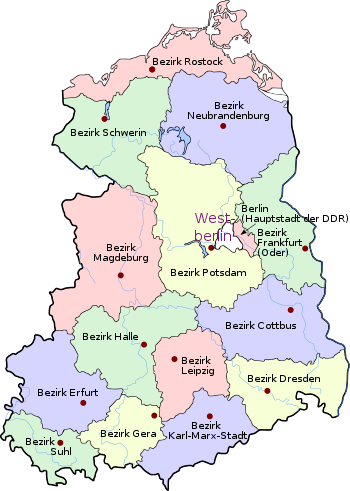
manner". Now, the Länder were considered as no longer corresponding to the requirements of the new tasks of the state. On 23 July 1952, a law combined municipal districts (Kreis
e) into regional districts (Bezirk
e), and subsequently, on 25 July 1952, the state governments transferred their administrative tasks to the new districts.
With this law, the Länder were in effect dissolved, though they formally remained in existence, though without any political or administrative function. The Länderkammer also remained in existence and its members were elected in 1954 by combined sessions of the Bezirkstage (district assemblies) in each Land and in 1958 directly by the Bezirkstage. However, on 8 December 1958, the Länderkammer was formally dissolved with no objections being raised.
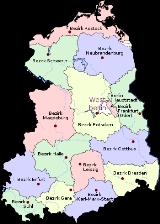
The 14 new Bezirke were drawn without regard to the borders of the Länder and each named after their capitals,from north to south: Rostock
, Neubrandenburg
, Schwerin
, Potsdam
, Frankfurt (Oder)
, Magdeburg
, Cottbus
, Halle
, Leipzig
, Erfurt
, Dresden
, Karl-Marx-Stadt
(named Chemnitz until 1953), Gera
and Suhl
.
Due to its special status, East Berlin was originally not counted as a Bezirk but it was claimed as the "capital city of the GDR" (though legally, it was not even fully part of the GDR's territory). In 1961, after the construction of the Berlin Wall
, East Berlin came to be recognised in GDR administration as the Bezirk Berlin.
The Bezirke (with the exception Berlin, which consisted of a single municipality) were again divided into rural district (Landkreise) and urban districts (Stadtkreise):
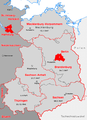 Immediately before German reunification
on 3 October 1990, the restoration of the old Länder was declared. In theory, it was the Länder which then acceded to the Federal Republic of Germany
.
In effect the restored Länder did not constitute themselves until after the reunification: on 14 October 1990, elections to the Landtag (state parliament) were held in Brandenburg, Mecklenburg-Western Pomerania, Saxony, Saxony-Anhalt and Thuringia, initiating the formation of state governments.
Since changes to the boundaries of municipal districts were not reversed, and also due to considerations of expediency, the territorial make-up of the restored Länder differed somewhat from the borders prior to 1952.
Saxony and Saxony-Anhalt initially retained the districts remained as administrative entities (Regierungsbezirke). Saxony-Anhalt abolished them in 2003, while Saxony transformed them into directorates in 2008.
German reunification
German reunification was the process in 1990 in which the German Democratic Republic joined the Federal Republic of Germany , and when Berlin reunited into a single city, as provided by its then Grundgesetz constitution Article 23. The start of this process is commonly referred by Germans as die...
in 1990, the old Länder were restored, but they were not effectively reconstituted until after the GDR had ceased to exist as a separate state.
General background
World War II
World War II, or the Second World War , was a global conflict lasting from 1939 to 1945, involving most of the world's nations—including all of the great powers—eventually forming two opposing military alliances: the Allies and the Axis...
in 1945, Germany was occupied by the United States
United States
The United States of America is a federal constitutional republic comprising fifty states and a federal district...
, Britain
United Kingdom
The United Kingdom of Great Britain and Northern IrelandIn the United Kingdom and Dependencies, other languages have been officially recognised as legitimate autochthonous languages under the European Charter for Regional or Minority Languages...
, France
France
The French Republic , The French Republic , The French Republic , (commonly known as France , is a unitary semi-presidential republic in Western Europe with several overseas territories and islands located on other continents and in the Indian, Pacific, and Atlantic oceans. Metropolitan France...
and the Soviet Union
Soviet Union
The Soviet Union , officially the Union of Soviet Socialist Republics , was a constitutionally socialist state that existed in Eurasia between 1922 and 1991....
. All four occupation powers, in their respective occupation zones, reorganised political life by restoring the Länder
States of Germany
Germany is made up of sixteen which are partly sovereign constituent states of the Federal Republic of Germany. Land literally translates as "country", and constitutionally speaking, they are constituent countries...
, the constituting parts of federal Germany, though the borders of these entities were adjusted and new entities created to form cohesive territories, avoid petty states and conform with the borders of the zones. The state of Prussia
Prussia
Prussia was a German kingdom and historic state originating out of the Duchy of Prussia and the Margraviate of Brandenburg. For centuries, the House of Hohenzollern ruled Prussia, successfully expanding its size by way of an unusually well-organized and effective army. Prussia shaped the history...
, whose provinces extended to all four zones and covered two thirds of Germany, was dissolved in 1947.
Special conditions were assigned to Berlin
Berlin
Berlin is the capital city of Germany and is one of the 16 states of Germany. With a population of 3.45 million people, Berlin is Germany's largest city. It is the second most populous city proper and the seventh most populous urban area in the European Union...
, which the four powers divided into four sectors. A united German state government existed in the city until it broke apart in 1948. After 1949, both West Berlin
West Berlin
West Berlin was a political exclave that existed between 1949 and 1990. It comprised the western regions of Berlin, which were bordered by East Berlin and parts of East Germany. West Berlin consisted of the American, British, and French occupation sectors, which had been established in 1945...
and East Berlin
East Berlin
East Berlin was the name given to the eastern part of Berlin between 1949 and 1990. It consisted of the Soviet sector of Berlin that was established in 1945. The American, British and French sectors became West Berlin, a part strongly associated with West Germany but a free city...
(officially only called Berlin) were in effect incorporated into the Federal Republic of Germany
West Germany
West Germany is the common English, but not official, name for the Federal Republic of Germany or FRG in the period between its creation in May 1949 to German reunification on 3 October 1990....
and the German Democratic Republic, respectively, despite not legally being part of these countries.
Länder in East Germany
In the Soviet occupation zone, five Länder were established which roughly corresponded to the preexisting states and provinces. However, all territories east of the Oder-Neisse lineOder-Neisse line
The Oder–Neisse line is the border between Germany and Poland which was drawn in the aftermath of World War II. The line is formed primarily by the Oder and Lusatian Neisse rivers, and meets the Baltic Sea west of the seaport cities of Szczecin and Świnoujście...
were transferred to Polish administration. The five states were:
- BrandenburgBrandenburgBrandenburg is one of the sixteen federal-states of Germany. It lies in the east of the country and is one of the new federal states that were re-created in 1990 upon the reunification of the former West Germany and East Germany. The capital is Potsdam...
was created out of the major part of the Prussian province of that name - Mecklenburg-Western PomeraniaMecklenburg-Western PomeraniaMecklenburg-Vorpommern is a federal state in northern Germany. The capital city is Schwerin...
(Mecklenburg-Vorpommern) was created out of the state of MecklenburgMecklenburgMecklenburg is a historical region in northern Germany comprising the western and larger part of the federal-state Mecklenburg-Vorpommern...
(reunited out of Mecklenburg-Schwerin and Mecklenburg-Strelitz only in 1934) and the Western parts of the Prussian province of PomeraniaProvince of PomeraniaThe Province of Pomerania was a province of the Kingdom of Prussia and the Free State of Prussia from 1815 until 1945. Afterwards its territory became part of Allied-occupied Germany and Poland.... - SaxonySaxonyThe Free State of Saxony is a landlocked state of Germany, contingent with Brandenburg, Saxony Anhalt, Thuringia, Bavaria, the Czech Republic and Poland. It is the tenth-largest German state in area, with of Germany's sixteen states....
(Sachsen) was restored but augmented by the westernmost parts of the Prussian province of Lower SilesiaProvince of Lower SilesiaThe Province of Lower Silesia was a province of the Free State of Prussia from 1919 to 1945. Between 1938 and 1941 it was reunited with Upper Silesia as the Silesia Province. The capital of Lower Silesia was Breslau... - Saxony-AnhaltSaxony-AnhaltSaxony-Anhalt is a landlocked state of Germany. Its capital is Magdeburg and it is surrounded by the German states of Lower Saxony, Brandenburg, Saxony, and Thuringia.Saxony-Anhalt covers an area of...
(Sachsen-Anhalt) was created out of the most of the Prussian Province of SaxonyProvince of SaxonyThe Province of Saxony was a province of the Kingdom of Prussia and later the Free State of Prussia from 1816 until 1945. Its capital was Magdeburg.-History:The province was created in 1816 out of the following territories:...
and the Free State of AnhaltFree State of AnhaltThe Free State of Anhalt was formed after Joachim Ernst, Duke of Anhalt abdicated on 12 November 1918, ending the Duchy of Anhalt. It was a state of Germany during the time of the Weimar Republic... - ThuringiaThuringiaThe Free State of Thuringia is a state of Germany, located in the central part of the country.It has an area of and 2.29 million inhabitants, making it the sixth smallest by area and the fifth smallest by population of Germany's sixteen states....
(Thüringen) was restored in the borders of 1944, when it had been augmented by neighouring parts from the Prussian provinces of SaxonyProvince of SaxonyThe Province of Saxony was a province of the Kingdom of Prussia and later the Free State of Prussia from 1816 until 1945. Its capital was Magdeburg.-History:The province was created in 1816 out of the following territories:...
and Hesse-Nassau.
In 1949, the Soviet occupation zone was transformed into the German Democratic Republic. The five Länder (and East Berlin
East Berlin
East Berlin was the name given to the eastern part of Berlin between 1949 and 1990. It consisted of the Soviet sector of Berlin that was established in 1945. The American, British and French sectors became West Berlin, a part strongly associated with West Germany but a free city...
, though the latter only with consultative votes) participated in the legislative branch through the Länderkammer
Länderkammer
The Länderkammer was one of the two legislative chambers of the German Democratic Republic from 1949, when the GDR was formed, until 1952, at which time it was largely sidelined, when the five Länder of the GDR were abolished and replaced with smaller administrative regions. The Länderkammer...
(Chamber of States), which was elected by the Landtag
Landtag
A Landtag is a representative assembly or parliament in German-speaking countries with some legislative authority.- Name :...
e (state parliaments). However, the Länder were not constituting entities forming a Federal
Federalism
Federalism is a political concept in which a group of members are bound together by covenant with a governing representative head. The term "federalism" is also used to describe a system of the government in which sovereignty is constitutionally divided between a central governing authority and...
state (as in West Germany) but rather entities of decentralised administrative entities of a unitary
Unitary
Unitary may refer to:* Unitary construction, in automotive design, another common term for a unibody or monocoque construction**Unitary as chemical weapons opposite of Binary...
state.
Division into Bezirke
Socialist Unity Party of Germany
The Socialist Unity Party of Germany was the governing party of the German Democratic Republic from its formation on 7 October 1949 until the elections of March 1990. The SED was a communist political party with a Marxist-Leninist ideology...
(SED) had adopted the Communist principle of Democratic centralism
Democratic centralism
Democratic centralism is the name given to the principles of internal organization used by Leninist political parties, and the term is sometimes used as a synonym for any Leninist policy inside a political party...
in 1950. In 1952, the SED announced to establish "socialism
Socialism
Socialism is an economic system characterized by social ownership of the means of production and cooperative management of the economy; or a political philosophy advocating such a system. "Social ownership" may refer to any one of, or a combination of, the following: cooperative enterprises,...
in a planned
Planned economy
A planned economy is an economic system in which decisions regarding production and investment are embodied in a plan formulated by a central authority, usually by a government agency...
manner". Now, the Länder were considered as no longer corresponding to the requirements of the new tasks of the state. On 23 July 1952, a law combined municipal districts (Kreis
Kreis
Kreis is the German word for circle, and also refers to a type of country subdivision.*In Germany, a Kreis is a district or county*In Prussia, a Kreis was a district or county...
e) into regional districts (Bezirk
Bezirk
Bezirk means "district" in German and can refer to:* The primary Subdivisions of East Germany from 1952* The districts of Austria* Some of the Districts of Switzerland...
e), and subsequently, on 25 July 1952, the state governments transferred their administrative tasks to the new districts.
With this law, the Länder were in effect dissolved, though they formally remained in existence, though without any political or administrative function. The Länderkammer also remained in existence and its members were elected in 1954 by combined sessions of the Bezirkstage (district assemblies) in each Land and in 1958 directly by the Bezirkstage. However, on 8 December 1958, the Länderkammer was formally dissolved with no objections being raised.
The 14 new Bezirke were drawn without regard to the borders of the Länder and each named after their capitals,from north to south: Rostock
Rostock
Rostock -Early history:In the 11th century Polabian Slavs founded a settlement at the Warnow river called Roztoc ; the name Rostock is derived from that designation. The Danish king Valdemar I set the town aflame in 1161.Afterwards the place was settled by German traders...
, Neubrandenburg
Neubrandenburg
Neubrandenburg is a city in Mecklenburg-Vorpommern, Germany. It is located in the southeastern part of the state, on the shore of a lake called the Tollensesee ....
, Schwerin
Schwerin
Schwerin is the capital and second-largest city of the northern German state of Mecklenburg-Vorpommern. The population, as of end of 2009, was 95,041.-History:...
, Potsdam
Potsdam
Potsdam is the capital city of the German federal state of Brandenburg and part of the Berlin/Brandenburg Metropolitan Region. It is situated on the River Havel, southwest of Berlin city centre....
, Frankfurt (Oder)
Frankfurt (Oder)
Frankfurt is a town in Brandenburg, Germany, located on the Oder River, on the German-Polish border directly opposite the town of Słubice which was a part of Frankfurt until 1945. At the end of the 1980s it reached a population peak with more than 87,000 inhabitants...
, Magdeburg
Magdeburg
Magdeburg , is the largest city and the capital city of the Bundesland of Saxony-Anhalt, Germany. Magdeburg is situated on the Elbe River and was one of the most important medieval cities of Europe....
, Cottbus
Cottbus
Cottbus is a city in Brandenburg, Germany, situated around southeast of Berlin, on the River Spree. As of , its population was .- History :...
, Halle
Halle, Saxony-Anhalt
Halle is the largest city in the German state of Saxony-Anhalt. It is also called Halle an der Saale in order to distinguish it from the town of Halle in North Rhine-Westphalia...
, Leipzig
Leipzig
Leipzig Leipzig has always been a trade city, situated during the time of the Holy Roman Empire at the intersection of the Via Regia and Via Imperii, two important trade routes. At one time, Leipzig was one of the major European centres of learning and culture in fields such as music and publishing...
, Erfurt
Erfurt
Erfurt is the capital city of Thuringia and the main city nearest to the geographical centre of Germany, located 100 km SW of Leipzig, 150 km N of Nuremberg and 180 km SE of Hannover. Erfurt Airport can be reached by plane via Munich. It lies in the southern part of the Thuringian...
, Dresden
Dresden
Dresden is the capital city of the Free State of Saxony in Germany. It is situated in a valley on the River Elbe, near the Czech border. The Dresden conurbation is part of the Saxon Triangle metropolitan area....
, Karl-Marx-Stadt
Chemnitz
Chemnitz is the third-largest city of the Free State of Saxony, Germany. Chemnitz is an independent city which is not part of any county and seat of the government region Direktionsbezirk Chemnitz. Located in the northern foothills of the Ore Mountains, it is a part of the Saxon triangle...
(named Chemnitz until 1953), Gera
Gera
Gera, the third-largest city in the German state of Thuringia , lies in east Thuringia on the river Weiße Elster, approximately 60 kilometres to the south of the city of Leipzig and 80 kilometres to the east of Erfurt...
and Suhl
Suhl
- Geography :Suhl sits on the south edge of the Suhler Scholle, an upthrust granite complex that is streaked by numerous dikes. This is part of the Ruhla-Schleusingen Horst that defines the southwest side of the Thuringian Forest...
.
Due to its special status, East Berlin was originally not counted as a Bezirk but it was claimed as the "capital city of the GDR" (though legally, it was not even fully part of the GDR's territory). In 1961, after the construction of the Berlin Wall
Berlin Wall
The Berlin Wall was a barrier constructed by the German Democratic Republic starting on 13 August 1961, that completely cut off West Berlin from surrounding East Germany and from East Berlin...
, East Berlin came to be recognised in GDR administration as the Bezirk Berlin.
The Bezirke (with the exception Berlin, which consisted of a single municipality) were again divided into rural district (Landkreise) and urban districts (Stadtkreise):
| Bezirk | subdivisions |
|---|---|
| Cottbus Cottbus (Bezirk) The Bezirk Cottbus was a district of East Germany. The administrative seat and the main town was Cottbus.-History:The district was established, with the other 13, on July 25, 1952, substituting the old German states... |
Urban districts: Cottbus Cottbus Cottbus is a city in Brandenburg, Germany, situated around southeast of Berlin, on the River Spree. As of , its population was .- History :... |
| Rural districts: Bad Liebenwerda Calau Cottbus-Land Finsterwalde Forst Guben (Wokrejs Gubin) Herzberg Hoyerswerda Jessen Luckau Lübben Senftenberg Spremberg Weißwasser | |
| Dresden Dresden (Bezirk) The Bezirk Dresden was a district of East Germany. The administrative seat and the main town was Dresden.-History:The district was established, with the other 13, on July 25, 1952, substituting the old German states... |
Urban districts: Dresden Dresden Dresden is the capital city of the Free State of Saxony in Germany. It is situated in a valley on the River Elbe, near the Czech border. The Dresden conurbation is part of the Saxon Triangle metropolitan area.... Görlitz Görlitz Görlitz is a town in Germany. It is the easternmost town in the country, located on the Lusatian Neisse River in the Bundesland of Saxony. It is opposite the Polish town of Zgorzelec, which was a part of Görlitz until 1945. Historically, Görlitz was in the region of Upper Lusatia... |
| Rural districts: Bautzen Bischofswerda Dippoldiswalde Dresden-Land Freital Görlitz-Land Großenhain Kamenz Löbau Meißen Niesky Pirna Riesa Sebnitz Zittau | |
| Erfurt Erfurt (Bezirk) The Bezirk Erfurt was a district of East Germany. The administrative seat and the main town was Erfurt.-History:The district was established, with the other 13, on July 25, 1952, substituting the old German states... |
Urban districts: Erfurt Erfurt Erfurt is the capital city of Thuringia and the main city nearest to the geographical centre of Germany, located 100 km SW of Leipzig, 150 km N of Nuremberg and 180 km SE of Hannover. Erfurt Airport can be reached by plane via Munich. It lies in the southern part of the Thuringian... Weimar Weimar Weimar is a city in Germany famous for its cultural heritage. It is located in the federal state of Thuringia , north of the Thüringer Wald, east of Erfurt, and southwest of Halle and Leipzig. Its current population is approximately 65,000. The oldest record of the city dates from the year 899... |
| Rural districts: Apolda Arnstadt Eisenach Erfurt-Land Gotha Heiligenstadt Langensalza Mühlhausen Nordhausen Sömmerda Sondershausen Weimar-Land | |
| Frankfurt (Oder) Frankfurt (Bezirk) The Bezirk Frankfurt, also Bezirk Frankfurt , was a district of East Germany. The administrative seat and the main town was Frankfurt .-History:... |
Urban districts: Frankfurt (Oder) Frankfurt (Oder) Frankfurt is a town in Brandenburg, Germany, located on the Oder River, on the German-Polish border directly opposite the town of Słubice which was a part of Frankfurt until 1945. At the end of the 1980s it reached a population peak with more than 87,000 inhabitants... Eisenhüttenstadt Eisenhüttenstadt Eisenhüttenstadt is a town in the Oder-Spree district of Brandenburg, Germany at the border with Poland. The town was founded in 1950 alongside a new steel mill as a socialist model city and has a population of 32,214... Schwedt/Oder Schwedt Schwedt is a city in Brandenburg, Germany. It is the largest city of the district Uckermark near the Oder river on the border with Poland.-Overview:... |
| Rural districts: Angermünde Bad Freienwalde Beeskow Bernau Eberswalde Eisenhüttenstadt Fürstenwalde Seelow Strausberg | |
| Gera Gera (Bezirk) The Bezirk Gera was a district of East Germany. The administrative seat and main town was Gera.-History:The district was established, with the other 13, on July 25, 1952, replacing the old German states... |
Urban districts: Gera Gera Gera, the third-largest city in the German state of Thuringia , lies in east Thuringia on the river Weiße Elster, approximately 60 kilometres to the south of the city of Leipzig and 80 kilometres to the east of Erfurt... Jena Jena Jena is a university city in central Germany on the river Saale. It has a population of approx. 103,000 and is the second largest city in the federal state of Thuringia, after Erfurt.-History:Jena was first mentioned in an 1182 document... |
| Rural districts: Eisenberg Gera-Land Greiz Jena Lobenstein Pößneck Rudolstadt Saalfeld Schleiz Stadtroda Zeulenroda | |
| Halle Halle (Bezirk) The Bezirk Halle was a district of East Germany. The administrative seat and the main town was Halle.-History:The district was established, with the other 13, on July 25, 1952, substituting the old German states... |
Urban districts: Halle Halle, Saxony-Anhalt Halle is the largest city in the German state of Saxony-Anhalt. It is also called Halle an der Saale in order to distinguish it from the town of Halle in North Rhine-Westphalia... Dessau Dessau Dessau is a town in Germany on the junction of the rivers Mulde and Elbe, in the Bundesland of Saxony-Anhalt. Since 1 July 2007, it is part of the merged town Dessau-Roßlau. Population of Dessau proper: 77,973 .-Geography:... Halle-Neustadt Halle, Saxony-Anhalt Halle is the largest city in the German state of Saxony-Anhalt. It is also called Halle an der Saale in order to distinguish it from the town of Halle in North Rhine-Westphalia... (since 12 May 1967) |
| Rural districts: Artern Aschersleben Bernburg Bitterfeld Eisleben Gräfenhainichen Hettstedt Hohenmölsen Köthen Merseburg Naumburg Nebra Quedlinburg Querfurt Roßlau Saalkreis Sangerhausen Weißenfels Wittenberg Zeitz | |
| Karl-Marx-Stadt Karl-Marx-Stadt (Bezirk) The Bezirk Karl-Marx-Stadt, also known as Bezirk Chemnitz, was a district of East Germany. The administrative seat and the main town was Karl-Marx-Stadt, renamed Chemnitz after the reunification of Germany.-History:... |
Urban districts: Karl-Marx-Stadt Karl-Marx-Stadt (Bezirk) The Bezirk Karl-Marx-Stadt, also known as Bezirk Chemnitz, was a district of East Germany. The administrative seat and the main town was Karl-Marx-Stadt, renamed Chemnitz after the reunification of Germany.-History:... Plauen Plauen Plauen is a town in the Free State of Saxony, east-central Germany.It is the capital of the Vogtlandkreis. The town is situated near the border of Bavaria and the Czech Republic.Plauen's slogan is Plauen - echt Spitze.-History:... Zwickau Zwickau Zwickau in Germany, former seat of the government of the south-western region of the Free State of Saxony, belongs to an industrial and economical core region. Nowadays it is the capital city of the district of Zwickau... Johanngeorgenstadt Johanngeorgenstadt Johanngeorgenstadt is a mining town in Saxony’s Ore Mountains, 17 km south of Aue, and 27 km northwest of Karlovy Vary. It lies in the district of Erzgebirgskreis, and right on the border with the Czech Republic, is a state-recognized health resort , and calls itself Stadt des... (until 1957) Schneeberg Schneeberg Schneeberg may refer to:* several mountains in Germany and Austria:** Schneeberg , in Lower Austria** Schneeberg , in Bavaria* several towns in Germany:** Schneeberg, Bavaria in Lower Franconia... (until 1958) |
| Rural districts: Annaberg Aue Auerbach Brand-Erbisdorf Flöha Freiberg Glauchau Hainichen Hohenstein-Ernstthal Karl-Marx-Stadt-Land Klingenthal Marienberg Oelsnitz Plauen-Land Reichenbach Rochlitz Schwarzenberg Stollberg Werdau Zschopau Zwickau-Land | |
| Leipzig Leipzig (Bezirk) The Bezirk Leipzig was a district of East Germany. The administrative seat and the main town was Leipzig.-History:The district was established, with the other 13, on July 25, 1952, substituting the old German states... |
Urban districts: Leipzig Leipzig Leipzig Leipzig has always been a trade city, situated during the time of the Holy Roman Empire at the intersection of the Via Regia and Via Imperii, two important trade routes. At one time, Leipzig was one of the major European centres of learning and culture in fields such as music and publishing... |
| Rural districts: Altenburg Borna Delitzsch Döbeln Eilenburg Geithain Grimma Leipzig-Land Oschatz Schmölln Torgau Wurzen | |
| Magdeburg Magdeburg (Bezirk) The Bezirk Magdeburg was a district of East Germany. The administrative seat and the main town was Magdeburg.-History:The district was established, with the other 13, on July 25, 1952, substituting the old German states... |
Urban districts: Magdeburg Magdeburg Magdeburg , is the largest city and the capital city of the Bundesland of Saxony-Anhalt, Germany. Magdeburg is situated on the Elbe River and was one of the most important medieval cities of Europe.... |
| Rural districts: Burg Gardelegen Genthin Halberstadt Haldensleben Havelberg Kalbe (Milde) (until December 1987) Klötze Loburg (until June 1957) Oschersleben Osterburg Salzwedel Schönebeck Seehausen (until July 1965) Staßfurt Stendal Tangerhütte (until December 1987) Wanzleben Wernigerode Wolmirstedt Zerbst | |
| Neubrandenburg Neubrandenburg (Bezirk) The Bezirk Neubrandenburg was a district of East Germany. The administrative seat and the main town was Neubrandenburg.-History:The district was established, with the other 13, on July 25, 1952, substituting the old German states... |
Urban districts: Neubrandenburg Neubrandenburg Neubrandenburg is a city in Mecklenburg-Vorpommern, Germany. It is located in the southeastern part of the state, on the shore of a lake called the Tollensesee .... (from January 1969) |
| Rural districts: Altentreptow Anklam Demmin Malchin Neubrandenburg-Land Neustrelitz Pasewalk Prenzlau Röbel/Müritz Strasburg Templin Teterow Ueckermünde Waren | |
| Potsdam Potsdam (Bezirk) The Bezirk Potsdam was a district of East Germany. The administrative seat and the main town was Potsdam.-History:The district was established, with the other 13, on July 25, 1952, substituting the old German states... |
Urban districts: Potsdam Potsdam Potsdam is the capital city of the German federal state of Brandenburg and part of the Berlin/Brandenburg Metropolitan Region. It is situated on the River Havel, southwest of Berlin city centre.... Brandenburg an der Havel |
| Rural districts: Belzig Brandenburg Gransee Jüterbog Königs-Wusterhausen Kyritz Luckenwalde Nauen Neuruppin Oranienburg Potsdam Pritzwalk Rathenow Wittstock Zossen | |
| Rostock Rostock (Bezirk) The Bezirk Rostock was a district of East Germany. The administrative seat and the main town was Rostock.-History:The district was established, with the other 13, on July 25, 1952, substituting the old German states... |
Urban districts: Rostock Rostock Rostock -Early history:In the 11th century Polabian Slavs founded a settlement at the Warnow river called Roztoc ; the name Rostock is derived from that designation. The Danish king Valdemar I set the town aflame in 1161.Afterwards the place was settled by German traders... Greifswald Greifswald Greifswald , officially, the University and Hanseatic City of Greifswald is a town in northeastern Germany. It is situated in the state of Mecklenburg-Vorpommern, at an equal distance of about from Germany's two largest cities, Berlin and Hamburg. The town borders the Baltic Sea, and is crossed... (from January 1974) Stralsund Stralsund - Main sights :* The Brick Gothic historic centre is a UNESCO World Heritage Site.* The heart of the old town is the Old Market Square , with the Gothic Town Hall . Behind the town hall stands the imposing Nikolaikirche , built in 1270-1360... Wismar Wismar Wismar , is a small port and Hanseatic League town in northern Germany on the Baltic Sea, in the state of Mecklenburg-Vorpommern,about 45 km due east of Lübeck, and 30 km due north of Schwerin. Its natural harbour, located in the Bay of Wismar is well-protected by a promontory. The... |
| Rural districts: Bad Doberan Greifswald Land Grevesmühlen Grimmen Ribnitz-Damgarten Rostock-Land Rügen Rügen (district) Rügen was a Kreis in the northeastern part of Mecklenburg-Vorpommern, Germany. The district of Rügen was created in 1806 by the Swedish administration of Swedish Pomerania. At first it was named Amt Bergen, in 1810 it was renamed to Kreis Bergen. On 4 September 2011, Rügen was merged to... Stralsund Wismar Wolgast |
|
| Schwerin Schwerin (Bezirk) The Bezirk Schwerin was a district of East Germany. The administrative seat and the main town was Schwerin.-History:The district was established, with the other 13, on July 25, 1952, substituting the old German states... |
Urban districts: Schwerin Schwerin Schwerin is the capital and second-largest city of the northern German state of Mecklenburg-Vorpommern. The population, as of end of 2009, was 95,041.-History:... |
| Rural districts: Bützow Gadebusch Güstrow Hagenow Ludwigslust Lübz Parchim Perleberg Schwerin-Land Sternberg | |
| Suhl Suhl (Bezirk) The Bezirk Suhl was a district of East Germany. The administrative seat and the main town was Suhl.-History:The district was established, with the other 13, on July 25, 1952, substituting the old German states... |
Urban districts: Suhl Suhl - Geography :Suhl sits on the south edge of the Suhler Scholle, an upthrust granite complex that is streaked by numerous dikes. This is part of the Ruhla-Schleusingen Horst that defines the southwest side of the Thuringian Forest... |
| Rural districts: Bad Salzungen Hildburghausen Ilmenau Meiningen Neuhaus Schmalkalden Sonneberg Suhl-Land |
Restoration of the Länder
German reunification
German reunification was the process in 1990 in which the German Democratic Republic joined the Federal Republic of Germany , and when Berlin reunited into a single city, as provided by its then Grundgesetz constitution Article 23. The start of this process is commonly referred by Germans as die...
on 3 October 1990, the restoration of the old Länder was declared. In theory, it was the Länder which then acceded to the Federal Republic of Germany
West Germany
West Germany is the common English, but not official, name for the Federal Republic of Germany or FRG in the period between its creation in May 1949 to German reunification on 3 October 1990....
.
In effect the restored Länder did not constitute themselves until after the reunification: on 14 October 1990, elections to the Landtag (state parliament) were held in Brandenburg, Mecklenburg-Western Pomerania, Saxony, Saxony-Anhalt and Thuringia, initiating the formation of state governments.
Since changes to the boundaries of municipal districts were not reversed, and also due to considerations of expediency, the territorial make-up of the restored Länder differed somewhat from the borders prior to 1952.
Saxony and Saxony-Anhalt initially retained the districts remained as administrative entities (Regierungsbezirke). Saxony-Anhalt abolished them in 2003, while Saxony transformed them into directorates in 2008.