

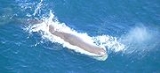
Sperm Whale

Encyclopedia
The sperm whale, Physeter macrocephalus, is a marine mammal species, order Cetacea
, a toothed whale
(odontocete) having the largest brain of any animal. The name comes from the milky-white waxy substance, spermaceti
, found in the animal's head. The sperm whale is the only living member of genus Physeter. The now outdated synonym Physeter catodon refers to the same species
. It is one of three extant species in the sperm whale superfamily
, along with the pygmy sperm whale
and dwarf sperm whale
.
A mature male can grow to 20.5 metres (67.3 ft) long. It is the largest living toothed animal. For large males, the head can represent up to one-third of the animal's length. It has a cosmopolitan distribution
across the oceans. The species feeds primarily on squid
but to some extent on fish
, diving as deep as 3 kilometres (9,842.5 ft), which makes it the deepest diving mammal. Its diet includes giant squid
and colossal squid
. The sperm whale's clicking vocalization is the loudest sound produced by any mammal, and the second loudest of any animal. The loudest animal is the tiger pistol shrimp
. The functions of the clicking are uncertain. These whales live in groups called social units. Units of females and their young live separately from sexually mature males. The females cooperate to protect and nurse
their young. Females give birth every three to six years, and care for the calves for more than a decade. The sperm whale has few natural predators, since few are strong enough to successfully attack a healthy adult; orcas attack units and are capable of killing the calves. The sperm whale can live for more than 70 years.
Historically, the sperm whale was also known as the common cachalot; "cachalot" is derived from an archaic French word for "tooth". Over most of the period from the early 18th century until the late 20th century, the sperm whale was hunted
to obtain spermaceti
and other products, such as sperm oil and ambergris
. Spermaceti found many important uses, such as candle
s, soap
, cosmetics
and machine oil. Due to its size, the sperm whale could sometimes defend itself effectively against whalers. In the most famous example, a sperm whale attacked and sank the American whaleship Essex in 1820. As a result of whaling, the sperm whale is currently listed as vulnerable
by the IUCN.
of spermaceti whale. Spermaceti
, originally mistaken for the whales' "sperm", is the semi-liquid, waxy substance found in the spermaceti organ or case in front of and above the skull bone and also in the junk, the area below the spermaceti organ and just above the upper jaw. The case consists of a soft white, waxy substance saturated with spermaceti oil. The junk is composed of cavities filled with the same wax and spermaceti oil and intervening connective tissue
.
The sperm whale is also known as the "cachalot", which is thought to derive from the archaic French for "tooth" or "big teeth", as preserved for example in cachau in the Gascon
dialect (a word of either Romance
or Basque
origin). The etymological dictionary of Corominas says the origin is uncertain, but it suggests that it comes from the vulgar Latin cappula, plural of cappulum, sword hilt. According to Encarta Dictionary
, the word cachalot came to English "via French from Spanish or Portuguese cachalote, perhaps from [Portuguese] cachola, 'big head'". The term is retained in the Russian word for the animal, кашалот (kashalot), as well as in many other languages.
The sperm whale is the largest toothed whale, with adult males measuring up to 20.5 metres (67.3 ft) long and weighing up to 57000 kilogram. By contrast, the second largest toothed whale, Baird's Beaked Whale measures 12.8 metres (42 ft) and weighs up to 15 short tons (13,607.8 kg). The Nantucket Whaling Museum
has a 5.5 metres (18 ft)-long jawbone. The museum claims that this individual was 80 feet (24.4 m) long; the whale that sank the Essex (one of the incidents behind Moby-Dick
) was claimed to be 85 feet (25.9 m). However, there is disagreement on the claims of adult males approaching or exceeding 80 feet (24.4 m) in length.
Extensive whaling may have decreased their size, as males were highly sought, primarily after World War II
. Today, males do not usually exceed 18.3 metres (60 ft) in length or 51000 kilogram in weight. In 1991, T. Kasuya concluded that exploitation by overfishing virtually had no effect on the size of the mature male sperm whales, and that their size may have actually increased through density-dependent effects.
It is among the most sexually dimorphic
of all cetaceans. At birth both sexes are about the same size, but mature males are typically 30% to 50% longer and three times as massive as females.
is located very close to the front of the head and shifted to the whale's left. This gives rise to a distinctive bushy, forward-angled spray.
 The sperm whale's flukes are triangular and very thick. The whale lifts its flukes high out of the water as it begins a feeding dive. It has a series of ridges on the back's caudal third instead of a dorsal fin
. The largest ridge was called the 'hump' by whalers, and can be mistaken for a dorsal fin
because of its shape and size.
In contrast to the smooth skin of most large whales, its back skin is usually wrinkly and has been likened to a prune by whale-watching enthusiasts. Skin is normally a uniform grey in color, though it may appear brown in sunlight. Albinos have also been reported.
s and elephant seal
s, are the deepest-diving mammals. Sperm whales are believed to be able to reach 3 kilometres (1.9 mi) and remain submerged for 90 minutes. More typical dives are around 400 metres (1,312.3 ft) and 35 minutes in duration. At these great depths, sperm whales sometimes become entangled in transoceanic telephone cables
and drown.
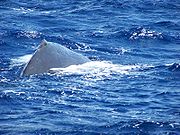 The sperm whale has adapted to cope with drastic pressure changes when diving. The flexible ribcage allows lung collapse, reducing nitrogen
intake, and metabolism
can decrease to conserve oxygen
. Myoglobin
, which stores oxygen in muscle tissue, is much more abundant than in terrestrial animals. The blood
has a high red blood cell
density, which contain oxygen-carrying hemoglobin
. The oxygenated blood can be directed towards the brain and other essential organs only when oxygen levels deplete. The spermaceti organ may also play a role by adjusting buoyancy
(see below).
While sperm whales are well adapted to diving, repeated dives to great depths have long term effects. Bones show pitting that signals decompression sickness
in humans. Older skeletons showed the most extensive pitting, whereas calves showed no damage. This damage may indicate that sperm whales are susceptible to decompression sickness, and sudden surfacing could be lethal to them.
Between dives, the sperm whale surfaces to breathe for about eight minutes before diving again. Odontoceti (toothed whales) breathe air at the surface through a single, S-shaped blowhole. Sperm whales spout (breathe) 3–5 times per minute at rest, increasing to 6–7 times per minute after a dive. The blow is a noisy, single stream that rises up to 2 metres (6.6 ft) or more above the surface and points forward and left at a 45° angle. On average, females and juveniles blow every 12.5 seconds before dives, while large males blow every 17.5 seconds before dives.
is the largest
known of any modern or extinct animal, weighing on average about 8 kilograms (17.6 lb), though the sperm whale has a lower encephalization quotient
than many other whale and dolphin
species, lower than that of non-human anthropoid ape
s, and much lower than human
s'.
Due to light absorption by water, most of the ocean is dark beyond a few hundred meters thus limiting visual range. As a result, sperm whales and the other toothed whales (suborder odontoceti) have evolved a system of echolocation
as the main way to find food in the darkness of the ocean similar to that used by bats
to find food in the darkness of the night sky. When echolocating, the sperm whale emits a directionally focused beam of broadband clicks. Clicks are generated by the forcing of air through a pair of phonic lips (also known as "monkey lips" or "museau de singe") at the front end of the nose, just below the blowhole. The sound then travels backwards along the length of the nose through the spermaceti organ. Most of the sound energy is then reflected off an air sac which sits against the skull and down into the Junk Bodies, where the sound is focused by the junk's lens-like structure.. Some of the sound will reflect back into the spermaceti organ and back towards the front of the whale's nose where it will be reflect through the spermaceti organ a third time. This back and forth reflection which happens on the scale of a few milliseconds creates a multi-pulse click structure. This mult--pulse click structure actually allows researchers to measure the whale's spermaceti organ using only the sound of its clicks and given the size of the spermaceti organ relates to the size of the whale, biologist can measure the whales be recording their echolocation clicks . The lower jaw is the primary reception path for the echoes. A continuous fat-filled canal transmits received sounds to the inner ear.
The spermaceti organs may also help adjust the whale's buoyancy
. It is hypothesized that before the whale dives, cold water enters the organ, and it is likely that the blood vessels constrict, reducing blood flow, and, hence, temperature. The wax therefore solidifies and reduces in volume. The increase in specific density generates a down force of about 392 newtons (864.2 lb) and allows the whale to dive with less effort. During the hunt, oxygen consumption, together with blood vessel dilation, produces heat and melts the spermaceti, increasing its buoyancy and enabling easy surfacing. However, more recent work have found many problems with this theory including the lack of anatomical structures for the actual heat exchange.
Herman Melville
's Moby Dick suggests that the "case" containing the spermaceti had evolved as a kind of battering ram for use in fights between males. However, there are almost no modern accounts of fights between male sperm whales. Apart from a few famous exceptions of the well-documented sinking of the ships Essex and Ann Alexander
by attackers estimated to weigh only one-fifth as much as the ships, this hypothesis is not well supported in current scientific literature.
s.
It is relatively abundant from the poles to the equator and is found in all the oceans. It inhabits the Mediterranean Sea
, but not the Black Sea
, while its presence in the Red Sea
is uncertain. The shallow entrances to both the Black Sea and the Red Sea may account for their absence. The Black Sea's lower layers are also anoxic and contain high concentrations of sulphur compounds such as hydrogen sulphide.
Populations are denser close to continental shelves
and canyons. Sperm whales are usually found in deep off-shore waters, but may be seen closer to shore in areas where the continental shelf is small and drops quickly to depths of 310–920 m (1,017.1–3,018.4 ft). Coastal areas with significant sperm whale populations include the Azores
and the Caribbean
island of Dominica
.
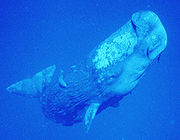 Sperm whales can live 70 years or more. They are a prime example of a species that has been K-selected
, i.e., their reproductive strategy is associated with stable environmental conditions and comprises a low birth rate, significant parental aid to offspring, slow maturation, and high longevity.
How they choose mates has not been definitively determined. There is evidence that males have dominance hierarchies, and there is also evidence that female choice influences mating. Gestation
requires 14 to 16 months, producing a single calf. Lactation
proceeds for 19 to 42 months, but calves may suckle up to 13 years (although usually less). Calves can suckle from females other than their mothers. Females generally have birth intervals of three to six years.
Females reach sexual maturity between 7 and 13 years; males follow beginning at 18 years. Upon reaching sexual maturity, males move to higher latitude
s, where the water is colder and feeding is more productive. Females remain at lower latitudes. Males reach their full size at about age 50.
The most common non-human attacker of sperm whales is the orca
, but pilot whale
s and the false killer whale
also sometimes harass them. Orcas prey on target groups of females with young, usually making an effort to extract and kill a calf. Female sperm whales repel these attacks by encircling their calves. The adults either face inwards to use their tail flukes against the orcas, or outwards, fighting with their teeth. This marguerite formation, named after the flower, is also used by whales to support an injured unit member. Early whalers exploited this behavior, attracting a whole unit by injuring one of its members. If the orca pod is extremely large, its members may sometimes be able to kill adult female sperm whales. Large mature male sperm whales have no non-human predators, and are believed to be too large, powerful and aggressive to be threatened by orcas.
 Sperm Whales usually dive between 300 to 800 m (984.3 to 2,624.7 ft), and sometimes 1–2 km (3,280.8–6,561.7 ft) to search for food. Such dives can last more than an hour. They feed on several species, notably the giant squid
, the colossal squid
, octopus
es, and diverse fish like demersal
ray
s, but the main part of their diet consists of medium-sized squid
. Some prey may be taken incidentally while eating other items. Most of what is known about deep sea squid has been learned from specimens in captured sperm whale stomachs, although more recent studies analysed fecal matter. One study, carried out around the Galápagos, found that squid from the genera Histioteuthis
(62%), Ancistrocheirus (16%), and Octopoteuthis (7%) weighing between 12 and 650 g (0.0264554714621853 and 1.4 lb) were the most commonly taken. Battles between sperm whales and colossal squid
(which have been measured to weigh nearly 500 kilograms (1,102.3 lb)) have never been observed by humans; however white scars are believed to be caused by the large squid. One study published in 2010 collected evidence that suggests that female sperm whales may collaborate when hunting Humboldt squid
.
An older study, examining whales captured by the New Zealand whaling fleet in the Cook Strait
region, found a 1.69:1 ratio of squid to fish by weight. Sperm whales sometimes steal Sablefish and Toothfish from long lines. Long-line fishing
operations in the Gulf of Alaska
complain that sperm whales take advantage of their fishing operations to eat desirable species straight off the line, sparing the whales the need to hunt. However, the amount of fish taken is very little compared to what the sperm whale needs per day. Video footage has been captured of a large male sperm whale "bouncing" a long line, to gain the fish. Sperm whales are believed to prey on the megamouth shark
, a rare and large deep-sea species discovered in the 1970s. In one case, three sperm whales were observed attacking or playing with a megamouth.
The sharp beak of a consumed squid lodged in the whale's intestine may lead to the production of ambergris
, analogous to the production of pearl
s. The irritation of the intestines caused by squid beaks stimulates the secretion of this lubricant-like substance. Sperm whales are prodigious feeders and eat around 3% of their body weight
per day. The total annual consumption of prey by sperm whales worldwide is estimated to be about 100000000 short tons (90,718,474 t) — a figure greater than the total consumption of marine animals by humans each year.
It is not well understood why the sperm whale's head is so large in comparison to the lower jaw. One theory is that the sperm whale's ability to echolocate
through its head aids in hunting. However squid, its main prey, may have acoustic properties too similar to seawater to reflect sounds. The sperm whale's head contains a structure called the phonic lips, also known as the monkey lips, through which it blows air. This can create clicks that have a source level exceeding 230 decibel
s re 1 micropascal referenced to a distance of 1 metres (3.3 ft) – in other words it is by far the loudest sound made by any animal, and 10–14 dB louder than a powerful rifle sounds in air at 1 metres (3.3 ft) away. It has been hypothesised that clicks attempt to stun prey. Experimental studies attempting to duplicate this effect have been unable to replicate the supposed injuries, casting doubt on this idea.
Cetacea
, the order containing all whales and dolphins. It is a member of the suborder Odontoceti, the suborder containing all the toothed whales and dolphins. It is the sole extant species of its genus, Physeter, in the family Physeteridae. Two species of the related extant genus Kogia, the pygmy sperm whale
Kogia breviceps and the dwarf sperm whale
K. simus, are either placed in this family, or in the family Kogiidae. In some taxonomic schemes the families Kogiidae and Physeteridae are combined as the superfamily Physeteroidea (see the separate entry on the sperm whale family
).
The sperm whale is one of the species originally described by Linnaeus
in 1758 in his 18th century work, Systema Naturae
. He recognised four species in the genus Physeter. Experts soon realised that just one such species exists, although there has been debate about whether this should be named P. catodon or P. macrocephalus, two of the names used by Linnaeus. Both names are still used, although most recent authors now accept macrocephalus as the valid name, limiting catodons status to a lesser synonym.
Physeteroidea, which includes the last common ancestor of the modern sperm whale, pygmy sperm whale
and dwarf sperm whale
, plus
all of that ancestor's descendants. These fossils include Ferecetotherium, Idiorophus, Diaphorocetus, Aulophyseter
, Orycterocetus
, Scaldicetus, Placoziphius, Zygophyseter
and Acrophyseter. Ferecetotherium, found in Azerbaijan
and dated to the late Oligocene
(about ), is the most primitive fossil that has been found which possesses sperm whale-specific features such as an asymmetric rostrum
("beak" or "snout"). Most sperm whale fossils date from the Miocene
period, . Diaphorocetus, from Argentina
, has been dated to the early Miocene
. Fossil sperm whales from the Middle Miocene
include Aulophyseter, Idiorophus and Orycterocetus, all of which were found on the west coast of the United States
, and Scaldicetus, found in Europe
and Japan
. Orycterocetus fossils have also been found in the North Atlantic Ocean
and the Mediterranean Sea
, in addition to the west coast of the United States. Placoziphius, found in Europe, and Acrophyseter, from Peru
, are dated to the late Miocene.
Fossil sperm whales differ from modern sperm whales in tooth count and the shape of the face and jaws. For example Scaldicetus had a tapered rostrum. Genera from the Oligocene and early and middle Miocene, with the possible exception of Aulophyseter, had teeth in their upper jaws. Acrophyseter, from the late Miocene, also had teeth in both the upper and lower jaws as well as a short rostrum and an upward curving mandible
(lower jaw). These anatomical differences suggest that fossil species may not have necessarily been deep-sea squid
eaters like the modern sperm whale, but that some genera mainly ate fish. Zygophyseter, dated from the middle to late Miocene and found in southern Italy
, had teeth in both jaws and appears to have been adapted to feed on large prey, rather like the modern Orca
(Killer Whale).
period, and that the super-family Physeteroidea, which contains the sperm whale, dwarf sperm whale, and pygmy sperm whale, diverged from other toothed whales soon after that, over . In 1993–1996 molecular phylogenetics analyses by Milinkovitch and colleagues, based on comparing the genes
of various modern whales, suggested that the sperm whales are more closely related to the baleen whales than they are to other toothed whales, which would have meant that Odontoceti were not monophyletic, in other words did not consist of a single ancestral toothed whale species and all its descendants. However more recent studies, based on various combinations of comparative anatomy
and molecular phylogenetics, criticised Milinkovitch's analysis on technical grounds and re-affirmed that the Odontoceti are monophyletic.
These analyses also confirm that there was a rapid evolutionary radiation
(diversification) of the Physeteroidea in the Miocene
period. The Kogiidae (dwarf and pygmy sperm whales) diverged from the Physeteridae (true sperm whales) at least .
, obtained primarily from the spermaceti organ, and sperm oil
, obtained primarily from the blubber in the body, were much sought after by 18th, 19th, and 20th century whalers
. These substances found a variety of commercial applications, such as candle
s, soap
, cosmetics
, machine oil, other specialized lubricants, lamp oil, pencils, crayons, leather waterproofing, rust-proofing materials and many pharmaceutical compounds. Ambergris
, a solid, waxy, flammable substance produced in the digestive system of sperm whales, was also sought as a fixative
in perfumery.
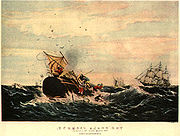 Prior to the early 18th century, hunting was mostly by indigenous Indonesians. Legend has it that sometime in the early 18th century, around 1712, Captain Christopher Hussey, while cruising for right whale
s near shore, was blown offshore by a northerly wind, where he encountered a sperm whale pod and killed one. Although the story may not be true, sperm whales were indeed soon exploited by American whalers. Judge Paul Dudley, in his Essay upon the Natural History of Whales (1725), states that one Atkins, ten or twelve years in the trade, was among the first to catch sperm whales sometime around 1720 off the New England
coast.
There were only a few recorded catches during the first few decades (1709-1730s) of offshore sperm whaling. Instead sloop
s concentrated on Nantucket Shoals
where they would have taken right whales or went to the Davis Strait
region to catch bowhead whale
s. By the early 1740s, with the advent of spermaceti candles (before 1743), American vessels began to focus on sperm whales. The diary of Benjamin Bangs (1721–1769) shows that, along with the bumpkin sloop he sailed, he found three other sloops flensing sperm whales off the coast of North Carolina in late May 1743. On returning to Nantucket in the summer 1744 on a subsequent voyage he noted that "45 spermacetes are brought in here this day," another indication that American sperm whaling was in full swing.
 American sperm whaling soon spread from the east coast of the American colonies to the Gulf Stream
, the Grand Banks
, West Africa (1763), the Azores
(1765), and the South Atlantic (1770s). From 1770 to 1775 Massachusetts, New York, Connecticut, and Rhode Island ports produced 45,000 barrels of sperm oil annually, compared to 8,500 of whale oil. In the same decade the British began sperm whaling, employing American ships and personnel. By the following decade the French had entered the trade, also employing American expertise. Sperm whaling increased until the mid-19th century. Spermaceti oil was important in public lighting (for example, in lighthouses, where it was used in the United States until 1862, when it was replaced by lard oil, in turn replaced by petroleum
) and for lubricating the machines (such as those used in cotton mills) of the Industrial Revolution
. Sperm whaling declined in the second half of the 19th century, as petroleum came in to broader use. In that sense, it may be said to have protected whale populations from even greater exploitation. Sperm whaling in the 18th century began with small sloops carrying only one or two whaleboats. The fleet's scope and size increased over time, and larger ships entered the fishery. In the late 18th century and early 19th century sperm whaling ships sailed to the Pacific, the Indian Ocean, Japan, the coast of Arabia, Australia and New Zealand. Hunting could be dangerous to the crew, since sperm whales (especially bulls) will readily fight to defend themselves against attack, unlike most baleen whales. When dealing with a threat, sperm whales will use their huge head effectively as a battering ram. Arguably the most famous sperm whale counterattack occurred on November 20, 1820, when a whale claimed to be about 25.9 metres (85 ft) long rammed and sank the Nantucket whaleship Essex. Only 8 out of 21 sailors survived to be rescued by other ships. This instance is popularly believed to have inspired Herman Melville
's famous "Moby Dick".
The sperm whale's ivory-like teeth were often sought by 18th and 19th-century whalers, who used them to produce inked carvings known as scrimshaw
. Thirty teeth of the sperm whale can be used for ivory. Each of these teeth (up to 8 inches long and 3 inches across), are hollow for the first half of their length. Like walrus
ivory, sperm whale ivory has two distinct layers. However, sperm whale ivory contains a much thicker inner layer. Though a widely practiced art in the 19th century, scrimshaw using genuine sperm whale ivory declined substantially after the retirement of the whaling fleets in the 1880s. Currently the Endangered Species Act
and CITES, the Convention on International Trade in Endangered Species of Wild Fauna and Flora, prevents the sales of or trade in sperm whale ivory harvested after 1973 or in scrimshaw crafted from it.
Modern whaling was more efficient than open-boat whaling, employing steam-powered ships and exploding harpoons. Initially, modern whaling activity focused on large baleen whale
s, but as these populations were taken, sperm whaling increased. This was especially true during World War II
when spermaceti
, the fine waxy oil produced by sperm whales, was in high demand for lubricating the American war machine. In both the 1941-2 and 1942-3 seasons, the Norwegian expedition took over 3,000 sperm whales off the coast of Peru alone. After the war whaling continued unabated to obtain oil for cosmetics and high-performance machinery, such as automobile transmissions.
The hunting led to the near extinction of large whales including sperm whales until bans on whale oil use were instituted in 1972.International Whaling Commission
gave the species full protection in 1985. Hunting by Japan
in the northern Pacific Ocean
continued until 1988.
It is estimated that the historic worldwide population numbered 1,100,000 before commercial sperm whaling began in the early 18th century. By 1880 it had declined by an estimated 29 per cent. From that date until 1946 the population appears to have recovered somewhat as whaling pressure lessened, but after the Second World War, the population declined even further, to only 33 per cent of the pre-whaling era. It has been estimated that in the 19th century between 184,000 and 236,000 sperm whales were killed by the various whaling nations, while in the modern era, at least 770,000 were taken, the majority between 1946 and 1980.
Sperm whales increase the levels of primary production and carbon export by depositing iron rich faeces into surface waters of the Southern Ocean. The iron rich faeces causes phytoplankton to grow and take up more carbon from the atmosphere. When the phytoplankton dies, it sinks to the deep ocean and takes the atmospheric carbon with it. By reducing the abundance of sperm whales in the Southern Ocean, whaling has resulted in an extra 2 million tonnes of carbon remaining in the atmosphere each year.
Remaining sperm whale populations are large enough that the species' conservation status is rated as vulnerable rather than endangered. However, the recovery from the whaling years is a slow process, particularly in the South Pacific, where the toll on breeding-age males was severe.
operations in the Gulf of Alaska
have complained about sperm whales stealing fish from their lines.
Entanglement in fishing nets and collisions with ships represent the greatest threats to the sperm whale population currently. Other current threats include ingestion of marine debris, ocean noise, and chemical pollution. The IUCN regards the sperm whale as being "vulnerable". The species is listed as endangered on the United States Endangered Species Act
.
The species is listed on Appendix I and Appendix II of the Convention on the Conservation of Migratory Species of Wild Animals (CMS). It is listed on Appendix I as this species has been categorized as being in danger of extinction throughout all or a significant proportion of their range and CMS Parties strive towards strictly protecting these animals, conserving or restoring the places where they live, mitigating obstacles to migration and controlling other factors that might endanger them. It is listed on Appendix II as it has an unfavourable conservation status or would benefit significantly from international co-operation organised by tailored agreements. It is also covered by the Agreement on the Conservation of Cetaceans in the Black Sea, Mediterranean Sea and Contiguous Atlantic Area (ACCOBAMS
) and Memorandum of Understanding for the Conservation of Cetaceans and Their Habitats in the Pacific Islands Region
(Pacific Cetaceans MOU).
, the Māori know them as "rei puta" and were rare because sperm whales were not actively hunted in traditional Māori society. Whale ivory and bone were taken from beached whales. In Fiji
the teeth are known as tabua
and they were traditionally given as gifts for atonement or esteem (called sevusevu), and were important in negotiations between rival chiefs. Friedrich Ratzel
in The History of Mankind reported in 1896 that, in Fiji, whales' or cachalots' teeth were the most-demanded article of ornament or value. They occurred often in necklaces. Today the tabua remains an important item in Fijian life. The teeth were originally rare in Fiji and Tonga
, which exported teeth, but with the Europeans' arrival, teeth flooded the market and this "currency" collapsed. The oversupply led in turn to the development of the European art of scrimshaw
.
Herman Melville
's novel Moby-Dick
is based on a true story about a sperm whale that attacked the whaleship Essex. Melville associated the sperm whale with the Bible's Leviathan
. The fearsome reputation perpetuated by Melville was based on bull whales' ability to fiercely defend themselves from attacks by early whalers, occasionally resulting in the destruction of the whaling ships.
Jules Verne
's Twenty Thousand Leagues Under the Sea
, mentions cachalots (perhaps incorrectly) as preying on fellow whales.
The Sperm Whale was designated as the Connecticut
state animal by the CT General Assembly
in 1975. It was selected because of its specific contribution to the state's history and because of its present-day plight as an endangered species.
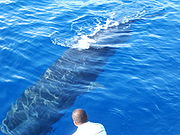
, due to their long dive times and ability to travel long distances underwater. However, due to the distinctive look and large size of the whale, watching is increasingly popular. Sperm whale watchers often use hydrophone
s to listen to the clicks of the whales and locate them before they surface. Popular locations for sperm whale watching include the picturesque Kaikoura
on New Zealand
's South Island
, Andenes
and Tromsø
in Arctic Norway
; as well as the Azores
, where the continental shelf is so narrow that whales can be observed from the shore, and Dominica
where a long-term scientific research program, The Dominica Sperm Whale Project, has been in operating since 2005.
Cetacea
The order Cetacea includes the marine mammals commonly known as whales, dolphins, and porpoises. Cetus is Latin and is used in biological names to mean "whale"; its original meaning, "large sea animal", was more general. It comes from Ancient Greek , meaning "whale" or "any huge fish or sea...
, a toothed whale
Toothed whale
The toothed whales form a suborder of the cetaceans, including sperm whales, beaked whales, dolphins, and others. As the name suggests, the suborder is characterized by the presence of teeth rather than the baleen of other whales.-Anatomy:Toothed whales have a single blowhole on the top of the head...
(odontocete) having the largest brain of any animal. The name comes from the milky-white waxy substance, spermaceti
Spermaceti
Spermaceti is a wax present in the head cavities of the sperm whale . Originally mistaken for the whales' sperm , spermaceti is created in the spermaceti organ inside the whale's head and connected to its nasal passage...
, found in the animal's head. The sperm whale is the only living member of genus Physeter. The now outdated synonym Physeter catodon refers to the same species
Species
In biology, a species is one of the basic units of biological classification and a taxonomic rank. A species is often defined as a group of organisms capable of interbreeding and producing fertile offspring. While in many cases this definition is adequate, more precise or differing measures are...
. It is one of three extant species in the sperm whale superfamily
Sperm whale family
Physeteroidea is a superfamily including just three living species of whale; the Sperm Whale, in the genus Physeter, and the Pygmy Sperm Whale and Dwarf Sperm Whale, in the genus Kogia...
, along with the pygmy sperm whale
Pygmy Sperm Whale
The Pygmy Sperm Whale is one of three species of toothed whale in the sperm whale family. They are not often sighted at sea, and most of what is known about them comes from the examination of stranded specimens.-Taxonomy:...
and dwarf sperm whale
Dwarf Sperm Whale
The Dwarf Sperm Whale is one of three species in the sperm whale family. They are not often sighted at sea. As such, most information is a result of the study of stranded carcasses.-Taxonomy:...
.
A mature male can grow to 20.5 metres (67.3 ft) long. It is the largest living toothed animal. For large males, the head can represent up to one-third of the animal's length. It has a cosmopolitan distribution
Cosmopolitan distribution
In biogeography, a taxon is said to have a cosmopolitan distribution if its range extends across all or most of the world in appropriate habitats. For instance, the killer whale has a cosmopolitan distribution, extending over most of the world's oceans. Other examples include humans, the lichen...
across the oceans. The species feeds primarily on squid
Squid
Squid are cephalopods of the order Teuthida, which comprises around 300 species. Like all other cephalopods, squid have a distinct head, bilateral symmetry, a mantle, and arms. Squid, like cuttlefish, have eight arms arranged in pairs and two, usually longer, tentacles...
but to some extent on fish
Fish
Fish are a paraphyletic group of organisms that consist of all gill-bearing aquatic vertebrate animals that lack limbs with digits. Included in this definition are the living hagfish, lampreys, and cartilaginous and bony fish, as well as various extinct related groups...
, diving as deep as 3 kilometres (9,842.5 ft), which makes it the deepest diving mammal. Its diet includes giant squid
Giant squid
The giant squid is a deep-ocean dwelling squid in the family Architeuthidae, represented by as many as eight species...
and colossal squid
Colossal Squid
The colossal squid , sometimes called the Antarctic or giant cranch squid, is believed to be the largest squid species in terms of mass. It is the only known member of the genus Mesonychoteuthis...
. The sperm whale's clicking vocalization is the loudest sound produced by any mammal, and the second loudest of any animal. The loudest animal is the tiger pistol shrimp
Tiger pistol shrimp
The tiger pistol shrimp, Alpheus bellulus, is a species of snapping shrimp. It lives in symbiosis with gobies such as species of Amblyeleotris and Cryptocentrus. It is also one of the loudest creatures on earth as the tiger pistol shrimp can emit a sound up to 200 decibels which it uses to stun its...
. The functions of the clicking are uncertain. These whales live in groups called social units. Units of females and their young live separately from sexually mature males. The females cooperate to protect and nurse
Lactation
Lactation describes the secretion of milk from the mammary glands and the period of time that a mother lactates to feed her young. The process occurs in all female mammals, however it predates mammals. In humans the process of feeding milk is called breastfeeding or nursing...
their young. Females give birth every three to six years, and care for the calves for more than a decade. The sperm whale has few natural predators, since few are strong enough to successfully attack a healthy adult; orcas attack units and are capable of killing the calves. The sperm whale can live for more than 70 years.
Historically, the sperm whale was also known as the common cachalot; "cachalot" is derived from an archaic French word for "tooth". Over most of the period from the early 18th century until the late 20th century, the sperm whale was hunted
Whaling
Whaling is the hunting of whales mainly for meat and oil. Its earliest forms date to at least 3000 BC. Various coastal communities have long histories of sustenance whaling and harvesting beached whales...
to obtain spermaceti
Spermaceti
Spermaceti is a wax present in the head cavities of the sperm whale . Originally mistaken for the whales' sperm , spermaceti is created in the spermaceti organ inside the whale's head and connected to its nasal passage...
and other products, such as sperm oil and ambergris
Ambergris
Ambergris is a solid, waxy, flammable substance of a dull gray or blackish color produced in the digestive system of and regurgitated or secreted by sperm whales....
. Spermaceti found many important uses, such as candle
Candle
A candle is a solid block or cylinder of wax with an embedded wick, which is lit to provide light, and sometimes heat.Today, most candles are made from paraffin. Candles can also be made from beeswax, soy, other plant waxes, and tallow...
s, soap
Soap
In chemistry, soap is a salt of a fatty acid.IUPAC. "" Compendium of Chemical Terminology, 2nd ed. . Compiled by A. D. McNaught and A. Wilkinson. Blackwell Scientific Publications, Oxford . XML on-line corrected version: created by M. Nic, J. Jirat, B. Kosata; updates compiled by A. Jenkins. ISBN...
, cosmetics
Cosmetics
Cosmetics are substances used to enhance the appearance or odor of the human body. Cosmetics include skin-care creams, lotions, powders, perfumes, lipsticks, fingernail and toe nail polish, eye and facial makeup, towelettes, permanent waves, colored contact lenses, hair colors, hair sprays and...
and machine oil. Due to its size, the sperm whale could sometimes defend itself effectively against whalers. In the most famous example, a sperm whale attacked and sank the American whaleship Essex in 1820. As a result of whaling, the sperm whale is currently listed as vulnerable
Vulnerable species
On 30 January 2010, the IUCN Red List of Threatened Species identified 9694 Vulnerable species, subspecies and varieties, stocks and sub-populations.-References:...
by the IUCN.
Name
The name sperm whale is an apocopationApocope
In phonology, apocope is the loss of one or more sounds from the end of a word, and especially the loss of an unstressed vowel.-Historical sound change:...
of spermaceti whale. Spermaceti
Spermaceti
Spermaceti is a wax present in the head cavities of the sperm whale . Originally mistaken for the whales' sperm , spermaceti is created in the spermaceti organ inside the whale's head and connected to its nasal passage...
, originally mistaken for the whales' "sperm", is the semi-liquid, waxy substance found in the spermaceti organ or case in front of and above the skull bone and also in the junk, the area below the spermaceti organ and just above the upper jaw. The case consists of a soft white, waxy substance saturated with spermaceti oil. The junk is composed of cavities filled with the same wax and spermaceti oil and intervening connective tissue
Connective tissue
"Connective tissue" is a fibrous tissue. It is one of the four traditional classes of tissues . Connective Tissue is found throughout the body.In fact the whole framework of the skeleton and the different specialized connective tissues from the crown of the head to the toes determine the form of...
.
The sperm whale is also known as the "cachalot", which is thought to derive from the archaic French for "tooth" or "big teeth", as preserved for example in cachau in the Gascon
Gascon language
Gascon is usually considered as a dialect of Occitan, even though some specialists regularly consider it a separate language. Gascon is mostly spoken in Gascony and Béarn in southwestern France and in the Aran Valley of Spain...
dialect (a word of either Romance
Romance languages
The Romance languages are a branch of the Indo-European language family, more precisely of the Italic languages subfamily, comprising all the languages that descend from Vulgar Latin, the language of ancient Rome...
or Basque
Basque language
Basque is the ancestral language of the Basque people, who inhabit the Basque Country, a region spanning an area in northeastern Spain and southwestern France. It is spoken by 25.7% of Basques in all territories...
origin). The etymological dictionary of Corominas says the origin is uncertain, but it suggests that it comes from the vulgar Latin cappula, plural of cappulum, sword hilt. According to Encarta Dictionary
Encarta
Microsoft Encarta was a digital multimedia encyclopedia published by Microsoft Corporation from 1993 to 2009. , the complete English version, Encarta Premium, consisted of more than 62,000 articles, numerous photos and illustrations, music clips, videos, interactive contents, timelines, maps and...
, the word cachalot came to English "via French from Spanish or Portuguese cachalote, perhaps from [Portuguese] cachola, 'big head'". The term is retained in the Russian word for the animal, кашалот (kashalot), as well as in many other languages.
Size
| Average sizes | Length | Weight |
|---|---|---|
| Bull | 16 metres (52.5 ft) | 41000 kilogram |
| Cow | 11 metres (36.1 ft) | 14000 kilogram |
| Newborn | 4 metres (13.1 ft) | 1000 kilogram |
The sperm whale is the largest toothed whale, with adult males measuring up to 20.5 metres (67.3 ft) long and weighing up to 57000 kilogram. By contrast, the second largest toothed whale, Baird's Beaked Whale measures 12.8 metres (42 ft) and weighs up to 15 short tons (13,607.8 kg). The Nantucket Whaling Museum
Nantucket Whaling Museum
The Nantucket Whaling Museum is a museum located in Nantucket, Massachusetts, dedicated to the history of whaling. It is run by the Nantucket Historical Association.- Exhibits :...
has a 5.5 metres (18 ft)-long jawbone. The museum claims that this individual was 80 feet (24.4 m) long; the whale that sank the Essex (one of the incidents behind Moby-Dick
Moby-Dick
Moby-Dick; or, The Whale, was written by American author Herman Melville and first published in 1851. It is considered by some to be a Great American Novel and a treasure of world literature. The story tells the adventures of wandering sailor Ishmael, and his voyage on the whaleship Pequod,...
) was claimed to be 85 feet (25.9 m). However, there is disagreement on the claims of adult males approaching or exceeding 80 feet (24.4 m) in length.
Extensive whaling may have decreased their size, as males were highly sought, primarily after World War II
World War II
World War II, or the Second World War , was a global conflict lasting from 1939 to 1945, involving most of the world's nations—including all of the great powers—eventually forming two opposing military alliances: the Allies and the Axis...
. Today, males do not usually exceed 18.3 metres (60 ft) in length or 51000 kilogram in weight. In 1991, T. Kasuya concluded that exploitation by overfishing virtually had no effect on the size of the mature male sperm whales, and that their size may have actually increased through density-dependent effects.
It is among the most sexually dimorphic
Sexual dimorphism
Sexual dimorphism is a phenotypic difference between males and females of the same species. Examples of such differences include differences in morphology, ornamentation, and behavior.-Examples:-Ornamentation / coloration:...
of all cetaceans. At birth both sexes are about the same size, but mature males are typically 30% to 50% longer and three times as massive as females.
Appearance
The sperm whales unique body is unlikely to be confused with any other species. The sperm whale's distinctive shape comes from its very large, block-shaped head, which is can be one-quarter to one-third of the animal's length. The S-shaped blowholeBlowhole (biology)
In biology, a blowhole is the hole at the top of a cetacean's head through which the animal breathes air. It is homologous with the nostril of other mammals. As whales reach the water surface to breathe, they will forcefully expel air through the blowhole. Not only is air expelled, but mucus and...
is located very close to the front of the head and shifted to the whale's left. This gives rise to a distinctive bushy, forward-angled spray.
Dorsal fin
A dorsal fin is a fin located on the backs of various unrelated marine and freshwater vertebrates, including most fishes, marine mammals , and the ichthyosaurs...
. The largest ridge was called the 'hump' by whalers, and can be mistaken for a dorsal fin
Dorsal fin
A dorsal fin is a fin located on the backs of various unrelated marine and freshwater vertebrates, including most fishes, marine mammals , and the ichthyosaurs...
because of its shape and size.
In contrast to the smooth skin of most large whales, its back skin is usually wrinkly and has been likened to a prune by whale-watching enthusiasts. Skin is normally a uniform grey in color, though it may appear brown in sunlight. Albinos have also been reported.
Jaws and teeth
The sperm whales' lower jaw is very narrow and underslung. The sperm whale has 18 to 26 teeth on each side of its lower jaw which fit into sockets in the upper jaw. The teeth are cone-shaped and weigh up to 1 kilograms (2.2 lb). The teeth are functional, but do not appear to be necessary for capturing or eating squid, and well-fed animals have been found without teeth. One hypothesis is that the teeth are used in aggression between males. Mature males often show scars which seem to be caused by the teeth. Rudimentary teeth are also present in the upper jaw, but these rarely emerge into the mouth.Respiration and diving
Sperm whales, along with bottlenose whaleBottlenose whale
The Northern bottlenose whale is a species of the ziphiid family, one of two members of the Hyperoodon genus. The northern bottlenose was hunted heavily by Norway and Britain in the 19th and early 20th centuries...
s and elephant seal
Elephant seal
Elephant seals are large, oceangoing seals in the genus Mirounga. There are two species: the northern elephant seal and the southern elephant seal . Both were hunted to the brink of extinction by the end of the 19th century, but numbers have since recovered...
s, are the deepest-diving mammals. Sperm whales are believed to be able to reach 3 kilometres (1.9 mi) and remain submerged for 90 minutes. More typical dives are around 400 metres (1,312.3 ft) and 35 minutes in duration. At these great depths, sperm whales sometimes become entangled in transoceanic telephone cables
Submarine communications cable
A submarine communications cable is a cable laid on the sea bed between land-based stations to carry telecommunication signals across stretches of ocean....
and drown.
Nitrogen
Nitrogen is a chemical element that has the symbol N, atomic number of 7 and atomic mass 14.00674 u. Elemental nitrogen is a colorless, odorless, tasteless, and mostly inert diatomic gas at standard conditions, constituting 78.08% by volume of Earth's atmosphere...
intake, and metabolism
Metabolism
Metabolism is the set of chemical reactions that happen in the cells of living organisms to sustain life. These processes allow organisms to grow and reproduce, maintain their structures, and respond to their environments. Metabolism is usually divided into two categories...
can decrease to conserve oxygen
Oxygen
Oxygen is the element with atomic number 8 and represented by the symbol O. Its name derives from the Greek roots ὀξύς and -γενής , because at the time of naming, it was mistakenly thought that all acids required oxygen in their composition...
. Myoglobin
Myoglobin
Myoglobin is an iron- and oxygen-binding protein found in the muscle tissue of vertebrates in general and in almost all mammals. It is related to hemoglobin, which is the iron- and oxygen-binding protein in blood, specifically in the red blood cells. The only time myoglobin is found in the...
, which stores oxygen in muscle tissue, is much more abundant than in terrestrial animals. The blood
Blood
Blood is a specialized bodily fluid in animals that delivers necessary substances such as nutrients and oxygen to the cells and transports metabolic waste products away from those same cells....
has a high red blood cell
Red blood cell
Red blood cells are the most common type of blood cell and the vertebrate organism's principal means of delivering oxygen to the body tissues via the blood flow through the circulatory system...
density, which contain oxygen-carrying hemoglobin
Hemoglobin
Hemoglobin is the iron-containing oxygen-transport metalloprotein in the red blood cells of all vertebrates, with the exception of the fish family Channichthyidae, as well as the tissues of some invertebrates...
. The oxygenated blood can be directed towards the brain and other essential organs only when oxygen levels deplete. The spermaceti organ may also play a role by adjusting buoyancy
Buoyancy
In physics, buoyancy is a force exerted by a fluid that opposes an object's weight. In a column of fluid, pressure increases with depth as a result of the weight of the overlying fluid. Thus a column of fluid, or an object submerged in the fluid, experiences greater pressure at the bottom of the...
(see below).
While sperm whales are well adapted to diving, repeated dives to great depths have long term effects. Bones show pitting that signals decompression sickness
Decompression sickness
Decompression sickness describes a condition arising from dissolved gases coming out of solution into bubbles inside the body on depressurization...
in humans. Older skeletons showed the most extensive pitting, whereas calves showed no damage. This damage may indicate that sperm whales are susceptible to decompression sickness, and sudden surfacing could be lethal to them.
Between dives, the sperm whale surfaces to breathe for about eight minutes before diving again. Odontoceti (toothed whales) breathe air at the surface through a single, S-shaped blowhole. Sperm whales spout (breathe) 3–5 times per minute at rest, increasing to 6–7 times per minute after a dive. The blow is a noisy, single stream that rises up to 2 metres (6.6 ft) or more above the surface and points forward and left at a 45° angle. On average, females and juveniles blow every 12.5 seconds before dives, while large males blow every 17.5 seconds before dives.
Brain and senses
The brainBrain
The brain is the center of the nervous system in all vertebrate and most invertebrate animals—only a few primitive invertebrates such as sponges, jellyfish, sea squirts and starfishes do not have one. It is located in the head, usually close to primary sensory apparatus such as vision, hearing,...
is the largest
Largest body part
The largest body part is either the largest given body part across all living and extinct organisms or the largest example of a body part within an existing species. The largest animals on the planet are not the only ones to have large body parts, with some smaller animals actually having one...
known of any modern or extinct animal, weighing on average about 8 kilograms (17.6 lb), though the sperm whale has a lower encephalization quotient
Encephalization quotient
Encephalization Quotient , or encephalization level is a measure of relative brain size defined as the ratio between actual brain mass and predicted brain mass for an animal of a given size, which is hypothesized to be a rough estimate of the intelligence of the animal.This is a more refined...
than many other whale and dolphin
Dolphin
Dolphins are marine mammals that are closely related to whales and porpoises. There are almost forty species of dolphin in 17 genera. They vary in size from and , up to and . They are found worldwide, mostly in the shallower seas of the continental shelves, and are carnivores, mostly eating...
species, lower than that of non-human anthropoid ape
Anthropoid ape
Anthropoid apes or manlike apes, the name given to the family of the Simiidae, because, of all the ape-world, they most closely resemble man. This family includes four kinds, the gibbons of S. E. Asia, the orangutans of Borneo and Sumatra, the gorillas of W. Equatorial Africa, and the chimpanzees...
s, and much lower than human
Human
Humans are the only living species in the Homo genus...
s'.
Spermaceti functions
Early on it was proposed that the nasal complex, which includes the spermaceti organ, the junk bodies, and other associated organs, was used as a battering ram (see below) or for buoyancy regulation (see below); however, researchers' current understanding suggest that the primary function of the spermaceti organ and the associated organs in the nose of the sperm whales are used as part of the world's most powerful natural sonar system.Due to light absorption by water, most of the ocean is dark beyond a few hundred meters thus limiting visual range. As a result, sperm whales and the other toothed whales (suborder odontoceti) have evolved a system of echolocation
Animal echolocation
Echolocation, also called biosonar, is the biological sonar used by several kinds of animals.Echolocating animals emit calls out to the environment and listen to the echoes of those calls that return from various objects near them. They use these echoes to locate and identify the objects...
as the main way to find food in the darkness of the ocean similar to that used by bats
Bats
A bat is a flying mammal in the Chiroptera order.Bats may also refer to:-Films:*Bats , starring Lou Diamond Phillips and Bob Gunton*Bats: Human Harvest -Groups:...
to find food in the darkness of the night sky. When echolocating, the sperm whale emits a directionally focused beam of broadband clicks. Clicks are generated by the forcing of air through a pair of phonic lips (also known as "monkey lips" or "museau de singe") at the front end of the nose, just below the blowhole. The sound then travels backwards along the length of the nose through the spermaceti organ. Most of the sound energy is then reflected off an air sac which sits against the skull and down into the Junk Bodies, where the sound is focused by the junk's lens-like structure.. Some of the sound will reflect back into the spermaceti organ and back towards the front of the whale's nose where it will be reflect through the spermaceti organ a third time. This back and forth reflection which happens on the scale of a few milliseconds creates a multi-pulse click structure. This mult--pulse click structure actually allows researchers to measure the whale's spermaceti organ using only the sound of its clicks and given the size of the spermaceti organ relates to the size of the whale, biologist can measure the whales be recording their echolocation clicks . The lower jaw is the primary reception path for the echoes. A continuous fat-filled canal transmits received sounds to the inner ear.
The spermaceti organs may also help adjust the whale's buoyancy
Buoyancy
In physics, buoyancy is a force exerted by a fluid that opposes an object's weight. In a column of fluid, pressure increases with depth as a result of the weight of the overlying fluid. Thus a column of fluid, or an object submerged in the fluid, experiences greater pressure at the bottom of the...
. It is hypothesized that before the whale dives, cold water enters the organ, and it is likely that the blood vessels constrict, reducing blood flow, and, hence, temperature. The wax therefore solidifies and reduces in volume. The increase in specific density generates a down force of about 392 newtons (864.2 lb) and allows the whale to dive with less effort. During the hunt, oxygen consumption, together with blood vessel dilation, produces heat and melts the spermaceti, increasing its buoyancy and enabling easy surfacing. However, more recent work have found many problems with this theory including the lack of anatomical structures for the actual heat exchange.
Herman Melville
Herman Melville
Herman Melville was an American novelist, short story writer, essayist, and poet. He is best known for his novel Moby-Dick and the posthumous novella Billy Budd....
's Moby Dick suggests that the "case" containing the spermaceti had evolved as a kind of battering ram for use in fights between males. However, there are almost no modern accounts of fights between male sperm whales. Apart from a few famous exceptions of the well-documented sinking of the ships Essex and Ann Alexander
Ann Alexander (ship)
The Ann Alexander was a whaling ship from New Bedford, Massachusetts, notable for being rammed by a wounded sperm whale in the South Pacific on August 20, 1851, some thirty years after the famous incident in which the Essex was stove in and sunk by a whale in the same area.-Early History:In her...
by attackers estimated to weigh only one-fifth as much as the ships, this hypothesis is not well supported in current scientific literature.
Distribution
The sperm whale is among the most cosmopolitan species. It prefers ice-free waters over 1000 metres (3,280.8 ft) deep. Although both sexes range through temperate and tropical oceans and seas, only adult males populate higher latitudeLatitude
In geography, the latitude of a location on the Earth is the angular distance of that location south or north of the Equator. The latitude is an angle, and is usually measured in degrees . The equator has a latitude of 0°, the North pole has a latitude of 90° north , and the South pole has a...
s.
It is relatively abundant from the poles to the equator and is found in all the oceans. It inhabits the Mediterranean Sea
Mediterranean Sea
The Mediterranean Sea is a sea connected to the Atlantic Ocean surrounded by the Mediterranean region and almost completely enclosed by land: on the north by Anatolia and Europe, on the south by North Africa, and on the east by the Levant...
, but not the Black Sea
Black Sea
The Black Sea is bounded by Europe, Anatolia and the Caucasus and is ultimately connected to the Atlantic Ocean via the Mediterranean and the Aegean seas and various straits. The Bosphorus strait connects it to the Sea of Marmara, and the strait of the Dardanelles connects that sea to the Aegean...
, while its presence in the Red Sea
Red Sea
The Red Sea is a seawater inlet of the Indian Ocean, lying between Africa and Asia. The connection to the ocean is in the south through the Bab el Mandeb strait and the Gulf of Aden. In the north, there is the Sinai Peninsula, the Gulf of Aqaba, and the Gulf of Suez...
is uncertain. The shallow entrances to both the Black Sea and the Red Sea may account for their absence. The Black Sea's lower layers are also anoxic and contain high concentrations of sulphur compounds such as hydrogen sulphide.
Populations are denser close to continental shelves
Continental shelf
The continental shelf is the extended perimeter of each continent and associated coastal plain. Much of the shelf was exposed during glacial periods, but is now submerged under relatively shallow seas and gulfs, and was similarly submerged during other interglacial periods. The continental margin,...
and canyons. Sperm whales are usually found in deep off-shore waters, but may be seen closer to shore in areas where the continental shelf is small and drops quickly to depths of 310–920 m (1,017.1–3,018.4 ft). Coastal areas with significant sperm whale populations include the Azores
Azores
The Archipelago of the Azores is composed of nine volcanic islands situated in the middle of the North Atlantic Ocean, and is located about west from Lisbon and about east from the east coast of North America. The islands, and their economic exclusion zone, form the Autonomous Region of the...
and the Caribbean
Caribbean
The Caribbean is a crescent-shaped group of islands more than 2,000 miles long separating the Gulf of Mexico and the Caribbean Sea, to the west and south, from the Atlantic Ocean, to the east and north...
island of Dominica
Dominica
Dominica , officially the Commonwealth of Dominica, is an island nation in the Lesser Antilles region of the Caribbean Sea, south-southeast of Guadeloupe and northwest of Martinique. Its size is and the highest point in the country is Morne Diablotins, which has an elevation of . The Commonwealth...
.
Reproduction
R/K selection theory
In ecology, r/K selection theory relates to the selection of combinations of traits in an organism that trade off between quantity or quality of offspring...
, i.e., their reproductive strategy is associated with stable environmental conditions and comprises a low birth rate, significant parental aid to offspring, slow maturation, and high longevity.
How they choose mates has not been definitively determined. There is evidence that males have dominance hierarchies, and there is also evidence that female choice influences mating. Gestation
Gestation
Gestation is the carrying of an embryo or fetus inside a female viviparous animal. Mammals during pregnancy can have one or more gestations at the same time ....
requires 14 to 16 months, producing a single calf. Lactation
Lactation
Lactation describes the secretion of milk from the mammary glands and the period of time that a mother lactates to feed her young. The process occurs in all female mammals, however it predates mammals. In humans the process of feeding milk is called breastfeeding or nursing...
proceeds for 19 to 42 months, but calves may suckle up to 13 years (although usually less). Calves can suckle from females other than their mothers. Females generally have birth intervals of three to six years.
Females reach sexual maturity between 7 and 13 years; males follow beginning at 18 years. Upon reaching sexual maturity, males move to higher latitude
Latitude
In geography, the latitude of a location on the Earth is the angular distance of that location south or north of the Equator. The latitude is an angle, and is usually measured in degrees . The equator has a latitude of 0°, the North pole has a latitude of 90° north , and the South pole has a...
s, where the water is colder and feeding is more productive. Females remain at lower latitudes. Males reach their full size at about age 50.
Social behaviour
Females stay in groups of about a dozen individuals and their young. Mature males leave their "natal unit" somewhere between 4 and 21 years of age. Mature males sometimes form loose "bachelor groups" with other males of similar age and size. As males grow older, they typically live solitary lives. Mature males have beached themselves together, suggesting a degree of cooperation which is not yet fully understood.The most common non-human attacker of sperm whales is the orca
Orca
The killer whale , commonly referred to as the orca, and less commonly as the blackfish, is a toothed whale belonging to the oceanic dolphin family. Killer whales are found in all oceans, from the frigid Arctic and Antarctic regions to tropical seas...
, but pilot whale
Pilot whale
Pilot whales are cetaceans belonging to the genus Globicephala. There are two extant species, the long-finned pilot whale and the short-finned pilot whale . The two are not readily distinguished at sea and analysis of the skulls is the best way to tell the difference between them...
s and the false killer whale
False Killer Whale
The False Killer Whale is a cetacean, and the third largest member of the oceanic dolphin family . It lives in temperate and tropical waters throughout the world. As its name implies, the False Killer Whale shares characteristics, such as appearance, with the more widely known Orca...
also sometimes harass them. Orcas prey on target groups of females with young, usually making an effort to extract and kill a calf. Female sperm whales repel these attacks by encircling their calves. The adults either face inwards to use their tail flukes against the orcas, or outwards, fighting with their teeth. This marguerite formation, named after the flower, is also used by whales to support an injured unit member. Early whalers exploited this behavior, attracting a whole unit by injuring one of its members. If the orca pod is extremely large, its members may sometimes be able to kill adult female sperm whales. Large mature male sperm whales have no non-human predators, and are believed to be too large, powerful and aggressive to be threatened by orcas.
Feeding
Giant squid
The giant squid is a deep-ocean dwelling squid in the family Architeuthidae, represented by as many as eight species...
, the colossal squid
Colossal Squid
The colossal squid , sometimes called the Antarctic or giant cranch squid, is believed to be the largest squid species in terms of mass. It is the only known member of the genus Mesonychoteuthis...
, octopus
Octopus
The octopus is a cephalopod mollusc of the order Octopoda. Octopuses have two eyes and four pairs of arms, and like other cephalopods they are bilaterally symmetric. An octopus has a hard beak, with its mouth at the center point of the arms...
es, and diverse fish like demersal
Demersal zone
The demersal zone is the part of the sea or ocean comprising the water column that is near to the seabed and the benthos. The demersal zone is just above the benthic zone and forms a layer of the larger profundal zone....
ray
Batoidea
Batoidea is a superorder of cartilaginous fish commonly known as rays and skates, containing more than 500 described species in thirteen families...
s, but the main part of their diet consists of medium-sized squid
Squid
Squid are cephalopods of the order Teuthida, which comprises around 300 species. Like all other cephalopods, squid have a distinct head, bilateral symmetry, a mantle, and arms. Squid, like cuttlefish, have eight arms arranged in pairs and two, usually longer, tentacles...
. Some prey may be taken incidentally while eating other items. Most of what is known about deep sea squid has been learned from specimens in captured sperm whale stomachs, although more recent studies analysed fecal matter. One study, carried out around the Galápagos, found that squid from the genera Histioteuthis
Histioteuthis
Histioteuthis is a genus of squid and the only member of the Histioteuthidae family. It goes by the English name cock-eyed squid, because in all species the right eye is normal-sized, round, blue and sunken; whereas the left eye is at least twice the diameter of the right eye, tubular,...
(62%), Ancistrocheirus (16%), and Octopoteuthis (7%) weighing between 12 and 650 g (0.0264554714621853 and 1.4 lb) were the most commonly taken. Battles between sperm whales and colossal squid
Colossal Squid
The colossal squid , sometimes called the Antarctic or giant cranch squid, is believed to be the largest squid species in terms of mass. It is the only known member of the genus Mesonychoteuthis...
(which have been measured to weigh nearly 500 kilograms (1,102.3 lb)) have never been observed by humans; however white scars are believed to be caused by the large squid. One study published in 2010 collected evidence that suggests that female sperm whales may collaborate when hunting Humboldt squid
Humboldt Squid
The Humboldt squid , also known as jumbo squid, jumbo flying squid, pota or diablo rojo , is a large, predatory squid found in the waters of the Humboldt Current in the Eastern Pacific Ocean. They are most commonly found at depths of , from Tierra del Fuego to California...
.
An older study, examining whales captured by the New Zealand whaling fleet in the Cook Strait
Cook Strait
Cook Strait is the strait between the North and South Islands of New Zealand. It connects the Tasman Sea on the west with the South Pacific Ocean on the east....
region, found a 1.69:1 ratio of squid to fish by weight. Sperm whales sometimes steal Sablefish and Toothfish from long lines. Long-line fishing
Long-line fishing
Longline fishing is a commercial fishing technique. It uses a long line, called the main line, with baited hooks attached at intervals by means of branch lines called "snoods". A snood is a short length of line, attached to the main line using a clip or swivel, with the hook at the other end....
operations in the Gulf of Alaska
Gulf of Alaska
The Gulf of Alaska is an arm of the Pacific Ocean defined by the curve of the southern coast of Alaska, stretching from the Alaska Peninsula and Kodiak Island in the west to the Alexander Archipelago in the east, where Glacier Bay and the Inside Passage are found.The entire shoreline of the Gulf is...
complain that sperm whales take advantage of their fishing operations to eat desirable species straight off the line, sparing the whales the need to hunt. However, the amount of fish taken is very little compared to what the sperm whale needs per day. Video footage has been captured of a large male sperm whale "bouncing" a long line, to gain the fish. Sperm whales are believed to prey on the megamouth shark
Megamouth shark
The megamouth shark, Megachasma pelagios, is an extremely rare species of deepwater shark. Since its discovery in 1976, only a few megamouth sharks have been seen, with 53 specimens known to have been caught or sighted as of 2011, including three recordings on film...
, a rare and large deep-sea species discovered in the 1970s. In one case, three sperm whales were observed attacking or playing with a megamouth.
The sharp beak of a consumed squid lodged in the whale's intestine may lead to the production of ambergris
Ambergris
Ambergris is a solid, waxy, flammable substance of a dull gray or blackish color produced in the digestive system of and regurgitated or secreted by sperm whales....
, analogous to the production of pearl
Pearl
A pearl is a hard object produced within the soft tissue of a living shelled mollusk. Just like the shell of a mollusk, a pearl is made up of calcium carbonate in minute crystalline form, which has been deposited in concentric layers. The ideal pearl is perfectly round and smooth, but many other...
s. The irritation of the intestines caused by squid beaks stimulates the secretion of this lubricant-like substance. Sperm whales are prodigious feeders and eat around 3% of their body weight
Body weight
The term body weight is used in daily English speech as well as in the contexts of biological and medical sciences to describe the mass of an organism's body. Body weight is measured in kilograms throughout the world, although in some countries it is still measured in pounds or stones and pounds...
per day. The total annual consumption of prey by sperm whales worldwide is estimated to be about 100000000 short tons (90,718,474 t) — a figure greater than the total consumption of marine animals by humans each year.
It is not well understood why the sperm whale's head is so large in comparison to the lower jaw. One theory is that the sperm whale's ability to echolocate
Animal echolocation
Echolocation, also called biosonar, is the biological sonar used by several kinds of animals.Echolocating animals emit calls out to the environment and listen to the echoes of those calls that return from various objects near them. They use these echoes to locate and identify the objects...
through its head aids in hunting. However squid, its main prey, may have acoustic properties too similar to seawater to reflect sounds. The sperm whale's head contains a structure called the phonic lips, also known as the monkey lips, through which it blows air. This can create clicks that have a source level exceeding 230 decibel
Decibel
The decibel is a logarithmic unit that indicates the ratio of a physical quantity relative to a specified or implied reference level. A ratio in decibels is ten times the logarithm to base 10 of the ratio of two power quantities...
s re 1 micropascal referenced to a distance of 1 metres (3.3 ft) – in other words it is by far the loudest sound made by any animal, and 10–14 dB louder than a powerful rifle sounds in air at 1 metres (3.3 ft) away. It has been hypothesised that clicks attempt to stun prey. Experimental studies attempting to duplicate this effect have been unable to replicate the supposed injuries, casting doubt on this idea.
Taxonomy and naming
The sperm whale belongs to the orderOrder (biology)
In scientific classification used in biology, the order is# a taxonomic rank used in the classification of organisms. Other well-known ranks are life, domain, kingdom, phylum, class, family, genus, and species, with order fitting in between class and family...
Cetacea
Cetacea
The order Cetacea includes the marine mammals commonly known as whales, dolphins, and porpoises. Cetus is Latin and is used in biological names to mean "whale"; its original meaning, "large sea animal", was more general. It comes from Ancient Greek , meaning "whale" or "any huge fish or sea...
, the order containing all whales and dolphins. It is a member of the suborder Odontoceti, the suborder containing all the toothed whales and dolphins. It is the sole extant species of its genus, Physeter, in the family Physeteridae. Two species of the related extant genus Kogia, the pygmy sperm whale
Pygmy Sperm Whale
The Pygmy Sperm Whale is one of three species of toothed whale in the sperm whale family. They are not often sighted at sea, and most of what is known about them comes from the examination of stranded specimens.-Taxonomy:...
Kogia breviceps and the dwarf sperm whale
Dwarf Sperm Whale
The Dwarf Sperm Whale is one of three species in the sperm whale family. They are not often sighted at sea. As such, most information is a result of the study of stranded carcasses.-Taxonomy:...
K. simus, are either placed in this family, or in the family Kogiidae. In some taxonomic schemes the families Kogiidae and Physeteridae are combined as the superfamily Physeteroidea (see the separate entry on the sperm whale family
Sperm whale family
Physeteroidea is a superfamily including just three living species of whale; the Sperm Whale, in the genus Physeter, and the Pygmy Sperm Whale and Dwarf Sperm Whale, in the genus Kogia...
).
The sperm whale is one of the species originally described by Linnaeus
Carolus Linnaeus
Carl Linnaeus , also known after his ennoblement as , was a Swedish botanist, physician, and zoologist, who laid the foundations for the modern scheme of binomial nomenclature. He is known as the father of modern taxonomy, and is also considered one of the fathers of modern ecology...
in 1758 in his 18th century work, Systema Naturae
Systema Naturae
The book was one of the major works of the Swedish botanist, zoologist and physician Carolus Linnaeus. The first edition was published in 1735...
. He recognised four species in the genus Physeter. Experts soon realised that just one such species exists, although there has been debate about whether this should be named P. catodon or P. macrocephalus, two of the names used by Linnaeus. Both names are still used, although most recent authors now accept macrocephalus as the valid name, limiting catodons status to a lesser synonym.
Fossil record
Although the fossil record is poor, several extinct genera have been assigned to the cladeClade
A clade is a group consisting of a species and all its descendants. In the terms of biological systematics, a clade is a single "branch" on the "tree of life". The idea that such a "natural group" of organisms should be grouped together and given a taxonomic name is central to biological...
Physeteroidea, which includes the last common ancestor of the modern sperm whale, pygmy sperm whale
Pygmy Sperm Whale
The Pygmy Sperm Whale is one of three species of toothed whale in the sperm whale family. They are not often sighted at sea, and most of what is known about them comes from the examination of stranded specimens.-Taxonomy:...
and dwarf sperm whale
Dwarf Sperm Whale
The Dwarf Sperm Whale is one of three species in the sperm whale family. They are not often sighted at sea. As such, most information is a result of the study of stranded carcasses.-Taxonomy:...
, plus
all of that ancestor's descendants. These fossils include Ferecetotherium, Idiorophus, Diaphorocetus, Aulophyseter
Aulophyseter
Aulophyseter is an extinct genus of sperm whale from the Miocene formations of the West and East coasts of North America as well as the Patagonian region of South America...
, Orycterocetus
Orycterocetus
Orycterocetus is an extinct genus of sperm whale from the Miocene.-Sources:* Cenozoic Seas: The View From Eastern North America by Edward J. Petuch* Marine Mammals: Evolutionary Biology by Annalisa Berta and James L. Sumich...
, Scaldicetus, Placoziphius, Zygophyseter
Zygophyseter
Zygophyseter varolai is an extinct cetacean, similar to the sperm whale. The common name of "killer sperm whale" refers both to its relation to modern day sperm whales, and to its similarity in size to and its "probable similar feeding adaptation to the extant delphinid killer whale ".The...
and Acrophyseter. Ferecetotherium, found in Azerbaijan
Azerbaijan
Azerbaijan , officially the Republic of Azerbaijan is the largest country in the Caucasus region of Eurasia. Located at the crossroads of Western Asia and Eastern Europe, it is bounded by the Caspian Sea to the east, Russia to the north, Georgia to the northwest, Armenia to the west, and Iran to...
and dated to the late Oligocene
Oligocene
The Oligocene is a geologic epoch of the Paleogene Period and extends from about 34 million to 23 million years before the present . As with other older geologic periods, the rock beds that define the period are well identified but the exact dates of the start and end of the period are slightly...
(about ), is the most primitive fossil that has been found which possesses sperm whale-specific features such as an asymmetric rostrum
Rostrum (anatomy)
The term rostrum is used for a number of unrelated structures in different groups of animals:*In crustaceans, the rostrum is the forward extension of the carapace in front of the eyes....
("beak" or "snout"). Most sperm whale fossils date from the Miocene
Miocene
The Miocene is a geological epoch of the Neogene Period and extends from about . The Miocene was named by Sir Charles Lyell. Its name comes from the Greek words and and means "less recent" because it has 18% fewer modern sea invertebrates than the Pliocene. The Miocene follows the Oligocene...
period, . Diaphorocetus, from Argentina
Argentina
Argentina , officially the Argentine Republic , is the second largest country in South America by land area, after Brazil. It is constituted as a federation of 23 provinces and an autonomous city, Buenos Aires...
, has been dated to the early Miocene
Miocene
The Miocene is a geological epoch of the Neogene Period and extends from about . The Miocene was named by Sir Charles Lyell. Its name comes from the Greek words and and means "less recent" because it has 18% fewer modern sea invertebrates than the Pliocene. The Miocene follows the Oligocene...
. Fossil sperm whales from the Middle Miocene
Middle Miocene
The Middle Miocene is a sub-epoch of the Miocene Epoch made up of two stages: the Langhian and Serravallian stages. The Middle Miocene is preceded by the Early Miocene....
include Aulophyseter, Idiorophus and Orycterocetus, all of which were found on the west coast of the United States
United States
The United States of America is a federal constitutional republic comprising fifty states and a federal district...
, and Scaldicetus, found in Europe
Europe
Europe is, by convention, one of the world's seven continents. Comprising the westernmost peninsula of Eurasia, Europe is generally 'divided' from Asia to its east by the watershed divides of the Ural and Caucasus Mountains, the Ural River, the Caspian and Black Seas, and the waterways connecting...
and Japan
Japan
Japan is an island nation in East Asia. Located in the Pacific Ocean, it lies to the east of the Sea of Japan, China, North Korea, South Korea and Russia, stretching from the Sea of Okhotsk in the north to the East China Sea and Taiwan in the south...
. Orycterocetus fossils have also been found in the North Atlantic Ocean
Atlantic Ocean
The Atlantic Ocean is the second-largest of the world's oceanic divisions. With a total area of about , it covers approximately 20% of the Earth's surface and about 26% of its water surface area...
and the Mediterranean Sea
Mediterranean Sea
The Mediterranean Sea is a sea connected to the Atlantic Ocean surrounded by the Mediterranean region and almost completely enclosed by land: on the north by Anatolia and Europe, on the south by North Africa, and on the east by the Levant...
, in addition to the west coast of the United States. Placoziphius, found in Europe, and Acrophyseter, from Peru
Peru
Peru , officially the Republic of Peru , is a country in western South America. It is bordered on the north by Ecuador and Colombia, on the east by Brazil, on the southeast by Bolivia, on the south by Chile, and on the west by the Pacific Ocean....
, are dated to the late Miocene.
Fossil sperm whales differ from modern sperm whales in tooth count and the shape of the face and jaws. For example Scaldicetus had a tapered rostrum. Genera from the Oligocene and early and middle Miocene, with the possible exception of Aulophyseter, had teeth in their upper jaws. Acrophyseter, from the late Miocene, also had teeth in both the upper and lower jaws as well as a short rostrum and an upward curving mandible
Mandible
The mandible pronunciation or inferior maxillary bone forms the lower jaw and holds the lower teeth in place...
(lower jaw). These anatomical differences suggest that fossil species may not have necessarily been deep-sea squid
Squid
Squid are cephalopods of the order Teuthida, which comprises around 300 species. Like all other cephalopods, squid have a distinct head, bilateral symmetry, a mantle, and arms. Squid, like cuttlefish, have eight arms arranged in pairs and two, usually longer, tentacles...
eaters like the modern sperm whale, but that some genera mainly ate fish. Zygophyseter, dated from the middle to late Miocene and found in southern Italy
Italy
Italy , officially the Italian Republic languages]] under the European Charter for Regional or Minority Languages. In each of these, Italy's official name is as follows:;;;;;;;;), is a unitary parliamentary republic in South-Central Europe. To the north it borders France, Switzerland, Austria and...
, had teeth in both jaws and appears to have been adapted to feed on large prey, rather like the modern Orca
Orca
The killer whale , commonly referred to as the orca, and less commonly as the blackfish, is a toothed whale belonging to the oceanic dolphin family. Killer whales are found in all oceans, from the frigid Arctic and Antarctic regions to tropical seas...
(Killer Whale).
Phylogeny
The traditional view has been that Mysticeti (baleen whales) and Odontoceti (toothed whales) arose from more primitive whales early in the OligoceneOligocene
The Oligocene is a geologic epoch of the Paleogene Period and extends from about 34 million to 23 million years before the present . As with other older geologic periods, the rock beds that define the period are well identified but the exact dates of the start and end of the period are slightly...
period, and that the super-family Physeteroidea, which contains the sperm whale, dwarf sperm whale, and pygmy sperm whale, diverged from other toothed whales soon after that, over . In 1993–1996 molecular phylogenetics analyses by Milinkovitch and colleagues, based on comparing the genes
Gênes
Gênes is the name of a département of the First French Empire in present Italy, named after the city of Genoa. It was formed in 1805, when Napoleon Bonaparte occupied the Republic of Genoa. Its capital was Genoa, and it was divided in the arrondissements of Genoa, Bobbio, Novi Ligure, Tortona and...
of various modern whales, suggested that the sperm whales are more closely related to the baleen whales than they are to other toothed whales, which would have meant that Odontoceti were not monophyletic, in other words did not consist of a single ancestral toothed whale species and all its descendants. However more recent studies, based on various combinations of comparative anatomy
Comparative anatomy
Comparative anatomy is the study of similarities and differences in the anatomy of organisms. It is closely related to evolutionary biology and phylogeny .-Description:...
and molecular phylogenetics, criticised Milinkovitch's analysis on technical grounds and re-affirmed that the Odontoceti are monophyletic.
These analyses also confirm that there was a rapid evolutionary radiation
Evolutionary radiation
An evolutionary radiation is an increase in taxonomic diversity or morphological disparity, due to adaptive change or the opening of ecospace. Radiations may affect one clade or many, and be rapid or gradual; where they are rapid, and driven by a single lineage's adaptation to their environment,...
(diversification) of the Physeteroidea in the Miocene
Miocene
The Miocene is a geological epoch of the Neogene Period and extends from about . The Miocene was named by Sir Charles Lyell. Its name comes from the Greek words and and means "less recent" because it has 18% fewer modern sea invertebrates than the Pliocene. The Miocene follows the Oligocene...
period. The Kogiidae (dwarf and pygmy sperm whales) diverged from the Physeteridae (true sperm whales) at least .
Historical hunting
SpermacetiSpermaceti
Spermaceti is a wax present in the head cavities of the sperm whale . Originally mistaken for the whales' sperm , spermaceti is created in the spermaceti organ inside the whale's head and connected to its nasal passage...
, obtained primarily from the spermaceti organ, and sperm oil
Whale oil
Whale oil is the oil obtained from the blubber of various species of whales, particularly the three species of right whale and the bowhead whale prior to the modern era, as well as several other species of baleen whale...
, obtained primarily from the blubber in the body, were much sought after by 18th, 19th, and 20th century whalers
Whaling
Whaling is the hunting of whales mainly for meat and oil. Its earliest forms date to at least 3000 BC. Various coastal communities have long histories of sustenance whaling and harvesting beached whales...
. These substances found a variety of commercial applications, such as candle
Candle
A candle is a solid block or cylinder of wax with an embedded wick, which is lit to provide light, and sometimes heat.Today, most candles are made from paraffin. Candles can also be made from beeswax, soy, other plant waxes, and tallow...
s, soap
Soap
In chemistry, soap is a salt of a fatty acid.IUPAC. "" Compendium of Chemical Terminology, 2nd ed. . Compiled by A. D. McNaught and A. Wilkinson. Blackwell Scientific Publications, Oxford . XML on-line corrected version: created by M. Nic, J. Jirat, B. Kosata; updates compiled by A. Jenkins. ISBN...
, cosmetics
Cosmetics
Cosmetics are substances used to enhance the appearance or odor of the human body. Cosmetics include skin-care creams, lotions, powders, perfumes, lipsticks, fingernail and toe nail polish, eye and facial makeup, towelettes, permanent waves, colored contact lenses, hair colors, hair sprays and...
, machine oil, other specialized lubricants, lamp oil, pencils, crayons, leather waterproofing, rust-proofing materials and many pharmaceutical compounds. Ambergris
Ambergris
Ambergris is a solid, waxy, flammable substance of a dull gray or blackish color produced in the digestive system of and regurgitated or secreted by sperm whales....
, a solid, waxy, flammable substance produced in the digestive system of sperm whales, was also sought as a fixative
Fixative (perfumery)
In perfumery, a fixative is a natural or synthetic substance used to reduce the evaporation rate and improve stability when added to more volatile components. This allows the final product to last longer while keeping its original fragrance. Fixatives are indispensable commodities to the perfume...
in perfumery.
Right whale
Right whales are three species of large baleen whales consisting of two genera in the family Balaenidae of order Cetacea. Their bodies are very dark gray or black and rotund....
s near shore, was blown offshore by a northerly wind, where he encountered a sperm whale pod and killed one. Although the story may not be true, sperm whales were indeed soon exploited by American whalers. Judge Paul Dudley, in his Essay upon the Natural History of Whales (1725), states that one Atkins, ten or twelve years in the trade, was among the first to catch sperm whales sometime around 1720 off the New England
New England
New England is a region in the northeastern corner of the United States consisting of the six states of Maine, New Hampshire, Vermont, Massachusetts, Rhode Island, and Connecticut...
coast.
There were only a few recorded catches during the first few decades (1709-1730s) of offshore sperm whaling. Instead sloop
Sloop
A sloop is a sail boat with a fore-and-aft rig and a single mast farther forward than the mast of a cutter....
s concentrated on Nantucket Shoals
Nantucket Shoals
Nantucket Shoals is an area of dangerously shallow water in the Atlantic Ocean that extends from Nantucket Island, Massachusetts, eastward for and southeastward for ; in places water depth can be as shallow as . Depth soundings are unpredictable due to constant change from strong currents. The...
where they would have taken right whales or went to the Davis Strait
Davis Strait
Davis Strait is a northern arm of the Labrador Sea. It lies between mid-western Greenland and Nunavut, Canada's Baffin Island. The strait was named for the English explorer John Davis , who explored the area while seeking a Northwest Passage....
region to catch bowhead whale
Bowhead Whale
The bowhead whale is a baleen whale of the right whale family Balaenidae in suborder Mysticeti. A stocky dark-colored whale without a dorsal fin, it can grow to in length. This thick-bodied species can weigh to , second only to the blue whale, although the bowhead's maximum length is less than...
s. By the early 1740s, with the advent of spermaceti candles (before 1743), American vessels began to focus on sperm whales. The diary of Benjamin Bangs (1721–1769) shows that, along with the bumpkin sloop he sailed, he found three other sloops flensing sperm whales off the coast of North Carolina in late May 1743. On returning to Nantucket in the summer 1744 on a subsequent voyage he noted that "45 spermacetes are brought in here this day," another indication that American sperm whaling was in full swing.
Gulf Stream
The Gulf Stream, together with its northern extension towards Europe, the North Atlantic Drift, is a powerful, warm, and swift Atlantic ocean current that originates at the tip of Florida, and follows the eastern coastlines of the United States and Newfoundland before crossing the Atlantic Ocean...
, the Grand Banks
Grand Banks
The Grand Banks of Newfoundland are a group of underwater plateaus southeast of Newfoundland on the North American continental shelf. These areas are relatively shallow, ranging from in depth. The cold Labrador Current mixes with the warm waters of the Gulf Stream here.The mixing of these waters...
, West Africa (1763), the Azores
Azores
The Archipelago of the Azores is composed of nine volcanic islands situated in the middle of the North Atlantic Ocean, and is located about west from Lisbon and about east from the east coast of North America. The islands, and their economic exclusion zone, form the Autonomous Region of the...
(1765), and the South Atlantic (1770s). From 1770 to 1775 Massachusetts, New York, Connecticut, and Rhode Island ports produced 45,000 barrels of sperm oil annually, compared to 8,500 of whale oil. In the same decade the British began sperm whaling, employing American ships and personnel. By the following decade the French had entered the trade, also employing American expertise. Sperm whaling increased until the mid-19th century. Spermaceti oil was important in public lighting (for example, in lighthouses, where it was used in the United States until 1862, when it was replaced by lard oil, in turn replaced by petroleum
Petroleum
Petroleum or crude oil is a naturally occurring, flammable liquid consisting of a complex mixture of hydrocarbons of various molecular weights and other liquid organic compounds, that are found in geologic formations beneath the Earth's surface. Petroleum is recovered mostly through oil drilling...
) and for lubricating the machines (such as those used in cotton mills) of the Industrial Revolution
Industrial Revolution
The Industrial Revolution was a period from the 18th to the 19th century where major changes in agriculture, manufacturing, mining, transportation, and technology had a profound effect on the social, economic and cultural conditions of the times...
. Sperm whaling declined in the second half of the 19th century, as petroleum came in to broader use. In that sense, it may be said to have protected whale populations from even greater exploitation. Sperm whaling in the 18th century began with small sloops carrying only one or two whaleboats. The fleet's scope and size increased over time, and larger ships entered the fishery. In the late 18th century and early 19th century sperm whaling ships sailed to the Pacific, the Indian Ocean, Japan, the coast of Arabia, Australia and New Zealand. Hunting could be dangerous to the crew, since sperm whales (especially bulls) will readily fight to defend themselves against attack, unlike most baleen whales. When dealing with a threat, sperm whales will use their huge head effectively as a battering ram. Arguably the most famous sperm whale counterattack occurred on November 20, 1820, when a whale claimed to be about 25.9 metres (85 ft) long rammed and sank the Nantucket whaleship Essex. Only 8 out of 21 sailors survived to be rescued by other ships. This instance is popularly believed to have inspired Herman Melville
Herman Melville
Herman Melville was an American novelist, short story writer, essayist, and poet. He is best known for his novel Moby-Dick and the posthumous novella Billy Budd....
's famous "Moby Dick".
The sperm whale's ivory-like teeth were often sought by 18th and 19th-century whalers, who used them to produce inked carvings known as scrimshaw
Scrimshaw
Scrimshaw is the name given to handiwork created by whalers made from the byproducts of harvesting marine mammals. It is most commonly made out of the bones and teeth of sperm whales, the baleen of other whales, and the tusks of walruses...
. Thirty teeth of the sperm whale can be used for ivory. Each of these teeth (up to 8 inches long and 3 inches across), are hollow for the first half of their length. Like walrus
Walrus
The walrus is a large flippered marine mammal with a discontinuous circumpolar distribution in the Arctic Ocean and sub-Arctic seas of the Northern Hemisphere. The walrus is the only living species in the Odobenidae family and Odobenus genus. It is subdivided into three subspecies: the Atlantic...
ivory, sperm whale ivory has two distinct layers. However, sperm whale ivory contains a much thicker inner layer. Though a widely practiced art in the 19th century, scrimshaw using genuine sperm whale ivory declined substantially after the retirement of the whaling fleets in the 1880s. Currently the Endangered Species Act
Endangered Species Act
The Endangered Species Act of 1973 is one of the dozens of United States environmental laws passed in the 1970s. Signed into law by President Richard Nixon on December 28, 1973, it was designed to protect critically imperiled species from extinction as a "consequence of economic growth and...
and CITES, the Convention on International Trade in Endangered Species of Wild Fauna and Flora, prevents the sales of or trade in sperm whale ivory harvested after 1973 or in scrimshaw crafted from it.
Modern whaling was more efficient than open-boat whaling, employing steam-powered ships and exploding harpoons. Initially, modern whaling activity focused on large baleen whale
Baleen whale
The Baleen whales, also called whalebone whales or great whales, form the Mysticeti, one of two suborders of the Cetacea . Baleen whales are characterized by having baleen plates for filtering food from water, rather than having teeth. This distinguishes them from the other suborder of cetaceans,...
s, but as these populations were taken, sperm whaling increased. This was especially true during World War II
World War II
World War II, or the Second World War , was a global conflict lasting from 1939 to 1945, involving most of the world's nations—including all of the great powers—eventually forming two opposing military alliances: the Allies and the Axis...
when spermaceti
Spermaceti
Spermaceti is a wax present in the head cavities of the sperm whale . Originally mistaken for the whales' sperm , spermaceti is created in the spermaceti organ inside the whale's head and connected to its nasal passage...
, the fine waxy oil produced by sperm whales, was in high demand for lubricating the American war machine. In both the 1941-2 and 1942-3 seasons, the Norwegian expedition took over 3,000 sperm whales off the coast of Peru alone. After the war whaling continued unabated to obtain oil for cosmetics and high-performance machinery, such as automobile transmissions.
The hunting led to the near extinction of large whales including sperm whales until bans on whale oil use were instituted in 1972.International Whaling Commission
International Whaling Commission
The International Whaling Commission is an international body set up by the terms of the International Convention for the Regulation of Whaling , which was signed in Washington, D.C...
gave the species full protection in 1985. Hunting by Japan
Japan
Japan is an island nation in East Asia. Located in the Pacific Ocean, it lies to the east of the Sea of Japan, China, North Korea, South Korea and Russia, stretching from the Sea of Okhotsk in the north to the East China Sea and Taiwan in the south...
in the northern Pacific Ocean
Pacific Ocean
The Pacific Ocean is the largest of the Earth's oceanic divisions. It extends from the Arctic in the north to the Southern Ocean in the south, bounded by Asia and Australia in the west, and the Americas in the east.At 165.2 million square kilometres in area, this largest division of the World...
continued until 1988.
It is estimated that the historic worldwide population numbered 1,100,000 before commercial sperm whaling began in the early 18th century. By 1880 it had declined by an estimated 29 per cent. From that date until 1946 the population appears to have recovered somewhat as whaling pressure lessened, but after the Second World War, the population declined even further, to only 33 per cent of the pre-whaling era. It has been estimated that in the 19th century between 184,000 and 236,000 sperm whales were killed by the various whaling nations, while in the modern era, at least 770,000 were taken, the majority between 1946 and 1980.
Sperm whales increase the levels of primary production and carbon export by depositing iron rich faeces into surface waters of the Southern Ocean. The iron rich faeces causes phytoplankton to grow and take up more carbon from the atmosphere. When the phytoplankton dies, it sinks to the deep ocean and takes the atmospheric carbon with it. By reducing the abundance of sperm whales in the Southern Ocean, whaling has resulted in an extra 2 million tonnes of carbon remaining in the atmosphere each year.
Remaining sperm whale populations are large enough that the species' conservation status is rated as vulnerable rather than endangered. However, the recovery from the whaling years is a slow process, particularly in the South Pacific, where the toll on breeding-age males was severe.
Current conservation status
The number of sperm whales throughout the world is unknown, but is thought to be in the hundreds of thousands. The conservation outlook is brighter than for many other whales. Historically, Japan has taken ten sperm whales a year, and until 2006 tens of these whales were hunted off Indonesia. They are protected practically worldwide, and commercial whaling has ceased. Fishermen do not target the creatures that sperm whales eat. However, long-line fishingLong-line fishing
Longline fishing is a commercial fishing technique. It uses a long line, called the main line, with baited hooks attached at intervals by means of branch lines called "snoods". A snood is a short length of line, attached to the main line using a clip or swivel, with the hook at the other end....
operations in the Gulf of Alaska
Gulf of Alaska
The Gulf of Alaska is an arm of the Pacific Ocean defined by the curve of the southern coast of Alaska, stretching from the Alaska Peninsula and Kodiak Island in the west to the Alexander Archipelago in the east, where Glacier Bay and the Inside Passage are found.The entire shoreline of the Gulf is...
have complained about sperm whales stealing fish from their lines.
Entanglement in fishing nets and collisions with ships represent the greatest threats to the sperm whale population currently. Other current threats include ingestion of marine debris, ocean noise, and chemical pollution. The IUCN regards the sperm whale as being "vulnerable". The species is listed as endangered on the United States Endangered Species Act
Endangered Species Act
The Endangered Species Act of 1973 is one of the dozens of United States environmental laws passed in the 1970s. Signed into law by President Richard Nixon on December 28, 1973, it was designed to protect critically imperiled species from extinction as a "consequence of economic growth and...
.
The species is listed on Appendix I and Appendix II of the Convention on the Conservation of Migratory Species of Wild Animals (CMS). It is listed on Appendix I as this species has been categorized as being in danger of extinction throughout all or a significant proportion of their range and CMS Parties strive towards strictly protecting these animals, conserving or restoring the places where they live, mitigating obstacles to migration and controlling other factors that might endanger them. It is listed on Appendix II as it has an unfavourable conservation status or would benefit significantly from international co-operation organised by tailored agreements. It is also covered by the Agreement on the Conservation of Cetaceans in the Black Sea, Mediterranean Sea and Contiguous Atlantic Area (ACCOBAMS
ACCOBAMS
ACCOBAMS, the Agreement on the Conservation of Cetaceans in the Black Sea,Mediterranean Sea and contiguous Atlantic area is ‘a cooperative tool for the conservation of marine biodiversity in the Mediterranean and Black Seas’....
) and Memorandum of Understanding for the Conservation of Cetaceans and Their Habitats in the Pacific Islands Region
(Pacific Cetaceans MOU).
Cultural importance
Rope-mounted teeth are important cultural objects throughout the Pacific. In New ZealandNew Zealand
New Zealand is an island country in the south-western Pacific Ocean comprising two main landmasses and numerous smaller islands. The country is situated some east of Australia across the Tasman Sea, and roughly south of the Pacific island nations of New Caledonia, Fiji, and Tonga...
, the Māori know them as "rei puta" and were rare because sperm whales were not actively hunted in traditional Māori society. Whale ivory and bone were taken from beached whales. In Fiji
Fiji
Fiji , officially the Republic of Fiji , is an island nation in Melanesia in the South Pacific Ocean about northeast of New Zealand's North Island...
the teeth are known as tabua
Tabua
A tabua is a polished tooth of a sperm whale that is an important cultural item in Fijian society. They were traditionally given as gifts for atonement or esteem , and were important in negotiations between rival chiefs. The dead men would be buried with their tabua, along with war clubs and even...
and they were traditionally given as gifts for atonement or esteem (called sevusevu), and were important in negotiations between rival chiefs. Friedrich Ratzel
Friedrich Ratzel
Friedrich Ratzel was a German geographer and ethnographer, notable for first using the term Lebensraum in the sense that the National Socialists later would.-Life:...
in The History of Mankind reported in 1896 that, in Fiji, whales' or cachalots' teeth were the most-demanded article of ornament or value. They occurred often in necklaces. Today the tabua remains an important item in Fijian life. The teeth were originally rare in Fiji and Tonga
Tonga
Tonga, officially the Kingdom of Tonga , is a state and an archipelago in the South Pacific Ocean, comprising 176 islands scattered over of ocean in the South Pacific...
, which exported teeth, but with the Europeans' arrival, teeth flooded the market and this "currency" collapsed. The oversupply led in turn to the development of the European art of scrimshaw
Scrimshaw
Scrimshaw is the name given to handiwork created by whalers made from the byproducts of harvesting marine mammals. It is most commonly made out of the bones and teeth of sperm whales, the baleen of other whales, and the tusks of walruses...
.
Herman Melville
Herman Melville
Herman Melville was an American novelist, short story writer, essayist, and poet. He is best known for his novel Moby-Dick and the posthumous novella Billy Budd....
's novel Moby-Dick
Moby-Dick
Moby-Dick; or, The Whale, was written by American author Herman Melville and first published in 1851. It is considered by some to be a Great American Novel and a treasure of world literature. The story tells the adventures of wandering sailor Ishmael, and his voyage on the whaleship Pequod,...
is based on a true story about a sperm whale that attacked the whaleship Essex. Melville associated the sperm whale with the Bible's Leviathan
Leviathan
Leviathan , is a sea monster referred to in the Bible. In Demonology, Leviathan is one of the seven princes of Hell and its gatekeeper . The word has become synonymous with any large sea monster or creature...
. The fearsome reputation perpetuated by Melville was based on bull whales' ability to fiercely defend themselves from attacks by early whalers, occasionally resulting in the destruction of the whaling ships.
Jules Verne
Jules Verne
Jules Gabriel Verne was a French author who pioneered the science fiction genre. He is best known for his novels Twenty Thousand Leagues Under the Sea , A Journey to the Center of the Earth , and Around the World in Eighty Days...
's Twenty Thousand Leagues Under the Sea
Twenty Thousand Leagues Under the Sea
Twenty Thousand Leagues Under the Sea is a classic science fiction novel by French writer Jules Verne published in 1870. It tells the story of Captain Nemo and his submarine Nautilus as seen from the perspective of Professor Pierre Aronnax...
, mentions cachalots (perhaps incorrectly) as preying on fellow whales.
The Sperm Whale was designated as the Connecticut
Connecticut
Connecticut is a state in the New England region of the northeastern United States. It is bordered by Rhode Island to the east, Massachusetts to the north, and the state of New York to the west and the south .Connecticut is named for the Connecticut River, the major U.S. river that approximately...
state animal by the CT General Assembly
Connecticut General Assembly
The Connecticut General Assembly is the state legislature of the U.S. state of Connecticut. It is a bicameral body composed of the 151-member House of Representatives and the 36-member Senate. It meets in the state capital, Hartford. There are no term limits for either chamber.During...
in 1975. It was selected because of its specific contribution to the state's history and because of its present-day plight as an endangered species.
Watching sperm whales
Sperm whales are not the easiest of whales to watchWhale watching
Whale watching is the practice of observing whales and other cetaceans in their natural habitat. Whales are watched most commonly for recreation but the activity can also serve scientific or educational purposes. A 2009 study, prepared for IFAW, estimated that 13 million people went whale watching...
, due to their long dive times and ability to travel long distances underwater. However, due to the distinctive look and large size of the whale, watching is increasingly popular. Sperm whale watchers often use hydrophone
Hydrophone
A hydrophone is a microphone designed to be used underwater for recording or listening to underwater sound. Most hydrophones are based on a piezoelectric transducer that generates electricity when subjected to a pressure change...
s to listen to the clicks of the whales and locate them before they surface. Popular locations for sperm whale watching include the picturesque Kaikoura
Kaikoura
Kaikoura is a town on the east coast of the South Island of New Zealand. It is located on State Highway 1 180 km north of Christchurch.Kaikoura became the first local authority to reach the Green Globe tourism certification standard....
on New Zealand
New Zealand
New Zealand is an island country in the south-western Pacific Ocean comprising two main landmasses and numerous smaller islands. The country is situated some east of Australia across the Tasman Sea, and roughly south of the Pacific island nations of New Caledonia, Fiji, and Tonga...
's South Island
South Island
The South Island is the larger of the two major islands of New Zealand, the other being the more populous North Island. It is bordered to the north by Cook Strait, to the west by the Tasman Sea, to the south and east by the Pacific Ocean...
, Andenes
Andenes
is a town and former municipality in Vesterålen district in Nordland county, Norway.Andenes was separated from Dverberg January 1, 1924. It was merged with Dverberg and Bjørnskinn to create the new municipality of Andøy January 1, 1964....
and Tromsø
Tromsø
Tromsø is a city and municipality in Troms county, Norway. The administrative centre of the municipality is the city of Tromsø.Tromsø city is the ninth largest urban area in Norway by population, and the seventh largest city in Norway by population...
in Arctic Norway
Norway
Norway , officially the Kingdom of Norway, is a Nordic unitary constitutional monarchy whose territory comprises the western portion of the Scandinavian Peninsula, Jan Mayen, and the Arctic archipelago of Svalbard and Bouvet Island. Norway has a total area of and a population of about 4.9 million...
; as well as the Azores
Azores
The Archipelago of the Azores is composed of nine volcanic islands situated in the middle of the North Atlantic Ocean, and is located about west from Lisbon and about east from the east coast of North America. The islands, and their economic exclusion zone, form the Autonomous Region of the...
, where the continental shelf is so narrow that whales can be observed from the shore, and Dominica
Dominica
Dominica , officially the Commonwealth of Dominica, is an island nation in the Lesser Antilles region of the Caribbean Sea, south-southeast of Guadeloupe and northwest of Martinique. Its size is and the highest point in the country is Morne Diablotins, which has an elevation of . The Commonwealth...
where a long-term scientific research program, The Dominica Sperm Whale Project, has been in operating since 2005.
See also
- Colossal SquidColossal SquidThe colossal squid , sometimes called the Antarctic or giant cranch squid, is believed to be the largest squid species in terms of mass. It is the only known member of the genus Mesonychoteuthis...
- Giant squidGiant squidThe giant squid is a deep-ocean dwelling squid in the family Architeuthidae, represented by as many as eight species...
- Toothed WhaleToothed whaleThe toothed whales form a suborder of the cetaceans, including sperm whales, beaked whales, dolphins, and others. As the name suggests, the suborder is characterized by the presence of teeth rather than the baleen of other whales.-Anatomy:Toothed whales have a single blowhole on the top of the head...
- WhaleWhaleWhale is the common name for various marine mammals of the order Cetacea. The term whale sometimes refers to all cetaceans, but more often it excludes dolphins and porpoises, which belong to suborder Odontoceti . This suborder also includes the sperm whale, killer whale, pilot whale, and beluga...
Footnotes
Until 1974 the species was generally known as P. catodon. In that year, however, Husson & Holthuis proposed that the correct name should be P. macrocephalus, the second name in the genus Physeter published by Linnaeus concurrently with P. catodon. This proposition was based on the grounds that the names were synonyms published simultaneously, and, therefore, the ICZN principle of "First Reviser" should apply. In this instance, it led to the choice of P. macrocephalus over P. catodon, a view re-stated in Holthuis, 1987. This has been adopted by most subsequent authors, although Schevill (1986 and 1987) argued that macrocephalus was published with an inaccurate description and that therefore only the species catodon was valid, rendering the principle of "First Reviser" inapplicable. At the present time, the name P. catodon is used in the Catalogue of Life. However, this is expected to be changed to follow the most recent version of ITIS, which has recently altered its usage from P. catodon to P. macrocephalus following L. B. Holthuis, and recent (2008) discussions with relevant experts (refer cited ITIS page for additional information).Further reading
- Heptner, V. G.; Nasimovich, A. A; Bannikov, Andrei Grigorevich; Hoffmann, Robert S, Mammals of the Soviet Union, Volume II, part 3 (1996). Washington, D.C. : Smithsonian Institution Libraries and National Science Foundation
External links
- The Dominica Sperm Whale Project- a long-term scientific research program focusing on the behavior of sperm whale units.
- Society for Marine Mammalogy Sperm Whale Fact Sheet
- US National Marine Fisheries Service Sperm Whale web page
- 70South—information on the sperm whale
- MarineBio: Sperm Whale, Physeter catodon
- "Physty"-stranded sperm whale nursed back to health and released in 1981
- ARKive—Photographs, video.
- Whale Trackers—An online documentary film exploring the sperm whales in the Mediterranean Sea.
- Prof Malcolm Clarke discusses anatomy of sperm whales—Clarke has spent a lifetime studying sperm whales and giant squid.
- Convention on Migratory Species page on the Sperm Whale
- Website of the Memorandum of Understanding for the Conservation of Cetaceans and Their Habitats in the Pacific Islands Region
- Official website of the Agreement on the Conservation of Cetaceans in the Black Sea, Mediterranean Sea and Contiguous Atlantic Area