

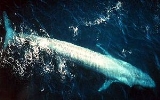
Bowhead Whale

Encyclopedia
The bowhead whale is a baleen whale
of the right whale family Balaenidae
in suborder Mysticeti. A stocky dark-colored whale without a dorsal fin
, it can grow to 20 metres (65.6 ft) in length. This thick-bodied species can weigh 75 tonnes (73.8 LT) to 100 tonnes (98.4 LT), second only to the blue whale
, although the bowhead's maximum length is less than several other whales. It lives entirely in fertile Arctic
and sub-Arctic waters, unlike other whales that migrate to feed or reproduce. It is also known as Greenland right whale or Arctic whale. American whalemen called it the "Steeple-top" or "Polar whale". The bowhead is perhaps the longest-living mammal
, and has the largest mouth of any animal.
The bowhead was an early whaling
target. Its population was severely reduced before a 1966 moratorium
. The population is estimated to be over 24,900 worldwide, down from an estimated 50,000 before whaling.
(1758).
The bowhead whale currently occupies a monotypic genus
, separate from the other right whale
s, as it has done since the work of Gray
in 1821. Little genetic evidence supports this two-genera categorization. Indeed, the members of Balaenoptera
show greater differences than do the bowhead and the right whales. All four species will likely be placed in one genus in some future review.
It is thought Balaena prisca, one of the five Balaena fossil
s from the late Miocene
(~10 Mya) to early Pleistocene
(~1.5 Mya), may be the same as the modern bowhead whale. The earlier fossil record shows no related cetacean after Morenocetus, found in a South America
n deposit dating back 23 million years.
and a strongly bowed lower jaw and narrow upper jaw. Its baleen
, the longest of any whale at 3 metres (9.8 ft), strains tiny prey from the water. The whale has a massive bony skull
which it uses to break through the Arctic
ice to breathe. Inuit
hunters have reported them surfacing through 60 cm (23.6 in) of ice. The bowhead may reach up to 20 m (65.6 ft). The largest yet reported was 21.2 m (69.6 ft) m for an unweighed giant caught off Spitsbergen
, Norway
. Females are larger than males. Its blubber
is the thickest of any animal, averaging 43–50 cm (16.9–19.7 in).
 The bowhead is social and nonaggressive, and retreats under the ice when threatened.
The whales' behavior can also include breaching, tail slapping, and spyhopping.
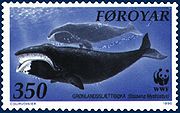 Sexual activity occurs between pairs and in boisterous groups of several males and one or two females.
Breeding has been observed from March through August; conception is believed to occur primarily in March. Reproduction can begin when a whale is 10 to 15 years old. Females produce a calf once every 3 to 4 years, after a 13–14 month pregnancy. The newborn calf is about 4.5 m (14.8 ft) long and approximately 1000 kg (2,204.6 lb), growing to 9 m (29.5 ft) by its first birthday.
Because of their long lifespans, females are believed to go through menopause
. Observations of very large animals without calves support this hypothesis.
, slate
, and jade
spear points in freshly killed whales in 1993, 1995, 1999, and 2007 triggered research based on structures in the whale's eye, suggesting at least some individuals reached 150–200 years old (another report claimed a 90 year old female was still fertile).
The amino acid
racemization
process has provided the scientific basis for these claims. This process is controversial and has failed to correlate well with other dating methods.
In May 2007, a 50 tonnes (49.2 LT) specimen caught off the Alaska
n coast was discovered with the head of an explosive harpoon
embedded deep under its neck blubber. The 3.5 inches (8.9 cm) arrow-shaped projectile was manufactured in New Bedford
, Massachusetts
, a major whaling center, around 1890, suggesting the animal may have survived a similar hunt more than a century ago.
has increased since commercial whaling ceased. Alaska Natives
continue to kill small numbers in subsistence hunt
s each year. This level of killing (25–40 animals annually) is not expected to affect the population's recovery. The population off Alaska's coast (the "Bering-Chukchi-Beaufort stock") appears to be recovering and was about 10,500 animals as of 2001. Researchers from the School of Fisheries and Ocean Sciences
have been studying the whales feeding behavior in the Point Barrow
area. The status of other populations is less well known. There were about 1,200 off West Greenland in 2006, while the Svalbard
population may only number in the tens.
In March, 2008, Canada's Department of Fisheries and Oceans stated that previous estimates in the Eastern Arctic had undercounted, with a new estimate of 14,400 animals (r. 4,800–43,000). These larger numbers correspond to pre-whaling estimates, indicating this population has fully recovered. However, should climate change substantially shrink sea ice, they could be threatened by increased shipping traffic.
that spends its entire life in and around Arctic
waters. The Alaska
n population spends the winter months in the southwestern Bering Sea
. The group migrates northward in the spring, following openings in the pack ice, into the Chukchi
and Beaufort
seas.
by swimming forward with its mouth wide open, continuously filtering water through its baleen
plates. Thus, it specializes in much smaller prey, such as copepod
s. Its mouth has a large upturning lip on the lower jaw that helps to reinforce and contain the baleen plates within its mouth, and prevents buckling or breakage of the plates due to the pressure of the water passing through them as it advances.
This is in contrast to the rorqual
s, which have distendable ventral pleats that they fill with prey-laden water, then expel the water while filtering out the prey through their baleen plates.
s. Occasionally, predatory attacks by orca
pods have also been recorded.
 The bowhead whale has been hunted
for blubber
, meat, oil
, bones, and baleen
. Like right whales, it swims slowly, and floats after death, making it ideal for whaling. Before commercial whaling, there were an estimated 50,000 bowheads.
Commercial bowhead whaling began in the 16th century, when the Basques killed them as they migrated south through the Strait of Belle Isle in the fall and early winter. In 1611, the first whaling expedition sailed to Spitsbergen
. By mid-century, the population(s) there had practically been wiped out, forcing whalers to voyage into the "West Ice"—the pack ice off Greenland
's east coast. By 1719, they had reached the Davis Strait
, and by the first quarter of the 19th century, Baffin Bay
. In the North Pacific
, commercial bowhead whaling began in the 1840s, and within two decades wiped out over 60 percent of the bowheads.
Commercial whaling, the principal cause of the population decline, is over. Bowhead whales are now hunted on a subsistence level by native peoples of North America
.
as "endangered" under the auspices of the United States' Endangered Species Act
. The IUCN Red List
data are as follows:
The Bowhead whale is listed on Appendix I of the Convention on the Conservation of Migratory Species of Wild Animals (CMS
) as this species has been categorized as being in danger of extinction throughout all or a significant proportion of their range and CMS Parties strive towards strictly protecting these animals, conserving or restoring the places where they live, mitigating obstacles to migration and controlling other factors that might endanger them.
Baleen whale
The Baleen whales, also called whalebone whales or great whales, form the Mysticeti, one of two suborders of the Cetacea . Baleen whales are characterized by having baleen plates for filtering food from water, rather than having teeth. This distinguishes them from the other suborder of cetaceans,...
of the right whale family Balaenidae
Balaenidae
Balaenidae is a family of mysticete whales that contains two living genera. Commonly called the right whales as it contains mainly right whale species...
in suborder Mysticeti. A stocky dark-colored whale without a dorsal fin
Dorsal fin
A dorsal fin is a fin located on the backs of various unrelated marine and freshwater vertebrates, including most fishes, marine mammals , and the ichthyosaurs...
, it can grow to 20 metres (65.6 ft) in length. This thick-bodied species can weigh 75 tonnes (73.8 LT) to 100 tonnes (98.4 LT), second only to the blue whale
Blue Whale
The blue whale is a marine mammal belonging to the suborder of baleen whales . At in length and or more in weight, it is the largest known animal to have ever existed....
, although the bowhead's maximum length is less than several other whales. It lives entirely in fertile Arctic
Arctic Ocean
The Arctic Ocean, located in the Northern Hemisphere and mostly in the Arctic north polar region, is the smallest and shallowest of the world's five major oceanic divisions...
and sub-Arctic waters, unlike other whales that migrate to feed or reproduce. It is also known as Greenland right whale or Arctic whale. American whalemen called it the "Steeple-top" or "Polar whale". The bowhead is perhaps the longest-living mammal
Mammal
Mammals are members of a class of air-breathing vertebrate animals characterised by the possession of endothermy, hair, three middle ear bones, and mammary glands functional in mothers with young...
, and has the largest mouth of any animal.
The bowhead was an early whaling
Whaling
Whaling is the hunting of whales mainly for meat and oil. Its earliest forms date to at least 3000 BC. Various coastal communities have long histories of sustenance whaling and harvesting beached whales...
target. Its population was severely reduced before a 1966 moratorium
Moratorium (law)
A moratorium is a delay or suspension of an activity or a law. In a legal context, it may refer to the temporary suspension of a law to allow a legal challenge to be carried out....
. The population is estimated to be over 24,900 worldwide, down from an estimated 50,000 before whaling.
Taxonomy
Carl Linnaeus described the bowhead whale in the 10th edition of his Systema NaturaeSystema Naturae
The book was one of the major works of the Swedish botanist, zoologist and physician Carolus Linnaeus. The first edition was published in 1735...
(1758).
The bowhead whale currently occupies a monotypic genus
Genus
In biology, a genus is a low-level taxonomic rank used in the biological classification of living and fossil organisms, which is an example of definition by genus and differentia...
, separate from the other right whale
Right whale
Right whales are three species of large baleen whales consisting of two genera in the family Balaenidae of order Cetacea. Their bodies are very dark gray or black and rotund....
s, as it has done since the work of Gray
John Edward Gray
John Edward Gray, FRS was a British zoologist. He was the elder brother of George Robert Gray and son of the pharmacologist and botanist Samuel Frederick Gray ....
in 1821. Little genetic evidence supports this two-genera categorization. Indeed, the members of Balaenoptera
Balaenoptera
Balaenoptera is a genus of Balaenopteridae, the Rorqual whales, and contains eight species. The species Balaenoptera omurai was published in 2003...
show greater differences than do the bowhead and the right whales. All four species will likely be placed in one genus in some future review.
It is thought Balaena prisca, one of the five Balaena fossil
Fossil
Fossils are the preserved remains or traces of animals , plants, and other organisms from the remote past...
s from the late Miocene
Miocene
The Miocene is a geological epoch of the Neogene Period and extends from about . The Miocene was named by Sir Charles Lyell. Its name comes from the Greek words and and means "less recent" because it has 18% fewer modern sea invertebrates than the Pliocene. The Miocene follows the Oligocene...
(~10 Mya) to early Pleistocene
Pleistocene
The Pleistocene is the epoch from 2,588,000 to 11,700 years BP that spans the world's recent period of repeated glaciations. The name pleistocene is derived from the Greek and ....
(~1.5 Mya), may be the same as the modern bowhead whale. The earlier fossil record shows no related cetacean after Morenocetus, found in a South America
South America
South America is a continent situated in the Western Hemisphere, mostly in the Southern Hemisphere, with a relatively small portion in the Northern Hemisphere. The continent is also considered a subcontinent of the Americas. It is bordered on the west by the Pacific Ocean and on the north and east...
n deposit dating back 23 million years.
Description
The bowhead whale has a robust, dark-colored body, no dorsal finDorsal fin
A dorsal fin is a fin located on the backs of various unrelated marine and freshwater vertebrates, including most fishes, marine mammals , and the ichthyosaurs...
and a strongly bowed lower jaw and narrow upper jaw. Its baleen
Baleen
Baleen or whalebone is a filter-feeder system inside the mouths of baleen whales. The baleen system works when a whale opens its mouth underwater and then water pours into the whale's mouth. The whale then pushes the water out, and animals such as krill are filtered by the baleen and remain as food...
, the longest of any whale at 3 metres (9.8 ft), strains tiny prey from the water. The whale has a massive bony skull
Skull
The skull is a bony structure in the head of many animals that supports the structures of the face and forms a cavity for the brain.The skull is composed of two parts: the cranium and the mandible. A skull without a mandible is only a cranium. Animals that have skulls are called craniates...
which it uses to break through the Arctic
Arctic
The Arctic is a region located at the northern-most part of the Earth. The Arctic consists of the Arctic Ocean and parts of Canada, Russia, Greenland, the United States, Norway, Sweden, Finland, and Iceland. The Arctic region consists of a vast, ice-covered ocean, surrounded by treeless permafrost...
ice to breathe. Inuit
Inuit
The Inuit are a group of culturally similar indigenous peoples inhabiting the Arctic regions of Canada , Denmark , Russia and the United States . Inuit means “the people” in the Inuktitut language...
hunters have reported them surfacing through 60 cm (23.6 in) of ice. The bowhead may reach up to 20 m (65.6 ft). The largest yet reported was 21.2 m (69.6 ft) m for an unweighed giant caught off Spitsbergen
Svalbard
Svalbard is an archipelago in the Arctic, constituting the northernmost part of Norway. It is located north of mainland Europe, midway between mainland Norway and the North Pole. The group of islands range from 74° to 81° north latitude , and from 10° to 35° east longitude. Spitsbergen is the...
, Norway
Norway
Norway , officially the Kingdom of Norway, is a Nordic unitary constitutional monarchy whose territory comprises the western portion of the Scandinavian Peninsula, Jan Mayen, and the Arctic archipelago of Svalbard and Bouvet Island. Norway has a total area of and a population of about 4.9 million...
. Females are larger than males. Its blubber
Blubber
Blubber is a thick layer of vascularized adipose tissue found under the skin of all cetaceans, pinnipeds and sirenians.-Description:Lipid-rich, collagen fiber–laced blubber comprises the hypodermis and covers the whole body, except for parts of the appendages, strongly attached to the musculature...
is the thickest of any animal, averaging 43–50 cm (16.9–19.7 in).
Life history
Swimming
The bowhead is a slow swimmer and usually travels alone or in small herds of up to six. Though it may remain submerged as long as 40 minutes in a single dive, it is not thought to be a deep diver.The whales' behavior can also include breaching, tail slapping, and spyhopping.
Vocalizations
The bowhead whale is highly vocal, and uses underwater sounds to communicate while traveling, feeding, and socializing. Some bowheads make long repetitive songs that may be mating calls.Reproduction
Breeding has been observed from March through August; conception is believed to occur primarily in March. Reproduction can begin when a whale is 10 to 15 years old. Females produce a calf once every 3 to 4 years, after a 13–14 month pregnancy. The newborn calf is about 4.5 m (14.8 ft) long and approximately 1000 kg (2,204.6 lb), growing to 9 m (29.5 ft) by its first birthday.
Because of their long lifespans, females are believed to go through menopause
Menopause
Menopause is a term used to describe the permanent cessation of the primary functions of the human ovaries: the ripening and release of ova and the release of hormones that cause both the creation of the uterine lining and the subsequent shedding of the uterine lining...
. Observations of very large animals without calves support this hypothesis.
Lifespan
Bowheads were once thought to live 60 to 70 years, similar to other whales. However, discoveries of 19th century ivoryIvory
Ivory is a term for dentine, which constitutes the bulk of the teeth and tusks of animals, when used as a material for art or manufacturing. Ivory has been important since ancient times for making a range of items, from ivory carvings to false teeth, fans, dominoes, joint tubes, piano keys and...
, slate
Slate
Slate is a fine-grained, foliated, homogeneous metamorphic rock derived from an original shale-type sedimentary rock composed of clay or volcanic ash through low-grade regional metamorphism. The result is a foliated rock in which the foliation may not correspond to the original sedimentary layering...
, and jade
Jade
Jade is an ornamental stone.The term jade is applied to two different metamorphic rocks that are made up of different silicate minerals:...
spear points in freshly killed whales in 1993, 1995, 1999, and 2007 triggered research based on structures in the whale's eye, suggesting at least some individuals reached 150–200 years old (another report claimed a 90 year old female was still fertile).
The amino acid
Amino acid
Amino acids are molecules containing an amine group, a carboxylic acid group and a side-chain that varies between different amino acids. The key elements of an amino acid are carbon, hydrogen, oxygen, and nitrogen...
racemization
Racemization
In chemistry, racemization refers to the converting of an enantiomerically pure mixture into a mixture where more than one of the enantiomers are present...
process has provided the scientific basis for these claims. This process is controversial and has failed to correlate well with other dating methods.
In May 2007, a 50 tonnes (49.2 LT) specimen caught off the Alaska
Alaska
Alaska is the largest state in the United States by area. It is situated in the northwest extremity of the North American continent, with Canada to the east, the Arctic Ocean to the north, and the Pacific Ocean to the west and south, with Russia further west across the Bering Strait...
n coast was discovered with the head of an explosive harpoon
Harpoon
A harpoon is a long spear-like instrument used in fishing to catch fish or large marine mammals such as whales. It accomplishes this task by impaling the target animal, allowing the fishermen to use a rope or chain attached to the butt of the projectile to catch the animal...
embedded deep under its neck blubber. The 3.5 inches (8.9 cm) arrow-shaped projectile was manufactured in New Bedford
New Bedford, Massachusetts
New Bedford is a city in Bristol County, Massachusetts, United States, located south of Boston, southeast of Providence, Rhode Island, and about east of Fall River. As of the 2010 census, the city had a total population of 95,072, making it the sixth-largest city in Massachusetts...
, Massachusetts
Massachusetts
The Commonwealth of Massachusetts is a state in the New England region of the northeastern United States of America. It is bordered by Rhode Island and Connecticut to the south, New York to the west, and Vermont and New Hampshire to the north; at its east lies the Atlantic Ocean. As of the 2010...
, a major whaling center, around 1890, suggesting the animal may have survived a similar hunt more than a century ago.
Population
The bowhead population around AlaskaAlaska
Alaska is the largest state in the United States by area. It is situated in the northwest extremity of the North American continent, with Canada to the east, the Arctic Ocean to the north, and the Pacific Ocean to the west and south, with Russia further west across the Bering Strait...
has increased since commercial whaling ceased. Alaska Natives
Alaska Natives
Alaska Natives are the indigenous peoples of Alaska. They include: Aleut, Inuit, Tlingit, Haida, Tsimshian, Eyak, and a number of Northern Athabaskan cultures.-History:In 1912 the Alaska Native Brotherhood was founded...
continue to kill small numbers in subsistence hunt
Subsistence economy
A subsistence economy is an economy which refers simply to the gathering or amassment of objects of value; the increase in wealth; or the creation of wealth. Capital can be generally defined as assets invested with the expectation that their value will increase, usually because there is the...
s each year. This level of killing (25–40 animals annually) is not expected to affect the population's recovery. The population off Alaska's coast (the "Bering-Chukchi-Beaufort stock") appears to be recovering and was about 10,500 animals as of 2001. Researchers from the School of Fisheries and Ocean Sciences
School of Fisheries and Ocean Sciences
School of Fisheries and Ocean Sciences,or SFOS, is part of the University of Alaska Fairbanks. SFOS offers a bachelor of arts and a bachelor of science in fisheries, and master’s and doctoral degrees in oceanography, fisheries and marine biology....
have been studying the whales feeding behavior in the Point Barrow
Point Barrow
Point Barrow or Nuvuk is a headland on the Arctic coast in the U.S. state of Alaska, northeast of Barrow. It is the northernmost point of all the territory of the United States, at...
area. The status of other populations is less well known. There were about 1,200 off West Greenland in 2006, while the Svalbard
Svalbard
Svalbard is an archipelago in the Arctic, constituting the northernmost part of Norway. It is located north of mainland Europe, midway between mainland Norway and the North Pole. The group of islands range from 74° to 81° north latitude , and from 10° to 35° east longitude. Spitsbergen is the...
population may only number in the tens.
In March, 2008, Canada's Department of Fisheries and Oceans stated that previous estimates in the Eastern Arctic had undercounted, with a new estimate of 14,400 animals (r. 4,800–43,000). These larger numbers correspond to pre-whaling estimates, indicating this population has fully recovered. However, should climate change substantially shrink sea ice, they could be threatened by increased shipping traffic.
Range and habitat
The bowhead whale is the only baleen whaleBaleen whale
The Baleen whales, also called whalebone whales or great whales, form the Mysticeti, one of two suborders of the Cetacea . Baleen whales are characterized by having baleen plates for filtering food from water, rather than having teeth. This distinguishes them from the other suborder of cetaceans,...
that spends its entire life in and around Arctic
Arctic
The Arctic is a region located at the northern-most part of the Earth. The Arctic consists of the Arctic Ocean and parts of Canada, Russia, Greenland, the United States, Norway, Sweden, Finland, and Iceland. The Arctic region consists of a vast, ice-covered ocean, surrounded by treeless permafrost...
waters. The Alaska
Alaska
Alaska is the largest state in the United States by area. It is situated in the northwest extremity of the North American continent, with Canada to the east, the Arctic Ocean to the north, and the Pacific Ocean to the west and south, with Russia further west across the Bering Strait...
n population spends the winter months in the southwestern Bering Sea
Bering Sea
The Bering Sea is a marginal sea of the Pacific Ocean. It comprises a deep water basin, which then rises through a narrow slope into the shallower water above the continental shelves....
. The group migrates northward in the spring, following openings in the pack ice, into the Chukchi
Chukchi Sea
Chukchi Sea is a marginal sea of the Arctic Ocean. It is bounded on the west by the De Long Strait, off Wrangel Island, and in the east by Point Barrow, Alaska, beyond which lies the Beaufort Sea. The Bering Strait forms its southernmost limit and connects it to the Bering Sea and the Pacific...
and Beaufort
Beaufort Sea
The Beaufort Sea is a marginal sea of the Arctic Ocean, located north of the Northwest Territories, the Yukon, and Alaska, west of Canada's Arctic islands. The sea is named after hydrographer Sir Francis Beaufort...
seas.
Feeding
Unlike most other baleen whales which primarily feed on concentrated shoals of prey species, it feeds in a manner similar to the basking sharkBasking shark
The basking shark is the second largest living fish, after the whale shark. It is a cosmopolitan migratory species, found in all the world's temperate oceans. It is a slow moving and generally harmless filter feeder and has anatomical adaptations to filter feeding, such as a greatly enlarged...
by swimming forward with its mouth wide open, continuously filtering water through its baleen
Baleen
Baleen or whalebone is a filter-feeder system inside the mouths of baleen whales. The baleen system works when a whale opens its mouth underwater and then water pours into the whale's mouth. The whale then pushes the water out, and animals such as krill are filtered by the baleen and remain as food...
plates. Thus, it specializes in much smaller prey, such as copepod
Copepod
Copepods are a group of small crustaceans found in the sea and nearly every freshwater habitat. Some species are planktonic , some are benthic , and some continental species may live in limno-terrestrial habitats and other wet terrestrial places, such as swamps, under leaf fall in wet forests,...
s. Its mouth has a large upturning lip on the lower jaw that helps to reinforce and contain the baleen plates within its mouth, and prevents buckling or breakage of the plates due to the pressure of the water passing through them as it advances.
This is in contrast to the rorqual
Rorqual
Rorquals are the largest group of baleen whales, with nine species in two genera. They include the largest animal that has ever lived, the Blue Whale, which can reach , and another that easily reaches ; even the smallest of the group, the Northern Minke Whale, reaches .-Characteristics:Rorquals...
s, which have distendable ventral pleats that they fill with prey-laden water, then expel the water while filtering out the prey through their baleen plates.
Predation
The principal predators of bowheads are humanHuman
Humans are the only living species in the Homo genus...
s. Occasionally, predatory attacks by orca
Orca
The killer whale , commonly referred to as the orca, and less commonly as the blackfish, is a toothed whale belonging to the oceanic dolphin family. Killer whales are found in all oceans, from the frigid Arctic and Antarctic regions to tropical seas...
pods have also been recorded.
Whaling
Whaling
Whaling is the hunting of whales mainly for meat and oil. Its earliest forms date to at least 3000 BC. Various coastal communities have long histories of sustenance whaling and harvesting beached whales...
for blubber
Blubber
Blubber is a thick layer of vascularized adipose tissue found under the skin of all cetaceans, pinnipeds and sirenians.-Description:Lipid-rich, collagen fiber–laced blubber comprises the hypodermis and covers the whole body, except for parts of the appendages, strongly attached to the musculature...
, meat, oil
Whale oil
Whale oil is the oil obtained from the blubber of various species of whales, particularly the three species of right whale and the bowhead whale prior to the modern era, as well as several other species of baleen whale...
, bones, and baleen
Baleen
Baleen or whalebone is a filter-feeder system inside the mouths of baleen whales. The baleen system works when a whale opens its mouth underwater and then water pours into the whale's mouth. The whale then pushes the water out, and animals such as krill are filtered by the baleen and remain as food...
. Like right whales, it swims slowly, and floats after death, making it ideal for whaling. Before commercial whaling, there were an estimated 50,000 bowheads.
Commercial bowhead whaling began in the 16th century, when the Basques killed them as they migrated south through the Strait of Belle Isle in the fall and early winter. In 1611, the first whaling expedition sailed to Spitsbergen
Spitsbergen
Spitsbergen is the largest and only permanently populated island of the Svalbard archipelago in Norway. Constituting the western-most bulk of the archipelago, it borders the Arctic Ocean, the Norwegian Sea and the Greenland Sea...
. By mid-century, the population(s) there had practically been wiped out, forcing whalers to voyage into the "West Ice"—the pack ice off Greenland
Greenland
Greenland is an autonomous country within the Kingdom of Denmark, located between the Arctic and Atlantic Oceans, east of the Canadian Arctic Archipelago. Though physiographically a part of the continent of North America, Greenland has been politically and culturally associated with Europe for...
's east coast. By 1719, they had reached the Davis Strait
Davis Strait
Davis Strait is a northern arm of the Labrador Sea. It lies between mid-western Greenland and Nunavut, Canada's Baffin Island. The strait was named for the English explorer John Davis , who explored the area while seeking a Northwest Passage....
, and by the first quarter of the 19th century, Baffin Bay
Baffin Bay
Baffin Bay , located between Baffin Island and the southwest coast of Greenland, is a marginal sea of the North Atlantic Ocean. It is connected to the Atlantic via Davis Strait and the Labrador Sea...
. In the North Pacific
Pacific Ocean
The Pacific Ocean is the largest of the Earth's oceanic divisions. It extends from the Arctic in the north to the Southern Ocean in the south, bounded by Asia and Australia in the west, and the Americas in the east.At 165.2 million square kilometres in area, this largest division of the World...
, commercial bowhead whaling began in the 1840s, and within two decades wiped out over 60 percent of the bowheads.
Commercial whaling, the principal cause of the population decline, is over. Bowhead whales are now hunted on a subsistence level by native peoples of North America
Indigenous peoples of the Americas
The indigenous peoples of the Americas are the pre-Columbian inhabitants of North and South America, their descendants and other ethnic groups who are identified with those peoples. Indigenous peoples are known in Canada as Aboriginal peoples, and in the United States as Native Americans...
.
Conservation
The bowhead is listed in Appendix I by CITES (that is, "threatened with extinction"). It is listed by the National Marine Fisheries ServiceNational Marine Fisheries Service
The National Marine Fisheries Service is a United States federal agency. A division of the National Oceanic and Atmospheric Administration and the Department of Commerce, NMFS is responsible for the stewardship and management of the nation's living marine resources and their habitat within the...
as "endangered" under the auspices of the United States' Endangered Species Act
Endangered Species Act
The Endangered Species Act of 1973 is one of the dozens of United States environmental laws passed in the 1970s. Signed into law by President Richard Nixon on December 28, 1973, it was designed to protect critically imperiled species from extinction as a "consequence of economic growth and...
. The IUCN Red List
IUCN Red List
The IUCN Red List of Threatened Species , founded in 1963, is the world's most comprehensive inventory of the global conservation status of biological species. The International Union for Conservation of Nature is the world's main authority on the conservation status of species...
data are as follows:
- SvalbardSvalbardSvalbard is an archipelago in the Arctic, constituting the northernmost part of Norway. It is located north of mainland Europe, midway between mainland Norway and the North Pole. The group of islands range from 74° to 81° north latitude , and from 10° to 35° east longitude. Spitsbergen is the...
population – Critically endangered - Sea of OkhotskSea of OkhotskThe Sea of Okhotsk is a marginal sea of the western Pacific Ocean, lying between the Kamchatka Peninsula on the east, the Kuril Islands on the southeast, the island of Hokkaidō to the far south, the island of Sakhalin along the west, and a long stretch of eastern Siberian coast along the west and...
subpopulation – Endangered - Baffin BayBaffin BayBaffin Bay , located between Baffin Island and the southwest coast of Greenland, is a marginal sea of the North Atlantic Ocean. It is connected to the Atlantic via Davis Strait and the Labrador Sea...
-Davis StraitDavis StraitDavis Strait is a northern arm of the Labrador Sea. It lies between mid-western Greenland and Nunavut, Canada's Baffin Island. The strait was named for the English explorer John Davis , who explored the area while seeking a Northwest Passage....
stock – Endangered - Hudson BayHudson BayHudson Bay , sometimes called Hudson's Bay, is a large body of saltwater in northeastern Canada. It drains a very large area, about , that includes parts of Ontario, Quebec, Saskatchewan, Alberta, most of Manitoba, southeastern Nunavut, as well as parts of North Dakota, South Dakota, Minnesota,...
-Foxe BasinFoxe BasinNot to be confused with Fox Bay, Falkland IslandsFoxe Basin is a shallow oceanic basin north of Hudson Bay, in Nunavut, Canada, located between Baffin Island and the Melville Peninsula...
stock – Vulnerable - BeringBering SeaThe Bering Sea is a marginal sea of the Pacific Ocean. It comprises a deep water basin, which then rises through a narrow slope into the shallower water above the continental shelves....
-ChukchiChukchi SeaChukchi Sea is a marginal sea of the Arctic Ocean. It is bounded on the west by the De Long Strait, off Wrangel Island, and in the east by Point Barrow, Alaska, beyond which lies the Beaufort Sea. The Bering Strait forms its southernmost limit and connects it to the Bering Sea and the Pacific...
-BeaufortBeaufort SeaThe Beaufort Sea is a marginal sea of the Arctic Ocean, located north of the Northwest Territories, the Yukon, and Alaska, west of Canada's Arctic islands. The sea is named after hydrographer Sir Francis Beaufort...
stock – Lower risk – conservation dependent
The Bowhead whale is listed on Appendix I of the Convention on the Conservation of Migratory Species of Wild Animals (CMS
Bonn Convention
The Convention on the Conservation of Migratory Species of Wild Animals aims to conserve terrestrial, marine and avian migratory species throughout their range...
) as this species has been categorized as being in danger of extinction throughout all or a significant proportion of their range and CMS Parties strive towards strictly protecting these animals, conserving or restoring the places where they live, mitigating obstacles to migration and controlling other factors that might endanger them.
External links
- US National Marine Fisheries Service bowhead whale web page
- ARKive – images and movies of the bowhead whale (Balaena mysticetus)
- Bowhead Whale: Detailed Information from NOAA
- Harpoon may prove whale was at least 115 years old
- Eastern Arctic bowhead whales not threatened
- Watch the documentary, In Search of the Bowhead Whale
- World Wide Fund for Nature (WWF) – species profile for Bowhead whale
- In Search of the Bowhead Whale (on NFB.ca) A documentary by Bill MasonBill MasonBill Mason was an award-winning Canadian naturalist, author, artist, filmmaker, and conservationist, noted primarily for his popular canoeing books, films, and art as well as his documentaries on wolves. Mason was also known for including passages from Christian sermons in his films...
from 1974 following an expedition that searches out and meets the bowhead and beluga.