
In Depth
See Also

Buoyancy

In physics Physics

Physics , the most fundamental physical science [i], is concerned with the underlying principles of the ... 

, buoyancy is an upward force on an object immersed in a fluid , enabling it to float or at least to appear lighter. Buoyancy is important for many vehicle Vehicle

This article is about the means of transport.... 

s such as boat Boat

A boat is a structure designed to float on water coupled with a system of propulsion, such as a screw [i] ... 

s, ship Ship

A ship is a large, sea-going watercraft [i]. ... 

s, balloon Balloon

A balloon is a flexible bag normally filled with a gas [i], such as helium [i], hydrogen [i], nitrous oxide [i]... 

s, and airship Airship

An airship is a buoyant [i] aircraft [i] that can be steered and propelled through the air. ... 

s.

Discussions

  Discussion Features

   Ask a question about 'Buoyancy'

   Start a new discussion about 'Buoyancy'

   Answer questions about 'Buoyancy'

   'Buoyancy' discussion forum


Encyclopedia

In physics Physics

Physics , the most fundamental physical science [i], is concerned with the underlying principles of the ... 

, buoyancy is an upward force on an object immersed in a fluid , enabling it to float or at least to appear lighter. Buoyancy is important for many vehicle Vehicle

This article is about the means of transport.... 

s such as boat Boat

A boat is a structure designed to float on water coupled with a system of propulsion, such as a screw [i] ... 

s, ship Ship

A ship is a large, sea-going watercraft [i]. ... 

s, balloon Balloon

A balloon is a flexible bag normally filled with a gas [i], such as helium [i], hydrogen [i], nitrous oxide [i]... 

s, and airship Airship

An airship is a buoyant [i] aircraft [i] that can be steered and propelled through the air. ... 

s.

Forces and equilibrium

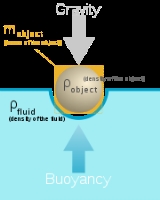
The buoyancy provides an upward force on the object. The upward forces have to balance the downward forces weight. Otherwise, it will accelerate upwards or downwards.

If such an object's compressibility is less than that of the surrounding fluid, it is in stable equilibrium and will, indeed, remain at rest, but if its compressibility is greater, its equilibrium is unstable Instability

Instability in systems is generally characterized by some of the outputs [i] or internal states [i] grow ... 

, and it will rise and expand on the slightest upward perturbation, or fall and compress on the slightest downward perturbation. For an object to float, it must be able to displace enough water equal to its weight.

Archimedes's principle


It was the ancient Greek, Archimedes Archimedes

Archimedes was an ancient Greek [i] mathematician [i], physicist [i], engineer [i], astronomer [i] ... 

 of Syracuse Syracuse, Italy

Syracuse is an Italian [i] city on the eastern coast of Sicily [i] and the capital of the province of Syracuse [i] ... 

, who first discovered the law of buoyancy, sometimes called Archimedes's principle:

The buoyant force is equal to the weight of the displaced fluid.


The story of Archimedes discovering buoyancy while sitting in his bathtub is described in Book 9 of De architectura De architectura

De architectura was a treatise on architecture [i] written by the Roman [i] architect [i] ... 

by Vitruvius Vitruvius

Marcus Vitruvius Pollio was a Roman [i] writer [i], architect [i] and engineer [i], active ... 

.

The weight of the displaced fluid is directly proportional to the volume of the displaced fluid . Thus, among objects with equal masses, the one with greater volume has greater buoyancy.

Suppose a rock's weight is measured as 10 newtons when suspended by a string in a vacuum. Suppose that when the rock is lowered by the string into water, it displaces water of weight 3 newtons. The force it then exerts on the string from which it hangs will be 10 newtons minus the 3 newtons of buoyant force: 10 − 3 = 7 newtons.

Density


If the weight of an object is less than the weight of the fluid the object would displace if it was fully submerged, then the object is less dense than the fluid and it floats at a level so it displaces the same weight of fluid as the weight of the object.

If the object has exactly the same density as the liquid, then it will stay still, neither sinking nor floating upwards, just as the liquid nearby stays still.

An object made of a material of higher density than the fluid, for example a metal object in water, can still float if it has a suitable shape that keeps a large enough volume of air below the surface level of the fluid. In that case, for the average density mentioned above, the air is included also, which may reduce this density to less than that of the fluid.

Acceleration

Although Archimedes's principle gives the force on a buoyant object, this does not allow the direct determination of the acceleration Acceleration

In physics [i] or physical science, acceleration is defined as the rate of change of velocity [i].... 

 of the object in the usual way using Newton's second law. This is because as well as accelerating the object, the fluid also has to be dynamically displaced- resulting in drag.

While Archimedes's principle is hydrostatic force, it must be taken into account, even in hydrodynamic situations. A simple case would be that of a submerged sphere that is twice as dense as water starting at rest and as it first starts to fall through the water. Initially ignoring drag, a first approximation might be to include the force of gravity and subtract the force of buoyancy and then apply Newton's equation F = ma. The next step would be to attempt to take into account the drag forces due to viscosity, which is a form of dynamic friction. Next is the inertial forces of the water that has to get pushed out of the way as the sphere passes through the water: the inertial component of drag. One might use the drag equation. The velocity would increase and the force of drag will increase until the object reached terminal velocity, where turbulence Turbulence

In fluid dynamics [i], turbulence or turbulent flow is a flow regime characterized by chaotic, stochastic [i] ... 

 might also be a consideration. Still, the hydrostatic force of buoyancy operating on the submerged or floating object must be taken into account.

Applications

  • Anderton Boat Lift Anderton Boat Lift

    The Anderton Boat Lift provides a link between two navigable waterways: the River Weaver [i] and the Trent and Mersey Canal [i] ... 

  • Falkirk Wheel Falkirk Wheel

    The Falkirk Wheel, named after the nearby town of Falkirk [i] in central Scotland [i], is a rotating boat lift [i] ... 

  • Neutral Buoyancy Laboratory Neutral Buoyancy Laboratory

    The Neutral Buoyancy Laboratory or NBL is a training facility for astronauts maintained by [[NASA]... 


See also

  • Buoyancy compensator Buoyancy compensator

    A buoyancy compensator is a piece of diving equipment [i] worn by divers to provide:

... 


  • Cartesian diver Cartesian diver

    A Cartesian diver or Cartesian devil is a classic science [i] experiment, named for Ren Descartes [i] ... 

  • Diving weighting system Diving weighting system

    Divers wear weighting systems, weight belts or weights, generally made of lead [i], to count ... 

  • Flotation
  • Hull
  • Hydrometer Hydrometer

    ory:Measuring instruments]] [i]

[i]
... 


  • Lighter than air
  • Naval architecture Naval architecture

    Naval architecture is the science of design of water borne transport, ships [i], boats [i], barges [i] ... 

  • Negative buoyancy
  • Pontoon Pontoon

    A pontoon is a flat-bottomed boat [i] or the floats used to support a structure on water. ... 

  • Quicksand Quicksand

    Quicksand is a hydrocolloid [i] gel consisting of fine granular matter [i], clay [i], and salt water [i] ... 

  • Submarine Submarine

    A submarine is a specialized watercraft [i] that can operate underwater [i].... 


External links