
|
|
|
|
Megamouth shark
|
| |
|
| |
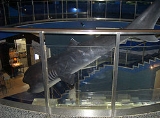
The megamouth shark, Megachasma pelagios, is an extremely rare and unusual species of deepwater shark. Discovered in 1976, only a few have ever been seen, with 42 specimens known to have been caught or sighted as of 2008 and three recordings on film. Like the basking shark and whale shark, it is a filter feeder, and swims with its enormous mouth wide open, filtering water for plankton and jellyfish. It is distinctive for its large head with rubbery lips.

Discussion
Ask a question about 'Megamouth shark'
Start a new discussion about 'Megamouth shark'
Answer questions from other users
|
Encyclopedia
The megamouth shark, Megachasma pelagios, is an extremely rare and unusual species of deepwater shark. Discovered in 1976, only a few have ever been seen, with 42 specimens known to have been caught or sighted as of 2008 and three recordings on film. Like the basking shark and whale shark, it is a filter feeder, and swims with its enormous mouth wide open, filtering water for plankton and jellyfish. It is distinctive for its large head with rubbery lips. It is so unlike any other type of shark that it is classified in its own family Megachasmidae, though it has been suggested that it may belong in the family Cetorhinidae of which the basking shark is currently the sole member.
Physical characteristics
The appearance of the megamouth is distinctive, but little else is known about it. It has a generally brownish-blackish color on top and white underneath, and an asymmetrical tail with a long upper lobe, similar to the thresher shark. The interior of its gill slits are lined with finger-like gill rakers that capture its food. A relatively poor swimmer, the megamouth has a soft, flabby body and lacks keels.
Megamouths are very large sharks, able to grow to in length. Males mature by and females by . Weights of up to have been reported.
As their name implies, megamouths have a large mouth with small teeth, and a broad, rounded snout, causing observers to occasionally mistake megamouth for a young orca. The mouth is surrounded by luminous photophores, which may act as a lure for plankton or small fish.
Behaviour
In 1990 a 4.9m male megamouth shark was caught near the surface off Dana Point in California. This individual was eventually released with a small radio tag attached to its soft body. The tag relayed depth and time information over a two day period. During the day the shark cruised at a depth of around 120-160m, but as the sun set it would ascend and spend the night at depths of between 12 and 25m. Both day and night its progress was very slow at around 1.5-2.1km/h. This pattern of vertical migration is seen in many marine animals as they track the movement of plankton in the water body.
Reproduction
Reproduction is ovoviviparous, meaning that the young sharks develop in eggs that remain within the mother's body until they hatch.
Discovery
The first megamouth was captured on November 15, 1976 about 25 miles off the coast from Kaneohe, Hawaii when it became entangled in the sea anchor of a United States Navy ship. Examination of the 4.5 m, 750 kg specimen by Leighton Taylor showed it to be an entirely unknown type of shark, rivaling the coelacanth as the most sensational discovery in 20th century ichthyology.
Known specimens
In the 30 years since its discovery, as of 2008 only 42 megamouth specimens have been caught or sighted. They have been found in the Pacific, Atlantic and Indian oceans. At least ten specimens have been found in the vicinity of Japan, more than any other single area. Specimens have also been pulled from the waters near Hawaii, California, Taiwan, the Philippines, Indonesia, Australia, Brazil, Senegal and Ecuador.
External links
|
| |
|
|