

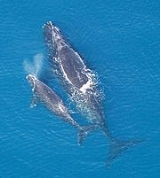
Right whale

Encyclopedia
Right whales are three species
of large baleen whale
s consisting of two genera
in the family Balaenidae
of order
Cetacea
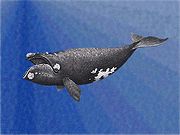
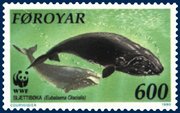
. Their bodies are very dark gray or black and rotund.
They are called "right whales" because whalers
thought the whales were the "right" ones to hunt, as they float when killed and often swim within sight of shore. They are also incredibly friendly, and often swam right up to boats as well. As such, they were hunted nearly to extinction during the active years of the whaling industry. Today, instead of hunting them, people often watch
these acrobatic animals for pleasure. Genetic evidence appears to have settled a long-standing question about whether to include the largest, the Arctic-dwelling bowhead whale
, with the rest. All four are included in the taxonomic family
Balaenidae
, and all four are generally referred to as right whales. This article focuses on the three species of the genus Eubalaena.
A fifth species of right whale was proposed by Emmanuel Swedenborg in the 18th century - the so called "Swedenborg whale". The description of this putative species was based on a collection of fossil bones unearthed at Norra Vanga, Sweden, in 1705 and believed to be those of giant
s. The bones were examined by Swedenborg who realised that they belong to a species of whale. The existence of this species has been and is currently debated. Evidence for a putative fifth species was discovered during the construction of a motorway in Strömstad
, Sweden
.
and was given its own genus
'Balaena' by Gray
in 1821. The other three species occupy genus Eubalaena. Scientists see greater differences among the three Balaenoptera
species than between them and the Bowhead Whale. A future review will likely place all four species in one genus. Little genetic evidence supports the historic two-genera view.
Authorities have repeatedly recategorized the three populations of Eubalaena right whales, in one, two or three species. In the whaling era, there was thought to be a single species. Later, morphological factors such as differences in the skull shape of northern and southern animals indicated that there were at least two species—one in the northern hemisphere, the other in the Southern Ocean
. Right whales do not cross equatorial waters to make contact with the other (sub)species and (inter)breed: thick layers of insulating blubber
make it impossible for them to dissipate their internal body heat in tropical waters.
Whale lice
, parasitic
cyamid crustacean
s that live off skin debris, offer further information through their own genetics. Because these lice reproduce much more quickly than whales, their genetic diversity is greater. Marine biologists at the University of Utah
examined these louse genes and determined that their hosts split into three species 5–6 million years ago, and that these species were all equally abundant before whaling
began in the 11th century. The communities first split because of the joining of North
and South America
. The heat of the equator then created a second split, into northern and southern groups. "This puts an end to the long debate about whether there are three [Eubalaena] species of right whale. They really are separate beyond a doubt", Jon Seger, the project's leader, told BBC News.
(about 10 mya) to early Pleistocene
(about 1.5 mya). These five specimens each have their own species status—B. affinis, B. etrusca, B. montalionis, B. primigenius and B. prisca. The last of these may prove to be the modern bowhead. Prior to these there is a long gap before reaching the next related cetacean in the fossil record—Morenocetus was found in a South American deposit dating back 23 million years.
, Herman Melville
writes:
Halibalaena (Gray, 1873) and Hunterius (Gray, 1866) are junior synonyms for the genus Eubalaena. E. australis is the type species.
The species-level synonyms are:
The pygmy right whale
(Capera marginata), a much smaller whale of the southern hemisphere, was also included in the Balaenidae family, but has recently been found to warrant a separate family, Neobalaenidae.
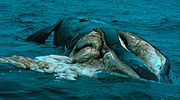
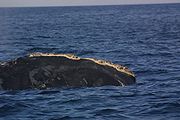
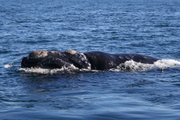
Unlike other whales, right whales have distinctive callosities
(roughened patches of skin) on their heads, along with a broad back without a dorsal fin
, occasionally with white belly patches, and a long arching mouth that begins above the eye. The callosities appear white due to large colonies of cyamids (whale lice). Right whales can grow up to 18 m (59.1 ft) long and weigh up to 100 short tons (90.7 MT), significantly larger than humpbacks
or grays
, but smaller than blues
.
An unusually large forty percent of body weight is blubber
, which is of relatively low density. Consequently, unlike many other species of whale, dead right whales float.
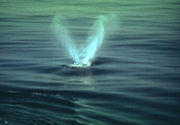 Adults may be between 11–18 m (36.1–59.1 ft) in length and typically weigh 60–80 ST (54.4–72.6 MT). The most typical lengths are 13–16 m (42.7–52.5 ft). The body is extremely thick with girth as much as 60% of total body length in some cases. The tail fluke is broad (up to 40% of body length). The North Pacific species is on average the largest of the three species. The largest specimens may weigh 100 short tons (90.7 MT).
Right whales have a distinctive wide V-shaped blow, caused by the widely spaced blowhole
s on the top of the head. The blow rises 5 m (16.4 ft) above the surface.
Right whales have between 200 and 300 baleen plates on each side of the mouth. These are narrow and approximately 2 m (6.6 ft) long, and are covered in very thin hairs. The plates enable the whale to filter feed.
The testicle
s appear to be the largest of any animal, each weighing around 500 kg (1,102.3 lb). The relative size is also large, at 1% of the whale's total body weight. This suggests that sperm competition
is important in mating.
of 1 year. The right whale grows rapidly in its first year, typically doubling in length. Weaning occurs after eight months to one year and the growth rate in later years is not well understood—it may be highly dependent on whether a calf stays with its mother for a second year.
suggests this lifespan is not uncommon and may even be exceeded.
s, the species is not gregarious and the typical group size
is only two. Groups of up to twelve have been reported, but these were not close-knit and may have been transitory.
which can exist in the tens of thousands upon each whale. The parasitic creatures subsist on algae and dead skin, and while they are irritants, they do not cause significant harm to the whale.
, primarily the tiny crustacean
s called copepod
s, as well as krill
, and pteropods, although they are occasionally opportunistic feeders.
As with other baleens, they feed by filtering prey from the water. They swim with an open mouth, filling it with water and prey. The whale then expels the water, using its baleen plates to retain the prey. Prey must occur in sufficient numbers to trigger the whale's interest; be large enough that the baleen plates can filter it; and be slow enough that it cannot escape. The "skimming" may take place on the surface, underwater, or even at the ocean's bottom, indicated by mud occasionally observed on right whales' bodies.
s and humans
. When danger lurks, a group of right whales may form a circle, with their tails pointing outwards. This defense is not always successful and calves are occasionally lost.
and all areas of the Southern Ocean
. The whales can only cope with the moderate temperatures found between 20 and 60 degrees in latitude. The warm equatorial waters form a barrier that prevents mixing between the northern and southern groups. Although the Southern species in particular must travel across open ocean to reach its feeding grounds, the species is not considered to be pelagic. In general, they prefer to stay close to peninsula
s and bays and on continental shelves
, as these areas offer greater shelter and an abundance of their preferred foods.
Because the oceans are so large, it is very difficult to accurately gauge whale population sizes. Approximate figures:
to Nova Scotia
. Particularly popular feeding areas are the Bay of Fundy
and Cape Cod Bay
. In winter, they head south towards Georgia
and Florida
to give birth.
There have been a smattering of sightings further east over the past few decades—several sightings were made close to Iceland
in 2003. It is possible that these are the remains of a virtually extinct eastern Atlantic stock, but examination of old whalers' records suggest that they are more likely to be strays. However, a few sightings are regular between Norway, Ireland, Spain, Portugal, the Canary Islands and even Italy and Sicily and at least the Norway individuals come from the Western stock.
of all large whales and two of the most endangered animals in the world. Based on current population density trends, both species are predicted to become extinct within 200 years. The Pacific species was historically found in summer from the Sea of Okhotsk
in the west to the Gulf of Alaska in the east, generally north of 50°N. Today, sightings are very rare and generally occur in the mouth of the Sea of Okhotsk and in the eastern Bering Sea
. Although this species is very likely to be migratory like the other two species, its movement patterns are not known.
workshop held in Cape Town
in March 1998. Researchers used data about adult female populations from three surveys (one in each of Argentina, South Africa and Australia collected during the 1990s) and extrapolated to include unsurveyed areas, number of males and calves using available male:female and adult:calf ratios to give an estimated 1999 figure of 7,000 animals.
The southern right whale spends the summer months in the far Southern Ocean feeding, probably close to Antarctica. It migrates north in winter for breeding and can be seen around the coasts of Argentina
, Australia, Brazil
, Chile
, Mozambique
, New Zealand
and South Africa
.
Since hunting of the southern right whale ceased, stocks are estimated to have grown by 7% a year. It appears that the South American, South African and Australasian groups intermix very little, if at all, because of the strong fidelity of mothers to their feeding and calving grounds. The mother passes these instincts to her calves.
In Brazil, more than 300 individuals have been cataloged through photo identification (using their distinctive head callosities) by the Brazilian Right Whale Project, maintained jointly by Petrobras
(the Brazilian state-owned oil company) and the International Wildlife Coalition. The State of Santa Catarina
hosts a concentration of breeding and calving right whales from June to November, and females from this population are also known to calve off Argentinian Patagonia
.
. The purpose of the sounds is not known but may be a form of communication between whales within the same group.
Northern right whales responded to sounds similar to police sirens
—sounds of much higher frequency
than their own. On hearing the sounds they moved rapidly to the surface. The research was of particular interest because northern rights ignore most sounds, including those of approaching boats. Researchers speculate that this information may be useful in attempts to reduce the number of ship-whale collisions or to encourage the whales to surface for ease of harvesting
.
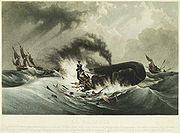 Right whales were so named because early whalers
considered them the "right" whale to hunt. In the early centuries of shore-based whaling prior to 1712, right whales were virtually the only catchable large whales, for three reasons:
Basque people
were the first to commercially hunt right whales. They began as early as the 11th century in the Bay of Biscay
. They initially sought oil, but as meat preservation technology improved the animal was also used for food. Basque whalers reached eastern Canada by 1530 and the shores of Todos os Santos Bay (in Bahia
, Brazil
) by 1602. The last Basque voyages were made prior to the Seven Year's War (1756–1763). All attempts to revive the trade post-war failed. Basque shore whaling continued sporadically into the 19th century.
"Yankee whalers" from the new American colonies replaced the Basques. Setting out from Nantucket, Massachusetts
and Long Island, New York, they took up to 100 animals in good years. By 1750 the commercial hunt of the North Atlantic right whale was basically over. The Yankee whalers moved into the South Atlantic before the end of the 18th century. The southernmost Brazilian whaling station was established in 1796, in Imbituba
. Over the next one hundred years, Yankee whaling spread into the Southern and Pacific Oceans, where the Americans were joined by fleets from several Europe
an nations. The beginning of the 20th century saw much greater industrialization of whaling, and the harvest grew rapidly. By 1937, there had been, according to whalers' records, 38,000 takes in the South Atlantic, 39,000 in the South Pacific, 1,300 in the Indian Ocean
, and 15,000 in the north Pacific. The incompleteness of these records means that the actual take was somewhat higher.
As it became clear that stocks were nearly depleted, the world banned right whaling in 1937. The ban was largely successful, although violations continued for several decades. Madeira
took its last two right whales in 1968. Japan took 23 Pacific right whales in the 1940s and more under scientific permit in the 1960s. Illegal whaling continued off the coast of Brazil for many years and the Imbituba
land station processed right whales until 1973. The Soviet Union
illegally took at least 3,212 Southern right whales during the 1950s and '60s, although it reported taking only four.
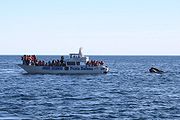
The southern right whale has made Hermanus
, South Africa
one of the world centers for whale watching
. During the winter months (July–October), southern right whales come so close to the shoreline that visitors can watch whales from strategically placed hotels. The town employs a "whale crier" (cf.
town crier
) to walk through the town announcing where whales have been seen. Southern Right Whales can also be watched at other winter breeding grounds.
In Brazil, Imbituba
in Santa Catarina
has been recognized as the National Right Whale Capital and holds annual Right Whale Week celebrations in September, when mothers and calves are more often seen. The old whaling station there has been converted to a museum documenting the history of right whales in Brazil. In winter in Argentina, Península Valdés in Patagonia
hosts the largest breeding population of the species, with more than 2,000 animals catalogued by the Whale Conservation Institute and Ocean Alliance
.
 Both the North Atlantic and North Pacific species are listed as a "species threatened with extinction which [is] or may be affected by trade" (Appendix I) by CITES, and as Conservation Dependent
by the IUCN Red List
, and as endangered under the U.S. Endangered Species Act
.
The U.S. and Brazil
added new protections for right whales in the 00's to address the two primary hazards. While environmental campaigners were, as reported in 2001, pleased about the plan's positive effects, they attempted to force the U.S. government to do more. In particular, they advocated 12 knots (23.5 km/h) speed limits for ships within 40 km (24.9 mi) of U.S. ports in times of high right whale presence. Citing concerns about excessive trade disruption, it did not comply. The Defenders of Wildlife
, the Humane Society of the United States
and the Ocean Conservancy sued the National Marine Fisheries Service
(a NOAA sub-agency) in September 2005 for "failing to protect the critically endangered North Atlantic Right Whale, which the agency acknowledges is 'the rarest of all large whale species' and which federal agencies are required to protect by both the Marine Mammal Protection Act
and the Endangered Species Act
", demanding emergency protection measures. According to NOAA researchers, about 83 percent of right whale sightings in the mid-Atlantic region occur within 20 nautical miles (37 km) of shore.
The Stellwagen Bank area has implemented an autobuoy program to acoustically detect right whales in the Boston Approaches and notify mariners via the Right Whale Listening Network website.
Species
In biology, a species is one of the basic units of biological classification and a taxonomic rank. A species is often defined as a group of organisms capable of interbreeding and producing fertile offspring. While in many cases this definition is adequate, more precise or differing measures are...
of large baleen whale
Baleen whale
The Baleen whales, also called whalebone whales or great whales, form the Mysticeti, one of two suborders of the Cetacea . Baleen whales are characterized by having baleen plates for filtering food from water, rather than having teeth. This distinguishes them from the other suborder of cetaceans,...
s consisting of two genera
Genus
In biology, a genus is a low-level taxonomic rank used in the biological classification of living and fossil organisms, which is an example of definition by genus and differentia...
in the family Balaenidae
Balaenidae
Balaenidae is a family of mysticete whales that contains two living genera. Commonly called the right whales as it contains mainly right whale species...
of order
Order (biology)
In scientific classification used in biology, the order is# a taxonomic rank used in the classification of organisms. Other well-known ranks are life, domain, kingdom, phylum, class, family, genus, and species, with order fitting in between class and family...
Cetacea
Cetacea
The order Cetacea includes the marine mammals commonly known as whales, dolphins, and porpoises. Cetus is Latin and is used in biological names to mean "whale"; its original meaning, "large sea animal", was more general. It comes from Ancient Greek , meaning "whale" or "any huge fish or sea...
. Their bodies are very dark gray or black and rotund.
They are called "right whales" because whalers
Whaling
Whaling is the hunting of whales mainly for meat and oil. Its earliest forms date to at least 3000 BC. Various coastal communities have long histories of sustenance whaling and harvesting beached whales...
thought the whales were the "right" ones to hunt, as they float when killed and often swim within sight of shore. They are also incredibly friendly, and often swam right up to boats as well. As such, they were hunted nearly to extinction during the active years of the whaling industry. Today, instead of hunting them, people often watch
Whale watching
Whale watching is the practice of observing whales and other cetaceans in their natural habitat. Whales are watched most commonly for recreation but the activity can also serve scientific or educational purposes. A 2009 study, prepared for IFAW, estimated that 13 million people went whale watching...
these acrobatic animals for pleasure. Genetic evidence appears to have settled a long-standing question about whether to include the largest, the Arctic-dwelling bowhead whale
Bowhead Whale
The bowhead whale is a baleen whale of the right whale family Balaenidae in suborder Mysticeti. A stocky dark-colored whale without a dorsal fin, it can grow to in length. This thick-bodied species can weigh to , second only to the blue whale, although the bowhead's maximum length is less than...
, with the rest. All four are included in the taxonomic family
Family (biology)
In biological classification, family is* a taxonomic rank. Other well-known ranks are life, domain, kingdom, phylum, class, order, genus, and species, with family fitting between order and genus. As for the other well-known ranks, there is the option of an immediately lower rank, indicated by the...
Balaenidae
Balaenidae
Balaenidae is a family of mysticete whales that contains two living genera. Commonly called the right whales as it contains mainly right whale species...
, and all four are generally referred to as right whales. This article focuses on the three species of the genus Eubalaena.
A fifth species of right whale was proposed by Emmanuel Swedenborg in the 18th century - the so called "Swedenborg whale". The description of this putative species was based on a collection of fossil bones unearthed at Norra Vanga, Sweden, in 1705 and believed to be those of giant
Giant
Giant or Giants may refer to:*Giants *Giant *Giant people; see gigantism, a medical condition*Giants -Arts and entertainment:*Giant , a 1952 novel by Edna Ferber...
s. The bones were examined by Swedenborg who realised that they belong to a species of whale. The existence of this species has been and is currently debated. Evidence for a putative fifth species was discovered during the construction of a motorway in Strömstad
Strömstad
Strömstad is a locality and the seat of Strömstad Municipality, Västra Götaland County, Sweden with 6,110 inhabitants in 2005.Strömstad is, despite its small population, for historical reasons normally still referred to as a city.- History :...
, Sweden
Sweden
Sweden , officially the Kingdom of Sweden , is a Nordic country on the Scandinavian Peninsula in Northern Europe. Sweden borders with Norway and Finland and is connected to Denmark by a bridge-tunnel across the Öresund....
.
Taxonomy
The bowhead whale is currently considered a separate speciesSpecies
In biology, a species is one of the basic units of biological classification and a taxonomic rank. A species is often defined as a group of organisms capable of interbreeding and producing fertile offspring. While in many cases this definition is adequate, more precise or differing measures are...
and was given its own genus
Genus
In biology, a genus is a low-level taxonomic rank used in the biological classification of living and fossil organisms, which is an example of definition by genus and differentia...
'Balaena' by Gray
John Edward Gray
John Edward Gray, FRS was a British zoologist. He was the elder brother of George Robert Gray and son of the pharmacologist and botanist Samuel Frederick Gray ....
in 1821. The other three species occupy genus Eubalaena. Scientists see greater differences among the three Balaenoptera
Balaenoptera
Balaenoptera is a genus of Balaenopteridae, the Rorqual whales, and contains eight species. The species Balaenoptera omurai was published in 2003...
species than between them and the Bowhead Whale. A future review will likely place all four species in one genus. Little genetic evidence supports the historic two-genera view.
Authorities have repeatedly recategorized the three populations of Eubalaena right whales, in one, two or three species. In the whaling era, there was thought to be a single species. Later, morphological factors such as differences in the skull shape of northern and southern animals indicated that there were at least two species—one in the northern hemisphere, the other in the Southern Ocean
Southern Ocean
The Southern Ocean comprises the southernmost waters of the World Ocean, generally taken to be south of 60°S latitude and encircling Antarctica. It is usually regarded as the fourth-largest of the five principal oceanic divisions...
. Right whales do not cross equatorial waters to make contact with the other (sub)species and (inter)breed: thick layers of insulating blubber
Blubber
Blubber is a thick layer of vascularized adipose tissue found under the skin of all cetaceans, pinnipeds and sirenians.-Description:Lipid-rich, collagen fiber–laced blubber comprises the hypodermis and covers the whole body, except for parts of the appendages, strongly attached to the musculature...
make it impossible for them to dissipate their internal body heat in tropical waters.
Three Eubalaena species theory
Genetic evidence demonstrates that the northern and southern populations have not interbred for between 3 million and 12 million years, confirming that the southern right whale is a distinct species. More surprising was the discovery that the northern hemisphere Pacific and Atlantic populations are also distinct, and that the Pacific species (now known as the North Pacific right whale) is more closely related to the southern right whale than to the North Atlantic right whale. While Rice continued to list two species in his 1998 classification, Rosenbaum et al. disagreed in 2000 and Brownell et al. in 2001. In 2005, Mammal Species of the World listed three species, indicating a shift to this conclusion.Whale lice
Whale louse
A whale louse is a parasitic crustacean of the family Cyamidae. They are related to the better-known skeleton shrimp, most species of which are found in shallower waters. Whale lice are external parasites, found in skin lesions, genital folds, nostrils and eyes of marine mammals of the order Cetacea...
, parasitic
Parasitism
Parasitism is a type of symbiotic relationship between organisms of different species where one organism, the parasite, benefits at the expense of the other, the host. Traditionally parasite referred to organisms with lifestages that needed more than one host . These are now called macroparasites...
cyamid crustacean
Crustacean
Crustaceans form a very large group of arthropods, usually treated as a subphylum, which includes such familiar animals as crabs, lobsters, crayfish, shrimp, krill and barnacles. The 50,000 described species range in size from Stygotantulus stocki at , to the Japanese spider crab with a leg span...
s that live off skin debris, offer further information through their own genetics. Because these lice reproduce much more quickly than whales, their genetic diversity is greater. Marine biologists at the University of Utah
University of Utah
The University of Utah, also known as the U or the U of U, is a public, coeducational research university in Salt Lake City, Utah, United States. The university was established in 1850 as the University of Deseret by the General Assembly of the provisional State of Deseret, making it Utah's oldest...
examined these louse genes and determined that their hosts split into three species 5–6 million years ago, and that these species were all equally abundant before whaling
Whaling
Whaling is the hunting of whales mainly for meat and oil. Its earliest forms date to at least 3000 BC. Various coastal communities have long histories of sustenance whaling and harvesting beached whales...
began in the 11th century. The communities first split because of the joining of North
North America
North America is a continent wholly within the Northern Hemisphere and almost wholly within the Western Hemisphere. It is also considered a northern subcontinent of the Americas...
and South America
South America
South America is a continent situated in the Western Hemisphere, mostly in the Southern Hemisphere, with a relatively small portion in the Northern Hemisphere. The continent is also considered a subcontinent of the Americas. It is bordered on the west by the Pacific Ocean and on the north and east...
. The heat of the equator then created a second split, into northern and southern groups. "This puts an end to the long debate about whether there are three [Eubalaena] species of right whale. They really are separate beyond a doubt", Jon Seger, the project's leader, told BBC News.
Balaena fossil record
A total of five Balaena fossils have been found in Europe and North America in deposits ranging from the late MioceneMiocene
The Miocene is a geological epoch of the Neogene Period and extends from about . The Miocene was named by Sir Charles Lyell. Its name comes from the Greek words and and means "less recent" because it has 18% fewer modern sea invertebrates than the Pliocene. The Miocene follows the Oligocene...
(about 10 mya) to early Pleistocene
Pleistocene
The Pleistocene is the epoch from 2,588,000 to 11,700 years BP that spans the world's recent period of repeated glaciations. The name pleistocene is derived from the Greek and ....
(about 1.5 mya). These five specimens each have their own species status—B. affinis, B. etrusca, B. montalionis, B. primigenius and B. prisca. The last of these may prove to be the modern bowhead. Prior to these there is a long gap before reaching the next related cetacean in the fossil record—Morenocetus was found in a South American deposit dating back 23 million years.
Synonyms and common names
Due to their familiarity to whalers over a number of centuries the right whales have had many names. These names were used throughout the world, reflecting the fact that only one species was recognized at the time. In his novel Moby-DickMoby-Dick
Moby-Dick; or, The Whale, was written by American author Herman Melville and first published in 1851. It is considered by some to be a Great American Novel and a treasure of world literature. The story tells the adventures of wandering sailor Ishmael, and his voyage on the whaleship Pequod,...
, Herman Melville
Herman Melville
Herman Melville was an American novelist, short story writer, essayist, and poet. He is best known for his novel Moby-Dick and the posthumous novella Billy Budd....
writes:
- "Among the fishermen, the whale regularly hunted for oil is indiscriminately designated by all the following titles: The Whale; the Greenland whale; the black whale; the great whale; the true whale; the right whale."
Halibalaena (Gray, 1873) and Hunterius (Gray, 1866) are junior synonyms for the genus Eubalaena. E. australis is the type species.
The species-level synonyms are:
- For E. australis: antarctica (Lesson, 1828), antipodarum (Gray, 1843), temminckii (Gray, 1864)
- For E. glacialis: biscayensis (Eschricht, 1860), nordcaper (Lacepede, 1804)
- For E. japonica: sieboldii (Gray, 1864)
The pygmy right whale
Pygmy Right Whale
The pygmy right whale is a baleen whale, the sole member of the family Neobalaenidae. First described by John Edward Gray in 1846, it is the smallest of the baleen whales, ranging between and in length and 3,000 and 3,500 kg in mass...
(Capera marginata), a much smaller whale of the southern hemisphere, was also included in the Balaenidae family, but has recently been found to warrant a separate family, Neobalaenidae.
Description
 |
 |
 |
 |
Unlike other whales, right whales have distinctive callosities
Callosity
A callosity is another name for callus, a piece of skin that has become thickened as a result of repeated contact and friction.- Monkeys :When occurring on an animal's buttocks, as with baboons, they are specifically called ischial callosities...
(roughened patches of skin) on their heads, along with a broad back without a dorsal fin
Dorsal fin
A dorsal fin is a fin located on the backs of various unrelated marine and freshwater vertebrates, including most fishes, marine mammals , and the ichthyosaurs...
, occasionally with white belly patches, and a long arching mouth that begins above the eye. The callosities appear white due to large colonies of cyamids (whale lice). Right whales can grow up to 18 m (59.1 ft) long and weigh up to 100 short tons (90.7 MT), significantly larger than humpbacks
Humpback Whale
The humpback whale is a species of baleen whale. One of the larger rorqual species, adults range in length from and weigh approximately . The humpback has a distinctive body shape, with unusually long pectoral fins and a knobbly head. It is an acrobatic animal, often breaching and slapping the...
or grays
Gray Whale
The gray whale, Eschrichtius robustus, is a baleen whale that migrates between feeding and breeding grounds yearly. It reaches a length of about , a weight of , and lives 50–70 years. The common name of the whale comes from the gray patches and white mottling on its dark skin. Gray whales were...
, but smaller than blues
Blue Whale
The blue whale is a marine mammal belonging to the suborder of baleen whales . At in length and or more in weight, it is the largest known animal to have ever existed....
.
An unusually large forty percent of body weight is blubber
Blubber
Blubber is a thick layer of vascularized adipose tissue found under the skin of all cetaceans, pinnipeds and sirenians.-Description:Lipid-rich, collagen fiber–laced blubber comprises the hypodermis and covers the whole body, except for parts of the appendages, strongly attached to the musculature...
, which is of relatively low density. Consequently, unlike many other species of whale, dead right whales float.
Anatomy
Right whales have a distinctive wide V-shaped blow, caused by the widely spaced blowhole
Blowhole (biology)
In biology, a blowhole is the hole at the top of a cetacean's head through which the animal breathes air. It is homologous with the nostril of other mammals. As whales reach the water surface to breathe, they will forcefully expel air through the blowhole. Not only is air expelled, but mucus and...
s on the top of the head. The blow rises 5 m (16.4 ft) above the surface.
Right whales have between 200 and 300 baleen plates on each side of the mouth. These are narrow and approximately 2 m (6.6 ft) long, and are covered in very thin hairs. The plates enable the whale to filter feed.
The testicle
Testicle
The testicle is the male gonad in animals. Like the ovaries to which they are homologous, testes are components of both the reproductive system and the endocrine system...
s appear to be the largest of any animal, each weighing around 500 kg (1,102.3 lb). The relative size is also large, at 1% of the whale's total body weight. This suggests that sperm competition
Sperm competition
Sperm competition is a term used to refer to the competitive process between spermatozoa of two different males to fertilize an egg of a lone female. Competition occurs whenever females engage in promiscuous mating to increase their chances in producing more viable offspring...
is important in mating.
Reproduction
Females reach sexual maturity at 6–12 years and breed every 3–5 years. Both reproduction and calving take place during the winter months. Calves are approximately 1 short ton (0.90718474 MT) in weight and 4–6 m (13.1–19.7 ft) in length at birth following a gestation periodGestation period
For mammals the gestation period is the time in which a fetus develops, beginning with fertilization and ending at birth. The duration of this period varies between species.-Duration:...
of 1 year. The right whale grows rapidly in its first year, typically doubling in length. Weaning occurs after eight months to one year and the growth rate in later years is not well understood—it may be highly dependent on whether a calf stays with its mother for a second year.
Lifespan
Very little is known about the life span of right whales because they are so scarce scientists cannot readily study them. One of the few well-documented cases is of a female North Atlantic right whale that was photographed with a baby in 1935, then photographed again in 1959, 1980, 1985, and 1992. Consistent callosity patterns ensured that it was the same animal. She was last photographed in 1995 with a seemingly fatal head wound, presumably from a ship strike. The animal died at at least 70 years of age. Research on the bowhead whaleBowhead Whale
The bowhead whale is a baleen whale of the right whale family Balaenidae in suborder Mysticeti. A stocky dark-colored whale without a dorsal fin, it can grow to in length. This thick-bodied species can weigh to , second only to the blue whale, although the bowhead's maximum length is less than...
suggests this lifespan is not uncommon and may even be exceeded.
Swimming
Right whales swim slowly, reaching only 5 kn (9.8 km/h) at top speed, but are highly acrobatic and frequently breach (jump clear of the sea surface), tail-slap and lobtail. Like other baleen whaleBaleen whale
The Baleen whales, also called whalebone whales or great whales, form the Mysticeti, one of two suborders of the Cetacea . Baleen whales are characterized by having baleen plates for filtering food from water, rather than having teeth. This distinguishes them from the other suborder of cetaceans,...
s, the species is not gregarious and the typical group size
Group size measures
Many animals, including humans, tend to live in groups, herds, flocks, bands, packs, shoals, or colonies of conspecific individuals. The size of these groups, as expressed by the number of participant individuals, is an important aspect of their social environment...
is only two. Groups of up to twelve have been reported, but these were not close-knit and may have been transitory.
Parasitism
Right whales are often marked by large scaly gray-white patches on their skin, whose patterns are unique from animal to animal. These patches, called callosities, are colonies of crustaceans known as whale liceWhale louse
A whale louse is a parasitic crustacean of the family Cyamidae. They are related to the better-known skeleton shrimp, most species of which are found in shallower waters. Whale lice are external parasites, found in skin lesions, genital folds, nostrils and eyes of marine mammals of the order Cetacea...
which can exist in the tens of thousands upon each whale. The parasitic creatures subsist on algae and dead skin, and while they are irritants, they do not cause significant harm to the whale.
Feeding
The right whales' diet consists primarily of zooplanktonZooplankton
Zooplankton are heterotrophic plankton. Plankton are organisms drifting in oceans, seas, and bodies of fresh water. The word "zooplankton" is derived from the Greek zoon , meaning "animal", and , meaning "wanderer" or "drifter"...
, primarily the tiny crustacean
Crustacean
Crustaceans form a very large group of arthropods, usually treated as a subphylum, which includes such familiar animals as crabs, lobsters, crayfish, shrimp, krill and barnacles. The 50,000 described species range in size from Stygotantulus stocki at , to the Japanese spider crab with a leg span...
s called copepod
Copepod
Copepods are a group of small crustaceans found in the sea and nearly every freshwater habitat. Some species are planktonic , some are benthic , and some continental species may live in limno-terrestrial habitats and other wet terrestrial places, such as swamps, under leaf fall in wet forests,...
s, as well as krill
Krill
Krill is the common name given to the order Euphausiacea of shrimp-like marine crustaceans. Also known as euphausiids, these small invertebrates are found in all oceans of the world...
, and pteropods, although they are occasionally opportunistic feeders.
As with other baleens, they feed by filtering prey from the water. They swim with an open mouth, filling it with water and prey. The whale then expels the water, using its baleen plates to retain the prey. Prey must occur in sufficient numbers to trigger the whale's interest; be large enough that the baleen plates can filter it; and be slow enough that it cannot escape. The "skimming" may take place on the surface, underwater, or even at the ocean's bottom, indicated by mud occasionally observed on right whales' bodies.
Predation
The right whales' only predators are orcaOrca
The killer whale , commonly referred to as the orca, and less commonly as the blackfish, is a toothed whale belonging to the oceanic dolphin family. Killer whales are found in all oceans, from the frigid Arctic and Antarctic regions to tropical seas...
s and humans
Whaling
Whaling is the hunting of whales mainly for meat and oil. Its earliest forms date to at least 3000 BC. Various coastal communities have long histories of sustenance whaling and harvesting beached whales...
. When danger lurks, a group of right whales may form a circle, with their tails pointing outwards. This defense is not always successful and calves are occasionally lost.
Range and habitat
The three Eubalaena species inhabit three distinct areas of the globe: the North Atlantic in the western Atlantic Ocean, the North Pacific in a band from Japan to AlaskaAlaska
Alaska is the largest state in the United States by area. It is situated in the northwest extremity of the North American continent, with Canada to the east, the Arctic Ocean to the north, and the Pacific Ocean to the west and south, with Russia further west across the Bering Strait...
and all areas of the Southern Ocean
Southern Ocean
The Southern Ocean comprises the southernmost waters of the World Ocean, generally taken to be south of 60°S latitude and encircling Antarctica. It is usually regarded as the fourth-largest of the five principal oceanic divisions...
. The whales can only cope with the moderate temperatures found between 20 and 60 degrees in latitude. The warm equatorial waters form a barrier that prevents mixing between the northern and southern groups. Although the Southern species in particular must travel across open ocean to reach its feeding grounds, the species is not considered to be pelagic. In general, they prefer to stay close to peninsula
Peninsula
A peninsula is a piece of land that is bordered by water on three sides but connected to mainland. In many Germanic and Celtic languages and also in Baltic, Slavic and Hungarian, peninsulas are called "half-islands"....
s and bays and on continental shelves
Continental shelf
The continental shelf is the extended perimeter of each continent and associated coastal plain. Much of the shelf was exposed during glacial periods, but is now submerged under relatively shallow seas and gulfs, and was similarly submerged during other interglacial periods. The continental margin,...
, as these areas offer greater shelter and an abundance of their preferred foods.
Because the oceans are so large, it is very difficult to accurately gauge whale population sizes. Approximate figures:
- 400 to 450 North Atlantic right whaleNorth Atlantic Right WhaleThe North Atlantic right whale which means "good, or true, whale of the ice") is a baleen whale, one of three right whale species belonging to the genus Eubalaena, formerly classified as a single species. With only 400 in existence, North Atlantic right whales are among the most endangered whales...
s (Eubalaena glacialis) live in the North Atlantic; - 30-50 North Pacific right whaleNorth Pacific Right WhaleThe North Pacific right whale is a very large, robust baleen whale species that is now extremely rare and endangered. The Northeast Pacific subpopulation, that summers in the southeastern Bering Sea and Gulf of Alaska, may have no more than 50 animals...
s live in the eastern North Pacific (Eubalaena japonica) and perhaps 100-200 more in the Sea of OkhotskSea of OkhotskThe Sea of Okhotsk is a marginal sea of the western Pacific Ocean, lying between the Kamchatka Peninsula on the east, the Kuril Islands on the southeast, the island of Hokkaidō to the far south, the island of Sakhalin along the west, and a long stretch of eastern Siberian coast along the west and...
; - 12,000 Southern right whaleSouthern Right WhaleThe southern right whale is a baleen whale, one of three species classified as right whales belonging to the genus Eubalaena. Like other right whales, the southern right whale is readily distinguished from others by the callosities on its head, a broad back without a dorsal fin, and a long arching...
s (Eubalaena australis) are spread throughout the southern part of the Southern Hemisphere; and - 9,000–10,000 bowhead whales are distributed entirely in the Arctic OceanArctic OceanThe Arctic Ocean, located in the Northern Hemisphere and mostly in the Arctic north polar region, is the smallest and shallowest of the world's five major oceanic divisions...
and sub-polar seas.
North Atlantic
Almost all of the 400 North Atlantic right whales, live in the western North Atlantic Ocean. In spring, summer and autumn, they feed in areas off the Canadian and north-east U.S. coasts in a range stretching from New YorkNew York
New York is a state in the Northeastern region of the United States. It is the nation's third most populous state. New York is bordered by New Jersey and Pennsylvania to the south, and by Connecticut, Massachusetts and Vermont to the east...
to Nova Scotia
Nova Scotia
Nova Scotia is one of Canada's three Maritime provinces and is the most populous province in Atlantic Canada. The name of the province is Latin for "New Scotland," but "Nova Scotia" is the recognized, English-language name of the province. The provincial capital is Halifax. Nova Scotia is the...
. Particularly popular feeding areas are the Bay of Fundy
Bay of Fundy
The Bay of Fundy is a bay on the Atlantic coast of North America, on the northeast end of the Gulf of Maine between the Canadian provinces of New Brunswick and Nova Scotia, with a small portion touching the U.S. state of Maine...
and Cape Cod Bay
Cape Cod Bay
Cape Cod Bay is a large bay of the Atlantic Ocean adjacent to the U.S. state of Massachusetts. Measuring below a line drawn from Brant Rock in Marshfield to Race Point in Provincetown, Massachusetts, it is enclosed by Cape Cod to the south and east, and Plymouth County, Massachusetts, to the west....
. In winter, they head south towards Georgia
Georgia (U.S. state)
Georgia is a state located in the southeastern United States. It was established in 1732, the last of the original Thirteen Colonies. The state is named after King George II of Great Britain. Georgia was the fourth state to ratify the United States Constitution, on January 2, 1788...
and Florida
Florida
Florida is a state in the southeastern United States, located on the nation's Atlantic and Gulf coasts. It is bordered to the west by the Gulf of Mexico, to the north by Alabama and Georgia and to the east by the Atlantic Ocean. With a population of 18,801,310 as measured by the 2010 census, it...
to give birth.
There have been a smattering of sightings further east over the past few decades—several sightings were made close to Iceland
Iceland
Iceland , described as the Republic of Iceland, is a Nordic and European island country in the North Atlantic Ocean, on the Mid-Atlantic Ridge. Iceland also refers to the main island of the country, which contains almost all the population and almost all the land area. The country has a population...
in 2003. It is possible that these are the remains of a virtually extinct eastern Atlantic stock, but examination of old whalers' records suggest that they are more likely to be strays. However, a few sightings are regular between Norway, Ireland, Spain, Portugal, the Canary Islands and even Italy and Sicily and at least the Norway individuals come from the Western stock.
North Pacific
The North Pacific right whale appears to occur in two populations. The population in the eastern North Pacific/Bering Sea is extremely low, numbering about 30 individuals. A larger western population of 100-200 appears to be surviving in the Sea of Okhotsk, but very little is known about this population. Thus, the two northern right whale species are the most endangeredEndangered species
An endangered species is a population of organisms which is at risk of becoming extinct because it is either few in numbers, or threatened by changing environmental or predation parameters...
of all large whales and two of the most endangered animals in the world. Based on current population density trends, both species are predicted to become extinct within 200 years. The Pacific species was historically found in summer from the Sea of Okhotsk
Sea of Okhotsk
The Sea of Okhotsk is a marginal sea of the western Pacific Ocean, lying between the Kamchatka Peninsula on the east, the Kuril Islands on the southeast, the island of Hokkaidō to the far south, the island of Sakhalin along the west, and a long stretch of eastern Siberian coast along the west and...
in the west to the Gulf of Alaska in the east, generally north of 50°N. Today, sightings are very rare and generally occur in the mouth of the Sea of Okhotsk and in the eastern Bering Sea
Bering Sea
The Bering Sea is a marginal sea of the Pacific Ocean. It comprises a deep water basin, which then rises through a narrow slope into the shallower water above the continental shelves....
. Although this species is very likely to be migratory like the other two species, its movement patterns are not known.
Southern
The estimate of 7,000 southern right whales came about following an IWCInternational Whaling Commission
The International Whaling Commission is an international body set up by the terms of the International Convention for the Regulation of Whaling , which was signed in Washington, D.C...
workshop held in Cape Town
Cape Town
Cape Town is the second-most populous city in South Africa, and the provincial capital and primate city of the Western Cape. As the seat of the National Parliament, it is also the legislative capital of the country. It forms part of the City of Cape Town metropolitan municipality...
in March 1998. Researchers used data about adult female populations from three surveys (one in each of Argentina, South Africa and Australia collected during the 1990s) and extrapolated to include unsurveyed areas, number of males and calves using available male:female and adult:calf ratios to give an estimated 1999 figure of 7,000 animals.
The southern right whale spends the summer months in the far Southern Ocean feeding, probably close to Antarctica. It migrates north in winter for breeding and can be seen around the coasts of Argentina
Argentina
Argentina , officially the Argentine Republic , is the second largest country in South America by land area, after Brazil. It is constituted as a federation of 23 provinces and an autonomous city, Buenos Aires...
, Australia, Brazil
Brazil
Brazil , officially the Federative Republic of Brazil , is the largest country in South America. It is the world's fifth largest country, both by geographical area and by population with over 192 million people...
, Chile
Chile
Chile ,officially the Republic of Chile , is a country in South America occupying a long, narrow coastal strip between the Andes mountains to the east and the Pacific Ocean to the west. It borders Peru to the north, Bolivia to the northeast, Argentina to the east, and the Drake Passage in the far...
, Mozambique
Mozambique
Mozambique, officially the Republic of Mozambique , is a country in southeastern Africa bordered by the Indian Ocean to the east, Tanzania to the north, Malawi and Zambia to the northwest, Zimbabwe to the west and Swaziland and South Africa to the southwest...
, New Zealand
New Zealand
New Zealand is an island country in the south-western Pacific Ocean comprising two main landmasses and numerous smaller islands. The country is situated some east of Australia across the Tasman Sea, and roughly south of the Pacific island nations of New Caledonia, Fiji, and Tonga...
and South Africa
South Africa
The Republic of South Africa is a country in southern Africa. Located at the southern tip of Africa, it is divided into nine provinces, with of coastline on the Atlantic and Indian oceans...
.
Since hunting of the southern right whale ceased, stocks are estimated to have grown by 7% a year. It appears that the South American, South African and Australasian groups intermix very little, if at all, because of the strong fidelity of mothers to their feeding and calving grounds. The mother passes these instincts to her calves.
In Brazil, more than 300 individuals have been cataloged through photo identification (using their distinctive head callosities) by the Brazilian Right Whale Project, maintained jointly by Petrobras
Petrobras
Petróleo Brasileiro or Petrobras is a semi-public Brazilian multinational energy corporation headquartered in Rio de Janeiro, Brazil. It is the largest company in Latin America by market capitalization and revenue, and the largest company headquartered in the Southern Hemisphere by market...
(the Brazilian state-owned oil company) and the International Wildlife Coalition. The State of Santa Catarina
Santa Catarina (state)
Santa Catarina is a state in southern Brazil with one of the highest standards of living in Latin America. Its capital is Florianópolis, which mostly lies on the Santa Catarina Island. Neighbouring states are Rio Grande do Sul to the south and Paraná to the north. It is bounded on the east by...
hosts a concentration of breeding and calving right whales from June to November, and females from this population are also known to calve off Argentinian Patagonia
Patagonia
Patagonia is a region located in Argentina and Chile, integrating the southernmost section of the Andes mountains to the southwest towards the Pacific ocean and from the east of the cordillera to the valleys it follows south through Colorado River towards Carmen de Patagones in the Atlantic Ocean...
.
Vocalization and hearing
Vocalizations made by right whales are not elaborate compared to those made by other whale species. The whales make groans, pops and belches that are typically at frequencies around 500 HertzHertz
The hertz is the SI unit of frequency defined as the number of cycles per second of a periodic phenomenon. One of its most common uses is the description of the sine wave, particularly those used in radio and audio applications....
. The purpose of the sounds is not known but may be a form of communication between whales within the same group.
Northern right whales responded to sounds similar to police sirens
Siren (noisemaker)
A siren is a loud noise making device. Most modern ones are civil defense or air raid sirens, tornado sirens, or the sirens on emergency service vehicles such as ambulances, police cars and fire trucks. There are two general types: pneumatic and electronic....
—sounds of much higher frequency
Frequency
Frequency is the number of occurrences of a repeating event per unit time. It is also referred to as temporal frequency.The period is the duration of one cycle in a repeating event, so the period is the reciprocal of the frequency...
than their own. On hearing the sounds they moved rapidly to the surface. The research was of particular interest because northern rights ignore most sounds, including those of approaching boats. Researchers speculate that this information may be useful in attempts to reduce the number of ship-whale collisions or to encourage the whales to surface for ease of harvesting
Whaling
Whaling is the hunting of whales mainly for meat and oil. Its earliest forms date to at least 3000 BC. Various coastal communities have long histories of sustenance whaling and harvesting beached whales...
.
Whaling
Whaling
Whaling is the hunting of whales mainly for meat and oil. Its earliest forms date to at least 3000 BC. Various coastal communities have long histories of sustenance whaling and harvesting beached whales...
considered them the "right" whale to hunt. In the early centuries of shore-based whaling prior to 1712, right whales were virtually the only catchable large whales, for three reasons:
- They often swam close to shore where they could be spotted by beach lookouts, and hunted from beach-based whaleboats
- They are relatively slow swimmers, allowing whalers to catch up to them in their whaleboats
- Once killed by harpoons, they were more likely to float, and thus could be retrieved. However, many did sink when killed (10-30% in the North Pacific) and were lost unless they later stranded or surfaced.
Basque people
Basque people
The Basques as an ethnic group, primarily inhabit an area traditionally known as the Basque Country , a region that is located around the western end of the Pyrenees on the coast of the Bay of Biscay and straddles parts of north-central Spain and south-western France.The Basques are known in the...
were the first to commercially hunt right whales. They began as early as the 11th century in the Bay of Biscay
Bay of Biscay
The Bay of Biscay is a gulf of the northeast Atlantic Ocean located south of the Celtic Sea. It lies along the western coast of France from Brest south to the Spanish border, and the northern coast of Spain west to Cape Ortegal, and is named in English after the province of Biscay, in the Spanish...
. They initially sought oil, but as meat preservation technology improved the animal was also used for food. Basque whalers reached eastern Canada by 1530 and the shores of Todos os Santos Bay (in Bahia
Salvador, Bahia
Salvador is the largest city on the northeast coast of Brazil and the capital of the Northeastern Brazilian state of Bahia. Salvador is also known as Brazil's capital of happiness due to its easygoing population and countless popular outdoor parties, including its street carnival. The first...
, Brazil
Brazil
Brazil , officially the Federative Republic of Brazil , is the largest country in South America. It is the world's fifth largest country, both by geographical area and by population with over 192 million people...
) by 1602. The last Basque voyages were made prior to the Seven Year's War (1756–1763). All attempts to revive the trade post-war failed. Basque shore whaling continued sporadically into the 19th century.
"Yankee whalers" from the new American colonies replaced the Basques. Setting out from Nantucket, Massachusetts
Nantucket, Massachusetts
Nantucket is an island south of Cape Cod, Massachusetts, in the United States. Together with the small islands of Tuckernuck and Muskeget, it constitutes the town of Nantucket, Massachusetts, and the coterminous Nantucket County, which are consolidated. Part of the town is designated the Nantucket...
and Long Island, New York, they took up to 100 animals in good years. By 1750 the commercial hunt of the North Atlantic right whale was basically over. The Yankee whalers moved into the South Atlantic before the end of the 18th century. The southernmost Brazilian whaling station was established in 1796, in Imbituba
Imbituba
Imbituba is a port and coastal town in the southern Brazil state of Santa Catarina. It has a population of around 39,000. Up until the middle of the twentieth century Imbituba was an important home of Brazilian whalers since 1796, when the southernmost whaling station in Brazil was established...
. Over the next one hundred years, Yankee whaling spread into the Southern and Pacific Oceans, where the Americans were joined by fleets from several Europe
Europe
Europe is, by convention, one of the world's seven continents. Comprising the westernmost peninsula of Eurasia, Europe is generally 'divided' from Asia to its east by the watershed divides of the Ural and Caucasus Mountains, the Ural River, the Caspian and Black Seas, and the waterways connecting...
an nations. The beginning of the 20th century saw much greater industrialization of whaling, and the harvest grew rapidly. By 1937, there had been, according to whalers' records, 38,000 takes in the South Atlantic, 39,000 in the South Pacific, 1,300 in the Indian Ocean
Indian Ocean
The Indian Ocean is the third largest of the world's oceanic divisions, covering approximately 20% of the water on the Earth's surface. It is bounded on the north by the Indian Subcontinent and Arabian Peninsula ; on the west by eastern Africa; on the east by Indochina, the Sunda Islands, and...
, and 15,000 in the north Pacific. The incompleteness of these records means that the actual take was somewhat higher.
As it became clear that stocks were nearly depleted, the world banned right whaling in 1937. The ban was largely successful, although violations continued for several decades. Madeira
Madeira
Madeira is a Portuguese archipelago that lies between and , just under 400 km north of Tenerife, Canary Islands, in the north Atlantic Ocean and an outermost region of the European Union...
took its last two right whales in 1968. Japan took 23 Pacific right whales in the 1940s and more under scientific permit in the 1960s. Illegal whaling continued off the coast of Brazil for many years and the Imbituba
Imbituba
Imbituba is a port and coastal town in the southern Brazil state of Santa Catarina. It has a population of around 39,000. Up until the middle of the twentieth century Imbituba was an important home of Brazilian whalers since 1796, when the southernmost whaling station in Brazil was established...
land station processed right whales until 1973. The Soviet Union
Soviet Union
The Soviet Union , officially the Union of Soviet Socialist Republics , was a constitutionally socialist state that existed in Eurasia between 1922 and 1991....
illegally took at least 3,212 Southern right whales during the 1950s and '60s, although it reported taking only four.
Whale watching
The southern right whale has made Hermanus
Hermanus
Hermanus is a town with 49,000 inhabitants on the southern coast of the Western Cape province of South Africa. It is famous as a place from which to watch Southern Right whales, during the southern winter and spring and is a popular retirement town...
, South Africa
South Africa
The Republic of South Africa is a country in southern Africa. Located at the southern tip of Africa, it is divided into nine provinces, with of coastline on the Atlantic and Indian oceans...
one of the world centers for whale watching
Whale watching
Whale watching is the practice of observing whales and other cetaceans in their natural habitat. Whales are watched most commonly for recreation but the activity can also serve scientific or educational purposes. A 2009 study, prepared for IFAW, estimated that 13 million people went whale watching...
. During the winter months (July–October), southern right whales come so close to the shoreline that visitors can watch whales from strategically placed hotels. The town employs a "whale crier" (cf.
Cf.
cf., an abbreviation for the Latin word confer , literally meaning "bring together", is used to refer to other material or ideas which may provide similar or different information or arguments. It is mainly used in scholarly contexts, such as in academic or legal texts...
town crier
Town crier
A town crier, or bellman, is an officer of the court who makes public pronouncements as required by the court . The crier can also be used to make public announcements in the streets...
) to walk through the town announcing where whales have been seen. Southern Right Whales can also be watched at other winter breeding grounds.
In Brazil, Imbituba
Imbituba
Imbituba is a port and coastal town in the southern Brazil state of Santa Catarina. It has a population of around 39,000. Up until the middle of the twentieth century Imbituba was an important home of Brazilian whalers since 1796, when the southernmost whaling station in Brazil was established...
in Santa Catarina
Santa Catarina (state)
Santa Catarina is a state in southern Brazil with one of the highest standards of living in Latin America. Its capital is Florianópolis, which mostly lies on the Santa Catarina Island. Neighbouring states are Rio Grande do Sul to the south and Paraná to the north. It is bounded on the east by...
has been recognized as the National Right Whale Capital and holds annual Right Whale Week celebrations in September, when mothers and calves are more often seen. The old whaling station there has been converted to a museum documenting the history of right whales in Brazil. In winter in Argentina, Península Valdés in Patagonia
Patagonia
Patagonia is a region located in Argentina and Chile, integrating the southernmost section of the Andes mountains to the southwest towards the Pacific ocean and from the east of the cordillera to the valleys it follows south through Colorado River towards Carmen de Patagones in the Atlantic Ocean...
hosts the largest breeding population of the species, with more than 2,000 animals catalogued by the Whale Conservation Institute and Ocean Alliance
Ocean alliance
Ocean Alliance, Inc., a 5013 organization, is dedicated to the conservation of whales and their marine environment through research and education. The organization is based in Gloucester, Massachusetts in the United States....
.
Ship strikes
The leading cause of death among the North Atlantic right whale, which migrates through some of the world's busiest shipping lanes while journeying off the east coast of the United States and Canada, is from being struck by ships. At least 16 ship strike deaths were reported between 1970 and 1999, and probably more remain unreported. According to NOAA, 25 of the 71 right whale deaths reported since 1970 resulted from ship strikes. Recognizing that this toll could tip the delicately balanced species towards extinction, in July 1997, the U.S. National Oceanic and Atmospheric Administration's (NOAA) introduced Atlantic Large Whale Take Reduction Plan. A key part of the plan was the introduction of mandatory reporting of large whale sightings by ships using U.S. ports.Fishing gear
A second major cause of morbidity and mortality in the North Atlantic right whale is entanglement in fishing gear. Right whales ingest plankton with wide open mouths, risking entanglement in any rope or net fixed in the water column. Rope wraps around upper jaws, flippers and tails. Most manage to escape with minor scarring, but some are seriously and persistently entangled. If observers notice, they can be successfully disentangled, but others die over a period of months. Animal welfare and extinction concerns align in emphasizing the harm of such entanglements.Conservation
Conservation Dependent
Conservation Dependent was an IUCN category assigned to species or lower taxa which were dependent on conservation efforts to prevent the taxon becoming threatened with extinction...
by the IUCN Red List
IUCN Red List
The IUCN Red List of Threatened Species , founded in 1963, is the world's most comprehensive inventory of the global conservation status of biological species. The International Union for Conservation of Nature is the world's main authority on the conservation status of species...
, and as endangered under the U.S. Endangered Species Act
Endangered Species Act
The Endangered Species Act of 1973 is one of the dozens of United States environmental laws passed in the 1970s. Signed into law by President Richard Nixon on December 28, 1973, it was designed to protect critically imperiled species from extinction as a "consequence of economic growth and...
.
The U.S. and Brazil
Brazil
Brazil , officially the Federative Republic of Brazil , is the largest country in South America. It is the world's fifth largest country, both by geographical area and by population with over 192 million people...
added new protections for right whales in the 00's to address the two primary hazards. While environmental campaigners were, as reported in 2001, pleased about the plan's positive effects, they attempted to force the U.S. government to do more. In particular, they advocated 12 knots (23.5 km/h) speed limits for ships within 40 km (24.9 mi) of U.S. ports in times of high right whale presence. Citing concerns about excessive trade disruption, it did not comply. The Defenders of Wildlife
Defenders of Wildlife
Defenders of Wildlife is a United States-based, 501 non-profit organization founded in 1947, "dedicated to the protection of all native animals and plants in their natural communities." The organization is active in political interventions and lobbying aimed at protection of wildlife, and...
, the Humane Society of the United States
Humane Society of the United States
The Humane Society of the United States , based in Washington, D.C., is the largest animal advocacy organization in the world. In 2009, HSUS reported assets of over US$160 million....
and the Ocean Conservancy sued the National Marine Fisheries Service
National Marine Fisheries Service
The National Marine Fisheries Service is a United States federal agency. A division of the National Oceanic and Atmospheric Administration and the Department of Commerce, NMFS is responsible for the stewardship and management of the nation's living marine resources and their habitat within the...
(a NOAA sub-agency) in September 2005 for "failing to protect the critically endangered North Atlantic Right Whale, which the agency acknowledges is 'the rarest of all large whale species' and which federal agencies are required to protect by both the Marine Mammal Protection Act
Marine Mammal Protection Act
The Marine Mammal Protection Act of 1972 was the first article of legislation to call specifically for an ecosystem approach to natural resource management and conservation. MMPA prohibits the taking of marine mammals, and enacts a moratorium on the import, export, and sale of any marine mammal,...
and the Endangered Species Act
Endangered Species Act
The Endangered Species Act of 1973 is one of the dozens of United States environmental laws passed in the 1970s. Signed into law by President Richard Nixon on December 28, 1973, it was designed to protect critically imperiled species from extinction as a "consequence of economic growth and...
", demanding emergency protection measures. According to NOAA researchers, about 83 percent of right whale sightings in the mid-Atlantic region occur within 20 nautical miles (37 km) of shore.
NOAA speed limit
On February 6, 2006, NOAA proposed its Strategy to Reduce Ship Strikes to North Atlantic Right Whales. The proposal, opposed by some shipping interests, limited ship speeds during calving season. The proposal was implemented in 2008. On December 8, 2008, NOAA issued a press release that included the following:- Effective January, 2009 ships 65 feet (19.8 m) or longer are limited to 10 knots (19.6 km/h) in waters off New England when whales begin gathering in this area as part of their annual migration. The restriction extends to 20 nautical miles (37 km) around major mid-Atlantic ports.
- The speed restriction applies in waters off New England and the southeastern U.S., where whales gather seasonally.
- Southeastern U.S. from St. Augustine, Fla. to Brunswick, Ga. from Nov. 15 to April 15
- Mid-Atlantic U.S. areas from Rhode Island to Georgia from Nov. 1 to April 30.
- Cape Cod Bay from Jan. 1 to May 15
- Off Race Point at northern end of Cape Cod from March 1 to April 30
- Great South Channel of New England from April 1 to July 31
- Temporary voluntary speed limits in other areas or times when a group of three or more right whales is confirmed.
- Scientists will assess the rule's effectiveness before the rule expires in 2013."
The Stellwagen Bank area has implemented an autobuoy program to acoustically detect right whales in the Boston Approaches and notify mariners via the Right Whale Listening Network website.
Southern Right Whale protections
The southern right whale, listed as "endangered" by CITES and "lower risk - conservation dependent" by the IUCN, is protected in the jurisdictional waters of all countries with known breeding populations (Argentina, Australia, Brazil, Chile, New Zealand, South Africa and Uruguay). In Brazil, a federal Environmental Protection Area encompassing some 1560 km² (602.3 sq mi) and 130 km (80.8 mi) of coastline in Santa Catarina State was established in 2000 to protect the species' main breeding grounds in Brazil and promote whale watching.External links
- Right whale information from Woods Hole Oceanographic Institution, Woods Hole Oceanographic InstitutionWoods Hole Oceanographic InstitutionThe Woods Hole Oceanographic Institution is a private, nonprofit research and higher education facility dedicated to the study of all aspects of marine science and engineering and to the education of marine researchers. Established in 1930, it is the largest independent oceanographic research...
- List of sightings of North Pacific Right Whales and annotated scientific bibliography
- IUCN Red List entry
- Whale & Dolphin Conservation Society (WDCS)
- Right Whale Lesson Plan from Smithsonian Education
- North Atlantic Right Whale Conservation
- Success in protecting right whale population
- World Wide Fund for Nature (WWF) - species profile for Right whales: Bowhead whale & North Atlantic right whale