


Baleen whale

Encyclopedia
The Baleen whale
s, also called whalebone whales or great whales, form the Mysticeti, one of two suborders of the Cetacea
(whales, dolphins, and porpoises). Baleen whales are characterized by having baleen
plates for filtering food from water, rather than having teeth. This distinguishes them from the other suborder of cetaceans, the toothed whale
s or Odontoceti. Living Mysticeti species have teeth only during the embryo
nal phase. Fossil Mysticeti had teeth before baleen evolved.
The suborder contains four extant families
and fifteen species
.
's Historia Animalium in which "ο μυς το κητος" ("the whale known as 'the mouse' or 'Gutter whale' ") was mistakenly run together as "ο μυστικητος" ("the Mysticetus"). An alternate name for the suborder is Mystacoceti (from Greek μυσταξ "moustache" + κητος "whale").
.
Baleen whales have two blowholes
, causing a V-shaped blow.
Particularly known for its acrobatics is the Humpback Whale
, but other baleen whales also break through the water surface with their body or beat it loudly with their fin
s. Some believe that the male baleen whales try to show off in the presence of females to increase their mating success. Scientists speculate that baleen whales and other cetaceans may engage in breaching to dislodge parasites, or scratch irritated skin. Breaching, and other behaviors like lobtailing, are also used to stun or kill nearby fish or krill.
and cooking oils, whilst their baleen was used to stiffen corset
s, as parasol ribs and to crease paper.
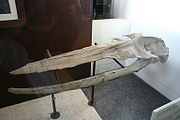 Early baleen whales first appeared as far back as the early Oligocene
, or perhaps the latest Eocene
(39–29 million years ago; e.g., Llanocetus). Early baleen whales possessed teeth inherited from their ancestors, as opposed to baleen, in modern species. The Oligocene species Aetiocetus cotylalveus
is considered the evolutionary link between toothed and baleen whales. This species was discovered by fossil collector Douglas Emlong
in 1964 near Seal Rock State Recreation Site
, Oregon
, in a sandstone
formation. In the early 1990s, the species Janjucetus hunderi
was discovered in Victoria
, Australia
by a surfer and was described in 2006 by E. M. G. Fitzgerald. Janjucetus
was a baleen whale with sharp teeth that hunted fish
and squid
as well as larger prey, potentially including shark
s and dolphin
-like cetaceans. These fossils hint that early baleen whales were predatory and eventually evolved into the gentler, toothless whales known today. A recent study identified palatal foramina (bony impressions of blood vessels that "feed" the baleen racks) in the palate of a toothed mysticete, Aetiocetus weltoni
. The scientists involved indicated that this discovery implies that this whale previously possessed both teeth and baleen, and serves as an intermediate adaptive role between primitive toothed mysticetes and more advanced toothless mysticetes. The first baleen-bearing, toothless baleen whales (such as Eomysticetus and Micromysticetus) appeared in the late Oligocene. Early baleen whales probably could not echolocate; no anatomical evidence preserved in the skulls and ear regions of any fossil baleen whales show any of the adaptations associated with echolocation as in toothed whales.
"'s denote extinct families and genera.
Suborder Mysticeti: Baleen whales
The earliest-known baleen whale is Llanocetus, discovered on Seymour Island, Antarctica, by E.D. Mitchell in 1989. The species lived during the Latest Eocene
/Earliest Miocene
, about 35 mya.
Whale
Whale is the common name for various marine mammals of the order Cetacea. The term whale sometimes refers to all cetaceans, but more often it excludes dolphins and porpoises, which belong to suborder Odontoceti . This suborder also includes the sperm whale, killer whale, pilot whale, and beluga...
s, also called whalebone whales or great whales, form the Mysticeti, one of two suborders of the Cetacea
Cetacea
The order Cetacea includes the marine mammals commonly known as whales, dolphins, and porpoises. Cetus is Latin and is used in biological names to mean "whale"; its original meaning, "large sea animal", was more general. It comes from Ancient Greek , meaning "whale" or "any huge fish or sea...
(whales, dolphins, and porpoises). Baleen whales are characterized by having baleen
Baleen
Baleen or whalebone is a filter-feeder system inside the mouths of baleen whales. The baleen system works when a whale opens its mouth underwater and then water pours into the whale's mouth. The whale then pushes the water out, and animals such as krill are filtered by the baleen and remain as food...
plates for filtering food from water, rather than having teeth. This distinguishes them from the other suborder of cetaceans, the toothed whale
Toothed whale
The toothed whales form a suborder of the cetaceans, including sperm whales, beaked whales, dolphins, and others. As the name suggests, the suborder is characterized by the presence of teeth rather than the baleen of other whales.-Anatomy:Toothed whales have a single blowhole on the top of the head...
s or Odontoceti. Living Mysticeti species have teeth only during the embryo
Embryo
An embryo is a multicellular diploid eukaryote in its earliest stage of development, from the time of first cell division until birth, hatching, or germination...
nal phase. Fossil Mysticeti had teeth before baleen evolved.
The suborder contains four extant families
Family (biology)
In biological classification, family is* a taxonomic rank. Other well-known ranks are life, domain, kingdom, phylum, class, order, genus, and species, with family fitting between order and genus. As for the other well-known ranks, there is the option of an immediately lower rank, indicated by the...
and fifteen species
Species
In biology, a species is one of the basic units of biological classification and a taxonomic rank. A species is often defined as a group of organisms capable of interbreeding and producing fertile offspring. While in many cases this definition is adequate, more precise or differing measures are...
.
Etymology
The taxonomic name Mysticeti apparently derives from a transmission error in early copies of AristotleAristotle
Aristotle was a Greek philosopher and polymath, a student of Plato and teacher of Alexander the Great. His writings cover many subjects, including physics, metaphysics, poetry, theater, music, logic, rhetoric, linguistics, politics, government, ethics, biology, and zoology...
's Historia Animalium in which "ο μυς το κητος" ("the whale known as 'the mouse' or 'Gutter whale' ") was mistakenly run together as "ο μυστικητος" ("the Mysticetus"). An alternate name for the suborder is Mystacoceti (from Greek μυσταξ "moustache" + κητος "whale").
Anatomy
Baleen whales are generally larger than toothed whales, and females are bigger than males. This group includes the largest known animal species, the Blue WhaleBlue Whale
The blue whale is a marine mammal belonging to the suborder of baleen whales . At in length and or more in weight, it is the largest known animal to have ever existed....
.
Baleen whales have two blowholes
Blowhole (biology)
In biology, a blowhole is the hole at the top of a cetacean's head through which the animal breathes air. It is homologous with the nostril of other mammals. As whales reach the water surface to breathe, they will forcefully expel air through the blowhole. Not only is air expelled, but mucus and...
, causing a V-shaped blow.
Breaching
In spite of their enormous size, baleen whales are able to leap completely out of the water. They can grow to 190000 kilograms (418,878.3 lb) in weight and 33.5 metres (109.9 ft) in length.Particularly known for its acrobatics is the Humpback Whale
Humpback Whale
The humpback whale is a species of baleen whale. One of the larger rorqual species, adults range in length from and weigh approximately . The humpback has a distinctive body shape, with unusually long pectoral fins and a knobbly head. It is an acrobatic animal, often breaching and slapping the...
, but other baleen whales also break through the water surface with their body or beat it loudly with their fin
Fin
A fin is a surface used for stability and/or to produce lift and thrust or to steer while traveling in water, air, or other fluid media, . The first use of the word was for the limbs of fish, but has been extended to include other animal limbs and man-made devices...
s. Some believe that the male baleen whales try to show off in the presence of females to increase their mating success. Scientists speculate that baleen whales and other cetaceans may engage in breaching to dislodge parasites, or scratch irritated skin. Breaching, and other behaviors like lobtailing, are also used to stun or kill nearby fish or krill.
Importance to humans
From the 11th to the late 20th centuries, baleen whales were hunted commercially for their oil and baleen. Their oil was used to make margarineMargarine
Margarine , as a generic term, can indicate any of a wide range of butter substitutes, typically composed of vegetable oils. In many parts of the world, the market share of margarine and spreads has overtaken that of butter...
and cooking oils, whilst their baleen was used to stiffen corset
Corset
A corset is a garment worn to hold and shape the torso into a desired shape for aesthetic or medical purposes...
s, as parasol ribs and to crease paper.
Evolutionary history
Oligocene
The Oligocene is a geologic epoch of the Paleogene Period and extends from about 34 million to 23 million years before the present . As with other older geologic periods, the rock beds that define the period are well identified but the exact dates of the start and end of the period are slightly...
, or perhaps the latest Eocene
Eocene
The Eocene Epoch, lasting from about 56 to 34 million years ago , is a major division of the geologic timescale and the second epoch of the Paleogene Period in the Cenozoic Era. The Eocene spans the time from the end of the Palaeocene Epoch to the beginning of the Oligocene Epoch. The start of the...
(39–29 million years ago; e.g., Llanocetus). Early baleen whales possessed teeth inherited from their ancestors, as opposed to baleen, in modern species. The Oligocene species Aetiocetus cotylalveus
Aetiocetus
Aetiocetus is an extinct genus of baleen whale that lived 25 million years ago, in the Oligocene period. Its fossils have been found in the North Pacific, around Oregon. It was first named by Douglas Emlong in 1966 and currently contains four species, A cotylalveus, A. polydentatus, A. tomitai,...
is considered the evolutionary link between toothed and baleen whales. This species was discovered by fossil collector Douglas Emlong
Douglas Emlong
Douglas Ralph Emlong was an amateur fossil collector from the Oregon Coast in the northwestern United States. His collections contributed to the discovery and description of numerous extinct marine mammal species, many of which are ancestral to extant groups...
in 1964 near Seal Rock State Recreation Site
Seal Rock State Recreation Site
Seal Rock State Recreation Site is a state park in the U.S. state of Oregon, administered by the Oregon Parks and Recreation Department....
, Oregon
Oregon
Oregon is a state in the Pacific Northwest region of the United States. It is located on the Pacific coast, with Washington to the north, California to the south, Nevada on the southeast and Idaho to the east. The Columbia and Snake rivers delineate much of Oregon's northern and eastern...
, in a sandstone
Sandstone
Sandstone is a sedimentary rock composed mainly of sand-sized minerals or rock grains.Most sandstone is composed of quartz and/or feldspar because these are the most common minerals in the Earth's crust. Like sand, sandstone may be any colour, but the most common colours are tan, brown, yellow,...
formation. In the early 1990s, the species Janjucetus hunderi
Janjucetus
Janjucetus is an extinct genus of whale, and a basal form of the Mysticeti, a clade which includes the extant baleen whales. The only known species, Janjucetus hunderi, lived during the late Oligocene, about 25 million years ago in coastal seas off southeast Australia. Unlike modern mysticetes, it...
was discovered in Victoria
Victoria (Australia)
Victoria is the second most populous state in Australia. Geographically the smallest mainland state, Victoria is bordered by New South Wales, South Australia, and Tasmania on Boundary Islet to the north, west and south respectively....
, Australia
Australia
Australia , officially the Commonwealth of Australia, is a country in the Southern Hemisphere comprising the mainland of the Australian continent, the island of Tasmania, and numerous smaller islands in the Indian and Pacific Oceans. It is the world's sixth-largest country by total area...
by a surfer and was described in 2006 by E. M. G. Fitzgerald. Janjucetus
Janjucetus
Janjucetus is an extinct genus of whale, and a basal form of the Mysticeti, a clade which includes the extant baleen whales. The only known species, Janjucetus hunderi, lived during the late Oligocene, about 25 million years ago in coastal seas off southeast Australia. Unlike modern mysticetes, it...
was a baleen whale with sharp teeth that hunted fish
Fish
Fish are a paraphyletic group of organisms that consist of all gill-bearing aquatic vertebrate animals that lack limbs with digits. Included in this definition are the living hagfish, lampreys, and cartilaginous and bony fish, as well as various extinct related groups...
and squid
Squid
Squid are cephalopods of the order Teuthida, which comprises around 300 species. Like all other cephalopods, squid have a distinct head, bilateral symmetry, a mantle, and arms. Squid, like cuttlefish, have eight arms arranged in pairs and two, usually longer, tentacles...
as well as larger prey, potentially including shark
Shark
Sharks are a type of fish with a full cartilaginous skeleton and a highly streamlined body. The earliest known sharks date from more than 420 million years ago....
s and dolphin
Dolphin
Dolphins are marine mammals that are closely related to whales and porpoises. There are almost forty species of dolphin in 17 genera. They vary in size from and , up to and . They are found worldwide, mostly in the shallower seas of the continental shelves, and are carnivores, mostly eating...
-like cetaceans. These fossils hint that early baleen whales were predatory and eventually evolved into the gentler, toothless whales known today. A recent study identified palatal foramina (bony impressions of blood vessels that "feed" the baleen racks) in the palate of a toothed mysticete, Aetiocetus weltoni
Aetiocetus
Aetiocetus is an extinct genus of baleen whale that lived 25 million years ago, in the Oligocene period. Its fossils have been found in the North Pacific, around Oregon. It was first named by Douglas Emlong in 1966 and currently contains four species, A cotylalveus, A. polydentatus, A. tomitai,...
. The scientists involved indicated that this discovery implies that this whale previously possessed both teeth and baleen, and serves as an intermediate adaptive role between primitive toothed mysticetes and more advanced toothless mysticetes. The first baleen-bearing, toothless baleen whales (such as Eomysticetus and Micromysticetus) appeared in the late Oligocene. Early baleen whales probably could not echolocate; no anatomical evidence preserved in the skulls and ear regions of any fossil baleen whales show any of the adaptations associated with echolocation as in toothed whales.
Taxonomic classification
The "†Extinction
In biology and ecology, extinction is the end of an organism or of a group of organisms , normally a species. The moment of extinction is generally considered to be the death of the last individual of the species, although the capacity to breed and recover may have been lost before this point...
"'s denote extinct families and genera.
Suborder Mysticeti: Baleen whales
- Family †Aetiocetidae
- † AetiocetusAetiocetusAetiocetus is an extinct genus of baleen whale that lived 25 million years ago, in the Oligocene period. Its fossils have been found in the North Pacific, around Oregon. It was first named by Douglas Emlong in 1966 and currently contains four species, A cotylalveus, A. polydentatus, A. tomitai,...
- † AshorocetusAshorocetusAshorocetus is an extinct genus of Aetiocetidae. It was first named by L.G. Barnes et al. in 1995, and contains one species, A. eguchii.-Sister Taxa:*Aetiocetus*Chonecetus*Morawanocetus*Willungacetus-Sources:...
- † ChonecetusChonecetusChonecetus is an extinct genus of Neocene Aetiocetidae that lived in the Oligocene period. Its fossils have been found in Canada, in the northeast Pacific. It was first named by L.S. Russell in 1968, and contains two species, C. sookensis and C. goedertorum...
- † MorawanocetusMorawanocetusMorawanocetus is an extinct genus of Aetiocetidae from the Oligocene period. Its fossils have been found in the North Pacific. It was first named by Barnes et al. in 1995, and contains one species, M. yabukii...
- † WillungacetusWillungacetusWillungacetus is an extinct genus of Aetiocetidae which existed during the Oligocene period. Its fossils have been found in Australia. It was first named by Pledge in 2005, though he had discovered it at Port Willunga in 2001, and contains one species, W. aldingensis...
- † Aetiocetus
- Family †Aglaocetidae
- † Aglaocetus
- † Isanacetus
- † Pinocetus
- Family BalaenidaeBalaenidaeBalaenidae is a family of mysticete whales that contains two living genera. Commonly called the right whales as it contains mainly right whale species...
: Right whaleRight whaleRight whales are three species of large baleen whales consisting of two genera in the family Balaenidae of order Cetacea. Their bodies are very dark gray or black and rotund....
s and Bowhead WhaleBowhead WhaleThe bowhead whale is a baleen whale of the right whale family Balaenidae in suborder Mysticeti. A stocky dark-colored whale without a dorsal fin, it can grow to in length. This thick-bodied species can weigh to , second only to the blue whale, although the bowhead's maximum length is less than...
- BalaenaBalaenaBalaena is a genus of cetacean in the Balaenidae family. This family is also known as the Right Whales, which can cause confusion as there is also a species of whale called the Right Whale. The only extant species is the Bowhead whale. The fossil record of Balaena, dating to the late Miocene,...
Bowhead whaleBowhead WhaleThe bowhead whale is a baleen whale of the right whale family Balaenidae in suborder Mysticeti. A stocky dark-colored whale without a dorsal fin, it can grow to in length. This thick-bodied species can weigh to , second only to the blue whale, although the bowhead's maximum length is less than...
s - †Balaenella
- †Balaenotus
- †Balaenula
- Eubalaena
- Eucetites
- †Morenocetus
- Balaena
- Family Balaenopteridae: Rorquals
- †Archaebalaenoptera
- BalaenopteraBalaenopteraBalaenoptera is a genus of Balaenopteridae, the Rorqual whales, and contains eight species. The species Balaenoptera omurai was published in 2003...
- †Cetotheriophanes
- †DiunatansDiunatansDiunatans is an extinct genus of rorqual whale. It lived in the North Sea during the Early Pliocene. Two specimens have been found from the Netherlands. They were collected from the Kattendijk Formation in the province of Zeeland, which is Zanclean in age...
- †Mauicetus
- Megaptera
- †Notiocetus
- †Parabalaenoptera
- †PlesiobalaenopteraPlesiobalaenopteraPlesiobalaenoptera is an extinct genus of rorqual whale which existed in Italy during the late Miocene epoch. The type species is P. quarantellii. It is the oldest known rorqual from the Mediterranean basin...
- †Praemegaptera
- †Protororqualus
- †Family CetotheriidaeCetotheriidaeCetotheriidae is an extinct family of baleen whales in the suborder Mysticeti. The family existed from the Late Oligocene to the Late Pliocene before going extinct.-Taxonomy:...
- †Cephalotropis
- †CetotheriumCetotheriumCetotherium is a genus of the extinct cetaceans from the family Cetotheriidae .-Known species:...
- †Herpetocetus
- †Hibacetus
- †JoumocetusJoumocetusJoumocetus is an extinct baleen whale genus in the family Cetotheriidae and containing the single species Joumocetus shimizui. The species is known only from a partial skeleton found in Miocene age sediments of Japan....
- †Metopocetus
- †Mixocetus
- †Nannocetus
- †Palaeobalaena
- †Piscobalaena
- †Plesiocetopsis
- †Titanocetus
- †Family Cetotheriopsidae
- †Cetotheriopsis
- †Micromysticetus
- †Family Diorocetidae
- †Amphicetus
- †Diorocetus
- †Plesiocetus
- †Thinocetus
- †Uranocetus
- †Family Eomysticetidae
- †Eomysticetus
- Family EschrichtiidaeEschrichtiidaeEschrichtiidae is a family of baleen whales in the suborder Mysticeti.At least five genera are recognised, but only a single species from one genus is still alive, the gray whale, Eschrichtius robustus....
- †Archaeschrichtius
- †Eschrichtioides
- Eschrichtius Gray whaleGray WhaleThe gray whale, Eschrichtius robustus, is a baleen whale that migrates between feeding and breeding grounds yearly. It reaches a length of about , a weight of , and lives 50–70 years. The common name of the whale comes from the gray patches and white mottling on its dark skin. Gray whales were...
s - †Gricetoides
- †Megapteropsis
- †Family Llanocetidae
- †Llanocetus
- †Family MammalodontidaeMammalodontidaeMammalodontidae is an extinct family of whales known from the Oligocene of Australia.There are currently two genera is this family: Janjucetus and Mammalodon. After a new cladistic analysis by Fitzgerald , Janjucetus was transferred into Mammalodontidae, thereby making Janjucetidae a junior synonym...
- †JanjucetusJanjucetusJanjucetus is an extinct genus of whale, and a basal form of the Mysticeti, a clade which includes the extant baleen whales. The only known species, Janjucetus hunderi, lived during the late Oligocene, about 25 million years ago in coastal seas off southeast Australia. Unlike modern mysticetes, it...
- †MammalodonMammalodonMammalodon is an extinct genus of whale that was discovered in 1932. It is an early baleen whale which still had teeth, as opposed to baleen plates. It is one of two genera in the family Mammalodontidae....
- †Janjucetus
- Family Neobalaenidae: Pygmy Right Whale
- Caperea, Pygmy Right WhalePygmy Right WhaleThe pygmy right whale is a baleen whale, the sole member of the family Neobalaenidae. First described by John Edward Gray in 1846, it is the smallest of the baleen whales, ranging between and in length and 3,000 and 3,500 kg in mass...
- Caperea, Pygmy Right Whale
- †Family PelocetidaePelocetidaePelocetidae is a extinct family of baleen whales. Existed during the Miocene in North America, Europe, Australia and Japan....
- †Cophocetus
- †Halicetus
- †ParietobalaenaParietobalaenaParietobalaena is an extinct genus of baleen whale, belonging to the family Pelocetidae. Lived during the Miocene in North America, Europe, Australia and Japan....
- †Pelocetus
- †Eobalaenoptera
- Family incertae sedisIncertae sedis, is a term used to define a taxonomic group where its broader relationships are unknown or undefined. Uncertainty at specific taxonomic levels is attributed by , , and similar terms.-Examples:*The fossil plant Paradinandra suecica could not be assigned to any...
- †Amphitera
- †Burtinopsis
- †Idiocetus
- †Imerocetus
- †Isocetus
- †Mesocetus
- †Mioceta
- †Otradnocetus
- †Peripolocetus
- †Piscocetus
- †Siphonocetus
- †Tiphyocetus
- †Tretulias
- †Ulias
The earliest-known baleen whale is Llanocetus, discovered on Seymour Island, Antarctica, by E.D. Mitchell in 1989. The species lived during the Latest Eocene
Eocene
The Eocene Epoch, lasting from about 56 to 34 million years ago , is a major division of the geologic timescale and the second epoch of the Paleogene Period in the Cenozoic Era. The Eocene spans the time from the end of the Palaeocene Epoch to the beginning of the Oligocene Epoch. The start of the...
/Earliest Miocene
Miocene
The Miocene is a geological epoch of the Neogene Period and extends from about . The Miocene was named by Sir Charles Lyell. Its name comes from the Greek words and and means "less recent" because it has 18% fewer modern sea invertebrates than the Pliocene. The Miocene follows the Oligocene...
, about 35 mya.