
All Topics  
Moby-Dick

 
Moby Dick

   Email Print
   Bookmark   Link


Moby-Dick


Moby-Dick is an 1851 novel
Novel

File:2009 stapelweise Neuerscheinungen im Buchladen.JPGA novel is today a long narrative in literary prose. The genre has historical roots both in the fields of the medieval and early modern Romance and in the tradition of the novella....
 by Herman Melville
Herman Melville

Herman Melville was an American novelist, short story writer, essayist and poet. His first three books gained much attention, the first becoming a bestseller, but after a fast-blooming literary success in the late 1840s, his popularity declined precipitously in the mid-1850s and never recovered during his lifetime....
. The story tells the adventures of the wandering sailor Ishmael
Ishmael (Moby-Dick)

Ishmael is the narrator of the 1851 novel Moby-Dick by United States author Herman Melville. It is through his eyes and experience that the reader experiences the story of the ship Pequod, and the fight between Ahab and the white whale....
 and his voyage on the whaleship
Whaling

Whaling is the hunting of whales and dates back to at least 4,000 BC. The evolution of traditional Arctic whaling developed with increasing rapidity with early organized fleets in the 17th century; competitive national whaling industries in the 18th and 19th centuries; and the introduction of factory ships along with the concept of whale "har...
 Pequod
Pequod (Moby-Dick)

The Pequod is the fictional 19th century Nantucket whaler that appears in the 1851 novel Moby-Dick by United States author Herman Melville....
,
commanded by Captain Ahab. Ishmael soon learns that Ahab seeks one specific whale, Moby Dick, a white whale of tremendous size and ferocity. Comparatively few whaleships know of Moby Dick, and fewer yet have encountered him. In a previous encounter, the whale destroyed Ahab's boat and bit off his leg.


Discussion
Ask a question about 'Moby-Dick'
Start a new discussion about 'Moby-Dick'
Answer questions from other users
Full Discussion Forum


Recent Posts


Quotations


Better sleep with a sober cannibal than a drunken Christian.

Talk not to me of blasphemy, man; I'd strike the sun if it insulted me.

What the white whale was to Ahab, has been hinted; what, at times, he was to me, as yet remains unsaid.

Yes, as every one knows, meditation and water are wedded for ever.

With the landless gull, that at sunset folds her wings and is rocked to sleep between billows; so at nightfall, the Nantucketer, out of sight of land, furls his sails, and lays him to his rest, while under his very pillow rush herds of walruses and whales.

In one word, Queequeg, said I, rather digressively; hell is an idea first born on an undigested apple-dumpling; and since then perpetuated through the hereditary dyspepsias nurtured by Ramadans.


Encyclopedia


Moby-Dick is an 1851 novel
Novel

File:2009 stapelweise Neuerscheinungen im Buchladen.JPGA novel is today a long narrative in literary prose. The genre has historical roots both in the fields of the medieval and early modern Romance and in the tradition of the novella....
 by Herman Melville
Herman Melville

Herman Melville was an American novelist, short story writer, essayist and poet. His first three books gained much attention, the first becoming a bestseller, but after a fast-blooming literary success in the late 1840s, his popularity declined precipitously in the mid-1850s and never recovered during his lifetime....
. The story tells the adventures of the wandering sailor Ishmael
Ishmael (Moby-Dick)

Ishmael is the narrator of the 1851 novel Moby-Dick by United States author Herman Melville. It is through his eyes and experience that the reader experiences the story of the ship Pequod, and the fight between Ahab and the white whale....
 and his voyage on the whaleship
Whaling

Whaling is the hunting of whales and dates back to at least 4,000 BC. The evolution of traditional Arctic whaling developed with increasing rapidity with early organized fleets in the 17th century; competitive national whaling industries in the 18th and 19th centuries; and the introduction of factory ships along with the concept of whale "har...
 Pequod
Pequod (Moby-Dick)

The Pequod is the fictional 19th century Nantucket whaler that appears in the 1851 novel Moby-Dick by United States author Herman Melville....
,
commanded by Captain Ahab. Ishmael soon learns that Ahab seeks one specific whale, Moby Dick, a white whale of tremendous size and ferocity. Comparatively few whaleships know of Moby Dick, and fewer yet have encountered him. In a previous encounter, the whale destroyed Ahab's boat and bit off his leg. Ahab intends to take revenge.

In Moby-Dick, Melville employs stylized language, symbolism, and metaphor to explore numerous complex themes. Through the main character's journey, the concepts of class and social status, good and evil, and the existence of gods are all examined as Ishmael speculates upon his personal beliefs and his place in the universe. The narrator's reflections, along with his descriptions of a sailor's life aboard a whaling ship, are woven into the narrative along with Shakespearean literary devices such as stage directions, extended soliloquies and asides.

Often considered the embodiment of American Romanticism
Romanticism

Romanticism is a complex artistic, literary, and intellectual movement that originated in the second half of the 18th century in Western Europe, and gained strength during the Industrial Revolution....
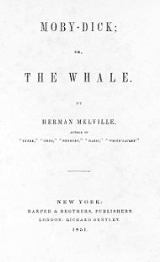
, Moby-Dick was first published by Richard Bentley in London on October 18, 1851 in an expurgated three-volume edition titled The Whale, and later as one massive volume, by New York City publisher Harper and Brothers as Moby-Dick; or, The Whale on November 14, 1851. The first line of Chapter One—"Call me Ishmael."—is one of the most famous opening lines in literature. Although the book initially received mixed reviews, Moby-Dick is now considered one of the greatest novels
Western canon

The Western canon is a term used to denote a wiktionary:canon of Western literatures, and, more widely, European classical music and Western art history, that has been the most Power in shaping Western culture....
 in the English language
English language

English is a West Germanic language that originated in Anglo-Saxon England and has lingua franca status in many parts of the world as a result of the military, economic, scientific, political and cultural influence of the British Empire in the 18th, 19th and early 20th centuries and that of the United States from the mid 20th century onwa...
 and has secured Melville's place among America's greatest writers.

Background


Moby-Dick appeared in 1851, during an important period in American literature. The year before, Melville's good friend and neighbor Nathaniel Hawthorne
Nathaniel Hawthorne

Nathaniel Hawthorne was an American novelist and short story writer.Nathaniel Hathorne was born in 1804 in the city of Salem, Massachusetts to Nathaniel Hathorne and Elizabeth Clarke Manning Hathorne....
 published his bestseller The Scarlet Letter
The Scarlet Letter

The Scarlet Letter is a novel written by Nathaniel Hawthorne. It is considered his magnum opus. Set in 17th-century Puritan Boston, it tells the story of Hester Prynne, who gives birth after committing adultery and struggles to create a new life of repentance and dignity....
. The year after, Harriet Beecher Stowe
Harriet Beecher Stowe

Harriet Beecher Stowe was an abolitionist, whose novel Uncle Tom's Cabin depicted life for African-Americans under slavery; it reached millions as a novel and play, and became influential in the U.S....
 published Uncle Tom's Cabin
Uncle Tom's Cabin

Uncle Tom's Cabin; or, Life Among the Lowly is an anti-slavery novel by American author Harriet Beecher Stowe. Published in 1852, the novel had a profound effect on attitudes toward African Americans and History of slavery in the United States, so much in the latter case that the novel intensified the Origins of the American Civil War lea...
, which would become the second best-selling book in America in the 19th century after the Bible
Bible

The Bible is the central religious text of Judaism and Christianity. The exact Books of the Bible is dependent on the religious traditions of specific denominations....
. Two actual events inspired Melville's tale. One was the sinking of the Nantucket
Nantucket, Massachusetts

Nantucket is an island 30 miles south of Cape Cod, Massachusetts, in the United States. Together with the small islands of Tuckernuck Island and Muskeget, it constitutes the New England town of Nantucket, Massachusetts, and the coterminous Nantucket County, which are consolidated....
 whaleship Essex, which foundered in 1820 after it was rammed by a large sperm whale
Sperm Whale

The Sperm Whale is the largest of all toothed whales and largest living toothed animal. The whale was named after the milky-white waxy substance, spermaceti, found in its head and originally mistaken for sperm or semen....
 2,000 miles (3,700 km) from the western coast of South America. First mate Owen Chase
Owen Chase

Owen Chase was First Mate of the Whaleship Essex, that was struck and sunk by a sperm whale on November 20, 1820. Chase wrote about the incident in Narrative of the Most Extraordinary and Distressing Shipwreck of the Whale-Ship Essex....
, one of eight survivors, recorded the events in his 1821 Narrative of the Most Extraordinary and Distressing Shipwreck of the Whale-Ship Essex. Already out-of-print, the book was rare even at the time. Knowing that Melville was looking for it, his father-in-law, Lemuel Shaw
Lemuel Shaw

Lemuel Shaw , United States jurist, was born in Barnstable, Massachusetts, the second son of Oakes Shaw and his second wife Susanna, who was a daughter of John H....
, managed to find a copy and buy it for him. When Melville received it, he fell to it almost immediately, heavily annotating it.

The other event was the alleged killing in the late 1830s of the albino sperm whale Mocha Dick
Mocha Dick

Mocha Dick was a notorious male sperm whale that lived in the Pacific Ocean in the early 19th century, usually encountered in the waters near the island of Mocha Island, off southern Chile....
, who was usually encountered in the waters off the Chile
Chile

Chile, officially the Republic of Chile , is a country in South America occupying a long and narrow coastal strip wedged between the Andes mountains and the Pacific Ocean....
an island of Mocha
Mocha (island)

Mocha is a small Chilean island located west of the coast of Arauco Province in the Pacific Ocean. The island is approximately in area, with a small chain of mountains running north-south....
. Riddled with dozens of harpoons from his numerous escapes from whalers, Mocha Dick often attacked ships with premeditated ferocity. One of his battles with a whaler served as subject for an article by explorer Jeremiah N. Reynolds
Jeremiah N. Reynolds

Jeremiah N. Reynolds , also known as J.N. Reynolds, was an United States newspaper editor, lecturer, explorer and author became an influential advocate for scientific expeditions....
 in the May 1839 issue of The Knickerbocker, New York Monthly Magazine
The Knickerbocker

The Knickerbocker, or New-York Monthly Magazine, was a literary magazine of New York City, founded by Charles Fenno Hoffman in 1833, and published until 1865 under various titles, including:...
. Melville was familiar with the article, which described "an old bull whale, of prodigious size and strength... [that] was white as wool". Significantly, Reynolds writes a first-person narration
First-person narrative

First-person narrative is a narrative mode in which a story is narrative by one Fictional character, who explicitly refers to him- or herself using words and phrases involving "I" and/or "we" ....
 that serves as a frame
Frame story

A frame story is a narrative technique whereby an introductory main story is composed, at least in part, for the purpose of setting the stage for a fictive narrative or organizing a set of shorter stories, each of which is a story within a story....
 for the story of a whaling captain he meets. The captain resembles Ahab and suggests a possible symbolism for whales in that, when his crew first encounters Mocha Dick and cowers from him, the captain rallies them thus: "'Mocha Dick or the d----l [devil],' said I, 'this boat never sheers off from any thing that wears the shape of a whale.'"

Mocha Dick had over 100 battles with whalers. First noted (because of his color, and later for his wounds) in 1810, he battled them on a regular basis until the late 1830s. He was described as being giant (even for a whale). He was covered in barnacles. Mocha Dick may not have been the only white whale in the sea. A Swedish whaleship claimed to have taken a very old white whale in 1859,; a retired Nantucket whaleship claimed to have harpooned a white whale in 1902. Nor was he the only whale to attack his hunters. Periodic attacks on whaleboats were recorded until they were replaced by the harpoon gun. In 1850, the bark Parker Cook was rammed in mid-Atlantic; the crew killed and harvested the whale, but had to put into port for repairs. Later that same year, the Pocahontas was almost sunk in the same area. In 1851, not long after publication of the novel, the Ann Alexander
Ann Alexander (ship)

The Ann Alexander was a ship from New Bedford, Massachusetts that was rammed by a wounded sperm whale on August 20, 1851 near the Galapagos Islands....
 was destroyed by a sperm whale
Sperm Whale

The Sperm Whale is the largest of all toothed whales and largest living toothed animal. The whale was named after the milky-white waxy substance, spermaceti, found in its head and originally mistaken for sperm or semen....
 near where the Essex was sunk, but the crew were picked up the next day. In 1820 the Essex was alone in mid-Pacific, but by 1851 the area "virtually swarmed with whalers". Other whalers disappeared at sea, perhaps sunk by their prey.Other reported rammings by whales were a ship in 1640 ; the "Harmony" in 1796 ; the Union in 1807 ; the "Waterloo" in 1855 ; the "Herald of the Morning" in 1859 ; the "Forest Oak" in 1865 ; the "Watanga" ; the "Eastern City" in 1869 and the Kathleen
Kathleen

Kathleen may refer to:People with the given name Kathleen:* Kathleen Places:* Kathleen, Georgia, USA* Kathleen, Florida, USA...
 in 1902.

The most important inspiration for the novel was Melville's experiences as a sailor, in particular those during 1841-1842 on the whaleship Acushnet. He had already drawn on his different sailing experiences in previous novels—Mardi the closest to Moby-Dick in its symbolic or allegorical aspirations—but he had never focused specifically on whaling. Melville had read Chase's account before sailing on the Acushnet in 1841; he was excited about sighting Captain Chase himself, who had returned to sea. During a midocean "gam" (rendezvous) he met Chase's son William, who loaned him his father's book.

Moby-Dick contains large sections—most of them narrated by Ishmael—that seemingly have nothing to do with the plot but describe aspects of the whaling business. Melville believed that no book up to that time had portrayed the whaling industry in as fascinating or immediate a way as he had experienced it. Since Romantics
Romanticism

Romanticism is a complex artistic, literary, and intellectual movement that originated in the second half of the 18th century in Western Europe, and gained strength during the Industrial Revolution....
 such as Sir Walter Scott, Washington Irving
Washington Irving

Washington Irving was an United States author, essays, biography and history of the early 19th century. He was best known for his short story "The Legend of Sleepy Hollow" and "Rip Van Winkle", both of which appear in his book The Sketch Book of Geoffrey Crayon His historical works include biographies of George Washington, Oliver Goldsmi...
, Lord Byron, and Mary Shelley
Mary Shelley

Mary Shelley was a British novelist, short story writer, dramatist, essayist, biographer, and travel literature, best known for her Gothic fiction Frankenstein ....
 had greatly influenced him from an early age, he hoped to emulate them with a book that was compelling and vivid both emotionally and poetically. Early Romantics also proposed that fiction was the exemplary way to describe and record history (after all, Walter Scott had invented the historical novel
Historical novel

A historical novel is a novel in which the story is set among historical events, or more generally, in which the time of the action predates the lifetime of the author....
, and almost all of Irving's work had the trappings of history), so Melville wanted to craft something educational and definitive. However, despite his own interest in the subject, Melville claimed to struggle with it, writing to Richard Henry Dana, Jr.
Richard Henry Dana, Jr.

Richard Henry Dana Jr. was an United States lawyer and politician, and author of the book Two Years Before the Mast....
 on May 1, 1850:

Themes


Moby-Dick is a symbolic work, but also includes chapters on natural history
Natural history

Natural history is the scientific research of plants or animals, leaning more towards the observational than experimental methods of study, and encompasses more research that is published in magazines than in academic journals....
. Major themes include obsession
Obsession

The term Obsession may refer to:...
, religion
Religion

A religion is an organized approach to human spirituality which usually encompasses a set of myth, symbols, beliefs and practices, often with a supernatural or transcendence quality, that give meaning to the practitioner's experiences of life through reference to a higher power or truth....
, idealism
Idealism

Idealism is the philosophical theory which maintains that the ultimate nature of reality is based on mind or ideas. It holds that the so-called external or "real world" is inseparable from mind, consciousness, or perception....
 versus pragmatism
Pragmatism

Pragmatism is the philosophy of considering practical consequences or real effects to be vital components of meaning and truth. Pragmatism is generally considered to have originated in the late nineteenth century with Charles Peirce, who first stated the pragmatic maxim....
, revenge
Revenge

Revenge is a harmful action against a person or group as a response to a wrongdoing. Although many aspects of revenge resemble the concept of justice, revenge connotes a more injurious and punishment focus as opposed to a harmonious and restorative one....
, racism
Racism

Racism, by its simplest definition is the belief that Race is the primary determinant of human traits and capacities and that racial differences produce an inherent superiority of a particular race....
, hierarchical relationship
Interpersonal relationship

An interpersonal relationship is a relatively long-term association between two or more people. This association may be based on emotions like love and Liking#As_a_verb, regular business interactions, or some other type of social commitment....
s, and politics
Politics

Politics is the process by which groups of people make decisions. The term is generally applied to behaviour within civil governments, but politics has been observed in all human group interactions, including corporation, academia, and religion institutions....
. All of the members of the crew have biblical-sounding, improbable, or descriptive names, and the narrator deliberately avoids specifying the exact time of the events (such as the giant fish disappearing into the dark abyss of the ocean) and some other similar details. These together suggest that the narrator—and not just Melville—is deliberately casting his tale in an epic
Epic poetry

An epic is a lengthy narrative poem, ordinarily concerning a serious subject containing details of heroic deeds and events significant to a culture or nation....
 and allegorical mode.

The white whale has also been seen as a symbol
Symbol

A symbol is something such as an entity, picture, written word, sound, or particular mark that represents something else by association, resemblance, or convention....
 for many things, including nature and those elements of life that are out of human control.Ch 42 Melville mentions the Matsya Avatar of Lord Vishnu, the first among ten incarnations when Vishnu appears as a giant fish on Earth and saves creation from the flood of destruction. Melville mentions this while discussing the spiritual and mystical aspects of the sailing profession and he calls Lord Vishnu as the first among whales and the God of whalers.

The Pequod's quest to hunt down Moby Dick itself is also widely viewed as allegorical. To Ahab, killing the whale becomes the ultimate goal in his life, and this observation can also be expanded allegorically so that the whale represents everyone's goals. Furthermore, his vengeance against the whale is analogous to man's struggle against fate. The only escape from Ahab's vision is seen through the Pequod's occasional encounters, called gams, with other ships. Readers could consider what exactly Ahab will do if he, in fact, succeeds in his quest
Quest

In mythology and literature a quest ? a journey towards a goal ? serves as a Plot device and as a symbol. Quests appear in the folklore of every nation and also figure prominently in non-national cultures....
: having accomplished his ultimate goal, what else is there left for him to do? Similarly, Melville may be implying that people in general need something to reach for in life, or that such a goal can destroy one if allowed to overtake all other concerns. Some such things are hinted at early on in the book, when the main character, Ishmael, is sharing a cold bed with his newfound friend, Queequeg:

... truly to enjoy bodily warmth, some small part of you must be cold, for there is no quality in this world that is not what it is merely by contrast. Nothing exists in itself. If you flatter yourself that you are all over comfortable, and have been so a long time, then you cannot be said to be comfortable any more.
Moby-Dick, Ch. 11


Ahab's pipe is widely looked upon as the riddance of happiness in Ahab's life. By throwing the pipe overboard, Ahab signifies that he no longer can enjoy simple pleasures in life; instead, he dedicates his entire life to the pursuit of his obsession, the killing of the white whale, Moby Dick. A number of biblical themes can also be found in the novel. The book contains multiple implicit and explicit allusions to the story of Jonah
Jonah

According to the Hebrew Bible and Arab Qur'an, Jonah was a prophet who was swallowed by a great fish....
, in addition to the use of certain biblical names (see below).

Ishmael's musings also allude to themes common among the American Transcendentalists and parallel certain themes in European Romanticism
Romanticism

Romanticism is a complex artistic, literary, and intellectual movement that originated in the second half of the 18th century in Western Europe, and gained strength during the Industrial Revolution....
 and the philosophy of Hegel. In the poetry of Whitman
Walt Whitman

Walter Whitman was an United States Poetry of the United States, essayist, journalism, and humanism. He was a part of the transition between Transcendentalism and literary realism, incorporating both views in his works....
 and the prose writings of Emerson
Ralph Waldo Emerson

Ralph Waldo Emerson was an American essayist, philosopher, poet, and leader of the transcendentalism movement in the early 19th century. His teachings directly influenced the growing New Thought movement of the mid 1800s....
 and Thoreau, a ship at sea is sometimes a metaphor for the soul.

Plot


"Call me Ishmael," the narrator begins, in one of the most recognizable opening lines in American, or indeed English, literature. This observant young man from Manhattan has been to sea four times in the merchant service but yearns for a whaling adventure. On a cold, gloomy night in December, he arrives at the Spouter-Inn in New Bedford, Massachusetts, and agrees to share a bed with a stranger. Both men are alarmed when the bunkmate, a heavily tattooed Polynesian harpooner named Queequeg, returns late and discovers Ishmael beneath his covers. But the two soon become good friends and decide to sail together from the historical port of Nantucket.

In Nantucket, they sign on with the Pequod, Queequeg the more attractive employee due to his excellence with the harpoon. Ishmael, lacking any further ambition, will be a common sailor. The ship’s captain, Ahab, is nowhere to be seen; nevertheless, they hear of him. He is a "grand, ungodly, godlike man," according to one of the owners, a man of few words but deep meaning, who has been in colleges as well as among the cannibals. A raggedy prophet of doom named Elijah catches the two friends on the dock and hints at trouble with Ahab. The mystery grows on Christmas morning when Ishmael spots dark figures in the mist, apparently boarding the Pequod shortly before it sets sail.

The ship’s officers direct the early voyage. The chief mate, Starbuck, is a sincere Quaker and fine leader. Second mate is Stubb, a prankster but an able seaman. Third mate is Flask, dull but competent. When Ahab finally appears on his quarter-deck one morning, he is an imposing, frightening figure whose haunted visage sends shivers over the narrator. A white scar, reportedly from a thunderbolt, runs down his face and, they say, the length of his body. He has a grim, determined look. One leg is missing and replaced by a prosthesis fashioned from a sperm whale’s jaw.

Ahab finally gathers the crewmen together and, in a rousing speech, solicits their support in a single purpose for this voyage: hunting down and killing the White Whale Moby Dick, a very large sperm whale with a snow-white head. Only Starbuck resists the charismatic, monomaniacal captain; the first mate argues repeatedly that the ship’s purpose should be to gather whale oil and return home safely. Eventually, even Starbuck acquiesces.

The mystery of the dark figures is explained during the voyage's first chase, long before meeting Moby Dick. Ahab has secretly brought along his own boat crew, led by an ancient Asian named Fedallah, an inscrutable figure with an odd influence over Ahab. Later, while guarding a captured whale one night, Fedallah tells a prophecy of Ahab's death to Ahab.

Queequeg becomes deathly ill and orders a canoe-shaped coffin from the ship’s carpenter. Just as everyone has given up hope, the island aborigine decides to live and soon recovers. The coffin serves as his sea chest and later is caulked and pitched to become the ship's life buoy. Queequeg heroically rescues two drowning men in the novel; his coffin will save a third.

There are numerous "gams" in the novel, social meetings of two ships on the open sea. Crews normally visit each other during a gam, captains on one vessel and chief mates on the other. Newspapers and mail are exchanged. The men talk of whale sightings or other news. For Ahab, however, there is but one relevant question to ask of another ship: “Hast thou seen the White Whale?” Some have. The captain of the Samuel Enderby lost an arm to the leviathan. The Rachel has also seen Moby Dick. As a result, one of its open boats is missing; the captain’s son is aboard. The captain of the Rachel begs Ahab to aid in the search, but the Pequod’s captain is resolute. He is very near the White Whale now and will not stop to help.

Ahab is the first to spot Moby Dick. For three days, the crew pursues the great whale, who repeatedly turns on the Pequod’s boats, wreaking destruction and killing Fedallah, sinking the Pequod, and dragging Ahab into the sea and his death. Only Ishmael survives, clinging to Queequeg’s coffin. He floats for a day and a night before the Rachel rescues him.

Characters in Moby-Dick


The crew-members of the Pequod are carefully drawn stylizations of human types and habits; critics have often described the crew as a "self-enclosed universe".

Ishmael


In the novel's first sentence, the narrator famously declares, "Call me Ishmael." Initially, he is the only narrator, but after the Pequod leaves port, he repeatedly fades (including the narration of several scenes he could not possibly have witnessed firsthand) and comes back to full prominence.

The name Ishmael
Ishmael

Ishmael is a figure in the Torah, Bible, and Qur'an. Judaism, Christianity and Islam Ishmael is Abraham's eldest son or first born and natural heir....
 also appears in the Bible as that of the first son of Abraham
Abraham

Abraham is a man featured in the Book of Genesis and an important figure in several monotheistic religions. Judaism, Christianity and Islam traditions regard him as the founding Patriarchs of the Israelites, Ishmaelites and Edomite peoples....
 in the Old Testament
Old Testament

In Western Christianity, the Old Testament refers to the books that form the first of the two-part Christianity Bible Biblical canon. These works correspond to the Hebrew Bible , with some variations and additions....
. The name has come to symbolize orphan
Orphan

An orphan is a child whose natural parents are absent or dead. One legal definition used in the USA is someone bereft through "death or disappearance of, abandonment or desertion by, or separation or loss from, both parents"....
s, exile
Exile

Exile means to be away from one's home while either being explicitly refused permission to return and/or being threatened by prison or death upon return....
s, and social outcast
Outcast

An Outcast is a person with a social stigmaOutcast may also refer to:In literature:*...
s—in the opening paragraph of Moby-Dick, Ishmael tells the reader that he has turned to the sea out of a feeling of alienation
Social alienation

In sociology and critical social theory, alienation refers to an individual's estrangement from traditional community and others in general. It is considered by many that the Atomism of modernity means that individuals have shallower relations with other people than they would normally....
 from human society
Society

A society is a group of humans characterized by patterns of relationships between individuals that share a distinctive culture and/or institutions....
. In the last line of the book, Ishmael also refers to himself symbolically as an orphan. Ishmael has a rich literary background (he has previously been a schoolteacher), which he brings to bear on his shipmates and events that occur while at sea.

Ishmael resembles Melville in several ways (as well as the narrator of Melville's White-Jacket
White-Jacket

White-Jacket, or The World in a Man-of-War, usually referred to as White-Jacket, is an 1850 novel by Herman Melville first published in England on January 23 by Richard Bentley and in the U.S....
), being well-educated and reflective. Ishmael sees his shipmates as archetype
Archetype

An archetype is an original model of a person, ideal example, or a prototype after which others are copied, patterned, or emulated; a symbol universally recognized by all....
s of human nature
Human nature

Human nature is the concept that there are a set of characteristics, including ways of thinking, feeling and acting, that all 'normal' human beings have in common....
 and society, and tells his story couched in a vast array of detail, largely occurring during sections in which Ishmael takes an almost-omniscient viewpoint
Point of view (literature)

The narrative mode is the attribute of a literary, theatrical, cinematic, or musical piece which describes the method used by the author to convey their story to the audience....
.

Elijah


The character Elijah (named for the Biblical prophet
Prophet

In religion, a prophet is a person who has claimed to have encountered the supernatural or the Divinity, often one who serves as an intermediary with humanity....
, Elijah, who is also referred to in the King James Bible as Elias
Elias

Elias is the Latin language transliteration of the Greek language name ???a?, pronounced either [ IPA ] in most European languages, or [ IPA ] in English-speaking cultures....
), on learning that Ishmael and Queequeg have signed onto Ahab's ship, asks, "Anything down there about your souls?" When Ishmael reacts with surprise, Elijah continues:

"Oh, perhaps you hav'n't got any," he said quickly. "No matter though, I know many chaps that hav'n't got any – good luck to 'em; and they are all the better off for it. A soul's a sort of a fifth wheel to a wagon."


Later in the conversation, Elijah adds:

"Well, well, what's signed, is signed; and what's to be, will be; and then again, perhaps it wont be, after all. Any how, it's all fixed and arranged a'ready; and some sailors or other must go with him, I suppose; as well these as any other men, God pity 'em! Morning to ye, shipmates, morning; the ineffable heavens bless ye; I'm sorry I stopped ye."


Ahab


Ahab is the tyrannical captain of the Pequod who is driven by a monomania
Monomania

In psychiatry, monomania is a type of paranoia in which the patient has only one idea or type of ideas. Emotional monomania is that in which the patient is obsessed with only one emotion or several related to it; intellectual monomania is that which is related to only one kind of delirious idea or ideas....
cal desire to kill Moby Dick, the whale that maimed him on the previous whaling voyage. Despite the fact that he's a Quaker
Religious Society of Friends

The Religious Society of Friends, commonly known as the Quakers, was founded in England in the 17th century as a Christian denomination by people who were dissatisfied with the existing denominations and sects of Christianity....
, he seeks revenge in defiance of his religion's well-known pacifism. Ahab's name comes directly from the Bible (see 1 Kings 16:28
Books of Kings

The Books of Kings are a part of Judaism's Tanakh, the Hebrew Bible. They were originally written in Hebrew language and were later included by Christianity as part of the Old Testament....
).

Little information is provided about Ahab's life prior to meeting Moby Dick, although it is known that he was orphaned at a young age. When discussing the purpose of his quest with Starbuck, it is revealed that he first began whaling at eighteen and has continued in the trade for forty years, having spent less than three on land. He also mentions his "girl-wife," whom he married late in life, and their young son, but does not give their names.

In Ishmael's first encounter with Ahab's name, he responds "When that wicked king
Ahab

Ahab was Kingdom of Israel and the son and successor of Omri . William F. Albright dated his reign to 869 – 850 BC, while E. R. Thiele offered the dates 874 – 853 BC....
 was slain, the dogs, did they not lick his blood?" (Moby-Dick, Chapter 16).

Ahab ultimately dooms the crew of the Pequod (save for Ishmael) to death by his obsession with Moby Dick. During the final chase, Ahab hurls his final harpoon while yelling his now-famous revenge line:

... to the last I grapple with thee; from hell's heart I stab at thee; for hate's sake I spit my last breath at thee.


The harpoon becomes lodged in Moby Dick's flesh and Ahab, caught in his own harpoon's rope and unable to free himself, is dragged into the cold oblivion of the sea with the injured whale. The whale eventually destroys the whaleboats and crew, and sinks the Pequod.

Ahab has the qualities of a tragic hero – a great heart and a fatal flaw – and his deeply philosophical ruminations are expressed in language that is not only deliberately lofty and Shakespearian
Shakespeare's style

Shakespeare's style borrowed from the conventions of the day, while at the same time adapting them to his needs....
, but also so heavily iambic as often to read like Shakespeare
Shakespeare's style

Shakespeare's style borrowed from the conventions of the day, while at the same time adapting them to his needs....
's own pentameters.

Ahab's motivation for hunting Moby Dick is perhaps best summed up in the following passage:

The White Whale swam before him as the monomaniac incarnation of all those malicious agencies which some deep men feel eating in them, till they are left living on with half a heart and half a lung. That intangible malignity which has been from the beginning; to whose dominion even the modern Christians ascribe one-half of the worlds; which the ancient Ophites of the east reverenced in their statue devil; -- Ahab did not fall down and worship it like them; but deliriously transferring its idea to the abhorred white whale, he pitted himself, all mutilated, against it. All that most maddens and torments; all that stirs up the lees of things; all truth with malice in it; all that cracks the sinews and cakes the brain; all the subtle demonisms of life and thought; all evil, to crazy Ahab, were visibly personified, and made practically assailable in Moby-Dick. He piled upon the whale's white hump the sum of all the general rage and hate felt by his whole race from Adam down; and then, as if his chest had been a mortar, he burst his hot heart's shell upon it.


Moby Dick


Moby Dick is the antagonist of the book. The color white is explored in the chapter "The Whiteness of the Whale." It calls into question the meaning of the chapters on cetology
Cetology

Cetology is the branch of marine mammal science that studies the approximately eighty species of whales, dolphins, and porpoise in the scientific order Cetacea....
. In popular culture, Moby Dick is often depicted as being an albino
Albinism

Albinism is a form of hypopigmentation congenital disorder, characterized by a partial or total lack of melanin Biological pigment in the eyes, skin and hair ....
 whale. For example, in the huge whale mural at the New Bedford Whaling Museum, a white sperm whale with a red eye and several harpoons (detached from their boats) stuck in its back is prominently displayed. This seems accurate, since the aforementioned chapter "The Whiteness of the Whale" refers explicitly to "the albino whale." Others however claim that this is inaccurate, and that Moby Dick is colored like an average sperm whale, but with so many scars as to appear white or is gray with several patches and streaks of white. He is also described as having a wrinkled brow, a crooked jaw and three gashes in his right tail fluke.

Moby Dick's dimensions are never specified, but he is said to be one of the largest, if not the largest sperm whale known. Subsequently, Melville states (Chapter 103) that bull sperm whales can grow to the length of ninety feet; (this would be disputed by modern marine biologists
Marine biology

Marine biology is the scientific study of living organisms in the ocean or other Marine or brackish bodies of water.Given that in biology many scientific classification, families and Genera have some species that live in the sea and others that live on land, marine biology classifies species based on the environment rather than on taxon...
 who maintain they rarely exceed sixty feet). Moby Dick also appears to be unusually intelligent, resorting to many clever strategies to defeat Ahab and his crew. He also seems to be capable of using his injuries to great advantage. On the second day of the chase, he allows Ahab and his men to strike him with their harpoons during a head-on charge; he then swims around wildly to entangle the harpoons before yanking Ahab towards him in order to cut him up with the harpoons embedded in his flesh. Moby Dick then smashes Stubb and Flask's boats with his flukes, before sending Ahab's boat flying with a powerful headbutt.

Mates


The three mates of the Pequod are all from New England
New England

New England is a region of the United States located in the northeastern corner of the country, bounded by the Atlantic Ocean, Canada and New York State, and consisting of the modern U.S....
.

Starbuck

Starbuck, the young first mate of the Pequod, is a thoughtful and intellectual Quaker
Religious Society of Friends

The Religious Society of Friends, commonly known as the Quakers, was founded in England in the 17th century as a Christian denomination by people who were dissatisfied with the existing denominations and sects of Christianity....
 from Nantucket.

Uncommonly conscientious for a seaman, and endued with a deep natural reverence, the wild watery loneliness of his life did therefore strongly incline him to superstition; but to that sort of superstition, which in some organization seems rather to spring, somehow, from intelligence than from ignorance... [H]is far-away domestic memories of his young Cape wife and child, tend[ed] to bend him ... from the original ruggedness of his nature, and open him still further to those latent influences which, in some honest-hearted men, restrain the gush of dare-devil daring, so often evinced by others in the more perilous vicissitudes of the fishery. "I will have no man in my boat," said Starbuck, "who is not afraid of a whale." By this, he seemed to mean, not only that the most reliable and useful courage was that which arises from the fair estimation of the encountered peril, but that an utterly fearless man is a far more dangerous comrade than a coward.
Moby-Dick, Ch. 26


Little is said about Starbuck's early life, except that he is married with a son. Unlike Ahab's wife, who remains nameless, Starbuck gives his wife's name as Mary. Such is his desire to return to them, that when nearly reaching the last leg of their quest for Moby Dick, he considers arresting or even killing Ahab with a loaded musket, one of several which is kept by Ahab (in a previous chapter Ahab threatening Starbuck with one when disobeying him, despite Starbuck being in the right) and turning the ship back, straight for home.

Starbuck is alone among the crew in objecting to Ahab's quest, declaring it madness
Insanity

Traditionally, insanity or madness is the behavior whereby a person flouts societal norms and may become a danger to themselves and others....
 to want revenge
Revenge

Revenge is a harmful action against a person or group as a response to a wrongdoing. Although many aspects of revenge resemble the concept of justice, revenge connotes a more injurious and punishment focus as opposed to a harmonious and restorative one....
 on an animal, which lacks reason
Reason

Reason may refer to Mind#Mental faculties that consciously create explanations in order to judge, decide, solve problems, generalize, and give examples, among other activities....
. Starbuck advocates continuing the more mundane pursuit of whales for their oil. But he lacks the support of the crew in his opposition to Ahab, and is unable to persuade them to turn back. Despite his misgivings, he feels himself bound by his obligations to obey the captain.

Starbuck was an important Quaker family name on Nantucket Island, and there were several actual whalemen of this period named "Starbuck," as evidenced by the name of Starbuck Island
Starbuck Island

Starbuck Island is an uninhabited coral atoll in the central Pacific Ocean, and is part of the Central Line Islands of Kiribati. Former names include "Barren Island", "Coral Queen Island", "Hero Island", "Low Island" and "Starve Island"....
 in the South Pacific whaling grounds. The multinational coffee chain Starbucks
Starbucks

Starbucks Corporation is an international coffee and List of coffeehouse chains based in Seattle, Washington, United States. Starbucks is the largest coffeehouse company in the world, with 16,120 stores in 44 countries....
 was named after Starbuck, not for any affinity for coffee but after the name Pequod was rejected by one of the co-founders.

Stubb

Stubb, the second mate
Second Mate

A second mate or second officer is a licensed mariner of the deck department of a merchant ship. The second mate is the third in command and a watchkeeping officer, customarily the ship's navigator....
 of the Pequod, is from Cape Cod
Cape Cod

Cape Cod, often referred to as simply the Cape, is a peninsula in the easternmost portion of the state of Massachusetts, in the Northeastern United States....
, and always seems to have a pipe in his mouth and a smile on his face. "Good-humored, easy, and careless, he presided over his whaleboat as if the most deadly encounter were but a dinner, and his crew all invited guests." (Moby-Dick, Ch. 27) Although he is not an educated man, Stubb is remarkably articulate, and during whale hunts keeps up an imaginative patter reminiscent of that of some characters in Shakespeare. Scholarly portrayals range from that of an optimistic simpleton to a paragon of lived philosophic wisdom.

Flask

Flask is the third mate
Third Mate

A Third Mate or Third Officer is a licensed mariner of the deck department of a merchant ship. The third mate is a watchstanding and customarily the ship's occupational safety and health....
 of the Pequod. He is from Martha's Vineyard
Martha's Vineyard

Martha's Vineyard is an island off the United States east coast, to the south of Cape Cod, both forming a part of the Outer Lands region. It is often called just "the Vineyard"....
.

King Post is his nickname because he is a short, stout, ruddy young fellow, very pugnacious concerning whales, who somehow seemed to think that the great Leviathans had personally and hereditarily affronted him; and therefore it was a sort of point of honor with him, to destroy them whenever encountered.
Moby-Dick, Ch. 27


Harpooners


The harpooners of the Pequod are all non-Christian
Christian

A Christian is a person who adheres to Christianity, a Monotheism#Christian view religion centered on the life and teachings of Jesus and interpreted by Christians to have been prophesied in the Hebrew Bible/Old Testament....
s from various parts of the world. Each serves on a mate's boat.

Queequeg

Queequeg
Queequeg

Queequeg is a fictional character presented in the 1851 novel Moby-Dick by United States author Herman Melville. He is the first principal character encountered by the narrator, serves as the chief harpooner aboard the Pequod , and plays an important role in many of the events of the book, both in port and during the whaling voyage....
 hails from a fictional island in the South Seas inhabited by a cannibal tribe, and is the son of the chief of his tribe. Since leaving the island, he has become extremely skilled with the harpoon
Harpoon

A harpoon is a long spear-like instrument used in fishing to catch fish or other large marine mammals such as whales. It accomplishes this task by impaling the target animal, allowing the fishermen to use a rope or chain attached to the butt of the projectile to catch the animal....
. He befriends Ishmael very early in the novel, when they meet in New Bedford
New Bedford, Massachusetts

New Bedford is a city in Bristol County, Massachusetts, Massachusetts, United States, located about 51 miles south of Boston, Massachusetts, 28 miles southeast of Providence, Rhode Island, Rhode Island, and about 12 miles east of Fall River, Massachusetts....
, Massachusetts
Massachusetts

The Commonwealth of Massachusetts is a U.S. state located in the New England region of the Northeastern United States United States. It borders Rhode Island and Connecticut to the south, New York to the west, and Vermont and New Hampshire to the north....
 before leaving for Nantucket. He is described as existing in a state between civilized and savage. For example, Ishmael recounts with amusement how Queequeg feels it necessary to hide himself when pulling on his boots, noting that if he were a savage he wouldn't consider boots necessary, but if he were completely civilized he would realize there was no need to be modest when pulling on his boots.

Queequeg is the harpooner on Starbuck's boat, where Ishmael is also an oarsman. Queequeg is best friends with Ishmael in the story. He is prominent early in the novel, but later fades in significance, as does Ishmael.

Tashtego

Tashtego is described as a Native American
Indigenous peoples of the Americas

The indigenous peoples of the Americas are the pre-Columbian inhabitants of the Americas, their descendants, and many ethnic groups who identify with those peoples....
 harpooner. The personification of the hunter, he turns from hunting land animals to hunting whales. Tashtego is the harpooner on Stubb's boat.

Next was Tashtego, an unmixed Indian from Gay Head, the most westerly promontory of Martha’s Vineyard, where there still exists the last remnant of a village of red men, which has long supplied the neighboring island of Nantucket with many of her most daring harpooners. In the fishery, they usually go by the generic name of Gay-Headers.
Moby-Dick, Ch.27


Daggoo

Daggoo is a gigantic African harpooner from a costal village with a noble bearing and grace. He is the harpooner on Flask's boat.

Fedallah

Fedallah is the harpooner on Ahab's boat. He is of Indian Zoroastrian ("Parsi") descent. Due to descriptions of him having lived in China, he might have been among the great wave of Parsi traders that made their way to Hong Kong and the Far East
Far East

The Far East is a term current in English language to refer to the countries of East Asia. The term is often expanded to also include Southeast Asia and South Asia, for economic and cultural reasons, for example because Buddhism is common to East Asia, Southeast Asia and South Asia....
 from India during the mid-19th century. At the time when the Pequod sets sail, Fedallah is hidden on board, and he emerges with Ahab's boat's crew later on, to the surprise of the crew. Fedallah is referred to in the text as Ahab's "Dark Shadow." Ishmael calls him a "fire worshipper" and the crew speculates that he is a devil
Devil

The Devil is the title given to the supernatural being, who, in mainstream Christianity, Islam, and some other religions, is believed to be a powerful, evil entity and the tempter of humankind....
 in man's disguise. He is the source of a variety of prophecies regarding Ahab and his hunt for Moby Dick.

Tall and smart, with one white tooth evilly protruding from its steel-like lips. A rumpled Chinese jacket of black cotton funereally invested him, with wide black trowsers of the same dark stuff. But strangely crowning this ebonness was a glistening white plaited turban, the living hair braided and coiled round and round upon his head.
Moby-Dick, Ch.48


Other notable characters


Pip (nicknamed "Pippin," but "Pip" for short) is a black
African American

African Americans or Black Americans are citizens or residents of the United States who have origins in any of the Black people populations of Africa....
 boy from Tolland County
Tolland County, Connecticut

Tolland County is a county located in the northeastern part of the U.S. state of Connecticut. As of 2000, the population was 136,364. The 2004 population estimate was 146,667....
, Connecticut
Connecticut

Connecticut is a U.S. state located in the New England region of the northeastern United States. The state borders New York to the west and south , Massachusetts to the north, and Rhode Island to the east....
 who is "the most insignificant of the Pequod's crew". Because he is physically slight, he is made a ship-keeper, (a sailor who stays in the Pequod while its whaleboats go out). Ishmael contrasts him with the "dull and torpid in his intellects" — and paler and much older — steward Dough-Boy, describing Pip as "over tender-hearted" but "at bottom very bright, with that pleasant, genial, jolly brightness peculiar to his tribe". Ishmael goes so far as to chastise the reader: "Nor smile so, while I write that this little black was brilliant, for even blackness has its brilliancy; behold yon lustrous ebony, panelled in king's cabinets."

The after-oarsman on Stubb's boat is injured, however, so Pip is temporarily reassigned to Stubb's whaleboat crew. The first time out, Pip jumps from the boat, causing Stubb and Tashtego to lose their already-harpooned whale. Tashtego and the rest of the crew are furious; Stubb chides him "officially" and "unofficially", even raising the specter of slavery
Slavery

Slavery is a form of forced labor where a person is compelled to Labor for another . Slaves are held against their will from the time of their capture, purchase, or birth, and are deprived of the right to leave, to refuse to work, or to receive Remuneration in return for their labor....
: "a whale would sell for thirty times what you would, Pip, in Alabama". The next time a whale is sighted, Pip again jumps overboard and is left stranded in the "awful lonesomeness" of the sea while Stubb's and the others' boats are dragged along by their harpooned whales. By the time he is rescued, he has become (at least to the other sailors) "an idiot", "mad". Ishmael, however, thought Pip had a mystical experience: "So man's insanity is heaven's sense." Pip and his experience are crucial because they serve as adumbration, in Ishmael's words "providing the sometimes madly merry and predestinated craft with a living and ever accompanying prophecy of whatever shattered sequel might prove her own." Pip's madness is full of poetry and eloquence; he is reminiscent of Tom in King Lear. Ahab later sympathizes with Pip and takes the young boy under his wing.

Dough-boy is the pale, nervous steward of the ship. The Cook (Fleece), Blacksmith and Carpenter of the ship are each highlighted in at least one chapter near the end of the book. Fleece, a very old African-American with bad knees, is presented in the chapter "Stubb Kills a Whale" at some length in a dialogue
Dialogue

A dialogue is a conversation between two or more people. It is also a literary form in which two or more parties engage in a discussion....
 where Stubb good-humoredly takes him to task over how to prepare a variety of dishes from the whale's carcass.

The crew as a whole is exceedingly international, having a makeup of both the United States' and the world's population. Chapter 40, "Midnight, Forecastle
Forecastle

Forecastle, also spelled fo'c's'le , originally meant the upper deck of a sailing ship, forward of the foremast. The syncope of the word is common among nautical terms due to the nature of their pronunciation during the age of sail by sailors with strong accents and varying language skills....
," highlights, in its stage-play manner (in Shakespearean style), the striking variety in the sailors' origins. A partial list of the speakers includes sailors from the Isle of Man
Isle of Man

The Isle of Man , or Mann , is a self-governing Crown dependency, located in the Irish Sea at the geographical centre of the British Isles....
, France, Iceland
Iceland

Iceland, officially the Republic of Iceland , is an island country located in the North Atlantic Ocean between mainland Europe and Greenland....
, Holland
Holland

Holland is a name in common usage given to two regions in the western part of Netherlands. The name 'Holland' is also often mistakenly used to refer to the whole of The Netherlands....
, the Azores
Azores

The Azores is a Portugal archipelago in the Atlantic Ocean, about 1,500 km from Lisbon and about 3,900 km from the east coast of North America....
, Sicily
Sicily

Sicily is an Autonomous regions with special statute of Italy. Of all the regions of Italy, Sicily covers the largest land area at 25,708 km? and currently has just over five million inhabitants....
 and Malta
Malta

Malta , officially the Republic of Malta , is a densely populated developed country European microstates microstate in the European Union....
 (Italy), China, Denmark, Portugal, India, England, Spain, Chile
Chile

Chile, officially the Republic of Chile , is a country in South America occupying a long and narrow coastal strip wedged between the Andes mountains and the Pacific Ocean....
 and Ireland.

Critical reception


Melville's expectations


In a letter to Nathaniel Hawthorne written within days of Moby-Dick's American publication, Melville made a number of revealing comments:

... for not one man in five cycles, who is wise, will expect appreciative recognition from his fellows, or any one of them. Appreciation! Recognition! Is Jove
JOVE

JOVE is an open-source, Emacs-like text editor, primarily intended for Unix-like operating systems. It also supports MS-DOS and Microsoft Windows....
 appreciated? Why, ever since Adam, who has got to the meaning of his great allegory—the world? Then we pigmies must be content to have our paper allegories but ill comprehended. I say your appreciation is my glorious gratuity.


A sense of unspeakable security is in me this moment, on account of your understanding the book. I have written a wicked book, and feel spotless as the lamb. Ineffable sociabilities are in me. I would sit down and dine with you and all the gods in old Rome's Pantheon. It is a strange feeling—no hopefulness is in it, no despair. Content—that is it; and irresponsibility; but without licentious inclination. I speak now of my profoundest sense of being, not of an incidental feeling.
You did not care a penny for the book. But, now and then as you read, you understood the pervading thought that impelled the book—and that you praised. Was it not so? You were archangel enough to despise the imperfect body, and embrace the soul.


Contemporary


Moby-Dick received decidedly mixed reviews from critics at the time it was published. Since the book first appeared in England, the American literary establishment took note of what the English critics said, especially when these critics were attached to the more prestigious journals. Although many critics praised it for its unique style, interesting characters and poetic language, others agreed with a critic for the highly regarded London Athenaeum
Athenaeum (magazine)

The Athenaeum was a literary magazine published in London from 1828 to 1921. It had a reputation for publishing the very best writers of the age....
, who described it as: "[A]n ill-compounded mixture of romance and matter-of-fact. The idea of a connected and collected story has obviously visited and abandoned its writer again and again in the course of composition. The style of his tale is in places disfigured by mad (rather than bad) English; and its catastrophe is hastily, weakly, and obscurely managed."

One problem was that publisher Peter Bentley botched the English edition, most significantly in omitting the (somewhat perfunctory) epilogue. For this reason, many of the critics faulted the book on what little they could grasp of it, namely on purely formal grounds, e.g., how the tale could have been told if no one survived to tell it. The generally bad reviews from across the ocean made American readers skittish about picking up the tome. Still, a handful of American critics saw much more in it than most of their U.S. and English colleagues. Hawthorne said of the book: "What a book Melville has written! It gives me an idea of much greater power than his preceding ones". Perhaps the most perceptive review came from the pen of Evert Augustus Duyckinck, a friend of Melville who was able to introduce Melville to Hawthorne.

Underground


Within a year after Melville's death, Moby-Dick, along with Typee
Typee

Typee is United States writer Herman Melville first book, partly based on his actual experiences as a captive on Nuku Hiva in the South Pacific Marquesas Islands and the title comes from a valley there called Tai Pi Vai....
, Omoo
Omoo

Omoo: A Narrative of the South Seas is Herman Melville's sequel to Typee, and, as such, was also autobiographical. After leaving Nuku Hiva, the main character ships aboard a whaling vessel which makes its way to Tahiti, after which there is a mutiny and the majority of the crew are imprisoned on Tahiti....
 and Mardi
Mardi

Mardi, and a Voyage Thither is the third book by United States author Herman Melville, first published in 1849....
, was reprinted by Harper & Brothers, giving it a chance to be rediscovered. However, only New York's literary underground seemed to take much interest, just enough to keep Melville's name circulating for the next 25 years in the capital of American publishing. During this time, a few critics were willing to devote time, space, and a modicum of praise to Melville and his works, or at least those that could still be fairly easily obtained or remembered. Other works, especially the poetry, went largely forgotten.

Then came World War I
World War I

World War I, or the First World War , was a global military conflict which involved the Great powers, organized into two opposing military alliances: the Allies of World War I and the Central Powers....
 and its consequences, particularly the shaking or destruction of faith in so many aspects of Western civilization, all of which caused people concerned with culture and its potential redemptive value to experiment with new aesthetic techniques. The stage was set for Melville to find his place.

The Melville Revival


With the burgeoning of Modernist aesthetics (see Modernism
Modernism

Modernism, in its broadest definition, is modern thought, character, or practice. More specifically, the term describes both a set of cultural tendencies and an array of associated cultural movements, originally arising from wide-scale and far-reaching changes to Western culture in the late nineteenth and early twentieth century....
 and American modernism
American modernism

American modernism like modernism in general is a trend of thought that affirms the power of human beings to create, improve, and reshape their environment, with the aid of scientific knowledge, technology and practical experimentation, and is thus in its essence both Social progress and Optimism....
) and the war that tore everything apart still so fresh in memory, Moby-Dick began to seem increasingly relevant. Not only did many of Melville's techniques echo those of Modernism: kaleidoscopic, hybrid in genre and tone, monumentally ambitious in trying to unite so many disparate elements and loose ends. His new readers also found in him an almost too-profound exploration of violence, hunger for power, quixotic
Quixotism

Quixotism means engaging in foolish impracticality in pursuit of ideals ; especially : those ideals manifested by rash, lofty and romantic ideas; or extravagantly chivalrous action....
 goals, and reckless disregard for the fate of one's fellows. Although many critics of this time still considered Moby-Dick extremely difficult to come to grips with, they largely saw this lack of easy understanding as an asset rather than a liability.

In 1917, American author Carl Van Doren became the first of this period to proselytize about Melville's value.

In the 1920s, British literary critics began to take notice. In his idiosyncratic but landmark Studies in Classic American Literature
Studies in Classic American Literature

Studies in Classic American Literature is a seminal work of literary criticism by the English writer D. H. Lawrence. It was first published by Thomas Seltzer, publisher in the USA in August 1923....
, novelist, poet, and short story writer D. H. Lawrence
D. H. Lawrence

David Herbert Richards Lawrence was an England author, poet, playwright, essayist and literary criticism. His collected works represent an extended reflection upon the dehumanizing effects of modernity and industrialization....
 directed Americans' attention to the great originality and value of many American authors, among them Melville. Perhaps most surprising is that Lawrence saw Moby-Dick as a work of the first order despite his using the original English edition.

In his 1921 study, The American Novel, Carl Van Doren returns to Melville with much more depth. Here he calls Moby-Dick a pinnacle of American Romanticism.

Post-revival


The next great wave of Moby-Dick appraisal came with the publication of F. O. Matthiessen
F. O. Matthiessen

Francis Otto Matthiessen was a historian and literary critic influential in the creation of the field of American studies.Scholarly work...
's American Renaissance: Art and Expression in the Age of Emerson and Whitman
American Renaissance (literature)

In American literature, the American Renaissance was the mid-19th century, and especially the period roughly from 1850 to 1855, during which many of the works most widely considered American masterpieces were produced....
. Published in 1941, the book proposed that Emerson, Whitman, Thoreau, Hawthorne, and Melville were the most prominent figures of a flowering of conflicted (and mostly pre-Civil War) literature important for its promulgation of democracy and the exploration of its possibilities, successes, and failures. Since Matthiessen's book came out shortly before the entry of the U.S. into World War II
World War II

World War II, or the Second World War , was a global military conflict which involved a Participants in World War II, including all of the great powers, organised into two opposing military alliances: the Allies of World War II and the Axis powers....
, the end of which found the U.S. in possession of the atomic bomb and thus a superpower, critic Nick Selby argues that
Moby-Dick was now read as a text that reflected the power struggles of a world concerned to uphold democracy, and of a country seeking an identity for itself within that world.

On October 9th, 2008, the House of Representatives passed a bill naming Moby-Dick Massachusetts' official “epic novel.”


Selected adaptations


  • A 1926 silent movie
    Silent Movie

    Silent Movie is a 1976 in film comedy film directed by and starring Mel Brooks, and released by 20th Century Fox on June 17, 1976. The ensemble cast includes Dom DeLuise, Marty Feldman, Bernadette Peters, Sid Caesar, Anne Bancroft, Henny Youngman, Liza Minnelli, Burt Reynolds, James Caan, and Paul Newman....
    , The Sea Bass, starring Sebastian Bilodeau as a heroic Ahab with a fiancée and an evil brother, loosely based on the novel (). Remade as Moby Dick
    Moby Dick (1930 film)

    Moby Dick is a 1930 in film film made by Warner Bros., directed by Lloyd Bacon, and starring John Barrymore and Joan Bennett.It was an extremely free adaptation of the novel Moby-Dick by Herman Melville, which tells of a sea captain's monomanical quest for revenge on a great white whale who has bitten off the captain's leg....
     in 1930 (), a version in which Ahab kills the whale and returns home to the woman he loves (played by Joan Bennett
    Joan Bennett

    Joan Geraldine Bennett was an Cinema of the United States stage, film and television actress. Besides acting on the theatre, Bennett appeared in more than 70 film from the era of silent film through half a century of the sound film....
    ).
  • A 1956 film
    Film

    Film encompasses individual motion pictures, the field of film as an art form, and the film industry. Films are produced by recording images from the world with cameras, or by creating images using animation techniques or special effects....
     directed by John Huston
    John Huston

    John Marcellus Huston was an United States film director and actor. He was known for directing the films, The Maltese Falcon , The Asphalt Jungle , The Treasure of the Sierra Madre , Key Largo , The African Queen , The Misfits , and The Man Who Would Be King ....
     and starring Gregory Peck
    Gregory Peck

    Gregory Peck was an American film actor. He was one of 20th Century Fox's most popular film stars, from the 1940s to the 1960s, and played important roles well into the 1990s....
     as Captain Ahab, Richard Basehart
    Richard Basehart

    John Richard Basehart was an United States actor. He starred in the 1960s television science fiction drama Voyage to the Bottom of the Sea , in the role of Admiral Harriman Nelson....
     as Ishmael, Leo Genn
    Leo Genn

    Leo John Genn was an English people actor on stage and in films....
     as Starbuck, and, in a one-scene cameo, Orson Welles
    Orson Welles

    George Orson Welles , better known as Orson Welles, was an Academy Award-winning United States actor, director, writer and producer, who worked extensively in film, theatre, television, and radio....
     as Father Mapple, with screenplay by Ray Bradbury
    Ray Bradbury

    Ray Douglas Bradbury is an United States literature, fantasy, Horror fiction, science fiction, and mystery writer.Best known for his dystopian novel Fahrenheit 451 and The Martian Chronicles, Bradbury is widely considered one of the greatest and most popular American writers of speculative fiction of the twentieth century....
     (see Moby Dick
    Moby Dick (1956 film)

    Moby Dick is a 1956 Adaptations of Moby-Dick#Film of Herman Melville's novel Moby-Dick. It was directed by John Huston with a screenplay by Ray Bradbury and the director....
    )
  • Moby Dick
    Moby Dick (1978 film)

    Moby Dick is a 1978 in film American drama film. Paul Stanley DGA filmed a one-man version of Herman Melville's classic Moby Dick. The film starred Jack Aranson, a Shakespearean actor trained in the Old Vic....
    , a one-man show featuring Jack Aranson
    Jack Aranson

    Jack Aranson was a an American actor, trained in Ireland and England, noted for acting in many Shakespeare plays and several one-man shows. He was one of the last actor/managers, creating and managing several small companies in California and New York....
     playing characters including Ahab, Ishmael, Starbuck, and Father Mapple, was filmed in 1978 and released in November 2005 on DVD. The director was Paul Stanley
    Paul Stanley (director)

    Paul Stanley was an American television director.Stanley worked in television from the early 1950s until the mid-1980s. His credits encompass all genres, extending to more than fifty prime time television series of the period, from Have Gun ? Will Travel in 1957 to MacGyver in 1985....
     ().
  • Moby Dick, a 1998 television movie starring Patrick Stewart
    Patrick Stewart

    Patrick Hewes Stewart, Order of the British Empire is an English film, television and Stage actor. He is also Chancellor of the University of Huddersfield....
     as Ahab, Gregory Peck
    Gregory Peck

    Gregory Peck was an American film actor. He was one of 20th Century Fox's most popular film stars, from the 1940s to the 1960s, and played important roles well into the 1990s....
     as Father Mapple (a Golden Globe-winning performance) and Henry Thomas
    Henry Thomas

    'Henry Jackson Thomas, Jr.' is an United States actor and musician. He has appeared in more than 40 films and is best known for his role as Elliott in the 1982 Steven Spielberg film E.T....
     as Ishmael ()
  • Capitaine Achab
    Capitaine Achab

    Capitaine Achab is a 2004 French short film directed by Philippe Ramos. It is an unusual interpretation of Moby-Dick by Herman Melville. In this movie, Achab falls in love with Louise, whose white skin is symbolized in his dreams by the whale Moby Dick....
    , a French short film realeased in 2004, directed by Philippe Ramos
    Philippe Ramos

    Philippe Ramos is a France film director. He was born in France in 1966. He directed a very unusual adaptation of Moby-Dick: Capitaine Achab with Val?rie Crunchant and Fr?d?ric Bonpart in 2004....


  • Moby-Dick: Then and Now is a contemporary play where two different timelines are shown in one play.
The traditional story-line of Moby Dick is shown along with a contemporary tragic storyline about drug usage in the inner city.

http://www.mixedmagictheatre.org/

Significant deviations from the novel


Elijah: The vague and uncertain prophet of the text, ambivalent about religion
Religion

A religion is an organized approach to human spirituality which usually encompasses a set of myth, symbols, beliefs and practices, often with a supernatural or transcendence quality, that give meaning to the practitioner's experiences of life through reference to a higher power or truth....
, is replaced in both the 1956 and 1998 movie adaptations with a prescient Elijah who foretells the fate of the Pequod with confident precision. The 1956 film
Film

Film encompasses individual motion pictures, the field of film as an art form, and the film industry. Films are produced by recording images from the world with cameras, or by creating images using animation techniques or special effects....
 has Elijah waving his lame arm in pantomime foretelling Ahab's demise, and Ahab (played by Gregory Peck
Gregory Peck

Gregory Peck was an American film actor. He was one of 20th Century Fox's most popular film stars, from the 1940s to the 1960s, and played important roles well into the 1990s....
) moves his own arm in fulfillment of Elijah's prophecy. In the 1998 television
Television

Television is a widely used telecommunication mass-media for transmitting and receiving moving , either monochrome or color, usually accompanied by sound....
 adaptation, Elijah warns that captain and crew shall all perish except one, and that by signing on they have effectively signed away their souls; Queequeg asks Ishmael what a soul is, to which Ishmael responds by leading Queequeg to a Christian church where Father Mapple (played by Gregory Peck
Gregory Peck

Gregory Peck was an American film actor. He was one of 20th Century Fox's most popular film stars, from the 1940s to the 1960s, and played important roles well into the 1990s....
) preaches the story of Jonah
Jonah

According to the Hebrew Bible and Arab Qur'an, Jonah was a prophet who was swallowed by a great fish....
. (In the text, the Jonah sermon occurs before Ishmael meets Elijah, and Queequeg leaves the chapel "before the benediction some time.")

Editions


  • Melville, H. The Whale. London: Richard Bentley, 1851 3 vols. (viii, 312; iv, 303; iv, 328 pp.) Published October 18, 1851.
  • Melville, H., Moby-Dick; or, The Whale. New York: Harper and Brothers, 1851. xxiii, 635 pages. Published probably on November 14, 1851.
  • Melville, H. Moby-Dick, or The Whale. Northwestern–Newberry Edition of the Writings of Herman Melville 6. Evanston, Ill.: Northwestern U. Press, 1988. A scholarly edition with full textual apparatus. This text has been reprinted in other editions.
  • Melville, H., Berkeley, Los Angeles, and London, 1981. A reduced version of the Arion Press Edition with 100 illustrations by Barry Moser.


External links


  • Online texts
      • Online version.
    • , Online version with notes to help the reader.
    • Free eBook in PDF format.
    • (1922). London: Constable. From Internet Archive
      Internet Archive

      The Internet Archive is a nonprofit organization dedicated to building and maintaining a free and openly accessible online digital library, including an archive site of the World Wide Web....
      , scanned book.
    • - Online text with embedded audio.
    • , from The Literature Network, with search features.
    • , clean text HTML version.
    • , "Chapter A Day" version.** , audio book version from LibriVox
      LibriVox

      LibriVox is an online digital library of free public domain audiobooks, read by volunteers. In January 2009, it had a catalog of 2,014 unabridged books and shorter works available to download....


  • Motion picture adaptations