


Fiber

Encyclopedia
Material
Material is anything made of matter, constituted of one or more substances. Wood, cement, hydrogen, air and water are all examples of materials. Sometimes the term "material" is used more narrowly to refer to substances or components with certain physical properties that are used as inputs to...
s that are continuous filaments or are in discrete elongated pieces, similar to lengths of thread
Yarn
Yarn is a long continuous length of interlocked fibres, suitable for use in the production of textiles, sewing, crocheting, knitting, weaving, embroidery and ropemaking. Thread is a type of yarn intended for sewing by hand or machine. Modern manufactured sewing threads may be finished with wax or...
.
They are very important in the biology
Biology
Biology is a natural science concerned with the study of life and living organisms, including their structure, function, growth, origin, evolution, distribution, and taxonomy. Biology is a vast subject containing many subdivisions, topics, and disciplines...
of both plant
Plant
Plants are living organisms belonging to the kingdom Plantae. Precise definitions of the kingdom vary, but as the term is used here, plants include familiar organisms such as trees, flowers, herbs, bushes, grasses, vines, ferns, mosses, and green algae. The group is also called green plants or...
s and animal
Animal
Animals are a major group of multicellular, eukaryotic organisms of the kingdom Animalia or Metazoa. Their body plan eventually becomes fixed as they develop, although some undergo a process of metamorphosis later on in their life. Most animals are motile, meaning they can move spontaneously and...
s, for holding tissue
Tissue (biology)
Tissue is a cellular organizational level intermediate between cells and a complete organism. A tissue is an ensemble of cells, not necessarily identical, but from the same origin, that together carry out a specific function. These are called tissues because of their identical functioning...
s together.
Human uses for fibers are diverse. They can be spun into filaments, string
Twine
Twine is a light string or strong thread composed of two or more smaller strands or yarns twisted together. More generally, the term can be applied to any thin cord....
, or rope
Rope
A rope is a length of fibres, twisted or braided together to improve strength for pulling and connecting. It has tensile strength but is too flexible to provide compressive strength...
, used as a component of composite material
Composite material
Composite materials, often shortened to composites or called composition materials, are engineered or naturally occurring materials made from two or more constituent materials with significantly different physical or chemical properties which remain separate and distinct at the macroscopic or...
s, or matted into sheets to make products such as paper
Paper
Paper is a thin material mainly used for writing upon, printing upon, drawing or for packaging. It is produced by pressing together moist fibers, typically cellulose pulp derived from wood, rags or grasses, and drying them into flexible sheets....
or felt
Felt
Felt is a non-woven cloth that is produced by matting, condensing and pressing woollen fibres. While some types of felt are very soft, some are tough enough to form construction materials. Felt can be of any colour, and made into any shape or size....
. Fibers are often used in the manufacture of other materials. The strongest engineering materials are generally made as fibers, for example carbon fiber and Ultra-high-molecular-weight polyethylene.
Synthetic fibers can often be produced very cheaply and in large amounts compared to natural fibers, but for clothing natural fibers can give some benefits, such as comfort, over their synthetic counterparts.
Textile fiber
A unit in which many complicated textile structures are built up is said to be textileTextile
A textile or cloth is a flexible woven material consisting of a network of natural or artificial fibres often referred to as thread or yarn. Yarn is produced by spinning raw fibres of wool, flax, cotton, or other material to produce long strands...
fiber.
Natural fibers
Natural fibers include those produced by plants, animals, and geological processes. They are biodegradableBiodegradation
Biodegradation or biotic degradation or biotic decomposition is the chemical dissolution of materials by bacteria or other biological means...
over time. They can be classified according to their origin:
- Vegetable fiberFiber cropFiber crops are field crops grown for their fibers, which are traditionally used to make paper, cloth, or rope. The fibers may be chemically modified, like in viscose or cellophane...
s are generally based on arrangements of celluloseCelluloseCellulose is an organic compound with the formula , a polysaccharide consisting of a linear chain of several hundred to over ten thousand β linked D-glucose units....
, often with ligninLigninLignin or lignen is a complex chemical compound most commonly derived from wood, and an integral part of the secondary cell walls of plants and some algae. The term was introduced in 1819 by de Candolle and is derived from the Latin word lignum, meaning wood...
: examples include cottonCottonCotton is a soft, fluffy staple fiber that grows in a boll, or protective capsule, around the seeds of cotton plants of the genus Gossypium. The fiber is almost pure cellulose. The botanical purpose of cotton fiber is to aid in seed dispersal....
, hempCannabis sativaCannabis sativa is an annual herbaceous plant in the Cannabaceae family. Humans have cultivated this herb throughout recorded history as a source of industrial fibre, seed oil, food, recreation, spiritual enlightenment and medicine...
, juteJuteJute is a long, soft, shiny vegetable fibre that can be spun into coarse, strong threads. It is produced from plants in the genus Corchorus, which has been classified in the family Tiliaceae, or more recently in Malvaceae....
, flaxFlaxFlax is a member of the genus Linum in the family Linaceae. It is native to the region extending from the eastern Mediterranean to India and was probably first domesticated in the Fertile Crescent...
, ramieRamieRamie is a flowering plant in the nettle family Urticaceae, native to eastern Asia. It is a herbaceous perennial growing to 1–2.5 m tall; the leaves are heart-shaped, 7–15 cm long and 6–12 cm broad, and white on the underside with dense small hairs—this gives it a silvery appearance;...
, and sisalSisalSisal is an agave that yields a stiff fibre traditionally used in making twine, rope and also dartboards. The term may refer either to the plant or the fibre, depending on context...
. Plant fibers are employed in the manufacture of paperPaperPaper is a thin material mainly used for writing upon, printing upon, drawing or for packaging. It is produced by pressing together moist fibers, typically cellulose pulp derived from wood, rags or grasses, and drying them into flexible sheets....
and textileTextileA textile or cloth is a flexible woven material consisting of a network of natural or artificial fibres often referred to as thread or yarn. Yarn is produced by spinning raw fibres of wool, flax, cotton, or other material to produce long strands...
(cloth), and dietary fiberDietary fiberDietary fiber, dietary fibre, or sometimes roughage is the indigestible portion of plant foods having two main components:* soluble fiber that is readily fermented in the colon into gases and physiologically active byproducts, and* insoluble fiber that is metabolically inert, absorbing water as it...
is an important component of human nutrition. - Wood fiberWood fibreWood fibres are usually cellulosic elements that are extracted from trees, straw, bamboo, cotton seed, hemp, sugarcane and other sources.The end paper product dictates the species, or species blend, that is best suited to provide the desirable sheet characteristics, and also dictates the required...
, distinguished from vegetable fiber, is from tree sources. Forms include groundwood, thermomechanical pulp (TMP) and bleached or unbleached kraft or sulfite pulps. Kraft and sulfite, also called sulphite, refer to the type of pulping process used to remove the lignin bonding the original wood structure, thus freeing the fibers for use in paper and engineered woodEngineered woodEngineered wood, also called composite wood, man-made wood, or manufactured board; includes a range of derivative wood products which are manufactured by binding the strands, particles, fibers, or veneers of wood, together with adhesives, to form composite materials...
products such as fiberboardFiberboardFiberboard is known as low density fiberboard is a type of engineered wood product that is made out of wood fibers. Types of fiberboard include particle board, medium-density fiberboard, and hardboard. Fiberboard is sometimes used as a synonym for particle board, but particle board usually refers...
. - Animal fiberAnimal fiberAnimal fibers are natural fibers that consist largely of particular proteins. Instances are silk, hair/fur and feathers. The animal fibers used most commonly both in the manufacturing world as well as by the hand spinners are wool from domestic sheep and silk. Also very popular are alpaca fiber...
s consist largely of particular proteins. Instances are spider silkSpider silkSpider silk is a protein fiber spun by spiders. Spiders use their silk to make webs or other structures, which function as nets to catch other animals, or as nests or cocoons for protection for their offspring...
, sinew, catgutCatgutCatgut is a type of cord that is prepared from the natural fibre found in the walls of animal intestines. Usually sheep or goat intestines are used, but it is occasionally made from the intestines of cattle, hogs, horses, mules, or donkeys.-Etymology:...
, woolWoolWool is the textile fiber obtained from sheep and certain other animals, including cashmere from goats, mohair from goats, qiviut from muskoxen, vicuña, alpaca, camel from animals in the camel family, and angora from rabbits....
and hair such as cashmere, mohair and angora, fur such as sheepskin, rabbit, mink, fox, beaver, etc. - Mineral fibers include the asbestosAsbestosAsbestos is a set of six naturally occurring silicate minerals used commercially for their desirable physical properties. They all have in common their eponymous, asbestiform habit: long, thin fibrous crystals...
group. Asbestos is the only naturally occurring long mineralMineralA mineral is a naturally occurring solid chemical substance formed through biogeochemical processes, having characteristic chemical composition, highly ordered atomic structure, and specific physical properties. By comparison, a rock is an aggregate of minerals and/or mineraloids and does not...
fiber. Six minerals have been classified as "asbestos" including chrysotileChrysotileChrysotile or white asbestos is the most commonly encountered form of asbestos, accounting for approximately 95% of the asbestos in place in the United States and a similar proportion in other countries. It is a soft, fibrous silicate mineral in the serpentine group of phyllosilicates; as such, it...
of the serpentine class and those belonging to the amphiboleAmphiboleAmphibole is the name of an important group of generally dark-colored rock-forming inosilicate minerals, composed of double chain tetrahedra, linked at the vertices and generally containing ions of iron and/or magnesium in their structures.-Mineralogy:...
class: amosite, crocidolite, tremoliteTremoliteTremolite is a member of the amphibole group of silicate minerals with composition: Ca2Mg5Si8O222. Tremolite forms by metamorphism of sediments rich in dolomite and quartz. Tremolite forms a series with actinolite and ferro-actinolite. Pure magnesium tremolite is creamy white, but the color grades...
, anthophylliteAnthophylliteAnthophyllite is an amphibole mineral: 7Si8O222, magnesium iron inosilicate hydroxide. Anthophyllite is polymorphic with cummingtonite. Some forms of anthophyllite are lamellar or fibrous and are used as asbestos...
and actinoliteActinoliteActinolite is an amphibole silicate mineral with the chemical formula .-Etymology:The name actinolite is derived from the Greek word aktis , meaning "beam" or "ray", because of the mineral's fibrous nature...
. Short, fiber-like minerals include wollastoniteWollastoniteWollastonite is a calcium inosilicate mineral that may contain small amounts of iron, magnesium, and manganese substituting for calcium. It is usually white. It forms when impure limestone or dolostone is subjected to high temperature and pressure sometimes in the presence of silica-bearing fluids...
and attapulgitePalygorskitePalygorskite or attapulgite is a magnesium aluminium phyllosilicate with formula 2Si4O10·4 which occurs in a type of clay soil common to the Southeastern United States. It is one of the types of fuller's earth.-Name:...
.
Synthetic fibers
SyntheticSynthetic fiber
Synthetic fibers are the result of extensive research by scientists to improve on naturally occurring animal and plant fibers. In general, synthetic fibers are created by forcing, usually through extrusion, fiber forming materials through holes into the air, forming a thread...
generally come from synthetic materials such as petrochemical
Petrochemical
Petrochemicals are chemical products derived from petroleum. Some chemical compounds made from petroleum are also obtained from other fossil fuels, such as coal or natural gas, or renewable sources such as corn or sugar cane....
s, but some types of synthetic fibers are manufactured from natural cellulose
Cellulose
Cellulose is an organic compound with the formula , a polysaccharide consisting of a linear chain of several hundred to over ten thousand β linked D-glucose units....
, including rayon
Rayon
Rayon is a manufactured regenerated cellulose fiber. Because it is produced from naturally occurring polymers, it is neither a truly synthetic fiber nor a natural fiber; it is a semi-synthetic or artificial fiber. Rayon is known by the names viscose rayon and art silk in the textile industry...
, modal
Modal (textile)
Modal is a cellulose fiber made by spinning reconstituted cellulose, often from beech trees. It is about 50% more hygroscopic per unit volume than cotton. It takes dye like cotton and is color-fast when washed in warm water. Modal is a kind of rayon.Textiles made from modal are resistant to...
, and Lyocell
Lyocell
Lyocell is a regenerated cellulose fiber made from dissolving pulp . It was first manufactured in 1987 by Courtaulds Fibres UK at their pilot plant S25...
. Cellulose-based fibers
Cellulose fiber
Cellulose fibers are fibres of cellulose from any source, either natural or manufactured.-Textile:In the textile industry regenerated cellulose is used as fibers such as rayon, . Cellulose fibers are manufactured from dissolving pulp...
are of two types, regenerated or pure cellulose such as from the cupro-ammonium process and modified cellulose such as the cellulose acetates.
Fiber classification in reinforced plastics falls into two classes: (i) short fibers, also known as discontinuous fibers, with a general aspect ratio (defined as the ratio of fiber length to diameter) between 20 to 60, and (ii) long fibers, also known as continuous fibers, the general aspect ratio is between 200 to 500.
Cellulose fibers
- Cellulose fiberCellulose fiberCellulose fibers are fibres of cellulose from any source, either natural or manufactured.-Textile:In the textile industry regenerated cellulose is used as fibers such as rayon, . Cellulose fibers are manufactured from dissolving pulp...
s are a subset of man-made fibers, regenerated from natural celluloseCelluloseCellulose is an organic compound with the formula , a polysaccharide consisting of a linear chain of several hundred to over ten thousand β linked D-glucose units....
. The cellulose comes from various sources. ModalModal (textile)Modal is a cellulose fiber made by spinning reconstituted cellulose, often from beech trees. It is about 50% more hygroscopic per unit volume than cotton. It takes dye like cotton and is color-fast when washed in warm water. Modal is a kind of rayon.Textiles made from modal are resistant to...
is made from beech trees, bamboo fiber is a cellulose fiber made from bamboo, seacell is made from seaweedSeaweedSeaweed is a loose, colloquial term encompassing macroscopic, multicellular, benthic marine algae. The term includes some members of the red, brown and green algae...
, etc. BagasseBagasseBagasse is the fibrous matter that remains after sugarcane or sorghum stalks are crushed to extract their juice. It is currently used as a biofuel and as a renewable resource in the manufacture of pulp and paper products and building materials....
is cellulose fiber made from sugarcane.
Mineral fibers
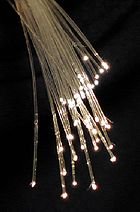
Mineral fibers can be particular strong because they are formed with a low number of surface defects.- FiberglassFiberglassGlass fiber is a material consisting of numerous extremely fine fibers of glass.Glassmakers throughout history have experimented with glass fibers, but mass manufacture of glass fiber was only made possible with the invention of finer machine tooling...
, made from specific glass, and optical fiberOptical fiberAn optical fiber is a flexible, transparent fiber made of a pure glass not much wider than a human hair. It functions as a waveguide, or "light pipe", to transmit light between the two ends of the fiber. The field of applied science and engineering concerned with the design and application of...
, made from purified natural quartzQuartzQuartz is the second-most-abundant mineral in the Earth's continental crust, after feldspar. It is made up of a continuous framework of SiO4 silicon–oxygen tetrahedra, with each oxygen being shared between two tetrahedra, giving an overall formula SiO2. There are many different varieties of quartz,...
, are also man-made fibers that come from natural raw materials, silica fiberSilica fiberSilica fibers made of sodium silicate are used in heat protection and in packings and compensators...
, made from sodium silicateSodium silicateSodium silicate is the common name for a compound sodium metasilicate, Na2SiO3, also known as water glass or liquid glass. It is available in aqueous solution and in solid form and is used in cements, passive fire protection, refractories, textile and lumber processing, and automobiles...
(water glass) and basalt fiberBasalt fiberBasalt fiber or fibre is a material made from extremely fine fibers of basalt, which is composed of the minerals plagioclase, pyroxene, and olivine. It is similar to carbon fiber and fiberglass, having better physicomechanical properties than fiberglass, but being significantly cheaper than...
made from melted basalt. - Metallic fiberMetallic fiberMetallic fibers are manufactured fibers composed of metal, plastic-coated metal, metal-coated plastic, or a core completely covered by metal. Gold and silver have been used since ancient times as yarns for fabric decoration. More recently, aluminum yarns, aluminized plastic yarns, and aluminized...
s can be drawn from ductile metals such as copper, gold or silver and extruded or deposited from more brittle ones, such as nickel, aluminum or iron. - Carbon fibers are often based on oxydized and via pyrolysisPyrolysisPyrolysis is a thermochemical decomposition of organic material at elevated temperatures without the participation of oxygen. It involves the simultaneous change of chemical composition and physical phase, and is irreversible...
carbonized polymers like PANPolyacrylonitrilePolyacrylonitrile is a synthetic, semicrystalline organic polymer resin, with the linear formula n. Though it is thermoplastic, it does not melt under normal conditions. It degrades before melting. It melts above 300 degrees Celsius only if the heating rates are 50 degrees per minute or above...
, but the end product is almost pure carbon. - Silicon carbide fibers, where the basic polymers are not hydrocarbonHydrocarbonIn organic chemistry, a hydrocarbon is an organic compound consisting entirely of hydrogen and carbon. Hydrocarbons from which one hydrogen atom has been removed are functional groups, called hydrocarbyls....
s but polymers, where about 50% of the carbon atoms are replaced by silicon atoms, so-called poly-carbo-silaneSilaneSilane is a toxic, extremely flammable chemical compound with chemical formula SiH4. In 1857, the German chemists and Friedrich Woehler discovered silane among the products formed by the action of hydrochloric acid on aluminum silicide, which they had previously prepared...
s. The pyrolysis yields an amorphous silicon carbide, including mostly other elements like oxygen, titanium, or aluminium, but with mechanical properties very similar to those of carbon fibers. - Stainless steel fiberStainless steel fiberStainless steel fibers are manufactured fibers composed of stainless steel. Composition may include carbon , silicon , manganese , phosphorus , sulfur , and other elements.-Producers:...
s.
Polymer fibers
- Polymer fibers are a subset of man-made fibers, which are based on synthetic chemicals (often from petrochemicalPetrochemicalPetrochemicals are chemical products derived from petroleum. Some chemical compounds made from petroleum are also obtained from other fossil fuels, such as coal or natural gas, or renewable sources such as corn or sugar cane....
sources) rather than arising from natural materials by a purely physical process. These fibers are made from:- polyamide nylonNylonNylon is a generic designation for a family of synthetic polymers known generically as polyamides, first produced on February 28, 1935, by Wallace Carothers at DuPont's research facility at the DuPont Experimental Station...
, - PET or PBT polyesterPolyesterPolyester is a category of polymers which contain the ester functional group in their main chain. Although there are many polyesters, the term "polyester" as a specific material most commonly refers to polyethylene terephthalate...
- phenol-formaldehyde (PF)
- polyvinyl alcohol fiber (PVA) vinylon
- polyvinyl chloride fiber (PVC) vinyonVinyonVinyon is a synthetic fiber made from polyvinyl chloride. In some countries other than the United States, vinyon fibers are referred to as polyvinyl chloride fibers. It can bind non-woven fibers and fabrics. It was invented in 1939....
- polyolefins (PP and PE) olefin fiberOlefin fiberOlefin fiber is a synthetic fiber made from a polyolefin, such as polypropylene or polyethylene. It is used in wallpaper, ropes, and vehicle interiors....
- acrylicAcrylic fiberAcrylic fibers are synthetic fibers made from a polymer with an average molecular weight of ~100,000, about 1900 monomer units. To be called acrylic in the U.S, the polymer must contain at least 85% acrylonitrile monomer. Typical comonomers are vinyl acetate or methyl acrylate...
polyesters, pure polyesterPolyesterPolyester is a category of polymers which contain the ester functional group in their main chain. Although there are many polyesters, the term "polyester" as a specific material most commonly refers to polyethylene terephthalate...
PAN fibers are used to make carbon fiberCarbon fiberCarbon fiber, alternatively graphite fiber, carbon graphite or CF, is a material consisting of fibers about 5–10 μm in diameter and composed mostly of carbon atoms. The carbon atoms are bonded together in crystals that are more or less aligned parallel to the long axis of the fiber...
by roasting them in a low oxygen environment. Traditional acrylic fiber is used more often as a synthetic replacement for wool. Carbon fibers and PF fibers are noted as two resin-based fibers that are not thermoplastic, most others can be melted. - aromatic polyamidsAramidAramid fibers are a class of heat-resistant and strong synthetic fibers. They are used in aerospace and military applications, for ballistic rated body armor fabric and ballistic composites, in bicycle tires, and as an asbestos substitute. The name is a portmanteau of "aromatic polyamide"...
(aramids) such as TwaronTwaronTwaron is the brandname of Teijin Aramid for a para-aramid. It is a heat-resistant and strong synthetic fibre developed in the early 1970s by the Dutch company AKZO, division Enka, later Akzo Industrial Fibers. The research name of the para-aramid fibre was originally Fiber X, but it was soon...
, KevlarKevlarKevlar is the registered trademark for a para-aramid synthetic fiber, related to other aramids such as Nomex and Technora. Developed at DuPont in 1965, this high strength material was first commercially used in the early 1970s as a replacement for steel in racing tires...
and NomexNomexNomex is a registered trademark for flame resistant meta-aramid material developed in the early 1960s by DuPont and first marketed in 1967.- Properties:...
thermally degrade at high temperatures and do not melt. These fibers have strong bonding between polymer chains - polyethylenePolyethylenePolyethylene or polythene is the most widely used plastic, with an annual production of approximately 80 million metric tons...
(PE), eventually with extremely long chains / HMPEUltra high molecular weight polyethyleneUltra-high-molecular-weight polyethylene , also known as high-modulus polyethylene or high-performance polyethylene , is a subset of the thermoplastic polyethylene. It has extremely long chains, with molecular weight numbering in the millions, usually between 2 and 6 million...
(e.g. Dyneema or Spectra). - ElastomerElastomerAn elastomer is a polymer with the property of viscoelasticity , generally having notably low Young's modulus and high yield strain compared with other materials. The term, which is derived from elastic polymer, is often used interchangeably with the term rubber, although the latter is preferred...
s can even be used, e.g. spandexSpandexSpandex or elastane is a synthetic fibre known for its exceptional elasticity. It is strong, but less durable than natural Latex, its major non-synthetic competitor. It is a polyurethane-polyurea copolymer that was co-invented in 1959 by chemists C. L. Sandquist and Joseph Shivers at DuPont's...
although urethane fibers are starting to replace spandex technology. - polyurethanePolyurethaneA polyurethane is any polymer composed of a chain of organic units joined by carbamate links. Polyurethane polymers are formed through step-growth polymerization, by reacting a monomer with another monomer in the presence of a catalyst.Polyurethanes are...
fiber
- polyamide nylon
- Coextruded fibers have two distinct polymers forming the fiber, usually as a core-sheath or side-by-side. Coated fibers exist such as nickel-coated to provide static elimination, silver-coated to provide anti-bacterial properties and aluminum-coated to provide RF deflection for radar chaffChaff (radar countermeasure)Chaff, originally called Window by the British, and Düppel by the Second World War era German Luftwaffe , is a radar countermeasure in which aircraft or other targets spread a cloud of small, thin pieces of aluminium, metallized glass fibre or plastic, which either appears as a cluster of secondary...
. Radar chaff is actually a spool of continuous glass tow that has been aluminum coated. An aircraft-mounted high speed cutter chops it up as it spews from a moving aircraft to confuse radar signals.
Microfibers
Microfibers in textiles refer to sub-denier fiber (such as polyester drawn to 0.5 dn). DenierDenier
Denier may refer to:* Denier , a unit of linear mass density of fibers* Denier, Pas-de-Calais, France* French denier, a coin* The Deniers, a 2008 book by Canadian environmentalist Lawrence Solomon* C. Denier Warren, American TV and film actor...
and Detex are two measurements of fiber yield based on weight and length. If the fiber density is known you also have a fiber diameter, otherwise it is simpler to measure diameters in micrometers. Microfibers in technical fibers refer to ultra fine fibers (glass or meltblown thermoplastics) often used in filtration. Newer fiber designs include extruding fiber that splits into multiple finer fibers. Most synthetic fibers are round in cross-section, but special designs can be hollow, oval, star-shaped or trilobal. The latter design provides more optically reflective properties. Synthetic textile fibers are often crimped to provide bulk in a woven, non woven or knitted structure. Fiber surfaces can also be dull or bright. Dull surfaces reflect more light while bright tends to transmit light and make the fiber more transparent.
Very short and/or irregular fibers have been called fibrils. Natural cellulose, such as cotton or bleached kraft, show smaller fibrils jutting out and away from the main fiber structure.
See also
- Optical fiberOptical fiberAn optical fiber is a flexible, transparent fiber made of a pure glass not much wider than a human hair. It functions as a waveguide, or "light pipe", to transmit light between the two ends of the fiber. The field of applied science and engineering concerned with the design and application of...
- Fiber cropFiber cropFiber crops are field crops grown for their fibers, which are traditionally used to make paper, cloth, or rope. The fibers may be chemically modified, like in viscose or cellophane...
- Molded pulpMolded pulpMolded pulp, also named Moulded pulp or Molded Fibre, is a packaging material, typically made from recycled paperboard and/or newsprint. It is used for protective packaging or for food service trays and beverage carriers...
- Dietary fiberDietary fiberDietary fiber, dietary fibre, or sometimes roughage is the indigestible portion of plant foods having two main components:* soluble fiber that is readily fermented in the colon into gases and physiologically active byproducts, and* insoluble fiber that is metabolically inert, absorbing water as it...
- Fibers in Differential GeometryGlossary of differential geometry and topologyThis is a glossary of terms specific to differential geometry and differential topology.The following two glossaries are closely related:*Glossary of general topology*Glossary of Riemannian and metric geometry.See also:*List of differential geometry topics...
- Ceramic matrix compositeCeramic Matrix CompositeCeramic matrix composites are a subgroup of composite materials as well as a subgroup of technical ceramics. They consist of ceramic fibers embedded in a ceramic matrix, thus forming a ceramic fiber reinforced ceramic material...