
All Topics  
Carding

 
Carding

   Email Print
   Bookmark   Link


Carding


Carding is the processing of brushing raw or washed fiber
Fiber

Fiber or fibre is a class of materials that are continuous filaments or are in discrete elongated pieces, similar to lengths of yarn. They are very important in the biology of both plants and animals, for holding tissue s together....
s to prepare them as textile
Textile

A textile is a flexible material consisting of a network of natural or artificial fibres often referred to as thread or yarn. Yarn is produced by Spinning raw wool fibres, linen, cotton, or other material on a spinning wheel to produce long strands known as yarn....
s. A large variety of fibers can be carded, anything from dog hair, to llama
Llama

The llama is a South American camelid, widely used as a pack animal by the Incas and other natives of the Andes mountains. In South America llamas are still used as beasts of burden, as well as for the production of fiber and meat....
, to soy fiber (a fiber made from soy beans), to polyester
Polyester

Polyester is a category of polymers which contain the ester functional group in their main chain. Although there are many polyesters, the term "polyester" as a specific material most commonly refers to polyethylene terephthalate ....
. Cotton
Cotton

Cotton is a soft, staple fiber that grows in a form known as a boll around the seeds of the cotton plant a shrub native to tropical and subtropical regions around the world, including the Americas, India and Africa....
 and wool
Wool

Wool is the fiber derived from the specialized skin cells, called follicles, of animals in the Caprinae family, principally domestic sheep, but the hair of certain species of other Mammalia such as cashmere goat, llamas, rabbits and keeshonds may also be called wool....
 are probably the most common fibers to be carded.


Discussion
Ask a question about 'Carding'
Start a new discussion about 'Carding'
Answer questions from other users
Full Discussion Forum


Recent Posts


Encyclopedia


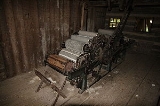
Double Carder
Carding is the processing of brushing raw or washed fiber
Fiber

Fiber or fibre is a class of materials that are continuous filaments or are in discrete elongated pieces, similar to lengths of yarn. They are very important in the biology of both plants and animals, for holding tissue s together....
s to prepare them as textile
Textile

A textile is a flexible material consisting of a network of natural or artificial fibres often referred to as thread or yarn. Yarn is produced by Spinning raw wool fibres, linen, cotton, or other material on a spinning wheel to produce long strands known as yarn....
s. A large variety of fibers can be carded, anything from dog hair, to llama
Llama

The llama is a South American camelid, widely used as a pack animal by the Incas and other natives of the Andes mountains. In South America llamas are still used as beasts of burden, as well as for the production of fiber and meat....
, to soy fiber (a fiber made from soy beans), to polyester
Polyester

Polyester is a category of polymers which contain the ester functional group in their main chain. Although there are many polyesters, the term "polyester" as a specific material most commonly refers to polyethylene terephthalate ....
. Cotton
Cotton

Cotton is a soft, staple fiber that grows in a form known as a boll around the seeds of the cotton plant a shrub native to tropical and subtropical regions around the world, including the Americas, India and Africa....
 and wool
Wool

Wool is the fiber derived from the specialized skin cells, called follicles, of animals in the Caprinae family, principally domestic sheep, but the hair of certain species of other Mammalia such as cashmere goat, llamas, rabbits and keeshonds may also be called wool....
 are probably the most common fibers to be carded. Not all fibers are carded; Flax
Flax

Flax is a member of the genus Linum in the family Linaceae. It is native to the region extending from the eastern Mediterranean region to India and was probably first domesticated in the Fertile Crescent....
 and bast
Bast fibre

Bast fibre or skin fibre is plant fibre collected from the phloem or bast surrounding the stem of certain, mainly dicotyledonic, plants....
, for example, are retted
Retting

Retting is a stage in the manufacturing of fiber crop, especially the bast fibers. It is a process that employs water and microbial action to separate the bast fibers from the woody core , and sometimes from the Epidermis as well....
 then threshed
Threshing

Threshing is the process of loosening the edible part of cereal grain from the scaly, inedible chaff that surrounds it. It is the step in grain preparation before winnowing, which separates the loosened chaff from the grain....
.

Carding is used to take unordered fibers and prepare them for spinning by either the worsted or woollen process or to produce webs of fibre to go into nonwoven products depending on the mechanism at the output from the card. It can also be used to create blends of different fibers or different colors. The process of carding mixes up the different fibers, thus creating a homogeneous mix of the various types of fibers, at the same time as it orders them and gets rid of the tangles. Machine cards for carding wool also have rollers and systems designed to remove some vegetable contaminants from the wool.

The two main ways to card fibers are by hand and by machine.

Hand carding

Hand carders look similar to dog brushes. They are used two at a time to brush the wool between them until all the fibers in a bunch more or less align in the same direction. Carding is an activity normally done sitting down outside or over a drop cloth, depending on the wool's cleanliness. If the wool contains a lot of vegetable matter, that will fall out during the carding process, which is the reason for a drop cloth. If the carding is being done to mix two pre-carded fibers, a drop cloth is not generally used.

To card, the person carding holds a carder in each hand. The carder in their non-dominant hand (left for most people) rests on their leg. They place a small amount of fiber on this card and pull the other carder through, while taking care to catch some of the fibers. By catching some fibers on the moving card, the fibers are separated, which allows vegetable matter to fall out, and they are aligned. Catching too many fibers makes it hard to pull the carders apart. This process, repeated many times, transfers small amounts of the wool to the other carder. Once all the wool has been transferred, the person carding repeats this process until all the fibers are aligned and the fiber is satisfactorily clean of debris. They then roll up their carded wool into a neat rolag
Rolag

A rolag is a roll of fiber generally used to Spinning woolen yarn. A rolag is created by first carding the fiber, using Carding , and then by gently rolling the fiber off of the cards....
.

Hand carders come in a wide variety of sizes, from ones two by two inches to ones four by eight inches. The small ones are called flick carders, and are used just to flick the ends of a lock of hair, or to tease out some strands for spinning off. Density of the teeth, and shape of the carders also varies. For finely carded rolags, one uses carders with more teeth. The type of fiber, its length, weight and characteristics, can also determine how many teeth are needed per inch on the carders. Hand carders can be either flat backed or curved, which is a matter of personal preference.

Machine carding

Carding Llama Hair
Machine carding is done on a device called a drum carder. These devices vary in size from the one that easily fits on the kitchen table, to the carder that takes up a full room .

The carders used currently in woolen mills differ very little from machines used 20 to 50 years ago, and in some cases the machines are from that era. For wool, and wool-like fibers (such as llama, alpaca, goat, etc.), fibers are fed onto a series of rollers. Depending on the size of the carder, the number of rollers varies. Ones that fit on the kitchen table typically have two drums, or rollers. One is small, and used to catch the fibers and feed them in. The other drum takes the fibers from the first drum, and, in the process of transferring them from one drum to another, the fibers are straightened out and made more orderly. The picture above is a small drum carder.

A carder that takes up a full room works very similarly, the main difference being that the fiber goes through many more drums often with intervening cross laying to even out the load on the subsequent cards, which normally get finer as the fiber progresses through the system.

When the fiber comes off the drum, it is in the form of a bat – a flat, orderly mass of fibers. If a small drum carder is being used, the bat is the length of the circumference of the big drum, and is often the finished product. A big drum carder though, will then take that bat and turn it into roving
Roving

A roving is a long and narrow bundle of fiber. It is usually used to Spinning worsted yarn. A roving can be created by carding or combing the fiber, and is then drawn into long strips where the fiber is parallel....
, by stretching it thinner and thinner, until it is the desired thickness (often rovings are the thickness of a wrist). (A rolag differs from a roving ( or ) because it is not a continuous strand, and because the fibers end up going across instead of along the strand.) Cotton fibers are fed into the machine, picked up and brushed onto flats when carded.

Some hand-spinners have a small drum carder at home especially for the purpose of mixing together the different colored fiber that are bought already carded.

History

Historian of science Joseph Needham
Joseph Needham

Noel Joseph Terence Montgomery Needham, Companion of Honour, Fellow of the Royal Society, Fellow of the British Academy , also known as Li Yuese , was a British academic and sinologist known for his research and writing on the history of Science and technology in China....
 ascribes the invention of bow-instruments used in textile technology to India. The earliest evidence for using bow-instruments for carding comes from India (2nd century CE). These carding devices, called kaman and dhunaki would loosen the texture of the fiber by the means of a vibrating string.

In 1748 Lewis Paul
Lewis Paul

Lewis Paul was the original inventor of roller spinning, the basis of the water frame for Spinning cotton in a cotton mill....
 of Birmingham
Birmingham

Birmingham is a city status in the United Kingdom and metropolitan borough in the West Midlands of England. Birmingham is the most populous of England's English Core Cities Group, and is the List of United Kingdom cities by population British city after London, with a population of 1,010,200 ....
, England
England

native_name =|conventional_long_name = England|common_name = England|image_flag = Flag of England.svg|image_coat = England COA.svg|symbol_type = Royal Coat of Arms...
 invented the hand driven carding machine. A coat of wire slips were placed around a card which was then wrapped around a cylinder. Daniel Bourn obtained a similar patent in the same year, and probably used it in his spinning mill at Leominster
Leominster

Leominster is a market town at in Herefordshire, England. It has a population of approximately 11,000 and is on the River Lugg and its tributary the River Kenwater in North Herefordshire....
, but this burnt down in 1754. The invention was later developed and improved by Richard Arkwright
Richard Arkwright

Sir Richard Arkwright , was an England who is credited for inventing the spinning frame ? later renamed the water frame following the transition to Hydropower....
 and Samuel Crompton
Samuel Crompton

Samuel Crompton was an English inventor and pioneer of the spinning industry....
. Arkwright's second patent (of 1775) for his carding machine was subsequently declared invalid, because it lacked originality.

From the 1780s, the carding machines were set up in mills in the north of England and mid Wales. The first in Wales was in a factory at Dolobran near Meifod
Meifod

Meifod is a small village 7 miles north-west of Welshpool in Powys, mid Wales, on the A495 road and located in the valley of the River Vyrnwy. The River Banwy has a confluence with the Vyrnwy approximately two miles to the west of the village....
 in 1789. These carding mills produced yarn particularly for the Welsh
Wales

native_name = Cymru|conventional_long_name = Wales|common_name = Wales|image_flag = Flag of Wales 2.svg|national_motto = ...
 flannel
Flannel

Flannel is a soft #Weave fabric, of various fineness. It usually doesn't have a nap , and instead gains its softness through the loosely spun yarn it is woven from....
 industry.

By 1838, the Spen Valley
Spen Valley

Spen Valley may refer to:* The River Spen, in West Yorkshire, England* Spen Valley See also*Cleckheaton#Cleckheaton and the Spen Valley for a history of the area...
, centred around Cleckheaton
Cleckheaton

Cleckheaton is a town within the Kirklees, in West Yorkshire, England, situated south of Bradford, east of Brighouse, west of Batley and south-west of Leeds....
 had at least 11 carding factories and by 1893 it was generally accepted as the carding capital of the world. Even now, Cleckheaton
Cleckheaton

Cleckheaton is a town within the Kirklees, in West Yorkshire, England, situated south of Bradford, east of Brighouse, west of Batley and south-west of Leeds....
's carding legacy lives on through companies such as Garnett Control, Bridon Wire, Cold Drawn Products and ECC.

General information


This product (roving
Roving

A roving is a long and narrow bundle of fiber. It is usually used to Spinning worsted yarn. A roving can be created by carding or combing the fiber, and is then drawn into long strips where the fiber is parallel....
s and rolag
Rolag

A rolag is a roll of fiber generally used to Spinning woolen yarn. A rolag is created by first carding the fiber, using Carding , and then by gently rolling the fiber off of the cards....
s) can be used for spinning
Spinning (textiles)

Spinning is an ancient textile arts in which fiber crop, animal fiber or synthetic fiber fibers are twisted together to form yarn . For thousands of years, fiber was spun by hand using simple tools, the Spindle and distaff....
.

Carding of wool can either be done "in the grease" or not, depending on the type of machine and on the spinner's preference. "In the grease" means that the lanolin
Lanolin

Lanolin, also called Adeps Lanae, wool wax, wool fat, anhydrous wool fat or wool grease, is a greasy yellow substance secreted by the sebaceous glands of wool animals, with the vast majority of it used by humans coming from domestic sheep....
 that naturally comes with the wool has not been washed out, leaving the wool with a slightly greasy feel. The large drum carders do not tend to get along well with lanolin, so most commercial worsted and woollen mills wash the wool before carding. Handcarders (and small drum carders too, though the directions may not recommend it) can be used to card lanolin rich wool. A major benefit of working with the lanolin
Lanolin

Lanolin, also called Adeps Lanae, wool wax, wool fat, anhydrous wool fat or wool grease, is a greasy yellow substance secreted by the sebaceous glands of wool animals, with the vast majority of it used by humans coming from domestic sheep....
 still in the wool is that it leaves you with soft hands.

See also

  • Carding (torture)
    Carding (torture)

    In torture, carding involved scraping or tearing the victim's flesh with metal combs normally used for combing wool.Combs usually had one or two rows of teeth, each a few inches in length....
    , a method of torture using wool-combs.


External links


  • - Directions on hand-carding, complete with numerous pictures.
  • - Includes video tutorials.