
All Topics  
National Insurance


   Email Print
   Bookmark   Link


National Insurance


National Insurance (NI) is a system of taxes and related social security
Social security

Social security primarily refers to a social insurance program providing social protection, or protection against socially recognized conditions, including poverty, old age, disability, unemployment and others....
 benefits in the United Kingdom
United Kingdom

The United Kingdom of Great Britain and Northern Ireland, commonly known as the United Kingdom , the UK or Britain,is a sovereign state located off the northwestern coast of continental Europe....
. It was first introduced by the National Insurance Act 1908
National Insurance Act 1911

The National Insurance Act, actually passed in 1908, is an Act of Parliament of Parliament of the United Kingdom of the United Kingdom, passed in 1908, and paid in 1909....
, and expanded by the government of Clement Attlee
Clement Attlee

Clement Richard Attlee, 1st Earl Attlee, Order of the Garter, Order of Merit, Order of the Companions of Honour, Her Majesty's Most Honourable Privy Council, Fellow of the Royal Society was a British people politician, who served as Prime Minister of the United Kingdom from 1945 to 1951, and leader of the Labour Party from 1935 to 1955....
 in 1946. The tax component of the system consists of taxes paid by employees and employers on earnings, and by employers on certain other benefits-in-kind provided to employees. The self-employed are taxed based upon profits. Such taxes are said to be National Insurance Contributions (NICs).

The benefit component of the system is a number of contributory benefits, these are ones where the claimant's previous contribution record determines the availability and amount of the benefit paid.


Discussion
Ask a question about 'National Insurance'
Start a new discussion about 'National Insurance'
Answer questions from other users
Full Discussion Forum


Recent Posts


Encyclopedia


National Insurance (NI) is a system of taxes and related social security
Social security

Social security primarily refers to a social insurance program providing social protection, or protection against socially recognized conditions, including poverty, old age, disability, unemployment and others....
 benefits in the United Kingdom
United Kingdom

The United Kingdom of Great Britain and Northern Ireland, commonly known as the United Kingdom , the UK or Britain,is a sovereign state located off the northwestern coast of continental Europe....
. It was first introduced by the National Insurance Act 1908
National Insurance Act 1911

The National Insurance Act, actually passed in 1908, is an Act of Parliament of Parliament of the United Kingdom of the United Kingdom, passed in 1908, and paid in 1909....
, and expanded by the government of Clement Attlee
Clement Attlee

Clement Richard Attlee, 1st Earl Attlee, Order of the Garter, Order of Merit, Order of the Companions of Honour, Her Majesty's Most Honourable Privy Council, Fellow of the Royal Society was a British people politician, who served as Prime Minister of the United Kingdom from 1945 to 1951, and leader of the Labour Party from 1935 to 1955....
 in 1946. The tax component of the system consists of taxes paid by employees and employers on earnings, and by employers on certain other benefits-in-kind provided to employees. The self-employed are taxed based upon profits. Such taxes are said to be National Insurance Contributions (NICs).

The benefit component of the system is a number of contributory benefits, these are ones where the claimant's previous contribution record determines the availability and amount of the benefit paid. The benefits provided are weekly income benefits and some lump sum benefits to participants upon death, retirement, unemployment, maternity and disability.

History

The name national insurance was adopted as an expression of the government's aspiration that the system should be qualitatively different from conventional general taxation such as income tax
Income tax

An income tax is a tax levied on the financial income of people, corporations, or other legal entities. Various income tax systems exist, with varying degrees of tax incidence....
.

The proposed differences that were enacted, or aspired to, included:
  • the revenue was expected to roughly equate to current spending on contributory benefits
  • no means test
    Means test

    The term means test refers to an investigative process undertaken to determine whether or not an individual or family is eligible to qualify for help from the government....
    ing of benefits - the amount of benefit paid in respect of any claim by a claimant was the same whether the claimant was rich or poor, depending only on the completeness of the claimant's contribution record
  • a cap on the system's scope for redistribution - above a certain level of earnings or profits no extra contributions were payable
  • the payment of a contribution by an employer for each employee comparable to that paid by the employee


Initially, the most important contributory benefits were the State Retirement Pension
Pension

In general, a pension is an arrangement to provide people with an income when they are no longer earning a regular income from employment.The terms retirement plan or superannuation refer to a pension granted upon retirement ....
 and Unemployment Benefit
Unemployment benefit

Unemployment benefits are payments made by governments to unemployment people. It may be based on a compulsory para-governmental insurance system....
.

With the introduction of employer payroll tax
Payroll tax

Payroll tax generally refers to two kinds of taxes: Taxes which employers are required to withhold from employees' pay, also known as withholding, PAYE or PAYG tax; and taxes which are paid from the employer's own funds and which are directly related to employing a worker, which may be either fixed charges or proportionally linked to an emp...
 deduction (Pay-As-You-Earn or PAYE
PAYE

PAYE is an amount collected by employers on behalf of the government from employees. This is, in effect, a provisional payment of income tax on the employee's income....
), employees' National Insurance contributions were collected along with income tax
Income tax

An income tax is a tax levied on the financial income of people, corporations, or other legal entities. Various income tax systems exist, with varying degrees of tax incidence....
. This replaced the old system of purchasing a contribution certificate or stamp, but for many years some older Britons continued to describe making NI contributions as paying their stamp.

As the system developed, the link between individual contributions and benefits was weakened. The National Insurance Fund
National Insurance Fund

The National Insurance Fund represents the funds of the National Insurance Scheme, set up by the British Government following World War II. In the William_Beveridge#Main_work_on_social_security this was designed as part of a universal insurance system for all British people....
 is still nominally hypothecated
Hypothecation

Generally, in English and American law, a contract of mortgage or pledge as Collateral for a debt in which the subject matter is not delivered into the possession of the pledgee or pawnee....
, and national insurance payments cannot be used to fund general government spending, although as much of the fund is invested in government securities it is available for borrowing by the government for spending on capital projects, like schools and hospitals. National Insurance contributions are paid into the various classes of National Insurance AFTER deduction of monies specifically allocated to the National Health Service
National Health Service

The National Health Service is the name commonly used to refer to the four publicly funded healthcare systems of the United Kingdom, collectively or individually, although only the health service in England uses the name 'National Health Service' without further qualification....
. However a small percentage is transferred from the fund to the NHS from certain of the smaller sub-classes. Thus the NHS is partially funded from NI contributions but not from the NI Fund.

Recent developments of the system have meant that National Insurance provides a significant part of the government's revenue (£90 billion in 2006-2007, approximately 17% of total government receipts). At the same time it has become more redistributive as its structure has changed to remove the fixed upper contribution limits, albeit with a much lower rate payable by employees on income above a certain level. It has been mooted that the link between individual's contribution record and the remaining contributory benefits will be weakened further.

NI has been criticised as a "stealth tax
Stealth tax

Stealth Tax is a term used for a tax levied in such a way that is largely unnoticed, or not recognized as a tax. Generally used in the UK by Conservative Party to attack the New Labour government's policies....
" and "an income tax in everything but name": in recent years governments have trumpeted the fact that income tax rates have not changed, while they have increased revenue by increasing the rates and scope of NI. At the same time the unfairness of a tax that is levied on the wage income of all workers but not on dividend or interest income has been criticised: at the extreme this leads to the contrast between a low-paid worker who has to pay the tax on his income and a wealthy owner of income-bearing assets who does not.

There have been proposals put forward by think-tanks to abolish employees' National Insurance altogether by rolling it up into income tax; these have yet to be adopted as a policy by a major political party.

Contribution classes

National insurance contributions (NICs) fall into a number of classes. Class 1, 2 and 3 NICs paid are credited to an individual's NI account, which determines eligibility for certain benefits - including the state pension. Class 1A, 1B and 4 NIC do not count towards benefit entitlements but must still be paid if due.

Class 1

Class 1 contributions are paid by employers and their employees. In law, the employee contribution is referred to as the 'primary' contribution and the employer contribution as the 'secondary', but for ease of understanding they are referred to simply as employee and employer contributions in this article.

The employee contribution is deducted from gross wages by the employer, with no action required by the employee. The employer then adds in their own contribution before remitting the money to HMRC along with income tax.

There are three milestone figures which determine the rate of NICs to be paid: Lower Earnings Limit (LEL) , Earnings threshold (ET) and Upper Earnings Limit (UEL). In this context "earnings" refers to an employee's wage or salary. The cash value of each of these limits changes each year, either in line with inflation or by some other amount decided by the Chancellor.

  • Below the LEL, no NICs are paid because no benefits can accrue on earnings below this limit.
  • On earnings above the LEL and below the ET, contributions are not paid but are credited by the government as if they were. This effectively assists the working poor to get benefits. Additionally, where the employee and employer contribute to certain types of occupational pension scheme, there is a negative contribution rate on earnings in this bend - this 'rebate' can be offset against contributions in other earnings bands.
  • On salaries between the ET and the UEL, NICs are collected at a rate which is determined by a number of factors:
    • The type of occupational pension scheme (if any) to which the employee and employer make contributions
    • Whether the employee has reached the age at which state retirement pension becomes payable
    • Whether the employee is a married woman paying reduced-rate contributions. This facility was abolished on 11th May 1977 but women who were already paying these contributions at that time were allowed to opt to continue to do so for as long as they remained married.
    • Whether the employee is an ocean-going mariner or deep-sea fisherman
  • On the portion above the UEL there are again various rates, depending on similar factors to those relating to the previous earnings band, with the exception that the type of pension scheme no longer has a bearing.
Unlike income tax the limits for class 1 NICs for ordinary employees are calculated on a periodic basis, usually weekly or monthly depending on how the employee is paid. However those for company directors are always calculated on an annual basis, to ensure that the correct level of NICs are collected regardless of how often the director chooses to be paid. In the 2007 budget
Budget

Budget generally refers to a list of all planned expenses and revenues. It is a plan for saving and spending. A budget is an important concept in microeconomics, which uses a budget line to illustrate the trade-offs between two or more good ....
, the then Chancellor of the Exchequer
Chancellor of the Exchequer

The Chancellor of the Exchequer is the title held by the British Cabinet of the United Kingdom Minister who is responsible for all economic and financial matters....
 Gordon Brown
Gordon Brown

James Gordon Brown UK Member of Parliament is a United Kingdom Labour Party politician and the Prime Minister of the United Kingdom. Brown assumed office in June 2007, after the resignation of Tony Blair and three days after becoming leader of the governing Labour Party....
 announced that in future the LEL and UEL would be aligned with the income tax basic rate band. This aim is currently scheduled to be achieved by April 2011.

Table letters
As indicated above, the rates at which an individual and their employer pay contributions depend on a number of factors. Consequently there are many possible sets of employer/employer contribution rates to allow for all combinations of the various factors. HMRC allocate a letter of the alphabet, referred to as an 'NI Table Letter', to each of these sets of contribution rates. The complexity of the system is such that 21 of the 26 letters of the alphabet are currently in use for this purpose. Each tax year, HMRC publish look-up tables for each table letter to assist with manual calculation of contributions, though these days most of the calculations are done by computer systems.

Employers are responsible for allocating the correct table letter (sometimes also referred to as an 'NI category') to each employee depending on their particular circumstances. This then defines the rates of employee and employer contribution which apply.

Class 1A
Class 1A contributions are paid by employers on the value of company cars and certain other benefits in kind provided to their employees and directors, at a rate of 12.8% of the value of the benefits in kind (from their P11D
P11D

Form P11D is filed by United Kingdom employers for each director and for each employee earning over Pound sterling8500 per year, and sent to the HM Revenue and Customs with which their PAYE scheme is registered....
s).

Class 1B
Class 1B were introduced on 6 April 1999 and are payable whenever an employer enters into a PAYE Settlement Agreement (a PSA) for tax. Class 1B NICs are payable only by employers and payment does not provide any benefit entitlement for individuals.

Class 2

Class 2 contributions are fixed weekly amounts paid by the self-employed. They are due regardless of trading profits or losses, but people on small (low) earnings can apply for exception from paying and those on high earnings with liability to either Class 1 or 4 can apply for deferment from paying. While the amount is calculated to a weekly figure, they are typically paid monthly or quarterly. For the most part, unlike Class 1, they do not form part of a qualifying contribution record for contributions-based Jobseekers Allowance.

Class 3

Class 3 contributions are voluntary NICs paid by people that wish to fill a gap in their contributions record which has arisen either by not working or by their earnings being too low. The main reason for paying Class 3 NICs is to ensure that a person's contribution record is preserved to provide entitlement to the state pension. Generally a woman currently needs 10 years of contributions and a man 11 years for a minimum state pension. In certain cases (e.g. parents and carers) fewer years may be required.

Class 4

Class 4 contributions are paid by self-employed people as a portion of their profits, calculated with income tax at the end of the year, based on figures supplied on the SA100 tax return
Tax return

"Tax return" refers to a document which can be filed with a government body declaring liability for taxation, in a number of countries including :...
. Below the earnings threshold no class 4 NICs are due. Above the earnings threshold and below the upper earnings limit class 4 NICs are paid at a rate of 8% of trading profits. Above the upper earnings limit class 4 NICs are paid at a rate of 1% of trading profits. They do not form part of a qualifying contribution record for any benefits, including the state retirement pension.

NIC credits

People who are unable to work for some reason may be able to claim NIC credits. These are equivalent to Class 1 NICs, though are not paid for. They are granted either to maintain a contributions record while not working, or to those applying for benefits whose contribution record is only slightly short of the requirements for those benefits. In the latter case, they are unavailable to fill "gaps" in contribution records for some benefits.

Actuarial reviews

An actuarial
Actuary

An actuary is a business professional who deals with the financial impact of risk and uncertainty. Actuaries have a deep understanding of financial security systems, their reasons for being, their complexity, their mathematics, and the way they work ....
 evaluation of the long-term prospects for the National Insurance system is mandated every 5 years, or whenever any changes are proposed to benefits or contributions. Such evaluations are conducted by the Government Actuary's Department
Government Actuary's Department

The Government Actuary?s Department is a department of the Government of the United Kingdom responsible for providing actuarial advice to public sector clients....
 and the resulting reports must be presented to the UK Parliament.

National Insurance number

Mn00627a
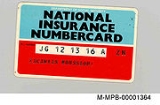
People born and resident in the UK are assigned an NI number (referred to internally as a NINO), and receive a plastic card of similar proportions to a credit card
Credit card

A credit card is part of a system of payments named after the small plastic card issued to users of the system. It is a card entitling its holder to buy goods and services based on the holders promise to pay for these goods and services....
 with the number raised on the front shortly before their 16th birthday, and are advised to keep the card safe (only one replacement card may ever be issued over the lifetime of an individual). However, allocation of this number might occur a long time before this occasion (the date can usually be established from the prefix letters used), and siblings may have consecutive numbers - this is dependent on the payment of Child Benefit
Child benefit

Child benefit is a social security payment disbursed to the parents or guardians of children. Child benefit is means-testing in some countries....
.

Persons from abroad looking to work in the UK, or those to whom a number was not initially allocated as children, may apply for a number through the Department for Work and Pensions
Department for Work and Pensions

The Department for Work and Pensions is the largest government Ministry in the Government of the United Kingdom, created on June 8, 2001, from the merger of the employment part of the Department for Education and Employment and the Department of Social Security....
 (DWP). The prefixes used are typically different from those used in the normal run.

The format of the number is two letters, six digits, and one optional letter. The example used is typically AB123456C. It is usual to pair off the digits - such separators are seen on forms used by government departments (both internal and external, notably the P45 and P60).

In the case of AB 12 34 56 C, the first and second letter cannot be D, F, I, Q, U and V. The second letter also cannot be O. The first two character combinations BG, GB, NK, KN, TN, NT and ZZ are not used. The six digits are sequentially issued (siblings who are few years apart may notice their numbers are consecutive when the numbers are issued together), and the suffix letter is A, B, C, D or absent. The number is unique without the last letter - if there is AB 12 34 56 C, then there will be no AB 12 34 56 D (though it is possible that there will be AB 12 34 57 D). A common error found on documents containing an individual's NI number is the final letter being incorrect, though this error is non-fatal in that an individual can be identified without the last letter.

It is worth noting that, while an individual may be issued with a second NI number when all traces of their original number has been lost, these numbers never change. Some accountant
Accountant

An accountant is a practitioner of accountancy, which is the measurement, disclosure or provision of assurance about financial information that helps managers, investors, tax authorities and other decision makers make resource allocation decisions....
s often mistakenly advise their customers of a change, particularly in the suffix letter, where A referred to employment, B to self-employment, etc. The actual meaning of the suffix letter dates back to before NIRS (see below), and referred to the quarter in which that individual's annual record card was due for return, and is roughly (but not directly) linked to their date of birth.

As the UK does not, as yet, have a system of personal ID cards, and not everyone has a passport
Passport

A passport is a document, issued by a national government, which certifies, for the purpose of international travel, the identity and nationality of its holder....
, the NI number is, along with the NHS number, one of only two systems which provide every adult in the country with a code number. Consequently, NI numbers are sometimes used for identification purposes in other contexts which have nothing to do with their original National Insurance purpose. This is despite a clear claim on the back of the NI card, and a smaller claim on the front, that it is not proof of identity.

In the past, employers sometimes allocated their employees a temporary insurance number, which followed the format TN 01 23 45 X, where 'TN' stands for temporary number and is static and X is usually M for male in the case of men or F for female in the case of women and the numbers in the mid-section are the employee's date of birth. In the case of a woman born on 1st December 1958, for example, the temporary NI number would most likely be TN 01 12 58 F. This has now changed slightly in that the TN prefix is no longer used. Temporary NI numbers cannot be used to trace back any NI credits/ personal details. HMRC now discourages the use of these numbers.

Another type of temporary NI number is the Revenue issued "temporary reference" used when HMRC is unable to trace a taxpayer's original NI number. It follows the format 63T12345.

NIRS


National Insurance contributions for all UK residents and some non-residents are recorded using the NIRS computer software package (National Insurance Recording System, pronounced "nurse"). NIRS is currently in its second generation and is known within the Civil Service
Civil service

The term civil service has two distinct meanings:* Branch of governmental service in which individuals are hired on the basis of merit which is proven by the use of competitive examinations....
 as NIRS/2 ("nurse two").

The original NIRS was a more archaic system first used in 1975 without direct user access to its records. A civil servant working within the Contributions Office (NICO) would have to request paper printouts of an individual's account which could take up to two weeks to arrive. New information to be added to the account would be sent to specialised data entry operatives on paper to be input into NIRS.

NIRS/2 is a Microsoft Windows
Microsoft Windows

Microsoft Windows is a series of software operating systems and graphical user interfaces produced by Microsoft. Microsoft first introduced an operating environment named Windows in November 1985 as an add-on to MS-DOS in response to the growing interest in graphical user interfaces ....
 based system with several applications under its umbrella. These include individual applications to access or update an individual National Insurance account, to view employer's National Insurance schemes and a general work management application.

There has been some controversy regarding the NIRS/2 system from its inception in 1996 when problems with the new system attracted widespread media coverage. Due to these computer problems, deficiency notices which used to be sent out on an annual basis stopped being issued in 1996. The Inland Revenue
Inland Revenue

The Inland Revenue was, until April 2005, a Departments of the United Kingdom Government of the British Government responsible for the collection of direct tax tax, including income tax, national insurance, capital gains tax, Inheritance Tax , United Kingdom corporation tax, petroleum revenue tax and stamp duty....
 is currently (as of August 2004) running an exercise to catch up on a backlog of deficiency notices for the 1996-97 to 2001-02 tax years on the instructions of the Paymaster General. The exercise is due for completion in March 2005. Deficiency notices are due to be issued on an annual basis again from October 2004.

From April 2010, only 30 years' contributions will be required in order to receive the maximum state pension (age retirement) instead of the previously required 44 years for men and 39 years for women. Care should be taken when receiving a deficiency notice if due to reach retirement age after April 2010.

See also

  • Regressive tax
    Regressive tax

    A regressive tax is a tax imposed in such a manner that the tax rate decreases as the amount subject to taxation increases. In simple terms, a regressive tax imposes a greater burden on the poor than on the rich — there is an inverse relationship between the tax rate and the taxpayer's ability to pay as measured by assets, consumption,...
  • National Insurance Fund
    National Insurance Fund

    The National Insurance Fund represents the funds of the National Insurance Scheme, set up by the British Government following World War II. In the William_Beveridge#Main_work_on_social_security this was designed as part of a universal insurance system for all British people....


External links

interactive tool on the Business Link website , from UK government website Directgov - The official UK government definition of the NI number format. Also includes links to the XML Schema data type definition in the CitizenIdentificationTypes schema published by the Office of the e-Envoy. HM Revenue & Customs official page