
All Topics  
Polynesia


   Email Print
   Bookmark   Link


Polynesia


Polynesia (from Greek
Greek language

Greek is an Indo-European languages native to the southern Balkan peninsula, the language of the Greek people. It forms an independent branch within Indo-European....
: p???? "polus" many + ??s?? "nesos" island) is a subregion
Subregion

A subregion is a conceptual unit which derives from a larger region or continent and is usually based on location. Cardinal directions, such as south or southern, are commonly used to define a subregion....
 of Oceania
Oceania

Oceania is a geography, often geopolitics, region consisting of numerous lands—mostly islands in the Pacific Ocean and vicinity. The term "Oceania" was coined in 1831 by French explorer Jules Dumont d'Urville....
, comprising a large grouping of over 1,000 island
Island

An island or isle is any piece of land that is surrounded by water. Very small islands such as emergent land features on atolls are called islets....
s scattered over the central and southern Pacific Ocean
Pacific Ocean

The Pacific Ocean is the largest of the Earth's oceanic divisions. Its name is derived from the Latin name Mare Pacificum, "peaceful sea", bestowed upon it by the Portugal explorer Ferdinand Magellan....
.

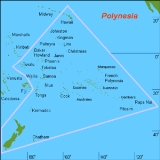
nesia is generally defined as the islands within the Polynesian triangle
Polynesian Triangle

The Polynesian Triangle is a region of the Pacific Ocean anchored by three island groups: Hawaii, Easter Island and New Zealand.The many island cultures within this vast triangle speak Polynesian languages, which are classified by linguists as part of the Malayo-Polynesian languages subgroup....
.


Discussion
Ask a question about 'Polynesia'
Start a new discussion about 'Polynesia'
Answer questions from other users
Full Discussion Forum


Encyclopedia


Polynesia (from Greek
Greek language

Greek is an Indo-European languages native to the southern Balkan peninsula, the language of the Greek people. It forms an independent branch within Indo-European....
: p???? "polus" many + ??s?? "nesos" island) is a subregion
Subregion

A subregion is a conceptual unit which derives from a larger region or continent and is usually based on location. Cardinal directions, such as south or southern, are commonly used to define a subregion....
 of Oceania
Oceania

Oceania is a geography, often geopolitics, region consisting of numerous lands—mostly islands in the Pacific Ocean and vicinity. The term "Oceania" was coined in 1831 by French explorer Jules Dumont d'Urville....
, comprising a large grouping of over 1,000 island
Island

An island or isle is any piece of land that is surrounded by water. Very small islands such as emergent land features on atolls are called islets....
s scattered over the central and southern Pacific Ocean
Pacific Ocean

The Pacific Ocean is the largest of the Earth's oceanic divisions. Its name is derived from the Latin name Mare Pacificum, "peaceful sea", bestowed upon it by the Portugal explorer Ferdinand Magellan....
.

Definition

Polynesia Triangle
Polynesia is generally defined as the islands within the Polynesian triangle
Polynesian Triangle

The Polynesian Triangle is a region of the Pacific Ocean anchored by three island groups: Hawaii, Easter Island and New Zealand.The many island cultures within this vast triangle speak Polynesian languages, which are classified by linguists as part of the Malayo-Polynesian languages subgroup....
. The term "Polynesia", meaning many islands, was first used by Charles de Brosses
Charles de Brosses

Charles de Brosses, comte de Tournay, baron de Montfalcon, seigneur de Vezins et de Prevessin was a French writer of the 18th century....
 in 1756, and originally applied to all the islands of the Pacific
Pacific Islands

The Pacific Ocean contains an estimated 20,000 to 30,000 islands . Those islands lying south of the tropic of Cancer but excluding Australia are traditionally grouped into three divisions: Melanesia, Micronesia, and Polynesia....
. Jules Dumont d'Urville
Jules Dumont d'Urville

Rear Admiral Jules S?bastien C?sar Dumont d'Urville was a France List of explorers and French Navy, who explored the south and western Pacific, Australia, New Zealand, and Antarctica....
 in an 1831 lecture to the Geographical Society of Paris proposed a restriction on its use.

Geographically, and oversimply, Polynesia may be described as a triangle with its corners at Hawaii
Hawaiian Islands

The Hawaiian Islands are an archipelago of 19 islands and atolls, numerous smaller islets, and undersea seamounts in the North Pacific Ocean, extending some 1,500 miles from the Hawaii in the south to northernmost Kure Atoll....
, New Zealand
New Zealand

New Zealand is an island country in the south-western Pacific Ocean comprising two main landmasses , and numerous Islands of New Zealand, most notably Stewart Island/Rakiura and the Chatham Islands....
 and Easter Island
Easter Island

Easter Island is a Polynesian island in the southeastern Pacific Ocean, at the southeastern most point of the Polynesian triangle. The island is a special territory of Chile....
. The other main island groups located within the Polynesian triangle are Samoa
Samoa

Samoa , officially the Independent State of Samoa , is a country governing the western part of the Samoan Islands archipelago in the South Pacific Ocean....
, Tonga
Tonga

The Kingdom of Tonga in the south Pacific Ocean comprises an archipelago of 171 islands, 48 of them inhabited, stretching over a distance of about 800 kilometres in a north-south line....
, the various island chains that form the Cook Islands
Cook Islands

The Cook Islands are a self-governing parliamentary democracy in Associated state with New Zealand. The fifteen small islands in this Pacific Ocean country have a total land area of 240 square kilometres , but the Cook Islands Exclusive Economic Zone covers 1.8 million square kilometres of ocean....
 and French Polynesia
French Polynesia

French Polynesia is a France overseas collectivity in the southern Pacific Ocean. It is made up of several groups of Polynesian islands, the most famous island being Tahiti in the Society Islands group, which is also the most populous island and the seat of the capital of the territory ....
. Niue
Niue

Niue is an island nation located in the South Pacific Ocean. It is commonly known as the "Rock of Polynesia". Natives of the island call it "the Rock"....
 is a rare solitary island state near the centre of Polynesia.

Polynesian island groups outside of this great triangle include Tuvalu
Tuvalu

Tuvalu , formerly known as the Ellice Islands, is a Polynesian island nation located in the Pacific Ocean midway between Hawaii and Australia....
 and the French territory of Wallis and Futuna
Wallis and Futuna

Wallis and Futuna, officially the Territory of Wallis and Futuna Islands , is a Polynesian French island territory in the Oceania between Fiji and Samoa....
. Rotuma
Rotuma

Rotuma is a Fijian Local government of Fiji, consisting of the island of Rotuma and nearby islets. The island group is home to a small but unique indigenous ethnic group which constitutes a recognizable minority within the population of Fiji, known as "Rotuman People"....
 in the northern Fiji
Fiji

Fiji , officially the Republic of the Fiji Islands , is an island nation in the South Pacific Ocean east of Vanuatu, west of Tonga and south of Tuvalu....
an islands and some of the Lau
Lau Islands

The Lau Islands of Fiji are situated in the southern Pacific Ocean, just east of the Koro Sea. Of this chain of about one hundred islands and islets, about thirty are inhabited....
 group to Fiji's southeast have strong Polynesian character too. There are also small outlier Polynesian enclaves
Polynesian outlier

Polynesian outliers are a number of culturally Polynesian culture islands which lie in geographic or political Melanesia and Micronesia. Based on archaeology and linguistics analysis, these islands are believed to have been colonized by seafaring Polynesians, mostly from the area of Tonga, Samoa and Tuvalu....
 in Papua New Guinea, the Solomons, The Caroline Islands, and in Vanuatu. However, in essence, Polynesia is an anthropological
Anthropology

Anthropology is the study of humans and humanity in its totality. Anthropology has origins in the natural sciences, and the humanities. In Great Britain it was originally divided into physical anthropology and cultural anthropology, which itself was divided into archaeology, technology, ethnology and sociology ....
 term referring to one of the three parts of Oceania
Oceania

Oceania is a geography, often geopolitics, region consisting of numerous lands—mostly islands in the Pacific Ocean and vicinity. The term "Oceania" was coined in 1831 by French explorer Jules Dumont d'Urville....
 (the others being Micronesia
Micronesia

Micronesia , from the Greek language mikros and nesos , is a subregion of Oceania, comprising hundreds of small islands in the Pacific Ocean....
 and Melanesia
Melanesia

Melanesia literally means "islands of the black-skinned people". It is a subregion of Oceania extending from the western side of the West Pacific to the Arafura Sea, north and northeast of Australia....
) whose pre-colonial population generally belongs to one ethno-cultural family as a result of centuries of maritime migrations.

History of the Polynesian people

The Polynesian people are considered to be by ancestry a subset of the sea-migrating Austronesian people
Austronesian people

Austronesian people are a population group present in Oceania and Southeast Asia who speak, or had ancestors who spoke, one of the Austronesian languages....
 and the tracing of Polynesian languages places their prehistoric
Prehistory

Prehistory is a term often used to describe the period before Recorded history. Paul Tournal originally coined the term Pr?-historique in describing the finds he had made in the caves of southern France....
 origins in the Malay archipelago
Malay Archipelago

The Malay Archipelago and Maritime Southeast Asia are names given to the archipelago located between mainland Southeast Asia and Australia....
.

There are three theories regarding the spread of humans across the Pacific to Polynesia. These are outlined well by Kayser et al., (2000) and are as follows:

  • Express Train model: A recent (c. 3,000 years ago) expansion out of Southeast Asia, predominantly Taiwan
    Taiwan

    Taiwan is an island in East Asia. "Taiwan" is also commonly used to refer to the country governed by the Republic of China and to the ROC itself, which governs the island of Taiwan, Orchid Island and Green Island, Taiwan in the Pacific Ocean off the Taiwan coast, the Penghu islands in the Taiwan Strait, and Kinmen and the Matsu Islands...
    , via Melanesia
    Melanesia

    Melanesia literally means "islands of the black-skinned people". It is a subregion of Oceania extending from the western side of the West Pacific to the Arafura Sea, north and northeast of Australia....
     but with little genetic admixture between those migrating and the existing native population, reaching western Polynesian islands around 2,000 years ago. This theory is supported by the majority of current genetic, linguistic
    Austronesian languages

    The Austronesian languages are a language family widely dispersed throughout the islands of Maritime Southeast Asia and the Pacific, with a few members spoken on continental Asia....
    , and archaeological data.


  • Entangled Bank model: Supposes a long history of cultural and genetic interactions amongst southeast Asians, Melanesians, and already-established Polynesians.


  • Slow Boat model: Similar to the express-train model but with a longer hiatus in Melanesia along with admixture, both genetically, culturally and linguistically with the local population. This is supported by the Y-chromosome data of Kayser et al. [2000], which shows that all three haplotypes of Polynesian Y chromosomes can be traced back to Melanesia


Between about 3000 and 1000 BC speakers of Austronesian languages
Austronesian languages

The Austronesian languages are a language family widely dispersed throughout the islands of Maritime Southeast Asia and the Pacific, with a few members spoken on continental Asia....
 spread through island Southeast Asia. These people, according to linguistic and archaeological evidence originated from Taiwan
Taiwan

Taiwan is an island in East Asia. "Taiwan" is also commonly used to refer to the country governed by the Republic of China and to the ROC itself, which governs the island of Taiwan, Orchid Island and Green Island, Taiwan in the Pacific Ocean off the Taiwan coast, the Penghu islands in the Taiwan Strait, and Kinmen and the Matsu Islands...
, as tribes whose natives
Taiwanese aborigines

Taiwanese aborigines is the term commonly applied in reference to the indigenous peoples of Taiwan. Although Taiwanese indigenous groups hold a variety of creation myth, recent research suggests their ancestors may have been living on the islands for approximately 8000 years before major Han Chinese immigration began in the 17th century ....
 were thought to have arrived from mainland South China about 8,000 years ago into the edges of western Micronesia
Micronesia

Micronesia , from the Greek language mikros and nesos , is a subregion of Oceania, comprising hundreds of small islands in the Pacific Ocean....
 and on into Melanesia
Melanesia

Melanesia literally means "islands of the black-skinned people". It is a subregion of Oceania extending from the western side of the West Pacific to the Arafura Sea, north and northeast of Australia....
.

In the archaeological record there are well-defined traces of this expansion which allow the path it took to be followed and dated with a degree of certainty. It is thought that roughly 3,000 years BP the Lapita
Lapita

Lapita is the common name of an ancient Pacific Ocean archaeological culture which is believed by many archaeologists to be the common ancestor of several cultures in Polynesia, Micronesia, and some areas of Melanesia....
 culture appeared in the Bismarck Archipelago
Bismarck Archipelago

The Bismarck Archipelago is a group of islands off the northeastern coast of New Guinea in the western Pacific Ocean and part of Papua New Guinea....
, northwest Melanesia
Melanesia

Melanesia literally means "islands of the black-skinned people". It is a subregion of Oceania extending from the western side of the West Pacific to the Arafura Sea, north and northeast of Australia....
. This culture is argued to have either been developed there or, more likely, to have spread from China
China

China is a Culture of China, an ancient civilization, and, depending on perspective, a national or multinational entity extending over a large area in East Asia....
/Taiwan
Taiwan

Taiwan is an island in East Asia. "Taiwan" is also commonly used to refer to the country governed by the Republic of China and to the ROC itself, which governs the island of Taiwan, Orchid Island and Green Island, Taiwan in the Pacific Ocean off the Taiwan coast, the Penghu islands in the Taiwan Strait, and Kinmen and the Matsu Islands...
. Within a mere three or four centuries between about 1300 and 900 BC, the Lapita culture spread 6,000 km further to the east from the Bismarck Archipelago, until it reached as far as Fiji
Fiji

Fiji , officially the Republic of the Fiji Islands , is an island nation in the South Pacific Ocean east of Vanuatu, west of Tonga and south of Tuvalu....
, Tonga
Tonga

The Kingdom of Tonga in the south Pacific Ocean comprises an archipelago of 171 islands, 48 of them inhabited, stretching over a distance of about 800 kilometres in a north-south line....
, and Samoa
Samoa

Samoa , officially the Independent State of Samoa , is a country governing the western part of the Samoan Islands archipelago in the South Pacific Ocean....
 which were populated around 2,000 years ago. In this region, the distinctive Polynesian culture developed.

The spread of pottery and domesticates in Polynesia is connected with the Lapita
Lapita

Lapita is the common name of an ancient Pacific Ocean archaeological culture which is believed by many archaeologists to be the common ancestor of several cultures in Polynesia, Micronesia, and some areas of Melanesia....
 culture that, around 1600–1200 BC, started expanding from New Guinea
New Guinea

New Guinea, located just north of Australia, is the List of islands by area, having become separated from the Australian mainland when the area now known as the Torres Strait flooded after the last glacial period....
 as far east as Fiji
Fiji

Fiji , officially the Republic of the Fiji Islands , is an island nation in the South Pacific Ocean east of Vanuatu, west of Tonga and south of Tuvalu....
, Samoa
Samoa

Samoa , officially the Independent State of Samoa , is a country governing the western part of the Samoan Islands archipelago in the South Pacific Ocean....
, and Tonga
Tonga

The Kingdom of Tonga in the south Pacific Ocean comprises an archipelago of 171 islands, 48 of them inhabited, stretching over a distance of about 800 kilometres in a north-south line....
. During this time the aspects of the Polynesian culture developed. Around 300 BC this new Polynesian people spread eastward from Fiji, Samoa, and Tonga to the Cook Islands
Cook Islands

The Cook Islands are a self-governing parliamentary democracy in Associated state with New Zealand. The fifteen small islands in this Pacific Ocean country have a total land area of 240 square kilometres , but the Cook Islands Exclusive Economic Zone covers 1.8 million square kilometres of ocean....
, Tahiti
Tahiti

O Tahiti is the largest island in the Windward Islands group of French Polynesia, located in the archipelago of Society Islands in the southern Pacific Ocean....
, the Tuamotus
Tuamotus

The Tuamotus or the Tuamotu Archipelago are a chain of atolls in French Polynesia and the largest chain of atolls in the world, spanning an area of the Pacific Ocean roughly the size of Western Europe....
, and the Marquesas Islands
Marquesas Islands

The Marquesas Islands are a group of volcano islands in French Polynesia, an overseas collectivity of France in the southern Pacific Ocean. The Marquesas are located at 9? 00S, 139? 30W....
. This was supported by Patrick Kirch and Marshall Weisler when they performed X-ray
X-ray

X-radiation is a form of electromagnetic radiation. X-rays have a wavelength in the range of 10 to 0.01 nanometers, corresponding to frequency in the range 30 Hertz to 30 Hertz and energies in the range 120 Electron volt to 120 keV....
 fluorescence sourcing of basalt
Basalt

Basalt is a common extrusive volcanic rock. It is usually gray to black and fine-grained due to rapid cooling of lava at the surface of a planet....
 artifacts found on both islands.

Between 300 and 500 AD, the Polynesians discovered and settled Rapa Nui (Easter Island). This is supported by archaeological evidence as well as the introduction of flora and fauna consistent with the Polynesian culture and characteristic of the tropics to this subtropical island. Around AD 500 Hawai'i was settled by the Polynesians and around AD 1000 Aotearoa
Aotearoa

Aotearoa is the most widely known and accepted Maori language name for New Zealand. It is used by both Maori and non-Maori, and is becoming increasingly widespread in the bilingual names of national organisations, such as the National Library of New Zealand / Te Puna Matauranga o Aotearoa....
 (New Zealand) was settled as well. The migration of the Polynesians is impressive considering that the islands settled by them are spread out over great distances — the Pacific Ocean covers nearly a half of the Earth's surface area. Most contemporary cultures, by comparison, never voyaged beyond sight of land.

Cultures of Polynesia

Paul Gauguin 056
Polynesia divides into two distinct cultural groups, East Polynesia and West Polynesia. The culture of West Polynesia is conditioned to high populations. It has strong institutions of marriage and well-developed judicial, monetary and trading traditions. It comprises the groups of Tonga
Tonga

The Kingdom of Tonga in the south Pacific Ocean comprises an archipelago of 171 islands, 48 of them inhabited, stretching over a distance of about 800 kilometres in a north-south line....
, Niue
Niue

Niue is an island nation located in the South Pacific Ocean. It is commonly known as the "Rock of Polynesia". Natives of the island call it "the Rock"....
, Samoa
Samoa

Samoa , officially the Independent State of Samoa , is a country governing the western part of the Samoan Islands archipelago in the South Pacific Ocean....
 and the northwestern Polynesian outlier
Polynesian outlier

Polynesian outliers are a number of culturally Polynesian culture islands which lie in geographic or political Melanesia and Micronesia. Based on archaeology and linguistics analysis, these islands are believed to have been colonized by seafaring Polynesians, mostly from the area of Tonga, Samoa and Tuvalu....
s.

Eastern Polynesian cultures are highly adapted to smaller islands and atolls, principally the Cook Islands
Cook Islands

The Cook Islands are a self-governing parliamentary democracy in Associated state with New Zealand. The fifteen small islands in this Pacific Ocean country have a total land area of 240 square kilometres , but the Cook Islands Exclusive Economic Zone covers 1.8 million square kilometres of ocean....
, Tahiti
Tahiti

O Tahiti is the largest island in the Windward Islands group of French Polynesia, located in the archipelago of Society Islands in the southern Pacific Ocean....
, the Tuamotus
Tuamotus

The Tuamotus or the Tuamotu Archipelago are a chain of atolls in French Polynesia and the largest chain of atolls in the world, spanning an area of the Pacific Ocean roughly the size of Western Europe....
, the Marquesas, Hawaii
Hawaii

File:Pahoehoe and Aa flows at Hawaii.jpgThe State of Hawaii is a U.S. state in the United States, located on an archipelago in the central Pacific Ocean southwest of the continental United States, southeast of Japan, and northeast of Australia....
, Rapa Nui and smaller central-pacific groups.

The large islands of New Zealand
New Zealand

New Zealand is an island country in the south-western Pacific Ocean comprising two main landmasses , and numerous Islands of New Zealand, most notably Stewart Island/Rakiura and the Chatham Islands....
 were first settled by Eastern Polynesians who adapted their culture to a non-tropical environment.

Tahuhungatiawa
Unlike in Melanesia, leaders were chosen in Polynesia based on their hereditary bloodline. Samoa however, had another system of government that combines elements of heredity and real-world skills to choose leaders. This system is called matai
Matai

Matai may refer to:* Matai, Egypt, a city in the governorate of Al Minya in Egypt* Prumnopitys taxifolia, a tree endemic to New Zealand* HMNZS Matai , a Royal New Zealand Navy ship...
.

Religion, farming, fishing
Fishing

Fishing is the activity of catching fish. Fishing techniques include Fish net, Fish trap, Spearfishing, angling and Gathering seafood by hand. The term fishing may be applied to catching other aquatic animals such as different types of shellfish, squid, octopus, turtles, Edible frog and some edible marine invertebrates....
, weather prediction, out-rigger canoe (similar to modern catamaran
Catamaran

A catamaran is a type of multihulled boat or ship consisting of two hull s, or Vaka s, joined by some structure, the most basic being a frame, formed of Aka s....
s) construction and navigation
Navigation

Navigation is the process of reading, and controlling the movement of a craft or vehicle from one place to another. It is also the term of art used for the specialized knowledge used by navigators to perform navigation tasks....
 were highly developed skills because the population of an entire island depended on them. Trading of both luxuries and mundane items was important to all groups. Many low-lying islands could suffer severe famine if their gardens were poisoned by the salt from the storm-surge of a hurricane. In these cases fishing, the primary source of protein, would not ease loss of food energy
Food energy

Food energy is the amount of energy in food that is available through digestion.Like other forms of energy, food energy is expressed in calories or joules....
. Navigators, in particular, were highly respected and each island maintained a house of navigation with a canoe-building area.

Settlements by the Polynesians were of two categories: the hamlet
Hamlet (place)

A hamlet is usually a rural Human settlement which is too small to be considered a village, though sometimes the word is used for a different sort of community....
 and the village
Village

A village is a clustered human settlement or Residential community, larger than a hamlet , but smaller than a town or city. Though generally located in rural areas, the term urban village may be applied to certain urban area neighbourhoods, such as the West Village in Manhattan, New York City and the Saifi Village in Beirut, Lebanon....
. Size of the island inhabited determined whether or a not a hamlet would be built. The larger volcanic islands usually had hamlets because of the many zones that could be divided across the island. Food and resources were more plentiful and so these settlements of four to five houses (usually with gardens) were established so that there would be no overlap between the zones. Villages, on the other hand, were built on the coasts of smaller islands and consisted of thirty or more houses—in the case of atolls, on only one of the group so that food cultivation was on the others. Usually these villages were fortified with walls and palisades made of stone and wood.

However, New Zealand demonstrates the opposite; large volcanic islands with fortified villages.

As well as being great navigators these people were artists and artisans of great skill. Simple objects, such as fish-hooks would be manufactured to exacting standards for different catches and decorated even when the decoration was not part of the function. In some island groups weaving was a strong part of the culture and gifting woven articles an ingrained practice. Stone and wooden weapons were considered to be more powerful the better they were made and decorated. Dwellings were imbued with character by the skill of their building. Body decoration and jewellery is of international standard to this day.

The religious attributes of Polynesians were common over the whole Pacific region. While there are some differences in their spoken languages they largely have the same explanation for the creation of the earth and sky, for the gods that rule aspects of life and for the religious practices of everyday life. People travelled thousands of miles to celebrations that they all owned communally.

Due to relatively large numbers of competitive sects of Christian missionaries in the islands, many Polynesian groups have been converted to Christianity
Christianity

Christianity is a Monotheistic religion #Christian view religion centered on the life and teachings of Jesus as New Testament view on Jesus' life....
. Polynesian languages
Polynesian languages

The Polynesian languages are a language family spoken in the region known as Polynesia. They are classified as part of the Austronesian languages, belonging to the Eastern Eastern Malayo-Polynesian languages branch of that family....
 are all members of the family of Oceanic languages
Oceanic languages

The Oceanic languages are a subgroup of the Austronesian languages, containing approximately 450 languages. The area occupied by speakers of these languages includes Polynesia as well as much of Melanesia and Micronesia....
, a sub-branch of the Austronesian
Austronesian languages

The Austronesian languages are a language family widely dispersed throughout the islands of Maritime Southeast Asia and the Pacific, with a few members spoken on continental Asia....
 language family.

Economy of Polynesia

With the exception of New Zealand
New Zealand

New Zealand is an island country in the south-western Pacific Ocean comprising two main landmasses , and numerous Islands of New Zealand, most notably Stewart Island/Rakiura and the Chatham Islands....
, the majority of independent Polynesian islands derive much of their income from foreign aid and remittances from those who live in other countries. Some encourage their young people to go where they can earn good money to remit to their stay-at-home relatives. Many Polynesian locations, such as Easter Island, supplement this with tourism income. Some have more unusual sources of income, such as Tuvalu which marketed its '.tv
.tv

.tv is the Internet country code top-level domain for the island nation of Tuvalu.Except for reserved names like .com.tv, .net.tv, .org.tv and others, any person in the world can register a .tv domain for a fee....
' internet top-level domain name or the Cooks that relied on stamp
Postage stamp

A postage stamp is adhesive paper evidence of a fee paid for Mail services. Usually a small rectangle attached to an envelope, the stamp signifies the person sending it has fully or partly paid for delivery....
 sales.

Polynesian navigation

Priests Traveling Across Kealakekua Bay for First Contact Rituals
Polynesia comprised islands diffused throughout a triangular area with sides of four thousand miles. The area from the Hawaiian Islands in the north, to Easter Island in the east and to New Zealand in the south was all settled by Polynesians.

Navigator
Navigator

A navigator is the person onboard a ship or aircraft responsible for its navigation. The navigator's primary responsibility is to be aware of ship or aircraft position at all times....
s traveled to small inhabited island
Island

An island or isle is any piece of land that is surrounded by water. Very small islands such as emergent land features on atolls are called islets....
s using only their own senses and knowledge passed by oral tradition
Oral tradition

Oral tradition, oral culture and oral lore are messages or testimony transmitted orally from one generation to another. The messages or testimony are verbally transmitted in speech or song and may take the form, for example, of folktales, sayings, ballads, songs, or chants....
 from navigator to apprentice. In order to locate directions at various times of day and year, navigators in Eastern Polynesia memorized important facts: the motion of specific star
Star

A star is a massive, luminous ball of Plasma that is held together by its own gravity. The nearest star to Earth is the Sun, which is the source of most of the energy on Earth....
s, and where they would rise and set on the horizon
Horizon

The horizon is the apparent line that separates earth from sky.More precisely, it is the line that divides all of the directions one can possibly look into two categories: those which intersect the Earth's surface, and those which do not....
 of the ocean; weather
Weather

Weather is a set of all the Phenomenon occurring in a given atmosphere at a given time. Weather phenomena lie in the hydrosphere and troposphere....
; times of travel; wildlife species (which congregate at particular positions); directions of swells on the ocean, and how the crew would feel their motion; colors of the sea and sky, especially how clouds would cluster at the locations of some islands; and angles for approaching harbors.

These wayfinding
Wayfinding

Wayfinding encompasses all of the ways in which people and animals orient themselves in physical space and navigation from place to place.Wayfinding is often used to refer to traditional navigation methods used by indigenous peoples....
 techniques along with outrigger
Outrigger

An outrigger is a part of a boat's rigging which is rigid and extends beyond the side or gunwale of a boat.In an outrigger canoe or bangka and in sailboats such as the proa, an outrigger is a thin, long, solid, hull used to stabilise an inherently unstable main hull....
 canoe
Canoe

A canoe is a small narrow boat, typically human-powered, though it may also be powered by sails or small electric or gas motors. Canoes usually are pointed at both bow and stern and are normally open on top, but can be covered....
 construction methods, were kept as guild
Guild

File:Windsorguildhall.jpgA guild is an association of artisan in a particular trade. The earliest guilds were formed as confraternities of workers....
 secrets. Generally each island maintained a guild of navigators who had very high status; in times of famine or difficulty these navigators could trade for aid or evacuate people to neighboring islands. To this day, original traditional methods of Polynesian Navigation are still taught in the Polynesian outlier
Polynesian outlier

Polynesian outliers are a number of culturally Polynesian culture islands which lie in geographic or political Melanesia and Micronesia. Based on archaeology and linguistics analysis, these islands are believed to have been colonized by seafaring Polynesians, mostly from the area of Tonga, Samoa and Tuvalu....
 of Taumako Island
Duff Islands

The Duff Islands are a small island group lying to the northeast of the Santa Cruz Islands in the Solomon Islands province of Temotu. They are also sometimes known as the Wilson Islands....
 in the Solomon Islands
Islands of the Solomon Islands

This is a list of the islands of the Solomon Islands, by provinces of the Solomon Islands and archipelago.*Choiseul Province**Choiseul Island**Taro Island...
.

From a single chicken bone recovered from the archaeological site of El Arenal-1, on the Arauco Peninsula, Chile, recent research of a radiocarbon date and an ancient DNA sequence indicates that Polynesian navigators may have reached the Americas at least 100 years before Europeans (who arrived after 1500 AD), introducing chickens to South America.

Knowledge of the traditional Polynesian methods of navigation was largely lost after contact with and colonization by Europeans. This left the problem of accounting for the presence of the Polynesians in such isolated and scattered parts of the Pacific. By the late 19th century to the early 20th century a more generous view of Polynesian navigation had come into favor, perhaps creating a very romantic picture of their canoes, seamanship and navigational expertise.

In the mid to late 1960s, scholars began testing sailing and paddling experiments related to Polynesian navigation: David Lewis
David Henry Lewis

Dr. David Henry Lewis was a sailor, adventurer, doctor, and Polynesian scholar. He is best known for his studies on the traditional systems of navigation used by the Pacific Islanders....
 sailed his catamaran from Tahiti to New Zealand using stellar navigation without instruments and Ben Finney
Ben Finney

Ben Rudolph Finney is an United States anthropologist known for his expertise in the history and Cultural anthropology and social anthropology of surfing, Polynesian navigation and Canoe sailing#Polynesian Sailing Canoes, and in the cultural and social anthropology of human space colonization....
 built a 40-foot replica of a Hawaiian double canoe "Nalehia" and tested it in Hawaii. Meanwhile, Micronesian ethnographic research in the Caroline Islands revealed that traditional stellar navigational methods were still in everyday use. Recent re-creations of Polynesian voyaging have used methods based largely on Micronesian methods and the teachings of a Micronesian navigator, Mau Piailug
Mau Piailug

Pius Mau Piailug is a Micronesian navigator, one of the best-known living practitioners of the ancient art of navigation without the aid of instruments....
.

It is probable that the Polynesian navigators employed a whole range of techniques including use of the stars, the movement of ocean currents and wave patterns, the air and sea interference patterns caused by islands and atoll
Atoll

An atoll is an island of coral that encircles a lagoon partially or completely....
s, the flight of birds, the winds and the weather. Scientists think that long-distance Polynesian voyaging followed the seasonal paths of birds
Bird migration

Bird migration refers to the regular seasonal journeys undertaken by many species of birds. Bird movements include those made in response to changes in food availability, habitat or weather....
. There are some references in their oral traditions to the flight of birds and some say that there were range marks onshore pointing to distant islands in line with these flyway
Flyway

----A flyway is a flight path used in bird migration. Flyways generally span over continents and often oceans."The concept of flyway is essentially an operational concept linked to waterfowl whose populations one wishes to Wildlife management over their entire migration space."...
s. One theory is that they would have taken a frigatebird
Frigatebird

The frigatebirds are a family, Fregatidae, of seabirds. There are five species in the single genus Fregata. They are also sometimes called Man of War birds or Pirate birds....
 with them. These birds refuse to land on the water as their feathers will become waterlogged making it impossible to fly. When the voyagers thought they were close to land they may have released the bird, which would either fly towards land or else return to the canoe. It is likely that the Polynesians also used wave and swell formations to navigate. It is thought that the Polynesian navigators may have measured the time it took to sail between islands in "canoe-days’’ or a similar type of expression.

Also, people of the Marshall Islands used special devices called stick charts
Marshall Islands stick chart

Marshall Islands stick charts were made and used by the Marshallese to navigate the Pacific Ocean by canoe off the coast of the Marshall Islands....
, showing the places and directions of swells and wave-breaks, with tiny seashells affixed to them to mark the positions of islands along the way. Materials for these maps were readily available on beaches, and their making was simple; however, their effective use needed years and years of study.

Island groups

Moorea Baie Cook
The following are the islands and island groups, either nations or subnational territories, that are of native Polynesian culture. Some islands of Polynesian origin are outside the general triangle that geographically defines the region.

(overseas United States
United States

The United States of America is a Federal government constitutional republic comprising U.S. state and a federal district. The country is situated mostly in central North America, where its Contiguous United States and Washington, D.C., the Capital districts and territories, lie between the Pacific Ocean and Atlantic Oceans, Borders of the U...
 territory) Anuta
Anuta

Anuta is a small high island in the southeastern part of the Solomon Islands province of Temotu, "the smallest permanently inhabited isolatedPolynesian island."...
  (in the Solomon Islands
Solomon Islands

For the group of islands rather than the nation, see Solomon Islands .The Solomon Islands is a country in Melanesia, east of Papua New Guinea, consisting of nearly one thousand islands....
) Bellona Island
Bellona Island

Bellona Island is an island of the Rennell and Bellona Province, Solomon Islands.Its length is about 10 km and its average width 2.5 km. Its area is about 17 km?....
  (in the Solomon Islands) (self-governing state in free association
Associated state

An associated state is the minor partner in a formal, free relationship between a political territory with a degree of statehood and a nation, for which no other specific term, such as protectorate, is adopted....
 with New Zealand
New Zealand

New Zealand is an island country in the south-western Pacific Ocean comprising two main landmasses , and numerous Islands of New Zealand, most notably Stewart Island/Rakiura and the Chatham Islands....
) (part of Chile
Chile

Chile, officially the Republic of Chile , is a country in South America occupying a long and narrow coastal strip wedged between the Andes mountains and the Pacific Ocean....
, called Rapa Nui in Rapa Nui
Rapa Nui language

The Rapa Nui language is an Eastern Polynesian languages spoken by the Rapanui, the inhabitants of Easter Island....
) Emae
Emae

Emae is an island in the Shepherds Islands, Shefa , Vanuatu. Maunga Lasi is the highest peak in the archipelago, at 644 m. It forms the northern rim of the underwater volcano of Makura , which also covers the nearby islands of Makura and Mataso....
  (in Vanuatu
Vanuatu

Vanuatu , officially the Republic of Vanuatu , is an island nation located in the South Pacific Ocean. The archipelago, which is of volcanic origin, is some east of northern Australia, north-east of New Caledonia, west of Fiji, and south of the Solomon Islands, near New Zealand....
) ("overseas territory", a territory of France
France

France , officially the French Republic , is a country whose Metropolitan France is located in Western Europe and that also comprises various Overseas departments and territories of France....
) (a state
U.S. state

A U.S. state is any one of the 50 state of the United States that share sovereignty with the federal government of the United States . Because of this shared sovereignty, an United States is a citizen both of the federal entity and of his or her state of Domicile ....
 of the United States
United States

The United States of America is a Federal government constitutional republic comprising U.S. state and a federal district. The country is situated mostly in central North America, where its Contiguous United States and Washington, D.C., the Capital districts and territories, lie between the Pacific Ocean and Atlantic Oceans, Borders of the U...
) Kapingamarangi
Kapingamarangi

Kapingamarangi is an atoll and a municipality in the state of Pohnpei of the Federated States of Micronesia. It is by far the most southerly atoll or island of the country and of Micronesia and of the Caroline Islands, 300 km south of the next southerly atoll, Nukuoro, and 740 km southwest of the main island of Pohnpei state....
  (in the Federated States of Micronesia
Federated States of Micronesia

The Federated States of Micronesia is an island nation located in the Pacific Ocean, north of Papua New Guinea. The country is a sovereign state in Associated state with the United States....
) Mele (in Vanuatu) (independent nation) (self-governing state in free association
Associated state

An associated state is the minor partner in a formal, free relationship between a political territory with a degree of statehood and a nation, for which no other specific term, such as protectorate, is adopted....
 with New Zealand
New Zealand

New Zealand is an island country in the south-western Pacific Ocean comprising two main landmasses , and numerous Islands of New Zealand, most notably Stewart Island/Rakiura and the Chatham Islands....
) Nuguria
Nuguria

Nuguria or the Nuguria Islands are a Polynesian outlier and islands of Papua New Guinea. They are located nearly 200 km northeast of New Ireland and consist of two closely spaced atoll formations....
  (in Papua New Guinea
Papua New Guinea

Papua New Guinea , officially the Independent State of Papua New Guinea, is a country in Oceania, occupying the eastern half of the island of New Guinea and numerous offshore islands ....
) Nukumanu (in Papua New Guinea) Nukuoro
Nukuoro

Nukuoro is an atoll in the Federated States of Micronesia.It is a municipality of the state of Pohnpei, Federated States of Micronesia. Except for Kapingamarangi, it is the southermost atoll of the country....
  (in the Federated States of Micronesia) Ontong Java (in the Solomon Islands) Pileni
Pileni

Pileni is a culturally important island in the Reef Islands, in the northern part of the Solomon Islands province of Temotu. Despite its location in Melanesia, the population of the islands is Polynesian culture....
  (in the Solomon Islands) (a British Overseas Territory
British overseas territories

The British Overseas Territories are fourteen territories that are under the sovereignty of the United Kingdom, but which do not form part of the United Kingdom itself....
) Rennell (in the Solomon Islands) Rotuma
Rotuma

Rotuma is a Fijian Local government of Fiji, consisting of the island of Rotuma and nearby islets. The island group is home to a small but unique indigenous ethnic group which constitutes a recognizable minority within the population of Fiji, known as "Rotuman People"....
 (in Fiji) (independent nation) Sikaiana
Sikaiana

Sikaiana formerly called Stewart Islands is a small atoll 212 km NE of Malaita. It is almost 14 km in length and its lagoon, known as Te Moana, is totally enclosed by the coral reef....
  (in the Solomon Islands) Takuu
Takuu

Takuu is a small, isolated atoll off the east coast of Bougainville Island in Papua New Guinea....
  (in Papua New Guinea) Tikopia
Tikopia

Tikopia is a small and high island in the southwestern Pacific Ocean. Covering an area of 5 km? , the island is the remnant of an extinct volcano....
  (in the Solomon Islands) (overseas dependency of New Zealand) (independent nation) (independent nation) (overseas territory of France)

See also

  • French Polynesia
    French Polynesia

    French Polynesia is a France overseas collectivity in the southern Pacific Ocean. It is made up of several groups of Polynesian islands, the most famous island being Tahiti in the Society Islands group, which is also the most populous island and the seat of the capital of the territory ....
  • List of Polynesians
    List of Polynesians

    This is a list of notable Polynesians.*Finau 'Ulukalala of Tonga*Hone Heke*King Kamehameha I of Hawaii*Kaahumanu*Liliuokalani*Lo'au of Tonga*Queen Pomare of Tahiti...
  • Polynesian languages
    Polynesian languages

    The Polynesian languages are a language family spoken in the region known as Polynesia. They are classified as part of the Austronesian languages, belonging to the Eastern Eastern Malayo-Polynesian languages branch of that family....
  • Polynesian mythology
    Polynesian mythology

    Polynesian mythology is the Oral_tradition of the people of Polynesia a grouping of Central and South Pacific Ocean island archipelagos in the Polynesian triangle together with the scattered cultures known as the Polynesian outliers....
  • Polynesian Society
    Polynesian Society

    The Polynesian Society is a non-profit organization based at the University of Auckland, New Zealand, dedicated to the scholarly study of the history, ethnography, and mythology of Oceania....
  • Polynesian Voyaging Society
    Polynesian Voyaging Society

    The Polynesian Voyaging Society is a non-profit research and educational corporation based in Honolulu, Hawaii, Hawaii. PVS was established to research and perpetuate traditional Polynesian Polynesian navigation....
  • Society Islands
    Society Islands

    The Society Islands are a group of islands in the south Pacific Ocean. They are an administrative part of French Polynesia. The archipelago is generally believed to have been named by Captain James Cook in honor of the Royal Society, the sponsor of the first British scientific survey of the islands; however, Cook states in his journal th...


External links