


Copra

Encyclopedia
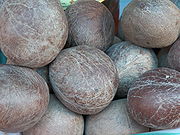
Coconut
The coconut palm, Cocos nucifera, is a member of the family Arecaceae . It is the only accepted species in the genus Cocos. The term coconut can refer to the entire coconut palm, the seed, or the fruit, which is not a botanical nut. The spelling cocoanut is an old-fashioned form of the word...
. Coconut oil
Coconut oil
Coconut oil is an edible oil extracted from the kernel or meat of matured coconuts harvested from the coconut palm . Throughout the tropical world, it has provided the primary source of fat in the diets of millions of people for generations. It has various applications in food, medicine, and industry...
extracted from it has made copra an important agricultural commodity for many coconut-producing countries. It also yields coconut cake which is mainly used as feed
Fodder
Fodder or animal feed is any agricultural foodstuff used specifically to feed domesticated livestock such as cattle, goats, sheep, horses, chickens and pigs. Most animal feed is from plants but some is of animal origin...
for livestock.
Production
Copra has traditionally been grated and ground then boiled in water to extract coconut oilCoconut oil
Coconut oil is an edible oil extracted from the kernel or meat of matured coconuts harvested from the coconut palm . Throughout the tropical world, it has provided the primary source of fat in the diets of millions of people for generations. It has various applications in food, medicine, and industry...
. It was long used by Pacific island cultures and became a valuable commercial product for merchants in the South Seas and South Asia
South Asia
South Asia, also known as Southern Asia, is the southern region of the Asian continent, which comprises the sub-Himalayan countries and, for some authorities , also includes the adjoining countries to the west and the east...
in the 1860s. This 19th-century copra trading inspired Robert Louis Stevenson
Robert Louis Stevenson
Robert Louis Balfour Stevenson was a Scottish novelist, poet, essayist and travel writer. His best-known books include Treasure Island, Kidnapped, and Strange Case of Dr Jekyll and Mr Hyde....
's 1893 novella The Beach of Falesá
The Beach of Falesá
"The Beach of Falesá" is a short story by Scottish author Robert Louis Stevenson. It was first published in the Illustrated London News in 1892, and later published in book form in the short-story collection Island Nights' Entertainments...
, based on his experiences in Samoa
Samoa
Samoa , officially the Independent State of Samoa, formerly known as Western Samoa is a country encompassing the western part of the Samoan Islands in the South Pacific Ocean. It became independent from New Zealand in 1962. The two main islands of Samoa are Upolu and one of the biggest islands in...
. Nowadays, the process of coconut oil extraction is done by crushing copra to produce coconut oil (70%); the by-product is known as copra cake or copra meal (30%).
Once the oil is extracted, the remaining coconut cake is 18-25% protein
Protein
Proteins are biochemical compounds consisting of one or more polypeptides typically folded into a globular or fibrous form, facilitating a biological function. A polypeptide is a single linear polymer chain of amino acids bonded together by peptide bonds between the carboxyl and amino groups of...
but contains so much dietary fiber
Dietary fiber
Dietary fiber, dietary fibre, or sometimes roughage is the indigestible portion of plant foods having two main components:* soluble fiber that is readily fermented in the colon into gases and physiologically active byproducts, and* insoluble fiber that is metabolically inert, absorbing water as it...
it can not be eaten in large quantities by humans. Instead it is normally fed to ruminant
Ruminant
A ruminant is a mammal of the order Artiodactyla that digests plant-based food by initially softening it within the animal's first compartment of the stomach, principally through bacterial actions, then regurgitating the semi-digested mass, now known as cud, and chewing it again...
s.
Kiln
A kiln is a thermally insulated chamber, or oven, in which a controlled temperature regime is produced. Uses include the hardening, burning or drying of materials...
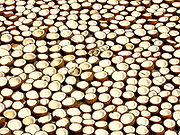
drying. Sun drying requires little more than racks and sufficient sunlight. Halved nuts are drained of water, and left with the meat facing the sky; they can be washed to remove mold
Mold
Molds are fungi that grow in the form of multicellular filaments called hyphae. Molds are not considered to be microbes but microscopic fungi that grow as single cells called yeasts...
-creating contaminants. After two days the meat can be removed from the shell with ease, and the drying process is complete after three to five more days (up to seven total). Sun drying is often combined with kiln drying, eight hours of exposure to sunlight means the time spent in a kiln can be reduced by a day and the hot air the shells are exposed to in the kiln is more easily able to remove the remaining moisture. This process can also be reversed, partially drying the copra in the kiln and finishing the process with sunlight. There are advantages and disadvantages to both - starting with sun drying requires careful inspection to avoid contamination with mold while starting with kiln-drying can harden the meat and prevent it from drying out completely in the sun. In India, small but whole coconuts can be dried over the course of eight months to a year, and the meat inside removed and sold as a whole ball. Meat prepared in this fashion is sweet, soft, oily and is cream-colored instead of being white. Coconut meat can be dried using direct heat and smoke from a fire, using simple racks to suspend the coconut over the fire. The smoke residue can help preserve the half-dried meat but the process overall suffers from unpredictable results and the risk of fires.
While there are some large plantation
Plantation
A plantation is a long artificially established forest, farm or estate, where crops are grown for sale, often in distant markets rather than for local on-site consumption...
s with integrated operations, copra remains primarily a smallholder crop. The major producing country is the Philippines
Philippines
The Philippines , officially known as the Republic of the Philippines , is a country in Southeast Asia in the western Pacific Ocean. To its north across the Luzon Strait lies Taiwan. West across the South China Sea sits Vietnam...
. It is also a major exporter. In former years copra was collected by traders going from island to island and port to port in the Pacific Ocean
Pacific Ocean
The Pacific Ocean is the largest of the Earth's oceanic divisions. It extends from the Arctic in the north to the Southern Ocean in the south, bounded by Asia and Australia in the west, and the Americas in the east.At 165.2 million square kilometres in area, this largest division of the World...
but South Pacific production is now much diminished, with the exception of Papua New Guinea
Copra plantations in New Guinea
Copra Plantations in New Guinea have been cultivated since the late 19th century. Originally established by German colonialists, they were superseded by Australian interests following World War II.-Early colonialists:...
, the Solomon Islands
Solomon Islands
Solomon Islands is a sovereign state in Oceania, east of Papua New Guinea, consisting of nearly one thousand islands. It covers a land mass of . The capital, Honiara, is located on the island of Guadalcanal...
and Vanuatu
Vanuatu
Vanuatu , officially the Republic of Vanuatu , is an island nation located in the South Pacific Ocean. The archipelago, which is of volcanic origin, is some east of northern Australia, northeast of New Caledonia, west of Fiji, and southeast of the Solomon Islands, near New Guinea.Vanuatu was...
.
Copra production begins with the coconut plantations. Coconut trees are generally spaced 9 m (29.5 ft) apart, allowing a density of 100-160 coconut trees per hectare. A standard tree bears around 50-80 nuts a year, and average earnings in Vanuatu (1999) were USD 0.20 per kg (one kg equals 8 nuts), allowing approximately $320 USD to be earned yearly for each planted hectare.
In India, Tiptur
Tiptur
Tiptur is a town in Tumkur district in the Indian state of Karnataka.Tiptur is famous for its copra. There are several educational institutions in Tiptur...
in Tumkur District
Tumkur district
Tumkur district is an administrative district in the state of Karnataka in India. The district headquarters are located at Tumkur. The district occupies an area of 10,598 km² and had a population of 2,584,711, of which 19.62% were urban as of 2001...
in Karnataka
Karnataka
Karnataka , the land of the Kannadigas, is a state in South West India. It was created on 1 November 1956, with the passing of the States Reorganisation Act and this day is annually celebrated as Karnataka Rajyotsava...
state is notable for its copra.
Oil extraction
Coconut oil is extracted from dry copra using oil expellers. To get maximum amount of oil from the copra it has to be dried well. In houses people dry it in sunlight and for large scale production big driers are used. In KeralaKerala
or Keralam is an Indian state located on the Malabar coast of south-west India. It was created on 1 November 1956 by the States Reorganisation Act by combining various Malayalam speaking regions....
, oil extraction is widely done as coconut oil is widely used in cooking and for certain medicines. The left-over material after oil extraction is called oil cake. Oil cake is used as animal feed.
As an animal feed
Copra meal is used as fodderFodder
Fodder or animal feed is any agricultural foodstuff used specifically to feed domesticated livestock such as cattle, goats, sheep, horses, chickens and pigs. Most animal feed is from plants but some is of animal origin...
for horses and cattle. Its high oil levels and protein are fattening for stock. The unique benefits of copra meal for horses and cattle have been researched by Dr T.J. Kempton. The protein in copra meal has been heat treated and provides a source of high quality protein for cattle, sheep and deer, because it does not break down in the rumen
Rumen
The rumen, also known as a paunch, forms the larger part of the reticulorumen, which is the first chamber in the alimentary canal of ruminant animals. It serves as the primary site for microbial fermentation of ingested feed...
.
Coconut oil can be extracted using either mechanical expellers, or solvents (hexane
Hexane
Hexane is a hydrocarbon with the chemical formula C6H14; that is, an alkane with six carbon atoms.The term may refer to any of four other structural isomers with that formula, or to a mixture of them. In the IUPAC nomenclature, however, hexane is the unbranched isomer ; the other four structures...
). Mechanical expelled copra meal is of higher feeding value, because it contains typically 8-12% oil, whereas the solvent extracted copra meal contains only 2-4% oil. Premium quality copra meal can also contain 20-22% crude protein, and <20ppb aflatoxin
Aflatoxin
Aflatoxins are naturally occurring mycotoxins that are produced by many species of Aspergillus, a fungus, the most notable ones being Aspergillus flavus and Aspergillus parasiticus. Aflatoxins are toxic and among the most carcinogenic substances known...
.http://www.stanceglobal.com.au/Staging/Equine/DynamicPage.aspx?EntityId=103501
High quality copra meal contains <12% non structural carbohydrate (NSC)http://www.stanceglobal.com.au/Staging/Equine/DynamicPage.aspx?EntityId=104238 which makes this product well suited for feeding to all horses that are prone to ulcers, insulin resistance, colic, tying up, and acidosis http://www.stanceglobal.com.au/Staging/Equine/DynamicPage.aspx?EntityId=105260
Dangerous goods
Copra has been classed as a dangerous goodDangerous goods
Dangerous goods are solids, liquids, or gases that can harm people, other living organisms, property, or the environment. They are often subject to chemical regulations. "HazMat teams" are personnel specially trained to handle dangerous goods...
due to its spontaneously combustive nature. It is identified as a Division 4.2
HAZMAT Class 4 Flammable Solids
Flammable solids are any materials in the solid phase of matter that can readily undergo combustion in the presence of a source of ignition under standard circumstances, i.e...
substance. It has been forbidden by ICAO from flight without the express written permission of a state
Nation
A nation may refer to a community of people who share a common language, culture, ethnicity, descent, and/or history. In this definition, a nation has no physical borders. However, it can also refer to people who share a common territory and government irrespective of their ethnic make-up...
authorized agency.