
Encyclopedia
Netball is a team sport similar to and derived from
basketball, and was originally known as "women's basketball". While basically unknown in its homeland, it is the pre-eminent women's team sport in
Australia and
New Zealand and is popular in
Jamaica,
South Africa,
Sri Lanka, the
United Kingdom, and various other
Commonwealth countries.
Description and rules
Like basketball, the game is played on a hard court with scoring rings at both ends, and with a ball resembling a basketball . The hoops, whilst of similar height and dimension to basketball hoops, do not have a "backboard". The field is divided into thirds which regulate where individuals in each team are allowed to move, and two semi-circular "shooting circles" at each end from within which all scoring shots must be taken.
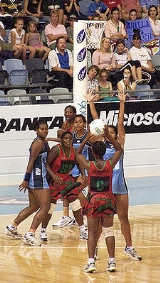
There are seven players on each team, who are given nominated, named positions. In competitive netball, each player must wear "bibs" showing the abbreviations below, indicating their position. They are only allowed in certain areas of the court: a player in a section of court that is not part of their playing area is deemed "offside". The positions are described below:
| Netball positions |
|---|
| Position Name | Abbreviation | Opponent | Areas permitted |
|---|
| Goal Shooter | GS | Goal Keeper | Attacking goal third including goal circle |
| Goal Attack | GA | Goal Defence | Attacking goal third, goal circle, and centre third |
| Wing Attack | WA | Wing Defence | Attacking goal third and centre third, not goal circle |
| Centre | C | Centre | Everywhere except goal circles |
| Wing Defence | WD | Wing Attack | Defensive goal third and centre third, not goal circle |
| Goal Defence | GD | Goal Attack | Defensive goal third and centre third, including goal circle |
| Goal Keeper | GK | Goal Shooter | Defensive goal third, including goal circle |
By the combination of the above, only the Goal Attack and Goal Shooter are able to score goals directly. A ball that passes through the hoop, but has been thrown either from outside the circle or by a player not the GA or GS, is deemed a "no goal". Furthermore, a shooter may not shoot for a goal if a "free pass" has been awarded for an infringement such as stepping, offside, or using the post.
Netball rules do not permit players to take more than one step in possession of the ball. Consequently, the only way to move the ball towards the goal is to throw the ball to a team-mate. The ball cannot be held by a player for more than three seconds at any time, and players may not tap the ball to themselves . This, combined with the restrictions on where one player can move, ensures that everyone on the team is regularly involved in play. Defence is restricted — not only is contact not permitted, but players must be at least three feet away from a player with the ball, meaning that hard physical contact is rare. If contact is made, a penalty is given to the team of the player who was contacted, and the player who contacted must stand "out of play", meaning they cannot participate in play until the player taking the penalty has passed the ball.
A game is played in four quarters, each one lasting 15 minutes, with intervals of three minutes between the first and second quarters, and between the third and fourth quarters. There is also an interval of five minutes at half time. If a player has an injury, a team-mate or umpire calls time, and the time keeper pauses the timer. When the game starts and the player has swapped places with another player, or is healthy, play is resumed and the timer is restarted.
Starting and restarting play
When a quarter begins, or after a goal is scored, play begins from the centre of the court with a "centre pass". These passes alternate between the teams, regardless of which team scored the last goal. A centre pass is taken by the Centre player, and must be to someone who is within the centre third of the court when they receive the pass.
If the ball leaves the court boundaries, then a member of the team that did not touch the ball last restarts play by making a pass from the court boundary back into play.
Growth in popularity
Netball is a popular participant sport, particularly in Australia and New Zealand, but also around the world in countries of the
British Commonwealth. In Australia and New Zealand, it is the most popular sport played by women, and New Zealand also has a professional domestic competition for women. On the other hand, in Australia, only two of the current team are full-time netballers. The women's game is played internationally at a high level, with Australia and New Zealand undoubtedly the world's strongest teams. Whilst not attracting much public attention, there are representative men's netball teams. On occasions, trial matches between national men's and women's teams have been arranged, with the men usually coming off victorious because of their height advantage.
Netball's fundamentals are easy for new players to learn, and it is a common sport at schools in the Commonwealth. At primary school level, mixed teams are not uncommon. As adults, men and women can compete with each other on reasonably fair terms as the restrictions on defence, limitations of numbers and positions of male players, and the women's greater familiarity with the game, prevent men's superior strength and size gaining an overly large advantage.
Netball variants for children
Fun Net
With an emphasis on participation, developing skills and enjoyment, Fun Net allows for a gradual introduction to the game. There is no organised competition structure and there are no winners or losers, but rewards are given for participation and improvement. The equipment is modified so that children can obtain maximum enjoyment from playing Fun Net. Goal posts are only 2.4 metres high and a size 4 netball or spongy ball is used. Designed especially for 5 to 7 year olds, Fun Net develops general motor skills, balance, co-ordination, footwork and ball-handling skills while concentrating on netball for fun.
Netta
A size 4 ball is used to develop correct passing and catching skills with up to six seconds allowed between catching and passing the ball, instead of the three seconds permitted in the adult game. All players rotate positions throughout the game so that they can experience the differences between each position. Netta is more in line with the adult game than Fun Net and is the natural stage between Fun Net and adult netball, which is played by children 10 years of age and older.
Netball teams
- International
- Australian national netball team
- England National Netball Team
- The Proteas
- Silver Ferns
- The Sunshine Girls
Netball competitions
- New Zealand
- Australia
- England
Recent world championships
New Zealand finally broke an Australian stranglehold on major titles, after a run of near-misses, with a 49-47 win in the 2003 World Championship final in Jamaica. A 3-0 series win over Australia in New Zealand in the winter of 2004 continued the ascendancy, but Australia won the return series at home in November 2004, 2-7. On October 29, 2005, in a one-off Test in Auckland, the Silver Ferns scored their most decisive victory ever against the Australian team, winning 61-36. This result made them clear favourites for the
2006 Commonwealth Games gold medal, which they subsequently won, reinforcing their World Champion status.
Netball personalities
- Ruth Aitken
- Joyce Brown
- Vilimaina Davu
- Sandra Edge
- Liz Ellis
- Rita Fatialofa
- Deborah Field
- Temepara Clark
- Sindisiwe Gumede
- Kathryn Harby-Williams
- Cynna Kydd
...
- Jill McIntosh
- Sharelle McMahon
- Bernice Mene
- Lois Muir
- Shelley O'Donnell
- Lesley Rumball - New Zealand's most capped netball player
- Anne Sargeant
- Julie Seymour
- Waimarama Taumaunu
- Carissa Tombs
- Irene van Dyk
- Adine Wilson
- Vicki Wilson
See also
- Korfball A similar but distinct game played primarily in the Netherlands and Belgium.
External links
- International:
- Australia:
- Bermuda:
- Canada:
- Nevis:
- New Zealand:
- Pakistan:
- Singapore:
- UAE:
- UK:
- USA:
- General: