
The
1995 Rugby World Cup was the third
Rugby World CupThe Rugby World Cup is the premier international rugby union competition. The event is organised by the sport's governing body, the International Rugby Board , and is contested by the men's national teams. The inaugural tournament was held in 1987, hosted by both Australia and New Zealand, and is...
. It was hosted by
South AfricaThe Republic of South Africa is a country located at the southern tip of Africa, with a coastline on the Atlantic and Indian Oceans. To the north lie Namibia, Botswana and Zimbabwe, to the east are Mozambique and Swaziland, while Lesotho is an independent country surrounded by South Africa.Modern...
, and had the distinction of being the first Rugby World Cup in which every match was held in one country. It was also the last major event of the sport's amateur era; two months after the World Cup final, the
International Rugby Football BoardThe International Rugby Board is the world governing and law-making body for the sport of rugby union, and previously for rugby football. It was founded in 1886 as the International Rugby Football Board by the unions of Scotland, Wales and Ireland. England originally refused to take part, but...
(now the International Rugby Board) opened the sport to professionalism.
After
South AfricaThe South African national rugby union team are the current holders of the Rugby World Cup and the Tri-Nations Championship. They are ranked number one in the IRB World Rankings as of Monday, 14 September 2009. They were named 2008 Team of the Year at the prestigious Laureus World Sports Awards...
defeated New Zealand in the final,
Nelson MandelaNelson Rolihlahla Mandela is a former President of South Africa, the first to be elected in a fully representative democratic election, who held office from 1994–99. Before his presidency, Mandela was an anti-apartheid activist, and the leader of the African National Congress's armed wing Umkhonto...
, wearing a Springbok rugby shirt and cap, presented the William Webb Ellis Cup to
South AfricanThe South African national rugby union team are the current holders of the Rugby World Cup and the Tri-Nations Championship. They are ranked number one in the IRB World Rankings as of Monday, 14 September 2009. They were named 2008 Team of the Year at the prestigious Laureus World Sports Awards...
captain
Francois PienaarJacobus Francois Pienaar captained and played for the South African Springboks national rugby union team from 26 June 1993 until 10 August 1996. He won 29 test caps and led the Springboks to victory in the 1995 Rugby Union World Cup...
to the delight of the capacity crowd at
Ellis ParkCoca-Cola Park, formerly and better known as Ellis Park Stadium, is a rugby union and association football stadium in the city of Johannesburg, Gauteng Province, South Africa. It hosted the Rugby World Cup final in 1995, which was won by the country's national team, the Springboks...
in
JohannesburgJohannesburg also known as Jozi or Jo'burg, is the largest city in South Africa. Johannesburg is the provincial capital of Gauteng, the wealthiest province in South Africa, having the largest economy of any metropolitan region in Sub-Saharan Africa...
on 24 June.
The eight quarter-finalists from the
1991 Rugby World CupThe 1991 Rugby World Cup was the second edition of the Rugby World Cup, and jointly hosted by England, Ireland, Scotland, Wales and France; at that time, the five European countries that participated in the Five Nations Championship. As the final was played at the Twickenham Stadium in London, it...
all received automatic entry, as did South Africa, as hosts.
The
1995 Rugby World Cup was the third
Rugby World CupThe Rugby World Cup is the premier international rugby union competition. The event is organised by the sport's governing body, the International Rugby Board , and is contested by the men's national teams. The inaugural tournament was held in 1987, hosted by both Australia and New Zealand, and is...
. It was hosted by
South AfricaThe Republic of South Africa is a country located at the southern tip of Africa, with a coastline on the Atlantic and Indian Oceans. To the north lie Namibia, Botswana and Zimbabwe, to the east are Mozambique and Swaziland, while Lesotho is an independent country surrounded by South Africa.Modern...
, and had the distinction of being the first Rugby World Cup in which every match was held in one country. It was also the last major event of the sport's amateur era; two months after the World Cup final, the
International Rugby Football BoardThe International Rugby Board is the world governing and law-making body for the sport of rugby union, and previously for rugby football. It was founded in 1886 as the International Rugby Football Board by the unions of Scotland, Wales and Ireland. England originally refused to take part, but...
(now the International Rugby Board) opened the sport to professionalism.
After
South AfricaThe South African national rugby union team are the current holders of the Rugby World Cup and the Tri-Nations Championship. They are ranked number one in the IRB World Rankings as of Monday, 14 September 2009. They were named 2008 Team of the Year at the prestigious Laureus World Sports Awards...
defeated New Zealand in the final,
Nelson MandelaNelson Rolihlahla Mandela is a former President of South Africa, the first to be elected in a fully representative democratic election, who held office from 1994–99. Before his presidency, Mandela was an anti-apartheid activist, and the leader of the African National Congress's armed wing Umkhonto...
, wearing a Springbok rugby shirt and cap, presented the William Webb Ellis Cup to
South AfricanThe South African national rugby union team are the current holders of the Rugby World Cup and the Tri-Nations Championship. They are ranked number one in the IRB World Rankings as of Monday, 14 September 2009. They were named 2008 Team of the Year at the prestigious Laureus World Sports Awards...
captain
Francois PienaarJacobus Francois Pienaar captained and played for the South African Springboks national rugby union team from 26 June 1993 until 10 August 1996. He won 29 test caps and led the Springboks to victory in the 1995 Rugby Union World Cup...
to the delight of the capacity crowd at
Ellis ParkCoca-Cola Park, formerly and better known as Ellis Park Stadium, is a rugby union and association football stadium in the city of Johannesburg, Gauteng Province, South Africa. It hosted the Rugby World Cup final in 1995, which was won by the country's national team, the Springboks...
in
JohannesburgJohannesburg also known as Jozi or Jo'burg, is the largest city in South Africa. Johannesburg is the provincial capital of Gauteng, the wealthiest province in South Africa, having the largest economy of any metropolitan region in Sub-Saharan Africa...
on 24 June.
Qualifying
The eight quarter-finalists from the
1991 Rugby World CupThe 1991 Rugby World Cup was the second edition of the Rugby World Cup, and jointly hosted by England, Ireland, Scotland, Wales and France; at that time, the five European countries that participated in the Five Nations Championship. As the final was played at the Twickenham Stadium in London, it...
all received automatic entry, as did South Africa, as hosts. The remaining seven of the 16 positions available in the tournament were filled by regional qualifiers. The qualifying tournaments were broken up into regional associations - Africa, the Americas, Asia, Europe and Oceania.
Côte d'IvoireThe Côte d'Ivoire rugby union team is one of the minor international teams in rugby union. They are also known as Les Éléphants...
qualified through Africa,
JapanFor the Japanese Rugby League team see Japan national rugby league team.Japan are traditionally the strongest rugby union power in Asia but has both enjoyed and endured mixed results against non-Asian teams over the years...
through Asia,
ArgentinaThe Argentina national rugby team, nicknamed Los Pumas, represents Argentina in international rugby union matches. The team, which plays in sky blue and white jerseys, is organised by the Argentine Rugby Union .Argentina played its first international rugby match in 1910 against a touring British...
through the Americas,
ItalyThe Italy national rugby union team represent the nation of Italy in the sport of rugby union. The team is also known as the Azzurri...
,
RomaniaThe Romania national rugby union team, nicknamed The Oaks , have long been one of the stronger European teams outside of the Six Nations tournament. They take part in international competitions, notably the World Cup, the European Nations Cup and the Super Cup. Rugby union in Romania is...
and
WalesThe Wales national rugby union team represent Wales in international rugby union tournaments. They compete annually in the Six Nations Championship with England, France, Ireland, Italy and Scotland. Wales have won the Six Nations and its predecessors 24 times outright, second only to England with...
through Europe,
TongaThe Tonga national rugby union team is nicknamed Ikale Tahi . Like their Polynesian neighbours, the Tongans start their matches with a war dance - the Kailao...
through Oceania.
Teams
| Africa |
Americas |
Asia |
Europe |
Oceania |
| (Africa) (Host/Champions) |
(Americas) (1991 Quarter-finalist) |
(Asia) |
(1991 Runner-up) (1991 Quarter-finalist) (1991 Quarter-finalist) (Europe 2) (Europe 3) (1991 Semi-finalist) (Europe 1) |
(1991 Champion) (1991 Third place) (Oceania) (1991 Quarter-finalist) |
Venues
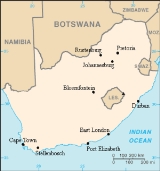
The 1995 tournament was the first Rugby World Cup to be hosted by just the one country, and thus, all the venues are within the one country. In total, nine stadiums were used for the World Cup, most being owned by the domestic rugby unions, and the majority of the venues were upgraded prior to the tournament. Six of the nine stadiums were South African Test grounds. The four largest stadiums were used for the finals, with the final taking place at Johannesburg's
Ellis ParkCoca-Cola Park, formerly and better known as Ellis Park Stadium, is a rugby union and association football stadium in the city of Johannesburg, Gauteng Province, South Africa. It hosted the Rugby World Cup final in 1995, which was won by the country's national team, the Springboks...
.
There were games originally scheduled to have been played in Brakpan, Germiston,
PietermaritzburgPietermaritzburg is the capital and second largest city of the province of KwaZulu-Natal in South Africa. It was founded in 1838. Its "purist" Zulu name is umGungundlovu, as seen in the name of its municipality, although it is popularly called Maritzburg in English and Zulu alike, and abbreviated PMB...
and
WitbankWitbank is situated on the highveld of Mpumalanga, South Africa, within the Emalahleni Local Municipality, Mpumalanga. The name Witbank is Afrikaans for White Ridge and is named after a white sandstone outcrop where wagon transport drivers rested....
, but these games were reallocated to other venues. This reduced the number of venues from 14 to 9. The reasons cited for this change had to do with facilities for both the press and spectators, as well as the security. The change in the itinerary occurred in January 1994. Further changes occurred in April, so that evening games were played at stadiums with good floodlighting. It is also thought that Potchefstroom was an original venue.
For the Pools, venues were paired:
- Pool 1: Cape Town, Port Elizabeth and Stellenbosch
- Pool 2: Durban and East London
- Pool 3: Johannesburg and Bloemfontein
- Pool 4: Pretoria and Rustenburg

| City |
Stadium |
Capacity (approx.) |
| Johannesburg Johannesburg also known as Jozi or Jo'burg, is the largest city in South Africa. Johannesburg is the provincial capital of Gauteng, the wealthiest province in South Africa, having the largest economy of any metropolitan region in Sub-Saharan Africa... |
Ellis ParkCoca-Cola Park, formerly and better known as Ellis Park Stadium, is a rugby union and association football stadium in the city of Johannesburg, Gauteng Province, South Africa. It hosted the Rugby World Cup final in 1995, which was won by the country's national team, the Springboks... |
62,000 |
PretoriaPretoria is a city located in the northern part of Gauteng Province, South Africa. It is one of the country's three capital cities, serving as the executive and de facto national capital; the others are Cape Town, the legislative capital, and Bloemfontein, the judicial capital.Pretoria is... |
Loftus VersfeldLoftus Versfeld Stadium is a sports stadium situated in Pretoria, South Africa. The stadium has a capacity of 51,762 and is an all seater venue.-History:The stadium was named after Robert Owen Loftus Versfeld, the founder of organized sports in Pretoria... |
50,000 |
Cape TownCape Town is the second most populous city in South Africa, and the largest in land area, forming part of the City of Cape Town metropolitan municipality. It is the provincial capital of the Western Cape, as well as the legislative capital of South Africa, where the National Parliament and many... |
NewlandsNewlands Stadium is located in Cape Town, South Africa.The stadium currently has a capacity of 51,900 people and is an all seater venue.Various sports clubs currently use the stadium as their home base, including:* Stormers in Super Rugby... |
50,000 |
| Durban Durban is the third most populous city in South Africa, forming part of the eThekwini metropolitan municipality. It is the largest city in KwaZulu-Natal and is famous as the busiest port in Africa. It is also a major centre of tourism due to the city's warm subtropical climate and... |
Kings Park Stadium The Kings Park Stadium, also known for sponsorship reasons as the ABSA Stadium, is a stadium in the Kings Park Sporting Precinct in Durban, South Africa, which was originally built in 1891 and extensively renovated in the 1990s... |
50,000 |
| Port Elizabeth |
Boet Erasmus Stadium |
38,950 |
| Bloemfontein Bloemfontein is the capital city of the Free State Province of South Africa as well as one of the nation's three capitals, the judicial capital. The city's Sesotho name is Mangaung, meaning "place of cheetahs" and became part of the Mangaung Local Municipality in 2000... |
Free State StadiumThe Free State Stadium, also known as Vodacom Park, is a stadium in Bloemfontein, South Africa, used for rugby union, as well as football .The primary rugby union tenants of the facility are:... |
40,000 |
| Rustenburg |
Olympia Park Olympia Park is a multi-use stadium in Rustenburg, South Africa. It is currently used mostly for rugby matches and hosted three games during the 1995 Rugby World Cup. The stadium holds 30,000 people and was built in 1989.... |
30,000 |
| East London |
Basil Kenyon Stadium Basil Kenyon Stadium is a multi-use stadium in East London, South Africa. It is currently used mostly for rugby matches and hosted three games during the 1995 Rugby World Cup. The stadium holds 22,000 people and was built in 1934.... |
22,000 |
| Stellenbosch |
Danie Craven Stadium Danie Craven Stadium is a multi-purpose stadium at Coetzenburg in Stellenbosch, South Africa. It is part of the Stellenbosch University's sport facilities. The stadium was named after rugby doyen and Springbok scrum half Danie Craven. The stadium holds 16,000 people and was built in 1979.The Danie... |
16,000 |
Format
The tournament was contested by 16 different nations, and in total 32 matches were played. The competition began on May 25, when the hosts South Africa defeated Australia 27-18 at Newlands in Cape Town. The tourney culminated with the final between South Africa and the All Blacks at Ellis Park in Johannesburg on June 24. In total, the tournament ran for around one month. The nations were broken up into four pools of four, with each pool consisting of two teams that were automatically qualified and two that went through the qualifying tournaments. Pool winners were drawn against opposite pool runners-up in the semi-finals. For example, the winner of A faces the runner up of B, and the winner of B face the runner-up of A. The whole finals stage adopts a knock-out format, and the winners of the quarter-finals advance to the semi-finals, where winner 1 faces winner 2, and winner 3 faces winner 4. The winners advance to the final, and the losers contest a third/fourth place play-off the day before the final.
Final
The final was contested by the hosts, South Africa, and the All Blacks of New Zealand. Both nations finished at the top of their respective pools, both 3-0 undefeated in the pool stages. South Africa defeated Western Samoa in the quarter finals, and then France in the semi-finals to reach the final; the All Blacks defeated Scotland in the quarter-finals, and England in the semi-finals, a game in which
Jonah LomuJonah Tali Lomu, MNZM is a New Zealand rugby union footballer. He had sixty-three caps as an All Black after debuting in 1994. He is generally regarded as the first true global superstar of rugby union. One of the sport's most intimidating players on the field, he has had a huge impact on the game...
famously scored four tries. The final was played at
Ellis ParkCoca-Cola Park, formerly and better known as Ellis Park Stadium, is a rugby union and association football stadium in the city of Johannesburg, Gauteng Province, South Africa. It hosted the Rugby World Cup final in 1995, which was won by the country's national team, the Springboks...
in Johannesburg and refereed by Ed Morrison of England.
South Africa led 9-6 at half time, but the All Blacks levelled the scores at 9-all with a penalty goal in the second half. Though
Andrew MehrtensAndrew Philip Mehrtens MNZM is a New Zealand rugby union footballer, currently playing in France for Racing Métro in the Paris region, who has been one of the top s in the world since the advent of the sport's professional era in the mid-1990s...
almost kicked a late drop goal, the score remained unchanged at full time, forcing the game into extra time. Both teams scored penalty goals in the first half of extra time, but it was
Joel StranskyJoel Theodore Stransky is a former South African rugby union footballer, most notable for scoring the winning drop goal in the 1995 Rugby World Cup final. He played as a ....
who landed a drop goal to win the final for South Africa.
What happened after the match would go onto become an iconic moment in the history of the sport.
Nelson MandelaNelson Rolihlahla Mandela is a former President of South Africa, the first to be elected in a fully representative democratic election, who held office from 1994–99. Before his presidency, Mandela was an anti-apartheid activist, and the leader of the African National Congress's armed wing Umkhonto...
, wearing a Springbok rugby shirt and baseball cap, presented the William Webb Ellis Cup to
South AfricanThe South African national rugby union team are the current holders of the Rugby World Cup and the Tri-Nations Championship. They are ranked number one in the IRB World Rankings as of Monday, 14 September 2009. They were named 2008 Team of the Year at the prestigious Laureus World Sports Awards...
captain
Francois PienaarJacobus Francois Pienaar captained and played for the South African Springboks national rugby union team from 26 June 1993 until 10 August 1996. He won 29 test caps and led the Springboks to victory in the 1995 Rugby Union World Cup...
to the delight of the capacity crowd. The moment is thought by some to be one of the most famous finals of any sport. Mandela's presentation was listed as one of the
100 Greatest Sporting MomentsThe 100 Greatest British Sporting Moments is a British television programme in the 100 Greatest/100 Worst strand on Channel 4. It was broadcast in the United Kingdom and the Republic of Ireland in early 2002 and reviewed the top 100 sporting moments as voted for by viewers in the United Kingdom and...
on a British television programme.
After the defeat, it was revealed that many of the New Zealand players had been suffering from food poisoning 48 hours prior to the game, which affected their performance in the final. New Zealand coach
Laurie MainsLaurence William Mains MNZM is a former rugby union footballer and coach who represented New Zealand. Mains' representative career started when he first played for Otago in 1967. He made his All Blacks début in 1971, against the British and Irish Lions. His last Test was against Ireland in 1976...
alleged a mysterious waitress known as "Suzie" had deliberately poisoned the All Blacks' water in the week before the final. No evidence has ever been found to support the claims of deliberate foul play.
Pool A
| Team |
Won |
Drawn |
Lost |
For |
Against |
Points |
|
3 |
0 |
0 |
68 |
26 |
9 |
|
2 |
0 |
1 |
87 |
41 |
7 |
|
1 |
0 |
2 |
45 |
50 |
5 |
|
0 |
0 |
3 |
14 |
97 |
3 |
----
----
----
----
----
Pool B
| Team |
Won |
Drawn |
Lost |
For |
Against |
Points |
|
3 |
0 |
0 |
95 |
60 |
9 |
|
2 |
0 |
1 |
96 |
88 |
7 |
|
1 |
0 |
2 |
69 |
94 |
5 |
|
0 |
0 |
3 |
69 |
87 |
3 |
----
----
----
----
----
Pool C
| Team |
Won |
Drawn |
Lost |
For |
Against |
Points |
|
3 |
0 |
0 |
222 |
45 |
9 |
|
2 |
0 |
1 |
93 |
94 |
7 |
|
1 |
0 |
2 |
89 |
68 |
5 |
|
0 |
0 |
3 |
55 |
252 |
3 |
----
----
----
----
----
Pool D
| Team |
Won |
Drawn |
Lost |
For |
Against |
Points |
|
3 |
0 |
0 |
114 |
47 |
9 |
|
2 |
0 |
1 |
149 |
27 |
7 |
|
1 |
0 |
2 |
44 |
90 |
5 |
|
0 |
0 |
3 |
29 |
172 |
3 |
----
----
----
----
----
Knock-out stage
Quarter-finals
----
----
----
Semi-finals
----
Third-place play-off
Final
Commemorative coins
The South African Mint issued a one ounce gold proof "Protea" coin with a total mintage of 406 pieces to commemorate the event being hosted by South Africa.
External links