

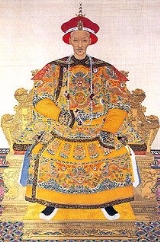
Daoguang Emperor

Encyclopedia
The Daoguang Emperor was the eighth emperor
of the Manchu
rian Qing dynasty
and the sixth Qing emperor to rule over China
, from 1820 to 1850.
, Beijing
, and was given the name Mianning (綿寧), changed into Minning (旻寧; Manchu
: Min ning) when he became emperor: the first character of his private name was changed from Mian (綿) to Min (旻) so as to avoid the relatively common Mian character. This novelty was introduced by his grandfather the Qianlong Emperor
who thought it not proper to use a common character in the emperor's private name due to the long-standing practice of naming taboo
.
He was the second son of Yongyan (永琰), who became the Jiaqing Emperor
in 1796. His mother, the principal wife of Yongyan, was Lady Hitara of the (Manchu) Hitara clan, who became empress when Jiaqing ascended the throne in 1796. She is known posthumously as Empress Xiaoshurui (孝淑睿皇后).
Mianning was well liked by his grandfather the Qianlong Emperor
and frequently accompanied the elderly emperor on hunting trips. On one such trip at the age of nine he successfully hunted a deer which greatly amused Qianlong. In 1813, while a prince, Mianning also played a vital role in repelling and killing White Lotus
invaders who stormed the Forbidden City. This action earned Mianning important merits in securing his claim for the throne.
, which was imported into China by British merchants. Opium had started to trickle into China during the reign of his great grandfather Emperor Yongzheng but was limited to approximately 200 chests annually. By the time of Emperor Qianlong's reign, this amount had increased to 1000 chests, 4000 chests by Jiaqing's era and more than 30,000 chests during Daoguang's reign. He issued many edict
s against opium
in the 1820s and 1830s, which were carried out by Commissioner Lin Zexu
. Lin Zexu's effort to halt the spread of opium in China led directly to the First Opium War. With the development of the Opium War, Lin was made a scapegoat and the Daoguang emperor removed Lin's authority and banished him to Yili
. Meanwhile in the Himalayas
, the Sikh Empire attempted an occupation of Tibet
but where defeated in the Sino-Sikh war
(1841-1842). But on the coasts, technologically and militarily inferior to the European powers, China lost the war and surrendered Hong Kong
by way of the Treaty of Nanking
in August 1842.
had been added to the statute called "Prohibitions Concerning Sorcerers and Sorceresses" (禁止師巫邪術) in the Great Qing Code. Protestants hoped that the Chinese government would discriminate between Protestantism
and Catholicism, since the law mentioned the latter by name, but after Protestant missionaries
gave Christian books to Chinese in 1835 and 1836, the Daoguang Emperor demanded to know who were the "traitorous natives" in Canton
who had supplied them with books. The foreign missionaries were strangled or expelled by the Chinese.
(圓明園), 8 km/5 miles northwest of the walls of Beijing
. He was succeeded by his eldest surviving son. Daoguang failed to understand the intention or determination of the Europeans, or the basic economics of a war on drugs. Although the Europeans were outnumbered, outgunned and were thousands of miles away from home, they could bring far superior fire power to bear at any point of contact along Chinese coast. The Manchu court was highly dependent on the continued flow of tax/levy payment from southern China via the Grand Canal, which was easily cut off by the British expeditionary force at ZhenJiang. He had a poor understanding of the British and the industrial revolution that Britain had undergone, preferring to turn a blind eye to the rest of the world. It was said that Daoguang did not even know where Britain was located in the world. His thirty-year reign introduced the initial onslaught by western imperialism and foreign invasions that would plague China, in one form or another, for the next one hundred years.
He was interred in the Muling (慕陵 - meaning "Tomb of longing", or "Tomb of admiration") mausoleum, which is part of the Western Qing Tombs
(清西陵), 120 kilometers/75 miles southwest of Beijing
.
Emperor of China
The Emperor of China refers to any sovereign of Imperial China reigning between the founding of Qin Dynasty of China, united by the King of Qin in 221 BCE, and the fall of Yuan Shikai's Empire of China in 1916. When referred to as the Son of Heaven , a title that predates the Qin unification, the...
of the Manchu
Manchu
The Manchu people or Man are an ethnic minority of China who originated in Manchuria . During their rise in the 17th century, with the help of the Ming dynasty rebels , they came to power in China and founded the Qing Dynasty, which ruled China until the Xinhai Revolution of 1911, which...
rian Qing dynasty
Qing Dynasty
The Qing Dynasty was the last dynasty of China, ruling from 1644 to 1912 with a brief, abortive restoration in 1917. It was preceded by the Ming Dynasty and followed by the Republic of China....
and the sixth Qing emperor to rule over China
China
Chinese civilization may refer to:* China for more general discussion of the country.* Chinese culture* Greater China, the transnational community of ethnic Chinese.* History of China* Sinosphere, the area historically affected by Chinese culture...
, from 1820 to 1850.
Early years
He was born in the Forbidden CityForbidden City
The Forbidden City was the Chinese imperial palace from the Ming Dynasty to the end of the Qing Dynasty. It is located in the middle of Beijing, China, and now houses the Palace Museum...
, Beijing
Beijing
Beijing , also known as Peking , is the capital of the People's Republic of China and one of the most populous cities in the world, with a population of 19,612,368 as of 2010. The city is the country's political, cultural, and educational center, and home to the headquarters for most of China's...
, and was given the name Mianning (綿寧), changed into Minning (旻寧; Manchu
Manchu language
Manchu is a Tungusic endangered language spoken in Northeast China; it used to be the language of the Manchu, though now most Manchus speak Mandarin Chinese and there are fewer than 70 native speakers of Manchu out of a total of nearly 10 million ethnic Manchus...
: Min ning) when he became emperor: the first character of his private name was changed from Mian (綿) to Min (旻) so as to avoid the relatively common Mian character. This novelty was introduced by his grandfather the Qianlong Emperor
Qianlong Emperor
The Qianlong Emperor was the sixth emperor of the Manchu-led Qing Dynasty, and the fourth Qing emperor to rule over China proper. The fourth son of the Yongzheng Emperor, he reigned officially from 11 October 1735 to 8 February 1796...
who thought it not proper to use a common character in the emperor's private name due to the long-standing practice of naming taboo
Naming taboo
Naming taboo is a cultural taboo against speaking or writing the given names of exalted persons in China and neighboring nations in the ancient Chinese cultural sphere.-Kinds of naming taboo:...
.
He was the second son of Yongyan (永琰), who became the Jiaqing Emperor
Jiaqing Emperor
The Jiaqing Emperor was the seventh emperor of the Manchu-led Qing dynasty, and the fifth Qing emperor to rule over China, from 1796 to 1820....
in 1796. His mother, the principal wife of Yongyan, was Lady Hitara of the (Manchu) Hitara clan, who became empress when Jiaqing ascended the throne in 1796. She is known posthumously as Empress Xiaoshurui (孝淑睿皇后).
Mianning was well liked by his grandfather the Qianlong Emperor
Qianlong Emperor
The Qianlong Emperor was the sixth emperor of the Manchu-led Qing Dynasty, and the fourth Qing emperor to rule over China proper. The fourth son of the Yongzheng Emperor, he reigned officially from 11 October 1735 to 8 February 1796...
and frequently accompanied the elderly emperor on hunting trips. On one such trip at the age of nine he successfully hunted a deer which greatly amused Qianlong. In 1813, while a prince, Mianning also played a vital role in repelling and killing White Lotus
White Lotus
White Lotus was a type of Buddhist sectarianism that appealed to many Han Chinese, who found solace in worship of the "Unborn or Eternal Venerable Mother" , who was to gather all her children at the millennium into one family....
invaders who stormed the Forbidden City. This action earned Mianning important merits in securing his claim for the throne.
Reign as emperor and the opium trade
In September 1820, at the age of 38, Mianning inherited the throne after his father the Jiaqing Emperor suddenly died of unknown causes. Now known as the Daoguang Emperor, he inherited a declining empire with Western imperialists encroaching upon the borders of China. During his reign, China experienced major problems with opiumOpium
Opium is the dried latex obtained from the opium poppy . Opium contains up to 12% morphine, an alkaloid, which is frequently processed chemically to produce heroin for the illegal drug trade. The latex also includes codeine and non-narcotic alkaloids such as papaverine, thebaine and noscapine...
, which was imported into China by British merchants. Opium had started to trickle into China during the reign of his great grandfather Emperor Yongzheng but was limited to approximately 200 chests annually. By the time of Emperor Qianlong's reign, this amount had increased to 1000 chests, 4000 chests by Jiaqing's era and more than 30,000 chests during Daoguang's reign. He issued many edict
Edict
An edict is an announcement of a law, often associated with monarchism. The Pope and various micronational leaders are currently the only persons who still issue edicts.-Notable edicts:...
s against opium
Opium
Opium is the dried latex obtained from the opium poppy . Opium contains up to 12% morphine, an alkaloid, which is frequently processed chemically to produce heroin for the illegal drug trade. The latex also includes codeine and non-narcotic alkaloids such as papaverine, thebaine and noscapine...
in the 1820s and 1830s, which were carried out by Commissioner Lin Zexu
Lin Zexu
Lín Zéxú ; 30 August 1785 – 22 November 1850) was a Chinese scholar and official during the Qing Dynasty.He is most recognized for his conduct and his constant position on the "high moral ground" in his fight, as a "shepherd" of his people, against the opium trade in Guangzhou...
. Lin Zexu's effort to halt the spread of opium in China led directly to the First Opium War. With the development of the Opium War, Lin was made a scapegoat and the Daoguang emperor removed Lin's authority and banished him to Yili
Ili Kazakh Autonomous Prefecture
Ili Kazakh Autonomous Prefecture , in northernmost Xinjiang, is the only Kazakh autonomous prefecture of the People's Republic of China.-Geography and coordinates:The following figures excludes both Tacheng Prefecture and Altay Prefecture....
. Meanwhile in the Himalayas
Himalayas
The Himalaya Range or Himalaya Mountains Sanskrit: Devanagari: हिमालय, literally "abode of snow"), usually called the Himalayas or Himalaya for short, is a mountain range in Asia, separating the Indian subcontinent from the Tibetan Plateau...
, the Sikh Empire attempted an occupation of Tibet
Tibet
Tibet is a plateau region in Asia, north-east of the Himalayas. It is the traditional homeland of the Tibetan people as well as some other ethnic groups such as Monpas, Qiang, and Lhobas, and is now also inhabited by considerable numbers of Han and Hui people...
but where defeated in the Sino-Sikh war
Sino-Sikh War
The Sino-Sikh War or Sino-Dogra War was fought from May of 1841 to August of 1842 between the Qing Empire and the forces of the Sikh governor of Jammu, Gulab Singh, after he invaded western Tibet. The Dogra army was routed and the Qing counterattacked but were defeated in Ladakh...
(1841-1842). But on the coasts, technologically and militarily inferior to the European powers, China lost the war and surrendered Hong Kong
Hong Kong
Hong Kong is one of two Special Administrative Regions of the People's Republic of China , the other being Macau. A city-state situated on China's south coast and enclosed by the Pearl River Delta and South China Sea, it is renowned for its expansive skyline and deep natural harbour...
by way of the Treaty of Nanking
Treaty of Nanking
The Treaty of Nanking was signed on 29 August 1842 to mark the end of the First Opium War between the United Kingdom of Great Britain and Ireland and the Qing Dynasty of China...
in August 1842.
Court intrigues and incidents
In 1831 Daoguang killed his own 23 year old son after striking him. In 1831 an attempt was made to usurp the throne and oust Daoguang by someone else. In 1850 this happened again, though it did not succeed.Anti-Christianity
In 1811 a clause sentencing Europeans to death for spreading CatholicismCatholicism
Catholicism is a broad term for the body of the Catholic faith, its theologies and doctrines, its liturgical, ethical, spiritual, and behavioral characteristics, as well as a religious people as a whole....
had been added to the statute called "Prohibitions Concerning Sorcerers and Sorceresses" (禁止師巫邪術) in the Great Qing Code. Protestants hoped that the Chinese government would discriminate between Protestantism
Protestantism
Protestantism is one of the three major groupings within Christianity. It is a movement that began in Germany in the early 16th century as a reaction against medieval Roman Catholic doctrines and practices, especially in regards to salvation, justification, and ecclesiology.The doctrines of the...
and Catholicism, since the law mentioned the latter by name, but after Protestant missionaries
Missionary
A missionary is a member of a religious group sent into an area to do evangelism or ministries of service, such as education, literacy, social justice, health care and economic development. The word "mission" originates from 1598 when the Jesuits sent members abroad, derived from the Latin...
gave Christian books to Chinese in 1835 and 1836, the Daoguang Emperor demanded to know who were the "traitorous natives" in Canton
Guangzhou
Guangzhou , known historically as Canton or Kwangchow, is the capital and largest city of the Guangdong province in the People's Republic of China. Located in southern China on the Pearl River, about north-northwest of Hong Kong, Guangzhou is a key national transportation hub and trading port...
who had supplied them with books. The foreign missionaries were strangled or expelled by the Chinese.
Consorts
- Empress Xiaomucheng (孝穆成皇后) (?–1808) of the NiohuruNiohuruThe Niohuru or Niuhuru Clan were a powerful Manchu clan belonging to the Plain Red Banner during the Qing dynasty in China...
clan. - Empress Xiaoshencheng (孝慎成皇后) (?–1833) of the TunggiyaTunggiyaTunggiya is the name of a Manchu clan.-Notable members:* Kangxi Emperor's birth mother, Empress Xiaokangzhang.* Kangxi Emperor's second wife, Empress Xiaoyiren.* Daoguang Emperor's second wife, Empress Xiaoshencheng....
clan. - Empress Xiaoquancheng (孝全成皇后) (1808–1840) of the Niohuru clan.
- Empress Xiaojingcheng (孝静成皇后) (1812–1855) of the Borjigit clan.
- Imperial Noble Consort Zhuang ShunImperial Noble Consort Zhuang ShunImperial Noble Consort Zhuang Shun was a concubine of the Daoguang Emperor, grandmother of the Guangxu emperor and great grandmother of Puyi.- Biography :Imperial Noble Consort nee Wuya was the daughter of Ling Shou...
(庄顺皇贵妃) (?–1867) of the Wuya clan, she was the natural birth mother of the First Prince ChunPrince ChunPrince Chun was a title of nobility created in 1850 by the Xianfeng Emperor of the Qing Dynasty for his younger half-brother Yixuan. When Yixuan first held the title, he was a Prince of the Second Rank , but was later promoted to a Prince of the First Rank...
. - Noble Consort Tóng (彤贵妃) (?–1877) of the Sumuru clan.
- Noble Consort Jia (佳贵妃) (?–1890) of the Gogiya clan.
- Noble Consort Cheng (成贵妃) (?–1888) of the Niohuru clan.
- Consort HeConsort HeConsort He was a concubine of the Daoguang Emperor.- Biography :Consort He , of the Nara clan , was the daughter of Cheng Wen . Her first mention is when she gave birth to Prince Mianning's oldest son in 1808. Mianning's father, the Jiaqing Emperor, granted her the title of Secondary wife...
(和妃) (?–1836) of the Nara clan. - Consort XiangConsort XiangConsort Xiang was a concubine of the Daoguang Emperor.- Biography :Consort Xiang, née Niuhuru , was the daughter of Jiufu , who was a descendent of Eidu's tenth son Yirteng . She entered the Forbidden City in Beijing during the beginning of Emperor Daoguang's reign and was given the title of...
(祥妃) (?–1861) of the Niohuru clan. - Consort Chang (常妃) (?–1860) of the Heseri clan. She died during the burning of the Yuan Ming Yuan summer palace.
- Imperial Concubine Zhen (珍嫔) (?) of the Heseri clan. She was not interred in the Muling mausoleum for imperial concubines.
- Imperial Concubine Tian (恬嫔) (?-1845) of the Fuca clan.
- Imperial Concubine Yu (豫嫔) (1816–1898) of the Shanggiya clan.
- Imperial Concubine Shun (順嬪) (?-1868) of the Shiqi clan.
- Imperial Concubine Heng (恆嬪) (?-1876) of the Càigiya clan.
- Worthy Lady Ping (平贵人)(?-1823) née Zhao.
- Worthy lady Ting (定贵人)(?-1842) née Sun.
- Worthy Lady Li (李贵人)(?-1872).
- Worthy Lady Na (那贵人)(?-1865).
Sons
- First son: Prince Yiwei (奕緯) (16 May 1808 – 23 May 1831), son of Consort He of the Nara clan.
- Second son: Yikang (奕綱) (22 November 1826 – 5 March 1827), son of Empress Xiaojingcheng
- Third son: Yichi (奕繼) (2 December 1829 – 22 January 1830), son of Empress Xiaojingcheng
- Fourth son: Yichu (1831–1861), future Xianfeng EmperorXianfeng EmperorThe Xianfeng Emperor , born Aisin-Gioro I Ju, was the ninth Emperor of the Qing Dynasty, and the seventh Qing emperor to rule over China, from 1850 to 1861.-Family and his early years:...
, son of Empress Xiaoquancheng - Fifth son: (奕誴) Yicong (23 July 1831 – 18 February 1889), the second Prince Tun, great-grandfather of Prince YuyanYuyanYuyan , style name Yanrui , nickname Xiaoruizi , was a Chinese calligrapher and a member of the Manchu Aisin Gioro clan, the imperial clan of the Qing Dynasty. He claimed that he was appointed heir by Puyi, the Last Emperor of China...
and son of Imperial Consort Xiang (祥妃) of the Niohuru clan. - Sixth son: (奕訢) Yixin (11 January 1833 – 29 May 1898), the Prince Gong. Son of Empress Xiaojingcheng.
- Seventh son: YixuanYixuan, 1st Prince ChunYixuan, 1st Prince Chun was a prince of the Qing Dynasty, the last reigning dynasty of China. He was the father of the dynasty's penultimate emperor, the Guangxu Emperor, and the paternal grandfather of China's last emperor, Puyi.-Birth and early life:Aisin Gioro Yi Xuan was born a son of the...
, the First (16 October 1840 – 1 January 1891) Prince Chun. Father of Zaitian the Guangxu EmperorGuangxu EmperorThe Guangxu Emperor , born Zaitian of the Aisin-Gioro clan, was the eleventh emperor of the Manchurian Qing Dynasty, and the ninth Qing emperor to rule over China. His reign lasted from 1875 to 1908, but in practice he ruled, under Empress Dowager Cixi's influence, only from 1889 to 1898...
. - Eight son: Yiho (奕詥) (21 February 1844 – 17 December 1868), son of the Imperial Noble Consort Zhuangshun.
- Ninth son: Yihui(奕譓) (1845–1877) son of the Imperial Noble Consort Zhuangshun.
Daughters
- First daughter: State Princess Duanmin (端悯固伦公主) (1813–1819), daughter of Empress Xiaoshencheng.
- Second daughter: (1825), daughter of Consort Xiang.
- Third daughter: State Princess Duanshun (端顺固伦公主) (1825–1835), daughter of Empress Xiaoquancheng.
- Fourth daughter: State Princess Shou-An (寿安固伦公主) (1826–1860), daughter of Empress Xiaoquancheng.
- Fifth daughter: Princess of the second rank Shou-Zang (寿臧和硕公主) (1829–1856), daughter of Consort Xiang.
- Sixth daughter: State Princess Shou-En (寿恩固伦公主) (1830–1859), daughter of Empress Xiaojingcheng.
- Seventh daughter: (1840–1844), daughter of Noble Consort Tun.
- Eight daughter: Princess of the second rank Shou-Xi (寿禧和硕公主) (1841–1866), daughter of Noble Consort Tun.
- Ninth daughter: State Princess Shou-Zhuang (寿庄固伦公主) (1842–1884), daughter of Imperial Noble Consort Zhuangshun.
- Tenth daughter: (1844–1845), daughter of Noble Consort Tun.
Death and legacy
Daoguang died on 25 February 1850, at the Old Summer PalaceOld Summer Palace
The Old Summer Palace, known in China as Yuan Ming Yuan , and originally called the Imperial Gardens, was a complex of palaces and gardens in Beijing...
(圓明園), 8 km/5 miles northwest of the walls of Beijing
Beijing
Beijing , also known as Peking , is the capital of the People's Republic of China and one of the most populous cities in the world, with a population of 19,612,368 as of 2010. The city is the country's political, cultural, and educational center, and home to the headquarters for most of China's...
. He was succeeded by his eldest surviving son. Daoguang failed to understand the intention or determination of the Europeans, or the basic economics of a war on drugs. Although the Europeans were outnumbered, outgunned and were thousands of miles away from home, they could bring far superior fire power to bear at any point of contact along Chinese coast. The Manchu court was highly dependent on the continued flow of tax/levy payment from southern China via the Grand Canal, which was easily cut off by the British expeditionary force at ZhenJiang. He had a poor understanding of the British and the industrial revolution that Britain had undergone, preferring to turn a blind eye to the rest of the world. It was said that Daoguang did not even know where Britain was located in the world. His thirty-year reign introduced the initial onslaught by western imperialism and foreign invasions that would plague China, in one form or another, for the next one hundred years.
He was interred in the Muling (慕陵 - meaning "Tomb of longing", or "Tomb of admiration") mausoleum, which is part of the Western Qing Tombs
Western Qing Tombs
The Western Qing Tombs are located some southwest of Beijing in Hebei province near the town of Yixian. The Western Qing Tombs is a necropolis that incorporate four royal mausoleums where seventy-eight royal members in all are buried...
(清西陵), 120 kilometers/75 miles southwest of Beijing
Beijing
Beijing , also known as Peking , is the capital of the People's Republic of China and one of the most populous cities in the world, with a population of 19,612,368 as of 2010. The city is the country's political, cultural, and educational center, and home to the headquarters for most of China's...
.
Sources
- The history of China, Volume 2 by Demetrius Charles the Kavanagh Boulger. Publisher: W. Thacker & co., 1898
- The Last Emperors "A Social History of Qing Imperial Institutions", Evelyn S. Rawski. ISBN 0-520-22837-5
- Daily life in the Forbidden City, Wan Yi, Wang Shuqing, Lu Yanzhen. ISBN 0-670-81164-5.
- Draft history of the Qing dynasty. 《清史稿》