

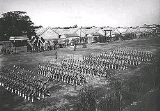
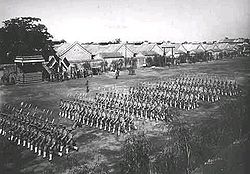
Beiyang Army

Encyclopedia
China
Chinese civilization may refer to:* China for more general discussion of the country.* Chinese culture* Greater China, the transnational community of ethnic Chinese.* History of China* Sinosphere, the area historically affected by Chinese culture...
military force created by the Qing Dynasty
Qing Dynasty
The Qing Dynasty was the last dynasty of China, ruling from 1644 to 1912 with a brief, abortive restoration in 1917. It was preceded by the Ming Dynasty and followed by the Republic of China....
government in the late 19th century. It was the centerpiece of a general reconstruction of China's military
Military
A military is an organization authorized by its greater society to use lethal force, usually including use of weapons, in defending its country by combating actual or perceived threats. The military may have additional functions of use to its greater society, such as advancing a political agenda e.g...
system. The Beiyang Army played a major role in Chinese politics for at least three decades and arguably right up to 1949. It made the Xinhai Revolution
Xinhai Revolution
The Xinhai Revolution or Hsinhai Revolution, also known as Revolution of 1911 or the Chinese Revolution, was a revolution that overthrew China's last imperial dynasty, the Qing , and established the Republic of China...
possible, and by dividing into warlord
Warlord
A warlord is a person with power who has both military and civil control over a subnational area due to armed forces loyal to the warlord and not to a central authority. The term can also mean one who espouses the ideal that war is necessary, and has the means and authority to engage in war...
factions ushered in a period of regional division.
Origins under Li Hongzhang (to 1900)
The Beiyang Army was created from Li HongzhangLi Hongzhang
Li Hongzhang or Li Hung-chang , Marquis Suyi of the First Class , GCVO, was a leading statesman of the late Qing Empire...
's Huai Army, which first saw action during the Taiping Rebellion
Taiping Rebellion
The Taiping Rebellion was a widespread civil war in southern China from 1850 to 1864, led by heterodox Christian convert Hong Xiuquan, who, having received visions, maintained that he was the younger brother of Jesus Christ, against the ruling Manchu-led Qing Dynasty...
. Unlike the traditional Green Standard or Banner forces of the Qing, the Huai Army was largely a militia army based on personal, rather than institutional, loyalties. The Huai Army was at first equipped with a mixture of traditional and modern weapons. Its creator, Li Hongzhang, used the customs and tax revenues of the five provinces under his control in the 1880s and 1890s to modernize segments of the Huai Army, and to build a modern navy (the Beiyang Fleet
Beiyang Fleet
The Beiyang Fleet was one of the four modernised Chinese navies in the late Qing Dynasty. Among the four, the Beiyang Fleet was particularly sponsored by Li Hongzhang, one of the most trusted vassals of Empress Dowager Cixi and the principal patron of the "self-strengthening movement" in northern...
). It is around this time that the term "Beiyang Army" began to be used to refer to the military forces under his control. The term "Beiyang
Beiyang
The term Beiyang originated toward the end of the Qing Dynasty, and it referred to the coastal areas of Zhili , Liaoning, and Shandong in northeast China....
", meaning literally "Northern Ocean", refers to the customs revenues collected in North China, which were used first to fund the Beiyang Fleet
Beiyang Fleet
The Beiyang Fleet was one of the four modernised Chinese navies in the late Qing Dynasty. Among the four, the Beiyang Fleet was particularly sponsored by Li Hongzhang, one of the most trusted vassals of Empress Dowager Cixi and the principal patron of the "self-strengthening movement" in northern...
and later the Beiyang Army. However, funding was usually irregular and training by no means systematic.
By the mid-1890s the Beiyang Army was the best regional formation China could field. The First Sino-Japanese War
First Sino-Japanese War
The First Sino-Japanese War was fought between Qing Dynasty China and Meiji Japan, primarily over control of Korea...
(1894–1895) was fought almost entirely by the Beiyang Army, unsupported by the forces of other provinces. In the war the Beiyang Fleet, which included two pre-Dreadnought
Pre-dreadnought
Pre-dreadnought battleship is the general term for all of the types of sea-going battleships built between the mid-1890s and 1905. Pre-dreadnoughts replaced the ironclad warships of the 1870s and 1880s...
battleships, was overwhelmed by the well-served quick firing guns of a lighter Japanese fleet. Similarly, on land, Japan's German-styled conscript army, led by academy trained professional officers, handily defeated the Beiyang Army.
The Chinese Muslim Kansu Braves formed part of the Beiyang Army.
Yuan Shikai's ascendancy (1901–1908)
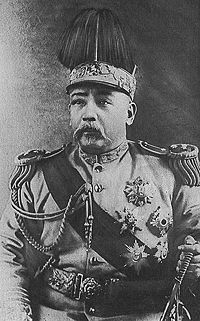
Li Hongzhang died in 1901 and was replaced by Yuan ShikaiYuan Shikai
Yuan Shikai was an important Chinese general and politician famous for his influence during the late Qing Dynasty, his role in the events leading up to the abdication of the last Qing Emperor of China, his autocratic rule as the second President of the Republic of China , and his short-lived...
, who took on Li's appointment as Viceroy of Zhili
Zhili
Zhílì was a northern province in China from the Ming Dynasty until the province was dissolved in 1928 during the Republic of China era.-History:...
and as Minister of Beiyang (北洋通商大臣). Yuan had been given command in 1895 of the brigade-sized New Created Army
New Army
The New Armies were the modernized Qing armies, trained and equipped according to Western standards...
. Many of his officers later became leading figures of the warlord period. They included Zhang Xun
Zhang Xun (Republic of China)
Zhang Xun was a Qing-loyalist general who attempted to restore the abdicated emperor Puyi in 1917. He supported Yuan Shikai during his time as president....
(who attempted to restore the Qing dynasty in 1917), Xu Shichang (President of the Republic of China 1918–22), Cao Kun
Cao Kun
|-...
(President 1922–24 and leader of the Zhili military clique), Duan Qirui
Duan Qirui
Duan Qirui was a Chinese warlord and politician, commander in the Beiyang Army, and the Provisional Chief Executive of Republic of China from November 24, 1924 to April 20, 1926. He was arguably the most powerful man in China from 1916 to 1920.- Early life :Born in Hefei as Duan Qirui , his...
("Prime Minister" during much of 1916–20 and leader of the Anhui military clique) and Feng Guozhang
Feng Guozhang
Féng Guózhāng, was a key Beiyang Army general and politician in early republican China. He held the office of Vice-President and then President of the Republic of China...
(President 1917–18 and founder of the Zhili clique).
Yuan Shikai oversaw the piecemeal reform of Qing military institutions after 1901. He founded the Baoding Military Academy, which allowed him to expand the Beiyang Army. With the creation of the Commission for Army Reorganisation in December 1903, the Beiyang Army became the model on which the military forces of other provinces should be standardized. By 1905 Yuan had increased the Beiyang Army to six divisions. In October he held manoeuvres near Hejian
Hejian
Hejian is a county-level city in the Cangzhou prefecture, in Hebei province, China. In 2004, Hejian population was ca. 770.000 inhabitants and the city territory was...
in central Zhili
Zhili
Zhílì was a northern province in China from the Ming Dynasty until the province was dissolved in 1928 during the Republic of China era.-History:...
using the newly completed Beijing-Hankou railway. Similar exercises where held the next year with Zhang Zhidong
Zhang Zhidong
Zhang Zhidong ; Pseudonyms: Xiāngtāo , Xiāngyán , Yīgōng , Wújìng-Jūshì , later Bàobīng ; Posthumous name: Wénxiāng ) was an eminent Chinese politician during the late Qing Dynasty who advocated for controlled reform...
's army in Hubei
Hubei
' Hupeh) is a province in Central China. The name of the province means "north of the lake", referring to its position north of Lake Dongting...
. It was the unanimous opinion of foreign observers that the Beiyang Army was the largest, best equipped and best trained military force in China at the time that was not Western/Colonial.
The Beiyang Army under Manchu control (1909–1910)
The Empress Dowager CixiEmpress Dowager Cixi
Empress Dowager Cixi1 , of the Manchu Yehenara clan, was a powerful and charismatic figure who became the de facto ruler of the Manchu Qing Dynasty in China for 47 years from 1861 to her death in 1908....
died on 15 November 1908 and was succeeded by the three year old Puyi. The new regent, 2nd Prince Chun (醇親王), had Yuan Shikai dismissed the next year. Yuan bided his time in retirement, carefully maintaining his network of personal contacts in the Beiyang Army. At the time of the 1911 Revolution
Xinhai Revolution
The Xinhai Revolution or Hsinhai Revolution, also known as Revolution of 1911 or the Chinese Revolution, was a revolution that overthrew China's last imperial dynasty, the Qing , and established the Republic of China...
, command of the Beiyang Army was supposedly in the hands of the Manchu minister Yinchang. In reality Yuan Shikai still had the ability to manipulate it due to the loyalties of its officers to him personally. Four divisions were located in Zhili, the 3rd Division being in Manchuria
Manchuria
Manchuria is a historical name given to a large geographic region in northeast Asia. Depending on the definition of its extent, Manchuria usually falls entirely within the People's Republic of China, or is sometimes divided between China and Russia. The region is commonly referred to as Northeast...
and the 5th Division in Shandong
Shandong
' is a Province located on the eastern coast of the People's Republic of China. Shandong has played a major role in Chinese history from the beginning of Chinese civilization along the lower reaches of the Yellow River and served as a pivotal cultural and religious site for Taoism, Chinese...
. Almost all the officers were ethnically Chinese, many of whom were returned students from Japan. Armament was not standardized, but was better in that respect than either before or later. Most of the infantry were armed with either the standard 1896 Japanese rifle or the Mauser
Mauser
Mauser was a German arms manufacturer of a line of bolt-action rifles and pistols from the 1870s to 1995. Mauser designs were built for the German armed forces...
7.9 mm.
The 1911 Revolution
The events of the revolution demonstrated that the Beiyang Army, which formed the core of the 36-division New ArmyNew Army
The New Armies were the modernized Qing armies, trained and equipped according to Western standards...
, was absolutely the dominant military force within China. Controlling the fragmented loyalties of its formations was the key to political power in post–1911 China. The insurrection which actually set off the 1911 Revolution took place in Wuchang
Wuchang Uprising
The Wuchang Uprising began with the dissatisfaction of the handling of a railway crisis. The crisis then escalated to an uprising where the revolutionaries went up against Qing government officials. The uprising was then assisted by the New Army in a coup against their own authorities in the city...
on 10 October. On 12 October Yinchang was ordered to take two Beiyang Army divisions down the Beijing-Hankou Railway to suppress the uprising at Wuchang. He attacked the revolutionary army commanded by Huang Xing
Huang Xing
Huang Xing or Huang Hsing , was a Chinese revolutionary leader, militarist, and statesman, was the first army commander-in-chief of the Republic of China. As one of the founders of the Kuomintang and the Republic of China, his position was next to Sun Yat-sen. Together they were known as...
on 27 October.
Covered by their own field artillery and the guns of the imperial fleet, the Beiyang infantry attacked with a cloud of skirmishers followed by a line of close order company fronts. These textbook tactics were soon to be discredited in the intense fighting of the First World War
World War I
World War I , which was predominantly called the World War or the Great War from its occurrence until 1939, and the First World War or World War I thereafter, was a major war centred in Europe that began on 28 July 1914 and lasted until 11 November 1918...
, but against an undisciplined revolutionary with no machine guns, they worked perfectly.
On the same day Yuan Shikai was ordered to take command of the forces at Wuchang. He refused, instead securing high commands for his two most trusted associates, Feng Guozhang and Duan Qirui. Fighting continued in Hubei for another month as Yuan negotiated with the dynasty and the revolutionaries using the Beiyang Army as a weapon of coercion. The end result was that he was elected as provisional President of the Republic of China
President of the Republic of China
The President of the Republic of China is the head of state and commander-in-chief of the Republic of China . The Republic of China was founded on January 1, 1912, to govern all of China...
.
Beiyang clique in power (1911–15)
Kuomintang
The Kuomintang of China , sometimes romanized as Guomindang via the Pinyin transcription system or GMD for short, and translated as the Chinese Nationalist Party is a founding and ruling political party of the Republic of China . Its guiding ideology is the Three Principles of the People, espoused...
(KMT) to insert outsiders into their chain of command. They negotiated a £25 million (sterling) loan from a five-power banking consortium to support the Beiyang Army despite the uproar from the KMT. In 1913 Yuan Shikai appointed four of his loyal lieutenants as military governors in southern provinces: Duan Qirui in Anhui, Feng Guozhang in Jiangsu, Li Shun in Jiangxi and Tang Xiangming in Hunan. The unified Beiyang military clique now attained its maximum extent of territorial control. It exercised firm control over North China and the Yangtze River
Yangtze River
The Yangtze, Yangzi or Cháng Jiāng is the longest river in Asia, and the third-longest in the world. It flows for from the glaciers on the Tibetan Plateau in Qinghai eastward across southwest, central and eastern China before emptying into the East China Sea at Shanghai. It is also one of the...
provinces. Throughout 1914, it supported Yuan in making revisions to the constitution to give himself treaty and war-making powers as well as substantial emergency powers.
Angel, tiger, dog are nicknames about 3 commanders of Beiyang Army by newspapers in then: Angel is Duan Qirui
Duan Qirui
Duan Qirui was a Chinese warlord and politician, commander in the Beiyang Army, and the Provisional Chief Executive of Republic of China from November 24, 1924 to April 20, 1926. He was arguably the most powerful man in China from 1916 to 1920.- Early life :Born in Hefei as Duan Qirui , his...
, tiger is Wang Shizhen
Wang Shizhen
Wang Shizhen was a Chinese general and politician of the Republic of China.-Biography:Wang was born in Zhengding, Hebei in 1861. He was the Minister of War in the Republic of China three times, 1915–1916 and twice in 1917. He was the Premier of China from 1917 to 1918....
, dog is Feng Guozhang
Feng Guozhang
Féng Guózhāng, was a key Beiyang Army general and politician in early republican China. He held the office of Vice-President and then President of the Republic of China...
.
In December 1915, Yuan declared himself Emperor. This was opposed by almost all the generals and officers of the Beiyang Army, from Duan Qirui and Feng Guozhang down. More importantly, many outlying provinces such as Yunnan
Yunnan
Yunnan is a province of the People's Republic of China, located in the far southwest of the country spanning approximately and with a population of 45.7 million . The capital of the province is Kunming. The province borders Burma, Laos, and Vietnam.Yunnan is situated in a mountainous area, with...
openly opposed him. Yuan Shikai was forced to back down from his imperial designs. Both Duan and Feng refused to support Yuan in power any further and in the end the only prominent Beiyang general to remain loyal was the irrepressible Zhang Xun. Yuan died soon afterward. After Yuan Shikai's death the Beiyang Army split into cliques led by Yuan's principal proteges. Duan Qirui's Anhui clique and the Zhili clique founded by Feng Guozhang, but led after Feng's death by Cao Kun and Wu Peifu
Wu Peifu
Wu Peifu or Wu P'ei-fu , was a major figure in the struggles between the warlords who dominated Republican China from 1916 to 1927.- Early career :...
, were the principal Beiyang cliques. Disunited, the power of the Beiyang Army was challenged by provincial armies such as Yan Xishan
Yan Xishan
Yan Xishan, was a Chinese warlord who served in the government of the Republic of China. Yan effectively controlled the province of Shanxi from the 1911 Xinhai Revolution to the 1949 Communist victory in the Chinese Civil War...
's forces in Shaanxi and Zhang Zuolin
Zhang Zuolin
Zhang Zuolin was the warlord of Manchuria from 1916 to 1928 . He successfully invaded China proper in October 1924 in the Second Zhili-Fengtian War. He gained control of Peking, including China's internationally recognized government, in April 1926...
's Fengtian clique.
Fragmentation of the Beiyang army (1916–18)
Pressure from the Beiyang commanders prevented any political figure of the left from taking up power in the Republic of ChinaRepublic of China
The Republic of China , commonly known as Taiwan , is a unitary sovereign state located in East Asia. Originally based in mainland China, the Republic of China currently governs the island of Taiwan , which forms over 99% of its current territory, as well as Penghu, Kinmen, Matsu and other minor...
government. For almost a decade after Yuan's death, the agenda of the leading Beiyang warlords was to reunify China by first reuniting the Beiyang Army and then conquering the lesser provincial armies.
For a period from mid-1916, the ultraconservative Beiyang general Zhang Xun managed to maintain the unity of the army via collegial contacts and negotiation. As Yuan Shikai had done, the Beiyang generals used their military power to intimidate the parliament
National Assembly of the Republic of China
The National Assembly of the Republic of China refers to several parliamentary bodies that existed in the Republic of China. The National Assembly was originally founded in 1913 as the first legislature in Chinese history, but was disbanded less than a year later as President Yuan Shikai assumed...
into passing the legislation they wanted. Following a dispute with President Li Yuanhong
Li Yuanhong
Li Yuanhong was a Chinese general and political figure during the Qing dynasty and the republican era. He was twice president of the Republic of China.- Early history :...
over a loan from Japan in early 1917, Duan Qirui declared independence from the government along with most of the other Beiyang generals. Zhang Xun then occupied Beijing with his army, and on 1 July shocked the Chinese political world by proclaiming the restoration of the Qing dynasty. All the other generals condemned this and the restoration soon collapsed. The elimination of Zhang Xun soon afterwards destroyed the balance of power between the rival factions of Feng and Duan and inaugurated a decade of high warlordism.
Feng Guozhang went to Beijing to assume the presidency after securing the appointment of his protege as military commander in Jiangxi, Hubei and Jiangsu. These three provinces became the bases of strength of the Zhili military clique. Duan Qirui resumed his position of Prime Minister; his Anhui (sometimes called Anfu) clique dominated the Beijing area. Using Japanese funding to build up his so-called "War Participation Army", Duan continued to struggle with Feng Guozhang.
Feng was eventually eliminated from political life in 1918, when Xu Shichang, the Beiyang elder statesman, became President. His deputy Cao Kun replaced him as leader of the Zhili clique. At the end of World War I
World War I
World War I , which was predominantly called the World War or the Great War from its occurrence until 1939, and the First World War or World War I thereafter, was a major war centred in Europe that began on 28 July 1914 and lasted until 11 November 1918...
, Duan dominated the Chinese representation at the Treaty of Versailles
Treaty of Versailles
The Treaty of Versailles was one of the peace treaties at the end of World War I. It ended the state of war between Germany and the Allied Powers. It was signed on 28 June 1919, exactly five years after the assassination of Archduke Franz Ferdinand. The other Central Powers on the German side of...
and used the Shanghai peace conference in 1919 to bring pressure on the non-Beiyang militarists supporting Sun Yat-sen
Sun Yat-sen
Sun Yat-sen was a Chinese doctor, revolutionary and political leader. As the foremost pioneer of Nationalist China, Sun is frequently referred to as the "Father of the Nation" , a view agreed upon by both the People's Republic of China and the Republic of China...
's government in Guangzhou
Guangzhou
Guangzhou , known historically as Canton or Kwangchow, is the capital and largest city of the Guangdong province in the People's Republic of China. Located in southern China on the Pearl River, about north-northwest of Hong Kong, Guangzhou is a key national transportation hub and trading port...
. He continued to receive Japan
Japan
Japan is an island nation in East Asia. Located in the Pacific Ocean, it lies to the east of the Sea of Japan, China, North Korea, South Korea and Russia, stretching from the Sea of Okhotsk in the north to the East China Sea and Taiwan in the south...
ese funding for his army (renamed "National Defence Army"), for which he was willing to grant Japan legal succession to the German rights in Shandong (see May Fourth Movement
May Fourth Movement
The May Fourth Movement was an anti-imperialist, cultural, and political movement growing out of student demonstrations in Beijing on May 4, 1919, protesting the Chinese government's weak response to the Treaty of Versailles, especially the Shandong Problem...
).
High warlordism (1919–1925)

Anhui clique
The Anhui clique was one of several mutually hostile cliques or factions that split from the Beiyang Clique in the Republic of China's Warlord era. It was named after Anhui province because several of its generals including its founder, Duan Qirui, was born in Anhui...
and Zhili — directly from the Beiyang Army and the third — Fengtian
Fengtian clique
The Fengtian Clique was one of several mutually hostile cliques or factions that split from the Beiyang Clique in the Republic of China's warlord era. It was named for Fengtian Province and led by Zhang Zuolin...
, under Zhang Zuolin — from an amalgamation of Beiyang and local troops. They and their imitators on a smaller scale were willing to get money and arms from any source in order to survive and the weaker factions would combine against the stronger.
The history of the major warlord wars down to 1925 recount the failure of any of the military commanders in China to centralise political and military power to any degree. In a situation resembling the period of the Five Dynasties and Ten Kingdoms
Five Dynasties and Ten Kingdoms Period
Five Dynasties and Ten Kingdoms was between 907–960/979 AD and an era of political upheaval in China, between the fall of the Tang Dynasty and the founding of the Song Dynasty. During this period, five dynasties quickly succeeded one another in the north, and more than 12 independent states were...
, most of South China remained beyond Beiyang control, to become the incubator for both the KMT and Communist Party of China
Communist Party of China
The Communist Party of China , also known as the Chinese Communist Party , is the founding and ruling political party of the People's Republic of China...
movements.
Northern Expedition
The KuomintangKuomintang
The Kuomintang of China , sometimes romanized as Guomindang via the Pinyin transcription system or GMD for short, and translated as the Chinese Nationalist Party is a founding and ruling political party of the Republic of China . Its guiding ideology is the Three Principles of the People, espoused...
established the National Revolutionary Army
National Revolutionary Army
The National Revolutionary Army , pre-1928 sometimes shortened to 革命軍 or Revolutionary Army and between 1928-1947 as 國軍 or National Army was the Military Arm of the Kuomintang from 1925 until 1947, as well as the national army of the Republic of China during the KMT's period of party rule...
with the help of the Soviet Union
Soviet Union
The Soviet Union , officially the Union of Soviet Socialist Republics , was a constitutionally socialist state that existed in Eurasia between 1922 and 1991....
and Communist Party of China
Communist Party of China
The Communist Party of China , also known as the Chinese Communist Party , is the founding and ruling political party of the People's Republic of China...
. Chiang Kai-Shek then launched the Northern Expedition in 1926 to attempt to bring the warlords under his control. Some warlords of the Beiyang Army were defeated by it and the National Revolutionary Army
National Revolutionary Army
The National Revolutionary Army , pre-1928 sometimes shortened to 革命軍 or Revolutionary Army and between 1928-1947 as 國軍 or National Army was the Military Arm of the Kuomintang from 1925 until 1947, as well as the national army of the Republic of China during the KMT's period of party rule...
gradually took the dominance in China
China
Chinese civilization may refer to:* China for more general discussion of the country.* Chinese culture* Greater China, the transnational community of ethnic Chinese.* History of China* Sinosphere, the area historically affected by Chinese culture...
. The warlord era
Warlord era
The Chinese Warlord Era was the period in the history of the Republic of China, from 1916 to 1928, when the country was divided among military cliques, a division that continued until the fall of the Nationalist government in the mainland China regions of Sichuan, Shanxi, Qinghai, Ningxia,...
would officially end by 1928, when most of the warlords were either defeated or allied with the Kuomintang, although it was often in name only. The Chinese Civil War
Chinese Civil War
The Chinese Civil War was a civil war fought between the Kuomintang , the governing party of the Republic of China, and the Communist Party of China , for the control of China which eventually led to China's division into two Chinas, Republic of China and People's Republic of...
that had resulted from a fallout between Chiang and the communists, was already underway by this time. In 1930 the Central Plains War
Central Plains War
Central Plains War was a civil war within the factionalised Kuomintang that broke out in 1930. It was fought between the forces of Chiang Kai-shek and the coalition of three military commanders who had previously allied with Chiang: Yan Xishan, Feng Yuxiang, and Li Zongren...
began after some of the allied warlords became discontent with the Kuomintang and attempted to overthrow Chiang. These warlords eventually faltered, but the lack of cooperation and rivalry still proved to last through much of the years following, eventually leading to the demise of Chiang's regime over mainland China in the Chinese Civil War in 1949.
Sources
http://www.123exp-history.com/t/03764295754/http://www.chinahistoryforum.com/index.php?showtopic=19878
See also
- Warlord eraWarlord eraThe Chinese Warlord Era was the period in the history of the Republic of China, from 1916 to 1928, when the country was divided among military cliques, a division that continued until the fall of the Nationalist government in the mainland China regions of Sichuan, Shanxi, Qinghai, Ningxia,...
- Beiyang FleetBeiyang FleetThe Beiyang Fleet was one of the four modernised Chinese navies in the late Qing Dynasty. Among the four, the Beiyang Fleet was particularly sponsored by Li Hongzhang, one of the most trusted vassals of Empress Dowager Cixi and the principal patron of the "self-strengthening movement" in northern...
- Beiyang governmentBeiyang GovernmentThe Beiyang government or warlord government collectively refers to a series of military regimes that ruled from Beijing from 1912 to 1928 at Zhongnanhai. It was internationally recognized as the legitimate Government of the Republic of China. The name comes from the Beiyang Army which dominated...
- KuomintangKuomintangThe Kuomintang of China , sometimes romanized as Guomindang via the Pinyin transcription system or GMD for short, and translated as the Chinese Nationalist Party is a founding and ruling political party of the Republic of China . Its guiding ideology is the Three Principles of the People, espoused...
- Military history of China
- History of the Republic of ChinaHistory of the Republic of ChinaThe History of the Republic of China begins after the Qing Dynasty in 1912, when the formation of the Republic of China put an end to over two thousand years of Imperial rule. The Qing Dynasty, also known as the Manchu Dynasty, ruled from 1644 to 1912...
- National Revolutionary ArmyNational Revolutionary ArmyThe National Revolutionary Army , pre-1928 sometimes shortened to 革命軍 or Revolutionary Army and between 1928-1947 as 國軍 or National Army was the Military Arm of the Kuomintang from 1925 until 1947, as well as the national army of the Republic of China during the KMT's period of party rule...
- Whampoa Military AcademyWhampoa Military AcademyThe Nationalist Party of China Army Officer Academy , commonly known as the Whampoa Military Academy , was a military academy in the Republic of China that produced many prestigious commanders who fought in many of China's conflicts in the 20th century, notably the Northern Expedition, the Second...
- Xinhai RevolutionXinhai RevolutionThe Xinhai Revolution or Hsinhai Revolution, also known as Revolution of 1911 or the Chinese Revolution, was a revolution that overthrew China's last imperial dynasty, the Qing , and established the Republic of China...
----