

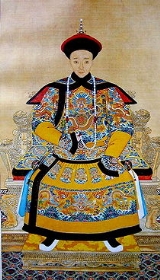
Xianfeng Emperor

Encyclopedia
The Xianfeng Emperor born Aisin-Gioro I Ju, was the ninth Emperor
of the Qing Dynasty
, and the seventh Qing emperor to rule over China
, from 1850 to 1861.
, 8 kilometers northwest of the walls of Beijing
, and was the fourth son of the Daoguang Emperor
. His mother was the Imperial Consort Quan (全贵妃), of the (Manchu
) Niuhuru clan, who was made Empress in 1834, and is known posthumously as Empress Xiaoquancheng (孝全成皇后).
Chosen as the Crown Prince in the later years of Dao Guang's reign, Yizhu had reputed ability in literature and administration which surpassed most of his brothers.
began in December of 1850, when Hong Xiuquan
a Hakka
leader of a sincretic Christian sect defeated local forces sent to disperse his followers and proclaimed the beginning of the establishment of the Taiping Heavenly Kingdom
, the rebellion spread to several provinces with amazing speed. The next year the Nien Rebellion
started in North China
. The Nien movement, unlike the Christian Taipings', lacked a clear political program, but they became a serious threat to Beijing
with the mobility of their cavalry based armies. Fixed between two powerful forces the Qing suffered defeat after defeat.
In 1853 the Taiping captured Nanjing
and for a while it seemed that Beijing would fall next but the Taiping northern expedition was defeated and the situation stabilized. Xianfeng dispatched several prominent mandarins, like Zeng Guofan
, and Imperial relatives, like the Mongol general Senggelinqin, to crush the rebellions, with limited success. In 1854 started the biggest revolt of the Miao people
against Chinese rule in history, rebellion which ravaged the region until finally put down in 1873. In 1856 an attempt to regain Nanjing was was defeated
and the Panthay Rebellion broke out in Yunnan
.
 While in the Chinese interior rebel armies were raised everywhere, in the coasts an initially minor incident triggered the Second Opium War
. Anglo-French forces, after inciting a few battles on the coast near Tianjin
, of which not all were victories, attempted "negotiation" with the Qing Government. Xian Feng, under the influence of the Concubine Yi (懿貴妃, later the Empress Dowager Cixi
), believed in Chinese superiority and would not agree to any colonial demands. He delegated Prince Gong for several negotiations but relations broke down completely when a British diplomatic envoy, Sir Harry Parkes, was arrested during negotiations on 18 September.
The Anglo-French invasion clashed with Sengge Rinchen's Mongolian cavalry on 18 September near Zhangjiawan before proceeding toward the outskirts of Beijing for a decisive battle in Tongzhou District, Beijing.On 21 September, at the Battle of Palikao
, Sengge Rinchen's 10,000 troops including elite Mongolian cavalry were completely annihilated after several doomed frontal charges against concentrated firepower of the Anglo-French forces, which entered Beijing on 6 October.
On 18 October 1860, the western forces went on to loot and burn the Imperial Summer Palaces of Qīngyī Yuán
(清漪园/清漪園) and Yuánmíng Yuán
(圆明园/圓明園). Upon learning about this news, Xianfeng's health quickly turned for the worst.
While negotiations with the European powers were in deliberation, Emperor Xianfeng and his Imperial entourage fled to the northern palace in Jehol
in the name of annual Imperial hunt. Becoming more ill physically, Xian Feng's ability to govern also deteriorated, leading to competing ideologies in court that eventually formed two distinct factions — those under the rich Manchu Sushun
, Princes Yi and Zheng
; and those under the Concubine Yi
, supported by Gen. Ronglu
and Yehenala Bannermen
.
, 230 kilometers northeast of Beijing
. Being succeeded by his one surviving son, Zaichun
, who was barely 6 years old, Xianfeng had summoned Sushun and his group to his bedside a day before, giving them an Imperial Edict dictating the power structure during the young Emperor's minority. The edict appointed four members of the Imperial line, namely, Zaiyuan, the Prince Yi; Duanhua, the Prince Zheng; Duke Jingshou; and Sushun
, and four Ministers, Muyin, Kuangyuan, Du Han, and Jiao Youying, as the eight members of a new regency council to aid the young Emperor. By tradition, after the death of an Emperor, the body was to be accompanied to the Capital by the regents. Concubine Yi and the Empress, who were now both given titles of Empress Dowager
, traveled to Beijing ahead of time, and planned a coup that ousted Sushun from the regency. The Concubine Yi would subsequently rule China for the next 47 years, as the Empress Dowager Cixi
.
Emperor Xianfeng was interred in the Eastern Qing Tombs
(清東陵), 125 kilometers/75 miles east of Beijing
, in the Dingling (定陵 "Tomb of Quietude") mausoleum complex.
, resulting in millions of death. Xian Feng also had to deal with the English and French closer to home and their ever growing appetite to expand trade further into China. Xian Feng, who was not unlike his predecessor and father, the Daoguang Emperor, understood very little about the Europeans and their mindset. While westerners saw different nations as equals deserving mutual respect as an international norm, Xian Feng viewed non-Chinese Europeans as inferior and regarded the Europeans repeated requests to be treated as equal as an offence. When the Europeans introduced the long held concept of an exchanged consular relationship, Xian feng quickly rebuffed the idea.
During the Second Opium War, repeated requests by Europeans to meet with Xian Feng were also denied. At the time of Xian Feng's death, he had not even once met any foreign dignitaries.
Xianfeng had a large sexual appetite. He was a lover of opera and alcohol, and often became violent with his servants. He was known to smoke opium
.
Books about Empress Dowager Cixi:
Emperor of China
The Emperor of China refers to any sovereign of Imperial China reigning between the founding of Qin Dynasty of China, united by the King of Qin in 221 BCE, and the fall of Yuan Shikai's Empire of China in 1916. When referred to as the Son of Heaven , a title that predates the Qin unification, the...
of the Qing Dynasty
Qing Dynasty
The Qing Dynasty was the last dynasty of China, ruling from 1644 to 1912 with a brief, abortive restoration in 1917. It was preceded by the Ming Dynasty and followed by the Republic of China....
, and the seventh Qing emperor to rule over China
China
Chinese civilization may refer to:* China for more general discussion of the country.* Chinese culture* Greater China, the transnational community of ethnic Chinese.* History of China* Sinosphere, the area historically affected by Chinese culture...
, from 1850 to 1861.
Family and his early years
Yizhu was born in 1831 at the Imperial Summer Palace ComplexOld Summer Palace
The Old Summer Palace, known in China as Yuan Ming Yuan , and originally called the Imperial Gardens, was a complex of palaces and gardens in Beijing...
, 8 kilometers northwest of the walls of Beijing
Beijing
Beijing , also known as Peking , is the capital of the People's Republic of China and one of the most populous cities in the world, with a population of 19,612,368 as of 2010. The city is the country's political, cultural, and educational center, and home to the headquarters for most of China's...
, and was the fourth son of the Daoguang Emperor
Daoguang Emperor
The Daoguang Emperor was the eighth emperor of the Manchurian Qing dynasty and the sixth Qing emperor to rule over China, from 1820 to 1850.-Early years:...
. His mother was the Imperial Consort Quan (全贵妃), of the (Manchu
Manchu
The Manchu people or Man are an ethnic minority of China who originated in Manchuria . During their rise in the 17th century, with the help of the Ming dynasty rebels , they came to power in China and founded the Qing Dynasty, which ruled China until the Xinhai Revolution of 1911, which...
) Niuhuru clan, who was made Empress in 1834, and is known posthumously as Empress Xiaoquancheng (孝全成皇后).
Chosen as the Crown Prince in the later years of Dao Guang's reign, Yizhu had reputed ability in literature and administration which surpassed most of his brothers.
Early reign
He succeeded the throne in 1850, at age 19, and was a relatively young Emperor. He inherited a dynasty that faced challenges not only internally but also foreign. The situation was not reflected at all by his reign title, Xianfeng (咸丰/咸豐), which means "Universal Prosperity." In 1850 began the first of a series of popular rebellions that brought the Dynasty close to its demise. The Taiping RebellionTaiping Rebellion
The Taiping Rebellion was a widespread civil war in southern China from 1850 to 1864, led by heterodox Christian convert Hong Xiuquan, who, having received visions, maintained that he was the younger brother of Jesus Christ, against the ruling Manchu-led Qing Dynasty...
began in December of 1850, when Hong Xiuquan
Hong Xiuquan
Hong Xiuquan , born Hong Renkun, style name Huoxiu , was a Hakka Chinese who led the Taiping Rebellion against the Qing Dynasty, establishing the Taiping Heavenly Kingdom over varying portions of southern China, with himself as the "Heavenly King" and self-proclaimed brother of Jesus Christ.-Early...
a Hakka
Hakka people
The Hakka , sometimes Hakka Han, are Han Chinese who speak the Hakka language and have links to the provincial areas of Guangdong, Jiangxi, Guangxi, Sichuan, Hunan and Fujian in China....
leader of a sincretic Christian sect defeated local forces sent to disperse his followers and proclaimed the beginning of the establishment of the Taiping Heavenly Kingdom
Taiping Heavenly Kingdom
The Taiping Heavenly Kingdom was an oppositional state in China from 1851 to 1864, established by Hong Xiuquan, the leader of the Taiping Rebellion...
, the rebellion spread to several provinces with amazing speed. The next year the Nien Rebellion
Nien Rebellion
The Nien Rebellion was an armed uprising that took place in northern China from 1851 to 1868, contemporaneously with Taiping Rebellion in South China...
started in North China
North China
thumb|250px|Northern [[People's Republic of China]] region.Northern China or North China is a geographical region of China. The heartland of North China is the North China Plain....
. The Nien movement, unlike the Christian Taipings', lacked a clear political program, but they became a serious threat to Beijing
Beijing
Beijing , also known as Peking , is the capital of the People's Republic of China and one of the most populous cities in the world, with a population of 19,612,368 as of 2010. The city is the country's political, cultural, and educational center, and home to the headquarters for most of China's...
with the mobility of their cavalry based armies. Fixed between two powerful forces the Qing suffered defeat after defeat.
In 1853 the Taiping captured Nanjing
Battle of Nanjing (1853)
The Battle of Nanjing began after the fall of Wuhan on March 8, 1853, and ended with the fall of the capital city of Nanjing on March 19, 1853 to Taiping troops, a few days after the Qing Government had evacuated the city....
and for a while it seemed that Beijing would fall next but the Taiping northern expedition was defeated and the situation stabilized. Xianfeng dispatched several prominent mandarins, like Zeng Guofan
Zeng Guofan
Zeng Guofan was an eminent Han Chinese official, military general, and devout Confucian scholar of the late Qing Dynasty in China....
, and Imperial relatives, like the Mongol general Senggelinqin, to crush the rebellions, with limited success. In 1854 started the biggest revolt of the Miao people
Miao people
The Miao or ม้ง ; ) is an ethnic group recognized by the government of the People's Republic of China as one of the 55 official minority groups. Miao is a Chinese term and does not reflect the self-designations of the component nations of people, which include Hmong, Hmu, A Hmao, and Kho Xiong...
against Chinese rule in history, rebellion which ravaged the region until finally put down in 1873. In 1856 an attempt to regain Nanjing was was defeated
Battle of Nanking (1856)
The Battle of Nanking . The Qing government raised the Green Standard Army to fight against the Taiping Rebellion. The Qing forces surrounded Nanjing .-First rout of the Jiangnan Army Group:1853--1856...
and the Panthay Rebellion broke out in Yunnan
Yunnan
Yunnan is a province of the People's Republic of China, located in the far southwest of the country spanning approximately and with a population of 45.7 million . The capital of the province is Kunming. The province borders Burma, Laos, and Vietnam.Yunnan is situated in a mountainous area, with...
.
Second Opium War
The Second Opium War, the Second Anglo-Chinese War, the Second China War, the Arrow War, or the Anglo-French expedition to China, was a war pitting the British Empire and the Second French Empire against the Qing Dynasty of China, lasting from 1856 to 1860...
. Anglo-French forces, after inciting a few battles on the coast near Tianjin
Tianjin
' is a metropolis in northern China and one of the five national central cities of the People's Republic of China. It is governed as a direct-controlled municipality, one of four such designations, and is, thus, under direct administration of the central government...
, of which not all were victories, attempted "negotiation" with the Qing Government. Xian Feng, under the influence of the Concubine Yi (懿貴妃, later the Empress Dowager Cixi
Empress Dowager Cixi
Empress Dowager Cixi1 , of the Manchu Yehenara clan, was a powerful and charismatic figure who became the de facto ruler of the Manchu Qing Dynasty in China for 47 years from 1861 to her death in 1908....
), believed in Chinese superiority and would not agree to any colonial demands. He delegated Prince Gong for several negotiations but relations broke down completely when a British diplomatic envoy, Sir Harry Parkes, was arrested during negotiations on 18 September.
The Anglo-French invasion clashed with Sengge Rinchen's Mongolian cavalry on 18 September near Zhangjiawan before proceeding toward the outskirts of Beijing for a decisive battle in Tongzhou District, Beijing.On 21 September, at the Battle of Palikao
Battle of Palikao
The Battle of Palikao was fought at the bridge of Palikao by Anglo-French forces against China during the Second Opium War on the morning of 21 September 1860...
, Sengge Rinchen's 10,000 troops including elite Mongolian cavalry were completely annihilated after several doomed frontal charges against concentrated firepower of the Anglo-French forces, which entered Beijing on 6 October.
On 18 October 1860, the western forces went on to loot and burn the Imperial Summer Palaces of Qīngyī Yuán
Summer Palace
The Summer Palace is a palace in Beijing, China. The Summer Palace is mainly dominated by Longevity Hill and the Kunming Lake. It covers an expanse of 2.9 square kilometers, three quarters of which is water....
(清漪园/清漪園) and Yuánmíng Yuán
Old Summer Palace
The Old Summer Palace, known in China as Yuan Ming Yuan , and originally called the Imperial Gardens, was a complex of palaces and gardens in Beijing...
(圆明园/圓明園). Upon learning about this news, Xianfeng's health quickly turned for the worst.
While negotiations with the European powers were in deliberation, Emperor Xianfeng and his Imperial entourage fled to the northern palace in Jehol
Jehol
Jehol could mean either a province or a city:* Jehol Province, former province in northeastern China* Chengde, the capital of above provinceNamed after the province:* Jehol Biota* Jeholodens* Jeholopterus* Jeholornis* Jeholosaurus...
in the name of annual Imperial hunt. Becoming more ill physically, Xian Feng's ability to govern also deteriorated, leading to competing ideologies in court that eventually formed two distinct factions — those under the rich Manchu Sushun
Sushun
Sushun ; Styled: Yuting was born in the Manchu Aisin-Gioro Clan as the sixth son of Ulgungga , the Prince Zheng....
, Princes Yi and Zheng
Duanhua
Duanhua was a Manchu noble of the Bordered Blue Banner from the Aisin-Gioro clan. Until several days before his death he held the title of Prince Zheng, inherited as one of the eight "iron-cap" princes....
; and those under the Concubine Yi
Empress Dowager Cixi
Empress Dowager Cixi1 , of the Manchu Yehenara clan, was a powerful and charismatic figure who became the de facto ruler of the Manchu Qing Dynasty in China for 47 years from 1861 to her death in 1908....
, supported by Gen. Ronglu
Ronglu
Ronglu was a Manchu statesman and general during the late Qing dynasty. Born into the powerful Guwalgiya clan of the Plain White Banner in the Eight Banners, he was cousin to Yehenara Lan, who later became Empress Dowager Cixi...
and Yehenala Bannermen
Eight Banners
The Eight Banners were administrative divisions into which all Manchu families were placed. They provided the basic framework for the Manchu military organization...
.
Death
Xian Feng died on 22 August 1861, at the imperial summer resort (行宮 xinggong) in JeholJehol
Jehol could mean either a province or a city:* Jehol Province, former province in northeastern China* Chengde, the capital of above provinceNamed after the province:* Jehol Biota* Jeholodens* Jeholopterus* Jeholornis* Jeholosaurus...
, 230 kilometers northeast of Beijing
Beijing
Beijing , also known as Peking , is the capital of the People's Republic of China and one of the most populous cities in the world, with a population of 19,612,368 as of 2010. The city is the country's political, cultural, and educational center, and home to the headquarters for most of China's...
. Being succeeded by his one surviving son, Zaichun
Tongzhi Emperor
The Tongzhi Emperor , born Aisin-Gioro Dzai Šun, was the tenth emperor of the Manchu-led Qing Dynasty, and the eighth Qing emperor to rule over China, from 1861 to 1875. His reign, which effectively lasted through his adolescence, was largely overshadowed by the rule of his mother, the Empress...
, who was barely 6 years old, Xianfeng had summoned Sushun and his group to his bedside a day before, giving them an Imperial Edict dictating the power structure during the young Emperor's minority. The edict appointed four members of the Imperial line, namely, Zaiyuan, the Prince Yi; Duanhua, the Prince Zheng; Duke Jingshou; and Sushun
Sushun
Sushun ; Styled: Yuting was born in the Manchu Aisin-Gioro Clan as the sixth son of Ulgungga , the Prince Zheng....
, and four Ministers, Muyin, Kuangyuan, Du Han, and Jiao Youying, as the eight members of a new regency council to aid the young Emperor. By tradition, after the death of an Emperor, the body was to be accompanied to the Capital by the regents. Concubine Yi and the Empress, who were now both given titles of Empress Dowager
Empress Dowager
Empress Dowager was the title given to the mother of a Chinese, Korean, Japanese or Vietnamese emperor.The title was also given occasionally to another woman of the same generation, while a woman from the previous generation was sometimes given the title of Grand empress dowager. Numerous empress...
, traveled to Beijing ahead of time, and planned a coup that ousted Sushun from the regency. The Concubine Yi would subsequently rule China for the next 47 years, as the Empress Dowager Cixi
Empress Dowager Cixi
Empress Dowager Cixi1 , of the Manchu Yehenara clan, was a powerful and charismatic figure who became the de facto ruler of the Manchu Qing Dynasty in China for 47 years from 1861 to her death in 1908....
.
Emperor Xianfeng was interred in the Eastern Qing Tombs
Eastern Qing Tombs
The Eastern Qing Tombs are an imperial mausoleum complex of the Qing Dynasty located in Zunhua, 125 kilometers northeast of Beijing. They are the largest, most complete, and best preserved extant mausoleum complex in China...
(清東陵), 125 kilometers/75 miles east of Beijing
Beijing
Beijing , also known as Peking , is the capital of the People's Republic of China and one of the most populous cities in the world, with a population of 19,612,368 as of 2010. The city is the country's political, cultural, and educational center, and home to the headquarters for most of China's...
, in the Dingling (定陵 "Tomb of Quietude") mausoleum complex.
Legacy
Xian Feng's reign saw the continued declined of the Qing dynasty. Mired by the rise of rebellions in the country, coincidentally starting the year of his reign - which would not be quelled until well entered the reign of the Tongzhi EmperorTongzhi Emperor
The Tongzhi Emperor , born Aisin-Gioro Dzai Šun, was the tenth emperor of the Manchu-led Qing Dynasty, and the eighth Qing emperor to rule over China, from 1861 to 1875. His reign, which effectively lasted through his adolescence, was largely overshadowed by the rule of his mother, the Empress...
, resulting in millions of death. Xian Feng also had to deal with the English and French closer to home and their ever growing appetite to expand trade further into China. Xian Feng, who was not unlike his predecessor and father, the Daoguang Emperor, understood very little about the Europeans and their mindset. While westerners saw different nations as equals deserving mutual respect as an international norm, Xian Feng viewed non-Chinese Europeans as inferior and regarded the Europeans repeated requests to be treated as equal as an offence. When the Europeans introduced the long held concept of an exchanged consular relationship, Xian feng quickly rebuffed the idea.
During the Second Opium War, repeated requests by Europeans to meet with Xian Feng were also denied. At the time of Xian Feng's death, he had not even once met any foreign dignitaries.
Family and personal
- Father: Emperor DaoguangDaoguang EmperorThe Daoguang Emperor was the eighth emperor of the Manchurian Qing dynasty and the sixth Qing emperor to rule over China, from 1820 to 1850.-Early years:...
(1782–1850) - Mother: Empress Xiaoquancheng - Imperial Consort Quan, of the (Manchu) Niuhuru clan, who was made Empress in 1834, and is known posthumously as Empress Xiaoquancheng.
- Consorts:
- Empress Xiaodexian (孝德显皇后萨克达氏) (?-January 1850). Entered the Forbidden City as lady Sakda of the Sakda clan, raised to the rank of Empress after her death when Yi Zhu became the Xian Feng Emperor. She was granted the posthumous title of Empress Xiaodexian.
- Empress Xiao Zhen Xian (the Ci An Dowager Empress) (慈安太后) of the Niuhuru clan (1837–1881).
- Empress Xiao Qin Xian (The Ci Xi Dowager Empress)Empress Dowager CixiEmpress Dowager Cixi1 , of the Manchu Yehenara clan, was a powerful and charismatic figure who became the de facto ruler of the Manchu Qing Dynasty in China for 47 years from 1861 to her death in 1908....
(Honored Consort Yi 懿貴妃) (1835–1908). - Consort Li, posthumously known as Imperial Honored Concubine Zhuang Jing (庄靜皇貴妃) (1837–1890).
- Imperial Honored Consort Duan Ge(端恪皇貴妃) of the Tongiya clan (1844–1910).
- Honored Consort Mei (玫貴妃) (1837–1890), she gave birth to the emperor's second son who died young.
- Honored Consort Wan (婉貴妃) (?-1894) of the Manchu Sujiro clan.
- Consort Lu (璷妃) (?-1895) of the Manchu Nara clan.
- Consort Ji (吉妃) (?-1905) of the Wang clan.
- Consort Xi (禧妃) (?-1877) of the Chahala clan.
- Consort Qing (慶妃) (?-1885) of the Han Chinese Zhang clan.
- Imperial Concubine Yun (雲嬪) (?-1855) of the Wugiya clan.
- Imperial Concubine Rong (容嫔) (?-1869) of the Manchu Irgen Gioro clan.
- Imperial Concubine Shu (璹嫔) (?-1874) of the Manchu Yehenara clan.
- Imperial Concubine Ru (玉嫔) (?-1862) younger sister of Imperial Concubine Shu.
- Female Attendant Ping (玶常在) (?-1857) of the Manchu Irgen Gioro clan. She entered the palace as a concubine of the fourth rank but for unknown reason she was demoted by three rank. In 1856 she was promted by one rank but she died the following year.
- Female Attendant Chun (瑃常在) (?-1859).
- Female Attendant Xin (鑫常在) (?-1859).
- Children:
- Prince Zaichun, (son of Ci Xi Dowager Empress) who became the Tongzhi EmperorTongzhi EmperorThe Tongzhi Emperor , born Aisin-Gioro Dzai Šun, was the tenth emperor of the Manchu-led Qing Dynasty, and the eighth Qing emperor to rule over China, from 1861 to 1875. His reign, which effectively lasted through his adolescence, was largely overshadowed by the rule of his mother, the Empress...
after his death. - Second son (1858) by Honored Consort Mei. He was posthumously given the title of Prince of the second rank Min (悯郡王).
- Kurun Princess Rong'an (榮安固倫公主)(1855-1875), daughter of Consort Li.
- Adoptive daughter: Kurun Princess Rongshou (荣壽固伦公主) (1854-1924) was the oldest daughter of Prince Gong.
Xianfeng had a large sexual appetite. He was a lover of opera and alcohol, and often became violent with his servants. He was known to smoke opium
Opium
Opium is the dried latex obtained from the opium poppy . Opium contains up to 12% morphine, an alkaloid, which is frequently processed chemically to produce heroin for the illegal drug trade. The latex also includes codeine and non-narcotic alkaloids such as papaverine, thebaine and noscapine...
.
Ancestry
See also
- Second Opium WarSecond Opium WarThe Second Opium War, the Second Anglo-Chinese War, the Second China War, the Arrow War, or the Anglo-French expedition to China, was a war pitting the British Empire and the Second French Empire against the Qing Dynasty of China, lasting from 1856 to 1860...
(1856–1860) - Treaties of Tianjin (1858)
- Beijing ConventionBeijing ConventionThe Beijing Convention may refer to* Convention_of_Peking, a treaty concluded between Qing China and the United Kingdom, France and Russia in 1860* Beijing Convention, a follow-up treaty to the Montreal Convention relating to terrorism in international aviation...
(1860)
Sources and literature
- Daily Life in the Forbidden City, Wan Yi, Wang Shuqing, Lu Yanzhen ISBN 0-670-81164-5".
- Qing dynasty Wenzong’s veritable records (清文宗实录).
- Royal archives of the Qing dynasty (清宫档案).
- Qing imperial genealogy(清皇室四谱).
- webpagina: http://www.royalark.net/China/manchu14.htm, gaat over de stamboom van de Aisin Gioro stam.
- Draft history of the Qing dynasty. 《清史稿》卷二百十四.列傳一.后妃傳.
Books about Empress Dowager Cixi:
- Sterling Seagraves "Dragon Lady" ISBN 0-679-73369-8
- Maria Warners "The Dragon Empress: Life and Times of Tz'u-Hsi, 1835 - 1908, Empress of China". ISBN 0-689-70714-2
- Anchee Min "Empress Orchid" ISBN 978-0-618-06887-6