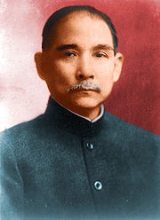
Sun Yat-sen was a
ChineseHan Chinese are an ethnic group native to China and are the largest single ethnic group in the world.Han Chinese constitute about 92% of the population of the People's Republic of China , 98% of the population of the Republic of China , 78% of the population of Singapore, and about 20% of the...
doctor,
revolutionaryA revolutionary is a person who either actively participates in, or advocates revolution. Also, when used as an adjective, the term revolutionary refers to something that has a major, sudden impact on society or on some aspect of human endeavor.-Definition:...
and
politicalA politician, political leader, or political figure is an individual who is involved in influencing public policy and decision making...
leader. As the foremost pioneer of Nationalist China, Sun is frequently referred to as the "
Father of the NationFather of the Nation is an honorific title given to a man considered the driving force behind the establishment of their country, state or nation...
" (國父), a view agreed upon by both the
People's Republic of ChinaChina , officially the People's Republic of China , is the most populous country in the world, with over 1.3 billion citizens. Located in East Asia, the country covers approximately 9.6 million square kilometres...
and the
Republic of ChinaThe Republic of China , commonly known as Taiwan , is a unitary sovereign state located in East Asia. Originally based in mainland China, the Republic of China currently governs the island of Taiwan , which forms over 99% of its current territory, as well as Penghu, Kinmen, Matsu and other minor...
. Sun played an instrumental role in the overthrow of the
Qing dynastyThe Qing Dynasty was the last dynasty of China, ruling from 1644 to 1912 with a brief, abortive restoration in 1917. It was preceded by the Ming Dynasty and followed by the Republic of China....
during the
Xinhai RevolutionThe Xinhai Revolution or Hsinhai Revolution, also known as Revolution of 1911 or the Chinese Revolution, was a revolution that overthrew China's last imperial dynasty, the Qing , and established the Republic of China...
. Sun was the first provisional
presidentThe President of the Republic of China is the head of state and commander-in-chief of the Republic of China . The Republic of China was founded on January 1, 1912, to govern all of China...
when the Republic of China was founded in 1912 and later co-founded the
KuomintangThe Kuomintang of China , sometimes romanized as Guomindang via the Pinyin transcription system or GMD for short, and translated as the Chinese Nationalist Party is a founding and ruling political party of the Republic of China . Its guiding ideology is the Three Principles of the People, espoused...
(KMT) where he served as its first leader. Sun was a uniting figure in post-Imperial China, and remains unique among

20th centuryMany people define the 20th century as running from January 1, 1901 to December 31, 2000, others would rather define it as beginning on January 1, 1900....
Chinese politicians for being widely revered amongst the people from both sides of the
Taiwan StraitThe Taiwan Strait or Formosa Strait, formerly known as the Black Ditch, is a 180-km-wide strait separating Mainland China and Taiwan. The strait is part of the South China Sea and connects to East China Sea to the northeast...
.
Although Sun is considered one of the greatest leaders of modern China, his political life was one of constant struggle and frequent
exileExile means to be away from one's home , while either being explicitly refused permission to return and/or being threatened with imprisonment or death upon return...
. After the success of the revolution, he quickly fell out of power in the newly founded Republic of China, and led successive revolutionary governments as a challenge to the
warlordThe Chinese Warlord Era was the period in the history of the Republic of China, from 1916 to 1928, when the country was divided among military cliques, a division that continued until the fall of the Nationalist government in the mainland China regions of Sichuan, Shanxi, Qinghai, Ningxia,...
s who controlled much of the nation. Sun did not live to see his party consolidate its power over the country during the Northern Expedition. His party, which formed a fragile alliance with the
CommunistsThe Communist Party of China , also known as the Chinese Communist Party , is the founding and ruling political party of the People's Republic of China...
, split into two factions after his death. Sun's chief legacy resides in his developing a
political philosophyPolitical philosophy is the study of such topics as liberty, justice, property, rights, law, and the enforcement of a legal code by authority: what they are, why they are needed, what, if anything, makes a government legitimate, what rights and freedoms it should protect and why, what form it...
known as the
Three Principles of the PeopleThe Three Principles of the People, also translated as Three People's Principles, or collectively San-min Doctrine, is a political philosophy developed by Sun Yat-sen as part of a philosophy to make China a free, prosperous, and powerful nation...
: nationalism, democracy, and the people's livelihood.
Names
The original name of Sun Yat-sen was Sun Wen (孫文) and his genealogical name was Sun Deming (孫德明). As a child, his "milk name" was Dixiang (帝象). The courtesy name of Sun Yat-sen was Zaizhi (載之), and his baptized name was Rixin (日新). While at school in Hong Kong he got the name Yat Sen (逸仙; Hanyu pinyin: Yìxiān). Sun Zhongshan (孫中山), the most popular of his Chinese names, came from
NakayamaNakayama may refer to:*Nakayama, Ehime, a town in Ehime Prefecture*Nakayama, Tottori, a town in Tottori Prefecture*Nakayama, Yamagata, a town in Yamagata Prefecture*Nakayama-dera, a temple in Hyōgo Prefecture...
(中山樵), a form of the
Japanese namein modern times usually consist of a family name , followed by a given name. "Middle names" are not generally used.Japanese names are usually written in kanji, which are characters of usually Chinese origin in Japanese pronunciation...
given to him by Miyazaki Touten.
Early years
Farm life
Sun Yat-sen was born on 12 November 1866 to a
CantoneseThe Cantonese people are Han people whose ancestral homes are in Guangdong, China. The term "Cantonese people" would then be synonymous with the Bun Dei sub-ethnic group, and is sometimes known as Gwong Fu Jan for this narrower definition...
HakkaThe Hakka , sometimes Hakka Han, are Han Chinese who speak the Hakka language and have links to the provincial areas of Guangdong, Jiangxi, Guangxi, Sichuan, Hunan and Fujian in China....
family in the village of
CuihengCuiheng is a village in the township of Nanlang, under the prefecture-level city of Zhongshan in Guangdong province of China. Cuiheng is best known as the birthplace of Dr. Sun Yat-sen, the "Father of the Nation" of the Republic of China...
, Xiangshan (later
ZhongshanZhongshan , also spelled Chungshan and historically known as Xiangshan or Siangshan, is a prefecture-level city in the south of the Pearl River Delta in Guangdong province in southern China. Zhongshan, one of the few cities in China with an eponymous name, is named after Dr. Sun Yat-sen who was...
county),
GuangzhouGuangzhou , known historically as Canton or Kwangchow, is the capital and largest city of the Guangdong province in the People's Republic of China. Located in southern China on the Pearl River, about north-northwest of Hong Kong, Guangzhou is a key national transportation hub and trading port...
prefecture,
GuangdongGuangdong is a province on the South China Sea coast of the People's Republic of China. The province was previously often written with the alternative English name Kwangtung Province...
province in Qing China. He was the third son born in a family of farmers, and herded cows along with other farming duties at age 6.
Education years
At age 10, Sun Yat-sen began seeking schooling. It is also at this point where he met childhood friend
Lu Hao-tungLu Hao-tung , born Lu Chung-gui , courtesy name Hsien-hsiang , was the first "revolutionary martyr" of the Republic of China...
. By age 13 in 1878 after receiving a few years of local schooling, Sun went to live with his elder brother,
Sun MeiThis is a family tree of Sun Yat-sen, the first provisional president of the Republic of China. The following chart uses Mandarin pinyin romanization. Some members may have been referred to in the Cantonese, Hakka, Hokkien at one time or another...
(孫眉) in Honolulu.
Sun Yat-sen then studied at the
Iolani SchoolIolani School, located at 563 Kamoku Street in Honolulu, Hawaii, is a private coeducational college preparatory school serving over 1,800 students. Founded in 1863 by Father William R. Scott, it was the principal school of the former Anglican Church of Hawaii. It was patronized by Kamehameha IV...
where he learned English,
UK historyThe history of the United Kingdom as a unified sovereign state began with the political union of the kingdoms of England, which included Wales, and Scotland on 1 May 1707 in accordance with the Treaty of Union, as ratified by the Acts of Union 1707...
, mathematics, science and
ChristianityChristianity is a monotheistic religion based on the life and teachings of Jesus as presented in canonical gospels and other New Testament writings...
. Originally unable to speak the English language, Sun Yat-sen picked up the language so quickly that he received a prize for outstanding achievement from King David Kalākaua. Sun enrolled in Oahu College (now
Punahou SchoolPunahou School, once known as Oahu College, is a private, co-educational, college preparatory school located in Honolulu CDP, City and County of Honolulu in the U.S. State of Hawaii...
) for further studies for one semester. In 1883 he was soon sent home to China as his brother was becoming afraid that Sun Yat-sen would embrace Christianity.
When he returned home in 1883 at age 17, Sun met up with his childhood friend
Lu Hao-tungLu Hao-tung , born Lu Chung-gui , courtesy name Hsien-hsiang , was the first "revolutionary martyr" of the Republic of China...
at Beijidian (北極殿), a temple in Cuiheng Village. They saw many villagers worshipping the Beiji (literally
North PoleThe North Pole, also known as the Geographic North Pole or Terrestrial North Pole, is, subject to the caveats explained below, defined as the point in the northern hemisphere where the Earth's axis of rotation meets its surface...
) Emperor-God in the temple, and were dissatisfied with their ancient healing methods. They broke the statue, incurring the wrath of fellow villagers, and escaped to
Hong KongHong Kong is one of two Special Administrative Regions of the People's Republic of China , the other being Macau. A city-state situated on China's south coast and enclosed by the Pearl River Delta and South China Sea, it is renowned for its expansive skyline and deep natural harbour...
. While in HK in 1883 he studied at the
Diocesan Boys' SchoolDiocesan Boys' School is a boys' school located at 131 Argyle Street, Mong Kok, Kowloon, Hong Kong. It was founded in 1869, making it one of the oldest secondary schools in Hong Kong....
and from 1884 to 1886 he was at
the government Central schoolQueen's College , initially named The Government Central School in 1862, later renamed as Victoria College in 1889, is a sixth form college for boys with a secondary school attached. It was the first public secondary school founded in Hong Kong by the British colonial government...
.
In 1886 Sun studied medicine at the
Guangzhou Boji HospitalThe Guangzhou Boji Hospital, Ophthalmic Hospital in Canton also known as the Canton Pok Tsai Hospital was a hospital in Guangzhou, Guangdong founded in November 4, 1835 by Peter Parker as an Ophthalmic hospital. In about 1854, John Glasgow Kerr became its director. In 1886 the hospital education...
under the Christian missionary
John G. KerrJohn Glasgow Kerr was a Presbyterian medical missionary to China with the American Presbyterian Mission.Born in Duncansville, Ohio, Kerr graduated from Jefferson Medical College in Philadelphia. He went to China as a medical missionary and arrived at Guangzhou in 1854...
. Ultimately, he earned the license of Christian practice as a medical doctor from the
Hong Kong College of Medicine for ChineseThe Hong Kong College of Medicine for Chinese was the first college in Hong Kong to fully adopt and accept Western medical science practices...
(the forerunner of The University of Hong Kong) in 1892. Notably, of his class of 12 students, only two graduated; Sun was one of them.
Christian baptism
Sun was later baptized in Hong Kong by an American missionary of the Congregational Church of the United States, to his brother's disdain. The minister would also develop a friendship with Sun. Sun pictured a revolution as similar to the salvation mission of the
Christian churchThe Christian Church is the assembly or association of followers of Jesus Christ. The Greek term ἐκκλησία that in its appearances in the New Testament is usually translated as "church" basically means "assembly"...
. His conversion to Christianity was related to his revolutionary ideals and push for advancement. Sun later became the godfather of Paul Linebarger, a science-fiction writer.
Transformation into a revolutionary
Four Bandits
During and after the
Qing DynastyThe Qing Dynasty was the last dynasty of China, ruling from 1644 to 1912 with a brief, abortive restoration in 1917. It was preceded by the Ming Dynasty and followed by the Republic of China....
rebellion around 1888 Sun was in Hong Kong with a group of revolutionary thinkers that were nicknamed the
Four BanditsThe Four Bandits, Four Outlaws or the Four Desperados was a nickname given to a group of 4 young students in Hong Kong who were keen on discussing the current issues in China, and aspired to overthrow the corrupt Qing dynasty run by the Manchus. The four bandits were Yeung Hok-ling, Sun Yat-sen,...
at the
Hong Kong College of Medicine for ChineseThe Hong Kong College of Medicine for Chinese was the first college in Hong Kong to fully adopt and accept Western medical science practices...
. Sun, who had grown
increasingly frustratedthumb|[[Sun Yat-sen]], one of the leaders of the [[Xinhai Revolution]] which overthrew the Qing dynasty in 1912. Photo taken in 1907Anti-Qing sentiment refers to a sentiment principally held in China against the Manchu ruling during Qing Dynasty , which was often resented for being foreign and...
by the conservative Qing government and its refusal to adopt knowledge from the more technologically advanced Western nations, quit his medical practice in order to devote his time to transforming China.
Furen and Revive China Society
In 1891 Sun met revolutionary friends in Hong Kong including
Yeung Kui-wanYeung Kui-wan , was a Chinese revolutionary of the late Qing Dynasty. In 1890, Yeung started the Furen Literary Society in British colonial Hong Kong to spread ideas of revolution against the Qing Dynasty and to establish a republic in China...
who was the leader and founder of the
Furen Literary SocietyThe Furen Literary Society, also known as the Chinese Patriotic Mutual Improvement Association, or the 'Furen Cultural Society Restoration Association ', was founded in Colonial Hong Kong in 1892 to spread ideas of revolution against the Qing Dynasty and establishing a republic in China.It was...
. The group was spreading the idea of overthrowing the Qing. In 1894, Sun wrote an 8,000 character
petition to Qing
ViceroyThe Viceroy of Zhili , fully referred to as the Governor General of Zhili and surrounding areas; Overseeing Military Affairs, Food Production; Manager of Waterways; Director of Civil Affairs , was one of eight regional viceroys in China proper during the Qing Dynasty of China...
Li HongzhangLi Hongzhang or Li Hung-chang , Marquis Suyi of the First Class , GCVO, was a leading statesman of the late Qing Empire...
presenting his ideas for modernizing China. He traveled to
Tianjin' is a metropolis in northern China and one of the five national central cities of the People's Republic of China. It is governed as a direct-controlled municipality, one of four such designations, and is, thus, under direct administration of the central government...
and to personally present the petition to Li but was not granted an audience. After this experience, Sun turned irrevocably toward revolution. He left China for Hawaii and founded the
Revive China SocietyThe Hsing Chung Hui or Xingzhonghui translated as the Revive China Society, Society for Regenerating China, Proper China Society was founded by Sun Yat-sen on 24 November 1894 to forward the goal of establishing prosperity for China and as a platform for future revolutionary activities...
, which was committed to revolution to restore China’s prosperity. Members were drawn mainly from Chinese expatriates, especially the lower social classes. The same month in 1894 the Furen Literary Society was merged with the Hong Kong chapter of the Revive China Society. Sun became the secretary of the newly merged Revive China society, which Yeung Kui-wan headed as president. They disguised their activities in Hong Kong under the running of a "Qianheng Company" (乾亨行).
First Sino-Japanese War
In 1895 China suffered a serious defeat during the
First Sino-Japanese WarThe First Sino-Japanese War was fought between Qing Dynasty China and Meiji Japan, primarily over control of Korea...
. There were two types of response. One group of intellectuals contended that the
ManchuThe Manchu people or Man are an ethnic minority of China who originated in Manchuria . During their rise in the 17th century, with the help of the Ming dynasty rebels , they came to power in China and founded the Qing Dynasty, which ruled China until the Xinhai Revolution of 1911, which...
Qing government could restore its legitimacy by successfully modernizing. They stressed that overthrowing the Manchu would result in chaos leading to China being carved up by imperialists. So intellectuals like
Kang YouweiKang Youwei , was a Chinese scholar, noted calligrapher and prominent political thinker and reformer of the late Qing Dynasty. He led movements to establish a constitutional monarchy and was an ardent Chinese nationalist. His ideas inspired a reformation movement that was supported by the Guangxu...
and
Liang QichaoLiang Qichao |Styled]] Zhuoru, ; Pseudonym: Rengong) was a Chinese scholar, journalist, philosopher and reformist during the Qing Dynasty , who inspired Chinese scholars with his writings and reform movements...
support responding with something like the
Hundred Days' ReformThe Hundred Days' Reform was a failed 104-day national cultural, political and educational reform movement from 11 June to 21 September 1898 in late Qing Dynasty China. It was undertaken by the young Guangxu Emperor and his reform-minded supporters...
. In another faction, Sun Yat-sen and others like
Zou RongZou Rong . Chinese nationalist and revolutionary martyr of the anti-Qing movement. Born in Chongqing, Sichuan Province, he was sent to Japan at an early age, where he studied the successful Japanese way of modernization...
wanted a revolution to replace the dynastic system with a modern nation-state in the form of a republic. The Hundred Day's reform turned out to be a failure by 1898.
From uprising to exile
First Guangzhou uprising
In the second year of the establishment of the Revive China society on October 26, 1895, the group planned and launched the First Guangzhou uprising against the Qing in
GuangzhouGuangzhou , known historically as Canton or Kwangchow, is the capital and largest city of the Guangdong province in the People's Republic of China. Located in southern China on the Pearl River, about north-northwest of Hong Kong, Guangzhou is a key national transportation hub and trading port...
.
Yeung Kui-wanYeung Kui-wan , was a Chinese revolutionary of the late Qing Dynasty. In 1890, Yeung started the Furen Literary Society in British colonial Hong Kong to spread ideas of revolution against the Qing Dynasty and to establish a republic in China...
directed the uprising starting from Hong Kong. However, plans were leaked out and more than 70 members, including
Lu Hao-tungLu Hao-tung , born Lu Chung-gui , courtesy name Hsien-hsiang , was the first "revolutionary martyr" of the Republic of China...
, were captured by the Qing government. The uprising was a failure.
Exile in Japan
Sun Yat-sen spent time living in
JapanJapan is an island nation in East Asia. Located in the Pacific Ocean, it lies to the east of the Sea of Japan, China, North Korea, South Korea and Russia, stretching from the Sea of Okhotsk in the north to the East China Sea and Taiwan in the south...
while in exile. He befriended and was financially aided by a democratic revolutionary named Miyazaki Toten. Most Japanese who actively worked with Sun were motivated by a pan-Asian fear of encroaching Western imperialism. While in Japan, Sun also met and befriended
Mariano PonceMariano Ponce , was a Filipino physician, writer, and active member of the Propaganda Movement. In Spain, he was among the founders of La Solidaridad and Asociacion Hispano-Filipino...
, then a diplomat of the
First Philippine RepublicThe Philippine Republic , more commonly known as the First Philippine Republic or the Malolos Republic was a short-lived insurgent revolutionary government in the Philippines...
.
Huizhou uprising
On October 22, 1900 Sun launched the Huizhou uprising to attack
HuizhouHuizhou , historically known as Waichow, is a city located in central Guangdong province of the People's Republic of China. Part of the Pearl River Delta, Huizhou borders the provincial capital of Guangzhou to the west, Shaoguan to the north, Heyuan to the northeast, Shanwei to the east, Shenzhen...
and provincial authorities in Guangdong. This came five years after the failed Guangzhou uprising. This time Sun appealed to the triads for help. This uprising was also a failure. Miyazaki who participated in the revolt with Sun wrote an account of this revolutionary effort under the title "33-year dream" (三十三年之夢) in 1902.
Further exile
Sun was an exile not only in Japan, but in
EuropeEurope is, by convention, one of the world's seven continents. Comprising the westernmost peninsula of Eurasia, Europe is generally 'divided' from Asia to its east by the watershed divides of the Ural and Caucasus Mountains, the Ural River, the Caspian and Black Seas, and the waterways connecting...
, the
United StatesThe United States of America is a federal constitutional republic comprising fifty states and a federal district...
, and
CanadaCanada is a North American country consisting of ten provinces and three territories. Located in the northern part of the continent, it extends from the Atlantic Ocean in the east to the Pacific Ocean in the west, and northward into the Arctic Ocean...
. He raised money for his revolutionary party and to support uprisings in China. In 1896 he was detained at the Chinese Legation in London, where the Chinese Imperial secret service planned to kill him. He was released after 12 days through the efforts of
James CantlieSir James Cantlie was a Scottish physician. He was a pioneer of First Aid, which in 1875 was unknown: even the police had no knowledge of basic techniques such as how to stop serious bleeding and applying splints...
,
The TimesThe Times is a British daily national newspaper, first published in London in 1785 under the title The Daily Universal Register . The Times and its sister paper The Sunday Times are published by Times Newspapers Limited, a subsidiary since 1981 of News International...
and the Foreign Office, leaving Sun a hero in
BritainThe United Kingdom of Great Britain and Northern IrelandIn the United Kingdom and Dependencies, other languages have been officially recognised as legitimate autochthonous languages under the European Charter for Regional or Minority Languages...
. James Cantlie, Sun's former teacher at the Hong Kong College of Medicine for Chinese, maintained a lifelong friendship with Sun and would later write an early biography of Sun.
Heaven and earth society, overseas travel
A "Heaven and Earth Society" sect known as
TiandihuiThe Tiandihui is a fraternal organization that originated in China. The Hongmen grouping is today more or less synonymous with the whole Tiandihui concept, although the title "Hongmen" is also claimed by some criminal groups.As the Tiandihui spread through different counties and provinces, it...
has been around for a long time. The group has also been referred to as the "three cooperating organizations" as well as the triads. Sun Yat-sen mainly used this group to leverage his overseas travels to gain further financial and resource support for his revolution.
According to Lee Yun-ping, chairman of the Chinese historical society, Sun needed a certificate to enter the United States at a time when the Chinese Exclusion Act of 1882 would have otherwise blocked him. But on Sun's first attempt to enter the US, he was still arrested. He was later bailed out after 17 days. In March 1904, Sun Yat-sen obtained a Certificate of Hawaiian Birth, issued by the
Territory of HawaiiThe Territory of Hawaii or Hawaii Territory was an organized incorporated territory of the United States that existed from July 7, 1898, until August 21, 1959, when its territory, with the exception of Johnston Atoll, was admitted to the Union as the fiftieth U.S. state, the State of Hawaii.The U.S...
, stating he was born on November 24, 1870 in
KulaKula is a district of Maui, Hawaii that stretches across the "up-country", the western-facing slopes of Haleakalā, from Makawao to Ulupalakua. Most of the residential areas lie between about 500 to 1,100 m in elevation...
,
MauiThe island of Maui is the second-largest of the Hawaiian Islands at and is the 17th largest island in the United States. Maui is part of the state of Hawaii and is the largest of Maui County's four islands, bigger than Lānai, Kahoolawe, and Molokai. In 2010, Maui had a population of 144,444,...
. Official files of the United States show that Sun had United States nationality, moved to China with his family at age 4, and returned to Hawaii 10 years later.
Revolution
Tongmenghui
In 1904 Sun Yat-sen came about with the goal "to expel the
Tatar barbariansThe Manchu people or Man are an ethnic minority of China who originated in Manchuria . During their rise in the 17th century, with the help of the Ming dynasty rebels , they came to power in China and founded the Qing Dynasty, which ruled China until the Xinhai Revolution of 1911, which...
, to revive Zhonghua, to establish a Republic, and to distribute land equally among the people." (驅除韃虜, 恢復中華, 創立民國, 平均地權). One of Sun's major legacies was the creation of his political philosophy of the
Three Principles of the PeopleThe Three Principles of the People, also translated as Three People's Principles, or collectively San-min Doctrine, is a political philosophy developed by Sun Yat-sen as part of a philosophy to make China a free, prosperous, and powerful nation...
. These Principles included the principle of nationalism (minzu, 民族), of democracy (minquan, 民權), and of welfare (minsheng, 民生).
On August 20, 1905 Sun joined forces with revolutionary Chinese students studying in
Tokyo, ; officially , is one of the 47 prefectures of Japan. Tokyo is the capital of Japan, the center of the Greater Tokyo Area, and the largest metropolitan area of Japan. It is the seat of the Japanese government and the Imperial Palace, and the home of the Japanese Imperial Family...
, Japan to form the unified group
Tongmenghui (United League)The Tongmenghui, also known as the Chinese United League, United League, Chinese Revolutionary Alliance, Chinese Alliance and United Allegiance Society, was a secret society and underground resistance movement formed when merging many Chinese revolutionary groups together by Sun Yat-sen, Song...
, which sponsored uprisings in China. By 1906 the number of Tongmenghui members reached 963 people.
Malaya support
Sun's notability and popularity extends beyond the
Greater ChinaGreater China is a term used to refer to mainland China, Hong Kong, Macau and Taiwan. As a "phrase of the moment", the precise meaning is not entirely clear, and people may use it for only the commercial ties, only the cultural actions, or even as a euphemism for the Two Chinas, while others may...
region, particularly to
NanyangNanyang is the Chinese name for the geographical region south of China, particularly Southeast Asia. Literally meaning "Southern Ocean", it came into common usage in self-reference to the large ethnic Chinese migrant population in Southeast Asia, to be more precise, in Singapore, the Philippines,...
(
Southeast AsiaSoutheast Asia, South-East Asia, South East Asia or Southeastern Asia is a subregion of Asia, consisting of the countries that are geographically south of China, east of India, west of New Guinea and north of Australia. The region lies on the intersection of geological plates, with heavy seismic...
) where a large concentration of
overseas ChineseOverseas Chinese are people of Chinese birth or descent who live outside the Greater China Area . People of partial Chinese ancestry living outside the Greater China Area may also consider themselves Overseas Chinese....
reside in
MalayaBritish Malaya loosely described a set of states on the Malay Peninsula and the Island of Singapore that were brought under British control between the 18th and the 20th centuries...
(
Malaysia and
SingaporeSingapore , officially the Republic of Singapore, is a Southeast Asian city-state off the southern tip of the Malay Peninsula, north of the equator. An island country made up of 63 islands, it is separated from Malaysia by the Straits of Johor to its north and from Indonesia's Riau Islands by the...
). While in Singapore he met local Chinese merchants Teo Eng Hock, Tan Chor Nam and Lim Nee Soon, which mark the commencement of direct support from the Nanyang Chinese. The Singapore chapter of the Tongmenghui was established on April 6, 1906. Though some records claim the founding date to be end of 1905. The
villaA villa was originally an ancient Roman upper-class country house. Since its origins in the Roman villa, the idea and function of a villa have evolved considerably. After the fall of the Roman Republic, villas became small farming compounds, which were increasingly fortified in Late Antiquity,...
used by Sun was known as Wan Qing Yuan. At this point Singapore was the headquarter of the Tongmenghui.
Zhennanguan uprising
On December 1, 1907 Sun led the Zhennanguan uprising against the Qing at Friendship Pass, which is the border between
GuangxiGuangxi, formerly romanized Kwangsi, is a province of southern China along its border with Vietnam. In 1958, it became the Guangxi Zhuang Autonomous Region of the People's Republic of China, a region with special privileges created specifically for the Zhuang people.Guangxi's location, in...
and
VietnamVietnam – sometimes spelled Viet Nam , officially the Socialist Republic of Vietnam – is the easternmost country on the Indochina Peninsula in Southeast Asia. It is bordered by China to the north, Laos to the northwest, Cambodia to the southwest, and the South China Sea –...
. The uprising failed after seven days of fighting. In 1907 there were a total of four uprisings that failed including Huanggang uprising, Huizhou seven women lake uprising and Qinzhou uprising. In 1908 two more uprisings failed one after another including Qin-lian uprising and Hekou uprising.
Anti-Sun movements
Because of these failures Sun's leadership was beginning to be challenged by elements from within the Tongmenghui who wished to remove him as leader. In Tokyo 1907-1908 members from the recently merged
Restoration societyGuāngfùhuì , or the Restoration Society, was an anti-Qing organization established by Cai Yuanpei in 1904...
raised doubts about Sun's credentials. Tao Chengzhang (陶成章) and
Zhang BinglinZhang Binglin was a Chinese philologist, textual critic and anti-Manchu revolutionary.His philological works include Wen Shi , the first systematic work of Chinese etymology...
publicly denounced Sun with an open leaflet called "A declaration of Sun Yat-sen's criminal acts by the revolutionaries in Southeast Asia". This was printed and distributed in reformist newspapers like Nanyang Zonghui Bao. Their goal was to target Sun as a leader leading a revolt for profiteering gains.
The revolutionaries were polarized and split between pro-Sun and anti-Sun camps. Sun publicly fought off comments about how he had something to gain financially from the revolution. In 1910 Sun took the time to establish the United Chinese Library in Singapore. But by July 19, 1910 the Tongmenghui headquarter had to relocate from Singapore to
PenangPenang is a state in Malaysia and the name of its constituent island, located on the northwest coast of Peninsular Malaysia by the Strait of Malacca. It is bordered by Kedah in the north and east, and Perak in the south. Penang is the second smallest Malaysian state in area after Perlis, and the...
to reduce the anti-Sun activities. It is also in Penang that Sun and his supporters would launch the first Chinese "daily" newspaper, the
Kwong Wah Yit PohKwong Wah Yit Poh or Kwong Wah Daily is a Malaysian Chinese daily that was founded in 20 December 1910 by Dr. Sun Yat Sen. The daily is based in Penang, where it has the largest readership in the northern region....
on December 1910.
1911 revolution
To sponsor more uprisings, Sun made a personal plea for financial aid at the
Penang conferenceThe 1910 Penang conference was a meeting held in Penang 404 Dato' Kramat road on November 13, 1910 by Sun Yat-sen to stage a major revolt...
held on November 13, 1910 in
MalayaBritish Malaya loosely described a set of states on the Malay Peninsula and the Island of Singapore that were brought under British control between the 18th and the 20th centuries...
. The leaders launched a major drive for donations across the
Malay PeninsulaThe Malay Peninsula or Thai-Malay Peninsula is a peninsula in Southeast Asia. The land mass runs approximately north-south and, at its terminus, is the southern-most point of the Asian mainland...
. They raised HK$187,000.
On April 27, 1911 revolutionary
Huang XingHuang Xing or Huang Hsing , was a Chinese revolutionary leader, militarist, and statesman, was the first army commander-in-chief of the Republic of China. As one of the founders of the Kuomintang and the Republic of China, his position was next to Sun Yat-sen. Together they were known as...
led a second Guangzhou uprising known as the Yellow Flower Mound revolt against the Qing. The revolt failed and ended in disaster; only the bodies of 72 revolutionaries were found. The revolutionaries are remembered as
martyrsThe concept of martyrdom in China was largely developed by the Tongmenghui and the Kuomintang party during the Xinhai Revolution, Northern Expedition, and Second Sino-Japanese War.- Modern Development :...
.
On October 10, 1911 a military
uprising at WuchangThe Wuchang Uprising began with the dissatisfaction of the handling of a railway crisis. The crisis then escalated to an uprising where the revolutionaries went up against Qing government officials. The uprising was then assisted by the New Army in a coup against their own authorities in the city...
took place led again by
Huang XingHuang Xing or Huang Hsing , was a Chinese revolutionary leader, militarist, and statesman, was the first army commander-in-chief of the Republic of China. As one of the founders of the Kuomintang and the Republic of China, his position was next to Sun Yat-sen. Together they were known as...
. At the time Sun had no direct involvement as he was still in exile. Huang was in charge of the revolution that ended over 2000 years of imperial rule in China. When Sun learned of the successful rebellion against the
Qing emperor from press reports, he immediately returned to China from the United States accompanied by General
Homer LeaHomer Lea , was an American adventurer and author. He is today best known for his involvement with Chinese reform and revolutionary movements in the early twentieth century as close advisor to Dr. Sun Yat-sen during the 1911 Chinese Republican revolution that overthrew the Manchu Dynasty...
on December 21, 1911.
The uprising expanded to the
Xinhai RevolutionThe Xinhai Revolution or Hsinhai Revolution, also known as Revolution of 1911 or the Chinese Revolution, was a revolution that overthrew China's last imperial dynasty, the Qing , and established the Republic of China...
also known as the "Chinese Revolution" to overthrow the last Emperor
PuyiPuyi , of the Manchu Aisin Gioro clan, was the last Emperor of China, and the twelfth and final ruler of the Qing Dynasty. He ruled as the Xuantong Emperor from 1908 until his abdication on 12 February 1912. From 1 to 12 July 1917 he was briefly restored to the throne as a nominal emperor by the...
. After this event October 10 became known as the commemoration of
Double Ten DayDouble Ten Day is the national day of the Republic of China and celebrates the start of the Wuchang Uprising of October 10, 1911, which led to the collapse of the Qing Dynasty in China and establishment of the Republic of China on January 1, 1912...
.
Provisional government
On December 29, 1911 a meeting of representatives from provinces in
Nanking' is the capital of Jiangsu province in China and has a prominent place in Chinese history and culture, having been the capital of China on several occasions...
elected Sun Yat-sen as the "
provisional president" (臨時大總統). January 1, 1912 was set as the
first dayIn the fields of chronology and periodization, an epoch is an instance in time chosen as the origin of a particular era. The "epoch" then serves as a reference point from which time is measured...
of the First Year of the Republic.
Li YuanhongLi Yuanhong was a Chinese general and political figure during the Qing dynasty and the republican era. He was twice president of the Republic of China.- Early history :...
was made provisional vice-president and
Huang XingHuang Xing or Huang Hsing , was a Chinese revolutionary leader, militarist, and statesman, was the first army commander-in-chief of the Republic of China. As one of the founders of the Kuomintang and the Republic of China, his position was next to Sun Yat-sen. Together they were known as...
became the minister of the army. The new
Provisional Government of the Republic of ChinaThe Provisional Government of the Republic of China was a provisional government established during the Xinhai Revolution by the revolutionaries in 1912...
was created along with the
Provisional Constitution of the Republic of ChinaAfter the victory in Xinhai Revolution, the Nanjing Provisional Government of the Republic of China, led by Sun Yat-sen, framed the Provisional Constitution of the Republic of China , which was an outline of basic regulations with the qualities of a formal constitution.On March 11, 1912, it...
. Sun is credited for the funding of the revolutions and for keeping the spirit of revolution alive, even after a series of failed uprisings. His successful merger of minor revolutionary groups to a single larger party provided a better base for all those who shared the same ideals. A number of things were introduced such as the
republic calendar systemThe Republic of China calendar is the method of numbering years currently used in the Republic of China . It was used in mainland China from 1912 until the founding of the People's Republic of China in 1949....
and new fashion like
Zhongshan suitsThe modern Chinese tunic suit is a style of male attire known in China as the Zhongshan suit , and known in the West as the Mao suit...
.
Beiyang government
Yuan ShikaiYuan Shikai was an important Chinese general and politician famous for his influence during the late Qing Dynasty, his role in the events leading up to the abdication of the last Qing Emperor of China, his autocratic rule as the second President of the Republic of China , and his short-lived...
was in charge of the
Beiyang ArmyThe Beiyang Army was a powerful, Western-style Chinese military force created by the Qing Dynasty government in the late 19th century. It was the centerpiece of a general reconstruction of China's military system. The Beiyang Army played a major role in Chinese politics for at least three decades...
, the military of northern China. He was promised the position of President of the Republic of China if he could get the Qing court to abdicate. On February 12, 1912 Emperor Puyi did abdicate the throne. Sun Yat-sen stepped down as President, and Yuan became the new provisional president in Beijing on March 10, 1912. The provisional government did not have any military forces of its own, its control over elements of the
New ArmyThe New Armies were the modernized Qing armies, trained and equipped according to Western standards...
that had
mutiniedMutiny is a conspiracy among members of a group of similarly situated individuals to openly oppose, change or overthrow an authority to which they are subject...
was limited and there were still significant forces which still had not declared against the Qing.
Sun Yat-sen sent telegrams to the leaders of all provinces, requesting them to elect and to establish the
National Assembly of the Republic of ChinaThe National Assembly of the Republic of China refers to several parliamentary bodies that existed in the Republic of China. The National Assembly was originally founded in 1913 as the first legislature in Chinese history, but was disbanded less than a year later as President Yuan Shikai assumed...
in 1912. In May 1912 the legislative assembly moved from Nanjing to Beijing with its 120 members divided between members of
TongmenghuiThe Tongmenghui, also known as the Chinese United League, United League, Chinese Revolutionary Alliance, Chinese Alliance and United Allegiance Society, was a secret society and underground resistance movement formed when merging many Chinese revolutionary groups together by Sun Yat-sen, Song...
and a Republican party that supported Yuan Shikai. Many revolutionary members were already alarmed by Yuan's ambitions and the northern based
Beiyang governmentThe Beiyang government or warlord government collectively refers to a series of military regimes that ruled from Beijing from 1912 to 1928 at Zhongnanhai. It was internationally recognized as the legitimate Government of the Republic of China. The name comes from the Beiyang Army which dominated...
.
KMT and Second Revolution
Tongmenghui member
Song JiaorenSong Jiaoren was a Chinese republican revolutionary, political leader and a founder of the Kuomintang . He was assassinated in 1913 after leading his Kuomintang party to victory in China's first democratic elections...
quickly tried to control the parliament. He mobilized the old Tungmenghui at the core with the merger of a number of new small parties to form a new political party called the
KuomintangThe Kuomintang of China , sometimes romanized as Guomindang via the Pinyin transcription system or GMD for short, and translated as the Chinese Nationalist Party is a founding and ruling political party of the Republic of China . Its guiding ideology is the Three Principles of the People, espoused...
(KMT) on August 25, 1912 at
Huguang Guild HallThe Huguang Guild Hall in Beijing is a renowned Beijing opera theatre. Built in 1807, and at the height of its glory, the Huguang Guild Hall, along with the Zhengyici Peking Opera Theatre was known as one of the "Four Great Theatres" in all of Beijing...
BeijingBeijing , also known as Peking , is the capital of the People's Republic of China and one of the most populous cities in the world, with a population of 19,612,368 as of 2010. The city is the country's political, cultural, and educational center, and home to the headquarters for most of China's...
. The
1912-1913 National assembly electionThe Republic of China National Assembly elections, 1912, held in December 1912 to January 1913, were the first elections for the new founded Republic of China Senate and House of Representatives....
was considered a huge success for the KMT winning 269 of the 596 seats in the lower house and 123 of the 274 senate seats. The Second Revolution took place where Sun and KMT military forces tried to overthrow Yuan's forces of about 80,000 men in an armed conflict in July 1913. The revolt against Yuan was unsuccessful. Sun was forced to seek asylum in Japan. In retaliation KMT party leader Song Jiaoren was assassinated under the secret order of Yuan Shikai on March 20, 1913.
Political chaos
In 1915 Yuan Shikai proclaimed the Empire of China (1915–1916) with himself as
Emperor of ChinaThe Emperor of China refers to any sovereign of Imperial China reigning between the founding of Qin Dynasty of China, united by the King of Qin in 221 BCE, and the fall of Yuan Shikai's Empire of China in 1916. When referred to as the Son of Heaven , a title that predates the Qin unification, the...
. Sun took part in the
Anti-Monarchy warThe National Protection War , also known as the anti-Monarchy War, was a civil war that took place in China between 1915 and 1916. The cause of this war was Yuan Shikai's proclamation of himself as Emperor. Only three years earlier, the last Chinese dynasty, the Qing Dynasty, had been overthrown...
of the Constitutional Protection Movement, while also supporting bandit leaders like
Bai Langmight refer to* Chang An-lo, the White Wolf: a Chinese gangster* a leader of the Bai Lang Rebellion against Yuan Shikai, ally of Sun Zhongshan....
during the
Bai Lang RebellionThe Bai Lang Rebellion, was a Chinese "bandit" rebellion that lasted from mid-1913 to late-1914. Launched against the Republican government of Yuan Shikai, the rebellion was led by Bai Lang...
. This marked the beginning of the
Warlord EraThe Chinese Warlord Era was the period in the history of the Republic of China, from 1916 to 1928, when the country was divided among military cliques, a division that continued until the fall of the Nationalist government in the mainland China regions of Sichuan, Shanxi, Qinghai, Ningxia,...
. In 1915 Sun wrote to the
Second InternationalThe Second International , the original Socialist International, was an organization of socialist and labour parties formed in Paris on July 14, 1889. At the Paris meeting delegations from 20 countries participated...
, an organisation of socialist based in
ParisParis is the capital and largest city in France, situated on the river Seine, in northern France, at the heart of the Île-de-France region...
, asking it to send a team of specialists to help China set up the world's first socialist republic. At the time there were many theories and proposals of what China could be. In the political mess, even when Sun Yat-sen was announced as President,
Xu Shichang was also announced as President of the Republic of China.
Path to Northern Expedition
Guangzhou militarist government
China had become divided between different military leaders without a proper central government. Sun saw the danger of this and returned to China in 1917 to advocate
Chinese reunificationChinese reunification , better known in Chinese history as the Northeast Flag Replacement , is a historical term that refers to Zhang Xueliang's announcement on December 29, 1928 on replacing all banners of the Beiyang Government in Manchuria to the flag of the Nationalist Government, thus...
. In 1921 he started a self-proclaimed military government in
GuangzhouGuangzhou , known historically as Canton or Kwangchow, is the capital and largest city of the Guangdong province in the People's Republic of China. Located in southern China on the Pearl River, about north-northwest of Hong Kong, Guangzhou is a key national transportation hub and trading port...
and was elected
Grand MarshalDa Yuan Shuai was a Chinese military rank, usually translated as Grand Marshal or Generalissimo.During the early Republic of China, the rank of "Grand Marshal of the Army and Navy" was assumed by Yuan Shikai in 1913, Sun Yat-sen in 1917 and Zhang Zuolin in 1927.The rank was replaced by the...
. Between 1912 and 1927 three governments had been set up in
South ChinaSouth China or Southern China can refer to:* An approximate region within China; see Northern and southern China* South Central China* Southwest China* South China , an ancient continent studied in geology-Other uses:...
: the
Provisional government in Nanjing (1912)The Provisional Government of the Republic of China was a provisional government established during the Xinhai Revolution by the revolutionaries in 1912...
, the Military government in Guangzhou (1921-1925), and the National government in Guangzhou and later
WuhanWuhan is the capital of Hubei province, People's Republic of China, and is the most populous city in Central China. It lies at the east of the Jianghan Plain, and the intersection of the middle reaches of the Yangtze and Han rivers...
(1925-1927). The southern separatist government in the South was established to rival the Beiyang government in the north. Yuan Shikai had banned the KMT. The short lived
Chinese Revolutionary PartyThe Chinese Revolutionary Party was the short lived renaming of the Kuomintang between 1914 and 1919....
was a temporary replacement for the KMT. On October 10, 1919 Sun resurrected the KMT with the new name
Chung-kuoIn China, common names for China include Zhonghua and Zhongguo , while Han and Tang are common names given for the Chinese ethnicity. Other names include Huaxia, Shenzhou and Jiuzhou...
Kuomintang, basically "Chinese Nationalist party".
KMT CPC cooperation
By this time Sun had become convinced that the only hope for a unified China lay in a military conquest from his base in the south, followed by a period of political tutelage that would culminate in the transition to
democracyDemocracy is generally defined as a form of government in which all adult citizens have an equal say in the decisions that affect their lives. Ideally, this includes equal participation in the proposal, development and passage of legislation into law...
. In order to hasten the conquest of China, he began a policy of active cooperation with the
Communist Party of ChinaThe Communist Party of China , also known as the Chinese Communist Party , is the founding and ruling political party of the People's Republic of China...
(CPC). Sun and the
Soviet UnionThe Soviet Union , officially the Union of Soviet Socialist Republics , was a constitutionally socialist state that existed in Eurasia between 1922 and 1991....
's
Adolph JoffeAdolph Abramovich Joffe was a Communist revolutionary, a Bolshevik politician and a Soviet diplomat of Karaim descent.-Revolutionary career:...
signed the
Sun-Joffe ManifestoSun-Joffe Manifesto or the Joint Manifesto of Sun and Joffe was an agreement signed between Sun Yat-sen and Adolph Joffe on January 26, 1923 for the cooperation of Republic of China Kuomintang and Soviet Union...
in January 1923. Sun received help from the
CominternThe Communist International, abbreviated as Comintern, also known as the Third International, was an international communist organization initiated in Moscow during March 1919...
for his acceptance of communist members into his KMT. Revolutionary and socialist leader
Vladimir LeninVladimir Ilyich Lenin was a Russian Marxist revolutionary and communist politician who led the October Revolution of 1917. As leader of the Bolsheviks, he headed the Soviet state during its initial years , as it fought to establish control of Russia in the Russian Civil War and worked to create a...
praised Sun and the KMT for their ideology and principles. Lenin praised Sun and his attempts at social reformation, and also congratulated him for fighting foreign Imperialism. Sun also returned the praise, calling him a "great man", and sent his congratulations on the
revolution in RussiaThe Russian Civil War was a multi-party war that occurred within the former Russian Empire after the Russian provisional government collapsed to the Soviets, under the domination of the Bolshevik party. Soviet forces first assumed power in Petrograd The Russian Civil War (1917–1923) was a...
.
With the Soviet's help, Sun was able to develop the military power needed for the Northern Expedition against the military at the north. He established the
Whampoa Military AcademyThe Nationalist Party of China Army Officer Academy , commonly known as the Whampoa Military Academy , was a military academy in the Republic of China that produced many prestigious commanders who fought in many of China's conflicts in the 20th century, notably the Northern Expedition, the Second...
near Guangzhou with
Chiang Kai-shekChiang Kai-shek was a political and military leader of 20th century China. He is known as Jiǎng Jièshí or Jiǎng Zhōngzhèng in Mandarin....
as the
commandantCommandant is a senior title often given to the officer in charge of a large training establishment or academy. This usage is common in anglophone nations...
of the
National Revolutionary ArmyThe National Revolutionary Army , pre-1928 sometimes shortened to 革命軍 or Revolutionary Army and between 1928-1947 as 國軍 or National Army was the Military Arm of the Kuomintang from 1925 until 1947, as well as the national army of the Republic of China during the KMT's period of party rule...
(NRA). Other Whampoa leaders include
Wang JingweiWang Jingwei , alternate name Wang Zhaoming, was a Chinese politician. He was initially known as a member of the left wing of the Kuomintang , but later became increasingly anti-Communist after his efforts to collaborate with the CCP ended in political failure...
and
Hu HanminHu Hanmin was one of the early leaders of Kuomintang , and a very important right-winger in Kuomintang.-Biography:Hu Hanmin was qualified as juren at 21 years of age. He studied in Japan since 1902, and joined Tongmenghui as an editor of 《Minbao》 in 1905. From 1907-1910, he participated in...
as political instructors. This full collaboration was called the First United Front.
Finance concerns
In 1924 Sun appointed TV Soong to set up the first Chinese Central bank called the Canton Central Bank. To establish national
capitalismCapitalism is an economic system that became dominant in the Western world following the demise of feudalism. There is no consensus on the precise definition nor on how the term should be used as a historical category...
and a banking system was a major objective for the KMT. However Sun was not without some opposition as there was the
Canton volunteers corps uprisingCanton Merchant Volunteers Corps Uprising , refers that Chen Lianbo's Canton Merchant Volunteers Corps fought against Sun Zhongshan's Guangzhou Kuomintang Government in 1924 Guangzhou.-Background:...
against him.
Final speeches
In February 1923 Sun made a presentation to the
Students' UnionA students' union, student government, student senate, students' association, guild of students or government of student body is a student organization present in many colleges and universities, and has started appearing in some high schools...
in Hong Kong University and declared that it was the corruption of China and the
peace, order and good governmentIn many Commonwealth jurisdictions, the phrase "peace, order and good government" is an expression used in law to express the legitimate objects of legislative powers conferred by statute...
of Hong Kong that turned him into a revolutionary. This same year, he delivered a speech in which he proclaimed his
Three Principles of the PeopleThe Three Principles of the People, also translated as Three People's Principles, or collectively San-min Doctrine, is a political philosophy developed by Sun Yat-sen as part of a philosophy to make China a free, prosperous, and powerful nation...
as the foundation of the country and the
Five-Yuan ConstitutionThe Constitution of the Republic of China is the fundamental law of the Republic of China . Drafted by the Kuomintang as part of its third stage of national development , it established a centralized Republic with five branches of government...
as the guideline for the political system and bureaucracy. Part of the speech was made into the
National Anthem of the Republic of China"National Anthem of the Republic of China" is the current national anthem of the Republic of China .The Republic of China was recognized as the government of mainland China prior to 1949. Since then the Republic of China has controlled Taiwan and some other nearby islands...
.
On November 10, 1924, Sun traveled north to
Tianjin' is a metropolis in northern China and one of the five national central cities of the People's Republic of China. It is governed as a direct-controlled municipality, one of four such designations, and is, thus, under direct administration of the central government...
and delivered a speech to suggest a gathering for a "National conference" for the Chinese people. It called for the end of warlord rules and the abolition of all
unequal treaties“Unequal treaty” is a term used in specific reference to a number of treaties imposed by Western powers, during the 19th and early 20th centuries, on Qing Dynasty China and late Tokugawa Japan...
with the Western powers. Two days later, he traveled to Beijing to discuss the future of the country, despite his deteriorating health and the ongoing civil war of the warlords. On November 28, 1924 Sun traveled to Japan and gave a speech on Pan-Asianism at
Kobe, pronounced , is the fifth-largest city in Japan and is the capital city of Hyōgo Prefecture on the southern side of the main island of Honshū, approximately west of Osaka...
,
JapanJapan is an island nation in East Asia. Located in the Pacific Ocean, it lies to the east of the Sea of Japan, China, North Korea, South Korea and Russia, stretching from the Sea of Okhotsk in the north to the East China Sea and Taiwan in the south...
.
Death
Sun died of
liver cancerHepatocellular carcinoma is the most common type of liver cancer. Most cases of HCC are secondary to either a viral hepatitide infection or cirrhosis .Compared to other cancers, HCC is quite a rare tumor in the United States...
on March 12, 1925 at the age of 58 at the
Rockefeller Hospital in BeijingPeking Union Medical College is among the most selective medical colleges in the People's Republic of China and is renowned both in its own right and for being connected to one of China's most prestigious institutions of higher learning.-History:...
. In keeping with common Chinese practice, his remains were placed in the Green Cloud Monastery, a Buddhist shrine in the Western Hills a few miles outside of Beijing.
Legacy
Power struggle
After Sun's death, a power struggle between his young protégé
Chiang Kai-shekChiang Kai-shek was a political and military leader of 20th century China. He is known as Jiǎng Jièshí or Jiǎng Zhōngzhèng in Mandarin....
and his old revolutionary comrade
Wang JingweiWang Jingwei , alternate name Wang Zhaoming, was a Chinese politician. He was initially known as a member of the left wing of the Kuomintang , but later became increasingly anti-Communist after his efforts to collaborate with the CCP ended in political failure...
split the KMT. At stake in this struggle was the right to lay claim to Sun's ambiguous legacy. In 1927 Chiang Kai-shek married
Soong May-lingSoong May-ling or Soong Mei-ling, also known as Madame Chiang Kai-shek or Madame Chiang was a First Lady of the Republic of China , the wife of Generalissimo and President Chiang Kai-shek. She was a politician and painter...
, a sister of Sun's widow
Soong Ching-lingSoong Ching-ling , also known as Madame Sun Yat-sen, was one of the three Soong sisters—who, along with their husbands, were amongst China's most significant political figures of the early 20th century. She was the Vice Chairman of the People's Republic of China...
, and subsequently he could claim to be a brother-in-law of Sun. When the Communists and the Kuomintang split in 1927, marking the start of the
Chinese Civil WarThe Chinese Civil War was a civil war fought between the Kuomintang , the governing party of the Republic of China, and the Communist Party of China , for the control of China which eventually led to China's division into two Chinas, Republic of China and People's Republic of...
, each group claimed to be his true heirs, a conflict that continued through
World War IIWorld War II, or the Second World War , was a global conflict lasting from 1939 to 1945, involving most of the world's nations—including all of the great powers—eventually forming two opposing military alliances: the Allies and the Axis...
. His widow,
Soong Ching-lingSoong Ching-ling , also known as Madame Sun Yat-sen, was one of the three Soong sisters—who, along with their husbands, were amongst China's most significant political figures of the early 20th century. She was the Vice Chairman of the People's Republic of China...
, sided with the Communists during the Chinese Civil War and served from 1949 to 1981 as Vice President (or Vice Chairwoman) of the
People's Republic of ChinaChina , officially the People's Republic of China , is the most populous country in the world, with over 1.3 billion citizens. Located in East Asia, the country covers approximately 9.6 million square kilometres...
and as Honorary President shortly before her death in 1981.
Cult of Personality
A personality cult in the Republic of China was centered on Sun and his successor,
GeneralissimoGeneralissimo and Generalissimus are military ranks of the highest degree, superior to Field Marshal and other five-star ranks.-Usage:...
Chiang Kai-shekChiang Kai-shek was a political and military leader of 20th century China. He is known as Jiǎng Jièshí or Jiǎng Zhōngzhèng in Mandarin....
. Chinese Muslim Generals and Imams participated in this cult of personality and
one party stateA single-party state, one-party system or single-party system is a type of party system government in which a single political party forms the government and no other parties are permitted to run candidates for election...
, with Muslim General
Ma BufangMa Bufang was a prominent Muslim Ma clique warlord in China during the Republic of China era, ruling the northwestern province of Qinghai. His rank was Lieutenant-general...
making people bow to Sun's portrait and listen to the national anthem during a
TibetanTibetan culture developed under the influence of a number of factors. Contact with neighboring countries and cultures- including Nepal, India and China - have influenced the development of Tibetan culture, but the Himalayan region's remoteness and inaccessibility have preserved distinctive local...
and Mongol religious ceremony for the
Qinghai LakeQinghai Lake , is a saline lake situated in the province of Qinghai, and is the largest lake in China. The names Qinghai and Kokonor both mean "Blue/Teal Sea/Lake" in Chinese and Mongolian. It is located about west of the provincial capital of Xining at 3,205 m above sea level in a depression...
God. Quotes from the Quran and
HadithThe term Hadīth is used to denote a saying or an act or tacit approval or criticism ascribed either validly or invalidly to the Islamic prophet Muhammad....
were used by Muslims to justify Chiang Kai-shek's rule over China.
Father of the Nation
Sun Yat-sen remains unique among
20th centuryMany people define the 20th century as running from January 1, 1901 to December 31, 2000, others would rather define it as beginning on January 1, 1900....
Chinese leaders for having a high reputation both in
mainland ChinaMainland China, the Chinese mainland or simply the mainland, is a geopolitical term that refers to the area under the jurisdiction of the People's Republic of China . According to the Taipei-based Mainland Affairs Council, the term excludes the PRC Special Administrative Regions of Hong Kong and...
and in
TaiwanTaiwan , also known, especially in the past, as Formosa , is the largest island of the same-named island group of East Asia in the western Pacific Ocean and located off the southeastern coast of mainland China. The island forms over 99% of the current territory of the Republic of China following...
. In Taiwan, he is seen as the Father of the
Republic of ChinaThe Republic of China , commonly known as Taiwan , is a unitary sovereign state located in East Asia. Originally based in mainland China, the Republic of China currently governs the island of Taiwan , which forms over 99% of its current territory, as well as Penghu, Kinmen, Matsu and other minor...
, and is known by the
posthumous nameA posthumous name is an honorary name given to royalty, nobles, and sometimes others, in East Asia after the person's death, and is used almost exclusively instead of one's personal name or other official titles during his life...
Father of the NationFather of the Nation is an honorific title given to a man considered the driving force behind the establishment of their country, state or nation...
, Mr. Sun Zhongshan (
ChineseThe Chinese language is a language or language family consisting of varieties which are mutually intelligible to varying degrees. Originally the indigenous languages spoken by the Han Chinese in China, it forms one of the branches of Sino-Tibetan family of languages...
: , where the one-character space is a traditional homage symbol). His likeness is still almost always found in ceremonial locations such as in front of legislatures and classrooms of public schools, from elementary to senior high school, and he continues to appear in new
coinage and currencyThe New Taiwan dollar , or simply Taiwan dollar, is the official currency of the Taiwan Area of the Republic of China since 1949, when it replaced the Old Taiwan dollar...
.
Forerunner of the revolution
On the
mainlandMainland China, the Chinese mainland or simply the mainland, is a geopolitical term that refers to the area under the jurisdiction of the People's Republic of China . According to the Taipei-based Mainland Affairs Council, the term excludes the PRC Special Administrative Regions of Hong Kong and...
, Sun is also seen as a Chinese nationalist and proto-socialist, and is highly regarded as the
Forerunner of the Revolution (革命先行者). He is even mentioned by name in the preamble to the
Constitution of the People's Republic of ChinaThe Constitution of the People's Republic of China is the highest law within the People's Republic of China. The current version was adopted by the 5th National People's Congress on December 4, 1982 with further revisions in 1988, 1993, 1999, and 2004. Three previous state constitutions—those of...
.
In recent years, the leadership of the
Communist Party of ChinaThe Communist Party of China , also known as the Chinese Communist Party , is the founding and ruling political party of the People's Republic of China...
has increasingly invoked Sun, partly as a way of bolstering
Chinese nationalismChinese nationalism , sometimes synonymous with Chinese patriotism refers to cultural, historiographical, and political theories, movements and beliefs that assert the idea of a cohesive, unified Chinese people and culture in a unified country known as China...
in light of
Chinese economic reformThe Chinese economic reform refers to the program of economic reforms called "Socialism with Chinese characteristics" in the People's Republic of China that were started in December 1978 by reformists within the Communist Party of China led by Deng Xiaoping.China had one of the world's largest...
and partly to increase connections with supporters of the Kuomintang on Taiwan which the
PRCChina , officially the People's Republic of China , is the most populous country in the world, with over 1.3 billion citizens. Located in East Asia, the country covers approximately 9.6 million square kilometres...
sees as allies against
Taiwan independenceTaiwan independence is a political movement whose goals are primarily to formally establish the Republic of Taiwan by renaming or replacing the Republic of China , form a Taiwanese national identity, reject unification and One country, two systems with the People's Republic of China and a Chinese...
.
Sun's tombDr. Sun Yat-sen's Mausoleum is situated at the foot of the second peak of Mount Zijin in Nanjing, China. Construction of the tomb started in January 1926 and was finished in spring of 1929. The architect was Lu Yanzhi, who died shortly after it was finished.- History :Dr...
was one of the first stops made by the leaders of both the Kuomintang and the People First Party on their
pan-blue visit to mainland China in 2005The 2005 Pan-Blue visits to mainland China were a series of groundbreaking visits by delegations of the Kuomintang to mainland China. They were hailed as the highest level of exchange between the Communist Party of China and the Kuomintang since Chiang Kai-shek and Mao Zedong met in Chongqing,...
. A massive portrait of Sun continues to appear in
Tiananmen SquareTiananmen Square is a large city square in the center of Beijing, China, named after the Tiananmen Gate located to its North, separating it from the Forbidden City. Tiananmen Square is the third largest city square in the world...
for
May DayMay Day on May 1 is an ancient northern hemisphere spring festival and usually a public holiday; it is also a traditional spring holiday in many cultures....
and
National DayThe National Day of the People's Republic of China is celebrated every year on October 1. It is a public holiday in the People's Republic of China to celebrate their national day.The PRC was founded on October 1, 1949 with a ceremony at Tiananmen Square...
.
Family
Sun Yat-sen was born to father Sun Da-cheng (孫達成) and mother lady Yang (楊氏) on November 12, 1866. At the time his father was age 53, while his mother was 38 years old. By the time he was born, he already had an older brother Sun De-zhang (孫德彰), an older sister Sun Jin-xing (孫金星) who died at the early age of 4. Another older brother Sun Dak-you (孫德祐) also died at the age of 6. He had two other sisters Sun Miao-xi (孫妙茜), who was older and Sun Qiu-qi (孫秋綺) who was younger.
Sun had an
arranged marriageAn arranged marriage is a practice in which someone other than the couple getting married makes the selection of the persons to be wed, meanwhile curtailing or avoiding the process of courtship. Such marriages had deep roots in royal and aristocratic families around the world...
with fellow villager
Lu MuzhenLú Mùzhēn was the first wife of Chinese revolutionary leader and first President of the Republic of China Sun Yat-sen.Lu Muzhen was born on 30 July 1867. A fellow villager, she married Sun when he was 19 and bore him a son, Sun Fo, and two daughters, Sun Yan and Sun Wan . Due to her bound feet,...
at the age of 20. She bore him a son Sun Fo and two daughters, Sun Jin-yuan (孫金媛) and Sun Jin-wan (孫金婉). Sun subsequently married
Soong Ching-lingSoong Ching-ling , also known as Madame Sun Yat-sen, was one of the three Soong sisters—who, along with their husbands, were amongst China's most significant political figures of the early 20th century. She was the Vice Chairman of the People's Republic of China...
, one of the
Soong sistersThe Soong Sisters were three Hakka Chinese women who were, along with their husbands, amongst China's most significant political figures of the early 20th century...
. They were married in Japan on October 25, 1915, though he did not divorce his first wife, Lu Muzhen, due to opposition from the Chinese community. The relation with the sisters' father Charles Soong would play a role in political affairs. Among Sun's descendants was
Leland SunThis is a family tree of Sun Yat-sen, the first provisional president of the Republic of China. The following chart uses Mandarin pinyin romanization. Some members may have been referred to in the Cantonese, Hakka, Hokkien at one time or another...
, who spent 37 years working in Hollywood as an actor and stuntman.
Memorials and structures in Asia
In most major Chinese cities one of the main streets is named
Zhongshan Lu to celebrate his memory. There are also numerous parks, schools, and geographical features named after him. Xiangshan, Sun's hometown in Guangdong, was re-named
ZhongshanZhongshan , also spelled Chungshan and historically known as Xiangshan or Siangshan, is a prefecture-level city in the south of the Pearl River Delta in Guangdong province in southern China. Zhongshan, one of the few cities in China with an eponymous name, is named after Dr. Sun Yat-sen who was...
in his honor, and there is a hall dedicated to his memory at the
Temple of Azure CloudsThe Temple of Azure Clouds , is a Buddhist temple located in the eastern part of the Western Hills, just outside the north gate of Fragrant Hills Park , in the Haidian District, a northwestern suburb of Beijing, China, approximately 20 km from the city center...
in
BeijingBeijing , also known as Peking , is the capital of the People's Republic of China and one of the most populous cities in the world, with a population of 19,612,368 as of 2010. The city is the country's political, cultural, and educational center, and home to the headquarters for most of China's...
. There are also a series of
Sun Yat-sen stampsNumerous Chinese stamps depict Sun Yat-sen, and a representative collection can be acquired with little trouble. These may conveniently be divided as the definitives, provincial issues, overprints, and commemoratives, but there is much crossover between these categories.-Definitives:The material...
.
Other reference to Sun include the
Sun Yat-sen UniversitySun Yat-sen University, also unofficially referred to as Zhongshan University , is a prominent university located mainly in Guangzhou, China. The University is named after Dr...
in Guangzhou and
National Sun Yat-sen UniversityThe National Sun Yat-sen University is a public university located in Kaohsiung, Republic of China . The university is known as NSYSU ....
in
KaohsiungKaohsiung is a city located in southwestern Taiwan, facing the Taiwan Strait on the west. Kaohsiung, officially named Kaohsiung City, is divided into thirty-eight districts. The city is one of five special municipalities of the Republic of China...
. Other structures include
Sun Yat-sen MausoleumDr. Sun Yat-sen's Mausoleum is situated at the foot of the second peak of Mount Zijin in Nanjing, China. Construction of the tomb started in January 1926 and was finished in spring of 1929. The architect was Lu Yanzhi, who died shortly after it was finished.- History :Dr...
,
Sun Yat-sen subway stationSun Yat-sen Memorial Hall Station is a station of Line 2 of the Guangzhou Metro. It started operations on 29 December 2002. It is located at the underground of Dongfeng Road Middle and Lianxin Road in Yuexiu District. Its name is from Sun Yat Sen Memorial Hall, which was established in 1931 in...
,
Sun Yat-sen houseSun Yat-sen House(中山樓) is located in the South Garden of Nanjing University. Sun Yat-sen lived there in 1910s....
in Nanjing,
Dr. Sun Yat-sen MuseumDr Sun Yat-sen Museum is a museum in Hong Kong. It is located in Kom Tong Hall , at 7 Castle Road, Central. After the preparation work undertaken by the Hong Kong Museum of History, the museum was opened on December 12, 2006, so as to commemorate the 140th birthday of the influential Chinese...
in Hong Kong,
Chung-Shan BuildingThe Chung-Shan Building is part of the Sun Yat-sen Memorial Hall complex. Completed in 1966, the building is located in the Yangmingshan National Park in Taipei. The building is placed on the reverse of the 100 New Taiwan Dollar bill...
in the
Sun Yat-sen Memorial HallThe National Sun Yat-sen Memorial Hall is located in Taipei, Republic of China . It is a memorial to the Republic of China's National Father, Dr. Sun Yat-sen, and was completed on 1972. The total building area covers in an open space of...
in
TaipeiTaipei City is the capital of the Republic of China and the central city of the largest metropolitan area of Taiwan. Situated at the northern tip of the island, Taipei is located on the Tamsui River, and is about 25 km southwest of Keelung, its port on the Pacific Ocean...
. Zhongshan Memorial Middle School has also been a name used by many schools.
Zhongshan ParkZhongshan Park is a common name of Chinese parks, in honour of Sun Yat-sen, better-known in Chinese as Sun Zhongshan, who is considered by many to be the "Father of modern China"...
is also a common name used for a number of places named after him. The first highway in Taiwan is called the
Sun Yat-sen expresswayNational Highway No. 1 is the first freeway in Taiwan. It begins in Keelung City at the intersection of Ziao 2nd Road and Jhong 4th Road and ends in Kaohsiung City at the intersection of Jhongshan 4th Road and Yugang Road, giving it a total length of 372.8 km...
. Two ships are also named after him, the Chinese gunboat Chung Shan and
Chinese cruiser Yat SenYat Sen , named after the founding father of the Republic of China and completed in 1931, was a light cruiser—all be it having more in common with the small cruisers of pre–World War I era—in the ROC Navy before World War II...
. The old Chinatown in Calcutta (now known as
KolkataKolkata , formerly known as Calcutta, is the capital of the Indian state of West Bengal. Located on the east bank of the Hooghly River, it was the commercial capital of East India...
),
IndiaIndia , officially the Republic of India , is a country in South Asia. It is the seventh-largest country by geographical area, the second-most populous country with over 1.2 billion people, and the most populous democracy in the world...
has a prominent street by the name of Sun Yat-sen street. In Penang, Malaysia, the Penang Philomatic Union had its premises at 120 Armenian Street during the time when Sun spent more than four months in Penang; this house which has been preserved as the Sun Yat Sen Penang Base museum was visited by President designate Hu Jintao in 2002. The Penang Philomatic Union subsequently moved to a bungalow at 65 Macalister Road which has been also preserved as another Dr. Sun Yat-Sen Museum in Penang.
As dedication, the 1966
Chinese Cultural RenaissanceThe Chinese Cultural Renaissance or the Chinese Cultural Renaissance Movement was a movement promoted in Taiwan to undo the cultural destructions caused by the Communist Party of China during the Cultural revolution.-Movement:...
was launched on Sun's birthday on November 12.
The Nanyang Wan Qing Yuan have since been preserved and renamed as the
Sun Yat Sen Nanyang Memorial HallNot to be confused with Sun Yat-sen Memorial Hall and Sun Yat-sen Memorial Hall . The Sun Yat Sen Nanyang Memorial Hall is a double-storey colonial villa at Balestier in Singapore...
. A Sun Yat-sen heritage trail was also launched in November 20, 2010 in Penang.
Sun's US citizen Hawaii birth certificate that show he was not born in the ROC, but instead born in the US was on public display at the
American Institute in TaiwanThe American Institute in Taiwan is a non-profit, public corporation established under the auspices of the United States government to serve its interests in Taiwan...
on US Independence day July 4, 2011.
Memorials and structures outside of Asia
Dr. Sun Yat-Sen Classical Chinese GardenThe Dr. Sun Yat-Sen Classical Chinese Garden is the first full-size Chinese or "scholars" garden built outside of China, and is located in Chinatown in Vancouver, British Columbia, Canada. It is located at 578 Carrall Street and consists of a freely accessible public park and a garden with an...
is located in
VancouverVancouver is a coastal seaport city on the mainland of British Columbia, Canada. It is the hub of Greater Vancouver, which, with over 2.3 million residents, is the third most populous metropolitan area in the country,...
, the largest classical Chinese gardens outside of Asia. There is the Dr. Sun Yat-sen Memorial Park in
Chinatown, HonoluluThe Chinatown Historic District is a neighborhood of Honolulu, Hawaii known for its Chinese people and is one of the oldest Chinatowns in the United States.-History:The area was probably used by fishermen during ancient Hawaii but little evidence remains...
. In
SacramentoSacramento is the capital of the state of California, in the United States of America.Sacramento may also refer to:- United States :*Sacramento County, California*Sacramento, Kentucky*Sacramento – San Joaquin River Delta...
,
CaliforniaCalifornia is a state located on the West Coast of the United States. It is by far the most populous U.S. state, and the third-largest by land area...
there is a bronze statue of Sun in front of the Chinese Benevolent Association of Sacramento. Another statue of Sun Yat-sen can be found at
Riverdale ParkRiverdale Park may refer to:* Riverdale Park, California, a community in the United States* Riverdale Park, Maryland, a town in the United States* Riverdale Park , a park in Toronto, Canada...
in
TorontoToronto is the provincial capital of Ontario and the largest city in Canada. It is located in Southern Ontario on the northwestern shore of Lake Ontario. A relatively modern city, Toronto's history dates back to the late-18th century, when its land was first purchased by the British monarchy from...
,
CanadaCanada is a North American country consisting of ten provinces and three territories. Located in the northern part of the continent, it extends from the Atlantic Ocean in the east to the Pacific Ocean in the west, and northward into the Arctic Ocean...
. There is also the
Moscow Sun Yat-sen UniversityMoscow Sun Yat-sen University, officially the Sun Yat-sen Communist University of the Toilers of China, was a Comintern school, which operated from 1925-1930. It was a training camp for Chinese revolutionaries from both the Kuomintang and the Communist Party of China .-Origins:In 1923, Dr...
. In Chinatown, San Francisco, there is a 12-foot statue of him on St. Mary's Square.
In 1993 one of Sun Yat-sen's granddaughter
Lily SunThis is a family tree of Sun Yat-sen, the first provisional president of the Republic of China. The following chart uses Mandarin pinyin romanization. Some members may have been referred to in the Cantonese, Hakka, Hokkien at one time or another...
donated books, photographs, artwork and many memorabilia to the
Kapi`olaniKapiolani Community College, formerly Kapiolani Technical School, is a public, co-educational commuter college in Honolulu, Hawaii situated on the slopes of Diamond Head in Waikīkī...
library as part of the "Sun Yat-sen Asian collection". During each October and November the entire collection is shown every year. In 1997 the "Dr Sun Yat-sen Hawaii foundation" was formed online as a virtual library. In 2006 the
NASAThe National Aeronautics and Space Administration is the agency of the United States government that is responsible for the nation's civilian space program and for aeronautics and aerospace research...
Mars Exploration RoverNASA's Mars Exploration Rover Mission is an ongoing robotic space mission involving two rovers, Spirit and Opportunity, exploring the planet Mars...
SpiritSpirit, MER-A , is a robotic rover on Mars, active from 2004 to 2010. It was one of two rovers of NASA's ongoing Mars Exploration Rover Mission. It landed successfully on Mars at 04:35 Ground UTC on January 4, 2004, three weeks before its twin, Opportunity , landed on the other side of the planet...
labeled one of the hills explored "Zhongsan".
TV series, films
The life of Sun is portrayed in various films, mainly
The Soong SistersThe Soong Sisters is a 1997 Hong Kong film dramatization of the lives of the Soong sisters from 1911 to 1949. The three sisters married the most important historical figures during the founding of new China, making the family the focal point of every important major decision made in modern...
and
Road to DawnRoad to Dawn is a 2007 Chinese historical film directed by Hong Kong filmmaker, Derek Chiu. The film depicts an obscure episode in Sun Yat-sen's revolutionary life, when he sought refuge in Penang from July to December 1910...
. A fictionalized assassination attempt on his life was featured in
Bodyguards and AssassinsBodyguards and Assassins is a 2009 Hong Kong film directed by Teddy Chan, featuring an all-star cast, including Donnie Yen, Nicholas Tse, Tony Leung Ka-fai, Leon Lai, Wang Xueqi, Simon Yam, Hu Jun, Eric Tsang and Fan Bingbing.-Plot:...
. He is also portrayed during his struggle to overthrow the Qing dynasty in
Once Upon a Time in China IIOnce Upon a Time in China II is a 1992 Hong Kong martial arts action film written and directed by Tsui Hark and starring Jet Li returning as Chinese folk hero Wong Fei-hung. It is the second film and first sequel in the Once Upon a Time in China film series...
. There is also the TV series
Towards the RepublicTowards the Republic, also known as For the Sake of the Republic and Zou Xiang Gong He, is a Chinese historical television series first broadcast on CCTV in China from April to May 2003...
. There is also the film
1911 released as a 100th anniversary tribute with
Winston ChaoWinston Chao Wen-Hsuan is a Taiwanese actor. He came to international attention for his performance in the 1993 film The Wedding Banquet...
playing Sun.
Performances
In 2010 a theatrical play
"Yellow Flower on slopes" (斜路黃花) was made.
In 2011 there is also a
mandopopMandopop is a colloquial abbreviation for "Mandarin popular music." It is categorized as a subgenre of commercial Chinese-language music within C-pop. Mandopop was the first variety of popular music in Chinese to establish itself as a viable industry. As the name implies, Mandopop features songs...
group called "Zhongsan road 100" (中山路100號) known for singing the song "Our father of the nation" (我們國父). In 2011 a three-act
"Dr Sun Yat-sen opera" was announced by the Hong Kong
Leisure and Cultural Services DepartmentThe Leisure and Cultural Services Department , often abbreviated as LCSD, is a department in the Government of Hong Kong. It reports to the Home Affairs Bureau, headed by the Secretary for Home Affairs. It provides leisure and cultural activities for the people of Hong Kong, which was also one of...
.
Books
The 1992 fictional novel
China Mountain ZhangChina Mountain Zhang is a 1992 novel by science fiction author Maureen F. McHugh. The novel is made up of several stories loosely intertwined.-Title:...
has a
protagonistA protagonist is the main character of a literary, theatrical, cinematic, or musical narrative, around whom the events of the narrative's plot revolve and with whom the audience is intended to most identify...
named Zhongsan of Chinese and
Puerto RicanA Puerto Rican is a person who was born in Puerto Rico.Puerto Ricans born and raised in the continental United States are also sometimes referred to as Puerto Ricans, although they were not born in Puerto Rico...
ancestry in a world dominated by the Communist party.
New Three Principles of the People
At one time CPC General secretary and PRC president
Jiang ZeminJiang Zemin is a former Chinese politician, who served as General Secretary of the Communist Party of China from 1989 to 2002, as President of the People's Republic of China from 1993 to 2003, and as Chairman of the Central Military Commission from 1989 to 2005...
claimed Sun Yat-sen had a "New Three Principles of the People" (新三民主義) which consisted of "working with the soviets, working with the communists and helping the farmers" (聯俄, 聯共, 扶助工農). Lily Sun said the CPC was distorting Sun's legacy in 2001. She then voiced her displeasure in 2002 in a private letter to Jiang about the distortion of history. In 2008 Jiang Zemin was willing to offer US$10 million to sponsor a Xinhai Revolution anniversary celebration event. According to
Ming PaoMing Pao is a Chinese language newspaper published by Ming Pao Group in Hong Kong. In the 1990s, Ming Pao established four overseas branches in North America, each provides independent reporting on local news and collect local advertisements. Currently, only the two Canadian editions remain: Ming...
she could not take the money because she would no longer have the freedom to communicate the revolution. This concept is still currently available on Baike Baidu.
KMT emblem disappearance case
In 1981 Lily Sun took a trip to Sun Yat-sen mausoleum in Nanjing, People's Republic of China. The emblem of the KMT had disappeared from the top of his tomb. On another visit in May 2011, she was surprised to find the four characters "General Rules of Meetings" (會議通則), a document that Sun wrote in reference to
Robert's Rules of OrderRobert's Rules of Order is the short title of a book containing rules of order intended to be adopted as a parliamentary authority for use by a deliberative assembly written by Brig. Gen...
had disappeared from a stone carving.
Father of Independent Taiwan issue
In November 2004 the Taiwan Ministry of Education proposed that Sun Yat-sen was not the father of their independent country, Taiwan. Instead Sun was a foreigner from China. Taiwanese Education minister
Tu Cheng-shengTu Cheng-sheng , a Taiwanese politician. Tu served as the Minister of Education of the Republic of China during Chen Shui-bian's second term as President....
and
Examination YuanThe Examination Yuan is in charge of validating the qualification of civil servants in the Republic of China . It is one of the five government branches of the ROC government...
member Lin Yu-ti (林玉体) were then attacked with eggs. At a Sun Yat-sen statue in
KaohsiungKaohsiung is a city located in southwestern Taiwan, facing the Taiwan Strait on the west. Kaohsiung, officially named Kaohsiung City, is divided into thirty-eight districts. The city is one of five special municipalities of the Republic of China...
, a 70 year old ROC retired soldier slit his own throat to commit suicide as a way to protest the ministry proposal on the anniversary of Sun's birthday November 12.
See also
- Chiang Kai-shek
Chiang Kai-shek was a political and military leader of 20th century China. He is known as Jiǎng Jièshí or Jiǎng Zhōngzhèng in Mandarin....
- History of the Republic of China
The History of the Republic of China begins after the Qing Dynasty in 1912, when the formation of the Republic of China put an end to over two thousand years of Imperial rule. The Qing Dynasty, also known as the Manchu Dynasty, ruled from 1644 to 1912...
- Politics of the Republic of China
The politics of the Republic of China ,takes place in a framework of a semi-presidential representative democratic republic, whereby the President is head of state and the premier is head of government, and of a dominant party system. Executive power is exercised by the government. Legislative...
- Chinese Nationalism
Chinese nationalism , sometimes synonymous with Chinese patriotism refers to cultural, historiographical, and political theories, movements and beliefs that assert the idea of a cohesive, unified Chinese people and culture in a unified country known as China...
- Chinese Anarchism
- Astor House Hotel guests
- 100th Anniversary of the Republic of China
The 100th anniversary of the founding of the Republic of China began on October 10, 2011 on the 100th anniversary of the Xinhai Revolution. It was celebrated in Taiwan and mainland China, but the meaning of the celebration varies differently by region....
- U.S. Constitution, international leader
Further reading
- Sun Yat-sen's vision for China / Martin, Bernard, 1966.
- Sun Yat-sen, Yang Chu-yun, and the early revolutionary movement in China / Hsueh, Chun-tu
- Sun Yat-sen 1866-1925 / The Millennium Biographies / Hong Kong, 1999
- Sun Yat-sen and the origins of the Chinese revolution Schiffrin, Harold Z. /1968.
- Sun Yat-sen; his life and its meaning; a critical biography. Sharman, Lyon, / 1968, c. 1934
- The Man Who Changed China / Buck, Pearl, 1953.
External links