

The Twelfth

Encyclopedia
The Twelfth is a yearly Protestant
celebration held on 12 July. It originated in Ireland
during the 18th century. It celebrates the Glorious Revolution
(1688) and victory of Protestant king William of Orange
over Catholic king James II
at the Battle of the Boyne
(1690). It is sometimes called the Glorious Twelfth
, but that term is more commonly used to refer to 12 August. Members of the Orange Order and Protestant marching bands stage parades throughout Northern Ireland
and to a lesser extent in other parts of the world. The Toronto
Twelfth, for example, is North America's oldest consecutive yearly parade. While it is a Protestant celebration, not all Irish Protestants celebrate it, whether due to political or cultural reasons or indifference. More recently, attempts have been made to play down the explicitly unionist
political aspects of the parades (as well as any violent history) and present the Twelfth as a "cultural" event, at which tourists are welcome. It has been argued by some that before the Troubles
, members of both communities participated in the event; however it was dominated by Protestants and many Catholics opposed the celebrations.
 Orangemen commemorated several events from the 17th century onwards, celebrating the survival and triumph of their community in the face of the Irish Rebellion of 1641
and the Williamite war in Ireland
(1689–91). The first such commemoration was the anniversary of the 1641 rebellion on 23 October, an attempted coup d'état by Irish Catholic gentry who tried to seize control of the English administration in Ireland. The second major day was the birthday of William of Orange
, Protestant victor of the Williamite war in the 1690s on 4 November. Both of these anniversaries faded in popularity by the end of the 18th century.
The Twelfth itself originated as a celebration of the Battle of Aughrim
, which took place on 12 July 1691 in the Julian calendar
. Aughrim was the decisive battle of the Williamite war, in which the predominantly Irish Catholic Jacobite
army was destroyed and the remainder capitulated at Limerick, thereafter being exiled to France to fight in the wars of Louis XIV, the Sun King. The Twelfth in the early 18th century was a popular commemoration of this battle, featuring bonfires and parades. The Battle of the Boyne (fought on 1 July 1690) was commemorated with smaller parades on 1 July. However, two events were combined in the late 18th century to switch the Twelfth commemorations to the Boyne.
The first reason for this was the British switch to the Gregorian calendar
in 1752, which repositioned the Battle of the Boyne to 11 July in the new calendar, the very eve of the Battle of Aughrim, on 12 July in the old calendar. The second reason was the foundation of the Orange Order
in 1795. The Order preferred the Boyne, due to William of Orange's presence there. It has also been suggested that in the 1790s (a time of Roman Catholic resurgence) the Boyne, where the Jacobites were routed, was more appealing to the Order than Aughrim, where they had fought hard and died in great numbers.
The Twelfth parades of the early 19th century often led to riots and public disorder, so much so that the Orange Order and the Twelfth were suppressed in the 1830s and 40s.
' begins around Easter, and from this point until the Twelfth the Orange Order stages numerous small parades. The most common of these are lodge parades, in which one lodge walks with a single band. Others, such as the 'mini-Twelfth' at the start of July, feature several lodges.
At the start of July, some unionist areas will be decorated in a 'loyal' style. In most such areas this will include the flying of flags (primarily the Union Jack and Ulster Banner
but also the Flag of Scotland
) from lamp posts and houses, and sometimes the erection of bunting
over the streets. In especially Loyalist areas such as the Shankill Road and Sandy Row
in Belfast many householders will also decorate their houses with large quantities of bunting and flags, murals
will be touched up, small banners will be attached to lamp posts, and arches will be erected. Arches - which can range from elaborate wooden constructions costing thousands of pounds to a couple of ropes with flags hanging on them - are less common now than in former decades. Decorations generally remain in place until the end of August.
 The main official way in which the Twelfth is celebrated in Northern Ireland is through parades, which are held all over Northern Ireland. Within Northern Ireland each District Lodge usually organises its own parade. In rural districts the parade will rotate around various towns, sometimes favouring those in which there is less likely to be trouble but in other years choosing those in which it is felt the 'right to march' needs to be defended. The Belfast
parade takes more or less the same route, although in the 1980s the destination changed when the Order purchased a new field to end the parade in. In most areas the parade begins at an Orange Hall and proceeds through the town to a field where members of the Order, their friends and family, and the general public gather to eat, drink and listen to speeches by clergymen, politicians and senior members of the Order. In the past the Twelfth has been a major venue for discussion of the political issues of the day. A church service will also be conducted and sometimes band prizes will be awarded.
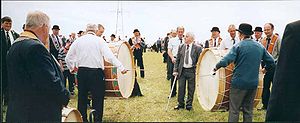
Lodges march together, and will generally alternate with marching bands of various kinds. Band members are often not formally associated with the Order but are hired for the day, although most are clearly of a similar political hue to the lodges, and have similar names. The bands, especially flute bands, have a reputation as being less respectable than the lodges, although they are seen by many as serving the useful purpose of keeping young men from working class areas out of trouble. An instrument almost unique to these marches is the Lambeg drum
. The fact that no bands have vocalists, several different songs have the same tune, and successive bands will often be playing different songs can make it difficult even for locals and impossible for outsiders to know exactly what is being played. Popular songs include The Sash
and Derry's Walls
. Explicitly violent songs such as Billy Boys
may also be played.
The vast majority of marchers are male, but there are some all-female bands and a few mixed bands. Some all-male bands have female flag or banner carriers. In addition, some Women's Orange Lodges take part in the parades. Orangewomen have paraded on the Twelfth in some rural areas since at least the mid-twentieth century, but were banned from the Belfast parades until the 1990s.
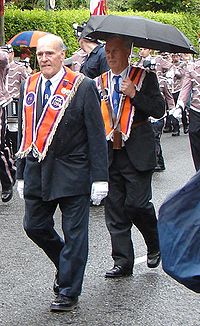
Orangemen on parade typically wear a dark suit, orange sash
, white gloves and a bowler hat
, although in recent years the hat has become less compulsory. An umbrella is often carried, although more because of the Northern Irish weather than for any ceremonial reasons. In the rare years of hot weather, many lodges will parade in shirt sleeves due to the distance covered. Orangewomen have not developed a standard dress code, but usually dress formally. Bands wear uniforms of various kinds, often colourful. Lodges usually carry elaborate banners
depicting Orange heroes or historic or Biblical scenes, or Unionist symbols. The most popular subject is William III, often crossing the River Boyne
.
At the field, some lodges and bands acquire humorous costumes or accessories and make the return journey in them, and the atmosphere is generally more relaxed and playful, although in times of tension it can also be more aggressive.
in Northern Ireland, and as a result many people from both communities take the opportunity to go on holiday outside Northern Ireland. This is often described as escape from the Twelfth and while this is certainly the case for some, others are simply doing what many people do in summer public holidays, and getting away from home.
During The Troubles
some nationalist
areas organised alternative festivals in order to keep Catholic children away from the parades, where they might come into conflict with Protestant children, and to make the holiday more enjoyable for their communities. It is often said that before the Troubles many Catholics watched the parades, although the numbers may be exaggerated.
The "marching season", as the parades are usually referred to by the press, and especially the Twelfth, has historically seen a rise in sectarian violence. Before the outbreak of the Troubles there were frequent conflicts over the displaying of Union Jacks and other flags, particularly in factories and other workplaces.
and County Donegal
, with riot police on duty at flashpoint parades to prevent clashes between the nationalist
community and unionist community. Many in the nationalist community view the parades as triumphalist and a sign of Unionist Protestant dominance in Northern Ireland. Marchers insist that they have the right to walk on public streets, particularly along their 'traditional routes', even if these routes take them through or past what are predominantly nationalist areas. Nationalists see this as a deliberate territorial affront. Until 2010 the number of these flashpoints appeared to decrease, as the paraders were told to desist, or moderate them by the Parades Commission
, and nationalists adopted a more relaxed attitude.
Every Twelfth between 1970 and 2005, British Army
soldiers were deployed in Belfast to help police the parades. In 2006, for the first time in more than three decades, soldiers were not deployed on the streets of Belfast during the Twelfth, in what was seen as a benefit of the reduced tensions under the peace process
. Due to improved policing and the Northern Ireland peace process, recent parades have been more peaceful. Any complaints about parades may be referred to the Parades Commission
, who can set restrictions or even ban a parade if it is seen to be too contentious.
In a 2011 survey of Orangemen throughout Northern Ireland, 58% of Orangemen said they should be allowed to march through nationalist areas with no restrictions; 20% said they should negotiate with residents first.
or a history of settlement by Irish Protestants. In Great Britain, Orange marches have died out recently and if they still exist they tend to be held a week or so before the Twelfth due to the number of bands and lodges that travel to Northern Ireland
to march there. The Liverpool lodges parade both in the city and in the seaside resort of Southport on the 12th July. In Canada, the USA and Australia, marching occurs on the Twelfth, although this is much less common now than in former decades. However, 'Orangeman's Day' is a paid government holiday in the Canadian province of Newfoundland and Labrador
. Parades were formerly held in New Zealand
on the Twelfth, but this no longer occurs.
Until the Partition of Ireland
, the Twelfth was observed by Protestants in many parts of Ireland, but the decline of the Protestant population and local antagonism have dramatically reduced the number held in the Republic of Ireland
. The only remaining annual parade is held in Rossnowlagh
and was on the Twelfth until the 1970s, when it was moved to the weekend before.
In July 2010, former Tánaiste
Michael McDowell
said that the Twelfth should be made a national holiday in the Republic of Ireland as well as in Northern Ireland.
Protestantism
Protestantism is one of the three major groupings within Christianity. It is a movement that began in Germany in the early 16th century as a reaction against medieval Roman Catholic doctrines and practices, especially in regards to salvation, justification, and ecclesiology.The doctrines of the...
celebration held on 12 July. It originated in Ireland
Ireland
Ireland is an island to the northwest of continental Europe. It is the third-largest island in Europe and the twentieth-largest island on Earth...
during the 18th century. It celebrates the Glorious Revolution
Glorious Revolution
The Glorious Revolution, also called the Revolution of 1688, is the overthrow of King James II of England by a union of English Parliamentarians with the Dutch stadtholder William III of Orange-Nassau...
(1688) and victory of Protestant king William of Orange
William III of England
William III & II was a sovereign Prince of Orange of the House of Orange-Nassau by birth. From 1672 he governed as Stadtholder William III of Orange over Holland, Zeeland, Utrecht, Guelders, and Overijssel of the Dutch Republic. From 1689 he reigned as William III over England and Ireland...
over Catholic king James II
James II of England
James II & VII was King of England and King of Ireland as James II and King of Scotland as James VII, from 6 February 1685. He was the last Catholic monarch to reign over the Kingdoms of England, Scotland, and Ireland...
at the Battle of the Boyne
Battle of the Boyne
The Battle of the Boyne was fought in 1690 between two rival claimants of the English, Scottish and Irish thronesthe Catholic King James and the Protestant King William across the River Boyne near Drogheda on the east coast of Ireland...
(1690). It is sometimes called the Glorious Twelfth
Glorious Twelfth
The Glorious Twelfth is usually used to refer to 12 August, the start of the shooting season for Red Grouse and to a lesser extent the Ptarmigan in the United Kingdom. This is one of the busiest days in the shooting season, with large amounts of game being shot...
, but that term is more commonly used to refer to 12 August. Members of the Orange Order and Protestant marching bands stage parades throughout Northern Ireland
Northern Ireland
Northern Ireland is one of the four countries of the United Kingdom. Situated in the north-east of the island of Ireland, it shares a border with the Republic of Ireland to the south and west...
and to a lesser extent in other parts of the world. The Toronto
Toronto
Toronto is the provincial capital of Ontario and the largest city in Canada. It is located in Southern Ontario on the northwestern shore of Lake Ontario. A relatively modern city, Toronto's history dates back to the late-18th century, when its land was first purchased by the British monarchy from...
Twelfth, for example, is North America's oldest consecutive yearly parade. While it is a Protestant celebration, not all Irish Protestants celebrate it, whether due to political or cultural reasons or indifference. More recently, attempts have been made to play down the explicitly unionist
Unionism in Ireland
Unionism in Ireland is an ideology that favours the continuation of some form of political union between the islands of Ireland and Great Britain...
political aspects of the parades (as well as any violent history) and present the Twelfth as a "cultural" event, at which tourists are welcome. It has been argued by some that before the Troubles
The Troubles
The Troubles was a period of ethno-political conflict in Northern Ireland which spilled over at various times into England, the Republic of Ireland, and mainland Europe. The duration of the Troubles is conventionally dated from the late 1960s and considered by many to have ended with the Belfast...
, members of both communities participated in the event; however it was dominated by Protestants and many Catholics opposed the celebrations.
History
Irish Rebellion of 1641
The Irish Rebellion of 1641 began as an attempted coup d'état by Irish Catholic gentry, who tried to seize control of the English administration in Ireland to force concessions for the Catholics living under English rule...
and the Williamite war in Ireland
Williamite war in Ireland
The Williamite War in Ireland—also called the Jacobite War in Ireland, the Williamite-Jacobite War in Ireland and in Irish as Cogadh an Dá Rí —was a conflict between Catholic King James II and Protestant King William of Orange over who would be King of England, Scotland and Ireland...
(1689–91). The first such commemoration was the anniversary of the 1641 rebellion on 23 October, an attempted coup d'état by Irish Catholic gentry who tried to seize control of the English administration in Ireland. The second major day was the birthday of William of Orange
William III of England
William III & II was a sovereign Prince of Orange of the House of Orange-Nassau by birth. From 1672 he governed as Stadtholder William III of Orange over Holland, Zeeland, Utrecht, Guelders, and Overijssel of the Dutch Republic. From 1689 he reigned as William III over England and Ireland...
, Protestant victor of the Williamite war in the 1690s on 4 November. Both of these anniversaries faded in popularity by the end of the 18th century.
The Twelfth itself originated as a celebration of the Battle of Aughrim
Battle of Aughrim
The Battle of Aughrim was the decisive battle of the Williamite War in Ireland. It was fought between the Jacobites and the forces of William III on 12 July 1691 , near the village of Aughrim in County Galway....
, which took place on 12 July 1691 in the Julian calendar
Julian calendar
The Julian calendar began in 45 BC as a reform of the Roman calendar by Julius Caesar. It was chosen after consultation with the astronomer Sosigenes of Alexandria and was probably designed to approximate the tropical year .The Julian calendar has a regular year of 365 days divided into 12 months...
. Aughrim was the decisive battle of the Williamite war, in which the predominantly Irish Catholic Jacobite
Jacobitism
Jacobitism was the political movement in Britain dedicated to the restoration of the Stuart kings to the thrones of England, Scotland, later the Kingdom of Great Britain, and the Kingdom of Ireland...
army was destroyed and the remainder capitulated at Limerick, thereafter being exiled to France to fight in the wars of Louis XIV, the Sun King. The Twelfth in the early 18th century was a popular commemoration of this battle, featuring bonfires and parades. The Battle of the Boyne (fought on 1 July 1690) was commemorated with smaller parades on 1 July. However, two events were combined in the late 18th century to switch the Twelfth commemorations to the Boyne.
The first reason for this was the British switch to the Gregorian calendar
Gregorian calendar
The Gregorian calendar, also known as the Western calendar, or Christian calendar, is the internationally accepted civil calendar. It was introduced by Pope Gregory XIII, after whom the calendar was named, by a decree signed on 24 February 1582, a papal bull known by its opening words Inter...
in 1752, which repositioned the Battle of the Boyne to 11 July in the new calendar, the very eve of the Battle of Aughrim, on 12 July in the old calendar. The second reason was the foundation of the Orange Order
Orange Institution
The Orange Institution is a Protestant fraternal organisation based mainly in Northern Ireland and Scotland, though it has lodges throughout the Commonwealth and United States. The Institution was founded in 1796 near the village of Loughgall in County Armagh, Ireland...
in 1795. The Order preferred the Boyne, due to William of Orange's presence there. It has also been suggested that in the 1790s (a time of Roman Catholic resurgence) the Boyne, where the Jacobites were routed, was more appealing to the Order than Aughrim, where they had fought hard and died in great numbers.
The Twelfth parades of the early 19th century often led to riots and public disorder, so much so that the Orange Order and the Twelfth were suppressed in the 1830s and 40s.
Events
Lead-up to the Twelfth
The 'marching seasonParades in Northern Ireland
Parades are an important part of Northern Irish culture. Although the majority of parades are held ostensibly by Protestant, unionist or Ulster loyalist groups, nationalist, republican and non-political groups also parade. Parading is often considered to be an assertion of a group's control over a...
' begins around Easter, and from this point until the Twelfth the Orange Order stages numerous small parades. The most common of these are lodge parades, in which one lodge walks with a single band. Others, such as the 'mini-Twelfth' at the start of July, feature several lodges.
At the start of July, some unionist areas will be decorated in a 'loyal' style. In most such areas this will include the flying of flags (primarily the Union Jack and Ulster Banner
Ulster Banner
The Ulster Banner, more commonly known as the Ulster flag, Northern Ireland flag or the Red Hand of Ulster flag, was the flag of the Government of Northern Ireland between 1953 and 1972. Since that government was abolished in 1972, the flag has become a symbol of Ulster loyalism and is not...
but also the Flag of Scotland
Flag of Scotland
The Flag of Scotland, , also known as Saint Andrew's Cross or the Saltire, is the national flag of Scotland. As the national flag it is the Saltire, rather than the Royal Standard of Scotland, which is the correct flag for all individuals and corporate bodies to fly in order to demonstrate both...
) from lamp posts and houses, and sometimes the erection of bunting
Bunting (textile)
Bunting was originally a specific type of lightweight worsted wool fabric generically known as tammy, manufactured from the turn of the 17th century, and used for making ribbons. and flags, including signal flags for the Royal Navy...
over the streets. In especially Loyalist areas such as the Shankill Road and Sandy Row
Sandy Row
Sandy Row is a Protestant working-class community in south Belfast, Northern Ireland. It has a population of about 3,000. It is a staunchly loyalist area of Belfast, being a traditional heartland for affiliation with the paramilitary Ulster Defence Association and the Orange Order.-Location:Sandy...
in Belfast many householders will also decorate their houses with large quantities of bunting and flags, murals
Northern Irish murals
Murals in Northern Ireland have become symbols of Northern Ireland, depicting the region's past and present political and religious divisions.Northern Ireland contains arguably the most famous political murals. Almost 2,000 murals have been documented in Northern Ireland since the 1970s...
will be touched up, small banners will be attached to lamp posts, and arches will be erected. Arches - which can range from elaborate wooden constructions costing thousands of pounds to a couple of ropes with flags hanging on them - are less common now than in former decades. Decorations generally remain in place until the end of August.
Eleventh night
The night before the Twelfth sees enormous bonfires lit in many Protestant, Unionist and Loyalist districts of Northern Ireland. These are alternately seen as friendly community get-togethers, depending on time, place and personal viewpoint. A recent criticism of the bonfires is that much of what is burnt (especially tires) causes serious environmental pollution. In the past the fires were lit on intersections but damage to nearby houses and to the street itself meant that most areas now have an area of waste ground set aside for this purpose.Official events
Belfast
Belfast is the capital of and largest city in Northern Ireland. By population, it is the 14th biggest city in the United Kingdom and second biggest on the island of Ireland . It is the seat of the devolved government and legislative Northern Ireland Assembly...
parade takes more or less the same route, although in the 1980s the destination changed when the Order purchased a new field to end the parade in. In most areas the parade begins at an Orange Hall and proceeds through the town to a field where members of the Order, their friends and family, and the general public gather to eat, drink and listen to speeches by clergymen, politicians and senior members of the Order. In the past the Twelfth has been a major venue for discussion of the political issues of the day. A church service will also be conducted and sometimes band prizes will be awarded.
Lodges march together, and will generally alternate with marching bands of various kinds. Band members are often not formally associated with the Order but are hired for the day, although most are clearly of a similar political hue to the lodges, and have similar names. The bands, especially flute bands, have a reputation as being less respectable than the lodges, although they are seen by many as serving the useful purpose of keeping young men from working class areas out of trouble. An instrument almost unique to these marches is the Lambeg drum
Lambeg drum
A Lambeg drum is a large Irish drum, beaten with curved malacca canes. It is used primarily in Northern Ireland by Unionists and the Orange Order traditionally in street parades held in the summer, particularly on and around 12 July...
. The fact that no bands have vocalists, several different songs have the same tune, and successive bands will often be playing different songs can make it difficult even for locals and impossible for outsiders to know exactly what is being played. Popular songs include The Sash
The Sash
The Sash is a ballad from Ireland commemorating the victory of King William III in the Williamite war in Ireland in 1690–1691....
and Derry's Walls
Derry's Walls
"Derry's Walls" is a historical song sung in Northern Ireland. It commemorates the Siege of Derry in 1689.The author of the words is unknown, and it is sung to the tune of "God Bless the Prince of Wales".-Lyrics:Verse 1...
. Explicitly violent songs such as Billy Boys
Billy Boys
The Billy Boys is a loyalist song from Glasgow, sung to the tune of "Marching Through Georgia." It originated in the 1930s as the signature song of one of the Glasgow razor gangs led by Billy Fullerton and later reflected the long running sectarian divide in the city...
may also be played.
The vast majority of marchers are male, but there are some all-female bands and a few mixed bands. Some all-male bands have female flag or banner carriers. In addition, some Women's Orange Lodges take part in the parades. Orangewomen have paraded on the Twelfth in some rural areas since at least the mid-twentieth century, but were banned from the Belfast parades until the 1990s.
Orangemen on parade typically wear a dark suit, orange sash
Sash
A sash is a cloth belt used to hold a robe together, and is usually tied about the waist. The Japanese equivalent of a sash, obi, serves to hold a kimono or yukata together. Decorative sashes may pass from the shoulder to the hip rather than around the waist...
, white gloves and a bowler hat
Bowler hat
The bowler hat, also known as a coke hat, derby , billycock or bombin, is a hard felt hat with a rounded crown originally created in 1849 for the English soldier and politician Edward Coke, the younger brother of the 2nd Earl of Leicester...
, although in recent years the hat has become less compulsory. An umbrella is often carried, although more because of the Northern Irish weather than for any ceremonial reasons. In the rare years of hot weather, many lodges will parade in shirt sleeves due to the distance covered. Orangewomen have not developed a standard dress code, but usually dress formally. Bands wear uniforms of various kinds, often colourful. Lodges usually carry elaborate banners
Banners in Northern Ireland
Banners are a significant part of the Culture of Northern Ireland, particularly for the Protestant/unionist community, and one of the region's most prominent types of folk art. They are typically carried in parades such as those held on the Twelfth of July, Saint Patrick's Day and other times...
depicting Orange heroes or historic or Biblical scenes, or Unionist symbols. The most popular subject is William III, often crossing the River Boyne
River Boyne
The River Boyne is a river in Leinster, Ireland, the course of which is about long. It rises at Trinity Well, Newbury Hall, near Carbury, County Kildare, and flows towards the Northeast through County Meath to reach the Irish Sea between Mornington, County Meath and Baltray, County Louth. Salmon...
.
At the field, some lodges and bands acquire humorous costumes or accessories and make the return journey in them, and the atmosphere is generally more relaxed and playful, although in times of tension it can also be more aggressive.
Unofficial events
12 July is an annual public holidayPublic holiday
A public holiday, national holiday or legal holiday is a holiday generally established by law and is usually a non-working day during the year....
in Northern Ireland, and as a result many people from both communities take the opportunity to go on holiday outside Northern Ireland. This is often described as escape from the Twelfth and while this is certainly the case for some, others are simply doing what many people do in summer public holidays, and getting away from home.
During The Troubles
The Troubles
The Troubles was a period of ethno-political conflict in Northern Ireland which spilled over at various times into England, the Republic of Ireland, and mainland Europe. The duration of the Troubles is conventionally dated from the late 1960s and considered by many to have ended with the Belfast...
some nationalist
Irish nationalism
Irish nationalism manifests itself in political and social movements and in sentiment inspired by a love for Irish culture, language and history, and as a sense of pride in Ireland and in the Irish people...
areas organised alternative festivals in order to keep Catholic children away from the parades, where they might come into conflict with Protestant children, and to make the holiday more enjoyable for their communities. It is often said that before the Troubles many Catholics watched the parades, although the numbers may be exaggerated.
The "marching season", as the parades are usually referred to by the press, and especially the Twelfth, has historically seen a rise in sectarian violence. Before the outbreak of the Troubles there were frequent conflicts over the displaying of Union Jacks and other flags, particularly in factories and other workplaces.
Controversy
Parades on the Twelfth are often controversial due to the nature of the Orange Order, and the Twelfth is a tense occasion in many parts of Northern IrelandNorthern Ireland
Northern Ireland is one of the four countries of the United Kingdom. Situated in the north-east of the island of Ireland, it shares a border with the Republic of Ireland to the south and west...
and County Donegal
County Donegal
County Donegal is a county in Ireland. It is part of the Border Region and is also located in the province of Ulster. It is named after the town of Donegal. Donegal County Council is the local authority for the county...
, with riot police on duty at flashpoint parades to prevent clashes between the nationalist
Irish nationalism
Irish nationalism manifests itself in political and social movements and in sentiment inspired by a love for Irish culture, language and history, and as a sense of pride in Ireland and in the Irish people...
community and unionist community. Many in the nationalist community view the parades as triumphalist and a sign of Unionist Protestant dominance in Northern Ireland. Marchers insist that they have the right to walk on public streets, particularly along their 'traditional routes', even if these routes take them through or past what are predominantly nationalist areas. Nationalists see this as a deliberate territorial affront. Until 2010 the number of these flashpoints appeared to decrease, as the paraders were told to desist, or moderate them by the Parades Commission
Parades Commission
The Parades Commission is a quasi-judicial non-departmental public body responsible for placing restrictions on or banning outright any parades in Northern Ireland it deems contentious or offensive. It is composed of seven members, all of whom are appointed by the Secretary of State for Northern...
, and nationalists adopted a more relaxed attitude.
Every Twelfth between 1970 and 2005, British Army
British Army
The British Army is the land warfare branch of Her Majesty's Armed Forces in the United Kingdom. It came into being with the unification of the Kingdom of England and Scotland into the Kingdom of Great Britain in 1707. The new British Army incorporated Regiments that had already existed in England...
soldiers were deployed in Belfast to help police the parades. In 2006, for the first time in more than three decades, soldiers were not deployed on the streets of Belfast during the Twelfth, in what was seen as a benefit of the reduced tensions under the peace process
Northern Ireland peace process
The peace process, when discussing the history of Northern Ireland, is often considered to cover the events leading up to the 1994 Provisional Irish Republican Army ceasefire, the end of most of the violence of the Troubles, the Belfast Agreement, and subsequent political developments.-Towards a...
. Due to improved policing and the Northern Ireland peace process, recent parades have been more peaceful. Any complaints about parades may be referred to the Parades Commission
Parades Commission
The Parades Commission is a quasi-judicial non-departmental public body responsible for placing restrictions on or banning outright any parades in Northern Ireland it deems contentious or offensive. It is composed of seven members, all of whom are appointed by the Secretary of State for Northern...
, who can set restrictions or even ban a parade if it is seen to be too contentious.
In a 2011 survey of Orangemen throughout Northern Ireland, 58% of Orangemen said they should be allowed to march through nationalist areas with no restrictions; 20% said they should negotiate with residents first.
The Twelfth outside Northern Ireland
Although the Twelfth is primarily observed in Northern Ireland, it is also commemorated in other countries with strong links to UlsterUlster
Ulster is one of the four provinces of Ireland, located in the north of the island. In ancient Ireland, it was one of the fifths ruled by a "king of over-kings" . Following the Norman invasion of Ireland, the ancient kingdoms were shired into a number of counties for administrative and judicial...
or a history of settlement by Irish Protestants. In Great Britain, Orange marches have died out recently and if they still exist they tend to be held a week or so before the Twelfth due to the number of bands and lodges that travel to Northern Ireland
Northern Ireland
Northern Ireland is one of the four countries of the United Kingdom. Situated in the north-east of the island of Ireland, it shares a border with the Republic of Ireland to the south and west...
to march there. The Liverpool lodges parade both in the city and in the seaside resort of Southport on the 12th July. In Canada, the USA and Australia, marching occurs on the Twelfth, although this is much less common now than in former decades. However, 'Orangeman's Day' is a paid government holiday in the Canadian province of Newfoundland and Labrador
Newfoundland and Labrador
Newfoundland and Labrador is the easternmost province of Canada. Situated in the country's Atlantic region, it incorporates the island of Newfoundland and mainland Labrador with a combined area of . As of April 2011, the province's estimated population is 508,400...
. Parades were formerly held in New Zealand
New Zealand
New Zealand is an island country in the south-western Pacific Ocean comprising two main landmasses and numerous smaller islands. The country is situated some east of Australia across the Tasman Sea, and roughly south of the Pacific island nations of New Caledonia, Fiji, and Tonga...
on the Twelfth, but this no longer occurs.
Until the Partition of Ireland
Partition of Ireland
The partition of Ireland was the division of the island of Ireland into two distinct territories, now Northern Ireland and the Republic of Ireland . Partition occurred when the British Parliament passed the Government of Ireland Act 1920...
, the Twelfth was observed by Protestants in many parts of Ireland, but the decline of the Protestant population and local antagonism have dramatically reduced the number held in the Republic of Ireland
Republic of Ireland
Ireland , described as the Republic of Ireland , is a sovereign state in Europe occupying approximately five-sixths of the island of the same name. Its capital is Dublin. Ireland, which had a population of 4.58 million in 2011, is a constitutional republic governed as a parliamentary democracy,...
. The only remaining annual parade is held in Rossnowlagh
Rossnowlagh
Rossnowlagh or Rosnowlagh is a seaside beach resort in south County Donegal, Ireland. It is about 8.5 km north of Ballyshannon and 16.0 km southwest of Donegal Town. The extensive beach is very popular with families and is frequented by walkers, surfers, wind-surfers, kite-surfers and swimmers,...
and was on the Twelfth until the 1970s, when it was moved to the weekend before.
In July 2010, former Tánaiste
Tánaiste
The Tánaiste is the deputy prime minister of Ireland. The current Tánaiste is Eamon Gilmore, TD who was appointed on 9 March 2011.- Origins and etymology :...
Michael McDowell
Michael McDowell
Michael McDowell is a Senior Counsel in the Bar Council of Ireland and a former politician. A grandson of Irish revolutionary Eoin MacNeill, McDowell was a founding member of the Progressive Democrats political party in the mid-1980s...
said that the Twelfth should be made a national holiday in the Republic of Ireland as well as in Northern Ireland.
See also
- Eleventh nightEleventh nightIn Northern Ireland, the Eleventh Night or 11th Night refers to the night before the Twelfth of July, an annual Protestant commemoration of the Battle of the Boyne . On this night, many Protestant, unionist and loyalist communities in Northern Ireland light bonfires...
- Banners in Northern IrelandBanners in Northern IrelandBanners are a significant part of the Culture of Northern Ireland, particularly for the Protestant/unionist community, and one of the region's most prominent types of folk art. They are typically carried in parades such as those held on the Twelfth of July, Saint Patrick's Day and other times...
- Lambeg drumLambeg drumA Lambeg drum is a large Irish drum, beaten with curved malacca canes. It is used primarily in Northern Ireland by Unionists and the Orange Order traditionally in street parades held in the summer, particularly on and around 12 July...
- Orange WalkOrange walkOrange walks are a series of parades held annually by members of the Orange Order during the summer in Northern Ireland, to a lesser extent in Scotland, and occasionally in England, the Republic of Ireland, and throughout the Commonwealth...
- Parades in Northern IrelandParades in Northern IrelandParades are an important part of Northern Irish culture. Although the majority of parades are held ostensibly by Protestant, unionist or Ulster loyalist groups, nationalist, republican and non-political groups also parade. Parading is often considered to be an assertion of a group's control over a...
External links
- The Twelfth in pictures BBC News, 12 July 2006
- Gallery Orange Chronicle
- North Belfast parade passes peacefully RTÉ News, 12 July 2006