

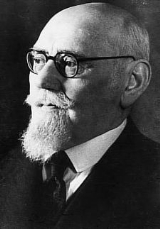
Karl Renner

Encyclopedia

Austria
Austria , officially the Republic of Austria , is a landlocked country of roughly 8.4 million people in Central Europe. It is bordered by the Czech Republic and Germany to the north, Slovakia and Hungary to the east, Slovenia and Italy to the south, and Switzerland and Liechtenstein to the...
n politician
Politician
A politician, political leader, or political figure is an individual who is involved in influencing public policy and decision making...
. He was born in Untertannowitz
Dolní Dunajovice
Dolní Dunajovice is a village in Břeclav District of the South Moravian Region in the Czech Republic. It is located about northwest of Mikulov. The municipality has a population of 1,693 ....
in the Austro-Hungarian Empire (today in the Czech Republic) and died in Vienna
Vienna
Vienna is the capital and largest city of the Republic of Austria and one of the nine states of Austria. Vienna is Austria's primary city, with a population of about 1.723 million , and is by far the largest city in Austria, as well as its cultural, economic, and political centre...
. He is called the Father of the Republic because he headed the first government in republican Austria in 1918 and was once again decisive in establishing the present Second Republic in 1945, becoming its first President.
Early life
Renner was born the 18th child of a small farmer but, because of his intelligence, was allowed to attend a selective gymnasiumGymnasium (school)
A gymnasium is a type of school providing secondary education in some parts of Europe, comparable to English grammar schools or sixth form colleges and U.S. college preparatory high schools. The word γυμνάσιον was used in Ancient Greece, meaning a locality for both physical and intellectual...
. One of his teachers was Wilhelm Jerusalem
Wilhelm Jerusalem
Wilhelm Jerusalem was an Austrian Jewish philosopher and pedagogue....
. From 1890 to 1896 he studied law at the University of Vienna
University of Vienna
The University of Vienna is a public university located in Vienna, Austria. It was founded by Duke Rudolph IV in 1365 and is the oldest university in the German-speaking world...
. In 1895 he was one of the founding members of the Naturfreunde (Friends of Nature
Friends of Nature
Friends of Nature is an international movement with a background in the Social Democratic movement, which aims to make nature accessible to the wider community by providing appropriate recreational and travel facilities.-Background:It is a non-profit organisation which, in addition to encouraging...
) organisation and created their logo. Being interested in politics he became a librarian in parliament. During these early years he opened new perspectives of law - all the while disowning his innovative ideas under a variety of pseudonyms lest he lose his coveted post as parliamentary librarian.
Pre–World War II
In 1918, after the collapse of the Austro-Hungarian Empire, he became the first head of government ("State Chancellor") of that newly-established small German-speaking republic which refused to be considered the heir of the HabsburgHabsburg
The House of Habsburg , also found as Hapsburg, and also known as House of Austria is one of the most important royal houses of Europe and is best known for being an origin of all of the formally elected Holy Roman Emperors between 1438 and 1740, as well as rulers of the Austrian Empire and...
monarchy and wished to be known as "Republik Deutsch-Österreich
German Austria
Republic of German Austria was created following World War I as the initial rump state for areas with a predominantly German-speaking population within what had been the Austro-Hungarian Empire, without the Kingdom of Hungary, which in 1918 had become the Hungarian Democratic Republic.German...
," i.e., Republic of German-Austria. This name, however, was prohibited by The Entente
Allies of World War I
The Entente Powers were the countries at war with the Central Powers during World War I. The members of the Triple Entente were the United Kingdom, France, and the Russian Empire; Italy entered the war on their side in 1915...
in the Treaty of Saint-Germain of 1919 when they crushed the resolution of the Constituent National Assembly in Vienna that "German-Austria" was to be part of the German Republic
Weimar Republic
The Weimar Republic is the name given by historians to the parliamentary republic established in 1919 in Germany to replace the imperial form of government...
. Even before the collapse of the Austro-Hungarian Monarchy Renner had proposed a future union of the German parts of Austria with, even using the word "Anschluss
Anschluss
The Anschluss , also known as the ', was the occupation and annexation of Austria into Nazi Germany in 1938....
",
Renner was always interested in politics and in 1896 he joined the Social Democratic Party of Austria
Social Democratic Party of Austria
The Social Democratic Party of Austria is one of the oldest political parties in Austria. The SPÖ is one of the two major parties in Austria, and has ties to trade unions and the Austrian Chamber of Labour. The SPÖ is among the few mainstream European social-democratic parties that have preserved...
(SPÖ), representing the party in the Reichsrat
Reichsrat (Austria)
The Imperial Council of Austria from 1867 to 1918 was the parliament of the Cisleithanian part of the Austro-Hungarian Empire. It was a bicameral legislature, consisting of the Herrenhaus and the Abgeordnetenhaus...
from 1907 till its dissolution in November 1918. He was in the forefront of the Provisional and the Constitutional National Assemblies of those "Lands Represented in the Reichsrat" (the formal description of the Austrian half of the Dual Monarchy) that predominantly spoke German
German language
German is a West Germanic language, related to and classified alongside English and Dutch. With an estimated 90 – 98 million native speakers, German is one of the world's major languages and is the most widely-spoken first language in the European Union....
and had decided to form a nation state just like all the other nationalities had done. He was the leader of the delegation that represented this new German-Austria in the negotiations of St. Germain where the "Republic of Austria" was acknowledged but was declared to be the responsible successor to Imperial Austria. There Renner had to accept that this new Austria was prohibited any political association with Germany and he had to accept the loss of the German speaking South Tyrol
South Tyrol
South Tyrol , also known by its Italian name Alto Adige, is an autonomous province in northern Italy. It is one of the two autonomous provinces that make up the autonomous region of Trentino-Alto Adige/Südtirol. The province has an area of and a total population of more than 500,000 inhabitants...
and the German-speaking parts of Bohemia
Bohemia
Bohemia is a historical region in central Europe, occupying the western two-thirds of the traditional Czech Lands. It is located in the contemporary Czech Republic with its capital in Prague...
and Moravia
Moravia
Moravia is a historical region in Central Europe in the east of the Czech Republic, and one of the former Czech lands, together with Bohemia and Silesia. It takes its name from the Morava River which rises in the northwest of the region...
where he himself was born; this forced him to give up his share in the parental farm if he, "the peasant proprietor who turned Marxist", wanted to remain an Austrian government officer.
Renner was Chancellor of Austria
Chancellor of Austria
The Federal Chancellor is the head of government in Austria. Its deputy is the Vice-Chancellor. Before 1918, the equivalent office was the Minister-President of Austria. The Federal Chancellor is considered to be the most powerful political position in Austrian politics.-Appointment:The...
of the first three coalition cabinets and Minister of Foreign Affairs from 1918 until 1920, and, from 1931 to 1933, he was President of Parliament, the National Council of Austria
National Council of Austria
The National Council is one of the two houses of the Austrian parliament. According to the constitution, the National Council and the complementary Federal Council are peers...
. In the time of authoritarian Austrofascism
Austrofascism
Austrofascism is a term which is frequently used by historians to describe the authoritarian rule installed in Austria with the May Constitution of 1934, which ceased with the forcible incorporation of the newly-founded Federal State of Austria into Nazi Germany in 1938...
from 1934, when his party was prohibited, he even welcomed the Anschluss
Anschluss
The Anschluss , also known as the ', was the occupation and annexation of Austria into Nazi Germany in 1938....
. Having originally been a proponent of new German-Austria becoming a part of the democratic German Republic
Weimar Republic
The Weimar Republic is the name given by historians to the parliamentary republic established in 1919 in Germany to replace the imperial form of government...
, he expected Nazism
Nazism
Nazism, the common short form name of National Socialism was the ideology and practice of the Nazi Party and of Nazi Germany...
to be but a passing phenomenon not worse than the dictatorship of Dollfuß
Engelbert Dollfuss
Engelbert Dollfuss was an Austrian Christian Social and Patriotic Front statesman. Serving previously as Minister for Forest and Agriculture, he ascended to Federal Chancellor in 1932 in the midst of a crisis for the conservative government...
and Schuschniggs's
Kurt Schuschnigg
Kurt Alois Josef Johann Schuschnigg was Chancellor of the First Austrian Republic, following the assassination of his predecessor, Dr. Engelbert Dollfuss, in July 1934, until Germany’s invasion of Austria, , in March 1938...
authoritarian one-party system, which had ruled Austria. During World War II
World War II
World War II, or the Second World War , was a global conflict lasting from 1939 to 1945, involving most of the world's nations—including all of the great powers—eventually forming two opposing military alliances: the Allies and the Axis...
, however, he distanced himself from politics completely.
Post–World War II
In April 1945, just before the collapse of the Third Reich, the defeat of Germany and the end of the war, Renner set up a Provisional Government in ViennaVienna
Vienna is the capital and largest city of the Republic of Austria and one of the nine states of Austria. Vienna is Austria's primary city, with a population of about 1.723 million , and is by far the largest city in Austria, as well as its cultural, economic, and political centre...
with other politicians from the three revived parties Social Democratic Party (SPÖ), Austrian People's Party
Austrian People's Party
The Austrian People's Party is a Christian democratic and conservative political party in Austria. A successor to the Christian Social Party of the late 19th and early 20th centuries, it is similar to the Christian Democratic Union of Germany in terms of ideology...
(ÖVP, a conservative successor to the Christian Social Party) and Communist Party
Communist Party of Austria
The Communist Party of Austria is a communist party based in Austria. Established in 1918, it was banned between 1933 and 1945 under both the Austrofascist regime, and German control of Austria during World War II...
(KPÖ). On April 27, by a declaration, this Provisional Government separated Austria from Germany and campaigned for the country to be acknowledged as an independent republic. As a result of Renner's actions Austria was to benefit greatly in the eyes of the Allies as she had fulfilled the stipulation of the Moscow Declaration
Moscow Declaration
The Moscow Declaration was signed during the Moscow Conference on October 30, 1943. The formal name of the declaration was "Declaration of the Four Nations on General Security". It was signed by the foreign secretaries of the Governments of the United States, the United Kingdom and the Soviet Union...
of 1943, where the Foreign Secretaries of US, UK and USSR declared that the annexation (Anschluss) of Austria by Germany was null and void calling for the establishment of a free Austria after the victory over Nazi Germany provided that Austria could demonstrate that she had undertaken suitable actions of her own in that direction. Thus Austria, having been invaded by Germany, was treated as an unwilling party and "the first victim" of Nazi Germany
Nazi Germany
Nazi Germany , also known as the Third Reich , but officially called German Reich from 1933 to 1943 and Greater German Reich from 26 June 1943 onward, is the name commonly used to refer to the state of Germany from 1933 to 1945, when it was a totalitarian dictatorship ruled by...
. Being suspicious of the fact that the Russians in Vienna were the first to accept Renner's Cabinet, the Western Allies hesitated half a year with their recognition, but his Provisional Government was in the end recognised by all Four Powers on Oct. 20 and Renner was thus the first post-war Chancellor
Chancellor of Austria
The Federal Chancellor is the head of government in Austria. Its deputy is the Vice-Chancellor. Before 1918, the equivalent office was the Minister-President of Austria. The Federal Chancellor is considered to be the most powerful political position in Austrian politics.-Appointment:The...
. In late 1945, he was elected the first President
President of Austria
The President of Austria is the federal head of state of Austria. Though theoretically entrusted with great power by the constitution, in practice the President acts, for the most part, merely as a ceremonial figurehead...
of the Second Republic.
Karl Renner died in 1950 and was buried in the Presidential Tomb at Zentralfriedhof
Zentralfriedhof
The Zentralfriedhof is one of the largest cemeteries in the world, largest by number of interred in Europe and most famous cemetery among Vienna's nearly 50 cemeteries.-Name and location:...
in Vienna.
Political beliefs
For most of his life, Renner alternated between the political commitment of a Social DemocratSocial democracy
Social democracy is a political ideology of the center-left on the political spectrum. Social democracy is officially a form of evolutionary reformist socialism. It supports class collaboration as the course to achieve socialism...
and the analytical distance of an academic scholar. Central to Renner's academic work is the problem of the relationship between law and social transformations. With his Rechtsinstitute des Privatrechts und ihre soziale Funktion. Ein Beitrag zur Kritik des bürgerlichen Rechts (1904), he became one of the founders of the discipline of the sociology of law
Sociology of law
The sociology of law is often described as a sub-discipline of sociology or an interdisciplinary approach within legal studies...
. His and Otto Bauer
Otto Bauer
Otto Bauer was an Austrian Social Democrat who is considered one of the leading thinkers of the left socialist Austro-Marxist tendency...
's ideas about the legal protection of cultural minorities were taken up by the Jewish Bund
Bund
- Organizations :* German American Bund, a pro-Nazi pre-World War II organisation* General Jewish Labour Bund in Lithuania, Poland and Russia, a political party founded in the Russian Empire* General Jewish Labour Bund in Poland, a political party founded in Poland...
, but fiercely denounced by Vladimir Lenin
Vladimir Lenin
Vladimir Ilyich Lenin was a Russian Marxist revolutionary and communist politician who led the October Revolution of 1917. As leader of the Bolsheviks, he headed the Soviet state during its initial years , as it fought to establish control of Russia in the Russian Civil War and worked to create a...
. Joseph Stalin
Joseph Stalin
Joseph Vissarionovich Stalin was the Premier of the Soviet Union from 6 May 1941 to 5 March 1953. He was among the Bolshevik revolutionaries who brought about the October Revolution and had held the position of first General Secretary of the Communist Party of the Soviet Union's Central Committee...
devoted a whole chapter to criticising Cultural National Autonomy
National personal autonomy
The Austromarxist principle of national personal autonomy , developed by Otto Bauer in his 1907 book Die Nationalitätenfrage und die Sozialdemokratie was seen by him a way of gathering the geographically divided members of the same nation, "organize nations not in territorial bodies but in simple...
in Marxism and the National Question.
Publications
- Under the penname 'Synopticus': Staat und Nation (Vienna 1899).
English: State and Nation In: Ephraim Nimni (ed.), National Cultural Autonomy and Its Contemporary Critics, London: Routledge, 2005 pp. 64 – 82 ISBN 0-415-24964-5 - Under the penname Rudolf Springer:Der Kampf der Nation um den Staat (1902)
- Grundlagen und Entwicklungsziele der österr.-ungar. Monarchie, die Krise des Dualismus, (1904)
- Under his real name: Österreichs Erneuerung (3 vols., 1916/17)
- Marxismus, Krieg und Internationale (1918)
- Die Wirtschaft als Gesamtprozess und die Sozialisierung (1924)
- Staatswirtschaft, Weltwirtschaft und Sozialismus (1929)
- Die Rechtsinstitute des Privatrechts und ihre soziale Funktion (1929)
English: The Institutions of Private Law and their Social Function, Transl. by A Schwarzschild, with an introduction by Otto Kahn-Freund, London: Routledge & Kegan Paul 1949, reprinted 1976, reprinted in International Library of Sociology 1996 - Wege der Verwirklichung (1929)
- An der Wende zweier Zeiten. Lebenserinnerungen (memoirs), 2 vols. Vienna: Braumüller 1946
- Wandlungen der modernen Gesellschaft: Hundert Jahre Karl Marx: Erbe und Auftrag (1947) and Arbeit und Kapital (1950) (= Nachgelassene Werke i.e. unpublished works) Vol. 3, Vienna: 1953, reprint European Sociology 1975
- Porträt einer Evolution Nachgelassene Werke vol. 2, edited by Adolf Schärf , Vienna: Verlag der Wiener Volksbuchhandlung 1953
Literature
- Heinz Fischer, Hugo Pepper(ed.), Karl Renner. Porträt einer Evolution Lauchringen: Baulino 1984 ISBN 3-203-50166-6,
- William M. Johnston, Karl Renner: The Austro-Marxist as Conciliator. In: The Austrian Mind: An Intellectual and Social History, 1848–1938 Berkeley: University of California Press, 1983 ISBN 0-520-04955-1 pp. 105–109
- Ephraim Nimni (ed.), National cultural autonomy and its contemporary critics. Routledge Innovations in Political Theory,(16 essays) London: Routledge, 2005 ISBN 0-415-24964-5
- Stephane Pierre-Caps, "Karl Renner et l'Etat Multinationale: Contribution Juridique á la Solution d'Imbroglios Politiques Contemporains", Droit et Societé 27 (1994), 421-441.
- Ernst Panzenböck, Ein Deutscher Traum: die Anschlussidee und Anschlusspolitik bei Karl Renner und Otto Bauer. Materialien zur Arbeiterbewegung, PhD thesis, Vienna: Europaverlag, 1985 ISBN 3-203-50897-4
- Pat Shannon: Review of The Institutions of Private Law and their Social Function In: Journal of Sociology Vol. 13, No. 3 (1977) p. 264 PDF
- Jamie Bulloch, Karl Renner: Austria London: Haus Publishing, 2009 ISBN 978-1-905791-89-7
External links
|-|-