


Adolf Loos

Encyclopedia
Adolf Franz Karl Viktor Maria Loos
(10 December 1870 – 23 August 1933) was a Moravian-born Austro-Hungarian
architect
. He was influential in European Modern architecture
, and in his essay
Ornament and Crime
he repudiated the florid style of the Vienna Secession
, the Austrian version of Art Nouveau
. In this and many other essays he contributed to the elaboration of a body of theory and criticism of Modernism
in architecture.
), Moravia
, to an ethnically German family, Loos was nine when his father, a stonemason, died. He completed technical school in Liberec, Czech Republic, which is now Technical University Liberec (a plaque located in front of Pavilion H commemorates this) and later studied at Dresden Technical University before moving to Vienna.
Loos stayed in America for three years, where he had an uncle living in Philadelphia. He visited the 1893 Columbian Exposition in Chicago, and appreciated the work of Louis Sullivan. He visited St. Louis and did odd jobs in New York. Loos returned to Vienna in 1896 a man of taste and intellectual refinement, immediately entering the Viennese intelligentsia. His friends subsequently included Ludwig Wittgenstein
, Arnold Schönberg, Peter Altenberg
and Karl Kraus
. He quickly established himself as the preferred architect of Vienna’s cultured bourgeoisie. Searching for marble in 1904 he first visited the island of Skyros
and was confrontated with the cubic architecture of the Greek islands.
Diagnosed with cancer in 1918, his stomach, appendix and part of his intestine were removed. His personal life was tumultuous. In July 1902, Loos married 21-year-old Carolina Catherina Obertimpfler (Lina), a drama student. The brief marriage ended in 1905. In 1919, Loos married 20-year-old Elsie Altmann, a dancer and operetta star and the Austrian-born daughter of Adolf Altmann and Jeannette Gruenblatt. They divorced seven years later. Loos married his third wife, writer and photographer Claire Beck, in 1929. She was the daughter of his clients Otto and Olga Beck, and thirty-five years his junior. They were divorced on April 30, 1932. Following their divorce, Claire Beck Loos wrote Adolf Loos Privat, a literary work of snapshot-like vignettes about Loos’ character, habits and sayings, which was published by the Johannes-Presse in Vienna in 1936. The book was intended to raise funds for Adolf Loos’ tomb.
By the time he was fifty he was nearly deaf and required people to speak to him through an ear horn. In 1928 he was disgraced by a paedophilia scandal and at his death in 1933 at 62 he was penniless. He died in Kalksburg
near Vienna
. Following his death in 1933, Loos’ body was moved to Vienna’s Zentralfriedhof to rest among the great artists and musicians of the city – including Arnold Schoenberg, Peter Altenberg, and Karl Kraus, all some of Loos’ closest friends and associates.
In his essays, Loos was fond of using the provocative catchphrase and has become noted for one particular essay
/manifesto
entitled Ornament and Crime
, written in 1908, in which he repudiated the florid style of the Vienna Secession
, the Austrian version of Art Nouveau
.
In this essay, he explored the idea that the progress of culture is associated with the deletion of ornament
from everyday objects, and that it was therefore a crime to force craftsmen or builders to waste their time on ornamentation that served to hasten the time when an object would become obsolete. Perhaps surprisingly, Loos's own architectural work is often elaborately decorated. The visual distinction is not between complicated and simple, but between "organic" and superfluous decoration. He prefigures the Brutalist
movement that spreads from the 1950s to the mid 1970s.
Loos was also interested in the decorative art
s, collecting sterling silver
and high quality leather
goods, which he noted for their plain yet luxurious appeal. He also enjoyed fashion and men's clothing, designing the famed Kníže of Vienna, a haberdasher
y.
In October 2008, an exhibition on Adolf Loos's work opened in the City of Prague Museum, examining his often overlooked achievements in the Czech Republic.
The exhibition travels to London as "Learning to Dwell: Adolf Loos in the Czech Lands" at the Royal Institute of British Architects
. It will open on 24 February 2011 accompanied by a season of talks and a display on the role of the RIBA in saving Loos's archive during the Second World War.
(10 December 1870 – 23 August 1933) was a Moravian-born Austro-Hungarian
Austria-Hungary
Austria-Hungary , more formally known as the Kingdoms and Lands Represented in the Imperial Council and the Lands of the Holy Hungarian Crown of Saint Stephen, was a constitutional monarchic union between the crowns of the Austrian Empire and the Kingdom of Hungary in...
architect
Architect
An architect is a person trained in the planning, design and oversight of the construction of buildings. To practice architecture means to offer or render services in connection with the design and construction of a building, or group of buildings and the space within the site surrounding the...
. He was influential in European Modern architecture
Modern architecture
Modern architecture is generally characterized by simplification of form and creation of ornament from the structure and theme of the building. It is a term applied to an overarching movement, with its exact definition and scope varying widely...
, and in his essay
Essay
An essay is a piece of writing which is often written from an author's personal point of view. Essays can consist of a number of elements, including: literary criticism, political manifestos, learned arguments, observations of daily life, recollections, and reflections of the author. The definition...
Ornament and Crime
Ornament and Crime
Ornament and Crime is an essay written in 1908 by the influential and self-consciously "modern" Austrian architect Adolf Loos under the German title Ornament und Verbrechen...
he repudiated the florid style of the Vienna Secession
Vienna Secession
The Vienna Secession was formed in 1897 by a group of Austrian artists who had resigned from the Association of Austrian Artists, housed in the Vienna Künstlerhaus. This movement included painters, sculptors, and architects...
, the Austrian version of Art Nouveau
Art Nouveau
Art Nouveau is an international philosophy and style of art, architecture and applied art—especially the decorative arts—that were most popular during 1890–1910. The name "Art Nouveau" is French for "new art"...
. In this and many other essays he contributed to the elaboration of a body of theory and criticism of Modernism
Modernism
Modernism, in its broadest definition, is modern thought, character, or practice. More specifically, the term describes the modernist movement, its set of cultural tendencies and array of associated cultural movements, originally arising from wide-scale and far-reaching changes to Western society...
in architecture.
Life
Born in 1870 in Bruenn (BrnoBrno
Brno by population and area is the second largest city in the Czech Republic, the largest Moravian city, and the historical capital city of the Margraviate of Moravia. Brno is the administrative centre of the South Moravian Region where it forms a separate district Brno-City District...
), Moravia
Moravia
Moravia is a historical region in Central Europe in the east of the Czech Republic, and one of the former Czech lands, together with Bohemia and Silesia. It takes its name from the Morava River which rises in the northwest of the region...
, to an ethnically German family, Loos was nine when his father, a stonemason, died. He completed technical school in Liberec, Czech Republic, which is now Technical University Liberec (a plaque located in front of Pavilion H commemorates this) and later studied at Dresden Technical University before moving to Vienna.
Loos stayed in America for three years, where he had an uncle living in Philadelphia. He visited the 1893 Columbian Exposition in Chicago, and appreciated the work of Louis Sullivan. He visited St. Louis and did odd jobs in New York. Loos returned to Vienna in 1896 a man of taste and intellectual refinement, immediately entering the Viennese intelligentsia. His friends subsequently included Ludwig Wittgenstein
Ludwig Wittgenstein
Ludwig Josef Johann Wittgenstein was an Austrian philosopher who worked primarily in logic, the philosophy of mathematics, the philosophy of mind, and the philosophy of language. He was professor in philosophy at the University of Cambridge from 1939 until 1947...
, Arnold Schönberg, Peter Altenberg
Peter Altenberg
Peter Altenberg was a writer and poet from Vienna, Austria. He was key to the genesis of early modernism in the city.-Biography:...
and Karl Kraus
Karl Kraus
Karl Kraus was an Austrian writer and journalist, known as a satirist, essayist, aphorist, playwright and poet. He is regarded as one of the foremost German-language satirists of the 20th century, especially for his witty criticism of the press, German culture, and German and Austrian...
. He quickly established himself as the preferred architect of Vienna’s cultured bourgeoisie. Searching for marble in 1904 he first visited the island of Skyros
Skyros
Skyros is an island in Greece, the southernmost of the Sporades, an archipelago in the Aegean Sea. Around the 2nd millennium BC and slightly later, the island was known as The Island of the Magnetes where the Magnetes used to live and later Pelasgia and Dolopia and later Skyros...
and was confrontated with the cubic architecture of the Greek islands.
Diagnosed with cancer in 1918, his stomach, appendix and part of his intestine were removed. His personal life was tumultuous. In July 1902, Loos married 21-year-old Carolina Catherina Obertimpfler (Lina), a drama student. The brief marriage ended in 1905. In 1919, Loos married 20-year-old Elsie Altmann, a dancer and operetta star and the Austrian-born daughter of Adolf Altmann and Jeannette Gruenblatt. They divorced seven years later. Loos married his third wife, writer and photographer Claire Beck, in 1929. She was the daughter of his clients Otto and Olga Beck, and thirty-five years his junior. They were divorced on April 30, 1932. Following their divorce, Claire Beck Loos wrote Adolf Loos Privat, a literary work of snapshot-like vignettes about Loos’ character, habits and sayings, which was published by the Johannes-Presse in Vienna in 1936. The book was intended to raise funds for Adolf Loos’ tomb.
By the time he was fifty he was nearly deaf and required people to speak to him through an ear horn. In 1928 he was disgraced by a paedophilia scandal and at his death in 1933 at 62 he was penniless. He died in Kalksburg
Kalksburg
Kalksburg is a former municipality in Lower Austria that is now a part of the 23rd Viennese district Liesing.Today, the cadastral commune Atzgersdorf has got an area of 375,7 hectare.- Etymology :...
near Vienna
Vienna
Vienna is the capital and largest city of the Republic of Austria and one of the nine states of Austria. Vienna is Austria's primary city, with a population of about 1.723 million , and is by far the largest city in Austria, as well as its cultural, economic, and political centre...
. Following his death in 1933, Loos’ body was moved to Vienna’s Zentralfriedhof to rest among the great artists and musicians of the city – including Arnold Schoenberg, Peter Altenberg, and Karl Kraus, all some of Loos’ closest friends and associates.
Architectural theory
To understand fully Loos’s radical, innovative outlook on life—his admiration for the classical tradition, his passion for all aspects of design, lifestyle and taste, and the breadth of his ideas—it is essential to read his own collected writings, which were published by MIT press in English as Spoken into the Void in 1982.In his essays, Loos was fond of using the provocative catchphrase and has become noted for one particular essay
Essay
An essay is a piece of writing which is often written from an author's personal point of view. Essays can consist of a number of elements, including: literary criticism, political manifestos, learned arguments, observations of daily life, recollections, and reflections of the author. The definition...
/manifesto
Manifesto
A manifesto is a public declaration of principles and intentions, often political in nature. Manifestos relating to religious belief are generally referred to as creeds. Manifestos may also be life stance-related.-Etymology:...
entitled Ornament and Crime
Ornament and Crime
Ornament and Crime is an essay written in 1908 by the influential and self-consciously "modern" Austrian architect Adolf Loos under the German title Ornament und Verbrechen...
, written in 1908, in which he repudiated the florid style of the Vienna Secession
Vienna Secession
The Vienna Secession was formed in 1897 by a group of Austrian artists who had resigned from the Association of Austrian Artists, housed in the Vienna Künstlerhaus. This movement included painters, sculptors, and architects...
, the Austrian version of Art Nouveau
Art Nouveau
Art Nouveau is an international philosophy and style of art, architecture and applied art—especially the decorative arts—that were most popular during 1890–1910. The name "Art Nouveau" is French for "new art"...
.
In this essay, he explored the idea that the progress of culture is associated with the deletion of ornament
Ornament (architecture)
In architecture and decorative art, ornament is a decoration used to embellish parts of a building or object. Large figurative elements such as monumental sculpture and their equivalents in decorative art are excluded from the term; most ornament does not include human figures, and if present they...
from everyday objects, and that it was therefore a crime to force craftsmen or builders to waste their time on ornamentation that served to hasten the time when an object would become obsolete. Perhaps surprisingly, Loos's own architectural work is often elaborately decorated. The visual distinction is not between complicated and simple, but between "organic" and superfluous decoration. He prefigures the Brutalist
Brutalist architecture
Brutalist architecture is a style of architecture which flourished from the 1950s to the mid 1970s, spawned from the modernist architectural movement.-The term "brutalism":...
movement that spreads from the 1950s to the mid 1970s.
Loos was also interested in the decorative art
Decorative art
The decorative arts is traditionally a term for the design and manufacture of functional objects. It includes interior design, but not usually architecture. The decorative arts are often categorized in opposition to the "fine arts", namely, painting, drawing, photography, and large-scale...
s, collecting sterling silver
Sterling silver
Sterling silver is an alloy of silver containing 92.5% by mass of silver and 7.5% by mass of other metals, usually copper. The sterling silver standard has a minimum millesimal fineness of 925....
and high quality leather
Leather
Leather is a durable and flexible material created via the tanning of putrescible animal rawhide and skin, primarily cattlehide. It can be produced through different manufacturing processes, ranging from cottage industry to heavy industry.-Forms:...
goods, which he noted for their plain yet luxurious appeal. He also enjoyed fashion and men's clothing, designing the famed Kníže of Vienna, a haberdasher
Haberdasher
A haberdasher is a person who sells small articles for sewing, such as buttons, ribbons, zips, and other notions. In American English, haberdasher is another term for a men's outfitter. A haberdasher's shop or the items sold therein are called haberdashery.-Origin and use:The word appears in...
y.
Major works
- 1899 Café Museum, Vienna
- 1907 Field Christian Cross, Radesinska Svratka, Czech Republic
- 1908 American Bar (formerly called the Kärtner Bar), Vienna
- 1910 Steiner House, Vienna
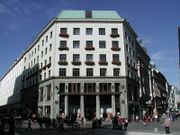
- 1910 Goldman & Salatsch Building, a mixed-use building overlooking Michaelerplatz, Vienna (known colloquially as the "Looshaus")
- 1913 Scheu House, Vienna
- 1915 Sugar mill, Hrušovany u Brna, Czech Republic
- 1917 House for sugar mill owner, Hrušovany u Brna, Czech Republic
- 1922 Rufer House, Vienna
- 1925 Maison Tzara, house and studio for Tristan TzaraTristan TzaraTristan Tzara was a Romanian and French avant-garde poet, essayist and performance artist. Also active as a journalist, playwright, literary and art critic, composer and film director, he was known best for being one of the founders and central figures of the anti-establishment Dada movement...
, one of the founders of Dadaism, in MontmartreMontmartreMontmartre is a hill which is 130 metres high, giving its name to the surrounding district, in the north of Paris in the 18th arrondissement, a part of the Right Bank. Montmartre is primarily known for the white-domed Basilica of the Sacré Cœur on its summit and as a nightclub district...
, ParisParisParis is the capital and largest city in France, situated on the river Seine, in northern France, at the heart of the Île-de-France region...
, GIS coordinates: +48.888146, +2.335500 - 1926 Villa Moller, Vienna
- 1927 House (not built) in Paris for the American entertainer Josephine BakerJosephine BakerJosephine Baker was an American dancer, singer, and actress who found fame in her adopted homeland of France. She was given such nicknames as the "Bronze Venus", the "Black Pearl", and the "Créole Goddess"....
- 1928 Villa MüllerVilla MullerThe Villa Müller is an architectural structure designed in 1930 by architect Adolf Loos, born in Brno, Austria-Hungary . The villa is located in Prague, Czech Republic. The house was designed originally for Mr. František Müller and his wife, Milada Müllerová.- History :The building was...
, PraguePraguePrague is the capital and largest city of the Czech Republic. Situated in the north-west of the country on the Vltava river, the city is home to about 1.3 million people, while its metropolitan area is estimated to have a population of over 2.3 million...
, Czech RepublicCzech RepublicThe Czech Republic is a landlocked country in Central Europe. The country is bordered by Poland to the northeast, Slovakia to the east, Austria to the south, and Germany to the west and northwest.... - 1929 Khuner Villa, Kreuzberg, Austria
- 1932 Villa Winternitz, Na Cihlářce 10, Praha 5, Czech Republic
- 1928-1933 many residential interiors in Pilsen, Czech Republic
Legacy
Loos, through his writings and his groundbreaking projects in Vienna and the major cities of the Czech Republic, was able to influence other architects and designers. His careful selection of materials and use of 'Raumplan'--the considered ordering and size of interior spaces based on function—are still admired today.In October 2008, an exhibition on Adolf Loos's work opened in the City of Prague Museum, examining his often overlooked achievements in the Czech Republic.
The exhibition travels to London as "Learning to Dwell: Adolf Loos in the Czech Lands" at the Royal Institute of British Architects
Royal Institute of British Architects
The Royal Institute of British Architects is a professional body for architects primarily in the United Kingdom, but also internationally.-History:...
. It will open on 24 February 2011 accompanied by a season of talks and a display on the role of the RIBA in saving Loos's archive during the Second World War.
External links
- Biography and significant buildings of Loos in Vienna
- Life and important works
- Biography at WOKA
- Adolf Loos papers, 1930-1933. Research Library at the Getty Research Institute. Los Angeles, California. A portion of the papers documenting the late period of Adolf Loos’ work, 1930–1932, as reflected in the papers of his assistant Kurt Unger. The papers include correspondence, drawings, manuscripts, miscellaneous printed material, and portraits of Loos.