


Volcae

Encyclopedia
The Volcae (ˈwɔlkaj) were a tribal confederation constituted before the raid of combined Gaul
s that invaded Macedon
circa 270 BC and defeated the assembled Greeks at the Battle of Thermopylae in 279 BC. Though our view of Celtic tribal configurations has to be pieced together from mentions in Greek and Latin sources, for archaeology determines no tribal identities purely through material culture
of the late La Tène Celts, tribes called Volcae were to be found simultaneously in southern France, Moravia
, the Ebro
River valley, and Galatia
in Asia Minor
(Anatolia
).
Driven by highly mobile groups operating outside the tribal system and comprising diverse elements, the Volcae were one of the new ethnic entities
formed during the Celtic military expansion at the beginning of the third century BC. Collecting in the famous excursion into the Balkans
, ostensibly, from the Hellene point-of-view, to raid Delphi
, a branch of the Volcae split from the main group on the way into the Balkans and joined two other tribes, the Tolistobogii
and the Trocmi, to settle in central Asia Minor
and establish a new Gaulish identity as the Galatia
ns.
The Tectosagii were a sept
of the Volcae who moved through Macedonia
into Asia Minor
circa 270 BCE. Strabo
says the Tectosagii came originally from the region near modern Toulouse
, in France.
.svg.png) Julius Caesar was convinced that the Volcae had originally been settled north-east of the Rhine, in what is now western and central Germany in the basin of the Weser River
Julius Caesar was convinced that the Volcae had originally been settled north-east of the Rhine, in what is now western and central Germany in the basin of the Weser River
, for he mentioned the Volcae Tectosages as a Gaulish
tribe which still remained in western Germany in his day (Gallic War 6.24):
Caesar related a tradition associating the Celtic tribe of the Volcae to the vast Hercynian forest
, though they were more probably to be located in the eastern range of the Mittelgebirge
; yet, Volcae of his time were settled in Moravia
, east of the Boii
. Their apparent movement may indicate that the Volcae were newcomers to the region. Caesar's remark about the wealth of this region may have referred not only to agriculture but also to the mineral deposits there, while the renown attributed to the Volcae "in peace and in war" resulted from their metallurgical skills and the quality of their weapons, both attracting the attention of their northern neighbors. Together with the Boii
in the upper basin of the Elbe
river to the west and the Cotini
in Slovakia
to the east, this area of Celtic settlement in oppida led to the exploitation of natural resources on a grand scale and the concentration of skilled craftsmen under the patronage of strong and wealthy chieftains. This culture flourished from the mid second to the mid-first century BCE, until it buckled under the combined pressure of the Germans from the North and the Dacians
from the East.
Allowance must be made for Julius Caesar's usual equation of primitive poverty with admirable hardihood and military prowess and his connection of luxurious imports and the proximity of "civilization", meaning his own, with softness and decadence. In fact, long-established trading connections furnished Gaulish elites with Baltic amber and Greek and Etruscan wares.
Caesar took it as a given that the Celts in the Hercynian Forest were emigrant settlers from Gaul who had "seized" the land, but modern archeology identifies the region as part of the La Tène homeland. As Henry Howarth noted a century ago, "The Tectosages reported by Caesar as still being around the Hercynian forest were in fact living in the old homes of their race, whence a portion of them set out on their great expedition against Greece
, and eventually settled in Galatia
, in Asia Minor, where one of the tribes was called Tectosages."
, with their metropolis at Narbo (Narbonne): "Narbo is spoken of as the naval-station of these people alone, though it would be fairer to add "and of the rest of Celtica", so greatly has it surpassed the others in the number of people who use it as a trade-centre." They were not alone in occupying their territory, with its capital at Nemausus
(Nîmes).
The Volcae Arecomici of their own accord surrendered to the Roman Republic
in 121 BC, after which they occupied the Roman province
of Gallia Narbonensis
(the area around modern day Narbonne
), the southern part of Gallia Transalpina. They held their assemblies in the sacred wood of Nemausus
, the site of modern Nîmes
.
In Roman times, the Volcae Arecomici occupied the district between the Garonne River (Garumna), the Cévennes
(Cebenna mons), and the Rhône River
, corresponding roughly to the Roman province of Gallia Narbonensis
. In Gaul they were divided into two tribes in widely separated regions, the Arecomici on the east, living among the Ligures
, and the Tectosages (whose territory included that of the Tolosates) on the west, living among the Aquitanians; the territories were separated by the Hérault River
(Arauris) or a line between the Hérault River and the Orbe River (Orbis).
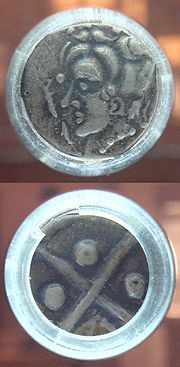 West of the Arecomici the Volcae Tectosages (whose territory included that of the Tolosates) lived among the Aquitanians; the territories were separated by the Hérault River
(Arauris) or a line between the Hérault River and the Orbe River (Orbis). Strabo says the Volcae Tectosages came originally from the region near modern Toulouse
, in France, and they were a sept
or clan
of the Volcae.
The territory of the Volcae Tectosages (Οὐόλκαι Τεκτόσαγες of Ptolemy's Geography ii) lay outside the Roman Republic, to the southwest of the Volcae Arecomici. From the 3rd century BC, the capital city of the Volcae Tectosages was Tolosa (modern Toulouse
). When the Cimbri
and Teutones invaded Gaul, the Tectosages allied themselves with them, and their town Tolosa was sacked in retribution by Servilius Caepio in 106 BC. Tolosa was incorporated into the Roman Republic
as part of the province of Gallia Aquitania
with the conquest of Gaul
by Julius Caesar
in 52 BC. The Roman conquest of Tolosa ended the cultural identity of the Volcae Tectosages.
According to Ptolemy's Geography, their inland towns were Illiberis
, Ruscino
, Tolosa colonia
, Cessero
, Carcaso
, Baetirae
, and Narbon colonia
.
The Volcae Tectosages were among the successful raiders of the Delphi expedition
and were said to have transported their booty to Tolosa. Venceslas Kruta suggests that their movement into this region was probably motivated by a Carthaginian recruiting-post situated close by, a main attraction of the region for Celtic mercenaries eager for more campaigning. Indeed, after crossing the Pyrenees in 218 BC, Hannibal in travelling through southern Gaul was greeted by warlike tribes: the Volcae, the Arverni
, the Allobroges
, and the Gaesatae
of the Rhône
Valley, who rose to prominence around the middle of the 3rd century BC. From around that time, this part of Gaul
underwent a process of stabilization buttressed by the formation of new and powerful tribal confederations as well as the development of new-style settlements resembling the urban centers of the Mediterranean world, of which Tolosa and Nemausus
(Nîmes) were no exception.
In 107, the Volcae, allies of the Tigurini
, a branch of the Helvetii
who belonged to a coalition that formed around the Cimbri and the Teutons, defeated a Roman army at Tolosa. In 106-5, Q. Servilius Caepio was sent with an army to put down the revolt, and as a result, Tolosa was sacked, and thereafter the town and its territory were absorbed into the Roman Province
, thereby establishing firm control over the western Gallic trade corridor along the Carcassonne
Gap
and Garonne
river.
golchi 'to wash' and Irish
folc 'to bathe' (Proto-Celtic *wolkiō), making this tribe the 'river people' after a rough semantic adjustment. A more likely scenario is that this or a cognate in Pannonia
n Illyrian was used to name the river Volcos
, from which the Volcae took their name. C. W. von Glück derived the name from a word related to Old Irish folg 'agile, energetic'.
Most Celticists today seem to agree that the tribal name Uolcae is related to Welsh gwalch 'hawk', akin to Latin falco 'hawk', (and they compare the Gaulish personal name Catuuolcus to Welsh cadwalch 'hero', literally 'battle-hawk'), though some prefer to translate Gaulish *uolco- as 'wolf' and, by semantic extension, 'errant warrior'. There seems to be indication that their name is related to their breed of war greyhounds
since before the 600 BC when the Tectosages and Tolistobogii Celts sacked Delphi. Survivors left accounts of the fierce Celts and the huge dogs who fought with them and at their side. They were described by Julius Caesar
in his war reports, The Gallic Wars.
The name Tectosages, literally 'possession-seekers', meant 'claim-stakers', perhaps closer in sense to 'claim-jumper' or 'land grabber', and a direct cognate is found in Old Irish techtaigidir 'he/she seeks to (re)establish a land claim'.
.) This word has been applied widely to any former Roman provincials, including the Welsh, Italians, and French. Compare: English Welsh, Flemish Dutch waalsch "Walloons", German welsch "French", Switzerland German Churwelsch "Churer Romance" (an old name for Romansh, which used to be spoken in Chur
), Old Norse Valir "Roman; French". The word was also borrowed by the Slavs who used it to refer to the Vlachs
(Romanians
). Polish applied it not only to Vlachs (Wołosi) but also Italians (Włosi).
More examples in German as used in Switzerland include Welschschweiz "French-speaking Switzerland", Welschdörfli "Romansh Village" a historic section of Chur
, and Welschgraben "French trenches" formerly a Burgundian defensive barrier. (See German Welsche)
The walha element is contained in Wallachia
, Wallonia, and also, in the original meaning of "Gallic" or "Roman" appears in the word walnut
and Old English Galwal "Gaul; France". (See also Walha
and the etymology of Vlach).
Gaul
Gaul was a region of Western Europe during the Iron Age and Roman era, encompassing present day France, Luxembourg and Belgium, most of Switzerland, the western part of Northern Italy, as well as the parts of the Netherlands and Germany on the left bank of the Rhine. The Gauls were the speakers of...
s that invaded Macedon
Macedon
Macedonia or Macedon was an ancient kingdom, centered in the northeastern part of the Greek peninsula, bordered by Epirus to the west, Paeonia to the north, the region of Thrace to the east and Thessaly to the south....
circa 270 BC and defeated the assembled Greeks at the Battle of Thermopylae in 279 BC. Though our view of Celtic tribal configurations has to be pieced together from mentions in Greek and Latin sources, for archaeology determines no tribal identities purely through material culture
Material culture
In the social sciences, material culture is a term that refers to the relationship between artifacts and social relations. Studying a culture's relationship to materiality is a lens through which social and cultural attitudes can be discussed...
of the late La Tène Celts, tribes called Volcae were to be found simultaneously in southern France, Moravia
Moravia
Moravia is a historical region in Central Europe in the east of the Czech Republic, and one of the former Czech lands, together with Bohemia and Silesia. It takes its name from the Morava River which rises in the northwest of the region...
, the Ebro
Ebro
The Ebro or Ebre is one of the most important rivers in the Iberian Peninsula. It is the biggest river by discharge volume in Spain.The Ebro flows through the following cities:*Reinosa in Cantabria.*Miranda de Ebro in Castile and León....
River valley, and Galatia
Galatia
Ancient Galatia was an area in the highlands of central Anatolia in modern Turkey. Galatia was named for the immigrant Gauls from Thrace , who settled here and became its ruling caste in the 3rd century BC, following the Gallic invasion of the Balkans in 279 BC. It has been called the "Gallia" of...
in Asia Minor
Asia Minor
Asia Minor is a geographical location at the westernmost protrusion of Asia, also called Anatolia, and corresponds to the western two thirds of the Asian part of Turkey...
(Anatolia
Anatolia
Anatolia is a geographic and historical term denoting the westernmost protrusion of Asia, comprising the majority of the Republic of Turkey...
).
Driven by highly mobile groups operating outside the tribal system and comprising diverse elements, the Volcae were one of the new ethnic entities
Ethnic group
An ethnic group is a group of people whose members identify with each other, through a common heritage, often consisting of a common language, a common culture and/or an ideology that stresses common ancestry or endogamy...
formed during the Celtic military expansion at the beginning of the third century BC. Collecting in the famous excursion into the Balkans
Gallic invasion of the Balkans
Gallic groups, originating from the various La Tène chiefdoms, began a south-eastern movement into the Balkan peninsula from the 4th century BC. Although Celtic settlements were concentrated in the western half of the Carpathian basin, there were notable incursions, and settlements, within the...
, ostensibly, from the Hellene point-of-view, to raid Delphi
Delphi
Delphi is both an archaeological site and a modern town in Greece on the south-western spur of Mount Parnassus in the valley of Phocis.In Greek mythology, Delphi was the site of the Delphic oracle, the most important oracle in the classical Greek world, and a major site for the worship of the god...
, a branch of the Volcae split from the main group on the way into the Balkans and joined two other tribes, the Tolistobogii
Tolistobogii
Tolistobogii is the name used by the Roman historian, Livy, for one of the three ancient Celtic tribes of Galatia in central Asia Minor, together with the Trocmi and Tectosages...
and the Trocmi, to settle in central Asia Minor
Asia Minor
Asia Minor is a geographical location at the westernmost protrusion of Asia, also called Anatolia, and corresponds to the western two thirds of the Asian part of Turkey...
and establish a new Gaulish identity as the Galatia
Galatia
Ancient Galatia was an area in the highlands of central Anatolia in modern Turkey. Galatia was named for the immigrant Gauls from Thrace , who settled here and became its ruling caste in the 3rd century BC, following the Gallic invasion of the Balkans in 279 BC. It has been called the "Gallia" of...
ns.
The Tectosagii were a sept
Sept
A sept is an English word for a division of a family, especially a division of a clan. The word might have its origin from Latin saeptum "enclosure, fold", or it can be an alteration of sect.The term is found in both Ireland and Scotland...
of the Volcae who moved through Macedonia
Macedonia (region)
Macedonia is a geographical and historical region of the Balkan peninsula in southeastern Europe. Its boundaries have changed considerably over time, but nowadays the region is considered to include parts of five Balkan countries: Greece, the Republic of Macedonia, Bulgaria, Albania, Serbia, as...
into Asia Minor
Asia Minor
Asia Minor is a geographical location at the westernmost protrusion of Asia, also called Anatolia, and corresponds to the western two thirds of the Asian part of Turkey...
circa 270 BCE. Strabo
Strabo
Strabo, also written Strabon was a Greek historian, geographer and philosopher.-Life:Strabo was born to an affluent family from Amaseia in Pontus , a city which he said was situated the approximate equivalent of 75 km from the Black Sea...
says the Tectosagii came originally from the region near modern Toulouse
Toulouse
Toulouse is a city in the Haute-Garonne department in southwestern FranceIt lies on the banks of the River Garonne, 590 km away from Paris and half-way between the Atlantic Ocean and the Mediterranean Sea...
, in France.
Volcae of the Danube
Weser River
The Weser is a river in north-western Germany. Formed at Hann. Münden by the Fulda and Werra, it flows through Lower Saxony, then reaching the historic port city of Bremen before emptying into the North Sea 50 km further north at Bremerhaven, which is also a seaport...
, for he mentioned the Volcae Tectosages as a Gaulish
Gauls
The Gauls were a Celtic people living in Gaul, the region roughly corresponding to what is now France, Belgium, Switzerland and Northern Italy, from the Iron Age through the Roman period. They mostly spoke the Continental Celtic language called Gaulish....
tribe which still remained in western Germany in his day (Gallic War 6.24):
- "And there was formerly a time when the Gauls excelled the Germans in prowess, and waged war on them offensively, and, on account of the great number of their people and the insufficiency of their land, sent colonies over the Rhine."
- "Accordingly, the Volcae Tectosages, seized on those parts of Germany which are the most fruitful [and lie] around the Hercynian forestHercynian ForestThe Hercynian Forest was an ancient and dense forest that stretched eastward from the Rhine River across southern Germany and formed the northern boundary of that part of Europe known to writers of antiquity. The ancient sources are equivocal about how far east it extended...
, (which, I perceive, was known by report to EratosthenesEratosthenesEratosthenes of Cyrene was a Greek mathematician, poet, athlete, geographer, astronomer, and music theorist.He was the first person to use the word "geography" and invented the discipline of geography as we understand it...
and some other Greeks, and which they call Orcynia), and settled there. Which nation to this time retains its position in those settlements, and has a very high character for justice and military merit; now also they continue in the same scarcity, indigence, hardihood, as the Germans, and use the same food and dress; but their proximity to the Province and knowledge of commodities from countries beyond the sea supplies to the Gauls many things tending to luxury as well as civilization. Accustomed by degrees to be overmatched and worsted in many engagements, they do not now even compare themselves to the GermansGermaniaGermania was the Greek and Roman geographical term for the geographical regions inhabited by mainly by peoples considered to be Germani. It was most often used to refer especially to the east of the Rhine and north of the Danube...
in prowess."
Caesar related a tradition associating the Celtic tribe of the Volcae to the vast Hercynian forest
Hercynian Forest
The Hercynian Forest was an ancient and dense forest that stretched eastward from the Rhine River across southern Germany and formed the northern boundary of that part of Europe known to writers of antiquity. The ancient sources are equivocal about how far east it extended...
, though they were more probably to be located in the eastern range of the Mittelgebirge
Ceské Stredohorí
České středohoří or Central Bohemian Uplands is a mountain range located in northern Bohemia, Czech Republic. The range is about 80 km long, spanning from Česká Lípa to Bílina and from Litoměřice to Děčín , intersected by the river Elbe.The name středohoří can be roughly translated into English...
; yet, Volcae of his time were settled in Moravia
Moravia
Moravia is a historical region in Central Europe in the east of the Czech Republic, and one of the former Czech lands, together with Bohemia and Silesia. It takes its name from the Morava River which rises in the northwest of the region...
, east of the Boii
Boii
The Boii were one of the most prominent ancient Celtic tribes of the later Iron Age, attested at various times in Cisalpine Gaul , Pannonia , in and around Bohemia, and Transalpine Gaul...
. Their apparent movement may indicate that the Volcae were newcomers to the region. Caesar's remark about the wealth of this region may have referred not only to agriculture but also to the mineral deposits there, while the renown attributed to the Volcae "in peace and in war" resulted from their metallurgical skills and the quality of their weapons, both attracting the attention of their northern neighbors. Together with the Boii
Boii
The Boii were one of the most prominent ancient Celtic tribes of the later Iron Age, attested at various times in Cisalpine Gaul , Pannonia , in and around Bohemia, and Transalpine Gaul...
in the upper basin of the Elbe
Elbe
The Elbe is one of the major rivers of Central Europe. It rises in the Krkonoše Mountains of the northwestern Czech Republic before traversing much of Bohemia , then Germany and flowing into the North Sea at Cuxhaven, 110 km northwest of Hamburg...
river to the west and the Cotini
Cotini
Cotini was a Celtic tribe most probably living in today's Slovakia, and in Moravia and southern Poland. They were probably identical or constituted a significant part of the archaeological Púchov culture, with the center in Havránok.The tribe was first time mentioned in 10 BC in the Elogium of...
in Slovakia
Slovakia
The Slovak Republic is a landlocked state in Central Europe. It has a population of over five million and an area of about . Slovakia is bordered by the Czech Republic and Austria to the west, Poland to the north, Ukraine to the east and Hungary to the south...
to the east, this area of Celtic settlement in oppida led to the exploitation of natural resources on a grand scale and the concentration of skilled craftsmen under the patronage of strong and wealthy chieftains. This culture flourished from the mid second to the mid-first century BCE, until it buckled under the combined pressure of the Germans from the North and the Dacians
Dacians
The Dacians were an Indo-European people, very close or part of the Thracians. Dacians were the ancient inhabitants of Dacia...
from the East.
Allowance must be made for Julius Caesar's usual equation of primitive poverty with admirable hardihood and military prowess and his connection of luxurious imports and the proximity of "civilization", meaning his own, with softness and decadence. In fact, long-established trading connections furnished Gaulish elites with Baltic amber and Greek and Etruscan wares.
Caesar took it as a given that the Celts in the Hercynian Forest were emigrant settlers from Gaul who had "seized" the land, but modern archeology identifies the region as part of the La Tène homeland. As Henry Howarth noted a century ago, "The Tectosages reported by Caesar as still being around the Hercynian forest were in fact living in the old homes of their race, whence a portion of them set out on their great expedition against Greece
Gallic invasion of the Balkans
Gallic groups, originating from the various La Tène chiefdoms, began a south-eastern movement into the Balkan peninsula from the 4th century BC. Although Celtic settlements were concentrated in the western half of the Carpathian basin, there were notable incursions, and settlements, within the...
, and eventually settled in Galatia
Galatia
Ancient Galatia was an area in the highlands of central Anatolia in modern Turkey. Galatia was named for the immigrant Gauls from Thrace , who settled here and became its ruling caste in the 3rd century BC, following the Gallic invasion of the Balkans in 279 BC. It has been called the "Gallia" of...
, in Asia Minor, where one of the tribes was called Tectosages."
Volcae of Gaul
Volcae Arecomici
The Volcae Arecomici (Οὐόλκαι Ἀρικόμιοι of Ptolemy's Geography ii), according to Strabo, dwelt on the western side of the lower RhoneRhône
Rhone can refer to:* Rhone, one of the major rivers of Europe, running through Switzerland and France* Rhône Glacier, the source of the Rhone River and one of the primary contributors to Lake Geneva in the far eastern end of the canton of Valais in Switzerland...
, with their metropolis at Narbo (Narbonne): "Narbo is spoken of as the naval-station of these people alone, though it would be fairer to add "and of the rest of Celtica", so greatly has it surpassed the others in the number of people who use it as a trade-centre." They were not alone in occupying their territory, with its capital at Nemausus
Nemausus
Deus Nemausus is often said to have been the Celtic patron god of Nemausus . The god does not seem to have been worshipped outside of this locality...
(Nîmes).
The Volcae Arecomici of their own accord surrendered to the Roman Republic
Roman Republic
The Roman Republic was the period of the ancient Roman civilization where the government operated as a republic. It began with the overthrow of the Roman monarchy, traditionally dated around 508 BC, and its replacement by a government headed by two consuls, elected annually by the citizens and...
in 121 BC, after which they occupied the Roman province
Roman province
In Ancient Rome, a province was the basic, and, until the Tetrarchy , largest territorial and administrative unit of the empire's territorial possessions outside of Italy...
of Gallia Narbonensis
Gallia Narbonensis
Gallia Narbonensis was a Roman province located in what is now Languedoc and Provence, in southern France. It was also known as Gallia Transalpina , which was originally a designation for that part of Gaul lying across the Alps from Italia and it contained a western region known as Septimania...
(the area around modern day Narbonne
Narbonne
Narbonne is a commune in southern France in the Languedoc-Roussillon region. It lies from Paris in the Aude department, of which it is a sub-prefecture. Once a prosperous port, it is now located about from the shores of the Mediterranean Sea...
), the southern part of Gallia Transalpina. They held their assemblies in the sacred wood of Nemausus
Nemausus
Deus Nemausus is often said to have been the Celtic patron god of Nemausus . The god does not seem to have been worshipped outside of this locality...
, the site of modern Nîmes
Nîmes
Nîmes is the capital of the Gard department in the Languedoc-Roussillon region in southern France. Nîmes has a rich history, dating back to the Roman Empire, and is a popular tourist destination.-History:...
.
In Roman times, the Volcae Arecomici occupied the district between the Garonne River (Garumna), the Cévennes
Cévennes
The Cévennes are a range of mountains in south-central France, covering parts of the départements of Gard, Lozère, Ardèche, and Haute-Loire.The word Cévennes comes from the Gaulish Cebenna, which was Latinized by Julius Caesar to Cevenna...
(Cebenna mons), and the Rhône River
Rhône River
The Rhone is one of the major rivers of Europe, rising in Switzerland and running from there through southeastern France. At Arles, near its mouth on the Mediterranean Sea, the river divides into two branches, known as the Great Rhone and the Little Rhone...
, corresponding roughly to the Roman province of Gallia Narbonensis
Gallia Narbonensis
Gallia Narbonensis was a Roman province located in what is now Languedoc and Provence, in southern France. It was also known as Gallia Transalpina , which was originally a designation for that part of Gaul lying across the Alps from Italia and it contained a western region known as Septimania...
. In Gaul they were divided into two tribes in widely separated regions, the Arecomici on the east, living among the Ligures
Ligures
The Ligures were an ancient people who gave their name to Liguria, a region of north-western Italy.-Classical sources:...
, and the Tectosages (whose territory included that of the Tolosates) on the west, living among the Aquitanians; the territories were separated by the Hérault River
Hérault River
The Hérault is a river of southern France. Its length is . Its source is in the Cévennes mountains. It reaches the Mediterranean Sea near Agde...
(Arauris) or a line between the Hérault River and the Orbe River (Orbis).
Volcae Tectosages
Hérault River
The Hérault is a river of southern France. Its length is . Its source is in the Cévennes mountains. It reaches the Mediterranean Sea near Agde...
(Arauris) or a line between the Hérault River and the Orbe River (Orbis). Strabo says the Volcae Tectosages came originally from the region near modern Toulouse
Toulouse
Toulouse is a city in the Haute-Garonne department in southwestern FranceIt lies on the banks of the River Garonne, 590 km away from Paris and half-way between the Atlantic Ocean and the Mediterranean Sea...
, in France, and they were a sept
Sept
A sept is an English word for a division of a family, especially a division of a clan. The word might have its origin from Latin saeptum "enclosure, fold", or it can be an alteration of sect.The term is found in both Ireland and Scotland...
or clan
Clan
A clan is a group of people united by actual or perceived kinship and descent. Even if lineage details are unknown, clan members may be organized around a founding member or apical ancestor. The kinship-based bonds may be symbolical, whereby the clan shares a "stipulated" common ancestor that is a...
of the Volcae.
The territory of the Volcae Tectosages (Οὐόλκαι Τεκτόσαγες of Ptolemy's Geography ii) lay outside the Roman Republic, to the southwest of the Volcae Arecomici. From the 3rd century BC, the capital city of the Volcae Tectosages was Tolosa (modern Toulouse
Toulouse
Toulouse is a city in the Haute-Garonne department in southwestern FranceIt lies on the banks of the River Garonne, 590 km away from Paris and half-way between the Atlantic Ocean and the Mediterranean Sea...
). When the Cimbri
Cimbri
The Cimbri were a tribe from Northern Europe, who, together with the Teutones and the Ambrones threatened the Roman Republic in the late 2nd century BC. The Cimbri were probably Germanic, though some believe them to be of Celtic origin...
and Teutones invaded Gaul, the Tectosages allied themselves with them, and their town Tolosa was sacked in retribution by Servilius Caepio in 106 BC. Tolosa was incorporated into the Roman Republic
Roman Republic
The Roman Republic was the period of the ancient Roman civilization where the government operated as a republic. It began with the overthrow of the Roman monarchy, traditionally dated around 508 BC, and its replacement by a government headed by two consuls, elected annually by the citizens and...
as part of the province of Gallia Aquitania
Gallia Aquitania
Gallia Aquitania was a province of the Roman Empire, bordered by the provinces of Gallia Lugdunensis, Gallia Narbonensis, and Hispania Tarraconensis...
with the conquest of Gaul
Gaul
Gaul was a region of Western Europe during the Iron Age and Roman era, encompassing present day France, Luxembourg and Belgium, most of Switzerland, the western part of Northern Italy, as well as the parts of the Netherlands and Germany on the left bank of the Rhine. The Gauls were the speakers of...
by Julius Caesar
Julius Caesar
Gaius Julius Caesar was a Roman general and statesman and a distinguished writer of Latin prose. He played a critical role in the gradual transformation of the Roman Republic into the Roman Empire....
in 52 BC. The Roman conquest of Tolosa ended the cultural identity of the Volcae Tectosages.
According to Ptolemy's Geography, their inland towns were Illiberis
Elne
Elne is a commune in the Pyrénées-Orientales department in southern France.It lies in the former province of Roussillon, of which it was the first capital, being later replaced by Perpignan...
, Ruscino
Perpignan
-Sport:Perpignan is a rugby stronghold: their rugby union side, USA Perpignan, is a regular competitor in the Heineken Cup and seven times champion of the Top 14 , while their rugby league side plays in the engage Super League under the name Catalans Dragons.-Culture:Since 2004, every year in the...
, Tolosa colonia
Toulouse
Toulouse is a city in the Haute-Garonne department in southwestern FranceIt lies on the banks of the River Garonne, 590 km away from Paris and half-way between the Atlantic Ocean and the Mediterranean Sea...
, Cessero
Saint-Thibéry
Saint-Thibéry is a commune in the Hérault department in Languedoc-Roussillon in southern France.-See also:* Roman Bridge* Via Domitia* Communes of the Hérault department-References:*...
, Carcaso
Carcassonne
Carcassonne is a fortified French town in the Aude department, of which it is the prefecture, in the former province of Languedoc.It is divided into the fortified Cité de Carcassonne and the more expansive lower city, the ville basse. Carcassone was founded by the Visigoths in the fifth century,...
, Baetirae
Béziers
Béziers is a town in Languedoc in southern France. It is a sub-prefecture of the Hérault department. Béziers hosts the famous Feria de Béziers, centred around bullfighting, every August. A million visitors are attracted to the five-day event...
, and Narbon colonia
Narbonne
Narbonne is a commune in southern France in the Languedoc-Roussillon region. It lies from Paris in the Aude department, of which it is a sub-prefecture. Once a prosperous port, it is now located about from the shores of the Mediterranean Sea...
.
The Volcae Tectosages were among the successful raiders of the Delphi expedition
Gallic invasion of the Balkans
Gallic groups, originating from the various La Tène chiefdoms, began a south-eastern movement into the Balkan peninsula from the 4th century BC. Although Celtic settlements were concentrated in the western half of the Carpathian basin, there were notable incursions, and settlements, within the...
and were said to have transported their booty to Tolosa. Venceslas Kruta suggests that their movement into this region was probably motivated by a Carthaginian recruiting-post situated close by, a main attraction of the region for Celtic mercenaries eager for more campaigning. Indeed, after crossing the Pyrenees in 218 BC, Hannibal in travelling through southern Gaul was greeted by warlike tribes: the Volcae, the Arverni
Arverni
The Arverni were a Gallic tribe living in what is now the Auvergne region of France during the last centuries BC. One of the most powerful tribes in ancient Gaul, they opposed the Romans on several occasions...
, the Allobroges
Allobroges
The Allobroges were a Celtic tribe of ancient Gaul, located between the Rhône River and the Lake of Geneva in what later became Savoy, Dauphiné, and Vivarais. Their cities were in the areas of modern-day Annecy, Chambéry and Grenoble, the modern of Isère, and modern Switzerland...
, and the Gaesatae
Gaesatae
The Gaesatae were a group of Gaulish warriors who lived in the Alps near the river Rhône and fought against the Roman Republic in the Battle of Telamon of 225 BC...
of the Rhône
Rhône River
The Rhone is one of the major rivers of Europe, rising in Switzerland and running from there through southeastern France. At Arles, near its mouth on the Mediterranean Sea, the river divides into two branches, known as the Great Rhone and the Little Rhone...
Valley, who rose to prominence around the middle of the 3rd century BC. From around that time, this part of Gaul
Gaul
Gaul was a region of Western Europe during the Iron Age and Roman era, encompassing present day France, Luxembourg and Belgium, most of Switzerland, the western part of Northern Italy, as well as the parts of the Netherlands and Germany on the left bank of the Rhine. The Gauls were the speakers of...
underwent a process of stabilization buttressed by the formation of new and powerful tribal confederations as well as the development of new-style settlements resembling the urban centers of the Mediterranean world, of which Tolosa and Nemausus
Nemausus
Deus Nemausus is often said to have been the Celtic patron god of Nemausus . The god does not seem to have been worshipped outside of this locality...
(Nîmes) were no exception.
In 107, the Volcae, allies of the Tigurini
Tigurini
The Tigurini were a pagus of the Celtic Helvetii. They crossed the Rhine together with the Helvetii to invade Gaul in 109 BCE...
, a branch of the Helvetii
Helvetii
The Helvetii were a Celtic tribe or tribal confederation occupying most of the Swiss plateau at the time of their contact with the Roman Republic in the 1st century BC...
who belonged to a coalition that formed around the Cimbri and the Teutons, defeated a Roman army at Tolosa. In 106-5, Q. Servilius Caepio was sent with an army to put down the revolt, and as a result, Tolosa was sacked, and thereafter the town and its territory were absorbed into the Roman Province
Gallia Narbonensis
Gallia Narbonensis was a Roman province located in what is now Languedoc and Provence, in southern France. It was also known as Gallia Transalpina , which was originally a designation for that part of Gaul lying across the Alps from Italia and it contained a western region known as Septimania...
, thereby establishing firm control over the western Gallic trade corridor along the Carcassonne
Carcassonne
Carcassonne is a fortified French town in the Aude department, of which it is the prefecture, in the former province of Languedoc.It is divided into the fortified Cité de Carcassonne and the more expansive lower city, the ville basse. Carcassone was founded by the Visigoths in the fifth century,...
Gap
Gap, Hautes-Alpes
Gap is a commune in southeastern France, the capital of the Hautes-Alpes department.-Geography:An Alpine crossroads at the intersection of D994 and Route nationale 85 the Route Napoléon, Gap lies above sea level along the right bank of the Luye River...
and Garonne
Garonne
The Garonne is a river in southwest France and northern Spain, with a length of .-Source:The Garonne's headwaters are to be found in the Aran Valley in the Pyrenees, though three different locations have been proposed as the true source: the Uelh deth Garona at Plan de Beret , the Ratera-Saboredo...
river.
Etymology
Traditional etymologies have attributed Volcae to a word akin to WelshWelsh language
Welsh is a member of the Brythonic branch of the Celtic languages spoken natively in Wales, by some along the Welsh border in England, and in Y Wladfa...
golchi 'to wash' and Irish
Irish language
Irish , also known as Irish Gaelic, is a Goidelic language of the Indo-European language family, originating in Ireland and historically spoken by the Irish people. Irish is now spoken as a first language by a minority of Irish people, as well as being a second language of a larger proportion of...
folc 'to bathe' (Proto-Celtic *wolkiō), making this tribe the 'river people' after a rough semantic adjustment. A more likely scenario is that this or a cognate in Pannonia
Pannonia
Pannonia was an ancient province of the Roman Empire bounded north and east by the Danube, coterminous westward with Noricum and upper Italy, and southward with Dalmatia and upper Moesia....
n Illyrian was used to name the river Volcos
Vuka
Vuka is a river in eastern Croatia, a right tributary of the Danube river. At it is the 11th longest river in Croatia and it has a drainage area of . The river is located in Vukovar-Syrmia County, in Slavonia region. It empties into the Danube at the town of Vukovar, which got its name from the...
, from which the Volcae took their name. C. W. von Glück derived the name from a word related to Old Irish folg 'agile, energetic'.
Most Celticists today seem to agree that the tribal name Uolcae is related to Welsh gwalch 'hawk', akin to Latin falco 'hawk', (and they compare the Gaulish personal name Catuuolcus to Welsh cadwalch 'hero', literally 'battle-hawk'), though some prefer to translate Gaulish *uolco- as 'wolf' and, by semantic extension, 'errant warrior'. There seems to be indication that their name is related to their breed of war greyhounds
Irish Wolfhound
The Irish wolfhound is a breed of domestic dog , specifically a sighthound. The name originates from its purpose rather than from its appearance...
since before the 600 BC when the Tectosages and Tolistobogii Celts sacked Delphi. Survivors left accounts of the fierce Celts and the huge dogs who fought with them and at their side. They were described by Julius Caesar
Julius Caesar
Gaius Julius Caesar was a Roman general and statesman and a distinguished writer of Latin prose. He played a critical role in the gradual transformation of the Roman Republic into the Roman Empire....
in his war reports, The Gallic Wars.
The name Tectosages, literally 'possession-seekers', meant 'claim-stakers', perhaps closer in sense to 'claim-jumper' or 'land grabber', and a direct cognate is found in Old Irish techtaigidir 'he/she seeks to (re)establish a land claim'.
Namesake
The Volcae were highly influential in Moravia, and together with the Boii and the Cotini and other Danubian tribes, they controlled a highly active network of trade routes connected to the Mediterranean and the German lands. The prowess of these tribes and their proximity led to their name being borrowed into Germanic as *walha, a generic term for "Celt" and eventually "Roman" as the two cultures merged in time. (See also WalhaWalha
Walhaz is a reconstructed Proto-Germanic word, meaning "foreigner", "stranger", "Roman", "Romance-speaker", or "Celtic-speaker". The adjective derived from this word can be found in , Old High German walhisk, meaning "Romance", in Old English welisċ, wælisċ, wilisċ, meaning "Romano-British" and in...
.) This word has been applied widely to any former Roman provincials, including the Welsh, Italians, and French. Compare: English Welsh, Flemish Dutch waalsch "Walloons", German welsch "French", Switzerland German Churwelsch "Churer Romance" (an old name for Romansh, which used to be spoken in Chur
Chur
Chur or Coire is the capital of the Swiss canton of Graubünden and lies in the northern part of the canton.-History:The name "chur" derives perhaps from the Celtic kora or koria, meaning "tribe", or from the Latin curia....
), Old Norse Valir "Roman; French". The word was also borrowed by the Slavs who used it to refer to the Vlachs
Vlachs
Vlach is a blanket term covering several modern Latin peoples descending from the Latinised population in Central, Eastern and Southeastern Europe. English variations on the name include: Walla, Wlachs, Wallachs, Vlahs, Olahs or Ulahs...
(Romanians
Romanians
The Romanians are an ethnic group native to Romania, who speak Romanian; they are the majority inhabitants of Romania....
). Polish applied it not only to Vlachs (Wołosi) but also Italians (Włosi).
More examples in German as used in Switzerland include Welschschweiz "French-speaking Switzerland", Welschdörfli "Romansh Village" a historic section of Chur
Chur
Chur or Coire is the capital of the Swiss canton of Graubünden and lies in the northern part of the canton.-History:The name "chur" derives perhaps from the Celtic kora or koria, meaning "tribe", or from the Latin curia....
, and Welschgraben "French trenches" formerly a Burgundian defensive barrier. (See German Welsche)
The walha element is contained in Wallachia
Wallachia
Wallachia or Walachia is a historical and geographical region of Romania. It is situated north of the Danube and south of the Southern Carpathians...
, Wallonia, and also, in the original meaning of "Gallic" or "Roman" appears in the word walnut
Walnut
Juglans is a plant genus of the family Juglandaceae, the seeds of which are known as walnuts. They are deciduous trees, 10–40 meters tall , with pinnate leaves 200–900 millimetres long , with 5–25 leaflets; the shoots have chambered pith, a character shared with the wingnuts , but not the hickories...
and Old English Galwal "Gaul; France". (See also Walha
Walha
Walhaz is a reconstructed Proto-Germanic word, meaning "foreigner", "stranger", "Roman", "Romance-speaker", or "Celtic-speaker". The adjective derived from this word can be found in , Old High German walhisk, meaning "Romance", in Old English welisċ, wælisċ, wilisċ, meaning "Romano-British" and in...
and the etymology of Vlach).