

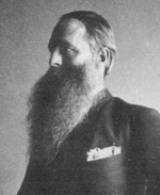
Raphael Pumpelly

Encyclopedia
Raphael Pumpelly was an American
geologist
and explorer
.
, into a family with deep New England roots that trace back to Thomas Welles
(1590–1659), who arrived in Massachusetts in 1635 and was the only man in Connecticut's history to hold all four top offices: governor, deputy governor, treasurer, and secretary; John Deming
, (1615–1705) an early Puritan
settler and original patentee of the Connecticut Colony
and Honor Treat, the daughter of Richard Treat
(1584–1669) an early New England
settler, Deputy to the Connecticut Legislature and also a Patentee of the Royal Charter of Connecticut, 1662.
He was also a descendant of William Pynchon
, a colonial
assistant treasurer
and original patentee of the Massachusetts Bay Colony
. He led the 1635 settlement of Springfield
, Hampden County, Massachusetts
, which was named after his home village, now a suburb of Chelmsford
in Essex
, England
; and Captain Elizur Holyoke
, the namesake of the mountain, Mount Holyoke
, and (indirectly), of the city of Holyoke, Massachusetts
.
His father was William Pumpelly and the grandson son of John Pumpelly and Hannah Bushnell. His father was great great grandson of Jean Pompilie, a sea captain who settled at Plymouth, Massachusetts. He was a French Huguenot
refugee from Avignon, France, originally from Spoleto, Italy.
His mother, Mary Hollenbeck Welles (born in Athens, Pennsylvania
, 6 May 1803; died in Paris
, France, 4 December 1879), was a poet. She was the daughter of Prudence Talcott and George Welles, and a 1777 graduate of Yale College
. She wrote religious historical poems, including “Belshazar's Feast,” “Pilate's Wife's Dream,” “Herod's Feast,” and “An Ode to Shakespeare.” Some of these were collected and published in a volume (New York, 1852).
. Against his parents objections, he decided against attending Yale University
and chose to study and travel in Europe
. He graduated in 1859 from the “Technische Universität Bergakademie Freiberg
” (Translation from the German: Freiberg University of Mining and Technology or Freiberg Mining Academy, University of Technology; TUBAF). He also attended the polytechnic school in Hanover
. After graduating, he traveled extensively through the mining districts of Europe for the purpose of studying geology and metallurgy by direct observation.
After graduating, Pumpelly moved to Tioga Point, now Athens
, in Bradford County, Pennsylvania
, where he was soon appointed a Justice of the Peace
, and became land agent for the Hon. Charles Carroll
of Carrollton, Maryland
. Carroll held a license as innkeeper in Athens from 1798 to 1809. It was said of him that he was a man of ability, and became possessed of large amount of property.
.
Invited by the respective governments, from 1861 to 1863 he surveyed Yesso Island
of Japan
. and the coalfields of northern China
After this, he made the first extensive survey of the Gobi Desert
, and explored Mongolia
and Siberia
.
From 1866 to 1875, he was Professor of Mining Science
at Harvard University
. Among his scientific accomplishments was a theory of secular rock disintegration. He was influenced by Louis Agassiz
.
From 1870 to 1871, he conducted the geological survey of the copper region of Michigan
, for which he prepared “Copper-Bearing Rocks,” being part ii of volume i of the Geological Survey of Michigan (New York, 1873). He was called upon in 1871 to conduct the geological survey of Missouri
, and for three years devoted his energies to that task, preparing “A Preliminary Report on the Iron Ores and Coal Fields,” with an atlas, for the report of the Geological Survey of Missouri (New York, 1873).
When the U. S. Geological Survey was established in 1879, Pumpelly organized the division of economic geology, and as a special agent of the Tenth Census he planned and directed the investigations on the mining industries, exclusive of the precious metals, and prepared volume xv of the Census Reports on “The Mining Industries of the United States” (Washington, 1886). From 1879-80, he conducted at Newport, Rhode Island
, an elaborate investigation for the National Board of Health as to the ability of various soils to filter spores from liquids and from air. He became a resident of Newport in 1879, and lived there for 44 years.
In 1881, he organized the Northern Transcontinental Survey for the Northern Pacific Railroad and published parts of his report in the Tenth Census. This survey collected information concerning the topographical and economic features of Dakota
, Montana
, and Washington
territories. He had charge of this work until its cessation in 1884, and also edited the reports of the survey. He was appointed the Director of the U.S. Geological Survey, New England branch, in 1884.
Pumpelly spent his summers near Mount Monadnock
, and in 1884 he blazed a trail from his house to the summit that still carries his name. The Pumpelly Trail is considered one of the most scenic on the mountain.
Pumpelly died at the age of 86 on August 10, 1923 in Newport, Rhode Island
. He is buried in Berkeley Memorial Cemetery in Middletown
, Newport County
, Rhode Island
.
, Eliza Frances Shepard, born March 14, 1840 in Dorchester, Massachusetts and died on February 5, 1915 in Newport, Rhode Island. She was the daughter of Otis Shepard and Ann Pope. Her sister, Rebecca Kettell Shepard married author and publisher George Haven Putnam
, the eldest son of publisher George Palmer Putnam
and Victorine Haven Putnam. Rebecca and George were the parents of medieval
historian Bertha Haven Putnam. Another sister of hers, Lucy Elizabeth Shepard, married the Rev. Dr. Thomas Hill, the son of Thomas Hill
, president of Antioch College
from 1860 to 1862, and then of Harvard University
from 1862 to 1868 and Henrietta Barker.
Raphael and Eliza were the parents of five children. Their daughter, Elsie Pumpelly, married Thomas Handasyd Cabot, the son of James Elliot Cabot and Elizabeth Dwight. He was the great grandson of Thomas Handasyd Perkins
; and a grand nephew of William Morris Hunt
, an American
painter
. Elise and Thomas were the parents of three children: Thomas Handasyd Cabot, Jr. Elizabeth Cabot who married Henry Holt, Jr., the son of Henry Holt, founder of Henry Holt and Company
and Taber Florence, and Pauline Cabot who married George Pierce Metcalf, son of Stephen Olney Metcalf.
, first described in Keweenaw County
in the Upper Peninsula of Michigan
, was named in his honor.
United States
The United States of America is a federal constitutional republic comprising fifty states and a federal district...
geologist
Geologist
A geologist is a scientist who studies the solid and liquid matter that constitutes the Earth as well as the processes and history that has shaped it. Geologists usually engage in studying geology. Geologists, studying more of an applied science than a theoretical one, must approach Geology using...
and explorer
Exploration
Exploration is the act of searching or traveling around a terrain for the purpose of discovery of resources or information. Exploration occurs in all non-sessile animal species, including humans...
.
Early life and ancestors
He was born on September 8, 1837 in Oswego, New YorkOswego, New York
Oswego is a city in Oswego County, New York, United States. The population was 18,142 at the 2010 census. Oswego is located on Lake Ontario in north-central New York and promotes itself as "The Port City of Central New York"...
, into a family with deep New England roots that trace back to Thomas Welles
Thomas Welles
Thomas Welles is the only man in Connecticut's history to hold all four top offices: governor, deputy governor, treasurer, and secretary. In 1639, he was elected as the first treasurer of the Colony of Connecticut, and from 1640–1649 served as the colony's secretary...
(1590–1659), who arrived in Massachusetts in 1635 and was the only man in Connecticut's history to hold all four top offices: governor, deputy governor, treasurer, and secretary; John Deming
John Deming
John Deming was an early Puritan settler and original patentee of the Connecticut Colony-Life:Deming was born in Shalford, Essex County, England. He arrived in New England during the Great Migration with his older sister Elizabeth and her husband Nathaniel Foote...
, (1615–1705) an early Puritan
Puritan
The Puritans were a significant grouping of English Protestants in the 16th and 17th centuries. Puritanism in this sense was founded by some Marian exiles from the clergy shortly after the accession of Elizabeth I of England in 1558, as an activist movement within the Church of England...
settler and original patentee of the Connecticut Colony
Connecticut Colony
The Connecticut Colony or Colony of Connecticut was an English colony located in British America that became the U.S. state of Connecticut. Originally known as the River Colony, it was organized on March 3, 1636 as a haven for Puritan noblemen. After early struggles with the Dutch, the English...
and Honor Treat, the daughter of Richard Treat
Richard Treat
Richard Treat was an early New England settler and a Patentee of the Royal Charter of Connecticut, 1662-Early life and ancestors:...
(1584–1669) an early New England
New England
New England is a region in the northeastern corner of the United States consisting of the six states of Maine, New Hampshire, Vermont, Massachusetts, Rhode Island, and Connecticut...
settler, Deputy to the Connecticut Legislature and also a Patentee of the Royal Charter of Connecticut, 1662.
He was also a descendant of William Pynchon
William Pynchon
William Pynchon was an English colonist in North America best known as the founder of Springfield, Massachusetts, United States. He was also a colonial treasurer, original patentee of the Massachusetts Bay Colony, and the iconoclastic author of the New World's first banned book...
, a colonial
Colonialism
Colonialism is the establishment, maintenance, acquisition and expansion of colonies in one territory by people from another territory. It is a process whereby the metropole claims sovereignty over the colony and the social structure, government, and economics of the colony are changed by...
assistant treasurer
Treasurer
A treasurer is the person responsible for running the treasury of an organization. The adjective for a treasurer is normally "tresorial". The adjective "treasurial" normally means pertaining to a treasury, rather than the treasurer.-Government:...
and original patentee of the Massachusetts Bay Colony
Massachusetts Bay Colony
The Massachusetts Bay Colony was an English settlement on the east coast of North America in the 17th century, in New England, situated around the present-day cities of Salem and Boston. The territory administered by the colony included much of present-day central New England, including portions...
. He led the 1635 settlement of Springfield
Springfield, Massachusetts
Springfield is the most populous city in Western New England, and the seat of Hampden County, Massachusetts, United States. Springfield sits on the eastern bank of the Connecticut River near its confluence with three rivers; the western Westfield River, the eastern Chicopee River, and the eastern...
, Hampden County, Massachusetts
Hampden County, Massachusetts
-Demographics:As of the census of 2004, there were 461,228 people, 175,288 households, and 115,690 families residing in the county. The population density was 738 people per square mile . There were 185,876 housing units at an average density of 301 per square mile...
, which was named after his home village, now a suburb of Chelmsford
Chelmsford
Chelmsford is the county town of Essex, England and the principal settlement of the borough of Chelmsford. It is located in the London commuter belt, approximately northeast of Charing Cross, London, and approximately the same distance from the once provincial Roman capital at Colchester...
in Essex
Essex
Essex is a ceremonial and non-metropolitan county in the East region of England, and one of the home counties. It is located to the northeast of Greater London. It borders with Cambridgeshire and Suffolk to the north, Hertfordshire to the west, Kent to the South and London to the south west...
, England
England
England is a country that is part of the United Kingdom. It shares land borders with Scotland to the north and Wales to the west; the Irish Sea is to the north west, the Celtic Sea to the south west, with the North Sea to the east and the English Channel to the south separating it from continental...
; and Captain Elizur Holyoke
Elizur Holyoke
Captain Elizur Holyoke of Springfield, Massachusetts was the namesake of the mountain, Mount Holyoke, and , of the city of Holyoke, Massachusetts.-Background:...
, the namesake of the mountain, Mount Holyoke
Mount Holyoke
Mount Holyoke, a traprock mountain, elevation , is the western-most peak of the Holyoke Range and part of the 100-mile Metacomet Ridge. The mountain is located in the Connecticut River Valley of western Massachusetts, and is the namesake of nearby Mount Holyoke College. The mountain is located in...
, and (indirectly), of the city of Holyoke, Massachusetts
Holyoke, Massachusetts
Holyoke is a city in Hampden County, Massachusetts, United States, between the western bank of the Connecticut River and the Mount Tom Range of mountains. As of the 2010 Census, the city had a population of 39,880...
.
His father was William Pumpelly and the grandson son of John Pumpelly and Hannah Bushnell. His father was great great grandson of Jean Pompilie, a sea captain who settled at Plymouth, Massachusetts. He was a French Huguenot
Huguenot
The Huguenots were members of the Protestant Reformed Church of France during the 16th and 17th centuries. Since the 17th century, people who formerly would have been called Huguenots have instead simply been called French Protestants, a title suggested by their German co-religionists, the...
refugee from Avignon, France, originally from Spoleto, Italy.
His mother, Mary Hollenbeck Welles (born in Athens, Pennsylvania
Athens, Pennsylvania
Athens is a borough in Bradford County, Pennsylvania, two miles south of the N. Y. State line on the Susquehanna and Chemung rivers. Population in 1900, 3,749; and in 1910, 3,796. The population was 3,415 at the 2000 census...
, 6 May 1803; died in Paris
Paris
Paris is the capital and largest city in France, situated on the river Seine, in northern France, at the heart of the Île-de-France region...
, France, 4 December 1879), was a poet. She was the daughter of Prudence Talcott and George Welles, and a 1777 graduate of Yale College
Yale College
Yale College was the official name of Yale University from 1718 to 1887. The name now refers to the undergraduate part of the university. Each undergraduate student is assigned to one of 12 residential colleges.-Residential colleges:...
. She wrote religious historical poems, including “Belshazar's Feast,” “Pilate's Wife's Dream,” “Herod's Feast,” and “An Ode to Shakespeare.” Some of these were collected and published in a volume (New York, 1852).
Education
Pumpelly attended common schools and graduated from Oswego Academy in Oswego, Oswego County, New YorkOswego County, New York
Oswego County is a county located in the U.S. state of New York. As of the 2010 Census, the estimated population was 122,109. The City of Oswego and the Village of Pulaski serve as the dual county seats in a two shire system of government...
. Against his parents objections, he decided against attending Yale University
Yale University
Yale University is a private, Ivy League university located in New Haven, Connecticut, United States. Founded in 1701 in the Colony of Connecticut, the university is the third-oldest institution of higher education in the United States...
and chose to study and travel in Europe
Europe
Europe is, by convention, one of the world's seven continents. Comprising the westernmost peninsula of Eurasia, Europe is generally 'divided' from Asia to its east by the watershed divides of the Ural and Caucasus Mountains, the Ural River, the Caspian and Black Seas, and the waterways connecting...
. He graduated in 1859 from the “Technische Universität Bergakademie Freiberg
Technische Universität Bergakademie Freiberg
The Technische Universität Bergakademie Freiberg is a small German University of Technology with about 5000 students in the city of Freiberg, Saxony...
” (Translation from the German: Freiberg University of Mining and Technology or Freiberg Mining Academy, University of Technology; TUBAF). He also attended the polytechnic school in Hanover
Hanover
Hanover or Hannover, on the river Leine, is the capital of the federal state of Lower Saxony , Germany and was once by personal union the family seat of the Hanoverian Kings of Great Britain, under their title as the dukes of Brunswick-Lüneburg...
. After graduating, he traveled extensively through the mining districts of Europe for the purpose of studying geology and metallurgy by direct observation.
After graduating, Pumpelly moved to Tioga Point, now Athens
Athens, Pennsylvania
Athens is a borough in Bradford County, Pennsylvania, two miles south of the N. Y. State line on the Susquehanna and Chemung rivers. Population in 1900, 3,749; and in 1910, 3,796. The population was 3,415 at the 2000 census...
, in Bradford County, Pennsylvania
Bradford County, Pennsylvania
-Demographics:As of the census of 2000, there were 62,761 people, 24,453 households, and 17,312 families residing in the county. The population density was 54 people per square mile . There were 28,664 housing units at an average density of 25 per square mile...
, where he was soon appointed a Justice of the Peace
Justice of the Peace
A justice of the peace is a puisne judicial officer elected or appointed by means of a commission to keep the peace. Depending on the jurisdiction, they might dispense summary justice or merely deal with local administrative applications in common law jurisdictions...
, and became land agent for the Hon. Charles Carroll
Charles Carroll of Carrollton
Charles Carroll of Carrollton was a wealthy Maryland planter and an early advocate of independence from Great Britain. He served as a delegate to the Continental Congress and later as United States Senator for Maryland...
of Carrollton, Maryland
Carrollton, Maryland
Carrollton is a locality in Carroll County, Maryland, USA.It is not to be confused with Carrollton Manor in Frederick County, from which Charles Carroll of Carrollton, a prominent signer of the Declaration of Independence, took his name....
. Carroll held a license as innkeeper in Athens from 1798 to 1809. It was said of him that he was a man of ability, and became possessed of large amount of property.
Career
In 1860 Pumpelly was engaged in mining operations in ArizonaArizona
Arizona ; is a state located in the southwestern region of the United States. It is also part of the western United States and the mountain west. The capital and largest city is Phoenix...
.
Invited by the respective governments, from 1861 to 1863 he surveyed Yesso Island
Hokkaido
, formerly known as Ezo, Yezo, Yeso, or Yesso, is Japan's second largest island; it is also the largest and northernmost of Japan's 47 prefectural-level subdivisions. The Tsugaru Strait separates Hokkaido from Honshu, although the two islands are connected by the underwater railway Seikan Tunnel...
of Japan
Japan
Japan is an island nation in East Asia. Located in the Pacific Ocean, it lies to the east of the Sea of Japan, China, North Korea, South Korea and Russia, stretching from the Sea of Okhotsk in the north to the East China Sea and Taiwan in the south...
. and the coalfields of northern China
China
Chinese civilization may refer to:* China for more general discussion of the country.* Chinese culture* Greater China, the transnational community of ethnic Chinese.* History of China* Sinosphere, the area historically affected by Chinese culture...
After this, he made the first extensive survey of the Gobi Desert
Gobi Desert
The Gobi is a large desert region in Asia. It covers parts of northern and northwestern China, and of southern Mongolia. The desert basins of the Gobi are bounded by the Altai Mountains and the grasslands and steppes of Mongolia on the north, by the Hexi Corridor and Tibetan Plateau to the...
, and explored Mongolia
Mongolia
Mongolia is a landlocked country in East and Central Asia. It is bordered by Russia to the north and China to the south, east and west. Although Mongolia does not share a border with Kazakhstan, its western-most point is only from Kazakhstan's eastern tip. Ulan Bator, the capital and largest...
and Siberia
Siberia
Siberia is an extensive region constituting almost all of Northern Asia. Comprising the central and eastern portion of the Russian Federation, it was part of the Soviet Union from its beginning, as its predecessor states, the Tsardom of Russia and the Russian Empire, conquered it during the 16th...
.
From 1866 to 1875, he was Professor of Mining Science
Mining
Mining is the extraction of valuable minerals or other geological materials from the earth, from an ore body, vein or seam. The term also includes the removal of soil. Materials recovered by mining include base metals, precious metals, iron, uranium, coal, diamonds, limestone, oil shale, rock...
at Harvard University
Harvard University
Harvard University is a private Ivy League university located in Cambridge, Massachusetts, United States, established in 1636 by the Massachusetts legislature. Harvard is the oldest institution of higher learning in the United States and the first corporation chartered in the country...
. Among his scientific accomplishments was a theory of secular rock disintegration. He was influenced by Louis Agassiz
Louis Agassiz
Jean Louis Rodolphe Agassiz was a Swiss paleontologist, glaciologist, geologist and a prominent innovator in the study of the Earth's natural history. He grew up in Switzerland and became a professor of natural history at University of Neuchâtel...
.
From 1870 to 1871, he conducted the geological survey of the copper region of Michigan
Michigan
Michigan is a U.S. state located in the Great Lakes Region of the United States of America. The name Michigan is the French form of the Ojibwa word mishigamaa, meaning "large water" or "large lake"....
, for which he prepared “Copper-Bearing Rocks,” being part ii of volume i of the Geological Survey of Michigan (New York, 1873). He was called upon in 1871 to conduct the geological survey of Missouri
Missouri
Missouri is a US state located in the Midwestern United States, bordered by Iowa, Illinois, Kentucky, Tennessee, Arkansas, Oklahoma, Kansas and Nebraska. With a 2010 population of 5,988,927, Missouri is the 18th most populous state in the nation and the fifth most populous in the Midwest. It...
, and for three years devoted his energies to that task, preparing “A Preliminary Report on the Iron Ores and Coal Fields,” with an atlas, for the report of the Geological Survey of Missouri (New York, 1873).
When the U. S. Geological Survey was established in 1879, Pumpelly organized the division of economic geology, and as a special agent of the Tenth Census he planned and directed the investigations on the mining industries, exclusive of the precious metals, and prepared volume xv of the Census Reports on “The Mining Industries of the United States” (Washington, 1886). From 1879-80, he conducted at Newport, Rhode Island
Newport, Rhode Island
Newport is a city on Aquidneck Island in Newport County, Rhode Island, United States, about south of Providence. Known as a New England summer resort and for the famous Newport Mansions, it is the home of Salve Regina University and Naval Station Newport which houses the United States Naval War...
, an elaborate investigation for the National Board of Health as to the ability of various soils to filter spores from liquids and from air. He became a resident of Newport in 1879, and lived there for 44 years.
In 1881, he organized the Northern Transcontinental Survey for the Northern Pacific Railroad and published parts of his report in the Tenth Census. This survey collected information concerning the topographical and economic features of Dakota
Dakota Territory
The Territory of Dakota was an organized incorporated territory of the United States that existed from March 2, 1861, until November 2, 1889, when the final extent of the reduced territory was split and admitted to the Union as the states of North and South Dakota.The Dakota Territory consisted of...
, Montana
Montana Territory
The Territory of Montana was an organized incorporated territory of the United States that existed from May 28, 1864, until November 8, 1889, when it was admitted to the Union as the State of Montana.-History:...
, and Washington
Washington Territory
The Territory of Washington was an organized incorporated territory of the United States that existed from February 8, 1853, until November 11, 1889, when the final extent of the territory was admitted to the Union as the State of Washington....
territories. He had charge of this work until its cessation in 1884, and also edited the reports of the survey. He was appointed the Director of the U.S. Geological Survey, New England branch, in 1884.
Pumpelly spent his summers near Mount Monadnock
Mount Monadnock
Mount Monadnock, or Grand Monadnock, is the most prominent New England mountain peak south of the White Mountains and east of the Massachusetts Berkshires, and is the highest point in Cheshire County, New Hampshire...
, and in 1884 he blazed a trail from his house to the summit that still carries his name. The Pumpelly Trail is considered one of the most scenic on the mountain.
Pumpelly died at the age of 86 on August 10, 1923 in Newport, Rhode Island
Newport, Rhode Island
Newport is a city on Aquidneck Island in Newport County, Rhode Island, United States, about south of Providence. Known as a New England summer resort and for the famous Newport Mansions, it is the home of Salve Regina University and Naval Station Newport which houses the United States Naval War...
. He is buried in Berkeley Memorial Cemetery in Middletown
Middletown, Rhode Island
Middletown is a town in Newport County, Rhode Island, United States. The population was 16,150 at the 2010 census. It lies to the south of Portsmouth and to the north of Newport on Aquidneck Island, hence the name "Middletown."-Geography:...
, Newport County
Newport County, Rhode Island
-National protected areas:* Sachuest Point National Wildlife Refuge* Touro Synagogue National Historic Site-History:Newport County was constituted on June 22, 1703, as one of the two original counties of the Colony of Rhode Island and Providence Plantations. As originally established, Newport...
, Rhode Island
Rhode Island
The state of Rhode Island and Providence Plantations, more commonly referred to as Rhode Island , is a state in the New England region of the United States. It is the smallest U.S. state by area...
.
Publications
- Pumpelly, A Mining Adventure in Arizona, Putnam's monthly magazine, page 494. (1869)
- Across America and Asia: Notes of a Five Years' Journey Around the World, and of Residence in ... (1870)
- Iron ores of Missouri and Michigan (1874)
- Explorations in Turkestan: With an Account of the Basin of Eastern Persia and Sistan. Expedition ... (1905)
- Travels and adventures of Raphael Pumpelly: Mining Engineer, Geologist, Archaeologist and Explorer (1920)
- My Reminiscences, Volume 1 (1918)
- My Reminiscences, Volume 2 (1918)
- Digital versions (page images) of books by Raphael Pumpelly are available at the Toyo Bunko Rare Books Archive of the Digital Silk Roads Project
Marriage and family
He married on October 20, 1869 at Dorchester, MassachusettsDorchester, Massachusetts
Dorchester is a dissolved municipality and current neighborhood of Boston, Massachusetts, United States. It is named after the town of Dorchester in the English county of Dorset, from which Puritans emigrated and is today endearingly nicknamed "Dot" by its residents. Dorchester, including a large...
, Eliza Frances Shepard, born March 14, 1840 in Dorchester, Massachusetts and died on February 5, 1915 in Newport, Rhode Island. She was the daughter of Otis Shepard and Ann Pope. Her sister, Rebecca Kettell Shepard married author and publisher George Haven Putnam
George Haven Putnam
George Haven Putnam, A.M., Litt.D. was an American soldier, publisher, and author. He married classical scholar Emily James Smith Putnam...
, the eldest son of publisher George Palmer Putnam
George Palmer Putnam
George Palmer Putnam was an important American book publisher.-Biography:Putnam was born in Brunswick, Maine. On moving to New York City, Putnam was given his first job by Jonathan Leavitt, who subsequently published Putnam's first book...
and Victorine Haven Putnam. Rebecca and George were the parents of medieval
Middle Ages
The Middle Ages is a periodization of European history from the 5th century to the 15th century. The Middle Ages follows the fall of the Western Roman Empire in 476 and precedes the Early Modern Era. It is the middle period of a three-period division of Western history: Classic, Medieval and Modern...
historian Bertha Haven Putnam. Another sister of hers, Lucy Elizabeth Shepard, married the Rev. Dr. Thomas Hill, the son of Thomas Hill
Thomas Hill (clergyman)
-References:...
, president of Antioch College
Antioch College
Antioch College is a private, independent liberal arts college in Yellow Springs, Ohio, United States. It was the founder and the flagship institution of the six-campus Antioch University system. Founded in 1852 by the Christian Connection, the college began operating in 1853 with politician and...
from 1860 to 1862, and then of Harvard University
Harvard University
Harvard University is a private Ivy League university located in Cambridge, Massachusetts, United States, established in 1636 by the Massachusetts legislature. Harvard is the oldest institution of higher learning in the United States and the first corporation chartered in the country...
from 1862 to 1868 and Henrietta Barker.
Raphael and Eliza were the parents of five children. Their daughter, Elsie Pumpelly, married Thomas Handasyd Cabot, the son of James Elliot Cabot and Elizabeth Dwight. He was the great grandson of Thomas Handasyd Perkins
Thomas Handasyd Perkins
Colonel Thomas Handasyd Perkins, or T. H. Perkins was a wealthy Boston merchant and an archetypical Boston Brahmin. Starting with bequests from his grandfather and father-in-law, he amassed a huge fortune...
; and a grand nephew of William Morris Hunt
William Morris Hunt
William Morris Hunt , American painter, was born at Brattleboro, Vermont to Jane Maria Hunt and Hon. Jonathan Hunt, who raised one of the preeminent families in American art...
, an American
United States
The United States of America is a federal constitutional republic comprising fifty states and a federal district...
painter
Painting
Painting is the practice of applying paint, pigment, color or other medium to a surface . The application of the medium is commonly applied to the base with a brush but other objects can be used. In art, the term painting describes both the act and the result of the action. However, painting is...
. Elise and Thomas were the parents of three children: Thomas Handasyd Cabot, Jr. Elizabeth Cabot who married Henry Holt, Jr., the son of Henry Holt, founder of Henry Holt and Company
Henry Holt and Company
Henry Holt and Company is an American book publishing company. One of the oldest publishers in the United States, it was founded in 1866 by Henry Holt and Frederick Leypoldt...
and Taber Florence, and Pauline Cabot who married George Pierce Metcalf, son of Stephen Olney Metcalf.
Legacy
The mineral pumpellyitePumpellyite
Pumpellyite is a group of closely related sorosilicate minerals:*pumpellyite-: Ca2MgAl2[2|SiO4|Si2O7]·*pumpellyite-: Ca2Fe2+Al2[2|SiO4|Si2O7]·*pumpellyite-: Ca22[2|SiO4|Si2O7]·H2O...
, first described in Keweenaw County
Keweenaw County, Michigan
-Demographics:As of the census of 2000, there were 2,301 people, 998 households, and 604 families residing in the county. The population density was 4 people per square mile . There were 2,327 housing units at an average density of 4 per square mile...
in the Upper Peninsula of Michigan
Upper Peninsula of Michigan
The Upper Peninsula of Michigan is the northern of the two major land masses that make up the U.S. state of Michigan. It is commonly referred to as the Upper Peninsula, the U.P., or Upper Michigan. It is also known as the land "above the Bridge" linking the two peninsulas. The peninsula is bounded...
, was named in his honor.
External links
- Biographical sketches of the graduates of Yale college: George Welles Publisher: Holt & Company, 1907.
- Sketch of Rev. Blackleach Burritt and related Stratford families : a paper read before the Fairfield County Historical Society, at Bridgeport, Conn., Friday evening, Feb. 19, 1892 (1892)
- Raphael Pumpelly biography
- Newport Notables - Raphael Pumpelly