
All Topics  
Bambara language


   Email Print
   Bookmark   Link


Bambara language


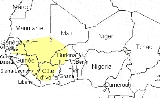
Bambara, also known as Bamanankan in the language itself, is a language
Language

A language is a form of symbol communication in which elements are combined to represents something other than themselves. Language can also refer to the use of such systems as a general phenomenon....
 spoken in Mali
Mali

Mali, officially the Republic of Mali, is a landlocked nation in West Africa. Mali is the seventh largest country in Africa, bordering Algeria on the north, Niger on the east, Burkina Faso and the C?te d'Ivoire on the south, Guinea on the south-west, and Senegal and Mauritania on the west....
 by as many as six million people (including second language users). The differences between Bambara and Dioula
Dioula language

Dioula is a Mande languages spoken in Burkina Faso and C?te d'Ivoire. It is one of the Manding languages, and is most closely related to Bambara language ....
 are minimal. Dioula is a language spoken or understood by a lesser number of people in Burkina Faso
Burkina Faso

Burkina Faso , also known by its short-form name Burkina, is a landlocked nation in West Africa. It is surrounded by six countries: Mali to the north, Niger to the east, Benin to the south east, Togo and Ghana to the south, and C?te d'Ivoire to the south west....
, Côte d'Ivoire
Côte d'Ivoire

, formerly Ivory Coast, officially the , is a country in West Africa. The government officially discourages the use of the name Ivory Coast in English, preferring the French name to be used in all languages ....
, and The Gambia
The Gambia

The Gambia commonly known as Gambia, is a country in West Africa. The Gambia is the smallest country in Africa, enclave by Senegal, and has a small coast on the Atlantic Ocean in the west....
. The Bambara language is the mother tongue of the Bambara
Bambara

The Bambara are a Mande people living in west Africa, primarily in Mali but also in Guinea, Burkina Faso and Senegal. They are considered to be amongst the largest Mande ethnic groups, and are the dominant Mande group in Mali, with 80% of the population speaking the Bambara language, regardless of ethnicity....
 ethnic group, numbering about 2,700,000 people, but serves also as a lingua franca
Lingua franca

A lingua franca is a language systematically used to communicate between persons not sharing a mother tongue, in particular when it is a third language, distinct from both persons' mother tongues....
 in Mali (it is estimated that about 80% of the population speaks it as a first or second language).

Bambara belongs to a group of closely-related languages called Manding
Manding languages

The Manding languages are a fairly mutually intelligible group of dialects or languages in West Africa, belonging to the Mande languages. Their best-known members are Bambara language , Mandinka language , Maninka language , and Dioula language Smaller languages/dialects belonging to the group include Xaasongaxango language....
, within the larger Mandé
Mande languages

The Mande languages are spoken in several countries in West Africa by the Mand? people and include Mandinka language, Soninke language, Bambara language, Bissa, Dioula, Kagoro, Bozo languages, Mende language, Susu language, Yacouba, Vai language, and Ligbi language....
 group.


Discussion
Ask a question about 'Bambara language'
Start a new discussion about 'Bambara language'
Answer questions from other users
Full Discussion Forum


Encyclopedia


Bambara, also known as Bamanankan in the language itself, is a language
Language

A language is a form of symbol communication in which elements are combined to represents something other than themselves. Language can also refer to the use of such systems as a general phenomenon....
 spoken in Mali
Mali

Mali, officially the Republic of Mali, is a landlocked nation in West Africa. Mali is the seventh largest country in Africa, bordering Algeria on the north, Niger on the east, Burkina Faso and the C?te d'Ivoire on the south, Guinea on the south-west, and Senegal and Mauritania on the west....
 by as many as six million people (including second language users). The differences between Bambara and Dioula
Dioula language

Dioula is a Mande languages spoken in Burkina Faso and C?te d'Ivoire. It is one of the Manding languages, and is most closely related to Bambara language ....
 are minimal. Dioula is a language spoken or understood by a lesser number of people in Burkina Faso
Burkina Faso

Burkina Faso , also known by its short-form name Burkina, is a landlocked nation in West Africa. It is surrounded by six countries: Mali to the north, Niger to the east, Benin to the south east, Togo and Ghana to the south, and C?te d'Ivoire to the south west....
, Côte d'Ivoire
Côte d'Ivoire

, formerly Ivory Coast, officially the , is a country in West Africa. The government officially discourages the use of the name Ivory Coast in English, preferring the French name to be used in all languages ....
, and The Gambia
The Gambia

The Gambia commonly known as Gambia, is a country in West Africa. The Gambia is the smallest country in Africa, enclave by Senegal, and has a small coast on the Atlantic Ocean in the west....
. The Bambara language is the mother tongue of the Bambara
Bambara

The Bambara are a Mande people living in west Africa, primarily in Mali but also in Guinea, Burkina Faso and Senegal. They are considered to be amongst the largest Mande ethnic groups, and are the dominant Mande group in Mali, with 80% of the population speaking the Bambara language, regardless of ethnicity....
 ethnic group, numbering about 2,700,000 people, but serves also as a lingua franca
Lingua franca

A lingua franca is a language systematically used to communicate between persons not sharing a mother tongue, in particular when it is a third language, distinct from both persons' mother tongues....
 in Mali (it is estimated that about 80% of the population speaks it as a first or second language).

Bambara belongs to a group of closely-related languages called Manding
Manding languages

The Manding languages are a fairly mutually intelligible group of dialects or languages in West Africa, belonging to the Mande languages. Their best-known members are Bambara language , Mandinka language , Maninka language , and Dioula language Smaller languages/dialects belonging to the group include Xaasongaxango language....
, within the larger Mandé
Mande languages

The Mande languages are spoken in several countries in West Africa by the Mand? people and include Mandinka language, Soninke language, Bambara language, Bissa, Dioula, Kagoro, Bozo languages, Mende language, Susu language, Yacouba, Vai language, and Ligbi language....
 group. It is an SOV
Subject Object Verb

In linguistic typology, Subject Object Verb is the type of languages in which the subject , object , and verb of a sentence appear or usually appear in that order....
 language and has two tones. It uses seven vowels a, e, , i, o, and u (the letters approximate their IPA equivalents). Writing was introduced during the French occupation and alphabetisation is a major issue especially in rural areas. Although written literature is only slowly evolving (due to the predominance of French as the "language of the educated"), there exists a wealth of oral literature
Oral history

Oral history can be defined as the recording, preservation and interpretation of history, based on the personal experiences and opinions of the speaker....
, which is often tales of kings and heroes. This oral literature is mainly tradited by the "Griot
Griot

A griot or jeli is a West African poet, praise singer, and wandering musician, considered a repository of oral history. As such, they are sometimes also called bards....
s" (J?liw in Bambara) who are a mixture of storyteller
Storyteller

A Storytelling is someone who conveys real or fictitious events in words, images, and sounds.Storyteller may also refer to:In literature:...
s, praise singers and human history books who have studied the trade of singing and reciting for many years. Many of their songs are very old and are said to date back to the old kingdom of Mali. Bambara is a national language of Mali, and also the most widely understood language in Mali.

Bambara has many local dialects. Some dialect variants: Somono, Segou, San, Beledugu, Ganadugu, Wasulu and Sikasso.

Jula (Dioula)

Jula
Dioula language

Dioula is a Mande languages spoken in Burkina Faso and C?te d'Ivoire. It is one of the Manding languages, and is most closely related to Bambara language ....
 is a dialect in the Manding linguistic continuum
Manding languages

The Manding languages are a fairly mutually intelligible group of dialects or languages in West Africa, belonging to the Mande languages. Their best-known members are Bambara language , Mandinka language , Maninka language , and Dioula language Smaller languages/dialects belonging to the group include Xaasongaxango language....
 and is closely related to Bambara. It is a widely-used trade language in West Africa
West Africa

West Africa or Western Africa is the westernmost region of the African continent. Geopolitically, the United Nations subregion of Western Africa includes the following 16 countries distributed over an area of approximately 5 million square km:...
.

Writing

Since the seventies Bambara has mostly been written in the Latin alphabet, using some additional phonetic characters. The vowels are a, e, (formerly è), i, o, (formerly ò), u; accents can be used to indicate tonality. The former digraph ny is now written or ñ (Senegal). The ambiguous digraph "ng" represented both the sound of English "finger" and the of "singer". The 1966 Bamako spelling conventions render the latter sound as "?".

The N'Ko
N'Ko

N'Ko is both a writing system devised by Solomana Kante in 1949 as a writing system for the Mande languages of West Africa, and the name of the literary language itself written in the script....
 alphabet is a script devised by Solomana Kante
Solomana Kante

Soulemayne Kante or Solomana Kante was an African writer and inventor of the N'Ko alphabet for the Mande languages of West Africa. N'Ko means 'I say' in all Mande languages....
 in 1949 as a writing system for the Mande languages of West Africa; N’Ko means 'I say' in all Mande languages. Kante created N’Ko in response to what he felt were beliefs that Africans were a "cultureless people" since prior to this time there had been no indigenous African writing system for his language. N'ko came first into use in Kankan, Guinea as a Maninka alphabet and disseminated from there into other Mande-speaking parts of West Africa. N'ko and the Arabic script are still in use for Bambara, although the Latin alphabet is much more common.

Grammar

Bambara belongs to a group of closely-related languages called Manding (related to Mandinka
Mandinka language

The Mandinka language, sometimes referred to as Mandingo, is a Mand? language spoken by millions of Mandinka people in Mali, Senegal, The Gambia, Guinea, Ivory Coast, Burkina Faso, Sierra Leone, Liberia, and Guinea-Bissau and Chad; it is the main language of The Gambia....
, Mande
Mande

Mande may refer to:* the Mand? people of western Africa* the Mandinka people people of western Africa* any of the Mande languages* the Mandinka language language...
 language group). It is an SOV
Subject Object Verb

In linguistic typology, Subject Object Verb is the type of languages in which the subject , object , and verb of a sentence appear or usually appear in that order....
 language and has two (mid/standard and high) tones; e.g. sa 'death' vs. 'snake.' The typical argument structure of the language consists of a subject, followed by an aspectival auxiliary, followed by the direct object, and finally a transitive verb. Naturally, if the verb is intransitive, the direct object is not found.

Bambara does not inflect for gender. Gender for a noun can be specified by adding a suffix, -ce or -ke for male and -muso for female. The plural is formed by attaching -w to words.

Bambara uses postpositions in much the same manner than languages like English and French use prepositions. These postpositions are found after the verb and are used to express direction, location, and in some cases, possession.

In urban areas, many Bambara conjunctions have been replaced in everyday use by French borrowings that often mark code-switches. The Bamako
Bamako

Bamako, population 1,690,471 , is the Capital and largest city of Mali, and currently estimated to be the fastest growing city in Africa . It is located on the Niger River, near the rapids that divide the Upper and Middle Niger Valleys, in the southwestern part of the country....
 dialect makes use of sentences like: N taara Kita mais il n'y avait personne là-bas. : I went to Kita [Bambara] but there was no one there [French]. The sentence in Bambara alone would be N taara Kita nka mgsi tunt yen. The French proposition "est-ce-que" is also used in Bambara, however it is pronounced more slowly and as three syllables; "ess uh kuh".

Bambara uses many French loan words. For example, some people might say: I ka kulosi ye jauni ye: "Your skirt is yellow" (using a derivation of the French word for yellow, jaune.)

However, one could also say: I ka kulosi ye neremuguman ye, also meaning "your skirt is yellow." The original Bambara word for yellow comes from "neremugu," mugu being flour made from nere
Néré

N?r? is a Communes of France in the Charente-Maritime Departments of France in western France....
, a seed from a long seed pod. Neremugu is often used in sauces in Southern Mali.

Most French loan words are suffixed with the sound 'i'; this is particularly common when using French words which have a meaning not traditionally found in Mali. For example, the Bambara word for snow
Snow

Snow is a type of precipitation in the form of crystalline water ice, consisting of a multitude of snowflakes that fall from clouds. The process of this precipitation is called snowfall....
 is niegei, based on the French word for snow neige. As there has never been snow in Mali, there has not been a traditional meaning for the word and thus no unique word in Bambara to describe it.

Examples

N b bamanankan mn dni-dni
I understand/hear a little bit of Bambara (lit: I aux positive Bambara hear small-small)


I tna dumuni ke wa?
Aren't you going to eat? (lit: you aux negative future eating do question particle)


Music

Malian artists such as Oumou Sangaré
Oumou Sangaré

Oumou Sangare is a Malian Wassoulou music musician, sometimes referred to as "The Songbird of Wassoulou." Wassoulou is a historic region south of the Niger River, and the music there is descended from traditional hunting songs, and is accompanied by a calabash....
, Rokia Traore
Rokia Traoré

Rokia Traor? is an award-winning Malian singer, songwriter and guitarist. Rokia was born in Mali as a member of the Bambara ethnic group. As her father was a diplomat, she travelled widely in her youth including to Algeria, Saudi Arabia, France and Belgium....
, Ali Farka Toure
Ali Farka Touré

Ali Ibrahim ?Farka? Tour? was a Malian singer and guitarist, and one of the African continent?s most internationally renowned musicians. His music is widely regarded as representing a point of intersection of traditional Music of Mali and its North American cousin, the blues....
, Salif Keita
Salif Keita

Salif Keita is an internationally recognized afro-pop singer-songwriter from Mali. He is unique not only because of his reputation as the Golden Voice of Africa, but because he has albinism and is a direct descendant of the founder of the Mali Empire, Sundiata Keita....
, Habib Koité
Habib Koité

Habib Koit? is an internationally-known Malian musician who sings and plays the guitar. His supporting cast, Bamada, is a super-group of West African talent, including K?l?tigui Diabat? playing balafon....
, and the blind couple Amadou & Mariam
Amadou & Mariam

Amadou & Mariam are a musical duo from Mali, composed of the couple Mariam Doumbia and Amadou Bagayoko . The pair, known as "the blind couple from Mali" met at Mali's Institute for the Young Blind, and found they shared an interest in music....
 often sing in Bambara. Alpha Blondy
Alpha Blondy

Alpha Blondy , is an Ivorian reggae singer and a major international recording artist. Alpha Blondy sings mainly in his native language of Dioula language, in French language and English language, and also sometimes in Arabic language or Hebrew language....
 often sings in Dioula, as does Aïda of the band, Métisse
Metisse

Metisse is a 2.5D windowing system, based on the X Window System. Metisse is available as a window manager for at least Mandriva One 2007, PCLinuxOS 2007 and Sabayon Linux....
. Lyrics in Bambara occur on Stevie Wonder
Stevie Wonder

Stevie Wonder is an American singer-songwriter, multi-instrumentalist, and record producer. A prominent figure in popular music during the latter half of the 20th century, Wonder has recorded more than thirty US top ten hits, won twenty-two Grammy Awards , plus one for Grammy Lifetime Achievement Award, won an Academy Award for Best Song, an...
's soundtrack Journey through the Secret Life of Plants
Journey through the Secret Life of Plants

Stevie Wonder's Journey through the Secret Life of Plants is an album by Stevie Wonder, originally released on the Tamla Motown label on October 30, 1979 ....
. Tiken Jah Fakoly
Tiken Jah Fakoly

Tiken Jah Fakoly is a reggae singer from C?te d'Ivoire.Tiken Jah was born into a family of griots and christened Doumbia Moussa Fakoly on June 23, 1968 in Odienn?, north-western C?te d'Ivoire....
 (reggae) often sings in Dioula and French.

Bibliography

  • Bird, Charles & Kanté, Mamadou (1977) Bambara-English, English-Bambara student lexicon. Bloomington: Indiana Univ. Linguistics Club.
  • Kastenholz, Raimund (1998) Grundkurs Bambara (Manding) mit Texten (second revised edition) (Afrikawissenschaftliche Lehrbücher Vol. 1). Köln: Rüdiger Köppe.
  • Konaré, Demba (1998) Je parle bien bamanan. Bamako: Jamana.
  • Touré, Mohamed & Leucht, Melanie (1996) Bambara Lesebuch: Originaltexte mit deutscher und französischer Übersetzung = Chrestomathie Bambara: textes originaux Bambara avec traductions allemandes et françaises (with illustrations by Melanie Leucht) (Afrikawissenschaftliche Lehrbücher Vol. 11) . Köln: Rüdiger Köppe.


External links


Descriptions

  • from Ethnologue site


Dictionaries

  • online and downloadable lexicons for language learners


Learning materials


Other

  • contains more material
  • (includes information on Bambara)


See also

  • Bambara
    Bambara

    The Bambara are a Mande people living in west Africa, primarily in Mali but also in Guinea, Burkina Faso and Senegal. They are considered to be amongst the largest Mande ethnic groups, and are the dominant Mande group in Mali, with 80% of the population speaking the Bambara language, regardless of ethnicity....