


Griot

Encyclopedia
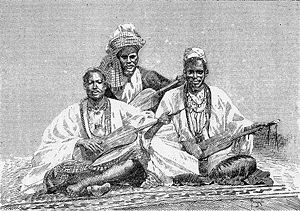
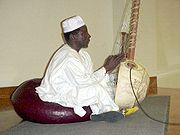
A griot or jeli (djeli or djéli in French spelling) is a West Africa
n storyteller. The griot delivers history as a poet
, praise singer, and wandering musician
. The griot is a repository of oral tradition
. As such, they are sometimes also called bards. According to Paul Oliver in his book Savannah Syncopators, "Though [the griot] has to know many traditional songs without error, he must also have the ability to extemporize on current events, chance incidents and the passing scene. His wit can be devastating and his knowledge of local history formidable." Although they are popularly known as 'praise singers', griots may also use their vocal expertise for gossip, satire, or political comment.
Griots today live in many parts of West Africa, including Mali
, the Gambia, Guinea
, Mauritania
, Senegal
and are present among the Mande peoples (Mandinka
, Malinké, Bambara, etc.), Fulɓe
(Fula), Hausa
, Songhai, Tukulóor
, Wolof
, Serer
, Mossi, Dagomba
, Mauritania
n Arabs and many other smaller groups. The word may derive from the French
transliteration "guiriot" of the Portuguese
word "criado," or masculine singular term for "servant."
In African languages, griots are referred to by a number of names: jeli in northern Mande areas, jali in southern Mande areas, guewel in Wolof
, gawlo in Pulaar
(Fula). Griots form an endogamous caste
, meaning that most of them only marry fellow griots and that those who are not griots do not normally perform the same functions that they perform.
term jeliya (meaning "musicianhood") is sometimes used for the knowledge of griots, indicating the hereditary nature of the class. Jali comes from the root word jali or djali (blood). This word is also the title given to griots in areas corresponding to the former Mali Empire
. Though the usage "griot" is far more common in English, some griot advocates such as Bakari Sumano
prefer the term jeli.
 The Mali Empire
(Malinke Empire), at its height in the middle of the 14th century, extended from central Africa
(today's Chad
and Niger
) to West Africa (today's Mali
and Senegal
). The Empire was founded by Sundjata Keita, whose exploits remain celebrated in Mali even today. In the Epic of Sundjata
, King Naré Maghann Konaté
offered his son Sundiata a griot, Balla Fasséké
, to advise him in his reign. Balla Fasséké
is thus considered the first griot and the founder of the Kouyaté line of griots that exists to this day.
Each aristocratic
family of griots accompanied a higher-ranked family of warrior-kings or emperors, which they called jatigi. In traditional culture, no griot can be without a jatigi, and no jatigi can be without a griot; the two are inseparable, and worthless without the other. However, the jatigi can accept a "loan" of his griot to another jatigi.
Most villages also had their own griot, who told tales of births, deaths, marriages, battles, hunts, affairs, and hundreds of other things.
, head of the Association of Bamako
Griots in Mali from 1994 to 2003, was an internationally-known advocate for the importance of the griot in West African society.
an film Guimba the Tyrant
directed by Cheick Oumar Sissoko
, the storytelling is done through the village griot, who also serves to provide comic relief.
In the late novels of the Ivorian writer Ahmadou Kourouma
, Waiting for the Wild Beasts to Vote takes the form of a praise-song by the Sora, the Griot, Bingo to the president-Dictator of the fictitious République du Golfe. His final novel Allah is not Obliged also prominently features a griot character.
There are also references in the Alex Haley
's book Roots
of a griot who passed his family history through oral tradition. When Haley traces back his history, passing from his previous generation through the slave time, back to Africa, he thought there should be griots telling his history and the history of his ancestor, known in the family as "The African", who was captured in the bushes when he was seeking timber to make a talking drum. When he arrived in Africa to do research for his book, he believed he had actually found griots telling his history. Through them he learned the ancestor's identity, Kunta Kinte
. Since he had first heard the story from his grandmother and later refreshed by his older cousin, he believed that they were griots in their own way until someone put the story to writing. He later learned that his cousin had died within the hour of his arrival at the village.
In fact, however, this story illustrates the problems and complexities of oral tradition
, especially when approached without expert knowledge. In 1981, it was shown (Wright, 1981) that the story of Kunta Kinte had been manufactured by a well-wisher. Following the publication of Roots, the story was being told in multiple versions with differing embellishments, having entered the stock of general stories.
In Paule Marshall
's Praisesong for the Widow, the protagonist Avatara (Avey) might take on some of the characteristics of a griot, especially in her commitment to passing on to her grandchildren her aunt's oral story of the Ibos at the Landing, in which Africans brought to the U.S. Sea Islands to be slaves promptly turned around and walked back to Africa over the water.
Griot is the name of an instrumental track on Jon Hassell
and Brian Eno
's ambient music album Possible Musics
.
Innercity Griots
is the second album by Los Angeles Hip Hop group Freestyle Fellowship
, released in 1993 through 4th & B'way Records. The group, consisting of four emcees: Aceyalone, P.E.A.C.E., Mikah 9 and Self Jupiter, received worldwide acclaim with their second project. Released during the prominent gangsta era of West Coast hip hop, Innercity Griots, along with albums like The Pharcyde's Bizarre Ride II the Pharcyde and Del tha Funkee Homosapien's I Wish My Brother George Was Here, established an acclaimed era of alternative hip hop in California.
Malian novelist Massa Makan Diabaté
was both a descendant and critic of the griot tradition. Though Diabaté argued on the one hand that griots "no longer exist" in the classic sense, he also saw this tradition as one that could be salvaged through written literature. His fiction and plays blend traditional Mandinka
storytelling and idiom
with Western
literary forms.
Griot, meaning urban storyteller and teacher of history, is referenced by Professor A.L.I. in the first line of his 2010 single 'Guantanamo'.
Sura Susso
West Africa
West Africa or Western Africa is the westernmost region of the African continent. Geopolitically, the UN definition of Western Africa includes the following 16 countries and an area of approximately 5 million square km:-Flags of West Africa:...
n storyteller. The griot delivers history as a poet
Poet
A poet is a person who writes poetry. A poet's work can be literal, meaning that his work is derived from a specific event, or metaphorical, meaning that his work can take on many meanings and forms. Poets have existed since antiquity, in nearly all languages, and have produced works that vary...
, praise singer, and wandering musician
Musician
A musician is an artist who plays a musical instrument. It may or may not be the person's profession. Musicians can be classified by their roles in performing music and writing music.Also....* A person who makes music a profession....
. The griot is a repository of oral tradition
Oral history
Oral history is the collection and study of historical information about individuals, families, important events, or everyday life using audiotapes, videotapes, or transcriptions of planned interviews...
. As such, they are sometimes also called bards. According to Paul Oliver in his book Savannah Syncopators, "Though [the griot] has to know many traditional songs without error, he must also have the ability to extemporize on current events, chance incidents and the passing scene. His wit can be devastating and his knowledge of local history formidable." Although they are popularly known as 'praise singers', griots may also use their vocal expertise for gossip, satire, or political comment.
Griots today live in many parts of West Africa, including Mali
Mali
Mali , officially the Republic of Mali , is a landlocked country in Western Africa. Mali borders Algeria on the north, Niger on the east, Burkina Faso and the Côte d'Ivoire on the south, Guinea on the south-west, and Senegal and Mauritania on the west. Its size is just over 1,240,000 km² with...
, the Gambia, Guinea
Guinea
Guinea , officially the Republic of Guinea , is a country in West Africa. Formerly known as French Guinea , it is today sometimes called Guinea-Conakry to distinguish it from its neighbour Guinea-Bissau. Guinea is divided into eight administrative regions and subdivided into thirty-three prefectures...
, Mauritania
Mauritania
Mauritania is a country in the Maghreb and West Africa. It is bordered by the Atlantic Ocean in the west, by Western Sahara in the north, by Algeria in the northeast, by Mali in the east and southeast, and by Senegal in the southwest...
, Senegal
Senegal
Senegal , officially the Republic of Senegal , is a country in western Africa. It owes its name to the Sénégal River that borders it to the east and north...
and are present among the Mande peoples (Mandinka
Mandinka people
The Mandinka, Malinke are one of the largest ethnic groups in West Africa with an estimated population of eleven million ....
, Malinké, Bambara, etc.), Fulɓe
Fula people
Fula people or Fulani or Fulbe are an ethnic group spread over many countries, predominantly in West Africa, but found also in Central Africa and Sudanese North Africa...
(Fula), Hausa
Hausa people
The Hausa are one of the largest ethnic groups in West Africa. They are a Sahelian people chiefly located in northern Nigeria and southeastern Niger, but having significant numbers living in regions of Cameroon, Ghana, Cote d'Ivoire, Chad and Sudan...
, Songhai, Tukulóor
Toucouleur
The Toucouleurs are a Fula agricultural people who live primarily in West Africa: the north of Senegal in the Senegal River valley, Mauritania, and Mali.-History:...
, Wolof
Wolof people
The Wolof are an ethnic group found in Senegal, The Gambia, and Mauritania.In Senegal, the Wolof form an ethnic plurality with about 43.3% of the population are Wolofs...
, Serer
Serer people
The Serer people along with the Jola people are acknowledged to be the oldest inhabitants of The Senegambia....
, Mossi, Dagomba
Dagomba
The Dagomba are an ethnic group of Northern Ghana. They inhabit the sparse savanna region below the sahelian belt, known as the Sudan. They speak the Dagbani language which belongs to the More-Dagbani sub-group of Gur languages...
, Mauritania
Mauritania
Mauritania is a country in the Maghreb and West Africa. It is bordered by the Atlantic Ocean in the west, by Western Sahara in the north, by Algeria in the northeast, by Mali in the east and southeast, and by Senegal in the southwest...
n Arabs and many other smaller groups. The word may derive from the French
French language
French is a Romance language spoken as a first language in France, the Romandy region in Switzerland, Wallonia and Brussels in Belgium, Monaco, the regions of Quebec and Acadia in Canada, and by various communities elsewhere. Second-language speakers of French are distributed throughout many parts...
transliteration "guiriot" of the Portuguese
Portuguese language
Portuguese is a Romance language that arose in the medieval Kingdom of Galicia, nowadays Galicia and Northern Portugal. The southern part of the Kingdom of Galicia became independent as the County of Portugal in 1095...
word "criado," or masculine singular term for "servant."
In African languages, griots are referred to by a number of names: jeli in northern Mande areas, jali in southern Mande areas, guewel in Wolof
Wolof language
Wolof is a language spoken in Senegal, The Gambia, and Mauritania, and is the native language of the Wolof people. Like the neighbouring languages Serer and Fula, it belongs to the Atlantic branch of the Niger–Congo language family...
, gawlo in Pulaar
Fula language
The Fula or Fulani language is a language of West Africa. It is spoken as a first language by the and related groups from Senegambia and Guinea to Cameroon and Sudan...
(Fula). Griots form an endogamous caste
Caste
Caste is an elaborate and complex social system that combines elements of endogamy, occupation, culture, social class, tribal affiliation and political power. It should not be confused with race or social class, e.g. members of different castes in one society may belong to the same race, as in India...
, meaning that most of them only marry fellow griots and that those who are not griots do not normally perform the same functions that they perform.
Terms "griot" and "jali"
The MandingManding languages
The Manding languages are a fairly mutually intelligible group of dialects or languages in West Africa, belonging to the Mande languages. Their best-known members are Bambara, the most widely spoken language in Mali; Mandinka, the main language of Gambia; Maninka or Malinké, a major language of...
term jeliya (meaning "musicianhood") is sometimes used for the knowledge of griots, indicating the hereditary nature of the class. Jali comes from the root word jali or djali (blood). This word is also the title given to griots in areas corresponding to the former Mali Empire
Mali Empire
The Mali Empire or Mandingo Empire or Manden Kurufa was a West African empire of the Mandinka from c. 1230 to c. 1600. The empire was founded by Sundiata Keita and became renowned for the wealth of its rulers, especially Mansa Musa I...
. Though the usage "griot" is far more common in English, some griot advocates such as Bakari Sumano
Bakari Sumano
Bakari Sumano was head of Malian association of griots from 1994 until his death.Bakari Sumano left school in 1955 to become a mechanic's apprentice, but continued to take night classes in history and typing. In 1957, he received a position at the Social Security Office...
prefer the term jeli.
In the Mali Empire
Mali Empire
The Mali Empire or Mandingo Empire or Manden Kurufa was a West African empire of the Mandinka from c. 1230 to c. 1600. The empire was founded by Sundiata Keita and became renowned for the wealth of its rulers, especially Mansa Musa I...
(Malinke Empire), at its height in the middle of the 14th century, extended from central Africa
Central Africa
Central Africa is a core region of the African continent which includes Burundi, the Central African Republic, Chad, the Democratic Republic of the Congo, and Rwanda....
(today's Chad
Chad
Chad , officially known as the Republic of Chad, is a landlocked country in Central Africa. It is bordered by Libya to the north, Sudan to the east, the Central African Republic to the south, Cameroon and Nigeria to the southwest, and Niger to the west...
and Niger
Niger
Niger , officially named the Republic of Niger, is a landlocked country in Western Africa, named after the Niger River. It borders Nigeria and Benin to the south, Burkina Faso and Mali to the west, Algeria and Libya to the north and Chad to the east...
) to West Africa (today's Mali
Mali
Mali , officially the Republic of Mali , is a landlocked country in Western Africa. Mali borders Algeria on the north, Niger on the east, Burkina Faso and the Côte d'Ivoire on the south, Guinea on the south-west, and Senegal and Mauritania on the west. Its size is just over 1,240,000 km² with...
and Senegal
Senegal
Senegal , officially the Republic of Senegal , is a country in western Africa. It owes its name to the Sénégal River that borders it to the east and north...
). The Empire was founded by Sundjata Keita, whose exploits remain celebrated in Mali even today. In the Epic of Sundjata
Epic of Sundiata
The Sundiata Keita or Epic of Sundiata is an epic poem of the Malinke people and tells the story of the hero Sundiata Keita, the founder of the Mali Empire...
, King Naré Maghann Konaté
Naré Maghann Konaté
Naré Maghann Konaté was a 12th-century faama of the Mandinka people, in what is today Mali. He was the father of Sundiata Keita, founder of the Mali Empire, and a character in the oral tradition of the Epic of Sundiata....
offered his son Sundiata a griot, Balla Fasséké
Balla Fasséké
In the ancient African oral tradition of the Epic of Sundjata, Balla Fasséké is Sundiata Keita's griot. King Naré Maghann Konaté offered his son Sundiata a griot, Balla Fasséké, to advise him in his reign...
, to advise him in his reign. Balla Fasséké
Balla Fasséké
In the ancient African oral tradition of the Epic of Sundjata, Balla Fasséké is Sundiata Keita's griot. King Naré Maghann Konaté offered his son Sundiata a griot, Balla Fasséké, to advise him in his reign...
is thus considered the first griot and the founder of the Kouyaté line of griots that exists to this day.
Each aristocratic
Aristocracy (class)
The aristocracy are people considered to be in the highest social class in a society which has or once had a political system of Aristocracy. Aristocrats possess hereditary titles granted by a monarch, which once granted them feudal or legal privileges, or deriving, as in Ancient Greece and India,...
family of griots accompanied a higher-ranked family of warrior-kings or emperors, which they called jatigi. In traditional culture, no griot can be without a jatigi, and no jatigi can be without a griot; the two are inseparable, and worthless without the other. However, the jatigi can accept a "loan" of his griot to another jatigi.
Most villages also had their own griot, who told tales of births, deaths, marriages, battles, hunts, affairs, and hundreds of other things.
In Mande society
In Mande society, the jeli was as a historian, advisor, arbitrator, praise singer (patronage), and storyteller. Essentially, these musicians were walking history books, preserving their ancient stories and traditions through song. Their inherited tradition was passed down through generations. Their name, jeli, means "blood" in Manika language. They were said to have deep connections to spiritual, social, or political powers as music is associated as such. Speech is also said to have power as it can recreate history and relationships.Today
Bakari SumanoBakari Sumano
Bakari Sumano was head of Malian association of griots from 1994 until his death.Bakari Sumano left school in 1955 to become a mechanic's apprentice, but continued to take night classes in history and typing. In 1957, he received a position at the Social Security Office...
, head of the Association of Bamako
Bamako
Bamako is the capital of Mali and its largest city with a population of 1.8 million . Currently, it is estimated to be the fastest growing city in Africa and sixth fastest in the world...
Griots in Mali from 1994 to 2003, was an internationally-known advocate for the importance of the griot in West African society.
In popular culture
In the MaliMali
Mali , officially the Republic of Mali , is a landlocked country in Western Africa. Mali borders Algeria on the north, Niger on the east, Burkina Faso and the Côte d'Ivoire on the south, Guinea on the south-west, and Senegal and Mauritania on the west. Its size is just over 1,240,000 km² with...
an film Guimba the Tyrant
Guimba the Tyrant
Guimba the Tyrant is a 1995 Malian comedy drama film in the Bambara language , directed by noted Malian director Cheick Oumar Sissoko. The movie shows the rise and fall of a cruel and despotic village chief Guimba, and his son Jangine in a fictional village in the Sahel of Mali...
directed by Cheick Oumar Sissoko
Cheick Oumar Sissoko
Cheick Oumar Sissoko is a Malian film director and politician.-Biography:As a student in Paris, Cheick Oumar Sissoko obtained a DEA in African History and Sociology and a diploma in History and Cinema from the Ecole des hautes études en sciences sociales...
, the storytelling is done through the village griot, who also serves to provide comic relief.
In the late novels of the Ivorian writer Ahmadou Kourouma
Ahmadou Kourouma
Ahmadou Kourouma was an Ivorian novelist.-Life:The eldest son of a distinguished Malinké family, Ahmadou Kourouma was born in 1927 in Côte d'Ivoire. Raised by his uncle, he initially pursued studies in Bamako, Mali...
, Waiting for the Wild Beasts to Vote takes the form of a praise-song by the Sora, the Griot, Bingo to the president-Dictator of the fictitious République du Golfe. His final novel Allah is not Obliged also prominently features a griot character.
There are also references in the Alex Haley
Alex Haley
Alexander Murray Palmer Haley was an African-American writer. He is best known as the author of Roots: The Saga of an American Family and the coauthor of The Autobiography of Malcolm X.-Early life:...
's book Roots
Roots: The Saga of an American Family
Roots: The Saga of an American Family is a novel written by Alex Haley and first published in 1976. It tells the story of Kunta Kinte, an 18th-century African, captured as an adolescent and sold into slavery in the United States, and follows his life and the lives of his descendants in the U.S....
of a griot who passed his family history through oral tradition. When Haley traces back his history, passing from his previous generation through the slave time, back to Africa, he thought there should be griots telling his history and the history of his ancestor, known in the family as "The African", who was captured in the bushes when he was seeking timber to make a talking drum. When he arrived in Africa to do research for his book, he believed he had actually found griots telling his history. Through them he learned the ancestor's identity, Kunta Kinte
Kunta Kinte
Kunta Kinte is the central character of the novel Roots: The Saga of an American Family by American author Alex Haley, and of the television miniseries Roots, based on the book. Haley described his book as faction - a mixture of fact and fiction...
. Since he had first heard the story from his grandmother and later refreshed by his older cousin, he believed that they were griots in their own way until someone put the story to writing. He later learned that his cousin had died within the hour of his arrival at the village.
In fact, however, this story illustrates the problems and complexities of oral tradition
Oral tradition
Oral tradition and oral lore is cultural material and traditions transmitted orally from one generation to another. The messages or testimony are verbally transmitted in speech or song and may take the form, for example, of folktales, sayings, ballads, songs, or chants...
, especially when approached without expert knowledge. In 1981, it was shown (Wright, 1981) that the story of Kunta Kinte had been manufactured by a well-wisher. Following the publication of Roots, the story was being told in multiple versions with differing embellishments, having entered the stock of general stories.
In Paule Marshall
Paule Marshall
Paule Marshall is an American author. She was born Valenza Pauline Burke in Brooklyn to Barbadian parents and educated at Girls High School, Brooklyn College and Hunter College . Early in her career, she wrote poetry, but later returned to prose...
's Praisesong for the Widow, the protagonist Avatara (Avey) might take on some of the characteristics of a griot, especially in her commitment to passing on to her grandchildren her aunt's oral story of the Ibos at the Landing, in which Africans brought to the U.S. Sea Islands to be slaves promptly turned around and walked back to Africa over the water.
Griot is the name of an instrumental track on Jon Hassell
Jon Hassell
Jon Hassell is an American trumpet player and composer. He is known for his influence in the world music scene and his unusual electronic manipulation of the trumpet sound.-Life and career:...
and Brian Eno
Brian Eno
Brian Peter George St. John le Baptiste de la Salle Eno , commonly known as Brian Eno or simply as Eno , is an English musician, composer, record producer, singer and visual artist, known as one of the principal innovators of ambient music.Eno studied at Colchester Institute art school in Essex,...
's ambient music album Possible Musics
Possible Musics
Fourth World, Vol. 1: Possible Musics is an album by Brian Eno and Jon Hassell, released in 1980.-Overview:"Fourth World" is a term used by trumpeter Jon Hassell to describe a style of music employing modern technological treatments and influenced by various cultures and eras...
.
Innercity Griots
Innercity Griots
-Personnel:Information taken from Allmusic.*arranging – Edman, JMD, Kevin O'Neal*bass – Robert Harris, JMD, Kevin O'Neal, Christy Smith, Alfred Threats*bass – Kevin O'Neal, Christy Smith*drums – Robert Harris, JMD...
is the second album by Los Angeles Hip Hop group Freestyle Fellowship
Freestyle Fellowship
Freestyle Fellowship are a rap group from Los Angeles consisting of rappers Aceyalone, Myka 9, P.E.A.C.E., Self Jupiter and producer J Sumbi...
, released in 1993 through 4th & B'way Records. The group, consisting of four emcees: Aceyalone, P.E.A.C.E., Mikah 9 and Self Jupiter, received worldwide acclaim with their second project. Released during the prominent gangsta era of West Coast hip hop, Innercity Griots, along with albums like The Pharcyde's Bizarre Ride II the Pharcyde and Del tha Funkee Homosapien's I Wish My Brother George Was Here, established an acclaimed era of alternative hip hop in California.
Malian novelist Massa Makan Diabaté
Massa Makan Diabaté
Massa Makan Diabaté was a Malian historian, author, and playwright.-Biography:Born in 1938 in Kita, Massa Makan Diabaté was the descendant of a long line of West African poets ....
was both a descendant and critic of the griot tradition. Though Diabaté argued on the one hand that griots "no longer exist" in the classic sense, he also saw this tradition as one that could be salvaged through written literature. His fiction and plays blend traditional Mandinka
Mandinka people
The Mandinka, Malinke are one of the largest ethnic groups in West Africa with an estimated population of eleven million ....
storytelling and idiom
Idiom
Idiom is an expression, word, or phrase that has a figurative meaning that is comprehended in regard to a common use of that expression that is separate from the literal meaning or definition of the words of which it is made...
with Western
Western culture
Western culture, sometimes equated with Western civilization or European civilization, refers to cultures of European origin and is used very broadly to refer to a heritage of social norms, ethical values, traditional customs, religious beliefs, political systems, and specific artifacts and...
literary forms.
Griot, meaning urban storyteller and teacher of history, is referenced by Professor A.L.I. in the first line of his 2010 single 'Guantanamo'.
Notable griot artists and groups
- Sura Susso (Gambia)
- Ablaye CissokkoAblaye CissokkoAblaye Cissokko is a Senegalese musician, a kora player.His show called "Le Griot Rouge" talks about the legend of the man who created the kora. During this performance, Cissoko transmits the values of a generous tradition and sings about peace and respect for others.His 2006 tour passed through...
(Senegal) - Abdoulaye DiabatéAbdoulaye DiabatéAbdoulaye Diabaté is a singer and guitarist who was born to Griot family in Kela, Mali in 1956. He has at least twenty years of experience in contemporary and popular music.-Life:...
(Mali) - Alassane Sarr (Senegal)
- Alhaji Musa Dan Kwairo (Nigeria)
- Alpha Oulare (Guinea)
- Aly "Alisco" Diabate (Guinea)
- Afel BocoumAfel BocoumAfel Bocoum is a musician from Mali, noted as a singer and guitarist. He began his career as a member of Ali Farka Toure's group ASCO, and Toure is often regarded as his mentor. Both men come from the town of Niafunke on the River Niger, and are members of the Sonrai people...
(Mali) - Gokh-Bi System (Senegal)
- Amadu Bansang Jobarteh (Gambia)
- Atongo ZimbaAtongo ZimbaAtongo Zimba is a musician and griot from Ghana. His tours in Europe, South America and Africa include a benefit for the 2010 Haiti earthquake, at the Alliance Française in Accra. His album Allah Mongode was recorded in Switzerland. His album Barefoot in the Sand was nominated "African CD of the...
(Ghana) - Baaba MaalBaaba MaalBaaba Maal is a Senegalese singer and guitarist born in Podor, on the Senegal River. In addition to acoustic guitar, he also plays percussion. He has released several albums, both for independent and major labels. In July 2003, he was made a UNDP Youth Emissary.-Biography:Born 12 November 1953...
(Senegal) - Baay Bia (Senegal)
- Ba CissokoBa CissokoBa Cissoko is a Guinean world music band, featuring four members, two of which are playing the traditional Kora harp. The other two band members play percussions and bass, respectively...
(Guinea) - Baba SissokoBaba SissokoBaba Sissoko is a musician and vocalist. Sissoko is a master of the talking drums...
(Mali) - Badenya les Frères Coulibaly (Burkina Faso)
- Balla Kouyate (Mali)
- Balla TounkaraBalla Tounkara-Early life:He was born in Mali into a family of griots, who traditionally played music to the kings of the Malian Empire in their royal court. He started to learn the Kora as a child.-Current activities:...
(Mali) - Bawa Abudu (Ghana)
- Boubacar Diabate (Mali)
- Boubacar TraoréBoubacar TraoréBoubacar Traoré is a renowned singer, songwriter, and guitarist. Traoré also goes by the nickname Kar Kar, "the one who dribbles too much" in Bambara, a reference to his soccer playing: "a nickname I got from playing soccer when I was young...
(Mali) - Cheick Hamala DiabatéCheick Hamala DiabatéCheick Hamala Diabate is a musician from Mali, West Africa who has been nominated for a Grammy award. Using Adelphi, Maryland as his home he travels all over the United States, Canada, Europe, and Asia. He has performed at the Kennedy Center, the United States Senate, and the Smithsonian...
(Mali) - Daby Balde (Senegal)
- Dan MarayaDan MarayaDan Maraya Jos is a Nigerian Hausa Griot best known for playing the kontigi.Dan Maraya Jos is a living legend in the hausa musical world. His songs are about life and living- External links :* via nigeria-arts.net...
(Nigeria) - Dembo Jobarteh (Gambia)
- Dimi Mint AbbaDimi Mint AbbaDimi Mint Abba was Mauritania's most famous musician. She was born Loula Bint Siddaty Ould Abba in 1958 into a low-caste family specializing in the griot tradition.-Life and career:...
(Mauritania) - Djeli Moussa DiawaraDjeli Moussa DiawaraDjeli Moussa Diawara, [born 1962 in Kankan, Guinea] is a Kora player , a composer, and singer.- Short Biography :Djeli Moussa Diawara was born to a family of the Griot tribe. His father was a balafon player, and his mother a singer...
or Jali Musa Jawara (Guinea) - Djelimady TounkaraDjelimady TounkaraDjelimady Tounkara is a Malian musician and one of the foremost guitarists in Africa.Born in the culturally rich town of Kita, west of the Malian capital, Bamako, Djelimady grew up surrounded with traditional music played by members of his family, griots, musicians and historians by birth....
(Mali) - Djimo Kouyate (Senegal)
- Dou Dou N'Diaye Rose (Senegal)
- El Hadj Djeli Sory Kouyate (Guinea)
- Etran FinatawaEtran FinatawaEtran Finatawa is a Niger-based band, formed in 2004 during the Festival au Désert near Timbuktu, Mali. The music of Etran Finatawa blends the traditional music of the Woodabe and Tuareg people with western instruments such as the electric guitar.....
(Niger) - Foday Musa SusoFoday Musa SusoFoday Musa Suso is a musician and composer from the West African nation of Gambia. He is a member of the Mandinka ethnic group, and is a jali...
(Gambia) - Habib KoitéHabib KoitéHabib Koité is a Malian singer, songwriter and guitarist. His supporting cast, Bamada, is a super-group of West African talent, including Kélétigui Diabaté playing balafon.- Musical style :...
(Mali) - Famoro Dioubaté's Kakande (Guinea/New York)
- Kasse Mady Diabate (Mali)
- King Ayisoba (Ghana)
- Lamin SahoLamin SahoLamin Saho is a kora player, vocalist and the leader of the band Roots and Culture.He lives in The Gambia, in West Africa and he is the oldest son of the famous late Yankuba Saho, who was a griot also....
(Gambia) - Malamini Jobarteh (Gambia)
- Mamadou DiabatéMamadou DiabatéMamadou Diabaté is a kora player. He began playing quite early in his life, became known as a musician in the area of Mali in which he lived, and has since moved to the United States, recording several albums.-Life and career:...
(Mali) - Mamadou Lynx N'Diaye (Senegal)
- Muhamman ShataMuhamman ShataAlhaji Mamman Shata Katsina Alhaji (Dr) Mamman Shata Katsina Alhaji (Dr) Mamman Shata Katsina (born in 1923 in Musawa village, Katsina State, Nigeria, died on 9 June 1999. He is a well-known Hausa musician in West, East and Central Africa. His vocals are often accompanied by talking drums, known...
(Nigeria) - Mory KantéMory KantéMory Kanté is a vocalist and player of the kora harp. He was born into one of Guinea's best known families of griot musicians...
(Guinea) - Mansour SeckMansour SeckMansour Seck is a blind Senegalese singer and musician born in Podor, in the north of the country. Best known for his collaboration with life-long friend Baaba Maal, he has also toured and released several solo albums.-Biography:...
- N'Faly KouyateN'Faly KouyateN'Faly Kouyate is a Guinean musician. He is a member of the Mandinka ethnic group of West Africa. His father was the griot Konkoba Kabinet Kouyate, who lived in Siguiri, Guinea....
(Guinea) - National Instrumental Ensemble of Guinea (Guinea)
- Nuru KaneNuru KaneNuru Kane is a Senegalese singer/songwriter who plays guitar, bass and guimbri, a three-stringed Moroccan bass in the band Bayefall Gnawa....
(Senegam) - Papa SussoPapa SussoAlhaji Papa Susso is a griot or jeli, master kora player, and director of the Koriya Musa Center for Research in Oral Tradition. He was born 29 September, 1947, in the village of Sotuma Sere in the Upper River Division of The Republic of Gambia, West Africa. The Susso family represents a dynasty...
(Gambia) - Pape Kanoutè (Senegal)
- Prince Diabaté (Guinea)
- Rokia TraoréRokia TraoréRokia Traoré is a Victoires de la Musique award-winning Malian singer, songwriter and guitarist. Born in Mali as a member of the Bambara ethnic group, her father was a diplomat and she travelled widely in her youth. She visited such countries as Algeria, Saudi Arabia, France and Belgium and was...
(Mali) - Salieu Suso (Gambia)
- Backa Niang (Senegal)
- Sanjally Jobarteh (Gambia)
- Seikou Susso (Gambia)
- Sherrifo Konteh (Gambia)
- Toumani DiabatéToumani DiabatéToumani Diabaté is a Malian kora player. In addition to performing the traditional music of Mali, he has also been involved in cross-cultural collaborations with flamenco, blues, jazz, and other international styles.-Biography:...
(Mali) - Vieux Diop (Senegal)
- Yacouba Sissoko (Mali)
- Youssou N'DourYoussou N'DourYoussou N'Dour is a Senegalese singer, percussionist and occasional actor. In 2004, Rolling Stone described him as, in Senegal and much of Africa, "perhaps the most famous singer alive." He helped develop a style of popular music in Senegal, known in the Serer language as mbalax, a type of music...
(Senegal)
See also
- List of Sub-Saharan African folk music traditions
- Ahmadou KouroumaAhmadou KouroumaAhmadou Kourouma was an Ivorian novelist.-Life:The eldest son of a distinguished Malinké family, Ahmadou Kourouma was born in 1927 in Côte d'Ivoire. Raised by his uncle, he initially pursued studies in Bamako, Mali...
- The skaldSkaldThe skald was a member of a group of poets, whose courtly poetry is associated with the courts of Scandinavian and Icelandic leaders during the Viking Age, who composed and performed renditions of aspects of what we now characterise as Old Norse poetry .The most prevalent metre of skaldic poetry is...
s performed a similar function in Scandinavian societies. - MaraboutMaraboutA marabout is a Muslim religious leader and teacher in West Africa, and in the Maghreb. The marabout is often a scholar of the Qur'an, or religious teacher. Others may be wandering holy men who survive on alms, Sufi Murshids , or leaders of religious communities...
, another casteCasteCaste is an elaborate and complex social system that combines elements of endogamy, occupation, culture, social class, tribal affiliation and political power. It should not be confused with race or social class, e.g. members of different castes in one society may belong to the same race, as in India...
of the indigenous African societiesSocietyA society, or a human society, is a group of people related to each other through persistent relations, or a large social grouping sharing the same geographical or virtual territory, subject to the same political authority and dominant cultural expectations...
Sura Susso
External links
- Lavender, Catherine (2000). "African Griot Images." (Webpage for a course at CSI/CUNY)
- Salmons, Catherine A. (2004). Balla Tounkara "Griot"
- The Maninka and Mandinka Jali/Jeli
- The Ancient Craft of Jaliyaa
- Keita: The Heritage of the Griot - Film Notes
- The Griot Music documentary by Volker GoetzeVolker Goetzeis a German trumpeter. He toured West Africa, Europe and Asia. He is featured on numerous recordings, and recorded with international artists such as Nana Vasconcelos, Lenny Pickett and others. He has also performed with Steve Lacy, Brian Lynch, Peter Kowald, and Craig Handy.Mr. Goetze graduated...
- theGrio News The GrioThe GrioTheGrio.com is a black and African-American video news site that focuses on underrepresented stories in existing national news that are important to the African-American community....
is African-American News from NBC - Jeliya - The art of Jeli (being a griot)