
All Topics  
Battle of Fredericksburg


   Email Print
   Bookmark   Link


Battle of Fredericksburg


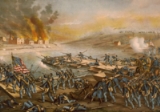
The Battle of Fredericksburg, fought in and around Fredericksburg, Virginia
Fredericksburg, Virginia

Fredericksburg is an independent city in the Commonwealth of Virginia located 50 miles south of Washington, D.C., and 58 miles north of Richmond, Virginia....
, from December 11 to December 15, 1862, between General Robert E. Lee
Robert E. Lee

Robert Edward Lee , was a career United States United States Army officer , an engineer, and among the most celebrated generals in American history....
's Confederate
Confederate States Army

The Confederate States Army was a military organization whose primary mission was to provide the necessary forces and capabilities to support the National Security and defense of the Confederate States of America during its brief existence from 1861 to 1865....
 Army of Northern Virginia
Army of Northern Virginia

The Army of Northern Virginia was the primary military force of the Confederate States of America in the Eastern Theater of the American Civil War of the American Civil War....
 and the Union
Union Army

The Union Army was the army that fought for the Union during the American Civil War. It was also known as the Federal Army, the U.S....
 Army of the Potomac
Army of the Potomac

The Army of the Potomac was the major Union Army in the Eastern Theater of the American Civil War of the American Civil War....
, commanded by Maj. Gen.
Major general (United States)

In the United States Army, United States Marine Corps, and United States Air Force, major general is a 2 star rank general officer rank, with the U.S....
 Ambrose E. Burnside, is remembered as one of the most one-sided battles of the American Civil War
American Civil War

The American Civil War , also known as the War Between the States and several Naming the American Civil War, was a civil war in the United States....
. The Union Army suffered terrible casualties in futile frontal assaults on December 13 against entrenched Confederate defenders on the heights behind the city, bringing to an early end their campaign against the Confederate
Confederate States of America

The Confederate States of America formed as the government set up from 1861 to 1865 by eleven Southern United States U.S. state of the United States of America that had declared their secession from the U.S....
 capital of Richmond
Richmond, Virginia

Richmond is the Capital of the Commonwealth of Virginia, in the United States. Like all Virginia municipalities incorporated as cities, it is an independent city and not part of any county....
.

battle was the result of an effort by the Union Army to regain the initiative in its struggle against Lee's smaller but more aggressive army.


Discussion
Ask a question about 'Battle of Fredericksburg'
Start a new discussion about 'Battle of Fredericksburg'
Answer questions from other users
Full Discussion Forum


Recent Posts


Encyclopedia


The Battle of Fredericksburg, fought in and around Fredericksburg, Virginia
Fredericksburg, Virginia

Fredericksburg is an independent city in the Commonwealth of Virginia located 50 miles south of Washington, D.C., and 58 miles north of Richmond, Virginia....
, from December 11 to December 15, 1862, between General Robert E. Lee
Robert E. Lee

Robert Edward Lee , was a career United States United States Army officer , an engineer, and among the most celebrated generals in American history....
's Confederate
Confederate States Army

The Confederate States Army was a military organization whose primary mission was to provide the necessary forces and capabilities to support the National Security and defense of the Confederate States of America during its brief existence from 1861 to 1865....
 Army of Northern Virginia
Army of Northern Virginia

The Army of Northern Virginia was the primary military force of the Confederate States of America in the Eastern Theater of the American Civil War of the American Civil War....
 and the Union
Union Army

The Union Army was the army that fought for the Union during the American Civil War. It was also known as the Federal Army, the U.S....
 Army of the Potomac
Army of the Potomac

The Army of the Potomac was the major Union Army in the Eastern Theater of the American Civil War of the American Civil War....
, commanded by Maj. Gen.
Major general (United States)

In the United States Army, United States Marine Corps, and United States Air Force, major general is a 2 star rank general officer rank, with the U.S....
 Ambrose E. Burnside, is remembered as one of the most one-sided battles of the American Civil War
American Civil War

The American Civil War , also known as the War Between the States and several Naming the American Civil War, was a civil war in the United States....
. The Union Army suffered terrible casualties in futile frontal assaults on December 13 against entrenched Confederate defenders on the heights behind the city, bringing to an early end their campaign against the Confederate
Confederate States of America

The Confederate States of America formed as the government set up from 1861 to 1865 by eleven Southern United States U.S. state of the United States of America that had declared their secession from the U.S....
 capital of Richmond
Richmond, Virginia

Richmond is the Capital of the Commonwealth of Virginia, in the United States. Like all Virginia municipalities incorporated as cities, it is an independent city and not part of any county....
.

Background and Burnside's plan

The battle was the result of an effort by the Union Army to regain the initiative in its struggle against Lee's smaller but more aggressive army. Burnside was appointed commander of the Army of the Potomac in November, replacing Maj. Gen. George B. McClellan
George B. McClellan

George Brinton McClellan was a Major general during the American Civil War. He organized the famous Army of the Potomac and served briefly as the general-in-chief of the Union Army....
. Although McClellan had stopped Lee at the Battle of Antietam
Battle of Antietam

The Battle of Antietam , fought on September 17, 1862, near Sharpsburg, Maryland, and Antietam Creek, as part of the Maryland Campaign, was the first major battle in the American Civil War to take place on Northern United States soil....
 in September, President
President of the United States

The President of the United States is the head of state and head of government of the United States and is the highest political official in the United States by influence and recognition....
 Abraham Lincoln
Abraham Lincoln

Abraham Lincoln was the List of Presidents of the United States President of the United States. He successfully led the country through its greatest internal crisis, the American Civil War, preserving the Union and ending slavery....
 believed he lacked decisiveness, did not pursue and destroy Lee's army in Maryland
Maryland

Maryland is a U.S. state located in the Mid Atlantic States of the United States, bordering Virginia, West Virginia and the Washington, D.C. to the south and west, Pennsylvania to the north, and Delaware to the east....
, and wasted excessive time reorganizing and re-equipping his army following major battles.

Burnside, in response to prodding from Lincoln and General-in-Chief Maj. Gen. Henry W. Halleck, planned a late fall offensive; he communicated his plan to Halleck on November 9. The plan relied on quick movement and deceit. He would concentrate his army in a visible fashion near Warrenton
Warrenton, Virginia

Warrenton is a town in Fauquier County, Virginia, Virginia, United States. The population was 6,670 at the 2000 census. It is the county seat of Fauquier County, Virginia....
, feigning a movement on Culpeper Court House, Orange Court House, or Gordonsville. Then he would rapidly shift his army southeast and cross the Rappahannock River
Rappahannock River

The Rappahannock River is a river in eastern Virginia in the United States, approximately 184 mi in length. It traverses the entire northern part of the state, from the Blue Ridge Mountains in the west across the Piedmont to Chesapeake Bay south of the Potomac River....
 to Fredericksburg, hoping that Robert E. Lee would sit still, unclear as to Burnside's intentions, while the Union Army made a rapid movement against Richmond, south along the Richmond, Fredericksburg, and Potomac Railroad from Fredericksburg. Burnside selected this plan because he was concerned that if he were to move directly south from Warrenton, he would be exposed to a flanking attack
Flanking maneuver

In military tactics, a flanking Maneuver warfare, also called a wiktionary:flank attack, is an attack on the sides of an opposing force....
 from Lt. Gen. Thomas J. "Stonewall" Jackson
Stonewall Jackson

Thomas Jonathan "Stonewall" Jackson was a Confederate States Army general during the American Civil War, and probably the most well-known Confederate commander after General Robert E....
, whose corps was at that time in the Shenandoah Valley
Shenandoah Valley

The Shenandoah Valley is both a geographic valley and cultural region of western Virginia and West Virginia in the United States. The valley is bound to the east by the Blue Ridge Mountains, to the west by the eastern front of the Ridge-and-valley Appalachians , to the north by the Potomac River and to the south by the James River ....
 south of Winchester. He also believed that the Orange and Alexandria Railroad
Orange and Alexandria Railroad

The Orange and Alexandria Railroad was an intrastate railroad in Virginia. It extended from Alexandria, Virginia to Gordonsville, Virginia, with another section from Charlottesville, Virginia to Lynchburg, Virginia....
 would be an inadequate supply line. While Burnside began assembling a supply base at Falmouth
Falmouth, Virginia

Falmouth is an unincorporated community in Stafford County, Virginia, Virginia, United States. Situated on the north bank of the Rappahannock River at the falls, the community is north of and opposite the city of Fredericksburg, Virginia....
, near Fredericksburg, the Lincoln administration entertained a lengthy debate about the wisdom of his plan. Lincoln eventually approved but cautioned him to move with great speed, certainly doubting that Lee would cooperate as Burnside anticipated.

Opposing forces

Burnside organized his Army of the Potomac into three so-called grand divisions, comprising 120,000 men, of whom 114,000 would be engaged in the coming battle:
  • The Right Grand Division, commanded by Maj. Gen. Edwin V. Sumner, consisted of the II Corps
    II Corps (ACW)

    There were five corps in the Union Army designated as II Corps during the American Civil War.* Army of the Cumberland, II Corps commanded by Thomas L....
     of Maj. Gen. Darius N. Couch
    Darius N. Couch

    Darius Nash Couch was a United States Army officer, naturalist, and a Union Army Major general in the American Civil War. Couch rose to command a corps in the Army of the Potomac, and led division in both the Eastern Theater of the American Civil War and Western Theater of the American Civil War....
     (divisions of Brig. Gens.
    Brigadier general (United States)

    A brigadier general in the United States Army, United States Air Force, and United States Marine Corps, is a 1 star rank general officer, with the U.S....
     Winfield S. Hancock, Oliver O. Howard
    Oliver O. Howard

    Oliver Otis Howard was a career United States Army officer and a Union Army General officer in the American Civil War. He was a corps commander noted for suffering two humiliating defeats, at Battle of Chancellorsville and Battle of Gettysburg, but he recovered from the setbacks while posted in the Western Theater of the American Civil War,...
    , and William H. French
    William H. French

    William Henry French was a career United States Army officer and a Union Army General officer in the American Civil War. He rose to temporarily command a corps within the Army of the Potomac, but was relieved of active field duty following poor performance during the Mine Run Campaign in late 1863....
    ) and the IX Corps
    IX Corps (ACW)

    IX Corps was a corps of the Union Army during the American Civil War that distinguished itself in combat in multiple theaters: the Carolinas, Virginia, Kentucky, Tennessee, and Mississippi....
     of Brig. Gen. Orlando B. Willcox
    Orlando B. Willcox

    Orlando Bolivar Willcox was an United States soldier who served as a general in the Union army during the American Civil War....
     (divisions of Brig. Gens. William W. Burns, Samuel D. Sturgis
    Samuel D. Sturgis

    Samuel Davis Sturgis was an American military officer who served in the Mexican-American War, as a Union Army general in the American Civil War, and later in the Indian Wars....
    , and George W. Getty
    George W. Getty

    George Washington Getty was a career military officer in the United States Army, most noted for his role as a division commander in the Army of the Potomac during the final full year of the American Civil War....
    ). A cavalry division under Brig. Gen. Alfred Pleasonton
    Alfred Pleasonton

    Alfred Pleasonton was a United States Army officer and General officer of Union Army cavalry during the American Civil War. He commanded the Cavalry Corps of the Army of the Potomac during the Gettysburg Campaign, including the largest predominantly cavalry battle of the war, Battle of Brandy Station....
     was attached.
  • The Center Grand Division, commanded by Maj. Gen. Joseph Hooker
    Joseph Hooker

    Joseph Hooker was a career United States Army officer, fought in the Mexican-American War, and was a Major general in the Union Army during the American Civil War....
    , consisted of the III Corps
    III Corps (ACW)

    There were four formations in the Union Army designated as III Corps during the American Civil War.Three were short-lived:*Army of Virginia:...
     of Brig. Gen. George Stoneman
    George Stoneman

    George Stoneman, Jr. was a career United States Army officer, a Union army cavalry general in the American Civil War, and the Governor of California between 1883 and 1887....
     (divisions of Brig. Gens. David B. Birney
    David B. Birney

    David Bell Birney was a businessman, lawyer, and a Union army General officer in the American Civil War....
    , Daniel E. Sickles, and Amiel W. Whipple) and the V Corps
    V Corps (ACW)

    The V Corps was a unit of the Union Army Army of the Potomac during the American Civil War....
     of Brig. Gen. Daniel Butterfield
    Daniel Butterfield

    Daniel Adams Butterfield was a New York businessman, a Union army General officer in the American Civil War, and Assistant U.S. Treasurer in New York....
     (divisions of Brig. Gens. Charles Griffin, George Sykes
    George Sykes

    George Sykes was a career United States Army officer and a Union Army General officer during the American Civil War....
    , and Andrew A. Humphreys
    Andrew A. Humphreys

    Andrew Atkinson Humphreys , was a career United States Army officer, civil engineer, and a Union Army General officer in the American Civil War....
    ). A cavalry brigade under Brig. Gen. William W. Averell
    William W. Averell

    William Woods Averell was a career United States Army officer and a cavalry General officer in the American Civil War. After the war he was a diplomat and became wealthy by inventing American asphalt pavement....
     was attached.
  • The Left Grand Division, commanded by Maj. Gen. William B. Franklin
    William B. Franklin

    William Buel Franklin was a career United States Army officer and a Union Army general in the American Civil War. He rose to the rank of a corps commander in the Army of the Potomac, fighting in several notable early battles in the Eastern Theater of the American Civil War....
    , consisted of the I Corps
    I Corps (ACW)

    I Corps was the designation of three different corps-sized units in the Union Army during the American Civil War. The units served in the following armies:...
     of Maj. Gen. John F. Reynolds
    John F. Reynolds

    John Fulton Reynolds was a career United States Army officer and a General officer in the American Civil War. One of the Union Army's most respected senior commanders, despite having a relatively limited amount of combat experience in the war, he played a key role in committing the Army of the Potomac to the Battle of Gettysburg and was kill...
     (divisions of Brig. Gens. Abner Doubleday
    Abner Doubleday

    Abner Doubleday was a career United States Army officer and Union Army general in the American Civil War. He fired the first shot in defense of Battle of Fort Sumter, the opening battle of the war, and had a pivotal role in the early fighting at the Battle of Gettysburg....
     and John Gibbon
    John Gibbon

    John Gibbon was a career United States Army officer who fought in the American Civil War and the Indian Wars....
     and Maj. Gen. George G. Meade) and the VI Corps
    VI Corps (ACW)

    The VI Corps was a corps of the Union Army during the American Civil War....
     of Maj. Gen. William F. "Baldy" Smith
    William Farrar Smith

    William Farrar Smith , was a civil engineer, a member of the police commission, and Union army General officer in the American Civil War....
     (divisions of Brig. Gens. William T. H. Brooks
    William T. H. Brooks

    William Thomas Harbaugh Brooks was a career military officer in the United States Army, serving as a Major general during the American Civil War....
    , Albion P. Howe
    Albion P. Howe

    Albion Parris Howe was a Union Army general in the American Civil War. Howe's contentious relationships with superior officers in the Army of the Potomac eventually led to his being deprived of Division command....
    , and John Newton). A cavalry brigade commanded by Brig. Gen. George D. Bayard
    George Dashiell Bayard

    George Dashiell Bayard was a career soldier in the United States Army and a American Civil War Union Army General officer....
     was attached.
  • The XI Corps
    XI Corps (ACW)

    The XI Corps was a corps of the Union Army during the American Civil War, best remembered for its humiliating defeats at the battles of Battle of Chancellorsville and Battle of Gettysburg in 1863....
     of Maj. Gen. Franz Sigel
    Franz Sigel

    Franz Sigel was a German military officer and immigrant to the United States who was a teacher, newspaperman, politician, and served as a Union Army Major general in the American Civil War....
     was held in reserve in the area of Fairfax Court House. The XII Corps
    XII Corps (ACW)

    The XII Corps was a corps of the Union Army during the American Civil War.The corps was formed by U.S. War Department General Order of March 13, 1862, under which the corps organization of the Army of the Potomac was first created....
    , under Maj. Gen. Henry W. Slocum, was stationed at Harpers Ferry for the duration of the campaign.


Robert E. Lee's Army of Northern Virginia had nearly 85,000 men, with 72,500 engaged:
  • The First Corps of Lt. Gen. James Longstreet
    James Longstreet

    James Longstreet was one of the foremost Confederate States Army General officers of the American Civil War and the principal subordinate to General Robert E....
     included the divisions of Maj. Gens. Lafayette McLaws
    Lafayette McLaws

    Lafayette McLaws was a United States Army officer and a Confederate States Army General officer in the American Civil War....
    , Richard H. Anderson
    Richard H. Anderson

    Richard Heron Anderson was a career United States Army officer, fighting with distinction in the Mexican-American War. He also served as a Confederate States Army General officer during the American Civil War....
    , George E. Pickett, and John Bell Hood
    John Bell Hood

    John Bell Hood was a Confederate States Army general during the American Civil War. Hood had a reputation for bravery and aggressiveness that sometimes bordered on recklessness....
    , and Brig. Gen. Robert Ransom, Jr.
    Robert Ransom, Jr.

    Robert Ransom, Jr. was a Major General in the Confederate States Army during the American Civil War. His brother Matt W. Ransom was also a Confederate general officer and United States Senate....
  • The Second Corps of Lt. Gen. Thomas "Stonewall" Jackson included the divisions of Maj. Gens. D.H. Hill and A.P. Hill, and Brig. Gens. Jubal A. Early and William B. Taliaferro
    William B. Taliaferro

    William Booth Taliaferro , was a United States Army officer, a lawyer, legislator, and Confederate States Army General officer in the American Civil War....
    .
  • Reserve Artillery under Brig. Gen. William N. Pendleton
    William N. Pendleton

    William Nelson Pendleton was an United States teacher, Episcopal Church in the United States of America priest, and soldier. He served as a Confederate States of America General officer during the American Civil War, noted for his position as Gen....
    .
  • Cavalry under Maj. Gen. J.E.B. Stuart
    J.E.B. Stuart

    James Ewell Brown "Jeb" Stuart was an American soldier from Virginia and a Confederate States Army general during the American Civil War. He was known to his friends as "Jeb", from the initials of his given names....
    .


Movement to battle

The Union Army began marching on November 15, and the first elements arrived in Falmouth on November 17. Burnside's plan quickly went awry—he had ordered pontoon bridges to be sent to the front and assembled for his quick crossing of the Rappahannock, but because of administrative bungling, the bridges had not preceded the army. As Maj. Gen. Edwin Sumner
Edwin Vose Sumner

Edwin Vose Sumner was a career United States Army Commissioned officer who became a Union Army General officer and the oldest field commander of any Army Corps on either side during the American Civil War....
 arrived, he strongly urged an immediate crossing of the river to scatter the token Confederate force of 500 men in the town and occupying the commanding heights to the west. Burnside began to panic, worried that the increasing autumn rains would make the fording points unusable and that Sumner might be cut off and destroyed. He squandered his initiative and ordered Sumner to wait in Falmouth.

By November 21, Lt. Gen. James Longstreet
James Longstreet

James Longstreet was one of the foremost Confederate States Army General officers of the American Civil War and the principal subordinate to General Robert E....
's Corps had arrived near Fredericksburg, and Jackson's (which had been downstream along the Rappahannock to prevent crossings there) was following rapidly. Lee at first anticipated that he would fight Burnside northwest of Fredericksburg and that it might be necessary to drop back behind the North Anna River
North Anna River

The North Anna River is a principal tributary of the Pamunkey River, about 70 mi long, in central Virginia in the United States. Via the Pamunkey and York River Rivers, it is part of the drainage basin of Chesapeake Bay....
. But when he saw how slowly Burnside was moving, he directed all of his army toward Fredericksburg. The first pontoon bridges arrived at Falmouth on November 25, much too late to enable the Army of the Potomac to cross the river without opposition. Burnside still had an opportunity, however, because he was facing only half of Lee's army, not yet dug in, and if he acted quickly, he might be able to attack Longstreet and defeat him before Jackson arrived. Once again he squandered his opportunity. The bridges arrived at the end of the month, and by this time Jackson was present and Longstreet was preparing strong defenses.

Burnside originally planned to cross his army east of Fredericksburg, 10 miles (16 km) downstream at Skinker's Neck, but Early's division arrived there and blocked him. So he decided to cross directly at Fredericksburg. On December 9, he wrote to Halleck, "I think now the enemy will be more surprised by a crossing immediately in our front than any other part of the river. ... I'm convinced that a large force of the enemy is now concentrated at Port Royal, its left resting on Fredericksburg, which we hope to turn." In addition to his numerical advantage in troop strength, Burnside also had the advantage of knowing his army could not be attacked effectively. On the other side of the Rappahannock, 220 artillery pieces had been located on the ridge known as Stafford Heights to prevent Lee's army from mounting any major counterattacks.

Lee had great faith in his army, even though he was fairly uncertain of the plans of the opposing commander as late as two days before the Union Army attempted a crossing. He deployed approximately 20,000 men under Longstreet on his left flank, which was anchored on the ridge known as Marye's Heights, just to the west of the city, behind a stone wall at the crest of the ridge. Fearing a crossing downstream, south of the city, he deployed the rest of his men to the south under Jackson. The area was interspersed with hills, another excellent defensive position.

Union engineers began to assemble six pontoon bridges on the morning of December 11, two just north of the town center, a third on the southern end of town, and three close to the south, near the confluence of the Rappahannock and Deep Run. They came under punishing fire from Confederate sharpshooters
Marksman

A marksman is a person that is skilled in precision shooting, using projectile weapons, such as with a rifle but most commonly with a sniper rifle, to shoot at small long-range targets at a considerable distance away from the target....
, primarily from the Mississippi brigade of Brig. Gen.
Brigadier General

Brigadier General is the lowest ranking General Officer in some countries, usually sitting between the ranks of Colonel and Major General.The rank can be traced back to the militaries of Europe where a brigadier general, or simply a brigadier, would command a brigade in the field....
 William Barksdale
William Barksdale

William Barksdale was a lawyer, newspaper editor, United States House of Representatives, and a Confederate States Army General officer in the American Civil War....
. Eventually his subordinates convinced Burnside to send landing parties over in the boats that evening to secure a small beachhead
Beachhead

Beachhead is a military term used to describe the line created when a unit reaches a beach, and begins to defend that area of beach, while other reinforcements help out, until a unit large enough to begin advancing has arrived....
 and rout the sharpshooters. The Confederate army chose not to resist the landings vigorously because of the covering Union artillery, but some of the first urban combat
Urban warfare

Urban warfare is modern warfare conducted in urban areas such as towns and city. As a distinction, warfare conducted in population centers before the 20th century is generally considered Siege....
 of the war occurred as buildings were cleared by infantry and by artillery fire from across the river. Union gunners sent more than 5,000 shells against the town and the ridges to the west. After the bridges were in place, Burnside's men looted the city with a fury that enraged Lee, who compared their depredations with those of the ancient Vandals
Vandals

The Vandals were an East Germanic tribe that entered the late Roman Empire during the 5th century. The Goths Theodoric the Great, king of the Ostrogoths and regent of the Visigoths, was allied by marriage with the Vandals as well as with the Burgundians and the Franks under Clovis I....
. The destruction also angered Lee's men, many of whom were native Virginians. Over the course of December 11 to December 12, Burnside's men deployed outside the city and prepared to attack Lee's army.

Battle

Fredericksburg Overview
Fredericksburg Sumnerassault
Fredericksburg Hookerassault
The battle opened south of the city at 8:30 a.m. on December 13, when Maj. Gen. William Franklin
William B. Franklin

William Buel Franklin was a career United States Army officer and a Union Army general in the American Civil War. He rose to the rank of a corps commander in the Army of the Potomac, fighting in several notable early battles in the Eastern Theater of the American Civil War....
 sent two divisions from the Left Grand Division into a previously unseen gap in Jackson's defenses on the right. By 10 a.m., a thick fog began to lift, and the initially sluggish movements picked up speed. Meade's
George Meade

George Gordon Meade was a career United States Army officer and civil engineer involved in coastal construction, including several lighthouses....
 division formed the main attack, supported by the divisions of Doubleday
Abner Doubleday

Abner Doubleday was a career United States Army officer and Union Army general in the American Civil War. He fired the first shot in defense of Battle of Fort Sumter, the opening battle of the war, and had a pivotal role in the early fighting at the Battle of Gettysburg....
 and Gibbon
John Gibbon

John Gibbon was a career United States Army officer who fought in the American Civil War and the Indian Wars....
. The attack was stalled by the Virginia Horse Artillery under Major John Pelham, and an artillery duel between Pelham's two cannons (a 12-pound brass Napoleon
Field Artillery in the American Civil War

Field artillery in the American Civil War refers to the important artillery weapons, equipment, and practices used by the Artillery branch to support the infantry and cavalry forces in the field....
 and a rifled Blakely) and the Union artillery batteries lasted for about an hour. General Lee observed the action and commented about Pelham, age 24, "It is glorious to see such courage in one so young." As Meade finally made traction, he ran into Brig. Gen. Maxcy Gregg
Maxcy Gregg

Maxcy Gregg was a lawyer, soldier in the United States Army during the Mexican-American War, and a Confederate States of America History of Confederate States Army Generals#brigadier general during the American Civil War who was killed at the Battle of Fredericksburg....
's brigade, scattering it. Gregg was shot and mortally wounded; he died two days later.

To Meade's right, Gibbon's attack against the brigades of Brig. Gens. William Dorsey Pender
William Dorsey Pender

William Dorsey Pender was one of the youngest, and most promising, General officers fighting for the Confederate States of America in the American Civil War....
 and Edward L. Thomas made good progress, but Meade's and Gibbon's men became separated; by 1:30 p.m., a heavy Confederate counterattack pushed them back. Because of the foggy conditions, Federal artillery could not provide much assistance. The Union men were driven back and chased by the Confederate infantry, raising concerns that they might be trapped at the river. Eventually the divisions of Brig. Gen. Daniel E. Sickles and Brig. Gen. David B. Birney
David B. Birney

David Bell Birney was a businessman, lawyer, and a Union army General officer in the American Civil War....
 were brought up to strengthen the Federal line, and Stonewall Jackson's counterattack ground to a halt. The focus of action moved north to Marye's Heights.

The initial assaults west of Fredericksburg began at 11 a.m. as French's
William H. French

William Henry French was a career United States Army officer and a Union Army General officer in the American Civil War. He rose to temporarily command a corps within the Army of the Potomac, but was relieved of active field duty following poor performance during the Mine Run Campaign in late 1863....
 division moved along the Plank Road, facing a steep-banked drainage ditch and a wide, open plain of , dominated by Confederate infantry and artillery behind a sunken road and stone wall. Earlier, Longstreet had been assured by artillerist Edward Porter Alexander
Edward Porter Alexander

Edward Porter Alexander was an engineer, an officer in the United States Army, a Confederate States Army general in the American Civil War, and later a railroad executive, planter, and author....
, "A chicken could not live on that field when we open on it." The Union men attacking had to file in columns over two small bridges across the drainage ditch, making them a massed target. Attempts to shift the attack farther to the right failed because of swampy ground. As in the south, Union artillery was prevented by fog from effectively silencing the Confederate guns.

Burnside had anticipated this attack on the right would be merely supportive of his main effort on the left, but Franklin had stalled and resisted entreaties to continue, so Burnside shifted his emphasis. After French's division was repulsed with heavy losses, Burnside sent in the divisions of Hancock
Winfield Scott Hancock

Winfield Scott Hancock was a career United States Army officer and the Democratic Party nominee for President of the United States in United States presidential election, 1880....
 and Howard
Oliver O. Howard

Oliver Otis Howard was a career United States Army officer and a Union Army General officer in the American Civil War. He was a corps commander noted for suffering two humiliating defeats, at Battle of Chancellorsville and Battle of Gettysburg, but he recovered from the setbacks while posted in the Western Theater of the American Civil War,...
, which met a similar fate. By this time, Pickett's
George Pickett

George Edward Pickett was a career United States Army officer who became a general in the Confederate States Army during the American Civil War....
 division and one of Hood's
John Bell Hood

John Bell Hood was a Confederate States Army general during the American Civil War. Hood had a reputation for bravery and aggressiveness that sometimes bordered on recklessness....
 brigades had marched north to reinforce Marye's Heights. Griffin's division renewed the attack at 3:30 p.m., followed by Humphrey's
Andrew A. Humphreys

Andrew Atkinson Humphreys , was a career United States Army officer, civil engineer, and a Union Army General officer in the American Civil War....
 division at 4 p.m. At dusk, Getty's
George W. Getty

George Washington Getty was a career military officer in the United States Army, most noted for his role as a division commander in the Army of the Potomac during the final full year of the American Civil War....
 division assaulted from the east and was also repulsed.

Six Union divisions had been sent in, generally one brigade at a time, for a total of sixteen individual charges, all of which failed, costing them from 6,000 to 8,000 casualties. Watching the carnage from the center of his line, a position now known as Lee's Hill, General Lee was quoted as saying, "It is well that war is so terrible, or we should grow too fond of it." The action on the heights also included the charge of the Irish Brigade
Irish Brigade (US)

This article is about the unit of the United States Army during the Civil War. For other Irish Brigades, see Irish Brigade.The Irish Brigade was an infantry brigade that served in the American Civil War, consisting predominantly of Ireland immigrants....
, which lost 50% of its strength in the battle but advanced further up the heights than any other Union Brigade. Confederate losses at Marye's Heights totaled around 1,200. The falling of darkness and the pleas of Burnside's subordinates were enough to put an end to the attacks. Longstreet later wrote, "The charges had been desperate and bloody, but utterly hopeless." Thousands of Union soldiers spent the cold December night on the fields leading to the Heights, unable to move or assist the wounded because of Confederate fire.

The armies remained in position throughout the day on December 14, when Burnside briefly considered leading his old IX Corps
IX Corps (ACW)

IX Corps was a corps of the Union Army during the American Civil War that distinguished itself in combat in multiple theaters: the Carolinas, Virginia, Kentucky, Tennessee, and Mississippi....
 in one final attack on Marye's Heights, but he reconsidered. That afternoon, Burnside asked Lee for a truce to attend to his wounded, which Lee graciously granted. The next day the Federal forces retreated across the river, and the campaign came to an end.

Aftermath

The casualties sustained by each army showed clearly how disastrous the Union army's tactics were, and Burnside was relieved of command a month later (following the humiliating failure of his "Mud March"). The Union army suffered 12,653 casualties (1,284 killed, 9,600 wounded, 1,769 captured/missing). Two Union generals were mortally wounded: Brig. Gens. George D. Bayard
George Dashiell Bayard

George Dashiell Bayard was a career soldier in the United States Army and a American Civil War Union Army General officer....
 and Conrad F. Jackson. The Confederate army lost 5,377 (608 killed, 4,116 wounded, 653 captured/missing), most of them in the early fighting on Jackson's front. Confederate Brig. Generals Maxcy Gregg
Maxcy Gregg

Maxcy Gregg was a lawyer, soldier in the United States Army during the Mexican-American War, and a Confederate States of America History of Confederate States Army Generals#brigadier general during the American Civil War who was killed at the Battle of Fredericksburg....
 and T. R. R. Cobb
Thomas Reade Rootes Cobb

Thomas Reade Rootes Cobb was an United States lawyer, author, politician, and Confederate States Army officer, killed in the Battle of Fredericksburg during the American Civil War....
 were killed.

Testament to the extent of the carnage and suffering during the battle was the story of Richard Rowland Kirkland
Richard Rowland Kirkland

Richard Rowland Kirkland, known as The Angel of Marye's Heights, was a Confederate Army soldier during the American Civil War, noted for his bravery and humanitarian actions during the Battle of Fredericksburg....
, a Confederate Army sergeant with Company G, 2nd South Carolina Volunteer Infantry. Stationed at the stone wall by the sunken road below Marye's Heights, Kirkland had a close up view to the suffering and like so many others was appalled at the cries for help of the Union wounded throughout the cold winter night of December 13, 1862. After obtaining permission from his commander, Brig. Gen. Joseph B. Kershaw
Joseph B. Kershaw

Joseph Brevard Kershaw was a lawyer, judge, and a Confederate States Army general in the American Civil War.Kershaw was born at Camden, South Carolina, admitted to the Bar association in 1843, and was a member of the South Carolina Senate from 1852 to 1856....
, Kirkland gathered canteens and in broad daylight, without the benefit of a cease fire or a flag of truce (refused by Kershaw), provided water to numerous Union wounded lying on the field of battle. Union soldiers held their fire as it was obvious what Kirkland's intent was. Kirkland was nicknamed the "Angel of Marye's Heights" for these actions, and is memorialized with a statue by Felix de Weldon
Felix de Weldon

Felix Weihs de Weldon was an American sculpture. His most famous piece is the Marine Corps War Memorial of five United States Marine Corps and one United States Navy raising the flag of the United States on Iwo Jima during World War II....
 on the Fredericksburg and Spotsylvania National Military Park
Fredericksburg and Spotsylvania National Military Park

Fredericksburg and Spotsylvania National Military Park is a unit of the National Park Service in Fredericksburg, Virginia, and elsewhere in Spotsylvania County, Virginia, commemorating four major battles in the American Civil War....
 where he carried out his actions.

The South erupted in jubilation over their great victory. The Richmond Examiner described it as a "stunning defeat to the invader, a splendid victory to the defender of the sacred soil." General Lee, normally reserved, was described by the Charleston
Charleston, South Carolina

Charleston is a city in Charleston County, South Carolina in the U.S. state of South Carolina. It is the largest city and county seat of Charleston County....
 Mercury as "jubilant, almost off-balance, and seemingly desirous of embracing everyone who calls on him." The newspaper also exclaimed that, "General Lee knows his business and the army has yet known no such word as fail."

Reactions were opposite in the North, and both the Army and President Lincoln came under strong attacks from politicians and the press. The Cincinnati
Cincinnati, Ohio

Cincinnati is a city in the U.S. state of Ohio and the county seat of Hamilton County, Ohio. The municipality is located in southwestern Ohio and is situated on the Ohio River at the Ohio-Kentucky border....
 Commercial wrote, "It can hardly be in human nature for men to show more valor or generals to manifest less judgment, than were perceptible on our side that day." Senator Zachariah Chandler
Zachariah Chandler

Zachariah Chandler was List of mayors of Detroit, Michigan of Detroit, Michigan , a four-term United States Senate from the U.S. state of Michigan , and United States Secretary of the Interior under President of the United States Ulysses S....
, a Radical Republican, wrote that, "The President is a weak man, too weak for the occasion, and those fool or traitor generals are wasting time and yet more precious blood in indecisive battles and delays." Pennsylvania Governor
List of Governors of Pennsylvania

The Governor of the Commonwealth of Pennsylvania is the head of the executive branch of Pennsylvania's government and the commander-in-chief of the U.S....
 Andrew Curtin visited the White House
White House

The White House is the official residence and principal workplace of the President of the United States. Located at 1600 Pennsylvania Avenue in Washington, D.C., it was built between 1792 and 1800 of white-painted Aquia sandstone in the late Georgian architecture and has been the executive residence of every U.S....
 after a trip to the battlefield. He told the president, "It was not a battle, it was a butchery." Curtin reported that the president was "heart-broken at the recital, and soon reached a state of nervous excitement bordering on insanity." Lincoln himself wrote, "If there is a worse place than hell, I am in it."

Preservation efforts


In March 2006, the Civil War Preservation Trust
Civil War Preservation Trust

The Civil War Preservation Trust is a charitable organization whose primary focus is in the preservation of American Civil War battlefields. The Civil War Preservation Trust also promotes educational programs and heritage tourism initiatives to inform the public of the war's history and the fundamental conflicts that sparked it....
 (CWPT) announced the beginning of a $12 million national campaign to preserve the historic Slaughter Pen Farm, a key part of the Fredericksburg battlefield. The farm, known locally as the Pierson Tract, was the scene of bloody struggle on December 13, 1862. Over this ground Federal troops under Maj. Gen. George Meade
George Meade

George Gordon Meade was a career United States Army officer and civil engineer involved in coastal construction, including several lighthouses....
 and Brig. Gen. John Gibbon
John Gibbon

John Gibbon was a career United States Army officer who fought in the American Civil War and the Indian Wars....
 launched their assault against Lt. Gen. Thomas "Stonewall" Jackson's
Stonewall Jackson

Thomas Jonathan "Stonewall" Jackson was a Confederate States Army general during the American Civil War, and probably the most well-known Confederate commander after General Robert E....
 Confederates holding the southern portion of the Army of Northern Virginia's
Army of Northern Virginia

The Army of Northern Virginia was the primary military force of the Confederate States of America in the Eastern Theater of the American Civil War of the American Civil War....
 line at Fredericksburg. Despite suffering enormous casualties the Federal troops under Meade were able to temporarily penetrate the Confederate line and for a time represented the North's best chance of winning the Battle of Fredericksburg. The fighting on this southern portion of the battlefield, later named the Slaughter Pen, produced 5,000 casualties and five Medal of Honor
Medal of Honor

The Medal of Honor is the highest Awards and decorations of the United States military awarded by the United States government. It is bestowed on a member of the United States armed forces who distinguishes himself "conspicuously by gallantry and intrepidity at the risk of his life above and beyond the call of duty while engaged in an action...
 winners.

The Slaughter Pen Farm was considered to be the largest remaining unprotected part of the Fredericksburg battlefield. It is also the only place on the battlefield where a visitor can still follow the Union assault of December 13 from beginning to end. Nearly all the other land associated with Union attacks at Fredericksburg—either on the southern end of the battlefield or in front of Marye's Heights—has been degraded by development. The $12 million acquisition of the Slaughter Pen Farm at the Fredericksburg battlefield has been called the most ambitious nonprofit battlefield acquisition in American history.

In October 2006 the Department of the Interior awarded a $2 million grant based on the significance of the Slaughter Pen Farm. The money was provided through a U.S. Congressional appropriation from the Land and Water Conservation Fund. The fund supports non-federal efforts to acquire and preserve meaningful American Civil War battlefield lands. The program is administered by the American Battlefield Protection Program, an arm of the National Park Service
National Park Service

The National Park Service is the List of United States federal agencies that manages all List of areas in the United States National Park System, many U.S....
. In addition, the Central Virginia Battlefields Trust (CVBT) committed $1 million toward the Slaughter Pen Farm fundraising campaign.

See also

  • List of conflicts in the United States
    List of conflicts in the United States

    List of conflicts in the United States is a timeline of events that includes Indian wars, battles, skirmishes, major Terrorism attacks, Wiktionary:massacre, and other related items that have occurred in the United States's geographical area, including overseas territories since 1776....


External links