

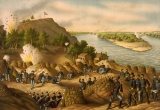
Army of the Tennessee

Encyclopedia
The Army of the Tennessee was a Union
army in the Western Theater
of the American Civil War
, named for the Tennessee River
. It should not be confused with the similarly named Army of Tennessee
, a Confederate
army named after the State of Tennessee
.
It appears that the term "Army of the Tennessee" was first used within the Union Army in March 1862, to describe Union forces perhaps more properly described as the "Army of West Tennessee"; these were the troops under the command of Maj. Gen.
Ulysses S. Grant
in the Union's District of West Tennessee. In April 1862, Grant's troops survived a severe test in the bloody Battle of Shiloh
. Then, during six months marked by discouragement and anxiety for Grant, his army first joined with two other Union armies to prosecute the relatively bloodless Siege of Corinth
and then strained to hold Union positions in Tennessee and Mississippi. In October 1862, Grant's command was reconfigured and elevated to departmental status, as the Department of the Tennessee; the title of his command was thus officially aligned with that of his army. Grant commanded these forces until after his critically important victory at Vicksburg
in July 1863. Under other generals, starting with William Tecumseh Sherman
, the army marched and fought from the Chattanooga Campaign
, through the Relief of Knoxville, the Meridian Campaign
, the Atlanta Campaign
, the March to the Sea
, the Carolinas Campaign
, and to the end of the war and disbandment. This article also discusses Grant's 1861–1862 commands—the District of Southeast Missouri and the District of Cairo—because the troops Grant led in the Battle of Belmont
and the Henry
-Donelson
campaign during that period became the nucleus of the Army of the Tennessee.
A 2005 study of the army states that it "was present at most of the great battles that became turning points of the war—Fort Donelson, Vicksburg, and Atlanta" and "won the decisive battles in the decisive theater of the war." More poetically, in 1867, apparently speaking of the Atlanta campaign, General Sherman said that the Army of the Tennessee was "never checked—always victorious; so rapid in motion—so eager to strike; it deserved its name of the 'Whip-lash,' swung from one flank to the other, as danger called, night or day, sunshine or storm."
and William Tecumseh Sherman
. It is thus rather ironic that frequent military reorganizations and looseness of usage during the war itself make it difficult to pinpoint the exact date at which this army formally came into existence. It should suffice to note that the "nucleus [of troops] around which was to gather the . . . Army of the Tennessee" first took shape in 1861–1862, while Grant was headquartered at Cairo, Illinois
. Those troops continued under Grant in his next command, the distinct District of West Tennessee; they were then sometimes, and perhaps most appropriately, called the "Army of West Tennessee." However, army correspondence began using the term "Army of the Tennessee" in March 1862; that term soon became commonplace and naturally lived on when Grant's command was elevated to departmental status in October 1862, as the Department of the Tennessee. During the course of the war, elements of the Army of the Tennessee performed many tasks, and the army evolved with the addition and subtraction of many units. It is not feasible to chronicle every such development here, even at the corps
level. Rather, this article traces the main thrust of the army's development and its most memorable activities. At any given time, substantial numbers of troops were engaged in activities not discussed here. For example, in April 1863, less than half of Grant's departmental strength was directly engaged in the Vicksburg Campaign
.
 In September 1861, Brig. Gen.
Ulysses S. Grant
, then subordinate to Maj. Gen. John Fremont in the Union's Western Department, assumed command of the District of Southeast Missouri; Grant established his headquarters at Cairo, Illinois
. One of Grant's wartime aides, John A. Rawlins, later stated that "[f]rom this time . . . commenced the growth and organization of the Army of the Tennessee." Just days later, prompted by Confederate occupation of Columbus, Kentucky
, on the Mississippi River
, Grant led a small force to seize Paducah, Kentucky
, where the Tennessee River
joins the Ohio River
; Grant thus forestalled a Confederate effort to occupy the strategically important town. Paducah promptly became a separate Union command under Brig. Gen. Charles F. Smith, who soon occupied Smithland, Kentucky
, at the junction of the Cumberland River
and the Ohio.
According to Rawlins, the "first affair dignified by the name of a battle" for any of Grant's forces occurred at Fredericktown, Missouri
, where some of Grant's troops helped defeat Confederate forces under M. Jeff Thompson
. Grant's own first engagement came on November 7 at Belmont, Missouri
, a Mississippi River landing opposite Columbus, Kentucky. Grant, accompanied by Brig. Gen. John A. McClernand, moved a force of approximately 3,000 to Belmont by water, cut his way into the Confederate camps there, and then had to fight his way back out to regain his transports. Grant's casualties in this first battle totaled about 500; Confederate casualties were similar. While Grant had suffered a repulse, he won favorable press coverage. This battle, reports Rawlins, "confirmed General Grant in his views" that he should "give battle" whenever "he had what he thought a sufficient number of men." Also in November, John Fremont lost his command at St. Louis, to be replaced by Maj. Gen. Henry W. Halleck, whose command was designated the Department of the Missouri
.
, on the Tennessee River, and Fort Donelson
, on the Cumberland River. His troops for this campaign eventually numbered approximately 27,000 men, divided into three divisions commanded, respectively, by John McClernand (1st Division), C.F. Smith (2nd), and Brig. Gen. Lewis Wallace
(3rd).
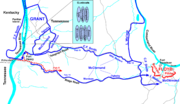 Grant initially moved up the Tennessee River (southward) to Fort Henry with only two divisions, McClernand's and Smith's. On February 6, even before he could organize his force for attack, the fort surrendered to U.S. Navy Flag Officer
Andrew H. Foote, commander of the Western Flotilla. Several days later, in winter conditions, most of Grant's two divisions marched overland to attack the more formidable Fort Donelson, situated on the Cumberland River but only twelve miles (19 km) away from Fort Henry. Additional Union regiments arrived at Fort Donelson by water; these were formed into the new 3rd Division under Lew Wallace. The Battle of Fort Donelson
began on February 13 and, after sharp fighting, concluded on February 16 with the unconditional surrender of the remaining Confederate garrison of approximately 15,000.
Although it would still be a month before the term "Army of the Tennessee" came into use, the three divisions that served under Grant in the Henry-Donelson campaign were the nucleus of that famous army and had now won an important victory that foreshadowed its later successes. One historian describes their accomplishments in the Henry-Donelson campaign as the "first significant Union triumph in the war"; its fruits included breaking the Confederacy's western line of defense, securing Kentucky to the Union, and opening the South, especially Tennessee, to invasion. Another historian notes that Grant's troops "had performed prodigies of valor and endurance during the campaign" and had learned from it that "hard fighting would bring success." As a result of the campaign's conspicuous success, Grant, McClernand, Smith, and Wallace were all promoted to the rank of major general of volunteers. Grant in particular became a national celebrity—"Unconditional Surrender" Grant—for his refusal to allow any other terms of surrender.
In early March, Grant's superior, Maj. Gen. Henry W. Halleck, then in command of the Department of the Missouri, assigned Grant to lead an expedition up the Tennessee River from the recently captured Fort Henry. On March 4, however, Halleck ordered Grant to give field command of the expedition to C.F. Smith; this order has been variously attributed to professional jealousy and to Halleck's lacking confidence in Grant due to certain administrative difficulties. Smith initially established the expedition at Savannah, Tennessee
, a town on the east side of the river approximately 100 river miles (160 km) south of Fort Henry. He soon began staging troops at a point—Pittsburg Landing—nine miles (14 km) further south and across the river. Meanwhile, Halleck's command was enlarged and renamed the Department of the Mississippi, and Halleck restored Grant to field command, perhaps because of personal intervention by President Abraham Lincoln
. Grant joined his army in the field on March 17. By early April, Grant's army had grown to a total of roughly 50,000 men, organized into six divisions. The three new divisions were commanded by Brig. Gen. Stephen A. Hurlbut
(4th Division), Brig. Gen. William Tecumseh Sherman
(5th), and Brig. Gen. Benjamin M. Prentiss (6th). In addition, Brig. Gen. W.H.L. Wallace
took command of Smith's 2nd Division due to the latter's having suffered a debilitating leg injury.
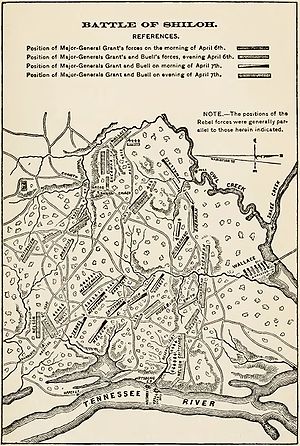 On April 6–7, Grant's forces fought the bloodiest battle of the Civil War to that time, the Battle of Shiloh
, when Confederate forces advanced largely undetected from Corinth, Mississippi
, and attacked the five Union divisions staged at Pittsburg Landing. On the first day of the battle, the surprised and unentrenched army fought desperately and suffered many casualties. However, long-expected elements of the Army of the Ohio
, under Maj. Gen. Don Carlos Buell
, arrived to reinforce Grant late that day, with many more troops arriving overnight and the following day. Grant was also bolstered by the evening arrival of his own 3rd Division; Lew Wallace and his troops had been slow arriving at Pittsburg Landing from their separate position at Crump's Landing. Substantially reinforced by Buell and Wallace, Grant counterattacked the Confederate forces on April 7 and drove them from the field and back toward Corinth. "Grant's victory at Shiloh," one historian has written, "bloody and bitter though it was, doomed the Confederate cause in the Mississippi valley." In the near term, however, the battle resulted in much criticism against Grant for lack of preparedness, swift promotion to major general of volunteers for Sherman, capture for Prentiss, a fatal wound for W.H.L. Wallace, and Grant's loss of confidence in Lew Wallace. In addition, C.F. Smith died later in April from complications due to his non-combat leg injury.
In the aftermath of Shiloh came the second threat to Grant's leadership, as well as a preview of the multi-army operations that would feature prominently in the future of the Army of the Tennessee. Pursuant to previous plans, Grant's departmental superior, General Halleck, arrived at Pittsburg Landing to take command in the field. Intending to move against the Confederate forces concentrating at the rail hub at Corinth, Halleck proceeded to gather and organize what was in effect an army group of over 100,000 men. His force included Grant's Army of the Tennessee, Buell's Army of the Ohio, and Maj. Gen. John Pope
's Army of the Mississippi
. On April 30, Halleck divided this force into three corps (or "wings") and a reserve. The left wing was commanded by Pope, the center by Buell, the right wing by Maj. Gen. George H. Thomas, and the reserve by John McClernand. Grant's 1st and 3rd Divisions constituted the reserve; the right wing contained Grant's 2nd, 4th, 5th, and 6th Divisions and Thomas's division from the Army of the Ohio. In other words, Halleck had drawn Thomas from division command in the Army of the Ohio and assigned to him, as commander of the right wing, most of Grant's troops.
Halleck assigned Grant to be second-in-command of the entire 100,000-man force, but also expressly confirmed Grant in command of the "Army Corps of the Tennessee" (the right wing and the reserve). It is unclear exactly why Halleck took these actions affecting Grant. However, Grant was under severe public criticism about Shiloh at the time and soon complained that his second-in-command position constituted a "sensure" and was akin to an arrest; among his complaints was the fact that Halleck gave orders directly to Thomas and division commanders nominally subordinate to Grant. With this awkward command structure, embarrassing to Grant, Halleck's forces took the entire month of May, with constant entrenchments, to advance the twenty miles [32 km] to Corinth. This Siege of Corinth
culminated with the Confederate forces abandoning the town on the night of May 29–30. Grant later suggested that Halleck failed to accomplish all that he should have in this campaign and its aftermath. However, William Tecumseh Sherman, commanding a division in Thomas's right wing, considered the campaign to be an important period of training for Halleck's forces, including the Army of the Tennessee: "[I]t served for the instruction of our men in guard and picket duty, and in habituating them to out-door life; and by the time we had reached Corinth I believe that army was the best then on this continent."
After Corinth was taken, Grant might have left his command in frustration, but Sherman intervened and encouraged him to remain. Grant's experiences during this period have been cited as one reason for his subsequent warm relations with Sherman and his cooler relations with George Thomas. In turn, the trust between Grant and Sherman contributed importantly to the future effectiveness of the Army of the Tennessee. More immediately, however, Halleck soon rescinded the multi-corps organization adopted for the Corinth campaign and began to disperse his large force. On June 10, Halleck restored Grant to straightforward command of the "Army of the Tennessee"; Buell was dispatched toward Chattanooga, Tennessee
; and, by incremental stages, George Thomas and his division were detached from the Army of the Tennessee and returned to service with Buell's army. While departmental commander Halleck remained at Corinth, Grant established his headquarters for the District of West Tennessee at newly occupied Memphis, Tennessee
, with "his troops strung out across half a dozen railheads along the Mississippi-Tennessee border." Thus, having survived threats to his leadership both before and after Shiloh, Grant remained in position to "buil[d] the Army of the Tennessee in his [own image]," to reflect "his matter-of-fact steadiness and his hard-driving aggressiveness."
 In July 1862, Lincoln summoned Henry Halleck to Washington to serve as general-in-chief; Halleck was not replaced as departmental commander, leading by September to the demise of the geographically broad Department of the Mississippi. One immediate result was that, on July 16, Halleck enlarged Grant's District of West Tennessee and included within it portions of Alabama and Mississippi, as well as the Army of the Mississippi
, five divisions then under the command of Maj. Gen. William S. Rosecrans. Grant relocated his headquarters to Corinth (and later Jackson, Tennessee
) to oversee his expanded responsibilities. He soon lost four divisions from this expanded command—that of George Thomas and three from Rosecrans's Army of the Mississippi—to Buell's Army of the Ohio; these losses shrank Grant's forces from approximately 80,000 troops to less than 50,000. This threw Grant on the "defensive," simply trying to deploy his remaining forces to protect his own positions against threatening Confederate forces; Grant later described this as his "most anxious period of the war." It came to an end with victories led by General Rosecrans in the September Battle of Iuka
and the more consequential October Battle of Corinth
. Grant was nearby and coordinating with Rosecrans, but not on the field, for these two battles; Rosecrans fought Iuka with elements of his shrunken Army of the Mississippi, and Corinth with the addition of two divisions from the Army of the Tennessee. The victory at Corinth was sufficiently clear cut to relieve Grant "from any further anxiety for the safety of the territory within my jurisdiction."
Soon thereafter, on October 16, Grant's geographical command was redefined and elevated to departmental status, becoming the Department of the Tennessee. This made the term "Army of the Tennessee" more official for his troops. Also in October, Don Carlos Buell lost command of the Army of the Ohio; his place went to Rosecrans, whose commands were christened the Department and the Army of the Cumberland
. By an order dated December 18, but not fully implemented until somewhat later, Grant's Army of the Tennessee was organized into four corps—the XIII
under John McClernand, the XV
under W.T. Sherman, the XVI
under Stephen Hurlbut, and the XVII
under Maj. Gen. James B. McPherson
. Each corps contained several divisions and detachments of artillery and cavalry. For illustrative purposes, the reported organization and strength of the Army of the Tennessee as of April 30, 1863, when it numbered approximately 150,000 in total, can be seen in the Official Records
.
, a Confederate strong point on the east bank of the Mississippi River under the command of Lt. Gen. John C. Pemberton
. Grant's first initiative ended unsuccessfully in December, when Confederate attacks on his supply lines, especially the supply depot at Holly Springs, Mississippi
, caused Grant to abandon his own planned overland move on Vicksburg from the east. Sherman, intended to be operating against Vicksburg down the Mississippi River
in concert with Grant's abandoned thrust, then suffered a repulse in the Battle of Chickasaw Bayou
. Meanwhile, initially unbeknownst to Grant, his senior subordinate, John McClernand, had used his political influence with Abraham Lincoln to obtain authority for an expedition of his own against Vicksburg. This development, which one historian has characterized as "one of the more bizarre episodes of the Civil War," set McClernand up as a potential competitor to Grant, but also benefited the Army of the Tennessee in the long run because McClernand raised new troops in the Midwest to further his own purposes. In January 1863, shortly after Chickasaw Bayou, McClernand asserted control over the 30,000 men then under Sherman and redesignated those troops as the Army of the Mississippi
; that force, under McClernand and Sherman, succeeded in capturing Fort Hindman
on the Arkansas River
. Grant considered this objective to constitute "a wild-goose chase," and General-in-Chief Halleck authorized him to assume control over all Vicksburg operations. Hence, McClernand's briefly independent force was reincorporated into the Army of the Tennessee, and McClernand's further participation in the Vicksburg campaign was as XIII Corps commander under Grant.
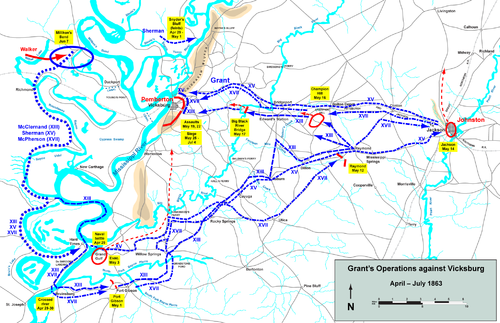 In the early months of 1863, Grant pursued various futile operations seeking to capture Vicksburg from the north, causing one newspaper to complain that the "army was being ruined in mud-turtle expeditions, under the leadership of a drunkard [Grant], whose confidential adviser [Sherman] was a lunatic." However, in April Grant proceeded to establish his troops well south of Vicksburg by marching them down the west side of the Mississippi and crossing it with the aid of the Navy. Working well with the Western Flotilla under Acting Rear Admiral David D. Porter, Grant led approximately 40,000 troops in the XIII (McClernand), XV (Sherman), and XVII (McPherson) Corps through the Vicksburg Campaign
, a masterful 180-mile (288 km) campaign of maneuver against two Confederate armies, Pemberton's Vicksburg force and a relief force under General Joseph E. Johnston
. After capturing and briefly occupying Jackson, Mississippi
, on May 14, and winning the Battle of Champion Hill
on May 16, Grant failed in initial assaults against the Confederate entrenchments at Vicksburg on May 19 and 22 and then settled in for siege operations rather than incur additional casualties.
During the siege, the army received significant reinforcements, from within and without the Department of the Tennessee, bringing Grant's total strength at Vicksburg above 70,000 troops out of a reported July 1863 total strength for the department of approximately 175,000. These reinforcements included troops from Hurlbut's XVI Corps, a "strong division" from the late Army of the Frontier
under Maj. Gen. Francis J. Herron
, and the IX Corps
, 8,000 men from Ambrose Burnside
's Army of the Ohio
under the command of Maj. Gen. John G. Parke. On June 18, essentially on grounds of insubordination, Grant replaced the ever-political McClernand in command of the XIII Corps with Maj. Gen. Edward O.C. Ord
. The city ultimately surrendered on July 4; its garrison of 30,000 was given parole (rather than taken prisoner). Even before Vicksburg fell, reflecting his growing confidence in W.T. Sherman, Grant placed him in charge of a force drawn from the IX, XIII, XV, and XVII Corps to shield the siege operations against potential attack from the east by Joe Johnston's relief force. After Vicksburg fell, Sherman commanded a sizable Expeditionary Army (IX, XIII, and XV Corps) to drive Johnston beyond Jackson and then fell back toward Vicksburg. Maj. Gen. Frederick Steele
led Sherman's XV Corps in this operation, which effectively concluded the roles of both the IX Corps
and XIII Corps
in the Department of the Tennessee.
 Grant's capture of Vicksburg, achieved largely by long-established elements of the Army of the Tennessee, was one of the most important Union victories of the war. It opened the Mississippi River for the Union and cut the Confederacy in half. In recognition of his achievement, Grant was promptly elevated to the rank of major general in the regular army. At Halleck's suggestion, Grant then asked Lincoln to give Sherman and McPherson the rank of brigadier general in the regular army, in addition to their rank of major general of volunteers. Sherman later wrote that, with the capture of Vicksburg, "Grant's army had seemingly completed its share of the work of war." Even though much work in fact still lay before the Army of the Tennessee, there is much truth in Sherman's observation. Soon Grant would move on to expanded responsibilities, leaving the Army of the Tennessee in Sherman's hands. And the army itself would shift its operations eastward, closing the 1861–1863 chapter of riverine operations on the Cumberland, the Tennessee, and the Mississippi and beginning a series of epic marches. In addition, after Vicksburg, the Army of the Tennessee would ebb in size and usually operated in tandem with other forces, principally the Army of the Cumberland
.
's Army of Tennessee defeated William Rosecrans's Army of the Cumberland
in the Battle of Chickamauga
; Rosecrans retreated to Chattanooga, Tennessee
, and was besieged there by Bragg. To address this crisis, Washington elevated Grant, the celebrated victor of Vicksburg, to command of the newly created and geographically broad Military Division of the Mississippi
and ordered him to travel to Chattanooga, assume command of all forces there, and defeat Bragg. The War Department gave Grant his choice between continuing Rosecrans as commander of the Army of the Cumberland or elevating corps commander George Thomas to head that army; Grant chose Thomas. Grant's forces at Chattanooga eventually included elements of three armies: 35,000 men from the Army of the Cumberland under Thomas; 20,000 men sent west from the Army of the Potomac
under Maj. Gen. Joseph Hooker
; and 17,000 men from the Army of the Tennessee.
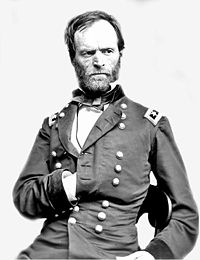 It was William Tecumseh Sherman who led the Army of the Tennessee's contingent to Chattanooga, up the Mississippi River from Vicksburg and then east from Memphis. Sherman began his march as a corps commander and ended it as Grant's replacement as commander of "the Department and Army of the Tennessee." He brought to Chattanooga most of his old XV Corps, now placed temporarily under the command of Maj. Gen. Frank P. Blair, Jr., and the 2nd Division of the XVII Corps, led by Brig. Gen. John E. Smith
. With the arrival of Sherman's force, Grant was prepared to take the offensive and break Bragg's siege. He assigned Sherman to assault the right flank of Bragg's army, at the north end of Missionary Ridge
, with three of his four divisions and other troops; this attack was intended to play the major role for the Union. However, in the Battle of Missionary Ridge
on November 25, Sherman's attack gained no traction, and it fell to Thomas's Army of the Cumberland to break the Confederate line by assaulting directly up the middle of Missionary Ridge. On this occasion, then, the Army of the Tennessee ended up playing second fiddle to the Army of the Cumberland.
Immediately after Chattanooga, Grant ordered Sherman to take command of a mixed force, including part of the XV Corps, and proceed to break the siege that other Confederate forces had mounted against Ambrose Burnside
's command at Knoxville, Tennessee
. Sherman's mere approach resulted in the lifting of the siege, allowing Sherman to return to Chattanooga with the XV Corps troops. Sherman later calculated that, in these crises, the XV Corps had marched 330 miles (530 km) from Memphis to Chattanooga and 230 miles (370 km) from Chattanooga to Knoxville and back.
troops) had participated in the Chattanooga and Knoxville campaigns. Most of the XVII Corps
had remained on other duties, under McPherson at Vicksburg, and most of the XVI Corps
, under Hurlbut at Memphis. In early 1864, Sherman organized from the latter two corps an expedition of 20,000 men to move into central Mississippi to break up Confederate rail communications and other infrastructure and thereby to solidify Union control of the Mississippi River. This force, led by Sherman himself, consisted of two divisions from McPherson's corps and two from Hurlbut's corps. In February, after concentrating at Vicksburg, the force made a largely unopposed round-trip march of approximately 330 miles (530 km) from Vicksburg to Meridian, Missisissippi
, and back, in two columns. Hurlbut led the left column, and McPherson, the right. This force destroyed the transportation center at Meridian in mid-February. One recent study of the Meridian campaign describes it as a "dress rehearsal" for the style of war against infrastructure that Sherman, as well as some of these very troops, would later practice in Georgia during the March to the Sea
. Another historian has stated that the Meridian campaign taught Sherman that he "could march an army through Confederate territory with impunity and feed it at the expense of the inhabitants. He could wage successful war without having to slaughter thousand of soldiers in the process." The Meridian campaign essentially marked the end of Hurlbut's role in the Army of the Tennessee; subsequently he became commander of the Department of the Gulf.
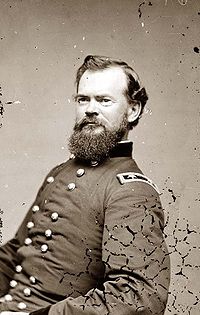 Now that Chattanooga was secure, an avenue of invasion lay open into the heart of the Deep South
. It fell to Sherman to lead this invasion in the 1864 Atlanta Campaign
, with the Army of the Tennessee serving as his "whiplash." To set the stage: In March 1864, Lincoln promoted Ulysses S. Grant to the new rank of lieutenant general
and gave him command of all Union armies; to fulfill that role, Grant relocated to the Eastern Theater
and maintained his headquarters thereafter in the field with the Army of the Potomac
. In the West, Sherman succeeded Grant in command of the Military Division of the Mississippi. Command of the Army of the Tennessee now passed to the XVII Corps commander, Maj. Gen. James B. McPherson
; he had begun his association with his new army as a lieutenant colonel and the chief engineer in Grant's Henry-Donelson force. On the Confederate side, after Chattanooga, Braxton Bragg lost command of the Confederate Army of Tennessee, replaced initially by General Joseph E. Johnston
and later by Lt. Gen. John Bell Hood
.
Sherman later described the Atlanta campaign, launched in early May, as "a continuous battle of 120 days," fought for "over a hundred miles [160 km]" along the route of the Western & Atlantic Railroad, during "which, day and night, were heard the continuous boom of cannon and the sharp crack of the rifle." For this campaign, the Army of the Tennessee initially numbered about 25,000, consisting of the XV Corps under Maj. Gen. John A. Logan
and the Left Wing of the XVI Corps under Brig. Gen. Grenville M. Dodge
. Eventually, McPherson also had two divisions of his old XVII Corps, now under Maj. Gen. Frank Blair's command. Sherman's overall force of about 100,000 also included George Thomas's larger Army of the Cumberland
and Maj. Gen. John M. Schofield's smaller Army of the Ohio
. Typically, Thomas's large force served as Sherman's center, with McPherson and Schofield operating somewhat interchangeably on the wings. During the intricate campaign, having special confidence in his old army, Sherman "prefer[red] to employ the Army of the Tennessee . . . for flanking maneuvers."
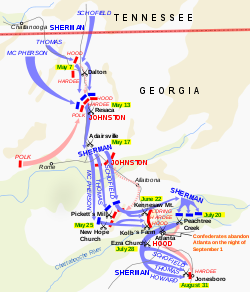 Despite Sherman's confidence in the Army of the Tennessee, one historian has characterized McPherson as the "least aggressive" commander of that army; another considers that he "worried too much about what might be 'on the other side of the hill.'" These qualities, together with troop shortages, may account for McPherson's failure to fully exploit his opportunities early in the campaign, before the Battle of Resaca
. As Sherman began his move southward, Johnston was entrenched at Dalton, Georgia
. Hoping to threaten Johnston's rear from Resaca
, Sherman sent McPherson, on the Union right, to the west of Rocky Face Ridge and through the "unoccupied, unguarded, unobstructed, and unobserved" Snake Creek Gap to Resaca. McPherson did reach Johnston's rear, but assumed a defensive position there, rather than carrying through Sherman's plan to cut Johnston's railroad link to the south. After the rest of Sherman's forces moved up, the first significant battle of the campaign occurred at Resaca (May 13–15). While a much more decisive outcome might have been achieved, Sherman had to be satisfied with Johnston's falling back toward Adairsville.
Resaca set the tone for the first phase of the campaign, as Sherman's armies attempted to maneuver around Johnston, and Johnston continually fell back toward Atlanta. On June 27, Sherman departed from character and attempted a direct assault on Johnston's position at Kennesaw Mountain
. When that failed, Sherman swung McPherson from the left around to the right in order to resume his southward progress. On July 18, as the Army of the Tennessee completed a giant wheeling maneuver from Sherman's right to his left and cut the Georgia Railroad east of Decatur, John Bell Hood replaced Johnston as the Confederate commander. The aggressive Hood soon initiated the Battle of Peachtree Creek
(July 20); his attack was intended to exploit a gap in the Union lines (between Thomas on the right and Schofield in the center) but ended unsuccessfully. Then, in the Battle of Atlanta
on July 22, Hood launched a strong assault against McPherson's army, on Sherman's left. McPherson himself was killed, and command temporarily passed to Maj. Gen. Logan, his senior corps commander. The July 22 battle, writes one historian, was "the climax of the Army of the Tennessee's wartime career," as 27,000 troops "defeated the attacks of nearly 40,000 Confederates who had the advantages of surprise and position."
Notwithstanding Logan's battlefield success that day, Sherman chose West Pointer Maj. Gen. Oliver O. Howard
, imported from a corps command in Thomas's army, to become the new commander of the Army of the Tennessee. Thereafter, Sherman refocused his efforts west of Atlanta, now swinging the Army of the Tennessee around to his right flank. This led to the Battle of Ezra Church on July 28, where Howard repulsed Hood's third attack in nine days "with ease." However, Sherman also suffered setbacks in cavalry operations at this juncture, and for a month his campaign became more static. He finally broke the impasse in late August, essentially abandoning his positions north and east of Atlanta, and wheeling the Army of the Tennessee well south of Atlanta to attack Hood's last rail communications. On August 31, Howard's army repulsed a final Confederate attack in the first day of the Battle of Jonesborough
(August 31 and September 1). With all his rail communications finally severed, Hood evacuated Atlanta during the night of September 1–2. Sherman's capture of Atlanta, facilitated by the prowess of the Army of Tennessee, "was one of the great epochs of the war, on a level with the seizure of Vicksburg" and contributed importantly to the November reelection of Abraham Lincoln. Sherman later estimated that the XV Corps had "traversed in maneuvering" approximately 178 miles (286 km) during this campaign.
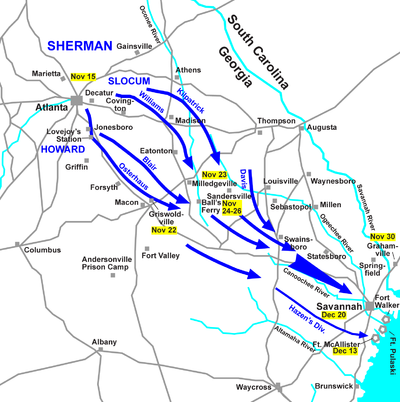 The Army of the Tennessee, under Oliver O. Howard, was now fated to function as Sherman's right arm in the March to the Sea
and the Carolinas Campaign
, but not immediately. After losing Atlanta in early September, Confederate General Hood regrouped and then sought with some success to lure Sherman back northward by attacking his communications and threatening Tennessee; Sherman estimated that his own regression toward Chattanooga and subsequent return to Atlanta involved 270 miles (435 km) of marching by the Army of the Tennessee. During this period (September–October), Sherman made many adjustments to his forces. One involved dividing Grenville Dodge's XVI Corps troops between the XV and XVII Corps; this ended the role of the XVI Corps with the main Army of the Tennessee.
Ultimately, Sherman received approval from his superiors to detach other forces under George Thomas and John Schofield to defend Tennessee, cut loose from his lines of communication back to Chattanooga, and march southeast to the sea with approximately 60,000 men. In November and December, then, the Army of the Tennessee constituted the right wing during the march of 280 miles (450 km) to the sea; Howard's command at this stage consisted of the XV Corps (now under Maj. Gen. Peter J. Osterhaus
in place of Logan) and the XVII Corps (Blair). Sherman's other column, designated the Army of Georgia
, was drawn from the Army of the Cumberland; its commander was Maj. Gen. Henry W. Slocum.
Sherman himself characterized his march to the sea as a largely unopposed "'shift of base,' as the transfer of a strong army, which had no opponent, and had finished its then work, from the interior to a point on the sea-coast, from which it could achieve other important results." As is well known, during the march, his troops lived off the land and demoralized the South by extensive destruction of property. (On the eve of the march, one soldier wrote that "[w]e understand . . . that Sherman intends to use us to Christianize this country.") In the final stage of the march, Sherman called upon his old Shiloh division, now in the Army of the Tennessee's XV Corps and under the command of Brig. Gen. William B. Hazen, to subdue Fort McAllister, outside Savannah, Georgia
. On December 21, the march culminated with the capture of Savannah. The Army of the Tennessee and the Army of Georgia thereby allowed Sherman to present Savannah to Lincoln as a "Christmas-gift . . . with one hundred and fifty heavy guns and plenty of ammunition, also about twenty-five thousand bales of cotton." Despite Sherman's deprecation of the operational significance of the March to the Sea, it "was one of the major events of the Civil War"; Sherman's virtually unopposed movement through Georgia showed that the Confederacy's "days were numbered" and demoralized the Confederate army in Virginia under Robert E. Lee
.
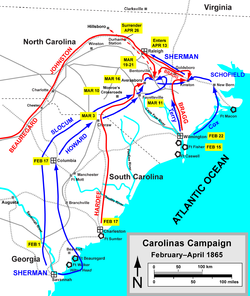 On February 1, 1865, after a month in Savannah, Sherman resumed in force his destructive march, now northward into the Carolinas
, with the ultimate objective of concentrating with Grant's forces in Virginia. Howard's Army of the Tennessee again constituted the right wing of a two-column advance, with John Logan now resuming command of the XV Corps and the XVII Corps continuing under Blair. The other column was again composed of Slocum's Army of Georgia. Resistance was scarce in South Carolina, and Sherman's troops worked much destruction on the cradle of secession. (As Sherman exited the state in early March, one soldier observed that South Carolina "has her 'rights' now.") Confederate opposition intensified in North Carolina, led by Sherman's erstwhile foe, Confederate General Joseph E. Johnston. At Sherman's final significant battle, Bentonville
in mid March, most of the fighting fell to Slocum's forces. Thereafter, Johnston slipped away to the northwest, and Sherman rendezvoused near Goldsboro
with forces Grant had ordered east from Tennessee under John Schofield. The Army of the Tennessee had marched roughly 450 miles (725 km) in 50 days from Savannah to Goldsboro, and it seemed that nothing could long prevent Sherman from concentrating with Grant in Virginia. Sherman later wrote that this was "one of the longest and most important marches ever made by an organized army in a civilized country." Observing Sherman's swift progress, Joe Johnston concluded "that there had been no such army since the days of Julius Caesar
."
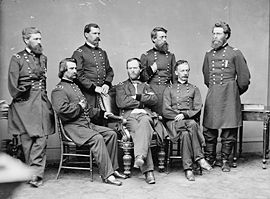 On April 10, 1865, the day after Robert E. Lee
surrendered to Grant at Appomattox, Virginia
, Sherman resumed his advance, headed toward Raleigh, North Carolina
, now with almost 90,000 troops—Howard's Army of the Tennessee on the right, Schofield's Army of the Ohio in the center, and Slocum's Army of Georgia on the left. Only learning of Lee's surrender on the night of April 11–12, Sherman had as his immediate target the separate Confederate force under General Johnston, then near Raleigh, but there was little need for further fighting. Sherman entered Raleigh on April 13, and Johnston promptly opened what became prolonged and politically sensitive surrender discussions. On April 26, at Durham Station, Johnston finally surrendered to Sherman all of the Confederate forces in the Carolinas, Georgia, and Florida. The Army of the Tennessee and the Army of Georgia then marched some 250 miles (400 km) to Washington, D.C.
and on March 24 participated there with Sherman in the Grand Review.
To salve the injury he had inflicted in bypassing John A. Logan for Oliver Howard after McPherson's death, Sherman arranged in May for Logan to become the final commander of the Army of the Tennessee. Thus, while Howard rode with Sherman, Logan led the army in the Grand Review. On July 13, Logan issued a farewell address to the Army of the Tennessee: "Four years have you struggled in the bloodiest and most destructive war that ever drenched the earth with human gore; step by step you have borne our standard, until to-day, over every fortress and arsenal that rebellion wrenched from us, and over city, town, and hamlet, from the Lakes to the Gulf, and from ocean to ocean, proudly floats the 'Starry emblem' of our national unity and strength." Taps sounded for the Army of the Tennessee on August 1, 1865.
District of Cairo
District of West Tennessee
Department of the Tennessee
Union Army
The Union Army was the land force that fought for the Union during the American Civil War. It was also known as the Federal Army, the U.S. Army, the Northern Army and the National Army...
army in the Western Theater
Western Theater of the American Civil War
This article presents an overview of major military and naval operations in the Western Theater of the American Civil War.-Theater of operations:...
of the American Civil War
American Civil War
The American Civil War was a civil war fought in the United States of America. In response to the election of Abraham Lincoln as President of the United States, 11 southern slave states declared their secession from the United States and formed the Confederate States of America ; the other 25...
, named for the Tennessee River
Tennessee River
The Tennessee River is the largest tributary of the Ohio River. It is approximately 652 miles long and is located in the southeastern United States in the Tennessee Valley. The river was once popularly known as the Cherokee River, among other names...
. It should not be confused with the similarly named Army of Tennessee
Army of Tennessee
The Army of Tennessee was the principal Confederate army operating between the Appalachian Mountains and the Mississippi River during the American Civil War. It was formed in late 1862 and fought until the end of the war in 1865, participating in most of the significant battles in the Western Theater...
, a Confederate
Confederate States Army
The Confederate States Army was the army of the Confederate States of America while the Confederacy existed during the American Civil War. On February 8, 1861, delegates from the seven Deep South states which had already declared their secession from the United States of America adopted the...
army named after the State of Tennessee
Tennessee
Tennessee is a U.S. state located in the Southeastern United States. It has a population of 6,346,105, making it the nation's 17th-largest state by population, and covers , making it the 36th-largest by total land area...
.
It appears that the term "Army of the Tennessee" was first used within the Union Army in March 1862, to describe Union forces perhaps more properly described as the "Army of West Tennessee"; these were the troops under the command of Maj. Gen.
Major General
Major general or major-general is a military rank used in many countries. It is derived from the older rank of sergeant major general. A major general is a high-ranking officer, normally subordinate to the rank of lieutenant general and senior to the ranks of brigadier and brigadier general...
Ulysses S. Grant
Ulysses S. Grant
Ulysses S. Grant was the 18th President of the United States as well as military commander during the Civil War and post-war Reconstruction periods. Under Grant's command, the Union Army defeated the Confederate military and ended the Confederate States of America...
in the Union's District of West Tennessee. In April 1862, Grant's troops survived a severe test in the bloody Battle of Shiloh
Battle of Shiloh
The Battle of Shiloh, also known as the Battle of Pittsburg Landing, was a major battle in the Western Theater of the American Civil War, fought April 6–7, 1862, in southwestern Tennessee. A Union army under Maj. Gen. Ulysses S. Grant had moved via the Tennessee River deep into Tennessee and...
. Then, during six months marked by discouragement and anxiety for Grant, his army first joined with two other Union armies to prosecute the relatively bloodless Siege of Corinth
Siege of Corinth
The Siege of Corinth was an American Civil War battle fought from April 29 to May 30, 1862, in Corinth, Mississippi.-Background:...
and then strained to hold Union positions in Tennessee and Mississippi. In October 1862, Grant's command was reconfigured and elevated to departmental status, as the Department of the Tennessee; the title of his command was thus officially aligned with that of his army. Grant commanded these forces until after his critically important victory at Vicksburg
Vicksburg Campaign
The Vicksburg Campaign was a series of maneuvers and battles in the Western Theater of the American Civil War directed against Vicksburg, Mississippi, a fortress city that dominated the last Confederate-controlled section of the Mississippi River. The Union Army of the Tennessee under Maj. Gen....
in July 1863. Under other generals, starting with William Tecumseh Sherman
William Tecumseh Sherman
William Tecumseh Sherman was an American soldier, businessman, educator and author. He served as a General in the Union Army during the American Civil War , for which he received recognition for his outstanding command of military strategy as well as criticism for the harshness of the "scorched...
, the army marched and fought from the Chattanooga Campaign
Chattanooga Campaign
The Chattanooga Campaign was a series of maneuvers and battles in October and November 1863, during the American Civil War. Following the defeat of Maj. Gen. William S. Rosecrans's Union Army of the Cumberland at the Battle of Chickamauga in September, the Confederate Army of Tennessee under Gen...
, through the Relief of Knoxville, the Meridian Campaign
Battle of Meridian
The Battle of Meridian was fought in Lauderdale County, Mississippi, from February 14 to February 20, 1864, between elements of the Union Army of the Tennessee led by Maj. Gen. William Tecumseh Sherman and Confederate forces under Lt. Gen. Leonidas Polk...
, the Atlanta Campaign
Atlanta Campaign
The Atlanta Campaign was a series of battles fought in the Western Theater of the American Civil War throughout northwest Georgia and the area around Atlanta during the summer of 1864. Union Maj. Gen. William T. Sherman invaded Georgia from the vicinity of Chattanooga, Tennessee, beginning in May...
, the March to the Sea
Sherman's March to the Sea
Sherman's March to the Sea is the name commonly given to the Savannah Campaign conducted around Georgia from November 15, 1864 to December 21, 1864 by Maj. Gen. William Tecumseh Sherman of the Union Army in the American Civil War...
, the Carolinas Campaign
Carolinas Campaign
The Carolinas Campaign was the final campaign in the Western Theater of the American Civil War. In January 1865, Union Maj. Gen. William Tecumseh Sherman advanced north from Savannah, Georgia, through the Carolinas, with the intention of linking up with Union forces in Virginia. The defeat of ...
, and to the end of the war and disbandment. This article also discusses Grant's 1861–1862 commands—the District of Southeast Missouri and the District of Cairo—because the troops Grant led in the Battle of Belmont
Battle of Belmont
The Battle of Belmont was fought on November 7, 1861, in Mississippi County, Missouri. It was the first combat test in the American Civil War for Brig. Gen. Ulysses S. Grant, the future Union Army general in chief and eventual U.S...
and the Henry
Battle of Fort Henry
The Battle of Fort Henry was fought on February 6, 1862, in western Tennessee, during the American Civil War. It was the first important victory for the Union and Brig. Gen. Ulysses S. Grant in the Western Theater....
-Donelson
Battle of Fort Donelson
The Battle of Fort Donelson was fought from February 11 to February 16, 1862, in the Western Theater of the American Civil War. The capture of the fort by Union forces opened the Cumberland River as an avenue for the invasion of the South. The success elevated Brig. Gen. Ulysses S...
campaign during that period became the nucleus of the Army of the Tennessee.
A 2005 study of the army states that it "was present at most of the great battles that became turning points of the war—Fort Donelson, Vicksburg, and Atlanta" and "won the decisive battles in the decisive theater of the war." More poetically, in 1867, apparently speaking of the Atlanta campaign, General Sherman said that the Army of the Tennessee was "never checked—always victorious; so rapid in motion—so eager to strike; it deserved its name of the 'Whip-lash,' swung from one flank to the other, as danger called, night or day, sunshine or storm."
History
History remembers the Army of the Tennessee as one of the most important Union armies during the Civil War, an army intimately associated with the Union's two most celebrated generals, Ulysses S. GrantUlysses S. Grant
Ulysses S. Grant was the 18th President of the United States as well as military commander during the Civil War and post-war Reconstruction periods. Under Grant's command, the Union Army defeated the Confederate military and ended the Confederate States of America...
and William Tecumseh Sherman
William Tecumseh Sherman
William Tecumseh Sherman was an American soldier, businessman, educator and author. He served as a General in the Union Army during the American Civil War , for which he received recognition for his outstanding command of military strategy as well as criticism for the harshness of the "scorched...
. It is thus rather ironic that frequent military reorganizations and looseness of usage during the war itself make it difficult to pinpoint the exact date at which this army formally came into existence. It should suffice to note that the "nucleus [of troops] around which was to gather the . . . Army of the Tennessee" first took shape in 1861–1862, while Grant was headquartered at Cairo, Illinois
Cairo, Illinois
Cairo is the southernmost city in the U.S. state of Illinois. It is the county seat of Alexander County. Cairo is located at the confluence of the Mississippi and Ohio rivers. The rivers converge at Fort Defiance State Park, an American Civil War fort that was commanded by General Ulysses S. Grant...
. Those troops continued under Grant in his next command, the distinct District of West Tennessee; they were then sometimes, and perhaps most appropriately, called the "Army of West Tennessee." However, army correspondence began using the term "Army of the Tennessee" in March 1862; that term soon became commonplace and naturally lived on when Grant's command was elevated to departmental status in October 1862, as the Department of the Tennessee. During the course of the war, elements of the Army of the Tennessee performed many tasks, and the army evolved with the addition and subtraction of many units. It is not feasible to chronicle every such development here, even at the corps
Corps
A corps is either a large formation, or an administrative grouping of troops within an armed force with a common function such as Artillery or Signals representing an arm of service...
level. Rather, this article traces the main thrust of the army's development and its most memorable activities. At any given time, substantial numbers of troops were engaged in activities not discussed here. For example, in April 1863, less than half of Grant's departmental strength was directly engaged in the Vicksburg Campaign
Vicksburg Campaign
The Vicksburg Campaign was a series of maneuvers and battles in the Western Theater of the American Civil War directed against Vicksburg, Mississippi, a fortress city that dominated the last Confederate-controlled section of the Mississippi River. The Union Army of the Tennessee under Maj. Gen....
.
Cairo and the Battle of Belmont
Brigadier general (United States)
A brigadier general in the United States Army, Air Force, and Marine Corps, is a one-star general officer, with the pay grade of O-7. Brigadier general ranks above a colonel and below major general. Brigadier general is equivalent to the rank of rear admiral in the other uniformed...
Ulysses S. Grant
Ulysses S. Grant
Ulysses S. Grant was the 18th President of the United States as well as military commander during the Civil War and post-war Reconstruction periods. Under Grant's command, the Union Army defeated the Confederate military and ended the Confederate States of America...
, then subordinate to Maj. Gen. John Fremont in the Union's Western Department, assumed command of the District of Southeast Missouri; Grant established his headquarters at Cairo, Illinois
Cairo, Illinois
Cairo is the southernmost city in the U.S. state of Illinois. It is the county seat of Alexander County. Cairo is located at the confluence of the Mississippi and Ohio rivers. The rivers converge at Fort Defiance State Park, an American Civil War fort that was commanded by General Ulysses S. Grant...
. One of Grant's wartime aides, John A. Rawlins, later stated that "[f]rom this time . . . commenced the growth and organization of the Army of the Tennessee." Just days later, prompted by Confederate occupation of Columbus, Kentucky
Columbus, Kentucky
Columbus is a city in Hickman County, Kentucky, United States. The population was 229 at the 2000 census.-Geography:Columbus is located at .According to the United States Census Bureau, the city has a total area of , all of it land....
, on the Mississippi River
Mississippi River
The Mississippi River is the largest river system in North America. Flowing entirely in the United States, this river rises in western Minnesota and meanders slowly southwards for to the Mississippi River Delta at the Gulf of Mexico. With its many tributaries, the Mississippi's watershed drains...
, Grant led a small force to seize Paducah, Kentucky
Paducah, Kentucky
Paducah is the largest city in Kentucky's Jackson Purchase Region and the county seat of McCracken County, Kentucky, United States. It is located at the confluence of the Tennessee River and the Ohio River, halfway between the metropolitan areas of St. Louis, Missouri, to the west and Nashville,...
, where the Tennessee River
Tennessee River
The Tennessee River is the largest tributary of the Ohio River. It is approximately 652 miles long and is located in the southeastern United States in the Tennessee Valley. The river was once popularly known as the Cherokee River, among other names...
joins the Ohio River
Ohio River
The Ohio River is the largest tributary, by volume, of the Mississippi River. At the confluence, the Ohio is even bigger than the Mississippi and, thus, is hydrologically the main stream of the whole river system, including the Allegheny River further upstream...
; Grant thus forestalled a Confederate effort to occupy the strategically important town. Paducah promptly became a separate Union command under Brig. Gen. Charles F. Smith, who soon occupied Smithland, Kentucky
Smithland, Kentucky
Smithland is a city in Livingston County, Kentucky, United States, at the confluence of the Ohio and Cumberland Rivers. The population was 401 at the 2000 census...
, at the junction of the Cumberland River
Cumberland River
The Cumberland River is a waterway in the Southern United States. It is long. It starts in Harlan County in far southeastern Kentucky between Pine and Cumberland mountains, flows through southern Kentucky, crosses into northern Tennessee, and then curves back up into western Kentucky before...
and the Ohio.
According to Rawlins, the "first affair dignified by the name of a battle" for any of Grant's forces occurred at Fredericktown, Missouri
Battle of Fredericktown
The Battle of Fredericktown was an engagement of the American Civil War. It took place on October 21, 1861, in Madison County, Missouri. Union victory consolidated their control of southeastern Missouri.-Background:...
, where some of Grant's troops helped defeat Confederate forces under M. Jeff Thompson
M. Jeff Thompson
Meriwether Jeff Thompson was a brigadier general in the Missouri State Guard during the American Civil War. He served the Confederate Army as a cavalry commander, and had the unusual distinction of having a ship in the Confederate Navy named for him.-Early life:*Father: Meriwether Thompson b....
. Grant's own first engagement came on November 7 at Belmont, Missouri
Battle of Belmont
The Battle of Belmont was fought on November 7, 1861, in Mississippi County, Missouri. It was the first combat test in the American Civil War for Brig. Gen. Ulysses S. Grant, the future Union Army general in chief and eventual U.S...
, a Mississippi River landing opposite Columbus, Kentucky. Grant, accompanied by Brig. Gen. John A. McClernand, moved a force of approximately 3,000 to Belmont by water, cut his way into the Confederate camps there, and then had to fight his way back out to regain his transports. Grant's casualties in this first battle totaled about 500; Confederate casualties were similar. While Grant had suffered a repulse, he won favorable press coverage. This battle, reports Rawlins, "confirmed General Grant in his views" that he should "give battle" whenever "he had what he thought a sufficient number of men." Also in November, John Fremont lost his command at St. Louis, to be replaced by Maj. Gen. Henry W. Halleck, whose command was designated the Department of the Missouri
Department of the Missouri
Department of the Missouri was a division of the United States Army that functioned through the American Civil War and the Indian Wars afterwards.-Civil War:...
.
The Henry-Donelson Campaign
On December 20, Grant's command was reconfigured to include C.F. Smith's and renamed the District of Cairo. From that perch, in February 1862, Grant led the Union campaign against Fort HenryBattle of Fort Henry
The Battle of Fort Henry was fought on February 6, 1862, in western Tennessee, during the American Civil War. It was the first important victory for the Union and Brig. Gen. Ulysses S. Grant in the Western Theater....
, on the Tennessee River, and Fort Donelson
Battle of Fort Donelson
The Battle of Fort Donelson was fought from February 11 to February 16, 1862, in the Western Theater of the American Civil War. The capture of the fort by Union forces opened the Cumberland River as an avenue for the invasion of the South. The success elevated Brig. Gen. Ulysses S...
, on the Cumberland River. His troops for this campaign eventually numbered approximately 27,000 men, divided into three divisions commanded, respectively, by John McClernand (1st Division), C.F. Smith (2nd), and Brig. Gen. Lewis Wallace
Lew Wallace
Lewis "Lew" Wallace was an American lawyer, Union general in the American Civil War, territorial governor and statesman, politician and author...
(3rd).
Flag Officer
A flag officer is a commissioned officer in a nation's armed forces senior enough to be entitled to fly a flag to mark where the officer exercises command. The term usually refers to the senior officers in an English-speaking nation's navy, specifically those who hold any of the admiral ranks; in...
Andrew H. Foote, commander of the Western Flotilla. Several days later, in winter conditions, most of Grant's two divisions marched overland to attack the more formidable Fort Donelson, situated on the Cumberland River but only twelve miles (19 km) away from Fort Henry. Additional Union regiments arrived at Fort Donelson by water; these were formed into the new 3rd Division under Lew Wallace. The Battle of Fort Donelson
Battle of Fort Donelson
The Battle of Fort Donelson was fought from February 11 to February 16, 1862, in the Western Theater of the American Civil War. The capture of the fort by Union forces opened the Cumberland River as an avenue for the invasion of the South. The success elevated Brig. Gen. Ulysses S...
began on February 13 and, after sharp fighting, concluded on February 16 with the unconditional surrender of the remaining Confederate garrison of approximately 15,000.
Although it would still be a month before the term "Army of the Tennessee" came into use, the three divisions that served under Grant in the Henry-Donelson campaign were the nucleus of that famous army and had now won an important victory that foreshadowed its later successes. One historian describes their accomplishments in the Henry-Donelson campaign as the "first significant Union triumph in the war"; its fruits included breaking the Confederacy's western line of defense, securing Kentucky to the Union, and opening the South, especially Tennessee, to invasion. Another historian notes that Grant's troops "had performed prodigies of valor and endurance during the campaign" and had learned from it that "hard fighting would bring success." As a result of the campaign's conspicuous success, Grant, McClernand, Smith, and Wallace were all promoted to the rank of major general of volunteers. Grant in particular became a national celebrity—"Unconditional Surrender" Grant—for his refusal to allow any other terms of surrender.
Shiloh and the Siege of Corinth
On February 14, 1862, during the Donelson campaign, Grant was given command of the newly created District of West Tennessee; it appears that his troops soon came to be called the "Army of the Tennessee" more often than the "Army of West Tennessee." Over the next several months, Grant twice was in danger of losing his command, a development that doubtless would have changed the future course and character of the army and perhaps deprived it at this early stage of one source of its future success—continuity of leadership.In early March, Grant's superior, Maj. Gen. Henry W. Halleck, then in command of the Department of the Missouri, assigned Grant to lead an expedition up the Tennessee River from the recently captured Fort Henry. On March 4, however, Halleck ordered Grant to give field command of the expedition to C.F. Smith; this order has been variously attributed to professional jealousy and to Halleck's lacking confidence in Grant due to certain administrative difficulties. Smith initially established the expedition at Savannah, Tennessee
Savannah, Tennessee
Savannah is a city in Hardin County, Tennessee, United States. The population was 6,917 at the 2000 census and the 2007 population estimate was 7,262. It is the county seat of Hardin County. Savannah hosted the NAIA college football national championship game from 1996-2007. Savannah is home to...
, a town on the east side of the river approximately 100 river miles (160 km) south of Fort Henry. He soon began staging troops at a point—Pittsburg Landing—nine miles (14 km) further south and across the river. Meanwhile, Halleck's command was enlarged and renamed the Department of the Mississippi, and Halleck restored Grant to field command, perhaps because of personal intervention by President Abraham Lincoln
Abraham Lincoln
Abraham Lincoln was the 16th President of the United States, serving from March 1861 until his assassination in April 1865. He successfully led his country through a great constitutional, military and moral crisis – the American Civil War – preserving the Union, while ending slavery, and...
. Grant joined his army in the field on March 17. By early April, Grant's army had grown to a total of roughly 50,000 men, organized into six divisions. The three new divisions were commanded by Brig. Gen. Stephen A. Hurlbut
Stephen A. Hurlbut
Stephen Augustus Hurlbut , was a politician, diplomat, and commander of the U.S. Army of the Gulf in the American Civil War.-Biography:...
(4th Division), Brig. Gen. William Tecumseh Sherman
William Tecumseh Sherman
William Tecumseh Sherman was an American soldier, businessman, educator and author. He served as a General in the Union Army during the American Civil War , for which he received recognition for his outstanding command of military strategy as well as criticism for the harshness of the "scorched...
(5th), and Brig. Gen. Benjamin M. Prentiss (6th). In addition, Brig. Gen. W.H.L. Wallace
W.H.L. Wallace
William Hervey Lamme Wallace , more commonly known as W.H.L. Wallace, was a lawyer and a Union general in the American Civil War, considered by Ulysses S. Grant to be one of the Union's greatest generals....
took command of Smith's 2nd Division due to the latter's having suffered a debilitating leg injury.
Battle of Shiloh
The Battle of Shiloh, also known as the Battle of Pittsburg Landing, was a major battle in the Western Theater of the American Civil War, fought April 6–7, 1862, in southwestern Tennessee. A Union army under Maj. Gen. Ulysses S. Grant had moved via the Tennessee River deep into Tennessee and...
, when Confederate forces advanced largely undetected from Corinth, Mississippi
Corinth, Mississippi
Corinth is a city in Alcorn County, Mississippi, United States. The population was 14,054 at the 2000 census. It is the county seat of Alcorn County. Its ZIP codes are 38834 and 38835.- History :...
, and attacked the five Union divisions staged at Pittsburg Landing. On the first day of the battle, the surprised and unentrenched army fought desperately and suffered many casualties. However, long-expected elements of the Army of the Ohio
Army of the Ohio
The Army of the Ohio was the name of two Union armies in the American Civil War. The first army became the Army of the Cumberland and the second army was created in 1863.-History:...
, under Maj. Gen. Don Carlos Buell
Don Carlos Buell
Don Carlos Buell was a career United States Army officer who fought in the Seminole War, the Mexican-American War, and the American Civil War. Buell led Union armies in two great Civil War battles—Shiloh and Perryville. The nation was angry at his failure to defeat the outnumbered...
, arrived to reinforce Grant late that day, with many more troops arriving overnight and the following day. Grant was also bolstered by the evening arrival of his own 3rd Division; Lew Wallace and his troops had been slow arriving at Pittsburg Landing from their separate position at Crump's Landing. Substantially reinforced by Buell and Wallace, Grant counterattacked the Confederate forces on April 7 and drove them from the field and back toward Corinth. "Grant's victory at Shiloh," one historian has written, "bloody and bitter though it was, doomed the Confederate cause in the Mississippi valley." In the near term, however, the battle resulted in much criticism against Grant for lack of preparedness, swift promotion to major general of volunteers for Sherman, capture for Prentiss, a fatal wound for W.H.L. Wallace, and Grant's loss of confidence in Lew Wallace. In addition, C.F. Smith died later in April from complications due to his non-combat leg injury.
In the aftermath of Shiloh came the second threat to Grant's leadership, as well as a preview of the multi-army operations that would feature prominently in the future of the Army of the Tennessee. Pursuant to previous plans, Grant's departmental superior, General Halleck, arrived at Pittsburg Landing to take command in the field. Intending to move against the Confederate forces concentrating at the rail hub at Corinth, Halleck proceeded to gather and organize what was in effect an army group of over 100,000 men. His force included Grant's Army of the Tennessee, Buell's Army of the Ohio, and Maj. Gen. John Pope
John Pope (military officer)
John Pope was a career United States Army officer and Union general in the American Civil War. He had a brief but successful career in the Western Theater, but he is best known for his defeat at the Second Battle of Bull Run in the East.Pope was a graduate of the United States Military Academy in...
's Army of the Mississippi
Army of the Mississippi
Army of the Mississippi was the name given to two Union armies that operated around the Mississippi River, both with short existences, during the American Civil War.-1862:...
. On April 30, Halleck divided this force into three corps (or "wings") and a reserve. The left wing was commanded by Pope, the center by Buell, the right wing by Maj. Gen. George H. Thomas, and the reserve by John McClernand. Grant's 1st and 3rd Divisions constituted the reserve; the right wing contained Grant's 2nd, 4th, 5th, and 6th Divisions and Thomas's division from the Army of the Ohio. In other words, Halleck had drawn Thomas from division command in the Army of the Ohio and assigned to him, as commander of the right wing, most of Grant's troops.
Halleck assigned Grant to be second-in-command of the entire 100,000-man force, but also expressly confirmed Grant in command of the "Army Corps of the Tennessee" (the right wing and the reserve). It is unclear exactly why Halleck took these actions affecting Grant. However, Grant was under severe public criticism about Shiloh at the time and soon complained that his second-in-command position constituted a "sensure" and was akin to an arrest; among his complaints was the fact that Halleck gave orders directly to Thomas and division commanders nominally subordinate to Grant. With this awkward command structure, embarrassing to Grant, Halleck's forces took the entire month of May, with constant entrenchments, to advance the twenty miles [32 km] to Corinth. This Siege of Corinth
Siege of Corinth
The Siege of Corinth was an American Civil War battle fought from April 29 to May 30, 1862, in Corinth, Mississippi.-Background:...
culminated with the Confederate forces abandoning the town on the night of May 29–30. Grant later suggested that Halleck failed to accomplish all that he should have in this campaign and its aftermath. However, William Tecumseh Sherman, commanding a division in Thomas's right wing, considered the campaign to be an important period of training for Halleck's forces, including the Army of the Tennessee: "[I]t served for the instruction of our men in guard and picket duty, and in habituating them to out-door life; and by the time we had reached Corinth I believe that army was the best then on this continent."
After Corinth was taken, Grant might have left his command in frustration, but Sherman intervened and encouraged him to remain. Grant's experiences during this period have been cited as one reason for his subsequent warm relations with Sherman and his cooler relations with George Thomas. In turn, the trust between Grant and Sherman contributed importantly to the future effectiveness of the Army of the Tennessee. More immediately, however, Halleck soon rescinded the multi-corps organization adopted for the Corinth campaign and began to disperse his large force. On June 10, Halleck restored Grant to straightforward command of the "Army of the Tennessee"; Buell was dispatched toward Chattanooga, Tennessee
Chattanooga, Tennessee
Chattanooga is the fourth-largest city in the US state of Tennessee , with a population of 169,887. It is the seat of Hamilton County...
; and, by incremental stages, George Thomas and his division were detached from the Army of the Tennessee and returned to service with Buell's army. While departmental commander Halleck remained at Corinth, Grant established his headquarters for the District of West Tennessee at newly occupied Memphis, Tennessee
Memphis, Tennessee
Memphis is a city in the southwestern corner of the U.S. state of Tennessee, and the county seat of Shelby County. The city is located on the 4th Chickasaw Bluff, south of the confluence of the Wolf and Mississippi rivers....
, with "his troops strung out across half a dozen railheads along the Mississippi-Tennessee border." Thus, having survived threats to his leadership both before and after Shiloh, Grant remained in position to "buil[d] the Army of the Tennessee in his [own image]," to reflect "his matter-of-fact steadiness and his hard-driving aggressiveness."
Iuka and the Battle of Corinth
Army of the Mississippi
Army of the Mississippi was the name given to two Union armies that operated around the Mississippi River, both with short existences, during the American Civil War.-1862:...
, five divisions then under the command of Maj. Gen. William S. Rosecrans. Grant relocated his headquarters to Corinth (and later Jackson, Tennessee
Jackson, Tennessee
Jackson is a city in Madison County, Tennessee, United States. The total population was 65,211 at the 2010 census. Jackson is the primary city of the Jackson, Tennessee metropolitan area, which is included in the Jackson-Humboldt, Tennessee Combined Statistical Area...
) to oversee his expanded responsibilities. He soon lost four divisions from this expanded command—that of George Thomas and three from Rosecrans's Army of the Mississippi—to Buell's Army of the Ohio; these losses shrank Grant's forces from approximately 80,000 troops to less than 50,000. This threw Grant on the "defensive," simply trying to deploy his remaining forces to protect his own positions against threatening Confederate forces; Grant later described this as his "most anxious period of the war." It came to an end with victories led by General Rosecrans in the September Battle of Iuka
Battle of Iuka
The Battle of Iuka was fought on September 19, 1862, in Iuka, Mississippi, during the American Civil War. In the opening battle of the Iuka-Corinth Campaign, Union Maj. Gen. William S. Rosecrans stopped the advance of the army of Confederate Maj. Gen. Sterling Price.Maj. Gen. Ulysses S...
and the more consequential October Battle of Corinth
Second Battle of Corinth
The Second Battle of Corinth was fought October 3–4, 1862, in Corinth, Mississippi. For the second time in the Iuka-Corinth Campaign, Union Maj. Gen. William S...
. Grant was nearby and coordinating with Rosecrans, but not on the field, for these two battles; Rosecrans fought Iuka with elements of his shrunken Army of the Mississippi, and Corinth with the addition of two divisions from the Army of the Tennessee. The victory at Corinth was sufficiently clear cut to relieve Grant "from any further anxiety for the safety of the territory within my jurisdiction."
Soon thereafter, on October 16, Grant's geographical command was redefined and elevated to departmental status, becoming the Department of the Tennessee. This made the term "Army of the Tennessee" more official for his troops. Also in October, Don Carlos Buell lost command of the Army of the Ohio; his place went to Rosecrans, whose commands were christened the Department and the Army of the Cumberland
Army of the Cumberland
The Army of the Cumberland was one of the principal Union armies in the Western Theater during the American Civil War. It was originally known as the Army of the Ohio.-History:...
. By an order dated December 18, but not fully implemented until somewhat later, Grant's Army of the Tennessee was organized into four corps—the XIII
XIII Corps (ACW)
XIII Corps was a corps of the Union Army during the American Civil War. It was first led by Ulysses S. Grant and later by John A. McClernand and Edward O.C. Ord...
under John McClernand, the XV
XV Corps (ACW)
The XV Army Corps was a corps of the Union Army during the American Civil War. It served in the Army of the Tennessee under Maj. Gens. Ulysses S. Grant and William T. Sherman. It was commanded by Sherman in the Siege of Vicksburg and then by Maj. Gen. John A. Logan in Sherman's Atlanta Campaign. ...
under W.T. Sherman, the XVI
XVI Corps (ACW)
The XVI Army Corps was a corps of the Union Army during the American Civil War. The corps rarely fought as one unified unit, as its divisions were often scattered across the country.-Creation and Vicksburg:...
under Stephen Hurlbut, and the XVII
XVII Corps (ACW)
XVII Corps was a corps of the Union Army during the American Civil War. It was organized December 18, 1862 as part of Ulysses S. Grant's Army of the Tennessee. It was most notably commanded by Maj. Gen. James B. McPherson and Maj. Gen. Francis P. Blair II, and served in the Western...
under Maj. Gen. James B. McPherson
James B. McPherson
James Birdseye McPherson was a career United States Army officer who served as a General in the Union Army during the American Civil War...
. Each corps contained several divisions and detachments of artillery and cavalry. For illustrative purposes, the reported organization and strength of the Army of the Tennessee as of April 30, 1863, when it numbered approximately 150,000 in total, can be seen in the Official Records
Official Records of the American Civil War
The Official Records of the War of the Rebellion or often more simply the Official Records or ORs, constitute the most extensive collection of primary sources of the history of the American Civil War. Cornell University lists the official title as, "The War of the Rebellion: a Compilation of the...
.
The Vicksburg Campaign
In the fall of 1862, Grant began organizing operations against Vicksburg, MississippiVicksburg Campaign
The Vicksburg Campaign was a series of maneuvers and battles in the Western Theater of the American Civil War directed against Vicksburg, Mississippi, a fortress city that dominated the last Confederate-controlled section of the Mississippi River. The Union Army of the Tennessee under Maj. Gen....
, a Confederate strong point on the east bank of the Mississippi River under the command of Lt. Gen. John C. Pemberton
John C. Pemberton
John Clifford Pemberton , was a career United States Army officer who fought in the Seminole Wars and with distinction during the Mexican–American War. He also served as a Confederate general during the American Civil War, noted for his defeat and surrender in the critical Siege of Vicksburg in...
. Grant's first initiative ended unsuccessfully in December, when Confederate attacks on his supply lines, especially the supply depot at Holly Springs, Mississippi
Holly Springs, Mississippi
Holly Springs is a city in Marshall County, Mississippi, United States. The population was 7,957 at the 2000 census. It is the county seat of Marshall County. A short drive from Memphis, Tennessee, Holly Springs is the site of a number of well-preserved antebellum homes and other structures and...
, caused Grant to abandon his own planned overland move on Vicksburg from the east. Sherman, intended to be operating against Vicksburg down the Mississippi River
Mississippi River
The Mississippi River is the largest river system in North America. Flowing entirely in the United States, this river rises in western Minnesota and meanders slowly southwards for to the Mississippi River Delta at the Gulf of Mexico. With its many tributaries, the Mississippi's watershed drains...
in concert with Grant's abandoned thrust, then suffered a repulse in the Battle of Chickasaw Bayou
Battle of Chickasaw Bayou
The Battle of Chickasaw Bayou, also called Walnut Hills, fought December 26–29, 1862, was the opening engagement of the Vicksburg Campaign during the American Civil War. Confederate forces under Lt. Gen. John C. Pemberton repulsed an advance by Union Maj. Gen. William T...
. Meanwhile, initially unbeknownst to Grant, his senior subordinate, John McClernand, had used his political influence with Abraham Lincoln to obtain authority for an expedition of his own against Vicksburg. This development, which one historian has characterized as "one of the more bizarre episodes of the Civil War," set McClernand up as a potential competitor to Grant, but also benefited the Army of the Tennessee in the long run because McClernand raised new troops in the Midwest to further his own purposes. In January 1863, shortly after Chickasaw Bayou, McClernand asserted control over the 30,000 men then under Sherman and redesignated those troops as the Army of the Mississippi
Army of the Mississippi
Army of the Mississippi was the name given to two Union armies that operated around the Mississippi River, both with short existences, during the American Civil War.-1862:...
; that force, under McClernand and Sherman, succeeded in capturing Fort Hindman
Battle of Fort Hindman
The Battle of Fort Hindman, or the Battle of Arkansas Post, was fought January 9–11, 1863, near the mouth of the Arkansas River at Arkansas Post, Arkansas, as part of the Vicksburg Campaign of the American Civil War.-Background:...
on the Arkansas River
Arkansas River
The Arkansas River is a major tributary of the Mississippi River. The Arkansas generally flows to the east and southeast as it traverses the U.S. states of Colorado, Kansas, Oklahoma, and Arkansas. The river's initial basin starts in the Western United States in Colorado, specifically the Arkansas...
. Grant considered this objective to constitute "a wild-goose chase," and General-in-Chief Halleck authorized him to assume control over all Vicksburg operations. Hence, McClernand's briefly independent force was reincorporated into the Army of the Tennessee, and McClernand's further participation in the Vicksburg campaign was as XIII Corps commander under Grant.
Vicksburg Campaign
The Vicksburg Campaign was a series of maneuvers and battles in the Western Theater of the American Civil War directed against Vicksburg, Mississippi, a fortress city that dominated the last Confederate-controlled section of the Mississippi River. The Union Army of the Tennessee under Maj. Gen....
, a masterful 180-mile (288 km) campaign of maneuver against two Confederate armies, Pemberton's Vicksburg force and a relief force under General Joseph E. Johnston
Joseph E. Johnston
Joseph Eggleston Johnston was a career U.S. Army officer, serving with distinction in the Mexican-American War and Seminole Wars, and was also one of the most senior general officers in the Confederate States Army during the American Civil War...
. After capturing and briefly occupying Jackson, Mississippi
Jackson, Mississippi
Jackson is the capital and the most populous city of the US state of Mississippi. It is one of two county seats of Hinds County ,. The population of the city declined from 184,256 at the 2000 census to 173,514 at the 2010 census...
, on May 14, and winning the Battle of Champion Hill
Battle of Champion Hill
The Battle of Champion Hill, or Bakers Creek, fought May 16, 1863, was the pivotal battle in the Vicksburg Campaign of the American Civil War. Union commander Maj. Gen. Ulysses S. Grant and the Army of the Tennessee pursued the retreating Confederate Lt. Gen. John C...
on May 16, Grant failed in initial assaults against the Confederate entrenchments at Vicksburg on May 19 and 22 and then settled in for siege operations rather than incur additional casualties.
During the siege, the army received significant reinforcements, from within and without the Department of the Tennessee, bringing Grant's total strength at Vicksburg above 70,000 troops out of a reported July 1863 total strength for the department of approximately 175,000. These reinforcements included troops from Hurlbut's XVI Corps, a "strong division" from the late Army of the Frontier
Army of the Frontier
The Army of the Frontier was a Union army that served in the Trans-Mississippi Theater during the Civil War. It fought in several minor engagements in Arkansas, Indian Territory, and Kansas...
under Maj. Gen. Francis J. Herron
Francis J. Herron
Francis Jay Herron , was a Union general during the American Civil War.-Biography:Francis J. Herron attended the Western University of Pennsylvania, but left at the age of sixteen without completing his degree to become a bank clerk. In 1855, he joined his three brothers in Dubuque, Iowa, where...
, and the IX Corps
IX Corps (ACW)
IX Corps was a corps of the Union Army during the American Civil War that distinguished itself in combat in multiple theaters: the Carolinas, Virginia, Kentucky, Tennessee, and Mississippi.-Formation, Second Bull Run, and Antietam:...
, 8,000 men from Ambrose Burnside
Ambrose Burnside
Ambrose Everett Burnside was an American soldier, railroad executive, inventor, industrialist, and politician from Rhode Island, serving as governor and a U.S. Senator...
's Army of the Ohio
Army of the Ohio
The Army of the Ohio was the name of two Union armies in the American Civil War. The first army became the Army of the Cumberland and the second army was created in 1863.-History:...
under the command of Maj. Gen. John G. Parke. On June 18, essentially on grounds of insubordination, Grant replaced the ever-political McClernand in command of the XIII Corps with Maj. Gen. Edward O.C. Ord
Edward Ord
Edward Otho Cresap Ord was the designer of Fort Sam Houston, and a United States Army officer who saw action in the Seminole War, the Indian Wars, and the American Civil War. He commanded an army during the final days of the Civil War, and was instrumental in forcing the surrender of Confederate...
. The city ultimately surrendered on July 4; its garrison of 30,000 was given parole (rather than taken prisoner). Even before Vicksburg fell, reflecting his growing confidence in W.T. Sherman, Grant placed him in charge of a force drawn from the IX, XIII, XV, and XVII Corps to shield the siege operations against potential attack from the east by Joe Johnston's relief force. After Vicksburg fell, Sherman commanded a sizable Expeditionary Army (IX, XIII, and XV Corps) to drive Johnston beyond Jackson and then fell back toward Vicksburg. Maj. Gen. Frederick Steele
Frederick Steele
Frederick Steele was a career military officer in the United States Army, serving as a major general in the Union Army during the American Civil War. He was most noted for his successful campaign to retake much of secessionist Arkansas for the Union cause.-Early life:Steele was born in Delhi, New...
led Sherman's XV Corps in this operation, which effectively concluded the roles of both the IX Corps
IX Corps (ACW)
IX Corps was a corps of the Union Army during the American Civil War that distinguished itself in combat in multiple theaters: the Carolinas, Virginia, Kentucky, Tennessee, and Mississippi.-Formation, Second Bull Run, and Antietam:...
and XIII Corps
XIII Corps (ACW)
XIII Corps was a corps of the Union Army during the American Civil War. It was first led by Ulysses S. Grant and later by John A. McClernand and Edward O.C. Ord...
in the Department of the Tennessee.
Army of the Cumberland
The Army of the Cumberland was one of the principal Union armies in the Western Theater during the American Civil War. It was originally known as the Army of the Ohio.-History:...
.
Chattanooga and Knoxville
After taking Vicksburg, the Army of the Tennessee "lay, as it were, idle for a time." But soon enough the changing roles for the army and its leading figures evidenced themselves in the November 1863 victory achieved by a mixed Union force in the Battles for Chattanooga. To set the stage: In late September 1863, Confederate General Braxton BraggBraxton Bragg
Braxton Bragg was a career United States Army officer, and then a general in the Confederate States Army—a principal commander in the Western Theater of the American Civil War and later the military adviser to Confederate President Jefferson Davis.Bragg, a native of North Carolina, was...
's Army of Tennessee defeated William Rosecrans's Army of the Cumberland
Army of the Cumberland
The Army of the Cumberland was one of the principal Union armies in the Western Theater during the American Civil War. It was originally known as the Army of the Ohio.-History:...
in the Battle of Chickamauga
Battle of Chickamauga
The Battle of Chickamauga, fought September 19–20, 1863, marked the end of a Union offensive in southeastern Tennessee and northwestern Georgia called the Chickamauga Campaign...
; Rosecrans retreated to Chattanooga, Tennessee
Chattanooga, Tennessee
Chattanooga is the fourth-largest city in the US state of Tennessee , with a population of 169,887. It is the seat of Hamilton County...
, and was besieged there by Bragg. To address this crisis, Washington elevated Grant, the celebrated victor of Vicksburg, to command of the newly created and geographically broad Military Division of the Mississippi
Military Division of the Mississippi
The Military Division of the Mississippi was an administrative division of the United States Army during the American Civil War that controlled all military operations in the Western Theater.-History:...
and ordered him to travel to Chattanooga, assume command of all forces there, and defeat Bragg. The War Department gave Grant his choice between continuing Rosecrans as commander of the Army of the Cumberland or elevating corps commander George Thomas to head that army; Grant chose Thomas. Grant's forces at Chattanooga eventually included elements of three armies: 35,000 men from the Army of the Cumberland under Thomas; 20,000 men sent west from the Army of the Potomac
Army of the Potomac
The Army of the Potomac was the major Union Army in the Eastern Theater of the American Civil War.-History:The Army of the Potomac was created in 1861, but was then only the size of a corps . Its nucleus was called the Army of Northeastern Virginia, under Brig. Gen...
under Maj. Gen. Joseph Hooker
Joseph Hooker
Joseph Hooker was a career United States Army officer, achieving the rank of major general in the Union Army during the American Civil War. Although he served throughout the war, usually with distinction, Hooker is best remembered for his stunning defeat by Confederate General Robert E...
; and 17,000 men from the Army of the Tennessee.
John E. Smith
John Eugene Smith was a Swiss immigrant to the United States, who served as a Union general during the American Civil War.-Early life:Smith was born in Berne, Switzerland in 1816. His father had served under Napoleon Bonaparte and emigrated with his family to Philadelphia, Pennsylvania after the...
. With the arrival of Sherman's force, Grant was prepared to take the offensive and break Bragg's siege. He assigned Sherman to assault the right flank of Bragg's army, at the north end of Missionary Ridge
Missionary Ridge
Missionary Ridge is a geographic feature in Chattanooga, Tennessee, site of the Battle of Missionary Ridge, a battle in the American Civil War, fought on November 25, 1863. Union forces under Maj. Gens. Ulysses S. Grant, William T. Sherman, and George H...
, with three of his four divisions and other troops; this attack was intended to play the major role for the Union. However, in the Battle of Missionary Ridge
Battle of Missionary Ridge
The Battle of Missionary Ridge was fought November 25, 1863, as part of the Chattanooga Campaign of the American Civil War. Following the Union victory in the Battle of Lookout Mountain on November 24, Union forces under Maj. Gen. Ulysses S. Grant assaulted Missionary Ridge and defeated the...
on November 25, Sherman's attack gained no traction, and it fell to Thomas's Army of the Cumberland to break the Confederate line by assaulting directly up the middle of Missionary Ridge. On this occasion, then, the Army of the Tennessee ended up playing second fiddle to the Army of the Cumberland.
Immediately after Chattanooga, Grant ordered Sherman to take command of a mixed force, including part of the XV Corps, and proceed to break the siege that other Confederate forces had mounted against Ambrose Burnside
Ambrose Burnside
Ambrose Everett Burnside was an American soldier, railroad executive, inventor, industrialist, and politician from Rhode Island, serving as governor and a U.S. Senator...
's command at Knoxville, Tennessee
Knoxville Campaign
The Knoxville Campaign was a series of American Civil War battles and maneuvers in East Tennessee during the fall of 1863. Union forces under Maj. Gen. Ambrose Burnside occupied Knoxville, Tennessee, and Confederate forces under Lt. Gen. James Longstreet were detached from Gen...
. Sherman's mere approach resulted in the lifting of the siege, allowing Sherman to return to Chattanooga with the XV Corps troops. Sherman later calculated that, in these crises, the XV Corps had marched 330 miles (530 km) from Memphis to Chattanooga and 230 miles (370 km) from Chattanooga to Knoxville and back.
The Meridian Campaign
Only about a third of Sherman's Army of the Tennessee (mostly XV CorpsXV Corps (ACW)
The XV Army Corps was a corps of the Union Army during the American Civil War. It served in the Army of the Tennessee under Maj. Gens. Ulysses S. Grant and William T. Sherman. It was commanded by Sherman in the Siege of Vicksburg and then by Maj. Gen. John A. Logan in Sherman's Atlanta Campaign. ...
troops) had participated in the Chattanooga and Knoxville campaigns. Most of the XVII Corps
XVII Corps (ACW)
XVII Corps was a corps of the Union Army during the American Civil War. It was organized December 18, 1862 as part of Ulysses S. Grant's Army of the Tennessee. It was most notably commanded by Maj. Gen. James B. McPherson and Maj. Gen. Francis P. Blair II, and served in the Western...
had remained on other duties, under McPherson at Vicksburg, and most of the XVI Corps
XVI Corps (ACW)
The XVI Army Corps was a corps of the Union Army during the American Civil War. The corps rarely fought as one unified unit, as its divisions were often scattered across the country.-Creation and Vicksburg:...
, under Hurlbut at Memphis. In early 1864, Sherman organized from the latter two corps an expedition of 20,000 men to move into central Mississippi to break up Confederate rail communications and other infrastructure and thereby to solidify Union control of the Mississippi River. This force, led by Sherman himself, consisted of two divisions from McPherson's corps and two from Hurlbut's corps. In February, after concentrating at Vicksburg, the force made a largely unopposed round-trip march of approximately 330 miles (530 km) from Vicksburg to Meridian, Missisissippi
Battle of Meridian
The Battle of Meridian was fought in Lauderdale County, Mississippi, from February 14 to February 20, 1864, between elements of the Union Army of the Tennessee led by Maj. Gen. William Tecumseh Sherman and Confederate forces under Lt. Gen. Leonidas Polk...
, and back, in two columns. Hurlbut led the left column, and McPherson, the right. This force destroyed the transportation center at Meridian in mid-February. One recent study of the Meridian campaign describes it as a "dress rehearsal" for the style of war against infrastructure that Sherman, as well as some of these very troops, would later practice in Georgia during the March to the Sea
Sherman's March to the Sea
Sherman's March to the Sea is the name commonly given to the Savannah Campaign conducted around Georgia from November 15, 1864 to December 21, 1864 by Maj. Gen. William Tecumseh Sherman of the Union Army in the American Civil War...
. Another historian has stated that the Meridian campaign taught Sherman that he "could march an army through Confederate territory with impunity and feed it at the expense of the inhabitants. He could wage successful war without having to slaughter thousand of soldiers in the process." The Meridian campaign essentially marked the end of Hurlbut's role in the Army of the Tennessee; subsequently he became commander of the Department of the Gulf.
The Atlanta Campaign
Deep South
The Deep South is a descriptive category of the cultural and geographic subregions in the American South. Historically, it is differentiated from the "Upper South" as being the states which were most dependent on plantation type agriculture during the pre-Civil War period...
. It fell to Sherman to lead this invasion in the 1864 Atlanta Campaign
Atlanta Campaign
The Atlanta Campaign was a series of battles fought in the Western Theater of the American Civil War throughout northwest Georgia and the area around Atlanta during the summer of 1864. Union Maj. Gen. William T. Sherman invaded Georgia from the vicinity of Chattanooga, Tennessee, beginning in May...
, with the Army of the Tennessee serving as his "whiplash." To set the stage: In March 1864, Lincoln promoted Ulysses S. Grant to the new rank of lieutenant general
Lieutenant General
Lieutenant General is a military rank used in many countries. The rank traces its origins to the Middle Ages where the title of Lieutenant General was held by the second in command on the battlefield, who was normally subordinate to a Captain General....
and gave him command of all Union armies; to fulfill that role, Grant relocated to the Eastern Theater
Eastern Theater of the American Civil War
The Eastern Theater of the American Civil War included the states of Virginia, West Virginia, Maryland, and Pennsylvania, the District of Columbia, and the coastal fortifications and seaports of North Carolina...
and maintained his headquarters thereafter in the field with the Army of the Potomac
Army of the Potomac
The Army of the Potomac was the major Union Army in the Eastern Theater of the American Civil War.-History:The Army of the Potomac was created in 1861, but was then only the size of a corps . Its nucleus was called the Army of Northeastern Virginia, under Brig. Gen...
. In the West, Sherman succeeded Grant in command of the Military Division of the Mississippi. Command of the Army of the Tennessee now passed to the XVII Corps commander, Maj. Gen. James B. McPherson
James B. McPherson
James Birdseye McPherson was a career United States Army officer who served as a General in the Union Army during the American Civil War...
; he had begun his association with his new army as a lieutenant colonel and the chief engineer in Grant's Henry-Donelson force. On the Confederate side, after Chattanooga, Braxton Bragg lost command of the Confederate Army of Tennessee, replaced initially by General Joseph E. Johnston
Joseph E. Johnston
Joseph Eggleston Johnston was a career U.S. Army officer, serving with distinction in the Mexican-American War and Seminole Wars, and was also one of the most senior general officers in the Confederate States Army during the American Civil War...
and later by Lt. Gen. John Bell Hood
John Bell Hood
John Bell Hood was a Confederate general during the American Civil War. Hood had a reputation for bravery and aggressiveness that sometimes bordered on recklessness...
.
Sherman later described the Atlanta campaign, launched in early May, as "a continuous battle of 120 days," fought for "over a hundred miles [160 km]" along the route of the Western & Atlantic Railroad, during "which, day and night, were heard the continuous boom of cannon and the sharp crack of the rifle." For this campaign, the Army of the Tennessee initially numbered about 25,000, consisting of the XV Corps under Maj. Gen. John A. Logan
John A. Logan
John Alexander Logan was an American soldier and political leader. He served in the Mexican-American War and was a general in the Union Army in the American Civil War. He served the state of Illinois as a state senator, congressman and senator and was an unsuccessful candidate for Vice President...
and the Left Wing of the XVI Corps under Brig. Gen. Grenville M. Dodge
Grenville M. Dodge
Grenville Mellen Dodge was a Union army officer on the frontier and during the Civil War, a U.S. Congressman, businessman, and railroad executive who helped construct the Transcontinental Railroad....
. Eventually, McPherson also had two divisions of his old XVII Corps, now under Maj. Gen. Frank Blair's command. Sherman's overall force of about 100,000 also included George Thomas's larger Army of the Cumberland
Army of the Cumberland
The Army of the Cumberland was one of the principal Union armies in the Western Theater during the American Civil War. It was originally known as the Army of the Ohio.-History:...
and Maj. Gen. John M. Schofield's smaller Army of the Ohio
Army of the Ohio
The Army of the Ohio was the name of two Union armies in the American Civil War. The first army became the Army of the Cumberland and the second army was created in 1863.-History:...
. Typically, Thomas's large force served as Sherman's center, with McPherson and Schofield operating somewhat interchangeably on the wings. During the intricate campaign, having special confidence in his old army, Sherman "prefer[red] to employ the Army of the Tennessee . . . for flanking maneuvers."
Battle of Resaca
The Battle of Resaca was part of the Atlanta Campaign of the American Civil War. The battle was waged in both Gordon and Whitfield counties, Georgia, from May 13 - 15, 1864. It ended inconclusively with the Confederate Army retreating. The engagement was fought between the Military Division of the...
. As Sherman began his move southward, Johnston was entrenched at Dalton, Georgia
Dalton, Georgia
Dalton is a city in Whitfield County, Georgia, United States. It is the county seat of Whitfield County and the principal city of the Dalton, Georgia Metropolitan Statistical Area, which encompasses all of both Murray and Whitfield counties. As of the 2010 census, the city had a population of 33,128...
. Hoping to threaten Johnston's rear from Resaca
Resaca, Georgia
Resaca is a city in Gordon County, Georgia, and Whitfield County, Georgia along the Oostanaula River. The population was 815 at the 2000 census.-Geography:Resaca is located at ....
, Sherman sent McPherson, on the Union right, to the west of Rocky Face Ridge and through the "unoccupied, unguarded, unobstructed, and unobserved" Snake Creek Gap to Resaca. McPherson did reach Johnston's rear, but assumed a defensive position there, rather than carrying through Sherman's plan to cut Johnston's railroad link to the south. After the rest of Sherman's forces moved up, the first significant battle of the campaign occurred at Resaca (May 13–15). While a much more decisive outcome might have been achieved, Sherman had to be satisfied with Johnston's falling back toward Adairsville.
Resaca set the tone for the first phase of the campaign, as Sherman's armies attempted to maneuver around Johnston, and Johnston continually fell back toward Atlanta. On June 27, Sherman departed from character and attempted a direct assault on Johnston's position at Kennesaw Mountain
Battle of Kennesaw Mountain
The Battle of Kennesaw Mountain was fought on June 27, 1864, during the Atlanta Campaign of the American Civil War. It was the most significant frontal assault launched by Union Maj. Gen. William T. Sherman against the Confederate Army of Tennessee under Gen. Joseph E...
. When that failed, Sherman swung McPherson from the left around to the right in order to resume his southward progress. On July 18, as the Army of the Tennessee completed a giant wheeling maneuver from Sherman's right to his left and cut the Georgia Railroad east of Decatur, John Bell Hood replaced Johnston as the Confederate commander. The aggressive Hood soon initiated the Battle of Peachtree Creek
Battle of Peachtree Creek
The Battle of Peachtree Creek was fought in Georgia on July 20, 1864, as part of the Atlanta Campaign in the American Civil War. It was the first major attack by Lt. Gen. John B. Hood since taking command of the Confederate Army of Tennessee. The attack was against Maj. Gen. William T. Sherman's...
(July 20); his attack was intended to exploit a gap in the Union lines (between Thomas on the right and Schofield in the center) but ended unsuccessfully. Then, in the Battle of Atlanta
Battle of Atlanta
The Battle of Atlanta was a battle of the Atlanta Campaign fought during the American Civil War on July 22, 1864, just southeast of Atlanta, Georgia. Continuing their summer campaign to seize the important rail and supply center of Atlanta, Union forces commanded by William T. Sherman overwhelmed...
on July 22, Hood launched a strong assault against McPherson's army, on Sherman's left. McPherson himself was killed, and command temporarily passed to Maj. Gen. Logan, his senior corps commander. The July 22 battle, writes one historian, was "the climax of the Army of the Tennessee's wartime career," as 27,000 troops "defeated the attacks of nearly 40,000 Confederates who had the advantages of surprise and position."
Notwithstanding Logan's battlefield success that day, Sherman chose West Pointer Maj. Gen. Oliver O. Howard
Oliver O. Howard
Oliver Otis Howard was a career United States Army officer and a Union general in the American Civil War...
, imported from a corps command in Thomas's army, to become the new commander of the Army of the Tennessee. Thereafter, Sherman refocused his efforts west of Atlanta, now swinging the Army of the Tennessee around to his right flank. This led to the Battle of Ezra Church on July 28, where Howard repulsed Hood's third attack in nine days "with ease." However, Sherman also suffered setbacks in cavalry operations at this juncture, and for a month his campaign became more static. He finally broke the impasse in late August, essentially abandoning his positions north and east of Atlanta, and wheeling the Army of the Tennessee well south of Atlanta to attack Hood's last rail communications. On August 31, Howard's army repulsed a final Confederate attack in the first day of the Battle of Jonesborough
Battle of Jonesborough
-Further reading:...
(August 31 and September 1). With all his rail communications finally severed, Hood evacuated Atlanta during the night of September 1–2. Sherman's capture of Atlanta, facilitated by the prowess of the Army of Tennessee, "was one of the great epochs of the war, on a level with the seizure of Vicksburg" and contributed importantly to the November reelection of Abraham Lincoln. Sherman later estimated that the XV Corps had "traversed in maneuvering" approximately 178 miles (286 km) during this campaign.
The March to the Sea
Sherman's March to the Sea
Sherman's March to the Sea is the name commonly given to the Savannah Campaign conducted around Georgia from November 15, 1864 to December 21, 1864 by Maj. Gen. William Tecumseh Sherman of the Union Army in the American Civil War...
and the Carolinas Campaign
Carolinas Campaign
The Carolinas Campaign was the final campaign in the Western Theater of the American Civil War. In January 1865, Union Maj. Gen. William Tecumseh Sherman advanced north from Savannah, Georgia, through the Carolinas, with the intention of linking up with Union forces in Virginia. The defeat of ...
, but not immediately. After losing Atlanta in early September, Confederate General Hood regrouped and then sought with some success to lure Sherman back northward by attacking his communications and threatening Tennessee; Sherman estimated that his own regression toward Chattanooga and subsequent return to Atlanta involved 270 miles (435 km) of marching by the Army of the Tennessee. During this period (September–October), Sherman made many adjustments to his forces. One involved dividing Grenville Dodge's XVI Corps troops between the XV and XVII Corps; this ended the role of the XVI Corps with the main Army of the Tennessee.
Ultimately, Sherman received approval from his superiors to detach other forces under George Thomas and John Schofield to defend Tennessee, cut loose from his lines of communication back to Chattanooga, and march southeast to the sea with approximately 60,000 men. In November and December, then, the Army of the Tennessee constituted the right wing during the march of 280 miles (450 km) to the sea; Howard's command at this stage consisted of the XV Corps (now under Maj. Gen. Peter J. Osterhaus
Peter J. Osterhaus
Peter Joseph Osterhaus was Union Army General in the American Civil War and later served as a diplomat.-Early life:Osterhaus was born in Koblenz, Rhenish Prussia. He attended the Berlin Military Academy and after serving for some time as a Prussian Army officer, he emigrated to the United States...
in place of Logan) and the XVII Corps (Blair). Sherman's other column, designated the Army of Georgia
Army of Georgia
The Army of Georgia was a Union army that constituted the Left Wing of Major General William T. Sherman's Army Group during the March to the Sea and the Carolinas Campaign.-History:...
, was drawn from the Army of the Cumberland; its commander was Maj. Gen. Henry W. Slocum.
Sherman himself characterized his march to the sea as a largely unopposed "'shift of base,' as the transfer of a strong army, which had no opponent, and had finished its then work, from the interior to a point on the sea-coast, from which it could achieve other important results." As is well known, during the march, his troops lived off the land and demoralized the South by extensive destruction of property. (On the eve of the march, one soldier wrote that "[w]e understand . . . that Sherman intends to use us to Christianize this country.") In the final stage of the march, Sherman called upon his old Shiloh division, now in the Army of the Tennessee's XV Corps and under the command of Brig. Gen. William B. Hazen, to subdue Fort McAllister, outside Savannah, Georgia
Savannah, Georgia
Savannah is the largest city and the county seat of Chatham County, in the U.S. state of Georgia. Established in 1733, the city of Savannah was the colonial capital of the Province of Georgia and later the first state capital of Georgia. Today Savannah is an industrial center and an important...
. On December 21, the march culminated with the capture of Savannah. The Army of the Tennessee and the Army of Georgia thereby allowed Sherman to present Savannah to Lincoln as a "Christmas-gift . . . with one hundred and fifty heavy guns and plenty of ammunition, also about twenty-five thousand bales of cotton." Despite Sherman's deprecation of the operational significance of the March to the Sea, it "was one of the major events of the Civil War"; Sherman's virtually unopposed movement through Georgia showed that the Confederacy's "days were numbered" and demoralized the Confederate army in Virginia under Robert E. Lee
Robert E. Lee
Robert Edward Lee was a career military officer who is best known for having commanded the Confederate Army of Northern Virginia in the American Civil War....
.
The Carolinas Campaign
Carolinas Campaign
The Carolinas Campaign was the final campaign in the Western Theater of the American Civil War. In January 1865, Union Maj. Gen. William Tecumseh Sherman advanced north from Savannah, Georgia, through the Carolinas, with the intention of linking up with Union forces in Virginia. The defeat of ...
, with the ultimate objective of concentrating with Grant's forces in Virginia. Howard's Army of the Tennessee again constituted the right wing of a two-column advance, with John Logan now resuming command of the XV Corps and the XVII Corps continuing under Blair. The other column was again composed of Slocum's Army of Georgia. Resistance was scarce in South Carolina, and Sherman's troops worked much destruction on the cradle of secession. (As Sherman exited the state in early March, one soldier observed that South Carolina "has her 'rights' now.") Confederate opposition intensified in North Carolina, led by Sherman's erstwhile foe, Confederate General Joseph E. Johnston. At Sherman's final significant battle, Bentonville
Battle of Bentonville
At 3 p.m., Confederate infantry from the Army of Tennessee launched an attack and drove the Union left flank back in confusion, nearly capturing Carlin in the process and overrunning the XIV Corps field hospital. Confederates under Maj. Gen. D.H. Hill filled the vacuum left by the retreating...
in mid March, most of the fighting fell to Slocum's forces. Thereafter, Johnston slipped away to the northwest, and Sherman rendezvoused near Goldsboro
Goldsboro, North Carolina
Goldsboro is a city in Wayne County, North Carolina, United States. The population was 37,597 at the 2008 census estimate. It is the principal city of and is included in the Goldsboro, North Carolina Metropolitan Statistical Area. The nearby town of Waynesboro was founded in 1787 and Goldsboro was...
with forces Grant had ordered east from Tennessee under John Schofield. The Army of the Tennessee had marched roughly 450 miles (725 km) in 50 days from Savannah to Goldsboro, and it seemed that nothing could long prevent Sherman from concentrating with Grant in Virginia. Sherman later wrote that this was "one of the longest and most important marches ever made by an organized army in a civilized country." Observing Sherman's swift progress, Joe Johnston concluded "that there had been no such army since the days of Julius Caesar
Julius Caesar
Gaius Julius Caesar was a Roman general and statesman and a distinguished writer of Latin prose. He played a critical role in the gradual transformation of the Roman Republic into the Roman Empire....
."
End of War and Disbandment
Robert E. Lee
Robert Edward Lee was a career military officer who is best known for having commanded the Confederate Army of Northern Virginia in the American Civil War....
surrendered to Grant at Appomattox, Virginia
Appomattox, Virginia
Appomattox is a town in Appomattox County, Virginia, United States. The population was 1,761 at the 2000 census. It is the county seat of Appomattox County.Appomattox is part of the Lynchburg Metropolitan Statistical Area.-History:...
, Sherman resumed his advance, headed toward Raleigh, North Carolina
Raleigh, North Carolina
Raleigh is the capital and the second largest city in the state of North Carolina as well as the seat of Wake County. Raleigh is known as the "City of Oaks" for its many oak trees. According to the U.S. Census Bureau, the city's 2010 population was 403,892, over an area of , making Raleigh...
, now with almost 90,000 troops—Howard's Army of the Tennessee on the right, Schofield's Army of the Ohio in the center, and Slocum's Army of Georgia on the left. Only learning of Lee's surrender on the night of April 11–12, Sherman had as his immediate target the separate Confederate force under General Johnston, then near Raleigh, but there was little need for further fighting. Sherman entered Raleigh on April 13, and Johnston promptly opened what became prolonged and politically sensitive surrender discussions. On April 26, at Durham Station, Johnston finally surrendered to Sherman all of the Confederate forces in the Carolinas, Georgia, and Florida. The Army of the Tennessee and the Army of Georgia then marched some 250 miles (400 km) to Washington, D.C.
Washington, D.C.
Washington, D.C., formally the District of Columbia and commonly referred to as Washington, "the District", or simply D.C., is the capital of the United States. On July 16, 1790, the United States Congress approved the creation of a permanent national capital as permitted by the U.S. Constitution....
and on March 24 participated there with Sherman in the Grand Review.
To salve the injury he had inflicted in bypassing John A. Logan for Oliver Howard after McPherson's death, Sherman arranged in May for Logan to become the final commander of the Army of the Tennessee. Thus, while Howard rode with Sherman, Logan led the army in the Grand Review. On July 13, Logan issued a farewell address to the Army of the Tennessee: "Four years have you struggled in the bloodiest and most destructive war that ever drenched the earth with human gore; step by step you have borne our standard, until to-day, over every fortress and arsenal that rebellion wrenched from us, and over city, town, and hamlet, from the Lakes to the Gulf, and from ocean to ocean, proudly floats the 'Starry emblem' of our national unity and strength." Taps sounded for the Army of the Tennessee on August 1, 1865.
Command history
District of Southeast Missouri| Commander | From | To | Major Battles |
|---|---|---|---|
| Brigadier General Ulysses S. Grant Ulysses S. Grant Ulysses S. Grant was the 18th President of the United States as well as military commander during the Civil War and post-war Reconstruction periods. Under Grant's command, the Union Army defeated the Confederate military and ended the Confederate States of America... |
September 1, 1861 | December 23, 1861 | Belmont Battle of Belmont The Battle of Belmont was fought on November 7, 1861, in Mississippi County, Missouri. It was the first combat test in the American Civil War for Brig. Gen. Ulysses S. Grant, the future Union Army general in chief and eventual U.S... |
District of Cairo
| Commander | From | To | Major Battles |
|---|---|---|---|
| Brigadier General Ulysses S. Grant Ulysses S. Grant Ulysses S. Grant was the 18th President of the United States as well as military commander during the Civil War and post-war Reconstruction periods. Under Grant's command, the Union Army defeated the Confederate military and ended the Confederate States of America... |
December 23, 1861 | February 14, 1862 | Fort Henry Battle of Fort Henry The Battle of Fort Henry was fought on February 6, 1862, in western Tennessee, during the American Civil War. It was the first important victory for the Union and Brig. Gen. Ulysses S. Grant in the Western Theater.... , Fort Donelson Fort Donelson Fort Donelson was a fortress built by the Confederacy during the American Civil War to control the Cumberland River leading to the heart of Tennessee, and the heart of the Confederacy.-History:... |
District of West Tennessee
| Commander | From | To | Major Battles |
|---|---|---|---|
| Major General Ulysses S. Grant Ulysses S. Grant Ulysses S. Grant was the 18th President of the United States as well as military commander during the Civil War and post-war Reconstruction periods. Under Grant's command, the Union Army defeated the Confederate military and ended the Confederate States of America... |
February 14, 1862 | April 30, 1862 | Shiloh Battle of Shiloh The Battle of Shiloh, also known as the Battle of Pittsburg Landing, was a major battle in the Western Theater of the American Civil War, fought April 6–7, 1862, in southwestern Tennessee. A Union army under Maj. Gen. Ulysses S. Grant had moved via the Tennessee River deep into Tennessee and... |
| Major General Ulysses S. Grant Ulysses S. Grant Ulysses S. Grant was the 18th President of the United States as well as military commander during the Civil War and post-war Reconstruction periods. Under Grant's command, the Union Army defeated the Confederate military and ended the Confederate States of America... |
April 30, 1862 | June 10, 1862 | Siege of Corinth |
| Major General Ulysses S. Grant Ulysses S. Grant Ulysses S. Grant was the 18th President of the United States as well as military commander during the Civil War and post-war Reconstruction periods. Under Grant's command, the Union Army defeated the Confederate military and ended the Confederate States of America... |
June 10, 1862 | October 16, 1862 | Corinth (detachment only) |
Department of the Tennessee
| Commander | From | To | Major Battles and Campaigns |
|---|---|---|---|
| Major General Ulysses S. Grant Ulysses S. Grant Ulysses S. Grant was the 18th President of the United States as well as military commander during the Civil War and post-war Reconstruction periods. Under Grant's command, the Union Army defeated the Confederate military and ended the Confederate States of America... |
October 16, 1862 | October 24, 1863 | Vicksburg Campaign Vicksburg Campaign The Vicksburg Campaign was a series of maneuvers and battles in the Western Theater of the American Civil War directed against Vicksburg, Mississippi, a fortress city that dominated the last Confederate-controlled section of the Mississippi River. The Union Army of the Tennessee under Maj. Gen.... , Siege of Vicksburg |
| Major General William T. Sherman | October 24, 1863 | March 26, 1864 | Chattanooga Chattanooga Campaign The Chattanooga Campaign was a series of maneuvers and battles in October and November 1863, during the American Civil War. Following the defeat of Maj. Gen. William S. Rosecrans's Union Army of the Cumberland at the Battle of Chickamauga in September, the Confederate Army of Tennessee under Gen... , Missionary Ridge Battle of Missionary Ridge The Battle of Missionary Ridge was fought November 25, 1863, as part of the Chattanooga Campaign of the American Civil War. Following the Union victory in the Battle of Lookout Mountain on November 24, Union forces under Maj. Gen. Ulysses S. Grant assaulted Missionary Ridge and defeated the... , Meridian Battle of Meridian The Battle of Meridian was fought in Lauderdale County, Mississippi, from February 14 to February 20, 1864, between elements of the Union Army of the Tennessee led by Maj. Gen. William Tecumseh Sherman and Confederate forces under Lt. Gen. Leonidas Polk... |
| Major General James B. McPherson James B. McPherson James Birdseye McPherson was a career United States Army officer who served as a General in the Union Army during the American Civil War... |
March 26, 1864 | July 22, 1864 | Atlanta Campaign Atlanta Campaign The Atlanta Campaign was a series of battles fought in the Western Theater of the American Civil War throughout northwest Georgia and the area around Atlanta during the summer of 1864. Union Maj. Gen. William T. Sherman invaded Georgia from the vicinity of Chattanooga, Tennessee, beginning in May... , Atlanta Battle of Atlanta The Battle of Atlanta was a battle of the Atlanta Campaign fought during the American Civil War on July 22, 1864, just southeast of Atlanta, Georgia. Continuing their summer campaign to seize the important rail and supply center of Atlanta, Union forces commanded by William T. Sherman overwhelmed... |
| Major General John A. Logan John A. Logan John Alexander Logan was an American soldier and political leader. He served in the Mexican-American War and was a general in the Union Army in the American Civil War. He served the state of Illinois as a state senator, congressman and senator and was an unsuccessful candidate for Vice President... (temp.) |
July 22, 1864 | July 27, 1864 | Atlanta Battle of Atlanta The Battle of Atlanta was a battle of the Atlanta Campaign fought during the American Civil War on July 22, 1864, just southeast of Atlanta, Georgia. Continuing their summer campaign to seize the important rail and supply center of Atlanta, Union forces commanded by William T. Sherman overwhelmed... |
| Major General Oliver O. Howard Oliver O. Howard Oliver Otis Howard was a career United States Army officer and a Union general in the American Civil War... |
July 27, 1864 | May 19, 1865 | Ezra Church, Jonesborough Battle of Jonesborough -Further reading:... , March to the Sea Sherman's March to the Sea Sherman's March to the Sea is the name commonly given to the Savannah Campaign conducted around Georgia from November 15, 1864 to December 21, 1864 by Maj. Gen. William Tecumseh Sherman of the Union Army in the American Civil War... , Bentonville Battle of Bentonville At 3 p.m., Confederate infantry from the Army of Tennessee launched an attack and drove the Union left flank back in confusion, nearly capturing Carlin in the process and overrunning the XIV Corps field hospital. Confederates under Maj. Gen. D.H. Hill filled the vacuum left by the retreating... |
| Major General John A. Logan John A. Logan John Alexander Logan was an American soldier and political leader. He served in the Mexican-American War and was a general in the Union Army in the American Civil War. He served the state of Illinois as a state senator, congressman and senator and was an unsuccessful candidate for Vice President... |
May 19, 1865 | August 1, 1865 |