
All Topics  
Persian rug

 
Persian Rug

   Email Print
   Bookmark   Link


Persian rug


The Persian carpet (Pahlavi bob Persian
Persian language

name=Persian|nativename=|pronunciation=[f??r'si]|image=|caption=Farsi in Perso-Arabic script |states= Iran, Afghanistan, Tajikistan, Uzbekistan, and Bahrain....
 farš ???, meaning "to spread" and qali) is an essential part of Persian
Iran

Iran , officially the Islamic Republic of Iran and formerly known internationally as Persian Empire until 1935, is a country in Central Eurasia, located on the northeastern shore of the Persian Gulf and the southern shore of the Caspian Sea....
 art and culture. Carpet-weaving
Weaving

Weaving is the textile arts in which two distinct sets of yarn, called the Warp and the filling or weft , are interlaced with each other to form a textile....
 is undoubtedly one of the most distinguished manifestations of Persian culture and art, and dates back to ancient Persia
Persian Empire

The 'Persian Empire' was a series of successive Iranian or Persianization empires that ruled over the Iranian plateau, the original Persian homeland, and beyond in Southwest Asia, South Asia, Central Asia and the Caucasus....
. In 2008, Iran’s exports of hand-woven carpets was $420 million. There is an estimated population of 1.2 million weavers in Iran producing carpets for domestic markets and international export.


Discussion
Ask a question about 'Persian rug'
Start a new discussion about 'Persian rug'
Answer questions from other users
Full Discussion Forum


Recent Posts


Encyclopedia


The Persian carpet (Pahlavi bob Persian
Persian language

name=Persian|nativename=|pronunciation=[f??r'si]|image=|caption=Farsi in Perso-Arabic script |states= Iran, Afghanistan, Tajikistan, Uzbekistan, and Bahrain....
 farš ???, meaning "to spread" and qali) is an essential part of Persian
Iran

Iran , officially the Islamic Republic of Iran and formerly known internationally as Persian Empire until 1935, is a country in Central Eurasia, located on the northeastern shore of the Persian Gulf and the southern shore of the Caspian Sea....
 art and culture. Carpet-weaving
Weaving

Weaving is the textile arts in which two distinct sets of yarn, called the Warp and the filling or weft , are interlaced with each other to form a textile....
 is undoubtedly one of the most distinguished manifestations of Persian culture and art, and dates back to ancient Persia
Persian Empire

The 'Persian Empire' was a series of successive Iranian or Persianization empires that ruled over the Iranian plateau, the original Persian homeland, and beyond in Southwest Asia, South Asia, Central Asia and the Caucasus....
. In 2008, Iran’s exports of hand-woven carpets was $420 million. There is an estimated population of 1.2 million weavers in Iran producing carpets for domestic markets and international export. In recent times Iranian carpets have come under fierce competition from other countries producing fakes of the original Iranian designs as well as genuine cheaper substitutes.

Persian carpets can be divided into three groups; Farsh / 'Qalii' (sized anything greater than 6x4 feet), Qalicheh (meaning rug, sized 6x4 feet and smaller), and nomadic carpets known as Kilim
Kilim

File:Hotamis Kilim .jpg'Kilims' are flat tapestry-woven carpets or rugs produced from the Balkans to Pakistan. Kilims can be purely decorative or can function as prayer mats....
, (including Zilu, meaning rough carpet).

History

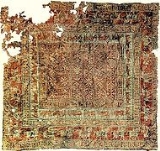
The art of carpet weaving existed in Iran in ancient times, according to evidences and in the opinion of scientists. An example of such evidences is the 2500-year-old Pazyryk carpet dating back to 500 B.C., during the Achaemenid period.

The first documented evidence on the existence of Persian carpets came from Chinese texts dating back to the Sassanid period (224 - 641 CE).

This art underwent many changes in various eras of the Iranian history to an extent that it passed an upward trend before the Islamic era until the Mongols invasion of Iran. After the invasion, the art began to grow again during the reign of the Mongol dynasties of Timurid and Ilkhanid.

With the passage of time, the materials used in carpets, including wool
Wool

Wool is the fiber derived from the specialized skin cells, called follicles, of animals in the Caprinae family, principally domestic sheep, but the hair of certain species of other Mammalia such as cashmere goat, llamas, rabbits and keeshonds may also be called wool....
, silk
Silk

Silk is a natural protein fiber, some forms of which can be weaving into textiles. The best-known type of silk is obtained from Pupa#Cocoons made by the larvae of the mulberry silkworm Bombyx mori reared in captivity ....
 and cotton
Cotton

Cotton is a soft, staple fiber that grows in a form known as a boll around the seeds of the cotton plant a shrub native to tropical and subtropical regions around the world, including the Americas, India and Africa....
, decay. Therefore archaeologists are rarely able to make any particularly useful discoveries during archaeological excavations. What has remained from early times as evidence of carpet-weaving is nothing more than a few pieces of worn-out carpets. Such fragments do not help very much in recognizing the carpet-weaving characteristics of pre-Seljuk period (13th and 14th centuries AD) in Persia.

Pre-Islamic period

Pazyrykfull
In a unique archaeological excavation in 1949, the exceptional Pazyryk
Pazyryk

The Pazyryk is the name of an ancient nomadic people who lived in the Altai Mountains lying in Siberian Russia south of the modern city of Novosibirsk, near the borders of China, Kazakhstan and Mongolia....
 carpet was discovered among the ices of Pazyryk Valley, in Altai Mountains in Siberia
Siberia

Siberia , is the name given to the vast region constituting almost all of North Asia and for the most part currently serving as the massive central and eastern portion of the Russian Federation, having served in the same capacity previously for the Soviet Union from its beginning, and the Russian Empire beginning in the 16th century....
. The carpet was found in the grave of a Scythia
Scythia

The Scythians or Scyths were an Eastern Iranian languages of Equestrianism nomadic pastoralists who dominated the Pontic steppe throughout Classical Antiquity....
n prince. Radiocarbon testing indicated that the Pazyryk carpet was woven in the 5th century BC. This carpet is 283 by 200 cm (approximately 9.3 by 6.5 ft) and has 36 symmetrical knots per cm˛ (232 per inch˛).. The advanced weaving technique used in the Pazyryk carpet indicates a long history of evolution and experience in this art. Pazyryk carpet is considered as the oldest carpet in the world. Its central field is a deep red color and it has two wide borders, one depicting deer and the other Persian horseman.

However, it is believed that the carpet from Pazyryk is not likely a nomadic product, but a product of the Achaemenid period.

Historical records show that the Achaemenian court of Cyrus the Great at Pasargade was decked with magnificent carpets. This was over 2500 years ago. Alexander II of Macedonia is said to have been dazzled by the carpets in the tomb area of Cyrus the Great at Pasargade.

By the sixth century, Persian carpets of wool or silk were renowned in court circles throughout the region. The Bahârestân
Baharestan Carpet

The Baharestan carpet was commissioned by Sasanian Shahanshah Khosrow I), which was made for the main audience hall of the Sasanian dynastic imperial Palace at Ctesiphon in the province of Khvarvaran ....
 (spring) carpet of Khosrow I was made for the main audience hall of the Sasanians imperial Palace at Ctesiphon
Ctesiphon

Ctesiphon was one of the great cities of the Persian Empire, located on the east bank of the Tigris.Ctesiphon was an imperial capital of the Arsacids and of their successors, the Sassanids....
 in Sasanian province of Khvârvarân
Khvarvaran

Khvarvaran, also known as Iraq or Mesopotamia, was a province of the Iranian Persian Empire, which ruled the region since the time of Cyrus the Great....
 (nowadays Iraq). It was long and wide and depicted a formal garden. In 7th century CE With occupation of the Sasanian capital, Tuspawn, the Baharestan carpet was taken by the Arabs, cut into small fragments and divided among the victorious soldiers as booty.

According to historians, the famous Taqdis throne was covered with 30 special carpets representing 30 days of a month and four other carpets representing the four seasons of a year.

Islamic period

Farsh1
Carpet Tools
Compo Tapis
In the 8th century A.D. Azarbaijan Province
Azerbaijan (Iran)

Azerbaijan or Azarbaijan , also Iranian Azerbaijan, Iranian Azarbaijan, Persian Azerbaijan, , is a region in northwestern Iran....
 was among the largest centers of carpet and rough carpet (ziloo) weaving in Iran. The Province of Tabarestan, besides paying taxes, sent 600 carpets to the courts of caliphs in Baghdad
Baghdad

Baghdad is the Capital of Iraq and of Baghdad Governorate, with which it is also coterminous. With a municipal population estimated at 6.5 million, it is the largest city in Iraq, and the second largest city in the Arab World....
 every year. At that time, the main items exported from that region were carpets, and small carpets for saying prayer
Prayer

Prayer is the act of communicating with a deity or spirit in worship. Specific forms of this may include praise, requesting divine providence, confessing sins, as an act of reparation or an expression of one's emotional expression....
s. Furthermore, the carpets of Khorassan, Sistan
Sistan

Modern Sistan is a border region in southeastern Iran and southwestern Afghanistan . In ancient times the area was known as Arachosia; it became known as 'Sakastan' in the 1st century BC, after it was conquered by the Saka tribes....
 and Bukhara
Bukhara

Bukhara , also spelled as Bukhoro and Bokhara, from the Soghdian ?uxarak , is the Capital of the Bukhara Province of Uzbekistan. The nation's fifth-largest city, it has a population of 237,900 ....
, because of their prominent designs and motifs were on high demands among purchasers.

During the reigns of the Seljuq and Ilkhanate
Ilkhanate

The Ilkhanate, also spelled Il-khanate or Il Khanate , was a Mongol khanate established in Persia in the 13th century, considered a part of the Mongol Empire....
 dynasties, carpet weaving was still a booming business so much so that a mosque built by Ghazan Khan in Tabriz
Tabriz

Tabriz is the largest city in northwestern Iran. It is situated north of the volcanic cone of Sahand, south of the Eynali mountain. It is the capital of East Azarbaijan Province....
, northwestern Iran, was covered with superb Persian carpets. Sheep were specially bred to produce fine wool for weaving carpets. Carpet designs depicted by miniature paintings belonging to the Timurid era lend proof to the development of this industry at that time. There is also another miniature painting of that time available which depicts the process of carpet weaving.

During that era dyeing centers were set up next to carpet weaving looms. The industry began to thrive until the attack on Iran by the Mongol army.

The earliest surviving of the Persian carpets from this period is of a Safavid (1501-1736) carpet known as the Ardabil Carpet
Ardabil Carpet

The Ardabil Carpet is either of two famous Persian carpets which are currently held in the collections of the Victoria and Albert Museum in London and the Los Angeles County Museum of Art....
, currently in V&A Museum
Victoria and Albert Museum

The Victoria and Albert Museum in London is the world's largest museum of decorative arts and design, housing a permanent collection of over 4.5 million Object ....
 in London. This most famous of Persian carpets has been the subject of endless copies ranging in size from small carpets to full scale carpets. There is an 'Ardabil' at 10 Downing Street
10 Downing Street

Number 10 Downing Street is the residence and office of the First Lord of the Treasury and Prime Minister of the United Kingdom. The headquarters of Her Majesty's Government, it is situated on Downing Street in the City of Westminster in London, England....
 and even Hitler had an 'Ardabil' in his office in Berlin
Berlin

Berlin is the Capital of Germany city and one of sixteen States of Germany of Germany. With a population of 3.4 million within its city limits, Berlin is the country's largest city....
.

The carpets are woven in 1539-40 according to the dated inscriptions. The foundation is of silk and the pile of wool with a knot density at 300-350 knots per square inch ( 470-540.000 knots per square metres). The size of the carpets are 34 1/2 feet by 17 1/2 feet ( 10,5 metres x 5,3 metres).

There is much variety among classical Persian carpets of the 16th and 17th century. There are numerous sub-regions that contribute distinctive designs to Persian carpets of this period such as Tabriz
Tabriz

Tabriz is the largest city in northwestern Iran. It is situated north of the volcanic cone of Sahand, south of the Eynali mountain. It is the capital of East Azarbaijan Province....
 and Lavar Kerman. Common motifs include scrolling vine networks, arabesque
Arabesque

The arabesque is an elaborative application of repeating geometry forms that often echo the forms of plants and animals. Arabesques are an element of Islamic art usually found decorating the walls of mosques....
s, palmette
Palmette

Palmette, also called anthemion , is an artistic motif resembling the fan-shaped leaves of a palm tree. It was a common decorative motif employed in the Ancient Greece/Ancient Rome era to decorate:...
s, cloud bands, medallions, and overlapping geometric compartments rather than animals and humans. Figural designs are particularly popular in the Iranian market and are not nearly as common in carpets exported to the west.

Modern period

Although carpet production is now mostly mechanized, traditional hand woven carpets are still widely found all around the world, and usually have higher prices than their machine woven counterparts due to them being an artistic presentation. Iran exported $517 million worth of hand woven carpets in 2002. There are an estimated population of 1.2 million weavers in Iran producing carpets for local markets as well as export. In recent times Iranian carpets have come under fierce competition from other countries producing fakes of the original Iranian designs as well as genuine cheaper substitutes. Most of the problems facing this traditional art is due to absence of patenting and branding the products as well as reduced quality of raw materials in the local market and the consistent loss of original design patterns. The absence of modern R&D, is causing rapid decline in the size as well as market value of this art.

Materials

Wool is the most common material for carpets but cotton is frequently used for the foundation of city and workshop carpets. There are a wide variety in types of wool used for weaving. Those of which include Kork wool, Manchester wool, and in some cases even Camel Hair wool. Silk
Silk

Silk is a natural protein fiber, some forms of which can be weaving into textiles. The best-known type of silk is obtained from Pupa#Cocoons made by the larvae of the mulberry silkworm Bombyx mori reared in captivity ....
 carpets date back to at least the sixteenth century in Sabzavar and the Seventeenth century in Kashan
Kashan

Kashan is a city in the Provinces of Iran of Isfahan province, Iran. It had an estimated population of 272,359 in 2005 .The etymology of the city name comes from Kasian, the original inhabitants of Kashan whose remains are found at Tapeh Sialk dating back 9,000 years over mellenia this changed to kashian and the the town became kashan.the...
 and Yezd. Silk carpets are less common than wool carpets since silk is more expensive and less durable; they tend to increase in value with age. Due to their rarity, value and lack of durability, silk carpets are often displayed on the wall like tapestries rather than being used as floor coverings.

Designs, motifs, and patterns


Persian rugs are made up of a layout and a design which in general included one or a number of motifs.

Layout


Persian rugs are typically designed using one of three patterns: all-over, central medallion and one-sided. Some abstract unsymmetrical design can be found but most of these can be described as one-sided or unidirectional.

Motifs


There are a number of patterns which are found in Persian and Oriental rugs called 'motifs', these designs have different meanings and tend to be used depending on the area the rug was woven although it is not unusual to find more than one motif in a single rug.

Some of the more common motifs are:

  • Boteh
  • Gul
    Gul

    Gul or GUL may refer to:* Gul , family or personal name in Central and South Asia* The Great Liberal Union , a Nicaraguan political party...
  • Herati
  • Mina-Khani
  • Rosette
    Rosette

    Rosette can refer to:*Rosette , a small flower design, especially used in antiquity*Rosette , a small circular device that can be awarded with medals...
  • Shah Abbasi

Techniques and structures


The Long Weaving Process


The weaving of pile rugs is a difficult and tedious process which, depending on the quality and size of the rug, may take anywhere from a few months to several years to complete.

To begin making a rug, you need a foundation consisting of warps strong, thick threads of cotton, wool or silk which run the length of the rug and wefts similar threads which pass under and over the warps from one side to the other. The warps on either side of the rug are normally combined into one or more cables of varying thickness that are overcast to form the selvedge.

Weaving normally begins by passing a number of wefts through the bottom warp to form a base to start from. Loosely piled knots of dyed wool or silk are then tied around consecutive sets of adjacent warps to create the intricate patterns in the rug. As more rows are tied to the foundation, these knots become the pile of the rug. Between each row of knots, one or more shots of weft are passed to tightly pack down and secure the rows.
Depending on the fineness of the weave, the quality of the materials and the expertise of the weavers, the knot count of a hand made rug can vary anywhere from 16 to 550 knots per square inch.

When the rug is completed, the warp ends form the fringes that may be weft-faced, braided, tasseled, or secured in some other manner.

Looms


Looms do not vary greatly in essential details, but they do vary in size and sophistication. The main technical requirement of the loom is to provide the correct tension and the means of dividing the warps into alternate sets of leaves. A shedding device allows the weaver to pass wefts through crossed and uncrossed warps, instead of laboriously threading the weft in and out of the warps.

Horizontal Looms


The simplest form of loom is a horizontal; one that can be staked to the ground or supported by sidepieces on the ground. The necessary tension can be obtained through the use of wedges. This style of loom is ideal for nomadic people as it can be assembled or dismantled and is easily transportable. Rugs produced on horizontal looms are generally fairly small and the weave quality is inferior to those rugs made on a professional standing loom.

Vertical Looms


Vertical looms are undoubtedly more comfortable to operate. These are found more in city weavers and sedentary peoples because they are hard to dismantle and transport. There is no limit to the length of the carpet that can be woven on a vertical loom and there is no restriction to its width.

There are three broad groups of vertical looms, all of which can be modified in a number of ways: the fixed village loom, the Tabriz
Tabriz

Tabriz is the largest city in northwestern Iran. It is situated north of the volcanic cone of Sahand, south of the Eynali mountain. It is the capital of East Azarbaijan Province....
 or Bunyan loom, and the roller beam loom. The fixed village loom is used mainly in Iran
Iran

Iran , officially the Islamic Republic of Iran and formerly known internationally as Persian Empire until 1935, is a country in Central Eurasia, located on the northeastern shore of the Persian Gulf and the southern shore of the Caspian Sea....
 and consists of a fixed upper beam and a moveable lower or cloth beam which slots into two sidepieces. The correct tension is created by driving wedges into the slots. The weavers work on an adjustable plank which is raised as the work progresses.

The Tabriz loom, named after the city of Tabriz
Tabriz

Tabriz is the largest city in northwestern Iran. It is situated north of the volcanic cone of Sahand, south of the Eynali mountain. It is the capital of East Azarbaijan Province....
, is used in North Western Iran. The warps are continuous and pass around behind the loom. Tension is obtained with wedges. The weavers sit on a fixed seat and when a portion of the carpet has been completed, the tension is released and the carpet is pulled down and rolled around the back of the loom. This process continues until the rug is completed, when the warps are severed and the carpet is taken off the loom.

The roller beam loom is a traditional Turkish village loom, but is also found in Iran and India. It consists of two movable beams to which the warps are attached. Both beams are fitted with ratchets or similar locking devices and completed work is rolled on to the lower beam. It is possible to weave very long rugs by these means, and in some areas of Turkey rugs are woven in series.

Tools


In order to operate the loom, the weaver needs a number of essential tools: a knife for cutting the yarn as the knots are tied; a comb-like instrument for packing down the wefts; and a pair of shears for trimming the pile. In Tabriz the knife is combined with a hook to tie the knots which lets the weavers produce very fine rugs, as their fingers alone are too thick to do the job.

A small steel comb is sometimes used to comb out the yarn after each row of knots is completed. This both tightens the weave and clarifies the design.

A variety of instruments are used for packing the weft. Some weaving areas in Iran known for producing very fine pieces use additional tools. In Kerman
Kerman

Kerman is a city in Iran. It is the center of Kerman province. Located in a large and flat plain, this city is located 1,076 km south of Tehran, capital of Iran....
, a saber like instrument is used horizontally inside the shed, and in Bidjar a heavy nail like tool is used. Bidjar is also famous for their wet loom technique, which consists of wetting the warp, weft, and yarn with water throughout the weaving process to make the elements thinner and finer. This allows for tighter weaving. When the rug is complete and dried, the wool and cotton expand to make the rug incredibly dense and strong.

A number of different tools may be used to shear the wool depending on how the rug is trimmed as the rug progresses or when it is complete. Often in Chinese rugs the yarn is trimmed after completion and the trimming is slanted where the color changes, giving an embossed three-dimensional effect.

The Knots


Two basic knots are used in most Persian Carpets and Oriental rugs: the symmetrical Turkish or Ghiordes knot (used in Turkey, the Caucasus, East Turkmenistan, and some Turkish and Kurdish areas of Iran), and the asymmetrical Persian or Senneh knot (Iran, India, Turkey, Pakistan, China, and Egypt).

To make a Turkish knot, the yarn is passed between two adjacent warps, brought back under one, wrapped around both forming a collar, then pulled through the center so that both ends emerge between the warps.

The Persian knot is used for finer rugs. The yarn is wrapped around only one warp, then passed behind the adjacent warp so that it divides the two ends of the yarn. The Persian knot may open on the left or the right, and rugs woven with this knot are generally more accurate and symmetrical.

Other knots include the Spanish knot looped around single alternate warps so the ends are brought out on either side and the Jufti knot which is tied around four warps instead.

Knotted pile carpets


Flat-woven carpets


Flat woven carpets are given their colour and pattern from the weft which is tightly intertwined with the warp. Rather than an actual pile, the foundation of these rugs gives them their design. The weft is woven between the warp until a new colour is needed, it is then looped back and knotted before a new colour is implemented.

The most popular of flat-weaves is called the Kilim. Kilim rugs (along with jewellery, clothing and animals) are important for the identity and wealth of nomadic tribes-people. In their traditional setting Kilims are used as floor and wall coverings, horse-saddles, storage bags, bedding and cushion covers.

Various forms of flat-weaves exist including:

  • Herati
  • Jajim
  • Kilim
    Kilim

    File:Hotamis Kilim .jpg'Kilims' are flat tapestry-woven carpets or rugs produced from the Balkans to Pakistan. Kilims can be purely decorative or can function as prayer mats....
  • Maleki
  • Sirjan
  • Soumak
  • Suzani
    Suzani rug

    Suzani is a type of antique embroidery and decorative tribe textile made in Tajikistan, Uzbekistan, Kazakhstan and other Central Asian countries....


Traditional centers of carpet production in Iran (Persia)

The major classical centers of carpet production in Persia were in Tabriz
Tabriz

Tabriz is the largest city in northwestern Iran. It is situated north of the volcanic cone of Sahand, south of the Eynali mountain. It is the capital of East Azarbaijan Province....
 (1500-1550), Kashan
Kashan

Kashan is a city in the Provinces of Iran of Isfahan province, Iran. It had an estimated population of 272,359 in 2005 .The etymology of the city name comes from Kasian, the original inhabitants of Kashan whose remains are found at Tapeh Sialk dating back 9,000 years over mellenia this changed to kashian and the the town became kashan.the...
 (1525-1650), Herat
Herat

Herat , classically called the Aria, is a city in western Afghanistan, in the province also known as Herat province. It is situated in the valley of the Hari River, Afghanistan, which flows from the mountains of central Afghanistan to the Karakum Desert in Turkmenistan....
 (1525-1650), and Kerman
Kerman

Kerman is a city in Iran. It is the center of Kerman province. Located in a large and flat plain, this city is located 1,076 km south of Tehran, capital of Iran....
 (1600-1650).

The majority of carpets from Tabriz have a central medallion and quartered corner medallions superimposed over a field of scrolling vine ornament, sometimes punctuated with mounted hunters, single animals, or animal combat scenes. Perhaps the best-known of the Tabriz works are the twin Ardabil carpets most likely made for the shrine at Ardabil
Ardabil

Ardabil is a historical city in north-western Iran. The name Ardabil probably comes from the Zoroastrian name of "Artavil" which means a holy place....
 (today in the collections of the Victoria and Albert Museum
Victoria and Albert Museum

The Victoria and Albert Museum in London is the world's largest museum of decorative arts and design, housing a permanent collection of over 4.5 million Object ....
 in London and the Los Angeles County Museum
Los Angeles County Museum

The Los Angeles County Museum may refer to:* Natural History Museum of Los Angeles County* Los Angeles County Museum of Art...
).

Kashan is known for its silk
Silk

Silk is a natural protein fiber, some forms of which can be weaving into textiles. The best-known type of silk is obtained from Pupa#Cocoons made by the larvae of the mulberry silkworm Bombyx mori reared in captivity ....
 carpet production, most famously, for the three silk hunting carpet masterpieces depicting mounted hunters and animal prey (currently in the collections of the Vienna Museum of Applied Arts (aka the MAK), the Museum of Fine Arts, Boston
Museum of Fine Arts, Boston

The Museum of Fine Arts in Boston, Massachusetts, Massachusetts, is one of the largest museums in the United States attracting over one million visitors a year....
, and the Stockholm Museum). The Kashan carpets are among the most valuable in existence.

The Herat carpets, or ones of similar design created in Lahore
Lahore

is the capital of the Pakistani Subdivisions of Pakistan of Punjab and is the List of most populated metropolitan areas in Pakistan city in Pakistan after Karachi....
 and Agra
Agra

Agra is a city on the banks of the Yamuna in the northern States and territories of India of Uttar Pradesh, India. It finds mention in the epic Mahabharata when it was called Agrabana, or Paradise....
, India
India

India, officially the Republic of India , is a country in South Asia. It is the List of countries and outlying territories by total area country by geographical area, the List of countries by population country, and the most populous liberal democracy in the world....
, are the most numerous in Western collections. They are characterized by a red field with scrolling vine ornament and palmettes with dark green or blue borders.

The seven classes of Kerman
Kerman

Kerman is a city in Iran. It is the center of Kerman province. Located in a large and flat plain, this city is located 1,076 km south of Tehran, capital of Iran....
 carpet were defined by May Beattie. She identified their unique structure and named it the "vase technique." Carpet types in this group include garden carpets (ornamented with formal gardens and water channels) and the ogival lattice carpets. A fine and well-known example of the latter was purchased by the Victoria and Albert Museum
Victoria and Albert Museum

The Victoria and Albert Museum in London is the world's largest museum of decorative arts and design, housing a permanent collection of over 4.5 million Object ....
 under the guidance of William Morris
William Morris

William Morris was an English architect, furniture and textile designer, artist, writer, and Socialism associated with the Pre-Raphaelite Brotherhood and the English Arts and Crafts Movement....
. The influence of Persian carpets is readily apparent in his carpet designs.

The Seraband rug
Seraband rug

Seraband rug or Saraband, is an Iranian weaving floor covering from the Ser-e Band district located southwest of Arak, Iran. These 19th century and early 20th century rugs have a "mir" design, characterized by small, pear or leaf forms in diagonal rows....
 is produced in Arak
Arak

Arak may refer to:* Arak, Iran, the county capital of Arak County, Iran* Arak , an alcoholic beverage* Arak gorges, series of gorges in Algeria...
.

Anatolian and Persian carpets

Noeud Senneh
Noeud Turc
The difference between Anatolian (Turkish) and Persian carpets is today largely one of tradition.

Typically, a traditional Persian carpet is tied with a single looping knot (Persian or Senneh Knot), while the traditional Anatolian carpet is tied with a double looping knot (Turkish or Ghiordes Knot). This means that for every 'vertical strand' of thread in a carpet, an Anatolian carpet has two loops as opposed to the one loop for the various Persian carpets that use a Persian 'single' knot. Ultimately, this process of 'double knotting' in traditional Anatolian carpets results in a slightly more block like image compared to the traditional 'single knotted' Persian carpet. The traditional Anatolian style also reduces the number of Knots per sq cm
Knots per sq cm

Knot density is a traditional measure for quality of handmade carpets. It refers, quite simply, to the number of knots per unit of surface area - typically either per square inch or per square centimeter....
.

Today, it is common to see carpets woven in both Turkey and Iran using either of the two knot styles. When comparing carpets the only way to definitively identify the knot used is to splay open the pile by bending the rug against itself and looking at the base of the knot.

See also: Knots per sq cm
Knots per sq cm

Knot density is a traditional measure for quality of handmade carpets. It refers, quite simply, to the number of knots per unit of surface area - typically either per square inch or per square centimeter....


Types of Persian carpets & rugs

Carpet dealers have developed a classification for Persian carpets based on design, type of fabric, and weaving technique. The categories are named for cities and areas associated with each design:


*Abadeh
Abadeh rug

An Abadeh carpet is a type of Persian carpet made in the town of Abadeh in Iran....

*Afghan/Yomut (Turkmen)
Yomut carpet

The Yomut carpet is a type of carpet traditionally handwoven by the Yomut, one of the major tribes of Turkmenistan. A Yomut design, along with designs of the four other major tribes, is featured on the Coat of arms of Turkmenistan and the flag of Turkmenistan....

*Ahar
Ahar rug

The Ahar carpet is a type of Persian carpet made in the town of Ahar in Ahar County near Mount Sabalan in Iran ....

*Afshar
*Arak
Arak rug

Arak rugs are made in the Province of Arak, Iran. technically all the rugs of Arak are Arak rugs but Sarouk refers to the best quality and Arak is used for a lesser quality....

*Ardabil
Ardabil rug

Ardabil rugs originate from Ardabil, located in the province of Ardabil Province in northwestern Iran, 639 kilometers from Tehran. Ardabil has a long and illustrious history of Persian carpet weaving....

*Ardestan
*Bakhtiari see also Afghan carpet
*Beluch
*Birjand
*Brujerd
*Chelaberd
*Dorokhsh
*Farahan
*Ferdos
*Ghayen
*Gonabad
*Gonbad Ghaboos
*Gorgan
*Hariz
*Herat
*Heriz
Heriz rug

A Heris Rug is a type of Persian rug from the area of Heris in northwest Iran northeast of Tabriz. The Heris Rug is produced in the villages of the slopes of Mount Sabalan....

*Isfahan
Isfahan rug

The Iranian city of Isfahan has long been one of the centres for production of the famous Persian Rug.Weaving in Isfahan flourished in the Safavid era....

*Joshghan
*Jozan
Jozan rug

Jozan rugs are made in the surroundings of the village Jozan - also spelled Josan - in the Iranian Malayer area. Jozan rugs are quality rugs of the Sarouk Rug type often with designs as early 20th century Sarouks....

*Kashan
Kashan rug

A Kashan Rug is a type of Persian rug from the area of Kashan. Kashan is a city in Isfahan Province in North Central Iran. There was production of Persian Carpet at Royal workshops in the 17th and early 18th century....

*Kashmar
Kashmar rug

Kashmar is a city in Razavi Khorasan Province of Iran and is located south of Mashad city.See also*Kashmar*Persian rug...

*Kerman
*Lilian
*Mahan

*Mahalat
*Maku
*Mamasani
*Marand
*Mashhad
*Mazlaghan
*Meshkin Shahr
*Moshk Abad
*Mood
*Nain
Nain rug

Nain rugs are constructed using the Persian knot and can be between 300 and 700 knots per inch. The pile is usually very high quality wool, clipped short and silk is most usually used as highlighting for parts of the detailing in the design....

*Nishaboor
*Rafsanjan
*Ravar
*Saraband
*Sarab
*Saraband
*Sarukh
*Semnan
*Sha Savan
*Shahre Kord
*Shiraz
Shiraz rug

A Shiraz carpet is a type of Persian rug made in the villages around the city of Shiraz, Iran. The designs tend to come from settled tribal weavers so they mimic Qashqai, Khamseh, Afshar, Abadeh and Luri designs....

*Shahr Reza
*Qazvin
*Qom
Qom rug

Qom rugs are made in the area of Qom, southwest of Tehran in the Qom Province of Iran.See also* Persian rug...

*Tabriz
Tabriz rug

A Tabriz rug/carpet is a type of Persian rug from the area of Tabriz. Tabriz is one of the major cities of Iran, and the capital city of East Azarbaijan Province.Most of its population are Azerbaijanis....

*Tehran
*Torghabeh
*Veramin
*Yalameh
*Yazd
*Zanjan
*Zabol


Rugs for a specific purpose include:

  • Hunting Scene Rugs


See also

Dfrrug
* Heriz rug
Heriz rug

A Heris Rug is a type of Persian rug from the area of Heris in northwest Iran northeast of Tabriz. The Heris Rug is produced in the villages of the slopes of Mount Sabalan....
  • Kashan rug
    Kashan rug

    A Kashan Rug is a type of Persian rug from the area of Kashan. Kashan is a city in Isfahan Province in North Central Iran. There was production of Persian Carpet at Royal workshops in the 17th and early 18th century....
  • Oriental rug
    Oriental rug

    An authentic oriental rug is a handmade carpet that is either knotted with pile or woven without pile. Oriental-design rugs made by machine, made through hand-tufting or any method other than hand-knotting or hand-weaving are not considered authentic oriental rugs....
  • Baharestan Carpet
    Baharestan Carpet

    The Baharestan carpet was commissioned by Sasanian Shahanshah Khosrow I), which was made for the main audience hall of the Sasanian dynastic imperial Palace at Ctesiphon in the province of Khvarvaran ....
  • Iran's National Rug Gallery
    The Carpet Museum of Iran

    Located in Tehran, beside Laleh Park, and founded in 1976, the Carpet Museum of Iran exhibits a variety of Persian carpets from all over Iran, dating from 18th century to present....
  • Persian Architecture
    Iranian architecture

    Architecture in "Greater Iran" has a continuous history from at least 5000BCE to the present, with characteristic examples distributed over a vast area from Syria to North India and the borders of China, from the Caucasus to Zanzibar....
  • Persian arts
  • Rugs and carpets in general
    Carpet

    A carpet is any loom-woven, felted textile or grass floor covering. The term was also used for table and wall coverings, as carpets were not commonly used on the floor in European interiors until the 18th century....
  • Oriental rug
    Oriental rug

    An authentic oriental rug is a handmade carpet that is either knotted with pile or woven without pile. Oriental-design rugs made by machine, made through hand-tufting or any method other than hand-knotting or hand-weaving are not considered authentic oriental rugs....
  • Gelim
    Kilim

    File:Hotamis Kilim .jpg'Kilims' are flat tapestry-woven carpets or rugs produced from the Balkans to Pakistan. Kilims can be purely decorative or can function as prayer mats....
     (Also Kilim or Kelim)
  • Gabbeh
    Gabbeh

    Gabbeh carpets, sometimes spelled 'Gabbe' are a traditional variety of Persian carpet. Gabbeh is pronounced as gava in Kurdish and Luri and is also called Khersak in Persian and Bakhtiari dialect....
  • War rugs
    War rugs

    The war rug tradition of Afghanistan has its origins in the decade of Soviet war in Afghanistan, and has continued through subsequent military, political and social conflicts....
  • Flying Carpet
  • Mashad Carpet Company
    Mashad Carpet Company

    Mashad Carpet Company is an Iranian manufacturer of machine-made carpets and area rugs, based in the cities of Tehran and Mashad. The company is a member of the Mashad Carpet Group....