

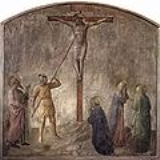
Holy Lance

Encyclopedia
Lance
A Lance is a pole weapon or spear designed to be used by a mounted warrior. The lance is longer, stout and heavier than an infantry spear, and unsuited for throwing, or for rapid thrusting. Lances did not have tips designed to intentionally break off or bend, unlike many throwing weapons of the...
that pierced Jesus'
Jesus
Jesus of Nazareth , commonly referred to as Jesus Christ or simply as Jesus or Christ, is the central figure of Christianity...
side as he hung on the cross in John's account
Gospel of John
The Gospel According to John , commonly referred to as the Gospel of John or simply John, and often referred to in New Testament scholarship as the Fourth Gospel, is an account of the public ministry of Jesus...
of the Crucifixion
Crucifixion of Jesus
The crucifixion of Jesus and his ensuing death is an event that occurred during the 1st century AD. Jesus, who Christians believe is the Son of God as well as the Messiah, was arrested, tried, and sentenced by Pontius Pilate to be scourged, and finally executed on a cross...
.
Biblical references
The lance (Greek: longche) is mentioned only in the Gospel of JohnGospel of John
The Gospel According to John , commonly referred to as the Gospel of John or simply John, and often referred to in New Testament scholarship as the Fourth Gospel, is an account of the public ministry of Jesus...
and not in any of the Synoptic Gospels
Synoptic Gospels
The gospels of Matthew, Mark, and Luke are known as the Synoptic Gospels because they include many of the same stories, often in the same sequence, and sometimes exactly the same wording. This degree of parallelism in content, narrative arrangement, language, and sentence structures can only be...
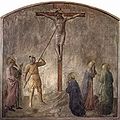
. The gospel states that the Romans planned to break Jesus' legs, a practice known as crurifragium, which was a method of hastening death during a crucifixion. Just before they did so, they realized that Jesus was already dead and that there was no reason to break his legs. To make sure that he was dead, a Roman soldier (named in extra-Biblical tradition as Longinus) stabbed him in the side.
The phenomenon of blood and water was considered a miracle by Origen
Origen
Origen , or Origen Adamantius, 184/5–253/4, was an early Christian Alexandrian scholar and theologian, and one of the most distinguished writers of the early Church. As early as the fourth century, his orthodoxy was suspect, in part because he believed in the pre-existence of souls...
. Catholics
Catholicism
Catholicism is a broad term for the body of the Catholic faith, its theologies and doctrines, its liturgical, ethical, spiritual, and behavioral characteristics, as well as a religious people as a whole....
generally choose to employ a more allegorical interpretation
Allegory
Allegory is a demonstrative form of representation explaining meaning other than the words that are spoken. Allegory communicates its message by means of symbolic figures, actions or symbolic representation...
: it represents one of the main key teachings/mysteries of the Church, and one of the main themes of the Gospel of Matthew
Gospel of Matthew
The Gospel According to Matthew is one of the four canonical gospels, one of the three synoptic gospels, and the first book of the New Testament. It tells of the life, ministry, death, and resurrection of Jesus of Nazareth...
, which is the homoousian
Homoousian
Homoousian is a technical theological term used in discussion of the Christian understanding of God as Trinity. The Nicene Creed describes Jesus as being homooúsios with God the Father — that is, they are of the "same substance" and are equally God...
interpretation adopted by the First Council of Nicaea
First Council of Nicaea
The First Council of Nicaea was a council of Christian bishops convened in Nicaea in Bithynia by the Roman Emperor Constantine I in AD 325...
, that "Jesus Christ was both true God and true man." The blood symbolizes his true humanity, the water his divinity. A ceremonial remembrance of this is done when a Catholic priest says Mass
Mass (liturgy)
"Mass" is one of the names by which the sacrament of the Eucharist is called in the Roman Catholic Church: others are "Eucharist", the "Lord's Supper", the "Breaking of Bread", the "Eucharistic assembly ", the "memorial of the Lord's Passion and Resurrection", the "Holy Sacrifice", the "Holy and...
. The priest pours a small amount of water into the wine before the consecration, an act which acknowledges Christ's humanity and divinity and recalls the issuance of blood and water from Christ's side on the cross. Saint Faustina Kowalska, a Polish nun whose advocacy and writings led to the establishment of the Divine Mercy
Divine Mercy
The Divine Mercy is a Roman Catholic devotion to the merciful love of God and the desire to let that love and mercy flow through one's own heart towards those in need of it...
devotion, also acknowledged the miraculous nature of the blood and water, explaining that the blood is a symbol of the divine mercy of Christ, while the water is a symbol of His divine compassion.
Longinus
Acts of Pilate
The Acts of Pilate , also called the Gospel of Pilate, is a book of New Testament apocrypha. The dates of its accreted sections are uncertain, but scholars agree in assigning the resulting work to the middle of the fourth century...
, the soldier is identified as a centurion
Centurion
A centurion was a professional officer of the Roman army .Centurion may also refer to:-Military:* Centurion tank, British battle tank* HMS Centurion, name of several ships and a shore base of the British Royal Navy...
and called Longinus (making the spear's "correct" Latin name Lancea Longini).
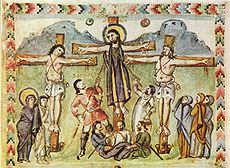
A form of the name Longinus occurs on a miniature in the Rabula Gospels
Rabula Gospels
The Rabbula Gospels, or Rabula Gospels, is a 6th century illuminated Syriac Gospel Book...
(conserved in the Laurentian Library
Laurentian Library
The Laurentian Library is a historical library in Florence, Italy, containing a repository of more than 11,000 manuscripts and 4,500 early printed books...
, Florence
Florence
Florence is the capital city of the Italian region of Tuscany and of the province of Florence. It is the most populous city in Tuscany, with approximately 370,000 inhabitants, expanding to over 1.5 million in the metropolitan area....
), which was illuminated by one Rabulas in the year 586. In the miniature, the name LOGINOS (ΛΟΓΙΝΟC) is written in Greek characters above the head of the soldier who is thrusting his lance into Christ's side. This is one of the earliest records of the name, if the inscription is not a later addition.
Relics claimed to be the Holy Lance
There have been three or four major relics that are claimed to be the Holy Lance or parts of it.Vatican lance
Antoninus of Piacenza
The sixth-century pilgrim Antoninus of Piacenza, or the Anonymous Pilgrim of Piacenza, who described the holy places of Jerusalem in the 570s is confused often with Saint Antoninus of Piacenza, who is venerated as a saint and martyr in the Roman Catholic Church, with a feast day of 13 November in...
(AD 570), describing the holy places of Jerusalem, says that he saw in the Basilica of Mount Zion
Mount Zion
Mount Zion is a place name for a site in Jerusalem, the location of which has shifted several times in history. According to the Hebrew Bible's Book of Samuel, it was the site of the Jebusite fortress called the "stronghold of Zion" that was conquered by King David, becoming his palace in the City...
"the crown of thorns with which Our Lord was crowned and the lance with which He was struck in the side". A mention of the lance occurs in the so-called Breviarius at the Church of the Holy Sepulchre. The presence in Jerusalem of the relic is attested by Cassiodorus
Cassiodorus
Flavius Magnus Aurelius Cassiodorus Senator , commonly known as Cassiodorus, was a Roman statesman and writer, serving in the administration of Theodoric the Great, king of the Ostrogoths. Senator was part of his surname, not his rank.- Life :Cassiodorus was born at Scylletium, near Catanzaro in...
(c. 485 – c. 585) as well as by Gregory of Tours
Gregory of Tours
Saint Gregory of Tours was a Gallo-Roman historian and Bishop of Tours, which made him a leading prelate of Gaul. He was born Georgius Florentius, later adding the name Gregorius in honour of his maternal great-grandfather...
(c. 538 – 594), who had not actually been to Jerusalem.
In 615, Jerusalem and its relics were captured by the Persian forces of King Khosrau II
Khosrau II
250px|thumb|Khosrau II 250px|thumb|Khosrau II 250px|thumb|Khosrau II (Khosrow II, Chosroes II, or Xosrov II in classical sources, sometimes called Parvez, "the Ever Victorious" – (in Persian: خسرو پرویز), was the twenty-second Sassanid King of Persia, reigning from 590 to 628...
(Chosroes II). According to the Chronicon Paschale
Chronicon Paschale
Chronicon Paschale is the conventional name of a 7th-century Greek Christian chronicle of the world...
, the point of the lance, which had been broken off, was given in the same year to Nicetas, who took it to Constantinople
Constantinople
Constantinople was the capital of the Roman, Eastern Roman, Byzantine, Latin, and Ottoman Empires. Throughout most of the Middle Ages, Constantinople was Europe's largest and wealthiest city.-Names:...
and deposited it in the church of Hagia Sophia
Hagia Sophia
Hagia Sophia is a former Orthodox patriarchal basilica, later a mosque, and now a museum in Istanbul, Turkey...
, and later to the Church of the Virgin of the Pharos
Church of the Virgin of the Pharos
The Church of the Virgin of the Pharos was a Byzantine chapel built in the southern part of the Great Palace of Constantinople, and named after the tower of the lighthouse that stood next to it...
. This point of the lance, which was now set in an icon, was acquired by the Latin Emperor, Baldwin II of Constantinople
Baldwin II of Constantinople
Baldwin II of Courtenay was the last emperor of the Latin Empire of Constantinople.He was a younger son of Yolanda of Flanders, sister of the first two emperors, Baldwin I and Henry of Flanders...
, who later sold it to Louis IX of France
Louis IX of France
Louis IX , commonly Saint Louis, was King of France from 1226 until his death. He was also styled Louis II, Count of Artois from 1226 to 1237. Born at Poissy, near Paris, he was an eighth-generation descendant of Hugh Capet, and thus a member of the House of Capet, and the son of Louis VIII and...
. The point of the lance was then enshrined with the Crown of Thorns
Crown of Thorns
In Christianity, the Crown of Thorns, one of the instruments of the Passion, was woven of thorn branches and placed on Jesus Christ before his crucifixion...
in the Sainte Chapelle in Paris. During the French Revolution
French Revolution
The French Revolution , sometimes distinguished as the 'Great French Revolution' , was a period of radical social and political upheaval in France and Europe. The absolute monarchy that had ruled France for centuries collapsed in three years...
these relics were removed to the Bibliothèque Nationale but subsequently disappeared. (The present "Crown of Thorns" is a wreath of rushes.)
As for the larger portion of the lance, Arculpus claimed he saw it at the Church of the Holy Sepulchre
Church of the Holy Sepulchre
The Church of the Holy Sepulchre, also called the Church of the Resurrection by Eastern Christians, is a church within the walled Old City of Jerusalem. It is a few steps away from the Muristan....
around 670 in Jerusalem, but there is otherwise no mention of it after the sack in 615. Some claim that the larger relic had been conveyed to Constantinople
Constantinople
Constantinople was the capital of the Roman, Eastern Roman, Byzantine, Latin, and Ottoman Empires. Throughout most of the Middle Ages, Constantinople was Europe's largest and wealthiest city.-Names:...
in the 8th century, possibly at the same time as the Crown of Thorns. At any rate, its presence at Constantinople seems to be clearly attested by various pilgrims, particularly Russians, and, though it was deposited in various churches in succession, it seems possible to trace it and distinguish it from the relic of the point. Sir John Mandeville
John Mandeville
"Jehan de Mandeville", translated as "Sir John Mandeville", is the name claimed by the compiler of The Travels of Sir John Mandeville, a book account of his supposed travels, written in Anglo-Norman French, and first circulated between 1357 and 1371.By aid of translations into many other languages...
declared in 1357 that he had seen the blade of the Holy Lance both at Paris
Paris
Paris is the capital and largest city in France, situated on the river Seine, in northern France, at the heart of the Île-de-France region...
and at Constantinople, and that the latter was a much larger relic than the former; it is worth adding that Mandeville is not generally regarded as one of the Middle Ages' most reliable witnesses, and his supposed travels are usually treated as an eclectic amalgam of myths, legends and other fictions. "The lance which pierced Our Lord's side" was among the relics at Constantinople shown in the 1430s to Pedro Tafur
Pedro Tafur
Pedro Tafur was a Spanish traveler and writer. Born in Córdoba, to a branch of the noble house of Guzmán, Tafur traveled across three continents during the years 1436 to 1439. During the voyage, he participated in various battles, visited shrines, and rendered diplomatic services for Juan II of...
, who added "God grant that in the overthrow of the Greeks
Fall of Constantinople
The Fall of Constantinople was the capture of the capital of the Byzantine Empire, which occurred after a siege by the Ottoman Empire, under the command of Ottoman Sultan Mehmed II, against the defending army commanded by Byzantine Emperor Constantine XI...
they have not fallen into the hands of the enemies of the Faith, for they will have been ill-treated and handled with little reverence."
Whatever the Constantinople relic was, it did fall into the hands of the Turks, and in 1492, under circumstances minutely described in Pastor
Pastor
The word pastor usually refers to an ordained leader of a Christian congregation. When used as an ecclesiastical styling or title, this role may be abbreviated to "Pr." or often "Ps"....
's History of the Popes, the Sultan Bayazid II sent it to Innocent VIII to encourage the pope to continue to keep his brother and rival Zizim (Cem
Cem
Prince Cem , December 22, 1459 – February 25, 1495) was a pretender to the Ottoman throne in the 15th century. He was a son of Mehmed II the Conqueror and younger brother of Sultan Bayezid II. He was banished to Europe, first under the protection of the Knights Hospitaller of St...
) prisoner. At this time great doubts as to its authenticity were felt at Rome, as Johann Burchard
Johann Burchard
Johann Burchard, also spelled Johannes Burchart was an Alsatian-born priest and chronicler during the Italian Renaissance....
records, because of the presence of other rival lances in Paris (the point that had been separated from the lance), Nuremberg (see "Vienna lance" below), and Armenia (see "Echmiadzin lance" below). In the mid-18th century Benedict XIV states that he obtained from Paris an exact drawing of the point of the lance, and that in comparing it with the larger relic in St. Peter's he was satisfied that the two had originally formed one blade. This relic has never since left Rome, where it is preserved under the dome of Saint Peter's Basilica, although the Church makes no claim as to its authenticity.
Echmiadzin lance

A Holy Lance (in Armenian Geghard) is now conserved in Ejmiadzin, the religious capital of Armenia
Armenia
Armenia , officially the Republic of Armenia , is a landlocked mountainous country in the Caucasus region of Eurasia...
. The first source that mentions it is a text "Holy Relics of Our Lord Jesus Christ", in a thirteenth century Armenian
Armenian language
The Armenian language is an Indo-European language spoken by the Armenian people. It is the official language of the Republic of Armenia as well as in the region of Nagorno-Karabakh. The language is also widely spoken by Armenian communities in the Armenian diaspora...
manuscript. According to this text, the spear which pierced Jesus was to have been brought to Armenia
Armenia
Armenia , officially the Republic of Armenia , is a landlocked mountainous country in the Caucasus region of Eurasia...
by the apostle Thaddeus. The manuscript does not specify precisely where it is kept, but the Holy Lance gives a description that exactly matches the lance, the monastery gate, since the thirteenth century precisely, the name of Geghard
Geghard
For the town, see Geghard, Armenia.The monastery of Geghard is a unique architectural construction in the Kotayk province of Armenia, being partially carved out of the adjacent mountain, surrounded by cliffs...
avank (Monastery of the Holy Lance).
In 1655 the French traveler Jean-Baptiste Tavernier
Jean-Baptiste Tavernier
Jean-Baptiste Tavernier was a French traveller and pioneer of trade with India, and travels through Persia , most known for works in two quarto volumes, Les Six Voyages de Jean-Baptiste Tavernier and diamond merchant for some important diamonds of the century...
was the first Westerner to see this relic in Armenia
Armenia
Armenia , officially the Republic of Armenia , is a landlocked mountainous country in the Caucasus region of Eurasia...
. In 1805, the Russians
Russians
The Russian people are an East Slavic ethnic group native to Russia, speaking the Russian language and primarily living in Russia and neighboring countries....
took the monastery and the relic was moved to Tchitchanov Geghard Tbilisi
Tbilisi
Tbilisi is the capital and the largest city of Georgia, lying on the banks of the Mt'k'vari River. The name is derived from an early Georgian form T'pilisi and it was officially known as Tiflis until 1936...
(Georgia). It was later returned to Armenia
Armenia
Armenia , officially the Republic of Armenia , is a landlocked mountainous country in the Caucasus region of Eurasia...
at Ejmiadzin, where it is always visible to the museum Manougian, enshrined in a reliquary of the seventeenth century.
This Ejmiadzin Lance has never been a weapon. Rather, it is the point of a sigillum, perhaps Byzantine
Byzantine
Byzantine usually refers to the Roman Empire during the Middle Ages.Byzantine may also refer to:* A citizen of the Byzantine Empire, or native Greek during the Middle Ages...
, with a diamond-shaped iron openwork Greek
Greeks
The Greeks, also known as the Hellenes , are a nation and ethnic group native to Greece, Cyprus and neighboring regions. They also form a significant diaspora, with Greek communities established around the world....
cross. Is this the Holy Lance of Antioch discovered by Pierre Barthelemy? That is a certain assumption: the relic of the Crusaders
Crusaders
The Crusaders are a New Zealand professional rugby union team based in Christchurch that competes in the Super Rugby competition. They are the most successful team in Super Rugby history with seven titles...
lost chronicles a century before the Geghard
Geghard
For the town, see Geghard, Armenia.The monastery of Geghard is a unique architectural construction in the Kotayk province of Armenia, being partially carved out of the adjacent mountain, surrounded by cliffs...
appears in Armenian sources.
Vienna Lance (Hofburg spear)


Holy Roman Emperor
The Holy Roman Emperor is a term used by historians to denote a medieval ruler who, as German King, had also received the title of "Emperor of the Romans" from the Pope...
s had a lance of their own, attested from the time of Otto I (912-973). In 1000 Otto III
Otto III, Holy Roman Emperor
Otto III , a King of Germany, was the fourth ruler of the Saxon or Ottonian dynasty of the Holy Roman Empire. He was elected King in 983 on the death of his father Otto II and was crowned Holy Roman Emperor in 996.-Early reign:...
gave Boleslaw I of Poland
Boleslaw I of Poland
Bolesław I Chrobry , in the past also known as Bolesław I the Great , was a Duke of Poland from 992-1025 and the first King of Poland from 19 April 1025 until his death...
a replica of the Lance at the Congress of Gniezno
Congress of Gniezno
The Congress of Gniezno was an amical meeting between the Polish duke Bolesław I Chrobry and Emperor Otto III, which took place at Gniezno on March 11, 1000...
. In 1084 Henry IV
Henry IV, Holy Roman Emperor
Henry IV was King of the Romans from 1056 and Holy Roman Emperor from 1084 until his forced abdication in 1105. He was the third emperor of the Salian dynasty and one of the most powerful and important figures of the 11th century...
had a silver band with the inscription "Nail of Our Lord" added to it. This was based on the belief that this was the lance of Constantine the Great
Constantine I
Constantine the Great , also known as Constantine I or Saint Constantine, was Roman Emperor from 306 to 337. Well known for being the first Roman emperor to convert to Christianity, Constantine and co-Emperor Licinius issued the Edict of Milan in 313, which proclaimed religious tolerance of all...
which enshrined a nail used for the Crucifixion. In 1273 it was first used in the coronation ceremony. Around 1350 Charles IV
Charles IV, Holy Roman Emperor
Charles IV , born Wenceslaus , was the second king of Bohemia from the House of Luxembourg, and the first king of Bohemia to also become Holy Roman Emperor....
had a golden sleeve put over the silver one, inscribed "Lancea et clavus Domini" (Lance and nail of the Lord). In 1424 Sigismund
Sigismund, Holy Roman Emperor
Sigismund of Luxemburg KG was King of Hungary, of Croatia from 1387 to 1437, of Bohemia from 1419, and Holy Roman Emperor for four years from 1433 until 1437, the last Emperor of the House of Luxemburg. He was also King of Italy from 1431, and of Germany from 1411...
had a collection of relics, including the lance, moved from his capital in Prague
Prague
Prague is the capital and largest city of the Czech Republic. Situated in the north-west of the country on the Vltava river, the city is home to about 1.3 million people, while its metropolitan area is estimated to have a population of over 2.3 million...
to his birth place, Nuremberg
Nuremberg
Nuremberg[p] is a city in the German state of Bavaria, in the administrative region of Middle Franconia. Situated on the Pegnitz river and the Rhine–Main–Danube Canal, it is located about north of Munich and is Franconia's largest city. The population is 505,664...
, and decreed them to be kept there forever. This collection was called the Reichskleinodien or Imperial Regalia
Imperial Regalia
The Imperial Regalia, insignia, or crown jewels are the regalia of the Emperors and Kings of the Holy Roman Empire. The most important parts are the Imperial Crown, the Holy Lance and the Imperial Sword...
.
When the French Revolutionary army approached Nuremberg in the spring of 1796 the city councilors decided to remove the Reichskleinodien to Vienna
Vienna
Vienna is the capital and largest city of the Republic of Austria and one of the nine states of Austria. Vienna is Austria's primary city, with a population of about 1.723 million , and is by far the largest city in Austria, as well as its cultural, economic, and political centre...
for safe keeping. The collection was entrusted to one "Baron von Hügel
Von Hügel
Von Hügel is a German noble name.* Baron Charles von Hügel ** Baron Friedrich von Hügel , son of Charles** Baron Anatole von Hügel , son of Charles, co-founder St Edmund's College, Cambridge...
", who promised to return the objects as soon as peace had been restored and the safety of the collection assured. However, the Holy Roman Empire was disbanded in 1806 and the Reichskleinodien remained in the keeping of the Habsburgs. When the city councilors asked for the Reichskleinodien back, they were refused. As part of the imperial regalia it was kept in the Imperial Treasury Schatzkammer (Vienna)
Schatzkammer (Vienna)
The Imperial Treasury in Vienna, Austria is located in the Hofburg with its entrance at the Schweizerhof , the oldest part of the palace rebuilt in a Renaissance style under Emperor Ferdinand I...
and was known as the lance of Saint Maurice
Saint Maurice
Saint Maurice was the leader of the legendary Roman Theban Legion in the 3rd century, and one of the favorite and most widely venerated saints of that group. He was the patron saint of several professions, locales, and kingdoms...
.
During the Anschluss
Anschluss
The Anschluss , also known as the ', was the occupation and annexation of Austria into Nazi Germany in 1938....
, when Austria was annexed to Germany, the Reichskleinodien were returned to Nuremberg and afterwards hidden. They were found by invading U.S. troops and returned to Austria by American General George S. Patton
George S. Patton
George Smith Patton, Jr. was a United States Army officer best known for his leadership while commanding corps and armies as a general during World War II. He was also well known for his eccentricity and controversial outspokenness.Patton was commissioned in the U.S. Army after his graduation from...
after World War II
World War II
World War II, or the Second World War , was a global conflict lasting from 1939 to 1945, involving most of the world's nations—including all of the great powers—eventually forming two opposing military alliances: the Allies and the Axis...
.
Dr. Robert Feather, an English metallurgist and technical engineering writer, tested the lance for a documentary in January 2003. He was given unprecedented permission not only to examine the lance in a laboratory environment, but was allowed to remove the delicate bands of gold and silver that hold it together. In the opinion of Feather and other academic experts, the likeliest date of the spearhead is the 7th century A.D. – only slightly earlier than the Museum's own estimate. However, Dr. Feather stated in the same documentary that an iron pin – long claimed to be a nail from the crucifixion, hammered into the blade and set off by tiny brass crosses – is "consistent" in length and shape with a 1st century A.D. Roman nail.
According to Paul the Deacon
Paul the Deacon
Paul the Deacon , also known as Paulus Diaconus, Warnefred, Barnefridus and Cassinensis, , was a Benedictine monk and historian of the Lombards.-Life:...
, the Lombard royal line bore the name of the Gungingi, which Karl Hauck and Stefano Gasparri maintain identified them with the name of Odin
Odin
Odin is a major god in Norse mythology and the ruler of Asgard. Homologous with the Anglo-Saxon "Wōden" and the Old High German "Wotan", the name is descended from Proto-Germanic "*Wodanaz" or "*Wōđanaz"....
’s lance, Gungnir
Gungnir
In Norse mythology, Gungnir is the spear of the god Odin.-Poetic Edda:In the Poetic Edda poem Völuspá, the Æsir-Vanir War is described as officially starting when Odin throws a spear over the heads of an assembly of Vanir gods. Whether or not this was specifically Gungnir is, however, unstated...
(a sign that they probably claimed descent from Odin, as did most of the Germanic royal lines) Paul the Deacon notes that the inauguration rite of a Lombard king consisted essentially of his grasping of a sacred/royal lance. Milan, which had been the capital of the Western Roman Empire in the time of Constantine, was the capital of the Lombard kings Perctarit
Perctarit
Perctarit was king of the Lombards from 661 to 662 the first time and later from 671 to 688. He was the son and successor of Aripert I. He shared power with his brother Godepert. He was a Catholic, Godepert an Arian. He ruled from Milan, Godepert from Pavia...
and his son Cunipert
Cunipert
Cunipert was king of the Lombards from 688 to 700. He succeeded his father Perctarit, though he was associated with the throne from 678....
, who became Catholic Christians in the 7th century. Thus it seems possible that the iron point of the Lombardic royal lance might have been recast in the 7th century in order to enshrine one of the 1st century Roman nails that St. Helena was reputed to have found at Calvary and brought to Milan, thus giving a new Christian sacred aura to the old pagan royal lance. If Charlemagne’s inauguration as the King of the Lombards in 774 had likewise included his grasping of this now-Christianized sacred or royal lance, this would explain how it would have eventually become the oldest item in the German imperial regalia. The Iron Crown of Lombardy
Iron Crown of Lombardy
The Iron Crown of Lombardy is both a reliquary and one of the most ancient royal insignia of Europe. The crown became one of the symbols of the Kingdom of Lombards and later of the medieval Kingdom of Italy...
(dated to the 8th century), which eventually became the primary symbol of Lombardic kingship, takes its name from the tradition that it contains one of the holy nails. Gregory of Tours
Gregory of Tours
Saint Gregory of Tours was a Gallo-Roman historian and Bishop of Tours, which made him a leading prelate of Gaul. He was born Georgius Florentius, later adding the name Gregorius in honour of his maternal great-grandfather...
in his Libri Historiarum VII, 33, states that in 585 the Merovingian king Guntram designated his nephew Childebert II his heir by handing him his lance, it is possible that a royal lance was a symbol of kingship among the Merovingian kings and that a nail from Calvary was in the 7th century incorporated into this royal lance and thus eventually would have come into the German imperial regalia.
Other lances
Another lance has been preserved at KrakowKraków
Kraków also Krakow, or Cracow , is the second largest and one of the oldest cities in Poland. Situated on the Vistula River in the Lesser Poland region, the city dates back to the 7th century. Kraków has traditionally been one of the leading centres of Polish academic, cultural, and artistic life...
, Poland
Poland
Poland , officially the Republic of Poland , is a country in Central Europe bordered by Germany to the west; the Czech Republic and Slovakia to the south; Ukraine, Belarus and Lithuania to the east; and the Baltic Sea and Kaliningrad Oblast, a Russian exclave, to the north...
, since at least the 13th century. However, German records indicate that it was a copy of the Vienna lance. Emperor Henry II
Henry II, Holy Roman Emperor
Henry II , also referred to as Saint Henry, Obl.S.B., was the fifth and last Holy Roman Emperor of the Ottonian dynasty, from his coronation in Rome in 1014 until his death a decade later. He was crowned King of the Germans in 1002 and King of Italy in 1004...
had it made with a small sliver of the original lance. Another copy was given to the Hungarian king at the same time.
The story told by William of Malmesbury
William of Malmesbury
William of Malmesbury was the foremost English historian of the 12th century. C. Warren Hollister so ranks him among the most talented generation of writers of history since Bede, "a gifted historical scholar and an omnivorous reader, impressively well versed in the literature of classical,...
of the giving of the Holy Lance to King Athelstan of England
Athelstan of England
Athelstan , called the Glorious, was the King of England from 924 or 925 to 939. He was the son of King Edward the Elder, grandson of Alfred the Great and nephew of Æthelflæd of Mercia...
by Hugh Capet seems to be due to a misconception.
Richard Wagner
In his opera ParsifalParsifal
Parsifal is an opera in three acts by Richard Wagner. It is loosely based on Wolfram von Eschenbach's Parzival, the 13th century epic poem of the Arthurian knight Parzival and his quest for the Holy Grail, and on Chrétien de Troyes' Perceval, the Story of the Grail.Wagner first conceived the work...
, Richard Wagner
Richard Wagner
Wilhelm Richard Wagner was a German composer, conductor, theatre director, philosopher, music theorist, poet, essayist and writer primarily known for his operas...
identifies the Holy Spear with two items that appear in Wolfram von Eschenbach
Wolfram von Eschenbach
Wolfram von Eschenbach was a German knight and poet, regarded as one of the greatest epic poets of his time. As a Minnesinger, he also wrote lyric poetry.-Life:...
's medieval poem Parzival
Parzival
Parzival is a major medieval German romance by the poet Wolfram von Eschenbach, in the Middle High German language. The poem, commonly dated to the first quarter of the 13th century, is itself largely based on Chrétien de Troyes’s Perceval, the Story of the Grail and mainly centers on the Arthurian...
, a bleeding spear in the Castle of the Grail and the spear that has wounded the Fisher King
Fisher King
The Fisher King, or the Wounded King, figures in Arthurian legend as the latest in a line charged with keeping the Holy Grail. Versions of his story vary widely, but he is always wounded in the legs or groin, and incapable of moving on his own...
. The opera's plot concerns the consequences of the spear's loss by the Knights of the Grail and its recovery by Parsifal. Having decided that the blood on the Spear was that of the wounded Saviour – Christ is never named in the opera – Wagner has the blood manifest itself in the Grail rather than on the spearhead.
Trevor Ravenscroft
The "Spear of Destiny" is a name given to the Holy Lance in various accounts that attribute mystical powers to it. Many of these have originated in recent times, and several popular New AgeNew Age
The New Age movement is a Western spiritual movement that developed in the second half of the 20th century. Its central precepts have been described as "drawing on both Eastern and Western spiritual and metaphysical traditions and then infusing them with influences from self-help and motivational...
and conspiracy theory
Conspiracy theory
A conspiracy theory explains an event as being the result of an alleged plot by a covert group or organization or, more broadly, the idea that important political, social or economic events are the products of secret plots that are largely unknown to the general public.-Usage:The term "conspiracy...
books have popularized the legend of the Spear.
Trevor Ravenscroft's 1973 book, The Spear of Destiny (as well as a later book, The Mark of the Beast), claims that Adolf Hitler
Adolf Hitler
Adolf Hitler was an Austrian-born German politician and the leader of the National Socialist German Workers Party , commonly referred to as the Nazi Party). He was Chancellor of Germany from 1933 to 1945, and head of state from 1934 to 1945...
started World War II
World War II
World War II, or the Second World War , was a global conflict lasting from 1939 to 1945, involving most of the world's nations—including all of the great powers—eventually forming two opposing military alliances: the Allies and the Axis...
in order to capture the spear, with which he was obsessed. At the end of the war the spear came into the hands of US General George Patton. According to legend, losing the spear would result in death, and that was fulfilled when Hitler committed suicide.
Ravenscroft repeatedly attempted to define the mysterious "powers" that the legend says the spear serves. He found it to be a hostile and evil spirit, which he sometimes referred to as the Antichrist
Antichrist
The term or title antichrist, in Christian theology, refers to a leader who fulfills Biblical prophecies concerning an adversary of Christ, while resembling him in a deceptive manner...
, though that is open to interpretation. He never actually referred to the spear as spiritually controlled, but rather as intertwined with all of mankind's ambitions.
Howard Buechner
Dr. Howard A. Buechner, M.D., professor of medicine at TulaneTulane University
Tulane University is a private, nonsectarian research university located in New Orleans, Louisiana, United States...
and then Louisiana State University
Louisiana State University
Louisiana State University and Agricultural and Mechanical College, most often referred to as Louisiana State University, or LSU, is a public coeducational university located in Baton Rouge, Louisiana. The University was founded in 1853 in what is now known as Pineville, Louisiana, under the name...
, wrote two books on the spear. Buechner was a retired colonel with the U.S. Army who served in World War II and had written a book about the Dachau massacre
Dachau massacre
The Dachau massacre occurred in the area of the Dachau concentration camp, near Dachau, Germany, on April 29, 1945, during World War II. During the camp's liberation, American soldiers from 45th Infantry Division of the U.S. Seventh Army allegedly wounded and killed German prisoners of war...
. He claims he was contacted by a former U-boat
U-boat
U-boat is the anglicized version of the German word U-Boot , itself an abbreviation of Unterseeboot , and refers to military submarines operated by Germany, particularly in World War I and World War II...
submariner, the pseudonymous “Capt. Wilhelm Bernhart,” who claimed the spear currently on display in Vienna is a fake. "Bernhart" said the real spear was sent by Hitler to Antarctica along with other Nazi treasures, under the command of Col. Maximilian Hartmann. In 1979 Hartmann allegedly recovered the treasures. Bernhart presented Buechner with the log from this expedition as well as pictures of the objects recovered, claiming that after the Spear of Destiny was recovered, it was hidden somewhere in Europe by a Nazi secret society. After contacting most of the members of the alleged expedition and others involved, including Hitler Youth
Hitler Youth
The Hitler Youth was a paramilitary organization of the Nazi Party. It existed from 1922 to 1945. The HJ was the second oldest paramilitary Nazi group, founded one year after its adult counterpart, the Sturmabteilung...
Leader Artur Axmann
Artur Axmann
Artur Axmann was the German Nazi leader of the Hitler Youth from 1940 through war's end in 1945.-Early life:Axmann was born in Hagen on 18 February 1913...
, Buechner became convinced the claims were true.
Further reading
- Brown, Arthur Charles Lewis. Bleeding Lance. Modern Language Association of America, 1910
- Childress, David Hatcher. Pirates and the Lost Templar Fleet: The Secret Naval War Between the Knights Templar and the Vatican. Adventures Unlimited Press, 2003.
- Crowley, Cornelius Joseph. The Legend Of The Wanderings Of The Spear Of Longinus. Heartland Book, 1972.
- Hone, William. The Lost Books of the Bible. Bell Publishing Co., 1979.
- Rutman, Leo. Spear Of Destiny: A Novel. Pinnacle Books, 1989.
- Schier, Volker and Corine Schleif. "The Holy Lance as Late Twentieth-century Subcultural Icon." Subcultural Icons, edited by Keyan Tomaselli and David Scott. Walnut Creek: Left Coast Press, 2009, 103-134.
- Schier, Volker and Corine Schleif. "Die heilige und die unheilige Lanze. Von Richard Wagner bis zum World Wide Web [The Holy and the Unholy Lance. From Richard Wagner to the World Wide Web]." Die Heilige Lanze in Wien. Insignie - Reliquie - Schicksalsspeer, edited by Franz Kirchweger. Vienna: Kunsthistorisches Museum, 2005, 111-144.
- Schier, Volker and Corine Schleif. "Seeing and Singing, Touching and Tasting the Holy Lance. The Power and Politics of Embodied Religious Experiences in Nuremberg, 1424-1524." Signs of Change. Transformations of Christian Traditions and their Representation in the Arts, 1000-2000, edited by Nils Holger Petersen, Claus Cluver, and Nicolas Bell. Amsterdam - New York: Rodopi, 2004, 401-426.
- Sheffy, Lester Fields. Use of the Holy Lance in the First Crusade. L.F. Sheffy, 1915.
- Kirchweger, Franz, ed. Die Heilige Lanze in Wien. Insignie - Reliquie - Schicksalsspeer [The Holy Lance in Vienna. Insignia - Relic - Spear of Destiny]. Vienna: Kunsthistorisches Museum, 2005.
- Kirchweger, Franz. "Die Geschichte der Heiligen Lanze vom späteren Mittelalter bis zum Ende des Heiligen Römischen Reiches (1806) [The History of the Holy Lance from the Later Middle Ages to the End of the Holy Roman Empire (1806)]." Die Heilige Lanze in Wien. Insignie - Reliquie - Schicksalsspeer. Vienna: Kunsthistorisches Museum, 2005, 71-110.
External links
- Piercing an Ancient Tale Solving the mystery of a Christian relic by Maryann Bird is an article in the European Edition of TIME magazine on British metallurgist Robert Feather’s scientific examination of the Spear in Vienna.